Iranian journal of educational Sociology
(Interdisciplinary Journal of Education)
Available online at: http://www.iase-idje.ir/
Volume 1, Number 4, August 2017
The effectiveness of mindfulness training method on male students’
self-efficacy and intelligence beliefs
Ali Ghorbannejad1, MohammadMohammadi pour2*, Ali Akbar Soleimanian3
1. PhD student of Educational Psychology, Islamic Azad University, Bojnord, Iran.
2. Assistant Professor of Educational Psychology, Department of Psychology, Quchan Branch, Islamic Azad University, Iran.
3. Assistant Professor of Counseling, Counseling Department, University of Bojnord, Bojnord, Iran.
Article history:
Received date: 22 April, 2017 Review date: 26 may 2017 Accepted date:26 June 2017 Printed on line: 2 August 2017
Abstract
Purpose: The present study aimed to discuss the effectiveness of mindfulness training method on male students’ self-efficacy and intelligence beliefs. Methodology: The present study was a descriptive correlation. The studied population consists of all male students in secondary schools of Qouchan city in academic year 96-97. The studied sample includes 30 members too, who were selected from the intended population in a targeted sampling way and were randomly substituted in a test group (15 members) and a control group (15 members). Findings: The results indicated that mindfulness training influenced male students’ self-efficacy and intelligence beliefs. Descriptive results indicated that the average scores of pretest and posttest for variables of self-efficacy and intelligence beliefs and levels of that difference between two test and control group, were in favor of test group, resulting from effectiveness of mindfulness training method. Also the results of effect tests among subjects which were conducted by covariance method, indicated that scores of intelligence beliefs and self-efficacy in test group was higher than control group. Discussion: It deserves that teachers and educators provide more and better opportunities for learning, by preparing appropriate conditions for self-efficacy growth and extrinsic intelligence beliefs increase, by mindfulness training method.
.
Keywords:
Mindfulness method,
Self-efficacy, Intelligence beliefs, Male students.
Please cite this article as: Ghorbannejad, A. Mohammad pour, M. Soleimanian, A. (2017). The effectiveness of
mindfulness training method on male students’ self-efficacy and intelligence beliefs, Iranian journal of educational Sociology, 1(4), 1-11
* Corresponding Author : [email protected]
1. Introduction
To study self-efficacy and intelligence beliefs comprehensively, the researchers have covered the role of various elements, including the role of intrapersonal (psychological) and environmental factors which predict academic self-efficacy (Britner, S.L. & Pajares, F.4
2012). One of intrapersonal factors is motivation. Academic motivation is an academic involvement or in other words, cognitive, emotional and behavioral investment for educational development based on school purposes (Tacker, Zaico & Herman 2002; quoted by Hafezi 1381).
In this regard, Mimi5
(2004) showed in his study that self-efficacy is the main component of social and cognitive theory known as Bandura’s Theory, and it refers to people’s perception toward their abilities for doing tasks. Based on this, people tend to deal with activities in which they feel confidence to do them and if people feel disability for doing a task, they usually avoid it. Self-efficacy beliefs have direct impacts on the amount of the consumed energy to do tasks and the amount of resistance against obstacles (Pajares3
, 2003; Ferla, Valcke & Cai4
, 2009).
Self-efficacy is associated with task selection, consumed effort, endurance in assignments and learners’ effective performance. The students with positive beliefs about their abilities, had better academic performance and conversely, the students who had negative judgments about their abilities and in other words low self-efficacy, had weak motivation and performance in academic affairs (Zimerman 2000, Zeinalpoor, Zarei and Zandinia 1388) and based on evidences, self-efficacy is considered as a powerful predictive variable in academic achievement (Ayotola & Adedeji1
, 2009; Walsh2
, 2008; Ferla, Wolk and Kai, 2009).
Nilson (2009) indicated that self-efficacy and academic motivation on students’ have positive impact on students’ academic performance. Zimerman et al. showed that students’ positive beliefs about learning self-regulation capabilities increase their self-efficacy in academic performance and ultimately cause to improve students’ academic performance and it means that students’ spontaneous academic academics are influenced by self-efficacy beliefs (Ferla, Wolk and Kai, 2009). Cheng & Chiou3
(2010) indicated that students with more self-efficacy organize higher level purposes for themselves that finally leads to their success.
Attention and interest in study strategy is natural results of change in orientating behaviorism theories11
to cognitive theories12
. Cognitive theories in learning seek to explain complicated cognitive activities like understanding13
, recall14
and learning strategies. These views emphasize how information is retained in memory (Galton et al., 2013).
Studies which were conducted in the recent years, represent the importance of study strategies in facilitation of learning process, memorial and reminder and indicate the role of cognitive evolution in using learning strategies. The results of these studies represent that cognitive strategies have the most powerful effect on learners’ learning and there is a positive and significant relationship between learning and average scores in the university. Learners’ comprehension, who used to note-take and questioning methods, is significantly higher than learners who did not use this method; in addition to learners who used strategies of retaining, organizing and transferring materials, had better performance than control group. Also, learners who underlined important phrases and took notes while reading, could remind more information (Berliner, 2014).
Besides in students who had learned using keywords and had used them during learning, reminding and learning information were significantly improved. Some researchers believe that recalling information with semantic communication is easier and correlation among information facilitates retrieval just as well as information organization. Learners who had took part in comprehension self-learning training sessions, had better performance than control group who had not been taught but had not used self-learning method. Additionally, in learners who show more
interest in using self-regulation activities such as using cognitive strategies, it facilitates learning materials. Some of the most important studying and learning strategies include: rehearsal16
, elaboration17
, organization18
, and comprehension monitoring. Ennis20
(1994) defined intelligence beliefs as intellectual orientation and tendency for thinking in a specific way and in certain conditions. In their opinions, intelligence belief is seen as inner mediator which provides outstanding mental structures for cognition, emotion, and behavior. Hence, intelligence beliefs can be situated in the dimension of documents stability because they primarily refer to changeability of intelligence ability and also effectiveness of effort and practice for intelligence ability (Duek, Legget21
, 1990). Students’ belief in stable and intrinsic intelligence and the role of effort and ability in failure is associated with goal selection, failure documents, tendency to learning, resistance to difficult assignments and the role of attempt in their future performance (Mangles & Lamb22
, 2008). Studies have shown that learners’ belief is a powerful prediction of students’ social anxiety in various academic dimensions (Bandura 1997; Robins & Pulse 2002).
Moreover, Duek and his coworkers indicated that intelligence beliefs and interpersonal difficulties affect their beliefs about effort meaning and failure of their strategies about how to deal with assignments and as a result, their social anxiety (Duek 1998; Robind & Pulse 2002).
The present study findings indicate that incremental beliefs and interpersonal difficulties can predict learners’ social anxiety. In Iran, not so much studies have been conducted in relation to interpersonal difficulties and intelligence beliefs, but some relevant studies can be found which are regarded as suitable theoretical bases in this regard. Hence, there are still ambiguous points in that regard and therefore it seems necessary to study so much interpersonal difficulties and social anxiety, that researchers can understand its relationship with other components such as intelligence beliefs and useful ways to achieve positive intelligence beliefs and social anxiety.
On the other hand, mental stresses for different reasons including peers, parents, age condition because of identification, independency, anxiety for test, and issues related to school and Cause necessary involvement for improving motivation beliefs and academic performance. Mindfulness based cognitive therapy is a type of modern and effective treatments on various samples. Among various types of psychological therapies such as biofeedback, imagination, cognitive therapy and there is a method based on mindfulness of team intervention which it sounds promising for treating various mental problems. In this case, by focusing on currently personal and interpersonal cognitions and feelings, mindfulness based cognitive therapy creates peace of mind for person and increases individual adaptation and tolerance to physical and mental stresses (Crane23
, 1390).
Mindfulness means paying attention to present tense in a specific, targeted and judgment-free manner. Mindfulness means being in the moment with all current things, free of judgment and comment about events, that is, experiencing pure reality without elaboration of mindfulness core concentrates on mindfulness meditation training and its applications for daily life and coping with stress, disease and pain (Rosenzweig24
, 2010).
The concept of mindfulness dates back to over 2000 years. The bases of this concept can be traced in the most ancient Buddhist texts. Mindfulness includes receptive awareness and free of judgment around current events. People understand actual inner and outer aware mind freely and without distortion and they are able to encounter wide domain of thoughts, emotions, and experiences (including pleasant and unpleasant). Mindfulness has a positive relationship with mental and psychological peace, and mental health, whereas mindfulness is associated with low amount of psychological tranquility (Nejati, 1389). In mindfulness, exercises are focused on thoughts, emotions, and perceptions. These skills are obtained by focusing on breathing to all life activities. Mindfulness helps people by changing people’s perception of stressful events and increasing their tolerance and capability for life control. Considering what was said, the question of the present study is whether
mindfulness training method influences male students’ self-efficacy and intelligence beliefs in the secondary school of Ghouchan city or not?
2. Method
The present study purpose was a category of basic researches and its method was a part of quantitative studies and it is a semi-experimental type of empirical research to collect data, and the present study design was pretest-posttest with control group. In this study, the population includes all male students of secondary school in Ghouchan city in the academic year 96-97. Based on the provided report from an educational expert of Education Department in Ghouchan city, this population is 8000 members. The sample includes 30 members too, who will be selected by a targeted sampling from the intended population and they will be substituted in a test group (15 member) and a control group (15 member) randomly. In this study, at first, two schools will be randomly selected among all public secondary schools of Ghouchan city, and then two classes are randomly selected from the first grade of secondary school. One class will be considered as a control group and the other class as a test group. In the following, at first, the questionnaires of study strategies, intelligence beliefs, and self-efficacy are given to test and control groups. After completing questionnaires, mindfulness based training is provided for test group and no training is taken by control group. Meanwhile test groups will be surely emphasized that educational content must not be submitted to other students till the end of the course, not to communicate trainings to control group indirectly.
3. 1. Measurement
3.1.1. Assessment scale of intelligence beliefs
Duek’s (1999) criterion for implicit intelligence beliefs constituted of 19 items, of which 10 items are related to intrinsic intelligence beliefs and 9 items are associated to increasing intelligence beliefs. Items in Likert 5-point scale are ranked from (1) (strongly disagreed) to (5) (strongly agreed). In Heslin, Latham and Vandle valle’s study25
(2005), internal stability for implicit intelligence beliefs was obtained 0/94. In this study, alpha coefficient for intrinsic belief was 0/76 and for increasing belief was 0/93 (Zabihi Hesari, quoted by Mahdian, 1385). To define durability, internal consistency among sub-scales was obtained after implementing this test on 400 members, and Cronbach’s alpha coefficient of this test was reported 61%.
3.1.2. Public self-efficacy questionnaire
This criterion has 17 questions. Each question is set up based on Likert scale from strongly disagreed to strongly agreed domain. Scale scoring means that 1 to 5 scores are belonged to each item. The questions 1, 3, 8, 9, 13, and 15 from right to left and the other questions in reverse, i.e. from left to right, are scored. Therefore, the maximum score which person can obtain from this scale is 85 and the minimum score is 17. This criterion was translated and validated by Barati (1375). Bakhtiyari Barati (1376) correlated the resulted scores from this scale with sizes of several personality traits (Rutter’s inner and outer control scale, personal control subscale, Marlo & Crane’s social rank scale, and Rosenberg’s interpersonal competency scale) to measure structural validity of public self-efficacy scale. The predicted correlation was between self-self-efficacy scale and average sizes of
personality traits (0/61 and in significance level of 0/05) and in order to confirm the intended structure (quoted by Keramati and Shahraray, 1383). Also durability coefficient of this scale was 0/76 by splitting Gutmann test and was 0/79 by using Cronbach’s alpha coefficient. In Ganji and Farahani’s study (1388), final coefficient 81% was obtained through Cronbach’s alpha.
3.1.3Mindfulness based cognitive therapy
Session one: General formulation of references, introduction of model, auto-guidance against mindfulness. Session two: Focusing on body and experiencing body senses, another way for acquiring awareness from internal experiences, coping with problems and barriers. Session three: Introducing rational and sedentary meditation exercise, mindfulness on respiration. Session four: Staying at the moment, sedentary meditation, awareness of sounds and thoughts breathing. Session five: Reception of attendance permission, sedentary meditation (deliberately reminding problems/difficulties). Session six: Negative thoughts and creating communication limit us by experience, thoughts are not facts, how can we work with emotional pains. Our resentment is not equal to yours, but you can do many things for healing and health. Session seven: How can we look after ourselves well? Session eight: Concluding learning for future and starting again for the rest of life, regular exercise of mindfulness helps keeping balance in life.
Findings
In this section, first we will cover demographics and study variables, and then assumptions of using parametric tests will be discussed. In posttest phase, study hypotheses will be covered. The studied population consists of all public secondary schools of Ghouchan city, of which 30 qualified members were selected through step by step clustered sampling method and were randomly divided in two groups, test group and control group.
Table 1. Descriptive data of involved students’ age in two groups Maximum
Age
Minimum Age
Standard
Deviation Average Age Number Gender Group
17.05 15.02 2.11 16.37 15 Male Test
17.02 15.09 2.01 16.06 15 Male Control
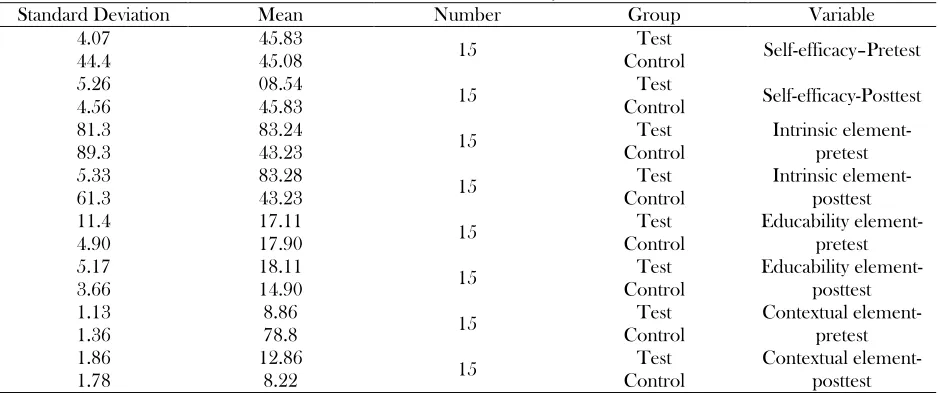
Table 2. Statistic indices of study variables
Standard Deviation Mean Number Group Variable
4.07 44.4
45.83
45.08 15
Test
Control Self-efficacy–Pretest 5.26
4.56
08.54
45.83 15
Test
Control Self-efficacy-Posttest 81.3
89.3
83.24
43.23 15
Test Control Intrinsic element-pretest 5.33 61.3 83.28
43.23 15
Test Control Intrinsic element-posttest 11.4 4.90 17.11
17.90 15
Test Control Educability element-pretest 5.17 3.66 18.11
14.90 15
Test Control Educability element-posttest 1.13 1.36 8.86
78.8 15
Test Control Contextual element-pretest 1.86 1.78 12.86
8.22 15
Test Control
Contextual element-posttest
2.13 2.36
17.08
17.50 15
Test Control Incremental element-pretest 3.86 2.78 19.50
16.23 15
Test Control Incremental element-posttest 5.13 5.36 57.02
57.52 15
Test Control Intelligence beliefs-pretest 6.86 5.78 63.27
56.74 15
Test Control
Intelligence beliefs-posttest
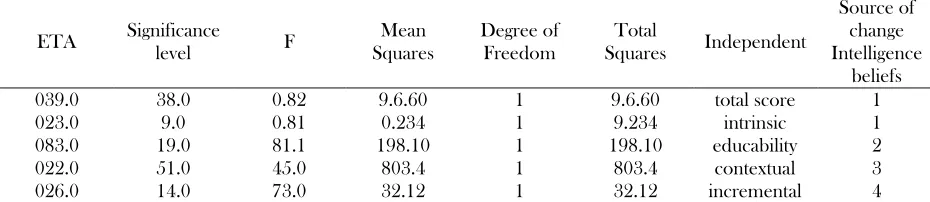
Considering Table (2), the average scores of pretest and posttest for self-efficacy, intelligence beliefs, and its levels in test group are different from control group, which results from the effectiveness of mindfulness training. To examine regression slop consistency (linear correlation among variables), interaction test among pretests and groups was used and the results were shown in Table (3).
Table 3. Regression slope consistency test of relevant variable of boredom in test and control groups
ETA Significance
level F
Mean Squares
Degree of Freedom
Total
Squares Independent
Source of change Intelligence
beliefs
039.0 38.0 0.82 9.6.60 1 9.6.60 total score 1
023.0 9.0 0.81 0.234 1 9.234 intrinsic 1
083.0 19.0 81.1 198.10 1 198.10 educability 2
022.0 51.0 45.0 803.4 1 803.4 contextual 3
026.0 14.0 73.0 32.12 1 32.12 incremental 4
Considering the above table, because significance level of interaction between pretest and group for self-efficacy, intelligence beliefs and its levels is higher than 05.0, it is concluded that interaction between test conditions and regression slope for two groups is identical. Kolmogrov-Smirnov test results indicate that scores distribution of intelligence beliefs and self-efficacy in pretest and posttest is normal. To specify equal and consistent covariance matrix of self-efficacy and intelligence beliefs, a Box Test was used. results show that significance level of the above test is higher than 0.05. Table result shows that assumption of covariance matrices consistency was validated. For test, univariate covariance analysis was used and dependent variable including posttest scores of participants’ self-efficacy questionnaire results and group as independent variable were included. Descriptive data of both test and control groups’ performance in self-efficacy level which includes the mean and standard deviation, is presented in Table (4).
Table (4). The mean and standard deviation of participants’ scores of test and control groups in self-efficacy variable Self-efficacy
Standard Deviation Mean Number
9.26 54.08 15 Test group
6.56 45.83 15 Control group
According to data in Table (4), the mean of test group is higher than control group. The results of effect tests among subjects for participants’ self-efficacy score imply significant difference between two groups (η2
= 0.79, p<0.05, F(1,11)= 82.19) that are presented in Table (5).
Table (5). The results of effect tests for self-efficacy variable ETA Square Significance
Level F Mean Squares
Degree of
Freedom Total Squares
Sources of Change
0.79 0.001 82.19 6041.667 1 6041.667 Self-efficacy
By comparing test and control groups, it was found that there is significant difference among self-efficacy scores of two test and control groups. To examine regression slope consistency (linear
correlation among variables), an interaction test between pretests and groups was used and its results are presented in Table (6).
Table (6). Regression slope consistency test of dependent variable of intelligence beliefs in test and control groups ETA Significance
Level F
Mean Squares
Degree of Freedom
Total Squares
Dependent Variable
Source of Change
0.02 0.49 0.50 61.46 1 61.46 Intelligence
beliefs Group
0.05 0.35 0.93 19.706 1 19.706 Intrinsic Group
0.11 0.13 2.57 42.214 1 42.214 Educability Group
0.01 0.87 0.03 2.093 1 2.093 Contextual Group
0.01 0.87 0.03 2.093 1 2.093 Incremental Group
Considering the above table, since significance level of interaction between pretest and group in variable of intelligence beliefs is higher than 0.05, it is concluded that interaction between test and pretest is not significant and there is linear correlation among them and regression slope for two groups is identical. To examine variance consistency, Levin test was used and it is presented in Table (6).
Table (9). Levin test results for examining variance consistency of intelligence beliefs in test and control groups
Significance Level Df2 Df1 F Dependent Variable
0.90 1 28 0.016 Intelligence beliefs
0.07 1 28 3.61 Intrinsic
0.59 1 28 0.31 Educability
0.28 1 28 1.25 Contextual
0.36 1 28 1.45 Incremental
The results included in Table (6) indicates that significance level of the above test is higher than 0.05. So, assumption of variance consistency of intelligence beliefs in test and control groups is validated. To specify consistent and equal covariance matrices of intelligence beliefs, Box Test was used.
Table (9). Box test relating to assumption of covariance matrix equality in test and control groups Significance
Level Df2 Df1 F Box Value Test Name
Dependent Variable
0.21 3.51 6 1.41 9.96 Box Intelligence
beliefs
0.81 0.000 87.20 10374.103 1 10374.103 Intelligence
beliefs
Inserted results in Table (10) indicate that significance level of the above test is higher than 0.05. Table results show that assumption of covariance matrices consistency is validated. The results of effect tests among subjects for participants’ intelligence beliefs score imply significant difference between two groups (η2
=0.81, p<0.05, F(1,21)=87.20).
5. Discussion
udo findings, the results of Klaassen studies (2010) indicated that students without social anxiety have interpersonal difficulties higher than students with learning disability. Also, it was stated this skill level in these students is likely associated with their low self-regulation. In his study, Omanchi (2006) discusses that self-regulation learning is an important topic for human learning and learning psychologists emphasize learner’s active involvement in learning self-regulation, rather than passive learning experience. Chang26
et.al (2006) studied the effects of mindfulness based tension reduction program on pain, positive modes of mind, tension and self-efficacy of mindfulness, after and before eight-week inventions. The results indicated that posttest scores of tension were significantly lower
than pretest scores and self-efficacy level of mindfulness and positive modes of mind were higher than pretest scores.
Nakamuraa27
, Lipschitza28
, Landwardb29
, Kuhna30
, and Westb31
(2011) studied the effect of two sessions of mindfulness training on sleeping quality and life quality in people suffered from post-injury mental stress. The results implied the effectiveness of training on sleeping quality improvement, but regarding variable of life variable, a significant difference was not obtained. Kingston32
, Dooley33
, Bates34
, Lawlor35
, Malone36
(2011) findings indicated that mindfulness based cognitive therapy can be effective treatment on decreasing patients’ rumination. Regarding the effect of mindfulness therapy on emotional regulation in patients with anxious disorder, the results of Goldin37
and Gross38
(2011) study showed this treatment leads to regulate emotions and decrease anxiety in people suffered from social anxiety disorders significantly.
In a study, Garland, Gaillard, Fredrickson (2012) explained a mindful confronting model and showed that catastrophe confront strategy is negatively correlated with mindfulness and this catastrophe is decreased, as mindfulness is increasing. Also, in the above-mentioned study, it was shown that catastrophe in posttest was significantly decreased. The results of Piet39
and Hougaard40
(2011) study concerning the effect of mindfulness based cognition on decreasing depression recurrence in patients with basic depression disorder indicated this treatment causes to decrease depression and reduce depression recurrence in patients with basic depression disorder significantly.
In a study, Scherer (2013) stated that learners’ performance is increased, as their self-efficacy is increasing and they represent higher preparation and endurance than learners with lower self-efficacy. Cheng & Chiou42
(2010) indicated that students with more self-efficacy regulate high level purposes for themselves that ultimately leads to their success. The results of Chang & Solomon43
(2010) study (quoted by Bakhtiyarpoor, Haafezi, and Behzadi, 1389) represent positive and significant correlation between self-efficacy and academic performance.
References
Aminfar, Morteza (1382). Academic failure or loss in Education. Education Quarterly, 17 and 18. Antonius, R. (2003) Interpreting Quantitative Data with SPSS. London: Sage Publications.
Baer, R. A., Fischer, S & Huss, D. B. (2007). Mindfulness-based cognitive therapy applied to binge eating: A case study. Cognitive and Behavioral Practice, 12, 351–358.
Baer, R.A. (2006). Mindfulness-Based Treatment Approaches: Clinicians Guide to Evidence Base and Application. USA: Academic Press is an imprint of Elsevier.
Bandura, A. (2011) Guide for constructing self-efficacy scales (Monograph). Stanford, CA: Stanford University. Berliner, W. (2014) why do girls get better results? Times Educational Supplement (May 7 2004) London: TSL
Education Ltd
Birami, Mansoor and Abdi, Reza (1388). Studying the effect of mindfulness based training techniques on reducing students’ test anxiety. Educational Sciences, 2(6). 35-54.
Bishop, F.C., Zack, M & McMain, S (2004). An information-processing analysis of mindfulness: Implications for recurrence prevention in the treatment of substance abuse. Journal of Clinical psychology, Science and Practice, 9, 275-299.
Creen, Rebeca (2009). Mindfulness based cognitive therapy. Translated by: Khoshlahjeh Sedgh, Ensi (1390). Edition 1. Besat Publications.
Davoodi, Iran and Nasimifar, Najmeh (1391). The effectiveness of mindfulness based stress reduction method on pain relief and catastrophe confronting strategy in women with chronic skeletal-muscular pain. New Findings in Psychology, 7(22), 45-62.
Deyo M, Wilson KA, Ong J & Koopman C (2010). Mindfulness and rumination: dose mindfulness training led to reductions in the rumination thinking associated with depression? Explore (NY); 5 (5), 265-71.
Farhadi, Ali; Movahedi, Yazdan; Kariminejad, Kolsoom and Movahed, Masoomeh (1392). The effect of mindfulness based cognitive therapy on depression in men with coronary arteries disease. Cardiovascular Nursing Journal. 2(4), 70-81.
Fathi, Ayatollah; Badrigari, Rahim; Birami, Mansoor (1392). The relationship of implicit intelligence beliefs with students’ procrastination and mediator role of learning self-regulation. Educational Psychology Studies Magazine, tenth year, issue 17, Spring & Summer.
Galton, M. Edwards, J., Hargreaves, L. and Pell, T. (2013) Continuities and discontinuities at transfer. In Galton, M. Gray, J. and Rudduck, J. Transfer and transitions in the middle years of schooling (7-14): Continuities and discontinuities in learning. DfES Research report 443. London: DfES
Garland, E. L., Gaylerd, G & Fredrickson, L (2012). Positive Reappraisal mediates the stress-reductive effects of mindfulness: An upward spiral process. Mindfulness, 2, 59–67.
Ghorban Jahromi, Reza (1390). The relationship of intelligence beliefs, progress goals and cognitive involvement in students of secondary school. Educational Psychology Studies Magazine, fifteenth year, issue 1.
Goldin PR & Gross JJ (2011). Effects of mindfulness-based stress reduction (MBSR) on emotion regulation in social anxiety disorder. Emotion; 10 (1), 83- 91.
Grossman, P (2004). Mindfulness-based stress reduction and heath benefit: a meta-analysis. Journal of Psychosomatic Research, 57, 35-43
Haaji Yakhchali, Alireza; Morovati, Zerkrollah; Fathi, Fataneh (1393). The relationship of personality traits, intelligence beliefs, and progress goals with academic self-efficacy in female students of secondary school, Personality and Personal Differences Journal, version 3, issue 4.
Hanasubzadeh, Maryam; Yazdandoost, Rokhsareh; Nejadfarid, Ali Asghar and Gharabi, Banafsheh (1390). Mindfulness based cognitive therapy around suicidal depressed patients: A qualitative study. Behavioral Sciences Magazine, 5(1), 33-38.
Hatice, O. (2011). Academic self-efficacy and academic procrastination as predictors of problematic internet use in university students. Computers & Education, 57, 1109–1113.
Herbert JD & Forman EM (2011). Acceptance and mindfulness in cognitive behavior therapy: understanding and applying the new therapies. 1st
Ed. New York: John Wiley & Sons, Inc.
Jahangirpour, Mahsa; Moosavi, Valiollah; Khosrojavid, Mahnaz; Salari, Arsalan and Rezaee, Sajad (1392). The effect of team training mindfulness on reducing depression, hostility, and anxiety in patients with coronary arteries disease. Medical Sciences Magazine of Orumieh, 24(9), 730-739.
Javaher, Foroozan (1385). Studying the effectiveness of mindfulness training on depresseion prevention in female students staying in dormitory of Isfahan University. Master Thesis of Clinical Psychology. Islamic Azad University of Rhudhen.
Kabat-Zinn, J. (2003). Mindfulness-based interventions in context: Past, present, and future. Clinical Psychology: Science and Practice, 10, 144–156.
Kaviani, Hossein; Javaheri, Foroozan and Bahiraee, Hadi (1386). The effectiveness of mindfulness based cognitive therapy on reducing negative automatic thoughts, inefficient attiude, depression and anxiety. Cognitive Sciences New Findings, 7(1), 49-58.
Kazemian, Somayeh (1393). The effectiveness of mindfulness based cognitive therapy on self-client addicts’ public health. Scientific-research magazine of behavioral and cognitive sciences studies, 4(1), 181-192.
Keng SL, Smoski MJ & Robins CJ (2013). Effects of mindfulness on psychological health: a review of empirical studies. Clin Psychol Rev; 31(6), 1041-56.
Kingston T, Dooley B, Bates A, Lawlor E & Malone K (2011). Mindfulness-based cognitive therapy for residual depressive symptoms. Psychol & Psychother: Theor, Res & Pract; 80, 193-203.
Lilian, K.Y. L. (2012). A Study of the Attitude, Self-efficacy, Effort and Academic Achievement of City Students towards Research Methods and Statistics. Discovery – SS Student E-Journal. Vol. 1, pp. 154-183.
Linehan, M.M (2000). Cognitive-behavioral treatment of borderline personality disorder. New York: Guilford.
Loo, C.W. & Choy, J.L.F. (2013). Sources of Self-Efficacy Influencing Academic Performance of Engineering Students. American Journal of Educational Research, 1 (3), pp. 86-92.
MacDonald EE & Hastings PH (2011). Mindful Parenting and Care Involvement of Fathers of Children with Intellectual Disabilities. Journal of Child and Family Studies; 19:236–40.
Mahdian, Hossein (1385). The relationship of intelligence beliefs with teachers’ and peers’ beliefs with academic achievement. Master Thesis. Allameh Tabatabaee University.
Mahdian, Hossein; Ahadihasan; Ghodsi, Sha’bani Hassan (1389). Standardization of instructive training questionnaire for examining its relationship with students’ intelligence beliefs and academic performance in secondary schools of Kashmar town. Educational Measurement Quarterly, version 1, issue 1.
Moghtadaee, Kamal; Kaafi, Mosa; Afshar, Hamid; AriaPooran, Saeed; Daghaghzadeh, Hamed and Poorkazem, Tahereh (1391). The effectiveness of team training mindfulness based cognitive therapy on physical symptoms in women with irritable intestine syndrome. Behavioral Sciences Researches Magazine, 10(7),698-708.
Mohammadkhani, Parvaneh and Khanipour, Hamid (1391). Immediacy based treatments along with scientific manual of immediacy based cognitive therapy for prevention from depression recurrence. Tehran. Welfare and Rehabilitation Sciences University Publications.
Moosavi Madani, Nooshin; Atashpour, Seyed Hamid and Molavi, Hossein (1390). The effect of team mindfulness training method on symptoms of compulsive obsessive disorder in women of Isfahan City. New Findings in Psychology, 6(4), 55-70.
Moosavian, Narges; Moradi, Alireza; Mirzaee, Jafar; Shidfar, Farzad; Mahmoodi Kahriz, Bahram and Taheri, Fatemeh (1389). The effect of mindfulness based cognitive therapy on reducing obesity. Opinion and Behavior, 4(16), 49-57. Nakamura, Y., Lipschitza, D & Westb, G (2011). Two sessions of sleep- focused mind-body bridging improve self-reported symptoms of sleep and PTSD in veterans: A pilot randomized controlled trial. Journal of psychosomatic Research, 70, 335- 345.
Omidi, Abdollah & Mohammadkhani, Parvaneh (1387). Training immediacy as a clinical intervention: conceptual and empirical review. Mental Health Quarterly, 1(1), 29-39.
Pajares, F. and Schunk, D. H. (2001). Self-beliefs and school success: Self-efficacy, self-conept and school achievement. In Riding, R., and Rayner, S. (Eds.) Perception (pp. 239-266). London: Ablex Publishing.
Piet J & Hougaard E (2012). The effect of mindfulness based cognitive therapy for prevention of recurrence in recurrent major depressive disorder: a systematic review and met analysis. Clin Psychol Rev, 11 (31), 1032–40.
Rosenzweig, S., Greeson, J. M., Reibel, D. K., Jasser, S. A & Beasley, D. (2011). Mindfulness-based stress reduction for chronic pain conditions: Variation. Journal of Psychosomatic Research, 68, 29–36.
Sajadian, Akbar; Neshatdoost, Hamid; Molavi, Hossein and Maroofi, Mohammad (1387). The effect of mindfulness on symptoms of women’s compulsive obsession disorder in Isfahan City. Educational Studies and Psychology of Ferdowsi University, 8(3), 128-140.
Sarmadi, Mohammadreza; Mahboobi, Taher; Abdollahzadeh, Hassan (1388). Studying the relationship between variables of intelligence beliefs, self-esteem and progress motivation with entrepreneurship in students of Payam Noor University in East & West Azarbayejan provinces, scientific-research Quarterly of Psychology in Tabriz University, fourth year, issue 14, Summer.
Sattari, Yousef and Kafashzadeh, Maryam (1394). The effect mindfulness metho on female students’ test anxiety in middle school of Saveh town. Education & Evaluation Journal, 8(31), 25-36.
Schunk, D. H. (2016). Developing children's self-efficacy and skills: The roles of social comparative information and goal setting. Contemporary Educational Psychology, 8, 76-86
Tabatabaee, Seyed Moosa; Aalboyeh, Gohar; Jahan, Elaheh; Tabatabaee, Khadijeh Sadat (1393). The effect of documentary retraining on intelligence beliefs and academic achievement in female students of secondary school with renewal period. Scientific-research Magazine of School Psychology, issue 1, Spring.
Taghi Panahi, Fatemeh (1386). Studying effective elements on study motivations in students of elementary and middle schools. Master Thesis. Ferdowsi University of Mashhad.
Tschannen-Moran, M. and Woolfolk Hoy, A. (2001). Teacher efficacy: Capturing and elusive concept. Teaching and Teacher Education 17, 783-805.
Webb, J. L. (2016). Measuring 10-11 Year Olds’ Self-Efficacy Beliefs: An Investigation into the Relationship with Science Performance. Unpublished MEd Thesis. Cambridge: Faculty of Education, University of Cambridge.
Williams, J. M. G (2007). Mindfulness-based Cognitive therapy for prevention of recurrence of suicidal behavior. Journal of Clinical Psychology, 6 (2), 201-210.
Zare, K.; Kadivar, P. (1386). Comparing self-efficacy and creativity in Internet user students and non-user students. Education Quarterly, 1(89), 111-133.
Zimmerman, B. J., Bonner, S. and Kovach, R. (2002) Developing Self-Regulated Learners: Beyond Achievement to Self-Efficacy. American Psychological Association: Washington.