Journal of Caring Sciences, 2017, 6(2), 153-161
doi:10.15171/jcs.2017.015 http:// journals.tbzmed.ac.ir/ JCS
*Corresponding Author: Foroozan Atashzadeh-Shoorideh, (PhD), email: [email protected]. This study was approved and funded by the deputy of research of Shahid Beheshti University of Medical Sciences (Project number: 6524).
© 2017 The Author(s). This work is published by Journal of Caring Sciences as an open access article distributed under the terms of the Creative Commons Attribution License (http://creativecommons.org/licenses/by-nc/4.0/). Non-commercial
Challenges of PhD Graduated Nurses for Role Acceptance as a Clinical
Educator: A Qualitative Study
Yusef Haghighi Moghadam1,2, Foroozan Atashzadeh-Shoorideh1*, Abbas Abbaszadeh3, Aram Feizi2
1Department of Nursing Management, Nursing and Midwifery Faculty, Shahid Beheshti University of Medical Sciences, Tehran, Iran
2Department of Medical -Surgical Nursing, Nursing and Midwifery Faculty, Urmia University of Medical Sciences, Urmia, Iran 3Department of Medical-Surgical Nursing, Nursing and Midwifery Faculty, Shahid Beheshti University of Medical Sciences, Tehran, Iran
ARTICLE INFO ABSTRACT
Article Type:
Original Article
Introduction: Clinical education is the core component of nursing education. PhD graduated nurses who are faculty members can play a main role in clinical instruction. However, there is not clear understanding about the challenges, which they may encounter for accepting their role as clinical educator. The aim of this study was to explore the challenges of role acceptance by PhD aduated nurses who are faculty members.
Methods: In this qualitative exploratory study a total of 13 participants (8 PhD graduated in nursing, 3 head of departments of nursing, one educational vice chancellor of nursing school, and one nurse) were selected by purposive sampling method. Data were collected by semi-structured, face to face interview and analyzed by conventional content analysis approach developed by Graneheim and Lundman.
Results: The main theme emerged from data analysis was “identity threat”. This theme had five categories including expectations beyond ability, lack of staff’s rely on the performance of PhD graduated nurses, poor clinical competencies, doubtfulness, and obligation.
Conclusion: PhD graduated nurses experienced some worries about their role as clinical educators and argued that they have not been prepared for their role. Therefore, policy makers and authorities of nursing schools should support PhD graduated nurses for accepting their new roles as clinical educators. In addition, some changes in nursing PhD curriculum is needed to improve the clinical competencies of PhD graduated and prepare them for their role as a clinical educator.
Article History:
Received: 23 Feb. 2016 Accepted: 11 Aug. 2016 ePublished: 1 Jun. 2017
Keywords:
Faculty Professional role Nursing education
Please cite this paper as:Haghighi Moghadam Y, Atashzadeh-Shoorideh F, Abbaszadeh A, Feizi A. The challenges of PhD graduates nurses for accepting their role as clinical educators: a qualitative study. J Caring Sci 2017; 6 (2): 153-61. doi:10.15171/jcs.2017.015.
Introduction
Nowadays the main goal of nursing schools is to prepare professional and competent nurses for clinical practice.1 For meeting this goal, there is a need for qualified nursing faculty members.2,3 Doctoral degree is the ideal qualification for nursing faculties.4 Dreher et al., argued that nursing schools need a doctoral graduate faculties with sufficient knowledge and skills to survive and flourish in university.5 Moreover, a study by Fang et al., showed that most of the PhD students in nursing try to pursue an academic career.6
PhD graduated nurses can promote the quality of both nursing education and nursing profession.7 They can also develop the scientific base of nursing body of knowledge and nursing practice.8
nurse educator.9,10 They also need to develop essential competencies and skills which are needed for teaching in different fields of nursing.11 However, some studies reported concerns about the quality of nursing doctoral programs, especially concerns was related to insufficient preparing of doctoral student for their future role as a faculty member.2 As reported by Kim et al, in nursing doctoral education, the programs and curricula mainly are focused on research rather than on clinical education which could impact on their teaching qualities.2 Furthermore, the prior studies have shown that most nursing faculties who have a doctoral degree prefer to do research activities, rather than teaching in undergraduate programs.
Therefore, students who graduate from PhD programs may not be prepared for their future role as a faculty member.1,12 It has been found that lack of preparedness for accepting the faculty role may decrease the job satisfaction among faculty members and have a negative impact on their performance in teaching role.13 Problems arise when some of the nurses’ faculties lack the qualifications and skills which are needed for accepting the nurse academic role.14
Faculties with doctoral degrees may have several roles such as conducting rigorous research, administrative role, scholarship role, etc. It is clear that teaching responsibilities is the main role of them which includes theoretical and clinical aspects.8 Therefore, nurse academics not only must fulfill their responsibilities in teaching in schools, but also could contribute in clinical education of nursing students.15
Clinical education has long been acknowledged as an important component of nursing education.16-19 It provide significant opportunities to improve nursing students’ skills and to develop their practice competency.20,21 Furthermore, clinical education prepares them for their future role as professional nurses16-18 and they could learn the skills needed for high quality nursing care by translating the theoretical knowledge into practice.22 In fact, clinical instructor can play a
main role for facilitating the learning process of nursing students within clinical settings.23 Nurse faculty roles differ internationally; it depends on the context of countries and the mission of healthcare systems.24 However, the school and the students hold specific expectations of the PhD graduated nurse.8 Although nursing is a clinical based profession and nursing faculties must be prepared for fulfilling their role as clinical educator, but most of the PhD programs in Iran focuses on improving students’ skill on conducting research, rather than focusing on their ability for teaching in clinical settings. Meanwhile, in our country due to faculty shortage, most of the students who graduate from PhD program not only should teach the theoretical knowledge, but also have to engage in clinical teaching as an educator. In spite of the importance of nurse faculties role in clinical education,20 there is not clear understanding about the challenges of PhD graduated in nursing for role acceptance as a clinical educator. Therefore, the aim of this study was to explore the challenges of role acceptance by PhD graduate nurses who are faculty members.
Materials and methods
recorded and transcribed verbatim. MAXQDA 10 software was used for data management. Data were analyzed by conventional content analysis approach developed by Graneheim and Lundman.25 In this approach, the interviews were read by several times to gain a sense of the whole. Then a code was allocated for labeling the meaning units and codes were sorted and organized based on similarities and differences into sub-categories, categories and a main theme.
We used Lincoln and Guba recommendation for ensuring the trustworthiness and rigor of the study.26 One of the main researchers conducted the interview but all of them contributed in data analysis.
Research approval was granted by the deputy of research of Shahid Beheshti University of Medical Sciences (Project number: 6524) and the Committee of Ethics in Research at this university under the code: sbmu.rec.1394.85 on 16 august 2015.
Permissions were obtained from the managers of hospital and faculties of nursing to recruit potential participants. Participation in the study was completely voluntary and all participants received information about the aims and the processes of the research and data collection.
Results
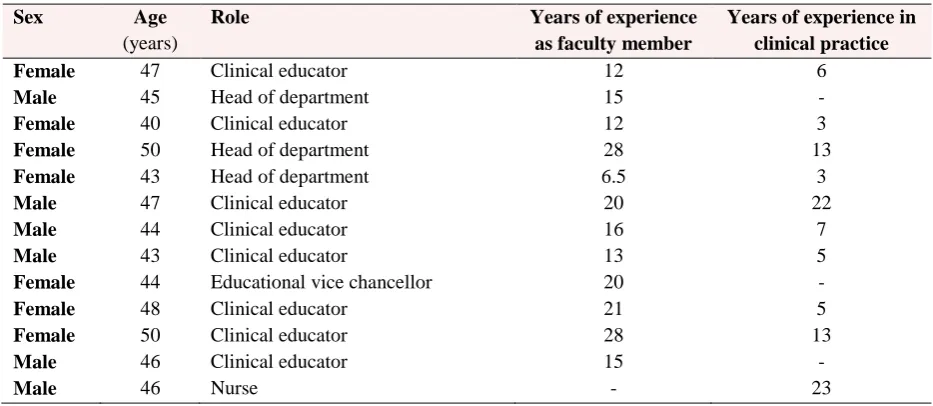
Thirteen people (8 faculty members, 3 head of departments of nursing, one educational vice chancellor of nursing school, and one nurse) participated in this study. Table 1 shows the detail characteristics of the participants.
The main theme emerged from data analysis was “identity threat”. This theme had five categories including expectations beyond ability, lack of staff’s reloy on PhD graduates performance, poor clinical competencies, doubtfulness, and obligation (Table 2).
Table 1. Demographic characteristic of participants
Sex Age
(years)
Role Years of experience
as faculty member
Years of experience in clinical practice
Female 47 Clinical educator 12 6
Male 45 Head of department 15
-Female 40 Clinical educator 12 3
Female 50 Head of department 28 13
Female 43 Head of department 6.5 3
Male 47 Clinical educator 20 22
Male 44 Clinical educator 16 7
Male 43 Clinical educator 13 5
Female 44 Educational vice chancellor 20
-Female 48 Clinical educator 21 5
Female 50 Clinical educator 28 13
Male 46 Clinical educator 15
-Male 46 Nurse - 23
Table 2. Theme and categories related to the challenges of doctoral (PhD) graduated
nurses for accepting their role as clinical educators
Theme Categories
Identity threat
Expectations beyond ability
Lack of staff’s rely on the performance of PhD graduated nurses
Poor clinical competencies Doubtfulness
1. Expectations beyond ability
According to the participants, “expectations beyond their ability” was the main concern of them. They said that within clinical education they encounter situations which they have not been received enough information about the situation in their PhD programs; therefore they lacked the skills needed for handling and managing the clinical situations. They argued that their PhD programs have not provided any opportunities for developing their clinical competency. Therefore, they are conflicted when encounters with several roles such as theoretical and clinical educator, clinical judgment, evaluation of students clinical skills, and etc. Therefore, they feel that they have not any ability and authority for doing changes in clinical settings. This condition alongside with the expectation of nursing students, nurse staff and other health care
professionals such as physician’s
expectation from a PhD graduated faculty leads to the “identity threat” and they feel some difficulties in accepting and fulfilling their role as a clinical educator. One of the participants said:
“Expectation of others from my abilities is not correct … Unfortunately students think such way. When I go to clinical ward they say you are professor, you are doctor too, so he says that they have the same expectations as he have from a specialist; while we have not prepared for most of the clinical situations”. (P2)
Other participant said:
“ … In fact, PhD program in Iran does not add anythings to our clinical abilities, as well as to our clinical skills. In fact, this course is the same as we learned in nursing Msc program. Ok, in this situation I can’t meet the clinical needs of students and even of personnel. This leads to despair… students ask me to interoperate the CT scan to them, They are students and it is their right to know, but I have not learned about it…”.(P11)
2. Lack of staff’s rely on the performance of PhD
graduated nurses
One of the main problems of PhD graduated nurses was the lack of nurses’ rely on the clinical skills of PhD graduated. Participants felt themselves as uninvited guests, which according to the staffs’ views they had not any responsibility in providing patients care. They argued that this problem was especially evident in the first days of their career as a clinical educator. Therefore, this had negative and harmful effects on self-identity and professional identity of them. When we asked a participant about his experience within the first days of clinical education as a clinical educator, he commented as following according to the quotation from his colleague:
“He was a top student in doctoral program, but he didn’t know the nursing practice,… His name is doctor in the ward but he don’t know how to insert an IV catheter. Therefore, staffs
were joshing him”. (P6)
Other participant discussed:
“… When staffs and students see that you can’t make any changes in clinical settings, …their confidence is lost not only on me but also on all
component of nursing”.(P5)
3. Poor clinical competency
Another category related to the identity threat was the problems emerged in acquiring clinical competencies. The feeling of confusion and experiencing more stress which resulted from the lack of clinical competence, and also feeling of inability to meet students’ needs lead to identity threats
among participants. The following
comment illustrates this and helps the understanding of this situation:
theoretical things, now its clinical training turn.
(P6)
The other participants said:
I always envy people who have a specialized work. They do things which have learned in their courses … The clinical settings don’t look at the content of your curriculum, they look at your experience and practical skills”.(P13)
4. Doubtfulness
Other identified category which have threated participants’ identity was the having doubt for accepting the clinical educator role. When they fell that there is not a good professional position in clinical settings and due to the lack of clinical skills, especially within the early days of fulfilling their role in clinical training, they doubt on the accepting their role as clinical educator. If they had no motivational factors, they encounter with role conflict and experience the crisis of professional identity. Participants described this as followings:
“Now a series of problems has been created to me, therefore I am in trouble for accepting my role as faculty member, as well being a clinical educator”. (P2)
When you receive PhD degree the expectations are going to be changed. All things is good in the school, but when you enter into the clinical settings you don’t have a defined position. You don’t have a good position and it leads to
obfuscation…”. (P4)
5. Obligation
During the process of role accepting, when a person encounters with command and compulsive orders resulted from accepting the new role and she/he have to accept the roles, she/he experience problems in developing professional identity. In this category several factors such as being in the force for obeying the routine rules of wards, accepting a lot of teaching responsibilities due to faculty shortage, and working in a wards which is not in the interest of faculty were identified. All of them had a negative impact on the process of accepting the clinical educator role.
One of the participants commented as following:
“I think 90 percent of them attend in clinical setting with compulsion. Now I have 5-6 faculty members who don’t like to go clinical setting. I have forced them to go there, even they don’t have such will”.(P9)
Other participant descried:
“Many authorities often consider clinical work as punishment for faculties. Faculties have to accept the all conditions. They have to work in
places which they don’t like to work …”.(P7)
Discussion
Clinical experience is the core component of nursing education.16-18 It play a critical role in promoting of clinical learning among nursing students, as well as developing nursing practice standards.27 It also prepare the students for acceptance of professional roles.28 For providing a high quality instruction, clinical educators should have a high clinical competencies qualification with higher education level such as PhD graduated nurse.20 Most of the previous studies investigated the process of nurse's transition from practice into an academe role.29 But we studied the process of PhD nurses transition from schools to practice as a clinical educator. The result of this study indicated that when PhD graduated faculties lack the clinical competencies and skills needed for clinical procedures, they could not meet the expectation of students and clinical staffs; therefore they may experience role conflict which consequently threatens the professional identity of them. A study conducted by Langan showed that when clinical faculty members could not accomplish their entire role, as well as course objectives, they show feelings of role conflict, overload, and ambiguity.30
demands. They also argued that professional identity development is an active process related to self-efficacy.24 Our study showed that PhD graduated nurses experienced identity threat which resulted from imbalances between their abilities and organizational or students expectations. The findings of a recent study support our findings. The aforementioned study showed that a lack of good tailored standards and lack of signed posts had a negative impact on the performance of nurse educators.24
Nursing schools and the clinical staffs hold specific expectations of the PhD nurses. As Feizolahzadeh and Hasani argues, when a student graduate from a higher degree, he or she should meet the society expectation, as well as his or her new expectations. When PhD graduated nurses encounter with unsupportive organizational culture and inappropriate position of their role, concern raises in accepting their new role.32
Although the main goal of nursing doctoral programs is to prepare students for faculty member positions to work in nursing colleges, other related associations, and within clinical settings as clinical educator,7 In this study our findings showed that PhD graduates in nursing have not been prepared for clinical trainings. On the other hand, they lack clinical skills and competencies that are necessary for clinical training. This has a negative impact on students learning, as well as on staffs’ behavior. This result is similar to other studies conducted in Iran.33 It has been found that staff nurses prefer to work with practicing and clinically competent faculties rather than non-practicing one.30 Some scholars believe that PhD graduated in nursing should be engaged in clinical education. They believe that PhD graduated could improve the quality of clinical education by fulfilling their role as a leaders and clinical educator.34,35 Meanwhile, due to the individual and organizational problems, these group of faculties faces with role
conflicts which subsequently have an incredible impact on their role acceptance.36 In this regard, Mc Dermid et al., argued that new academic staffs are faced with difficulties such as lack of understanding on their roles in academic environment as a challenging situation.1 Other studies have shown that better development of professional identity influence on faculty performance in teaching.31,37 Therefore, the faculties’ identity needs to be supported.31 It is notable that there are other PhD programs which focus on clinical nursing which is called doctor of nursing practice (DNP) program.38 This is a “Practice
focused” doctorate degree and is
considered as the terminal practice degree in nursing.39 DNP curricula provide education in evidence-based practice and quality improvement. It also prepares the
students for systems change and
organization leadership among other key areas. Therefore this program prepares students for both clinical and leadership roles. In clinical settings, DNP prepared nurses have many important roles in clinical settings such as role models, problems solvers and advocates.40
In Iran, there is only one opportunity for doctoral program and it is the PhD program. This program mainly focuses on research area rather than clinical nursing. Therefore, developing other doctoral programs such as DNP could result in quality improvement of nursing profession and will increases nurses motivation for studying in the doctoral programs.
Conclusion
needed to improve the clinical competencies of PhD graduated nurses and prepare them for clinical educator role.
Acknowledgments
This study is a part of a PhD thesis in nursing. The authors would like to thanks the support of research deputy of Shahid Beheshti University of Medical Sciences for financial support. In addition we thank all participants who shared their experiences with research team.
Ethical issues
None to be declared.Conflict of interest
The authors declare no conflict of interest in this study.