RESEARCH PAPER
PSO-ANFIS and ANN Modeling of Propane/Propylene
Separation using Cu-BTC Adsorbent
Sohrab Fathia, Abbas Rezaeib, Majid Mohadesia,*, Mona Nazaria
a. Department of Chemical Engineering, Faculty of Energy, Kermanshah University of Technology, Kermanshah, Iran
b. Department of Electrical Engineering, Kermanshah University of Technology, Kermanshah, Iran
Received: 7 November 2018, Revised: 15 December 2018, Accepted: 25 August 2019 © University of Tehran 2019
Abstract
In this work, an artificial neural network (ANN) model along with a combination of adaptive neuro-fuzzy inference system (ANFIS) and particle swarm optimization (PSO) i.e. (PSO-ANFIS) are proposed for modeling and prediction of the propylene/propane adsorption under various conditions. Using these computational intelligence (CI) approaches, the input parameters such as adsorbent shape (SA),
temperature (T), and pressure (P) were related to the output parameter which is propylene or propane adsorption. A thorough comparison between the experimental, artificial neural network and particle swarm optimization-adaptive neuro-fuzzy inference system models was carried out to prove its efficiency in accurate prediction and computation time. The obtained results show that both investigated methods have good agreements in comparison with the experimental data, but the proposed artificial neural network structure is more precise than our proposed PSO-ANFIS structure. Mean absolute error (MAE) for ANN and ANFIS models were 0.111 and 0.421, respectively.
Keywords:
Adsorption, ANN, Cu-BTC,
Propylene/Propane, PSO-ANFIS
Introduction
Olefins are one of the most important feeds in the petrochemical industries which are used for the production of various commodities. Light olefins such as ethylene and propylene are usually obtained by steam cracking or fluid catalytic cracking of heavy petroleum fractions and are mainly produced in mixtures with their paraffin homologs. The separation of these paraffin and olefin mixture is energy-intensive and also a costly process due to the very close relative volatility of components. Propylene as an important intermediate in the petrochemical industry is obtained by traditional separation process such as cryogenic distillation, which operates at low temperatures or high pressures, and needs a large number of distillation stages and very large reflux ratio due to the similarity of propylene and propane boiling points [1,2].
For example, the process for separation of propane/propylene was carried out at about 30 ℃ and 30 bar [3] and more than 150 theoretical stages are required to achieve high purity propylene (99.5%) [4]. So, the alternative propane/propylene separation processes to reduce the energy costs are required. For example, the separation techniques such as membrane, absorption, hydrogenation, and physical adsorption have been considered and adsorptive separation seems to be a more energy-efficient process for propane/propylene separation [5
-10].
* Corresponding author
Pressure swing adsorption (PSA), temperature swing adsorption (TSA) and also vacuum swing adsorption (VSA) techniques, based on solid molecular sieves, have been applied as an appropriate process. These processes have been considered for more than one decade [11-14] showing a satisfactory product recovery (87%) and very high purity (99%) [4]. In these processes, the separation is obtained in ambient temperature and no additional power was required to cool the gas mixture. Both commercial [4,11,13,15-17] and tailor-made adsorbents [18-21] have been used for separation of a propane-propylene mixture. Also, the use of activated carbon [22,23], carbon molecular sieves [24-26] and metal-doped adsorbents [27-30] for separation of olefin/paraffin mixture has been reported in the literature. The double bond of olefins can forms π-complexes with some transition metals which leads to making a difference in adsorption affinity between olefin and paraffin [18,31]. 13X and 4A zeolites were widely evaluated among the commercial adsorbents and have been demonstrated to be effective adsorbents for VSA process in order to produce high purity of propylene [13,14,32]. Da Silva and Rodrigues [33] studied adsorption isotherms of propylene and propane and investigated single component adsorption on commercial 13X and 4A zeolites at temperature between 273 and 473 K. It was shown that 13X zeolite shows a lower mass transfer resistance and higher adsorption capacity than 4A zeolite, while higher selectivity for propylene in mixture of propylene/propane has been reported for 4A zeolite relative to 13X. Also, in the other study, Grande and Rodrigues [34] reported that high purity propylene can be achieved using 4A zeolite. Commercial zeolite 4A presented excellent performance to be applied in vacuum pressure swing adsorption (VPSA) process; the propane diffusion within micro-pores is extremely slow which leads to reduce adsorbed propane. It was concluded that micro-pore diffusion strongly limits the adsorption rate of propane and thus, its adsorption can be controlled by the size of zeolite crystals [35,36]. Padin et al. [19] reported that the modification of commercial 4A zeolite with Li+ cations (NaLiA zeolite) improve the uptake rate of propane. In a same study, the selective adsorption of propylene from the mixture with propane by Li-exchange zeolite 13X was studied. The results indicated that propylene is adsorbed preferentially over propane at low pressures and adsorption equilibrium can be described with Virial and multi-site Langmuir models [17]. Hanaa et al. [36] investigated the adsorption of propane/propylene onto the binary (introduction of Ni2+ or Cr3+ instead of Na+) and ternary (introduction of Ni2+ and Cr3+ instead of Na+) zeolites. They found that change in Henry’s low slope indicates strong and weak interactions with propylene and propane, respectively. Iglesias et al. [37] verified 4A commercial zeolite for separation of C3H6/C3H8 mixture at a temperature below and above the critical temperature of propylene. They found that a certain amount of propylene was adsorbed irreversibly below the critical temperature. But at above the critical temperature, 4A zeolite could be excellent adsorbent for separation of propylene/propane mixtures in the temperature range of 150-180 °C.
Artificial neural network (ANN) and adaptive neuro-fuzzy inference system (ANFIS ) have been used in many studies to determine and also anticipate the physical and chemical properties in various industrial processes [38-54]. Reviewing the related studies showed that, propylene/propane adsorption has not been investigated using ANN and PSO-ANFIS methods.
In this study, the effects of temperature, pressure and Cu-BTC adsorbent structures on the adsorption of propylene/propane were investigated and modeling of PSO-ANFIS and ANN for this process were performed and the model with the best matching of the experimental data was determined.
Experimental Methods
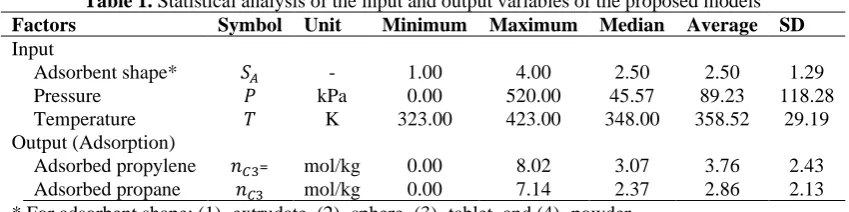
operating pressure and temperature have important roles in adsorption efficiency. In this study, with emphasis on the metal-organic framework (MOF) adsorbent and the Cu-BTC molecular structure, the adsorption rates of propylene and propane were studied. A set of 271 experimental data points of propylene and propane adsorption on Cu-BTC adsorbent were collected from previous studies [55-57]. The difference in the data was in the shape of Cu-BTC adsorbent which was in extrudate [55], sphere [56], tablet [56], and powder [57] shapes. Temperature and pressure were applied in the range of 423-323 K and 0-520 kPa, respectively. Statistical analysis of the input and output data are shown in Table 1.
Table 1. Statistical analysis of the input and output variables of the proposed models SD Average Median Maximum Minimum Unit Symbol Factors Input 1.29 2.50 2.50 4.00 1.00 - 𝑆𝐴 Adsorbent shape* 118.28 89.23 45.57 520.00 0.00 kPa 𝑃 Pressure 29.19 358.52 348.00 423.00 323.00 K 𝑇 Temperature Output (Adsorption) 2.43 3.76 3.07 8.02 0.00 mol/kg
𝑛𝐶3= Adsorbed propylene 2.13 2.86 2.37 7.14 0.00 mol/kg 𝑛𝐶3 Adsorbed propane
* For adsorbent shape: (1)=extrudate, (2)=sphere, (3)=tablet, and (4)=powder
Description of Proposed Models
In this paper, precise PSO-ANFIS and ANN models are introduced for the modeling and prediction of propylene/propane adsorption under several conditions. In these computational intelligence (CI) structures, the inputs are an adsorbent shape (SA), temperature (T), and pressure
(P).
Artificial Neural Network
ANN structures [58,59] basically consist of interconnected neurons. A neuron is the basic processing part of ANN. The weights in ANNs are equivalent to the synapses of biological neurons. the weights are adjusted Using an error-minimization technique i.e. back-propagation method. Between the ANN models, the multi-layer perceptron (MLP) network is the most commonly used ANN which consists of a number of neurons [58,59].
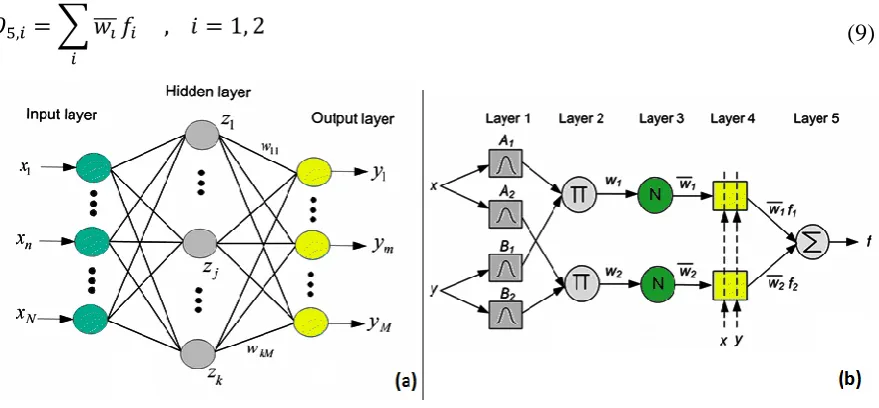
The MLP is a feed-forward network, which has three or more layers: one input layer, one or more hidden layers and one output layer [58,59]. In Fig. 1a, x1, x2,…, xN are the inputs, y1, y2,
…, yM are the outputs and k is the number of hidden layer neurons. Also, N and M are the
number of inputs and outputs, respectively. The output of tth neuron in the hidden layer is described as below:
𝑧𝑗 = 𝑓 (∑(𝑥𝑝𝑤𝑝𝑡)
𝑁
𝑝=1
+ 𝑏𝑗) , 𝑡 = 1, 2, … , 𝑘 (1)
where f is the hidden layer activation function, x is the input, w is the weighting factor and b is the bias term. The output of the jth neuron in the output layer is given by:
Adaptive Neuro-fuzzy Inference System/PSO Algorithm
ANFIS is a combination of ANN and fuzzy inference system (FIS), which has both ANN and FIS advantages [60,61]. An ANFIS structure has five layers. Each ANFIS layer contains some
𝑦𝑚 = ∑(𝜃𝑝𝑊𝑝𝑚)
𝑘
𝑝=1
nodes, which have their node functions. If a FIS has one output (f) and two inputs (x, y), the following equation describes a single fuzzy if-then rule:
Rule1: if 𝑥 is 𝐴1 and 𝑦 is 𝐵1, then 𝑓1 = 𝑝1𝑥 + 𝑞1𝑦 + 𝑟1 Rule2: if 𝑥 is 𝐴2 and 𝑦 is 𝐵2, then 𝑓2 = 𝑝2𝑥 + 𝑞2𝑦 + 𝑟2
where, pi, qi, and ri are called consequent parameters (linear output parameters) and i=1,2. A
sample of an ANFIS structure is shown in Fig. 1b. Each node in layer 1 has the following node function:
𝑂1,𝑖 = 𝜇𝐴𝑖(𝑥), 𝑖 = 1, 2 (3)
𝑂1,𝑖 = 𝜇𝐵𝑖−2(𝑦), 𝑖 = 3, 4 (4)
i is the membership grade of A1, A2, B1, and B2 and O1,i is the node i output. As an example,
the Gaussian function is given by:
𝜇𝐴(𝑥) = exp(−
(𝑥 − 𝑐)2
2𝜎2 ) (5)
where c and σ are called premise parameters. Each node in layer 2 denotes the firing strength of a rule and multiplies all incoming signals with the following output:
𝑂2,𝑖= 𝑤𝑖 = 𝜇𝐴𝑖(𝑥)𝜇𝐵𝑖(𝑦) , 𝑖 = 1, 2 (6)
The nodes in layer 3 are called normalized firing strengths with the following node functions:
𝑂3,𝑖= 𝑤̅̅̅ =𝑖 𝑤𝑖
𝑤1+ 𝑤2 , 𝑖 = 1, 2 (7)
Each node in layer 4 has the node functions given by:
𝑂4,𝑖 = 𝑤̅̅̅𝑓𝑖 𝑖 = 𝑤̅̅̅(𝑝𝑖 𝑖𝑥 + 𝑞𝑖𝑦 + 𝑟𝑖), 𝑖 = 1, 2 (8)
where, 𝑤̅̅̅ is a normalized firing strength from layer 3 and 𝑖 {𝑝𝑖, 𝑞𝑖, 𝑟𝑖} are named consequent
parameters. Finally, layer 5 computes the only output with the following equation:
𝑂5,𝑖 = ∑ 𝑤̅̅̅𝑖 𝑖
𝑓𝑖 , 𝑖 = 1, 2 (9)
Modeling Approach
In this work, ANN and PSO-ANFIS approaches were used to predict the effect of several parameters influencing on propylene/propane adsorption. In Table 1, the input and output variables of the presented PSO-ANFIS and ANN models are shown. An ANFIS model has two sets of parameters (premise and consequent parameters). During the training process, these parameters are adjusted. Some existing training approaches for ANFIS structure may cause the local minimum problem. To solve this problem and for updating the premise and consequent parameters of ANFIS, PSO technique can be applied. PSO, first proposed by Kennedy et al. [62], is an evolutionary computational method which is widely used in many optimization applications [63]. PSO is a population-based search technique. In PSO, each possible solution is represented as the swarm, which is a particle in a population. In the presented PSO-ANFIS technique, we used PSO method for adjusting the parameters of membership functions. This method is more flexible and less expensive in hardware implementation in comparison with the conventional ANFIS methods. In this method, at first, the ANFIS structure is trained by the hybrid learning algorithm, which is based on the least-squares and gradient descent techniques. After that, the number of ANFIS membership functions (MFs) and their parameters are adjusted by the PSO method. For this step, mean absolute error (MAE) as the fitness function is used. The training and testing data sets required for the presented PSO-ANFIS and ANN models are obtained from the previous studies [55-57]. For this study, 271 experimental data were used, about 70% of them are applied for training the presented models. MATLAB 7.1 software was used to develop PSO-ANFIS and ANN structures. For obtaining the best ANN model, different configurations were tested with a different number of hidden layers. Also, epochs and the hidden layer neurons were changed from 50 to 500 and 1 to 10, respectively. To obtain the best PSO-ANFIS structures, epochs, the number and the types of input MFs were changed. Then, the PSO parameters such as the number of epochs and the number of particles for each population were determined. Tables 2 and 3 show the best ANN and PSO-ANFIS models obtained.
To compare the developed models with the experimental data, we used the MAE, correlation factor (R), and root mean square error (RMSE) whose equations are given as follow:
MAE = 1
𝑁∑ |𝑥𝑖𝑒𝑥𝑝− 𝑥𝑖𝑝𝑟𝑒𝑑| 𝑁
𝑖=1
(10)
RMSE = [∑ (𝑥𝑖𝑒𝑥𝑝 − 𝑥𝑖𝑝𝑟𝑒𝑑)
𝑁 𝑖=1
2
𝑁 ]
0.5
(11)
R = 1 − [
∑ (𝑥𝑖𝑒𝑥𝑝− 𝑥𝑖𝑝𝑟𝑒𝑑)
𝑁 𝑖=1
2
∑𝑁 (𝑥𝑖𝑒𝑥𝑝)
𝑖=1
2 ] (12)
where, ‘𝑥𝑖𝑒𝑥𝑝’ and ‘𝑥𝑖𝑝𝑟𝑒𝑑’ are the experimental and predicted values (ANN and PSO-ANFIS), respectively, and N is the total number of data.
Results and Discussions
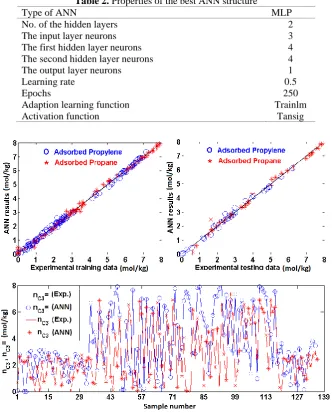
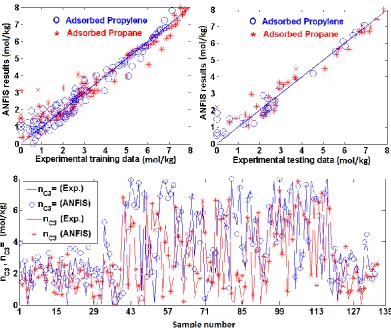
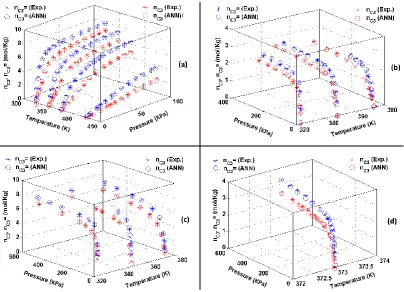
and the predicted values for testing and training data. As can be seen in these figures, PSO-ANFIS structure is less precise than our ANN structure. A membership function in a fuzzy system is more complicated than a neuron in an ANN structure, thus if we assume that a neuron in ANN model is equivalent to a membership function in ANFIS model, an ANN model will have a simpler structure than PSO-ANFIS model. Therefore, in the hardware implementation, the presented ANN model is faster, cheaper, and more flexible.
Table 2. Properties of the best ANN structure
Type of ANN MLP
No. of the hidden layers 2
The input layer neurons 3
The first hidden layer neurons 4
The second hidden layer neurons 4
The output layer neurons 1
Learning rate 0.5
Epochs 250
Adaption learning function Trainlm
Activation function Tansig
Fig. 2. The results of ANN model
Fig. 3. The results of PSO-ANFIS model
Table 3. Properties of the best PSO-ANFIS structure
Type Sugeno
Number of the inputs 3
Number of the outputs 1
Number of membership functions for each input 3 Number of membership functions for the output 3 Type of the input membership function Gaussian Type of the output membership function Linear
Total number of fuzzy rules 3
Total number of nonlinear parameters 36 Total number of linear parameters 15
Epochs (for each population) 420
Number of particles (for each population) 84
w1 (inertia weight) 1
w2 (inertia weight damping ratio) 0.99 C1 (personal learning coefficient) 1 C2 (global learning coefficient) 2
Table 4. The obtained standard errors for the introduced models
Network Data MAE RMSE R
ANN
Training 0.09 0.12 0.9986 Testing 0.12 0.17 0.9966
Fig. 4. Comparison results of the presented ANN structure, and adsorbent shapes (a) sphere, (b) extrudate, (c) tablet, and (d) powder
Conclusions
In this work, ANN structure along with a novel and effective hybrid approach are proposed for prediction of propylene/propane separation by Cu-BTC adsorbent. The proposed hybrid method is based on the combination of PSO and ANFIS structures. We compared the predictions of the proposed ANN and PSO-ANFIS models with the experimental data. The results showed that the PSO-ANFIS and ANN approaches have high accuracies. Also, the ANN model with less complicated structure was found to be more accurate than the PSO-ANFIS model. The MAE for ANN model had an average value of 0.111, outperforming PSO-ANFIS approach. Therefore, the proposed models could be used to solve more complex scientific problems.
References
[1] Teramoto M, Shimizu S, Matsuyama H, Matsumiya N. Ethylene/ethane separation and concentration by hollow fiber facilitated transport membrane module with permeation of silver nitrate solution. Separation and Purification Technology. 2005 Jul 1;44(1):19-29.
[2] Reine TA, Eldridge RB. Absorption equilibrium and kinetics for ethylene− ethane separation with a novel solvent. Industrial & Engineering Chemistry Research. 2005 Sep 14;44(19):7505-10. [3] Bao Z, Alnemrat S, Yu L, Vasiliev I, Ren Q, Lu X, Deng S. Adsorption of ethane, ethylene,
propane, and propylene on a magnesium-based metal–organic framework. Langmuir. 2011 Oct 12;27(22):13554-62.
[4] Lamia N, Wolff L, Leflaive P, Sá Gomes P, Grande CA, Rodrigues AE. Propane/propylene separation by simulated moving bed I. Adsorption of propane, propylene and isobutane in pellets of 13X zeolite. Separation Science and Technology. 2007 Aug 1;42(12):2539-66.
[6] Ghosh TK, Lin HD, Hines AL. Hybrid adsorption-distillation process for separating propane and propylene. Industrial & Engineering Chemistry Research. 1993 Oct;32(10):2390-9.
[7] Lamia N, Jorge M, Granato MA, Paz FA, Chevreau H, Rodrigues AE. Adsorption of propane, propylene and isobutane on a metal–organic framework: Molecular simulation and experiment. Chemical Engineering Science. 2009 Jul 15;64(14):3246-59.
[8] Giannakopoulos IG, Nikolakis V. Recovery of hydrocarbons from mixtures containing C3H6, C3H8 and N2 using NaX membranes. Journal of Membrane Science. 2007 Nov 15;305(1-2):332-7.
[9] Van Miltenburg A, Zhu W, Kapteijn F, Moulijn JA. Adsorptive separation of light olefin/paraffin mixtures. Chemical Engineering Research and Design. 2006 May 1;84(5):350-4.
[10]Matsuyama E, Ikeda A, Komatsuzaki M, Sasaki M, Nomura M. High-temperature propylene/propane separation through silica hybrid membranes. Separation and Purification Technology. 2014 May 13;128:25-30.
[11]Da Silva FA, Rodrigues AE. Propylene/propane separation by vacuum swing adsorption using 13X zeolite. AIChE Journal. 2001 Feb 1;47(2):341-57.
[12]Da Silva FA, Rodrigues AE. Vacuum swing adsorption for propylene/propane separation with 4A zeolite. Industrial & Engineering Chemistry Research. 2001 Nov 28;40(24):5758-74.
[13]Grande CA, Rodrigues AE. Propane/propylene separation by pressure swing adsorption using zeolite 4A. Industrial & Engineering Chemistry Research. 2005 Nov 9;44(23):8815-29.
[14]Grande CA, Poplow F, Rodrigues AE. Vacuum pressure swing adsorption to produce polymer-grade propylene. Separation Science and Technology. 2010 May 28;45(9):1252-9.
[15]Grande CA, Cavenati S, Barcia P, Hammer J, Fritz HG, Rodrigues AE. Adsorption of propane and propylene in zeolite 4A honeycomb monolith. Chemical Engineering Science. 2006 May 1;61(10):3053-67.
[16]Al-Muhtaseb, S. A. (2008). Role of catalyst type in the selective separation of olefinic and paraffinic hydrocarbons using xerogel-based adsorbents. Carbon, 46(7), 1003-9.
[17]Grande CA, Gascon J, Kapteijn F, Rodrigues AE. Propane/propylene separation with Li-exchanged zeolite 13X. Chemical Engineering Journal. 2010 May 15;160(1):207-14.
[18]Grande CA, Firpo N, Basaldella E, Rodrigues AE. Propane/propene separation by SBA-15 and π-complexated Ag-SBA-15. Adsorption. 2005 Jul 1;11(1):775-80.
[19]Padin J, Rege SU, Yang RT, Cheng LS. Molecular sieve sorbents for kinetic separation of propane/propylene. Chemical Engineering Science. 2000 Oct 15;55(20):4525-35.
[20]Olson DH, inventor; University of Pennsylvania, assignee. Light hydrocarbon separation using 8-member ring zeolites. United States patent US 6,488,741. 2002 Dec 3.
[21]Kuznicki SM, Bell VA, inventors; BASF Catalysts LLC, assignee. Olefin separations employing CTS molecular sieves. United States patent US 6,517,611. 2003 Feb 11.
[22]Olivier MG, Bougard J, Jadot R. Adsorption of propane, propylene and propadiene on activated carbon. Applied Thermal Engineering. 1996 May 1;16(5):383-7.
[23]Mofarahi M, Sadrameli M, Towfighi J. Characterization of activated carbon by propane and propylene adsorption. Journal of Chemical & Engineering Data. 2003 Sep 11;48(5):1256-61. [24]Grande CA, Rodrigues AE. Adsorption of binary mixtures of propane− propylene in carbon
molecular sieve 4A. Industrial & Engineering Chemistry Research. 2004 Dec 8;43(25):8057-65. [25]Grande CA, Silva VM, Gigola C, Rodrigues AE. Adsorption of propane and propylene onto carbon
molecular sieve. Carbon. 2003 Jan 1;41(13):2533-45.
[26]Rege SU, Padin J, Yang RT. Olefin/paraffin separations by adsorption: π‐Complexation vs. kinetic separation. AIChE Journal. 1998 Apr 1;44(4):799-809.
[27]Park JH, Han SS, Kim JN, Cho SH. Vacuum swing adsorption process for the separation of ethylene/ethane with AgNO 3/clay adsorbent. Korean Journal of Chemical Engineering. 2004 Jan 1;21(1):236-45.
[28]Iucolano F, Aprea P, Caputo D, Colella C, Eić M, Huang Q. Adsorption and diffusion of propane and propylene in Ag+-impregnated MCM-41. Adsorption. 2008 Jun 1;14(2-3):241-6.
[30]Aguilar-Armenta G, Patiño-Iglesias ME. Adsorption equilibria and kinetics of propylene and propane on natural erionite and on erionite exchanged with K+ and Ag+. Langmuir. 2002 Oct 1;18(20):7456-61.
[31]Yang RT, Kikkinides ES. New sorbents for olefin/paraffin separations by adsorption via π‐ complexation. AIChE Journal. 1995 Mar 1;41(3):509-17.
[32]Gomes PS, Lamia N, Rodrigues AE. Design of a gas phase simulated moving bed for propane/propylene separation. Chemical Engineering Science. 2009 Mar 16;64(6):1336-57. [33]Da Silva FA, Rodrigues AE. Adsorption equilibria and kinetics for propylene and propane over
13X and 4A zeolite pellets. Industrial & Engineering Chemistry Research. 1999 May 3;38(5):2051-7.
[34]Grande CA, Rodrigues AE. Adsorption kinetics of propane and propylene in zeolite 4A. Chemical Engineering Research and Design. 2004 Dec 1;82(12):1604-12.
[35]Grande CA, Basaldella E, Rodrigues AE. Crystal size effect in vacuum pressure-swing adsorption for propane/propylene separation. Industrial & Engineering Chemistry Research. 2004 Nov 10;43(23):7557-65.
[36]Merad− Dib H, Bendenia S, Merouani DR, Bendenia C, Batonneau− Gener I, Khelifa A. Adsorption of Propylene and Propane onto M n+ X (M n+= Cr3+ and/or Ni2+) Zeolites and Comparison between Binary and Ternary Exchanges. Journal of Chemical & Engineering Data. 2016 Aug 31;61(10):3510-8.
[37]Patiño-Iglesias ME, Aguilar-Armenta G, Jiménez-López A, Rodrıguez-Castellón E. Kinetics of the total and reversible adsorption of propylene and propane on zeolite 4A (CECA) at different temperatures. Colloids and Surfaces A: Physicochemical and Engineering Aspects. 2004 Apr 20;237(1-3):73-7.
[38]Bhat N, McAvoy TJ. Use of neural nets for dynamic modeling and control of chemical process systems. Computers & Chemical Engineering. 1990 May 1;14(4-5):573-82.
[39]Hashemipour H, Baroutian S, Jamshidi E, Abazari A. Experimental study and artificial neural networks simulation of activated carbon synthesis in fluidized bed reactor. International Journal of Chemical Reactor Engineering. 2009 Jan 1;7(1).
[40]Nabavi R, Salari D, Niaei A, Vakil-Baghmisheh MT. A neural network approach for prediction of main product yields in methanol to olefins process. International Journal of Chemical Reactor Engineering. 2009 Jan 1;7(1).
[41]Khataee A, Khani A. Modeling of nitrate adsorption on granular activated carbon (GAC) using artificial neural network (ANN). International Journal of Chemical Reactor Engineering. 2009 Jan 1;7(1).
[42]Eslamloueyan R, Khademi MH. Estimation of thermal conductivity of pure gases by using artificial neural networks. International Journal of Thermal Sciences. 2009 Jun 1;48(6):1094-101.
[43]Eslamloueyan, R., and Khademi, M. H. (2009). Using artificial neural networks for estimation of thermal conductivity of binary gaseous mixtures. Journal of Chemical & Engineering Data, 54(3), 922-932.
[44]Eslamloueyan R, Khademi MH. A neural network-based method for estimation of binary gas diffusivity. Chemometrics and Intelligent Laboratory Systems. 2010 Dec 15;104(2):195-204. [45]Moradi MR, Nazari K, Alavi S, Mohaddesi M. Prediction of equilibrium conditions for hydrate
formation in binary gaseous systems using artificial neural networks. Energy Technology. 2013 Mar;1(2‐3):171-6.
[46]Moradi G, Mohadesi M, Moradi MR. Prediction of wax disappearance temperature using artificial neural networks. Journal of Petroleum Science and Engineering. 2013 Aug 1;108:74-81.
[47]Mohadesi M, Moradi G, Mousavi HS. Estimation of binary infinite dilute diffusion coefficient using artificial neural network. Journal of Chemical and Petroleum Engineering 2014 Jun 1;48:27-45.
[48]Moradi G, Mohadesi M, Karami B, Moradi R. Using artificial neural network for estimation of density and viscosities of biodiesel–diesel blends. Journal of Chemical and Petroleum Engineering. 2015 Dec 1;49(2):153-65.
[50]Rahmanian B, Pakizeh M, Mansoori SA, Esfandyari M, Jafari D, Maddah H, Maskooki A. Prediction of MEUF process performance using artificial neural networks and ANFIS approaches. Journal of the Taiwan Institute of Chemical Engineers. 2012 Jul 1;43(4):558-65.
[51]Swain A, Das MK. Development of generalized ANFIS model for flow boiling of refrigerants on plain tube bundles. InInternational Conference on Production and Mechanical Engineering (ICPME’2014) Dec 2014;30-1.
[52]Abbasi A, Eslamloueyan R. Determination of binary diffusion coefficients of hydrocarbon mixtures using MLP and ANFIS networks based on QSPR method. Chemometrics and Intelligent Laboratory Systems. 2014 Mar 15;132:39-51.
[53]Ay M, Kisi O. Modelling of chemical oxygen demand by using ANNs, ANFIS and k-means clustering techniques. Journal of Hydrology. 2014 Apr 16;511:279-89.
[54]Beigzadeh R, Hajialyani M, Rahimi M. Heat transfer and fluid flow modeling in serpentine microtubes using adaptive neuro-fuzzy approach. Korean Journal of Chemical Engineering. 2016 May 1;33(5):1534-50.
[55]Ferreira AF, Santos JC, Plaza MG, Lamia N, Loureiro JM, Rodrigues AE. Suitability of Cu-BTC extrudates for propane–propylene separation by adsorption processes. Chemical Engineering Journal. 2011 Feb 15;167(1):1-2.
[56]Plaza MG, Ribeiro AM, Ferreira A, Santos JC, Lee UH, Chang JS, Loureiro JM, Rodrigues AE. Propylene/propane separation by vacuum swing adsorption using Cu-BTC spheres. Separation and Purification Technology. 2012 Apr 27;90:109-19.
[57]Jorge M, Lamia N, Rodrigues AE. Molecular simulation of propane/propylene separation on the metal–organic framework CuBTC. Colloids and Surfaces A: Physicochemical and Engineering Aspects. 2010 Mar 20;357(1-3):27-34.
[58]Hagan MT, Demuth HB, Beale MH. Neural network design, PWS Pub. Co., Boston. 1996;3632. [59]Hornik K, Stinchcombe M, White H. Multilayer feedforward networks are universal
approximators. Neural Networks. 1989 Jan 1;2(5):359-66.
[60]Jang JS, Sun CT. Neuro-fuzzy modeling and control. Proceedings of the IEEE. 1995 Mar;83(3):378-406.
[61]Jang JS, Sun CT, Mizutani E. Neuro-fuzzy and soft computing-a computational approach to learning and machine intelligence [Book Review]. IEEE Transactions on Automatic Control. 1997 Oct;42(10):1482-4.
[62]Kennedy J, Eberhart R. Particle swarm optimization (PSO). InProc. IEEE International Conference on Neural Networks, Perth, Australia 1995 Nov 27 (pp. 1942-1948).
[63]Bashir ZA, El-Hawary ME. Applying wavelets to short-term load forecasting using PSO-based neural networks. IEEE Transactions on Power Systems. 2009 Jan 13;24(1):20-7.