Adv. Fixed Point Theory, 9 (2019), No. 2, 99-110 https://doi.org/10.28919/afpt/4000
ISSN: 1927-6303
BIFURCATION AND CHAOS OF AN SIS MODEL WITH LOGISTIC TERM
NING CUI1,∗, XIAOCHUN ZHONG2, JUNHONG LI1,3
1Department of Mathematics and Sciences, Hebei Institute of Architecture and Civil Engineering, Zhangjiakou,
Hebei, 075000, China
2Office of Academic Affairs, Hebei Institute of Architecture and Civil Engineering, Zhangjiakou, Hebei, 075000,
China
3School of Mathematics and Statistics, Beijing Institute of Technology, Beijing, 100081, China
Copyright c2019 the authors. This is an open access article distributed under the Creative Commons Attribution License, which permits
unrestricted use, distribution, and reproduction in any medium, provided the original work is properly cited.
Abstract.This paper presents a discrete-time SIS epidemic model with Logistic term. The transcritical bifurcation, flip bifurcation and Hopf bifurcation are investigated. The results show that the epidemic system with Logistic
growth of susceptible population has rich dynamic behaviors, including period-6, 7, 8, 10, 11-orbits and chaotic
phenomena.
Keywords:SIS model; logistic term; bifurcation; chaotic attractor.
2010 AMS Subject Classification:37F99, 65E05.
1.
INTRODUCTIONStudies of epidemic models that incorporate the disease causing death and variation in total
population have become one of the important areas in the mathematical theory of epidemiology.
In the theory of epidemics, there are two kinds of mathematical models: the continuous-time
models described by differential equations and the discrete-time models described by difference
∗Corresponding author
E-mail address: [email protected]
Received January 18, 2019
equations. The continuous-time epidemic models have been widely studied in many literatures
[1-6]. Recently, discrete-time epidemic models have been used to study [7-14]. The
advan-tages of a discrete-time approach are multiple. Firstly, difference models are more realistic than
differential ones since the epidemic statistics are compiled from given time intervals and are
discontinuous. Secondly, the discrete-time models can provide natural simulators for the
con-tinuous cases. One can thus not only study the behaviors of the concon-tinuous-time model with
good accuracy, but also assess the effect of lager time steps. Finally, the use of discrete-time
models makes it possible to use the entire arsenal of methods recently developed for the study
of mappings and lattice equations, either from the integrability and/or chaos points of view.
On the other hand, simple models, by their own nature, cannot incorporate many of the
com-plex biological factors. However, they often provide useful insights to help our understanding
of complex process. For such reasons, assume only susceptible population are capable of
re-producing with logistic equation [15-18], we firstly focus on the SIS model with Logistic term
(1)
dS
dt =rS(1− N
K)−βSI+γI, dI
dt =βSI−dI−γI,
Where S, I are denoted the susceptible and infected, respectively. N =S+I is the total
population. All these of course are functions of time. r is the intrinsic birth rate. K, β are the
carrying capacity and the infection rate respectively. γ ≥0 is the recovery rate. d is the death
rate ofI.
Let
S= d+γ
β ,I=
(d+γ)K
r+βK I1,τ= (d+γ)t.
We obtain the following system analogous to (1)
(2)
dS1
dτ =m1S1−m2S
2
1−S1I1+m3I1, dI
dτ =S1I1−I1,
where
In this paper, we apply the Euler scheme to discrete the SIS epidemic model and investigate
the dynamical behaviors in detail by using bifurcation theory and center manifold theory
[19-21]. It is verified that there are phenomena of the transcritical bifurcation, flip bifurcation, Hopf
bifurcation types and chaos.
This paper is organized as follows. In Section 2, we give sufficient conditions of existence
for transcritical bifurcation, flip bifurcation and Hopf bifurcation. In Section 3, a series of
numerical simulations show that there are bifurcation and chaos in the discrete-time epidemic
model. Finally, we give remarks to conclude this paper in Section 4.
2.
DYNAMIC ANALYSIS2.1.
Existence of fixed points. Applying the Euler scheme to (2), we obtain the discretesys-tem
(3)
S1n+1= (m1+1)S1n−m2S1n2 −S1nI1n+m3I1n, I1n+1=S1nI1n.
The fixed points of (3) satisfy the following equations
(4)
m1S1−m2S21−S1I1+m3I1=0,
I1−S1I1=0.
By the analysis of roots for Eq. (4), we obtain the following theorem
Theorem 1. (i). (3) has three fixed pointsP0(0,0), P1(m1
m2,0), andP2(1,
m1−m2
1−m3 ), when m1> m2. (ii) Ifm1≤m2, (3) has two fixed pointsP0(0,0),P1(m1
m2,0).
The Jacobian matrix of the system (3) at fixed pointP(S1n,I1n)takes the form
(5) J(P) =
1+m1−2m2S1n−I1n m3−S1n
I1n S1n
2.2.
Bifurcations. It is easy to see that the fixed pointP0(0,0)is a saddle. In the following, we focus on investigating the bifurcations ofP1,P2.Theorem 2. Ifm2=m1andm16=2, (3) undergoes a transcritical bifurcation atP1.
Proof. The Jacobian matrixJ(P1)has eigenvalues λ1=1−m1, λ2=1 whenm2=m1, and
m16=2 implies|λ1| 6=1.
xn=S1n−m1
m2,yn=I1n,cn=m1−m2,
(3) becomes (6)
xn+1= (1−m2)xn+ (m3−1)yn−xn(m2xn+cn+yn)−cnyn
m2 ,
yn+1=yn+cmny2n +xnyn,
cn+1=cn.
By the following transformation
xn yn cn =
1 1 0
1 m2
m3−1 0
0 0 1
φn ψn σn (6) becomes
φn+1
ψn+1
σn+1 =
1−m2 0 0
0 1 0
0 0 1
φn ψn σn +
f1(φn,ψn,σn)
f2(φn,ψn,σn)
0 where
f1(φn,ψn,σn) =−m2φn2−(
(2m2m3+m3−m2−1)ψn
m3−1 +σn)φn−
m2m3+m3−1
m3−1 ψ
2
n−m2m3
+m3−1
m2(m3−1) ψn, f2(φn,ψn,σn) =ψn2+ψmnσn
2 +φnψn.
Then, we can consider
φn=g(ψn,σn) =ε1ψn2+ε2ψnσn+ε3σn2+o((|ψn|+|σn|)3),
which must satisfy
g(ψn+f2(g(ψn,σn),ψn,σn),σn+1) = (1−m2)g(ψn,σn) + f1(g(ψn,σn),ψn,σn).
Thus, we have
ε1= mm2m2−3+mm2m3−31,ε2=mm2m23+m3−1 2−m
2 2m3
,ε3=0.
And (6) is restricted to the center manifold, which is given by
f :ψn+1=ψn+ψn2+
ψnσn
m2 +
m2m3+m3−1
m2−m2m3 ψ
3 n+
m2m3+m3−1
m2 2−m
2 2m3
ψn2σn+o((|ψn|+|σn|)4).
Since
f(0,σn) =0, ∂ ψ∂f
(0,0) =1, ∂
2f
∂ ψ2
(0,0) =2, ∂
2f
∂ ψ ∂ σ
(0,0) = 1 m2 6=0.
Theorem 3. (3) undergoes a flip bifurcation atP1whenm1=2,m16=m2. Furthermore, the stable periodic-2 point bifurcates from this fixed point.
Proof. Let
xn=S1n−m1
m2,yn=I1n,cn=m1−2,
the system (3) becomes
(7)
xn+1=−xn+ (m3−m22)yn−(m2xn+cn+yn)xn−cmny2n,
cn+1=−cn,
yn+1= m22yn+ynxn+cmny2n.
By the following transformation
xn cn yn =
1 0 1
0 1 0
0 0 (m2+2)/(m2m3−2) pn σn qn (7) becomes
pn+1
σn+1
qn+1 =
−1 0 0
0 −1 0
0 0 2/m2
pn σn qn +
f1(pn,qn,σn)
0
f2(pn,qn,σn) where
f1(pn,qn,σn) = m2m13−2(2pn+qn−m2m3pn−m2m3qn+m3qn)(m2pn+m2qn+σn),
f2(pn,qn,σn) =qn2+pnqn+qmnσ2n.
Then, we can consider
qn=g(pn,σn) =θ1p2n+θ2pnσn+θ3σn2+o((|pn|+|σn|)3),
which must satisfy
g(−pn+f1(pn,g(pn,σn),σn),σn+1) = m22g(pn,σn) +g2(pn,σn) +png(pn,σn) +g(pn,mσ2n)σn
Thus, we have
θk=0,k=1,2,3.
We obtain the center manifold as followed
qn=g(pn,σn) =θ4p3n+θ5p2nσn+θ6pnσn2+θ7σn3+o((|pn|+|σn|)4).
f1:pn+1=−pn−m2m13−m2(m2m3pn−2pn−qn+m2m3qn+m3qn)(m2pn+m2qn+σn).
Direct calculations show that
(∂f
∂ σ ∂2f
∂p2+2
∂2f
∂p∂ σ)
(0,0) =−2,(12(∂
2f
∂p2)2+
1 3(
∂3f
∂p3))
(0,0) =2m22.
Hence, the system (3) undergoes a flip bifurcation atP1. This completes the proof.
The positive fixed point is so important to the biological system that people usually are very
interested in it. We will next pay attention to the unique positive fixed pointP2.
Theorem 4. Ifm16=m2andm2=2, (3) undergoes a flip bifurcation atP2.
Since the analysis is similar to the case atP1, the above proofs are omitted.
We next give the condition of existence of Hopf bifurcation using the Hopf bifurcation
theo-rem in [21]. The characteristic equation of the Jacobian matrixJ(P2)can be written as
λ2−t2λ+d2=0.
where
t2=2+m1−2m2−m1−m2
1−m3 ,d2=1+2m1−3m2−
m1−m2
1−m3 .
The eigenvalues of the Jacobian matrix of (3) atP2are
λ1,2= t2±
√
t2 2−4d2
2 .
The eigenvaluesλ1,2are complex conjugates fort22<4d2.
We transform the fixed pointP2(1,m1−m2
1−m3 )to the origin by xn=S1n−1,yn=I1n−m11−−mm32.
the system (3) becomes
(8)
xn+1= (1+m1−2m2−m1−m2
1−m3 )xn+ (m3−1)yn−m2x
2
n−xnyn,
yn+1= m11−−mm32xn+yn+xnyn.
The eigenvalues of the matrix associated with the linearized map (8) at fixed point (0.0) are
complex conjugates which are written asλ,λ¯ =t2±i √
4d2−t22
2 , where
|λ|=q1+2m1−3m2−m1−m2
1−m3 .
Now assumem3<12 and letm10= m21(−2−2m3m33). Then we have d(|λ|)
dm1 |m1=m10 =
1−2m3
2(1−m3),|λ(m10)|=1,λ(m10) =1+
m2−m2m3
4m3−2 ±i √
m2(1−m3)(m2m3+4−m2−8m3)
2−4m3 ,
T =
m3−1 0
2−t2
2 −
√
4d2−t22
2 , xn yn
=T φn ξn , (8) becomes (9)
φn+1
ξn+1 = t2 2 − √
4d2−t22
2
√
4d2−t22
2 t2 2 φn ξn +
f1(φn,ξn)
f2(φn,ξn)
,
where
f1(φn,ξn) =2m13−2(2m2m3+m1m3−m2−2m2m23)φn2− √
4d2−t22
2 φnξn,
f2(φn,ξn) =( 1 4d2−t22)(m3−1)2
(2m2m3−m2−2m2m23+m1m3−2+4m3−2m23)(m1m3+m2 −2m2m3)φn2+ (m2−m21+m2−1−2mm32 −1+m3)φnξn.
Notice that (9) is exactly on the center manifold in the form, in which the coefficientl [20] is
given by
l=−Re[(1−12−λ)λ¯2
λ l11l20]−
1 2|l11|
2− |l
02|2+Re(λ¯l21),
where
l11= 14[(f1φ φ+f1ξ ξ) + (f2φ φ+f2ξ ξ)i] = 4(1−1
m3)(m2−2m2m3+2m2m
2
3−m1m3)
− 1
4(1−m3)2 √
4d2−t22
(m1m3+m2−2m2m3)(2m2m3−m2−2m2m23+m1m3−2+4m3−2m23)i,
l20= 18[(f1φ φ−f1ξ ξ+2f2φ ξ) + (f2φ φ−f2ξ ξ−2f1φ ξ)i] =
1−m3
4(m2−1)−[
1 4(1−m3)2
√
4d2−t22
(m1m3 +m2−2m2m3)(2m2m3−m2−2m2m23+m1m3−2+4m3−2m23) +
√
4d2−t22
8 ]i,
l02= 18[(f1φ φ−f1σ σ−2f2φ σ) + (f2φ φ−f2σ σ+2f1φ σ)i] =
m1m3−1+2m3−m23−m2m23
4(m3−1)
−[ 1
8(1−m3)2 √
4d2−t22
(m1m3+m2−2m2m3)(2m2m3−m2−2m2m23+m1m3−2+4m3−2m23) +
√
4d2−t22
8 ]i,
l21=0.
By direct calculating, we obtain thatl6=0 . From the above analysis, we get the theorem 5.
Theorem 5. Ift22<4d2, m3< 12, m10= m2(2−3m3)
1−2m3 , andm16=
1
m3(2−2m3−m2+2m2m3), (3)
undergoes a Hopf bifurcation at fixed pointP2.
3.
NUMERICAL SIMULATIONSIt has been long supposed that the existence of chaotic behaviour in the microscopic motions
shows that (3) has rich dynamic behaviors. In this section, we use the bifurcation diagrams,
Lyapunov exponents and phase portraits to illustrate the above analytic results and find new
dynamic behaviors of the model (3) as the parameters varies. The bifurcation parameters are
considered in the following three cases:
(I) Varyingm1in range 1≤m1≤2.5, and fixingm2=0.7,m3=0.12.
(II) Varyingm2in range 0.5≤m2≤1.2, and fixingm1=2,m3=0.12. (III)Varyingm3in range 0≤m3≤0.8, and fixingm1=2,m2=0.7.
Since that the bifurcation diagrams ofmk−S1n are similar with the bifurcation diagrams of
mk−I1n (k=1,2,3),we will only show the former. For case (I), the bifurcation diagram of
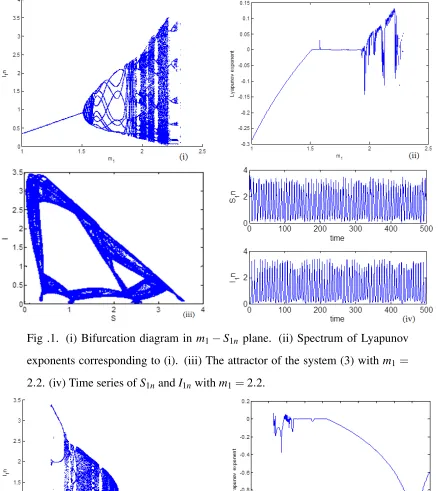
system (3) inm1−S1nspace is given in Fig. 1(i) to show the dynamical changes of susceptible and infective respectively as m1 varying. The spectrum of Lyapunov exponents of (3) with
respect to parameterm1is given in Fig. 1(ii). Thus, we can see that the orbit with initial values approaches to the stable fixed pointP2form1<1.4 approximately, and Hopf bifurcation occurs
at m1≈1.4. When increases to m1≈2.3, (3) becomes stable. In Fig. 1(i), we observe the period-10, period-11 windows within the chaotic regions and boundary crisis atm1≈2.3. For
m1∈(1.9,2.3)the maximum Lyapunov exponents are mostly positive which corresponding to chaotic region. To well see the dynamics, the attractor in the system and time series of (3) with
m1=2.2 and time series ofS1n andI1n are given in Fig. 1(iii) and (iv) respectively. For case (II), Fig. 2(i) is shows that there are period-6 windows, period-7 windows, period-8 windows
and invariant in the chaotic regions and boundary crisis at m2 ≈0.92. Fig. 2(ii) shows that there is a part of Lyapunov exponents are positive which corresponding to chaotic region when
m2∈(0.65,0.75).
For case (III), Fig . 3(i) depicts that there are period-6, period-8 windows and invariant in the
chaotic regions, and two onsets of chaos atm3≈0.32 andm3≈0.68, , respectively. Fig 3(ii) shows a part of Lyapunov exponents are positive which corresponding to chaotic region when
m3∈(0.1,0.2).
4.
CONCLUSIONIn this paper, we investigate the behaviors of the SIS epidemic with logistic term as a
discrete-time dynamical system, and find many complex and new interesting dynamical phenomena.
Fig .1. (i) Bifurcation diagram in m1−S1n plane. (ii) Spectrum of Lyapunov exponents corresponding to (i). (iii) The attractor of the system (3) with m1=
2.2. (iv) Time series ofS1nandI1nwithm1=2.2.
Fig. 3. (i) Bifurcation diagram inm3−S1nplane. (ii) The spectrum of Lyapunov exponents of (3) with respect to parameterm3.
analysis and numerical simulations have demonstrated that the model exhibits the variety of
dynamical behaviors, which include the discrete epidemic model undergoes transcritical
bifur-cation, flip bifurbifur-cation, Hopf bifurcation and chaos. The results show that there are different
dynamical behaviors between discrete system and its corresponding continuous system and the
results are different from [23]. Furthermore, chaos can cause the population to run a higher
risk of extinction due to the unpredictably [24-25]. Thus, how to control chaos in the epidemic
model is very important, which needs further consideration.
Acknowledgement
Project supported by the Youth Science Foundations of Education Department of Hebei Province
(No. QN2016265), Hebei Special Foundation ’333’ talent project (No. A20160 01123), and
Scientific Research Funds of Hebei Institute of Architecture and Civil Engineering
(Nos. 2016XJJQN03, 2016XJJYB05).
Conflict of Interests
The authors declare that there is no conflict of interests.
REFERENCES
[1] A. Gray, D. Greenhalgh, X. Mao, J. Pan, The SIS epidemic model with Markovian switching, J. Math. Anal.
Appl. 294 (2012), 496-516.
[2] X. Zhang, X. Liu, Backward bifurcation and global dynamics of an SIS epidemic model with general
[3] J. Linda, K. Nadarajah, M. Sherri, SIS epidemic models with multiple pathogen strains, J. Differ. Equ. Appl.
10 (2004), 53-75.
[4] J. Liu, T. Zhang, Bifurcation analysis of an SIS epidemic model with nonlinear birth rate, Chaos Soliton
Fract. 40 (2009), 1091-1099.
[5] D. Gao, S. Ruan, An SIS patch model with variable transmission coefficients, Math. Biosci. 232 (2011),
110-115.
[6] Y. Li, J. Cui, The effect of constant and pulse vaccination on SIS epidemic models incorporating media
coverage, Commun. Nonlinear Sci Numer. Simulat. 14 (2009), 2353-2365.
[7] Q. Wu, Y. Lou, Local immunization program for susceptible-infected-recovered network epidemic model,
Chaos 26 (2016), 023108.
[8] M. Frasca, K. Sharkey, Discrete-time moment closure models for epidemic spreading in populations of
inter-acting individuals, J. Theor. Biol. 399 (2016), 13-21.
[9] Q. Wu, X. Fu, Modelling of discrete-time SIS models with awareness interactions on degree-uncorrelated
networks, Physica A 390 (2011), 463-470.
[10] P. Salceanu, H. Smith, Persistence in a discrete-time stage-structured fungal disease model, J. Biol. Dynam.
3 (2009), 271-285.
[11] C. Wu, Existence of traveling waves with the critical speed for a discrete diffusive epidemic model, J. Differ.
Equations 262 (2016), 272-282.
[12] J. Li, Z. Ma, F. Brauer, Global analysis of discrete-time SI and SIS epidemic models, Math. Biosci. Eng. 4
(2007), 699-710.
[13] L. Allen, Y. Lou, A. Nevai. Spatial patterns in a discrete-time SIS patch model, J. Math. Biol. 18 (2009),
339-375.
[14] L. Li, G. Sun, Z. Jin, Bifurcation and chaos in an epidemic model with nonlinear incidence rates, Appl. Math.
Comput. 216 (2010), 1226-1234.
[15] Y. Xiao, L. Chen, A ratio-dependent predator-prey model with disease in the prey, Appl. Math. Comput. 131
(2002), 397-414.
[16] B. Liu, Y. Duan, S. Luan, Dynamics of an SI epidemic model with external effects in a polluted environment,
Nonlinear Anal-Real. 13 (2012), 27-38.
[17] N. Bairagi, S. Chaudhuri, J. Chattopadhyay, Harvesting as a disease control measure in an
eco-epidemiological system-A theoretical study, Math. Biosci.217 (2009), 134-144.
[18] G. Hu, X. Li, Stability and Hopf bifurcation for a delayed predator-prey model with disease in the prey,
Chaos, Soliton Fract. 45 (2012), 229-237.
[20] J. Guckenheimer, P. Holmes, Nonlinear oscillations, dynamical systems and bifurcations of vector fields, NY:
Spring Verlag; (1983).
[21] S. Wiggins, Introduction to applied nonlinear dynamical systems and chaos, Berlin: Springer-Verlag; (1990).
[22] P. Gaspard, M. Briggs, M. Francis, et al. Experimental evidence for microscopic chaos, Nature, 6696 (1998),
865-868.
[23] J. Li, J. Lou, M. Lou, Some discrete SI and SIS epidemic models, Appl. Math. Mech-Engl. 29 (2008),
113-119.
[24] A. Berryman, J. Millstein, Are ecological systems chaotic and if not, why not? Trends Ecol. Evol. 4 (1989),
26-28.
[25] M. Hassell, H. Comins, R. May, Spatial structure and chaos in insect population dynamics, Nature 353 (1991)