journal homepage: http://jac.ut.ac.ir
Asteroidal number for some product graphs
S. ALAGU
∗1and R. KALA
†21,2Department of Mathematics, Manonmaniam Sundaranar University, Tirunelveli - 627 012,
Tamilnadu, India.
ABSTRACT ARTICLE INFO
The notion of Asteroidal triples was introduced by
Lekkerkerker and Boland [6]. D.G.Corneil and others
[2], Ekkehard Kohler [3] further investigated asteroidal
triples. Walter generalized the concept of asteroidal
triples to asteroidal sets [8]. Further study was carried
out by Haiko Muller [4]. In this paper we find asteroidal
numbers for Direct product of cycles, Direct product of
path and cycle, Strong product of paths and cycles and
some more graphs.
Article history:
Received 27,November 2016
Received in revised form 8, May
2017
Accepted 25 May 2017
Available online 01, June 2017
Keyword: vertex equitable labeling, Asteroidal number,
as-teroidal sets, independence number, cartesian product.
AMS subject Classification: 05C76,05C69
1
Introduction
We collect all the relevant definitions needed in the sequel.
Definition 1.1. The neighbourhood of a vertex u in a graph G is the set N(u)
con-sisting of all vertices v which are adjacent with u. The closed neighbourhood is
N[u] =N(u)∪ {u}.
Definition 1.2. Let G= (V, E) be a graph. A subset A of vertices is called anasteroidal
set of the graph G if for each vertex a∈ A all elements of A\ {a} are contained in the
same connected component of G-N[a].
Definition 1.3. The asteroidal number of G denoted by an(G) is defined as the
maximum cardinality of an asteroidal set in G.
Definition 1.4. Let G = (VG, EG) and H = (VH, EH) be two graphs. The Cartesian
product of G and H, denoted by G◦H, has V (G◦H) ={(g, h)/g ∈G;h ∈H} and
E(G◦H) ={(g1, h1) (g2, h2)/g1 =g2, h1h2 ∈E(H) or g1g2 ∈E(G), h1 =h2}.[7]
Definition 1.5. Let G = (VG, EG) and H = (VH, EH) be two graphs. The Direct
product of G and H, denoted by G×H, has V (G×H) = {(g, h)/g∈G;h∈H} as
the vertex set and E(G×H) ={(g1, h1) (g2, h2)/g1g2 ∈E(G) and h1h2 ∈E(H)}.[7]
Definition 1.6. Let G = (VG, EG) and H = (VH, EH) be two graphs. The Strong
product of G and H, denoted by G⊗H, has V (G⊗H) = {(g, h)/g∈G;h∈H} as
the vertex set and E(G⊗H) =E(G◦H)∪E(G×H).[7].
Definition 1.7. Let G= (V, E) be a graph. A subset S of V is called an independent
set if there is no edge between any two vertices of S.
Definition 1.8. The cardinality of a maximum independent set of a graph G is called
independence number of G and is denoted by β0(G) or simply β0.
Definition 1.9. Let V = {x1, x2, . . . xn} and E = {(xi, xi+1)/0≤i≤n−1}. The
Definition 1.10. Let V ={x1, x2, . . . xn} and E ={(xi, xi+1)/0≤i≤n−1}∪{(x1, xn)}.
The graph (V, E) is called a cycle on n vertices and is denoted by Cn.
The following results are from [4] and [5] respectively.
Lemma 1.11. For a disconnected graph G, an(G) = max{an(G[C]) :C ∈Comp(G)},
where Comp(G) denotes the set of all components of G.
Lemma 1.12. Let G = (V, E) be a graph. If G−N[v] is connected ∀ v ∈ V , then
an(G) = β0.
The following theorem is from [1].
Theorem 1.13. Indepedence number for some product graphs are given below :
1.β0(Pm⊗Pn) =
m
2
n
2
2.β0(Cm⊗Cn) =β0(Cm)β0(Cn) where β0(Cn) =
n
2
3.β0(Pm⊗Cn) = β0(Pm)β0(Cn) where β0(Pm) =
m
2
Definition 1.14. Let G = (VG, EG) and H = (VH, EH) be two graphs. The Strong
product of G and H, denoted by G⊗H, has V (G⊗H) = {(g, h)/g∈G;h∈H} as
the vertex set and E(G⊗H) =E(G◦H)∪E(G×H).[7].
Definition 1.15. Let G= (V, E) be a graph. A subset S of V is called anindependent
set if there is no edge between any two vertices of S.
Definition 1.16. The cardinality of a maximum independent set of a graph G is called
independence number of G and is denoted by β0(G) or simply β0.
Definition 1.17. Let V = {x1, x2, . . . xn} and E = {(xi, xi+1)/0≤i≤n−1}. The
graph (V, E) is called a path on n vertices and is denoted by Pn.
Definition 1.18. Let V ={x1, x2, . . . xn} and E ={(xi, xi+1)/0≤i≤n−1}∪{(x1, xn)}.
The graph (V, E) is called a cycle on n vertices and is denoted by Cn.
Lemma 1.19. For a disconnected graph G, an(G) = max{an(G[C]) :C ∈Comp(G)},
where Comp(G) denotes the set of all components of G.
Lemma 1.20. Let G = (V, E) be a graph. If G−N[v] is connected ∀ v ∈ V , then
an(G) = β0.
The following theorem is from [1].
Theorem 1.21. Indepedence number for some product graphs are given below :
1.β0(Pm⊗Pn) =
m
2
n
2
2.β0(Cm⊗Cn) =β0(Cm)β0(Cn) where β0(Cn) =
n
2
3.β0(Pm⊗Cn) = β0(Pm)β0(Cn) where β0(Pm) =
m
2
2
Main Results
Theorem 2.1. an(Pm×Cn) =
(k−1)l if m = 2k , n= 2l
m
2
n
2 if m = 2k+ 1 , n= 2l
m
2
n if n= 2l+ 1
Proof. We draw Pm×Cn in such a way that it has m columns and n rows.
b b b b b
b b b b b
b b b b b
b b b b b
b
b b b
b b b b b b b b b b
b b b b
b b b b
b b b b
b b b b
b b b b b
b
b
b
b
b
b b b b
b b b b
b
b
b b b b b
b b b b b
(2,1)
(1,1) (3,1) (4,1) (5,1) (6,1) (7,1) (8,1) (9,1) (10,1)
(1,2) (1,3) (1,4) (1,5) (1,6) (1,7) (1,8) (2,2)
(3,2) (4,2) (5,2) (6,2) (7,2) (8,2) (9,2) (10,2)
(2,3) (3,3) (4,3) (5,3) (6,3) (7,3) (8,3) (9,3) (2,4) (3,4) (4,4) (5,4) (6,4) (7,4) (8,4) (9,4) (2,5) (3,5) (4,5) (5,5) (6,5) (7,5) (8,5) (9,5)
(2,6) (3,6) (4,6)
(5,6) (6,6)
(7,6) (8,6) (9,6)
(2,7) (3,7) (4,7) (5,7) (6,7) (7,7) (8,7) (9,7)
(2,8) (3,8) (4,8) (5,8) (6,8) (7,8) (8,8) (9,8) (10,3) (10,4) (10,5) (10,6) (10,7) (10,8) Fig. 1
For even m and n, Pm ×Cn has two components - one being the upside down
im-age of other. Therefore, it is enough if we find asteroidal number for one component.
Let us consider the component containing (1,1), say G1. Collect all the vertices in the
first column of G1 for Γ . None of the second column vertices can be chosen for Γ ,
since they are adjacent with those of first column vertices lying in Γ . Third column
vertices are also to be avoided, since removal of any third column vertex and its
neigh-bourhood will leave a first column vertex alone. Now, choosing all the vertices (in G1)
of first/second, fourth, sixth, eighth,. . .(m−2)th columns or first/third, fifth, seventh,
ninth,. . .(m−1)th columns, we get maximum asteroidal sets of cardinality (k−1)l.
Case(ii): m= 2k+ 1 ; n= 2l
For even m and odd n, Pm×Cn has two components - one being the upside down image
of other. Therefore, it is enough if we find asteroidal number for one component. Let
us consider the component containing (1,1), say G1. The procedure to choose maximum
b b b b b
b b b b b
b b b b b
b b b b b
b
b b b
b
b
b
b
b
b
b
b
b b b b
b b b b
b b b b
b b b b
b b b b
b
b
b
b
b b b b
b b b b
b b b b
b b b b
(2,1)
(1,1) (3,1) (4,1) (5,1) (6,1) (7,1) (8,1) (9,1)
(1,2)
(1,3)
(1,4)
(1,5)
(1,6)
(1,7)
(1,8)
(2,2) (3,2) (4,2) (5,2) (6,2) (7,2) (8,2) (9,2)
(2,3) (3,3) (4,3) (5,3) (6,3) (7,3) (8,3) (9,3)
(2,4) (3,4) (4,4) (5,4) (6,4) (7,4) (8,4) (9,4)
(2,5) (3,5) (4,5) (5,5) (6,5) (7,5) (8,5) (9,5)
(2,6) (3,6) (4,6) (5,6) (6,6) (7,6) (8,6) (9,6)
(2,7) (3,7) (4,7) (5,7) (6,7) (7,7) (8,7) (9,7)
(2,8) (3,8) (4,8) (5,8) (6,8) (7,8) (8,8)
(9,8)
Fig. 2
Choosing all the vertices (in G1) of first/second, fourth, sixth, eighth,. . .(m−1)
th
columns
or first/third, fifth, seventh, ninth,. . .(m−2)th columns, we get maximum asteroidal sets
of cardinality m
2
n
2 .
Case (iii) : n = 2l+ 1
For odd n, irrespective of m, Pm × Cn is connected. Choosing all the vertices of
first/second, fourth, sixth, eighth,. . . columns or first/third, fifth, seventh, ninth,. . .columns
(the last column will be m−1or m−2 depending on m) , we get maximum asteroidal
sets of cardinality m
2
b b b b b
b b b b b
b b b b b
b b b b b
b
b b b
b
b
b
b
b
b
b
b b b b
b b b b
b b b b
b b b b
b
b
b
b
b b b b
b b b b
b b b b
(2,1)
(1,1) (3,1) (4,1) (5,1) (6,1) (7,1) (8,1) (9,1)
(1,2)
(1,3)
(1,4)
(1,5)
(1,6)
(1,7)
(2,2) (3,2) (4,2) (5,2) (6,2) (7,2) (8,2) (9,2)
(2,3) (3,3) (4,3) (5,3) (6,3) (7,3) (8,3) (9,3)
(2,4) (3,4) (4,4) (5,4) (6,4) (7,4) (8,4) (9,4)
(2,5) (3,5) (4,5) (5,5) (6,5) (7,5) (8,5) (9,5)
(2,6) (3,6) (4,6) (5,6) (6,6) (7,6) (8,6) (9,6)
(2,7) (3,7) (4,7) (5,7) (6,7) (7,7) (8,7) (9,7)
Fig. 3
Now we deal with direct product of cycles.
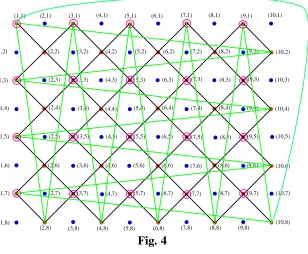
Theorem 2.2. an(Cm×Cn) =
mn
4 if m, n are both even
β0(Cm×Cn) otherwise
Proof. Cm×Cn is drawn such that number of columns is greater than number of rows.
Case (i): For even m and n, the graph has two components - one being the mirror
image of the other. Hence it is enough if we find asteroidal number for one component.
Let G1 be the component containing (1,1) . Choosing all the vertices (of G1) in the
first, third,...last but one columns or second, fourth,....last columns, we get maximum
asteroidal sets of cardinality mn
4 .
Case (ii): If at least one of m, n is odd, the graph Cm×Cn is connected and satisfies
the condition for Lemma 1.12. Hence asteroidal number in this case will be independence
b b b b b
b b b b b
b b b b b
b b b b b
b
b b b
b b b b b b b b b b
b b b b
b b b b
b b b b
b b b b
b b b b b
b
b
b
b
b
b b b b
b b b b
b
b
b b b b b
b b b b b
(2,1)
(1,1) (3,1) (4,1) (5,1) (6,1) (7,1) (8,1) (9,1) (10,1)
(1,2) (1,3) (1,4) (1,5) (1,6) (1,7) (1,8)
(2,2) (3,2) (4,2) (5,2) (6,2) (7,2) (8,2) (9,2) (10,2)
(2,3) (3,3) (4,3) (5,3) (6,3) (7,3) (8,3) (9,3)
(2,4) (3,4) (4,4) (5,4) (6,4) (7,4) (8,4) (9,4)
(2,5) (3,5) (4,5) (5,5) (6,5) (7,5) (8,5) (9,5)
(2,6) (3,6) (4,6) (5,6) (6,6) (7,6) (8,6) (9,6)
(2,7) (3,7) (4,7) (5,7) (6,7) (7,7) (8,7) (9,7)
(2,8) (3,8) (4,8) (5,8) (6,8) (7,8) (8,8) (9,8)
(10,3) (10,4) (10,5) (10,6) (10,7) (10,8) Fig. 4
In the following we make a simple observation on Cartesian and Strong products of cycles
and paths.
Theorem 2.3. Asteroidal number is the same as that of independence number for the
following graphs :
(i)Cm◦Cn
(ii)Pm⊗Pn
(iii)Cm⊗Cn
(iv)Pm⊗Cn
Proof. Since G − N[u] is connected ∀u ∈ G,where G may denote any graph from
(i)to(iv) ,by Lemma 1.11, the result holds. Also we see that an(Pm⊗Pn) =
m 2 n 2 ,
an(Cm⊗Cn) =
m
2
n
2
, an(Pm⊗Cn) =
m
2
n
2
(By theorem 1.13).
Definition 2.4. The complete bipartite graph K1,n is called a star.
Definition 2.5. The bistar Bm,n is the graph obtained from K2 by joining m pendent
edges to one end of K2 and n pendent edges to the other end of K2.
Definition 2.6. The graph obtained by joining a single pendent edge to each vertex of a
path is called a comb.
Definition 2.7. ATriangular snake denoted by Tn is obtained from a path v1v2...vn
by joining vi and vi+1 to a new vertex wi for 1≤i≤n−1.
Definition 2.8. A Quadrilateral snake is obtained from a path u1u2...un by joining
ui, ui+1 to new vertices vi, wi respectively and joining vi and wi.
Definition 2.9. A Laddergraph, denoted by Ln is a graph obtained from the cartesian
product of Pn and P1.
Definition 2.10. Thecorona product G1⊙G2 of two graphs G1 and G2 is defined as
the graph G obtained by taking one copy of G1 (which has p1 vertices) and p1 copies
of G2 and then joining the ith vertex of G1 to every vertex in the ith copy of G2.
Definition 2.11. An asteroidal triple of a graph G= (V, E) is a set of three vertices,
such that there exists a path between any two of them avoiding the neighbourhood of the
third. Graphs without asteroidal triples are called asteroidal triple free graphs.[2]
In the following we enumerate some asteroidal triple free graphs.
Theorem 2.12. The following graphs are asteroidal triple free graphs and hence their
asteroidal number is two:
1. Star graphs
2. Bistar graphs
3. Comb
4. Triangular snake
6. Ladder graph
7. Pn⊙mK1
8. Pm⊙Km
Proof. 1. Since removal of any pendent vertex and its neighbourhood (see F ig 1) will
result in a graph full of isolated vertices, asteroidal number of star graph is 2. Any two
pendent vertices can be taken for a maximum asteroidal set.
b
b
b
b
b
b
b
b
b
b
b
b
b
bb
Star
2. Removal of a pendent vertex and its neighbourhood will result in a union of a star and
isolated vertices. Hence it is asteroidal triple free.
b b
b
b
b
b
b
b
b
b
b
b
b
b
b b
Bistar
For 3,7 and 8, consider any three vertices that are mutually non adjacent. For one vertex
(among the three) , the removal of it’s closed neighbourhood will disconnect the path
thereby leaving the other two vertices in two different components. Hence combs have
asteroidal number two.
b b b b b
b b b b b
Comb
b b b b b
b
b b b b b b b b b b b b b
b b bbb
b bb
b bb bbb
bbb bb b
b
The argument for 4,5 and 6 is the same as that for 3.
b b b b b
b b b b
Triangular snake
b b b b b
b b b b b b b b
Quadrilateral snake
b
b
b
b
b
b
b
b
b
b
Fig 6
Definition 2.13. The graph Cn+K1 is called a wheel with n spokes and is denoted by
Wn.
Definition 2.14. Helm graph, denoted by Hn is a graph obtained from a wheel by
adjoining a pendent edge to each node of a cycle.
Definition 2.15. The web graph Wn,r is a graph consisting of r concentric copies of
the cycle graph Cn, with corresponding vertices connected by ”spokes”.
Definition 2.16. The Mobius ladder Mn is a cubic circulant graph with an even
number n of vertices, formed from an n-cycle by adding edges (called ”rungs”) connecting
opposite pairs of vertices in the cycle.
Definition 2.17. The graph Cn⊙K1 is called a crown.
Definition 2.18. A dragon is a graph formed by joining an end vertex of a path Pm to
a vertex of the cycle Cn. It is denoted as Cn@Pm.
Theorem 2.19. Asteroidal number for some graphs is given below :
1.an(Wn) =
n
2
2.an(Wn,r) = r
n
2
3.an(Hn) =an(Cn⊙K1) =n
4.an(Mn) =
n
2 if n= 2k ; k contains an odd f actor
n
2 −1 otherwise
5.an(Cn@Pm) =
m
2
Proof. For a wheel Wn, alternate vertices of the cycle form a maximum asteroidal set and
hence the cardinality is n
2
. For a web graph Wn,r, alternate vertices in each cycle are
chosen in such a way they are mutually non adjacent. For a helm graph Hn and crown
graph, all the pendent vertices form a maximum asteroidal set and hence cardinality is
n. b b b b b b b b b b b b b b b b b b b b b b b b b Wheel Helm b b b b b b b b b b b b b b b Web b b b b b b b b b b b
b b b
b b b b b b Crown b b b b b b b b b b b b b b b b b b b b b b 1 2 3 4 5 6 7 8 9 10 1 2 3 4 5 6 7 8 9 10 11 12
In Mobius Ladder graph Mn, when n has no odd factor, on choosing alternate vertices
of the cycle, one vertex has to be left out since it is adjacent with an already chosen
vertex. This problem doesn’t arise if n has no odd factor and so alternate vertices form
a maximum asteroidal set.
b b b b b b b b b b
b b b b b b b b b b b b
Dragon
Avoiding the vertex common to the path and the cycle, we choose alternate vertices on
References
[1] Antoaneta Klobucar, Independent Sets and independent dominating sets in the strong
product of paths and cycles Mathematical Communications 10, 2005,23-30.
[2] Corneil.D.G, Olariu.S and Stewart.L.K, Asteroidal triple free graphsSIAM J. Discrete
Math., 10(1997), pp.399-430.
[3] Ekkehard Kohler, Recognizing graphs without asteroidal triples, J. Discrete
Algo-rithms 2(2004) pp.439-452.
[4] Haiko Muller, Asteroidal Sets in Graphs, Report submitted to Friedrich-Schiller
Uni-versity, Jena, on 3.2.1999.
[5] Hepzibai Jeyakumar, Studies in Graph theory-Asteroidal Sets in Graphs, Ph.D thesis,
Manonmaniam Sundaranar University, Tirunelveli, India, February 2003.
[6] Lekkerkerker.C.G and Boland.J.C,Representation of a finite graph by a set of intervals
on the real line, Fund. Math., 51(1962), pp.45-64.
[7] Richard Hammack, Wilfried Imrich, Sandi Klavzar Handbook of Product Graphs,
Sec-ond edition, CRC Press, 2011.
[8] Walter.J.R,Representations of chordal graphs as subtrees of a tree, J. Graph Theory,
2(1978), pp.265-267.
Acknowledgement : First author thanks Department of Science and Technology (DST),