www.geosci-model-dev.net/7/249/2014/ doi:10.5194/gmd-7-249-2014
© Author(s) 2014. CC Attribution 3.0 License.
Geoscientific
Model Development
Methodological aspects of a pattern-scaling approach to produce
global fields of monthly means of daily maximum and
minimum temperature
S. Kremser, G. E. Bodeker, and J. Lewis
Bodeker Scientific, Alexandra, New Zealand
Correspondence to: S. Kremser ([email protected])
Received: 6 August 2013 – Published in Geosci. Model Dev. Discuss.: 13 September 2013 Revised: 4 December 2013 – Accepted: 23 December 2013 – Published: 30 January 2014
Abstract. A Climate Pattern-Scaling Model (CPSM) that
simulates global patterns of climate change, for a prescribed emissions scenario, is described. A CPSM works by quan-titatively establishing the statistical relationship between a climate variable at a specific location (e.g. daily maximum surface temperature, Tmax) and one or more predictor time
series (e.g. global mean surface temperature,Tglobal) –
re-ferred to as the “training” of the CPSM. This training uses a regression model to derive fit coefficients that describe the statistical relationship between the predictor time series and the target climate variable time series. Once that relationship has been determined, and given the predictor time series for any greenhouse gas (GHG) emissions scenario, the change in the climate variable of interest can be reconstructed – re-ferred to as the “application” of the CPSM. The advantage of using a CPSM rather than a typical atmosphere–ocean global climate model (AOGCM) is that the predictor time series re-quired by the CPSM can usually be generated quickly us-ing a simple climate model (SCM) for any prescribed GHG emissions scenario and then applied to generate global fields of the climate variable of interest. The training can be per-formed either on historical measurements or on output from an AOGCM. Using model output from 21st century simu-lations has the advantage that the climate change signal is more pronounced than in historical data and therefore a more robust statistical relationship is obtained. The disadvantage of using AOGCM output is that the CPSM training might be compromised by any AOGCM inadequacies. For the pur-poses of exploring the various methodological aspects of the CPSM approach, AOGCM output was used in this study to train the CPSM. These investigations of the CPSM method-ology focus on monthly mean fields of daily temperature
extremes (TmaxandTmin). The methodological aspects of the
CPSM explored in this study include (1) investigation of the advantage gained in having five predictor time series over having only one predictor time series, (2) investigation of the time dependence of the fit coefficients and (3) investigation of the dependence of the fit coefficients on GHG emissions scenario. Key conclusions are (1) overall, the CPSM trained on simulations based on the Representative Concentration Pathway (RCP) 8.5 emissions scenario is able to reproduce AOGCM simulations ofTmax and Tmin based on predictor
time series from an RCP 4.5 emissions scenario; (2) access to hemisphere average land and ocean temperatures as predic-tors improves the variance that can be explained, particularly over the oceans; (3) regression model fit coefficients derived from individual simulations based on the RCP 2.6, 4.5 and 8.5 emissions scenarios agree well over most regions of the globe (the Arctic is the exception); (4) training the CPSM on concatenated time series from an ensemble of simulations does not result in fit coefficients that explain significantly more of the variance than an approach that weights results based on single simulation fits; and (5) the inclusion of a lin-ear time dependence in the regression model fit coefficients improves the variance explained, primarily over the oceans.
1 Introduction
Atmosphere–ocean general circulation models (AOGCMs) are currently the primary tool used to project the future climate response to a prescribed scenario of greenhouse gas (GHG) and aerosol emissions. Since AOGCMs are
computationally demanding and expensive to run, typically only a limited number of long-term simulations, for only a few GHG emissions scenarios, can be conducted in support of any scientific study. However, a fully probabilistic assess-ment of future regional climate change and its potential im-pacts requires simulations of climate change that span a wide range of possible future GHG and aerosol emissions. Simple climate models (SCMs), while computationally less expen-sive than AOGCMs, provide only annually and globally (or sometimes hemispherically) averaged time series of surface temperature and therefore cannot represent spatial patterns of changes in surface climate variables (Mitchell, 2003). SCMs can, however, simulate changes in global annual mean surface temperature (Tglobal) for any prescribed GHG and
aerosol emissions scenarios and can be tuned to emulate any specific AOGCM (Frieler et al., 2012; Meinshausen et al., 2009).
To generate fields of climate variables for a range of emis-sions scenarios, the climate pattern-scaling method was de-veloped (Mitchell et al., 1999; Mitchell, 2003) and encoded, in what is referred to, in this study, as a climate pattern-scaling model (CPSM). This CPSM provides a tool to con-duct regional-scale climate projections for a range of climate variables such as daily maximum and minimum temperatures (TmaxandTmin) for a wide range of GHG emissions
scenar-ios. Using maximum and minimum temperatures as opposed to monthly mean temperature is more useful for some spe-cific applications, for example, for agriculture and for public health officials tasked with providing warnings of extreme climate events. Crop growth, and therefore crop yields, are more sensitive to maximum and minimum temperature than to daily mean values. Furthermore, probabilistic projections of Tmax andTmin provide means to estimate future energy
demand (e.g. increase/decrease in the usage of air condition-ing or heatcondition-ing). As a result, this study uses monthly means of daily maximum and minimum temperature rather than monthly means of daily mean temperature to explore the methodological aspects of climate pattern scaling. The cli-mate pattern-scaling method has been used to capture the statistical relationship between time series of surface climate variables (such as maximum and minimum temperatureTmax
andTmin) and predictor time series (typicallyTglobal), based
either on measurement time series or on AOGCM output – referred to as the “training” of the CPSM. Those statistical relationships can then be used to project the spatial pattern of changes in a climate variable for different emissions sce-narios, or for future time periods, that were not covered by the data set used for the training – referred to as the “appli-cation” of the CPSM. Once the data required for the train-ing are available, the pattern-scaltrain-ing approach is computa-tionally inexpensive and therefore provides a mechanism for representing a more complete range of uncertainties associ-ated with climate projections that arise from equally probable emissions scenarios and from uncertainties in our knowledge of key parameters in the climate system. The pattern-scaling
method is based on the assumption that the local response of a given climate variable, such as daily maximum and min-imum surface temperatures (TmaxandTmin), and to a lesser
extent precipitation, can be statistically related to the change in a more easily modelled climate variable such as Tglobal
(Giorgi et al., 2005; Frieler et al., 2012), irrespective of the forcing that caused the change inTglobal. Non-linearities can
arise, for example, as a result of local climate change depend-ing on the rate of global mean temperature change in addition to the magnitude of the change (Mitchell, 2003). Giorgi et al. (2005) showed that the non-linear fraction of the climate change signal tends to decrease with increasing magnitude of the signal, suggesting that the linear response assumption will be increasingly robust as the climate change signal be-comes more pronounced.
Different methods have previously been developed to de-termine the statistical relationship between the climate vari-able of interest and its predictors (e.g. Huntingford et al., 2000; Mitchell, 2003; Ruosteenoja et al., 2007). Linear least squares regression models, in general, produce more robust statistical results than an approach that uses two time-slice simulations separated in time (Mitchell, 2003; Ruosteenoja et al., 2007).
In this study, a CPSM is used to explore some of the methodological aspects of the pattern-scaling approach that have not been, to our knowledge, investigated in detail in the existing literature. The motivation is to define more clearly where the assumptions underlying the CPSM approach are valid, possible reasons for breakdowns in those assumptions, and potential strategies to improve the CPSM approach to mitigate the effects of methodological weaknesses. Follow-ing the best practice approaches outlined in Mitchell et al. (1999), Huntingford et al. (2000), and Mitchell (2003), the climate pattern response is obtained by using a linear least squares regression model to relate the anomaly in a surface climate variable (the predictand) to the anomaly in the dictor. By using anomalies in both the predictor and the pre-dictand with respect to the same baseline period, more sta-tistically robust results are obtained than in the case where absolute values are modelled. CPSM generated patterns of change can be added to an observations-based climatology over the baseline period to obtain absolute values of the cli-mate variable of interest. Throughout this paper, unless oth-erwise specified, all anomalies are with respect to the 1961– 1990 mean as this is the baseline period recommended by the World Meteorological Organization (WMO) Commission on Climatology and is used as the climatological baseline in cli-mate impact studies (Parry et al., 2007).
In this studyTglobal0 , where the prime denotes that it is an anomaly, is usually used as the predictor. In addition to using Tglobal0 as a predictor, and unlike previous studies, the CPSM presented here is also able to use hemispheric ocean and land mean temperature anomalies as predictors since some SCMs, such as MAGICC (Meinshausen et al., 2011), are also able to produce these as output. One of the methodological aspects
of the CPSM explored in this study (see Sect. 4) is the ad-vantage gained in having five predictor time series (Tglobal0 , the hemispheric ocean and land temperatures) over having only one predictor time series (Tglobal0 ).
The surface climate variables used to explore selected fea-tures of the CPSM are the monthly means of daily maxi-mum and minimaxi-mum temperature (TmaxandTmin). While the
regression model applied in the CPSM training could use ob-servational data as input, the climate signal to date has been weaker than the signal expected over the 21st century. There-fore, the CPSM has been trained on output from the Met Of-fice Hadley Centre Earth System Model (HadGEM2-ES) per-formed under the Coupled Model Intercomparison Project phase 5 (CMIP5) in support of the Intergovernmental Panel on Climate Change (IPCC) 5th assessment report (see Ap-pendix A). The results presented in this paper are therefore contingent on only a single AOGCM being used and only for simulations to 2100.
The training of the CPSM is described in detail in Sect. 2 which includes the construction of the regression model, how autocorrelation in the regression model residuals is ac-counted for to obtain a robust estimate of the regression model fit coefficient uncertainties, a demonstration of the CPSM training, how seasonality in the fit coefficients is cap-tured, and examples of global maps of fit coefficients. The application of the CPSM is described in Sect. 3. The first of the methodological issues explored in this paper – the value obtained by including additional predictors (basis functions) in the regression model – is documented in Sect. 4. This sec-tion includes a discussion of the need to orthogonalise the multiple basis functions, presents an example of the use of a multiple basis function CPSM, and an assessment of the value of including additional basis functions. The underlying assumption in the CPSM approach of linearity across scenar-ios in the response of the predictor to the predictand(s) is ex-plored in Sect. 5. The training of the CPSM can be performed on more than one simulation, either concatenated (the super-ensemble approach) or in parallel with appropriate weighting of the different outcomes. The methodological aspects of the choices involved in the use of multiple simulations for CPSM training are detailed in Sect. 6. The possibility of time depen-dence in the fit coefficients is examined in Sect. 7. A discus-sion of the results and the concludiscus-sions drawn appear in the final section of the paper.
2 Training of the CPSM
2.1 Model construct
The most simple construct for the regression model underly-ing the CPSM is
Fi,j0 (y, m)=αi,j(m)×Tglobal0 (y)+Ri,j(y, m), (1)
whereF0is the anomaly field of the climate variable of inter-est (eitherTmax0 orTmin0 in this study) in year (y) and month (m) and where the subscriptsiandj refer to longitude and latitude indices,Tglobal0 is the annual global mean tempera-ture anomaly andRi,j(y, m)is the residual time series.
Un-certainties on the fit coefficients are derived from the diago-nal elements of the covariance matrix as described further in Bodeker et al. (1998).
2.2 Accounting for autocorrelation in the residuals
Ri,j(y, m)in Eq. (1) is the residual (i.e. that part of the signal
not explained byαi,j(m)×Tglobal0 (y)). Due to the timescales
associated with the climate system, temporal correlation be-tween these residuals is expected, that is, if thenth residual is positive there is a greater chance of the (n+1)th residual be-ing positive rather than negative. This autocorrelation (Tiao et al., 1990; Weatherhead et al., 1998; Reinsel et al., 2005) implies that the data to which the regression model is being fitted are not completely independent and as a result there are effectively fewer independent values than the number of months of data available. This effectively increases the un-certainty on the fit coefficients. If this autocorrelation is not correctly accounted for in the regression model, the uncer-tainty on the fit coefficients will be underestimated (Tiao et al., 1990). Here, a first order autocorrelation model is used, where thenth residual is correlated against the (n−1)th resid-ual to determine the coefficient of autocorrelation. The de-rived coefficient is then incorporated into a revised estimate of the uncertainty on the data to which the model is fitted, as described in Tiao et al. (1990). This autocorrelation also varies with season and this seasonality is captured in the re-gression model.
2.3 Demonstration of CPSM training
To demonstrate the use of this very simple regression model, time series of Tmin0 at Alexandra, New Zealand (45.2◦S, 169.4◦E), extracted from a HadGEM2-ES simulation under Representative Concentration Pathway (RCP) 4.5 emissions (see Appendix A), andTglobal0 from the same model and emis-sions scenario, are shown in Fig. 1.
Unforced variability within a model simulation (e.g. aris-ing from El Niño events) can cause theTmin0 andTglobal0 time series to be correlated in a way that is unique to this par-ticular simulation (e.g. a HadGEM2-ES simulation based on RCP 4.5 emissions). With different initial conditions, how-ever, this particular simulation might produce an equally validTglobal0 time series but with weaker correlation than the time series shown in Fig. 1. In the example presented in Fig. 1 the short-term correlation between the orange and cyan traces appears to be small but the correlation can be greatly exacer-bated if additional predictors are included in the CPSM (see Sect. 4). When it comes to the application of the CPSM, the Tglobal0 time series will come from an independent source,
1960 1980 2000 2020 2040 2060 2080 2100 Year -2 -1 0 1 2 3 4 5 6 T e m p e ra tu re a n o m a ly w .r .t . 1 9 6 1 -1 9 9 0 [ oC ]
January T'minat 45.2 oS, 169.4oE Smoothed January T'minat 45.2
oS, 169.4oE Annual mean T'global
Smoothed annual mean T'global
Fig. 1.January mean daily minimum temperature anomalies (with respect to 1961-1990) at 45.2◦S, 169.4◦E
extracted from a HadGEM2-ES simulation under RCP 4.5 emissions (orange), the time series smoothed using
the Savitzky-Golay filter (red), the annual mean global mean surface temperature anomaly (with respect to
1961-1990) time series (Tglobal0 ) from the same model simulation and emission scenario (pale blue) and the smoothedTglobal0 time series (blue).
appears to be small but the correlation can be greatly exacerbated if additional predictors are included in the CPSM (see Sect. 4). When it comes to the application of the CPSM, theT0
globaltime series
will come from an independent source, most likely output from a SCM that captures only long-term, forced climate change, and therefore it is essential that none of the correlation betweenT0
minand
T0
globalarises from unforced, short-term variability. The focus of this study is to apply the CPSM
170
to simulate the underlying forced climate change. To this end, theT0
minandTglobal0 time series are
filtered (smoothed) to reduce unforced variability;T0
mintime series are smoothed individually across
each calendar month to avoid smoothing away the annual cycle. The time series smoothed with a Savitzky-Golay filter (Savitzky and Golay, 1964; Press et al., 1989), which was found to work well for this application, are also shown in Fig. 1.
175
The regression of January meanT0
minat Alexandra, New Zealand (45.2◦S, 169.4◦E), against
Tglobal0 is shown in Fig. 2 where the smoothed AOGCM time series shown in Fig. 1 have been used.
Regression model fits (solid lines in Fig. 2) are shown for two time periods viz. (1) 1961-2012 to indicate how a fit might look were it is based on observations alone, and (2) 1961-2100 to indicate the result obtained using a much longer time series. A fit using only 1961-2012 data has the benefit that
180
it could be based on observations and therefore not subject to model inadequacies. However,
gap-6
Fig. 1. January mean daily minimum temperature anomalies (with respect to 1961–1990) at 45.2◦S, 169.4◦E extracted from a HadGEM2-ES simulation under RCP 4.5 emissions (orange), the time series smoothed using the Savitzky–Golay filter (red), the an-nual mean global mean surface temperature anomaly (with respect to 1961–1990) time series (Tglobal0 ) from the same model simula-tion and emission scenario (pale blue), and the smoothedTglobal0 time series (blue).
most likely output from a SCM that captures only long-term, forced climate change, and therefore it is essential that none of the correlation betweenTmin0 andTglobal0 arises from short-term, unforced variability. The focus of this study is to apply the CPSM to simulate the underlying forced climate change. To this end, theTmin0 andTglobal0 time series are fil-tered (smoothed) to reduce unforced variability;Tmin0 time series are smoothed individually across each calendar month to avoid smoothing away the annual cycle. The time series smoothed with a Savitzky–Golay filter (Savitzky and Golay, 1964; Press et al., 1989), which was found to work well for this application, are also shown in Fig. 1.
The regression of January meanTmin0 at Alexandra, New Zealand (45.2◦S, 169.4◦E), againstTglobal0 is shown in Fig. 2, where the smoothed AOGCM time series shown in Fig. 1 have been used.
Regression model fits (solid lines in Fig. 2) are shown for two time periods, namely, (1) 1961–2012 to indicate how a fit might look were it is based on observations alone, and (2) 1961–2100 to indicate the result obtained using a much longer time series. A fit using only 1961–2012 data has the benefit that it could be based on observations and therefore not subject to model inadequacies. However, gap-free monthly mean data would not be available for all loca-tions for this period. Access to a longer time series, span-ning a greater range inTmin0 andTglobal0 , produces fit coef-ficients with smaller uncertainties (see fit coefficient values in Fig. 2) but are, of course, subject to any inadequacies of the AOGCM that was used to generate the time series. It be-comes a judgment call on the part of the user whether to use
-0.5 0 0.5 1 1.5 2 2.5 3 3.5
T'globalw.r.t. 1961-1990 [K]
-0.5 0 0.5 1 1.5 2 2.5 3 T
'min
w .r .t . 1 9 6 1 -1 9 9 0 [ K ]
slope = 0.92 ± 0.047
slope = 1.08 ± 0.355
T'minat 45.2
oS and 169.4oE vs. T' global
Fig. 2. Smoothed January mean daily minimum temperature anomalies at 45.2◦S, 169.4◦E regressed against
annual mean global mean surface temperature anomalies. The data shown are from a single simulation, with the
blue dots showing data from 1961 to 2012 and the black dots showing data from 2013 to 2100. All anomalies
are with respect to the 1961-1990 baseline. Regression model fits (solid lines) are shown for 1961-2012 to
indicate how a fit might look were it based on observations (blue solid line) alone and 1961-2100 to indicate
the result obtained using a much longer time series (black solid line).
free monthly mean data would not be available for all locations for this period. Access to a longer
time series, spanning a greater range in
T
min0and
T
global0, produces fit-coefficients with smaller
uncertainties (see fit-coefficient values in Fig. 2) but are, of course, subject to any inadequacies of the
AOGCM that was used to generate the time series. It becomes a judgment call on the part of the user
185whether to use a (shorter) observational record or a (longer) model record to calculate the regression
model coefficient(s) that constitute the training of the CPSM. Hereafter, output from HadGEM2-ES
simulations are used to train the CPSM (more detailed information on the HadGEM2-ES model and
simulations used in this study is given in Appendix A).
2.4
Fitting for seasonality
190
The
T
global0time series are obtained at annual resolution, as denoted by the (
y
) dependence in Eq. (1),
and yet are required to produce monthly mean fields of the predictand, e.g.
T
min0. The seasonality
is captured by the regression model fit-coefficients which depend on season as denoted by the (
m
)
dependence in Eq. (1). One approach is to fit Eq. (1) separately for each month. However, this
ignores the fact that the dependence of
F
0on
T
global0in any given month is likely to be similar to the
195
7
Fig. 2. Smoothed January mean daily minimum temperature anomalies at 45.2◦S, 169.4◦E regressed against annual mean global mean surface temperature anomalies. The data shown are from a single simulation, with the blue dots showing data from 1961 to 2012 and the black dots showing data from 2013 to 2100. All anomalies are with respect to the 1961–1990 baseline. Regression model fits (solid lines) are shown for 1961–2012 to indicate how a fit might look were it based on observations (blue solid line) alone and 1961–2100 to indicate the result obtained using a much longer time series (black solid line).
a (shorter) observational record or a (longer) model record to calculate the regression model coefficient(s) that constitute the training of the CPSM. Hereafter, output from HadGEM2-ES simulations are used to train the CPSM (more detailed in-formation on the HadGEM2-ES model and simulations used in this study is given in Appendix A).
2.4 Fitting for seasonality
TheTglobal0 time series are obtained at annual resolution, as denoted by the (y) dependence in Eq. (1), and yet are re-quired to produce monthly mean fields of the predictand (e.g. Tmin0 ). The seasonality is captured by the regression model fit coefficients which depend on season as denoted by the (m) dependence in Eq. (1). One approach is to fit Eq. (1) sepa-rately for each month. However, this ignores the fact that the dependence ofF0onTglobal0 in any given month is likely to be similar to the dependence in the neighbouring months. To ac-count for the seasonality in the fit coefficients, and to reduce the number of fit coefficients and thus avoid the likelihood of over-fitting, a more statistically robust approach is to expand
the regression model fit coefficient in a Fourier series, that is,
α(m)=α0+ M
X
k=1
[α2k−1sin(2π×k×m/12)
+α2kcos(2π×k×m/12)], (2)
wheremis the month of the year andM is the number of Fourier pairs in which the fit coefficients are expanded (Ran-del and Cobb, 1994; Bodeker et al., 1998; Reinsel et al., 2005). The value ofMcan be set depending on the seasonal structure expected in the fit coefficients. For the analysis pre-sented below,Mwas set to three for all Fourier expansions. In addition to reducing the number of fit coefficients by a factor of 7/12 compared to the approach of fitting the regres-sion model separately in each month, the method used here also reduces the statistical uncertainty on the derived fit co-efficients (we now refer to the fit coco-efficients as plural since the application of Eq. (2) results in more than one coefficient that relatesF0toTglobal0 ).
2.5 Global maps
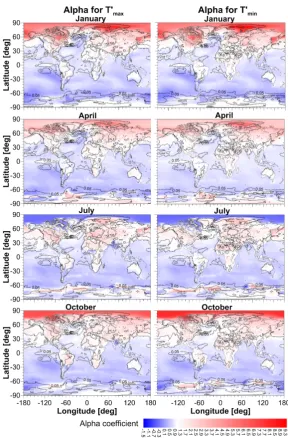
Global spatial patterns ofαfor bothTmax0 andTmin0 together with their 1σ uncertainties are shown in Fig. 3. The fit co-efficients were obtained from the fit of Tglobal0 to Tmax0 and Tmin0 time series, respectively, where all time series were ex-tracted from the HadGEM2-ES RCP 4.5 simulation. The de-rivedαcoefficients are displayed for four selected months of the year.
The α fit coefficient captures the “magnification” of re-gional temperature change compared to the global mean sur-face temperature change, that is, a value ofα=4 forTmax0 indicates that a 1◦C increase inTglobal0 corresponds to a 4◦C increase inTmax0 at that location. The largestα coefficients occur at high latitudes over the Northern Hemisphere in Jan-uary and October (i.e. it is over the Arctic in winter when feedback processes in the climate system are most efficient in amplifying the effects of increases in GHG emissions). This indicates that the CPSM faithfully emulates the Arctic amplification observed in HadGEM2-ES (i.e. that the mag-nitude of the temperature change in the Arctic in response to a change in global climate forcing tends to be significantly larger than the magnitude of the global mean temperature change) (Moritz et al., 2002). Arctic amplification is most pronounced in autumn and winter (Serreze and Barry, 2011) which is consistent with the results shown here (i.e. greaterα and therefore greater sensitivity inTmax0 andTmin0 toTglobal0 ). Southern Hemisphere αcoefficients also maximize at high latitudes, particularly around the Antarctic Peninsula, but do not show values as high as over the Arctic. The larger val-ues of α in April over the Weddell Sea may be related to long-term changes in sea ice. The results presented in Fig. 3 indicate that the climate feedbacks that amplify the global signal in the Arctic (e.g. changes in the ice–albedo feedback) are stronger than those active in the Antarctic. Overall, as
expected due to the differences in the heat capacity of ocean and land, theαcoefficients are larger over land than over the ocean showing that land masses are expected to show greater changes inTmax0 and Tmin0 with changes in Tglobal0 than the oceans.
Note that some regions in Fig. 3 exhibit negativeα coeffi-cients, typically over the sub-polar oceans. Negativeαvalues indicate a temperature trend opposite in sign to that ofTglobal0 . This could occur, for example, if changes in the ocean heat transport in a particular model simulation cause some regions of the ocean to warm at the expense of other regions which cool.
2.6 Area averaging
In much the same way that regression model fit coefficients in neighbouring months are related (suggesting the use of Fourier expansions to capture the seasonal coherence), fit coefficients in neighbouring grid cells are also expected to be closely related. Throughout this paper Eq. (1) is applied in isolation in each grid cell of the AOGCM and therefore does not inherently capture the geospatial correlation of the fit coefficients. This may result in structure in the fit coeffi-cients that is a function of the specific emissions scenario(s) on which the CPSM is trained and therefore not represen-tative of the structure of the response of the climate system in general. Previous analyses (e.g. Frieler et al., 2012) have used area averaging of the fields prior to training the CPSM to avoid fine-scale structure in the fit coefficients. However, this results in sharp discontinuities between regions when the CPSM is used in application mode. An alternative ap-proach is to further expand the model fit coefficients (e.g. theαk in Eq. 2) in spherical harmonics where again the
or-der of the meridional and zonal expansions can be selected to capture the broad-scale features of the fit coefficient fields but to smooth over the fine-scale features. The spherical har-monic expansion recognises the geospatial correlation in the fit coefficients between neighbouring grid cells. This also re-quires only a single fit of the regression model to the data. In this study, such an approach has not been followed since it is our goal to explore the issues that may arise when applying the regression model in the traditional way (i.e. separately in each grid cell).
3 Application of the CPSM
Once the regression model fit coefficients have been de-rived, the CPSM can be used in application mode. In appli-cation mode,Tglobal0 based on any emissions scenario can be used in Eq. (1) to generateF0. Usually,Tglobal0 would be ob-tained from a source other than an AOGCM (otherwise the AOGCM simulation itself may just as well be used to pro-duce theF0fields), such as a SCM. However, when used in this way, it is necessary to first ensure that anyTglobal0 time
Fig. 3. Global maps ofαfit-coefficients forTmax0 (left column) andTmin0 (right column) for four selected
months of the year. The coefficients were obtained by fitting T0global(Eq. (1)) toT
0
maxandTmin0 time series
from the HadGEM2-ES RCP 4.5 simulation. The colour scale shows the value ofαwhile the overlaid contours
show the 1σuncertainties onα(hatch marks on the contours show the direction towards smaller uncertainties).
Regions in red show whereTmax0 andTmin0 are warming faster than the global mean surface temperature and
regions in blue where they are warming slower than the global mean surface temperature and possibly even
cooling (negativeαvalues).
9
Fig. 3. Global maps ofαfit coefficients forTmax0 (left column) andTmin0 (right column) for four selected months of the year. The coefficients were obtained by fittingTglobal0 (Eq. 1) toTmax0 andTmin0 time series from the HadGEM2-ES RCP 4.5 simulation. The colour scale shows
the value ofαwhile the overlaid contours show the 1σuncertainties onα(hatch marks on the contours show the direction towards smaller uncertainties). Regions in red show whereTmax0 andTmin0 are warming faster than the global mean surface temperature and regions in blue where they are warming slower than the global mean surface temperature and possibly even cooling (negativeαvalues).
series from the AOGCM used to train the CPSM, andTglobal0 time series from the SCM for the same emissions scenarios, are identically correlated. Because the SCM and AOGCM may have different climate sensitivities, scaling of the SCM data may be required. This introduces some uncertainty. To avoid the additional complexity and uncertainty introduced by such scaling ofTglobal0 from a SCM, in this paper that ex-plores the methodological aspects of climate pattern-scaling, Tglobal0 time series are extracted from simulations generated
by the same AOGCM as used in the training, but from differ-ent emissions scenarios, were used in application mode.
The use of the CPSM in application mode is demonstrated in Fig. 4.
Regression model fit coefficients derived by regressing Tmin0 againstTglobal0 using HadGEM2-ES output from an RCP 4.5 simulation were used to simulateTmin0 time series using predictor time series,Tglobal0 , obtained from HadGEM2-ES simulations based on RCP 2.6 (dark blue line in Fig. 4) and RCP 8.5 (dark red line in Fig. 4) emissions. The confidence
1960 1970 1980 1990 2000 2010 2020 2030 2040 2050 2060 2070 2080 2090 2100 Year -1 -0.5 0 0.5 1 1.5 2 2.5 3 3.5 4 A n n u a l m e a n
Tmin
a n o m a li e s w .r .t . 1 9 6 1 -1 9 9 0 [K ]
Smoothed HadGEM2-ES RCP 8.5
Smoothed HadGEM2-ES RCP 4.5 Smoothed HadGEM2-ES RCP 2.6 CPSM RCP 8.5 CPSM RCP 4.5 CPSM RCP 2.6
Season 0 1 2 3 4 5 M e a n a n n u a l c y c le 2 0 9 0 -2 0 9 8 [K ] 0.5 0.6 0.7 0.8 0.9 1 A lp h a c o e ff ic ie n t
Fig. 4. Annual meanT0
minsmoothed time series at Alexandra, New Zealand (45.2◦S, 169.4◦E) from a
HadGEM2-ES simulation based on RCP 4.5 emissions (light green), together with its regression model fit
(dark green). Theαcoefficients, resolved by season, are shown in the lower right inset. When these fit-coefficients are used together with theT0
globalpredictor time series from HadGEM2-ES simulations under the
RCP 2.6 and RCP 8.5 scenarios they produce the dark red and dark blue curves, respectively. The actual annual
mean RCP 2.6 and RCP 8.5 smoothedT0
mintime series at 45.2
◦
S, 169.4◦
E are shown as light blue and light
red lines, respectively. The insert in the upper left shows the mean annual cycle, calculated from the monthly
T0
mintime series, from 2090 to 2098 for all six time series.
emissions scenarios, were used in application mode.
265
The use of the CPSM in application mode is demonstrated in Fig. 4. Regression model
fit-coefficients derived by regressingT0
minagainstT
0
globalusing HadGEM2-ES output from an RCP
4.5 simulation were used to simulateT0
mintime series using predictor time series,Tglobal0 , obtained
from HadGEM2-ES simulations based on RCP 2.6 (dark blue line in Fig. 4) and RCP 8.5 (dark red
line in Fig. 4) emissions. The confidence levels required on the monthly meanT0
mintime series, 270
used to derive weights within the regression model, were provided as the standard deviations on the
differences between the smoothed and unsmoothed time series for each calendar month. In this way,
months exhibiting greater natural variability are given less weight than those with smaller variability.
The extent of the agreement between these CPSM derived time series and the original
HadGEM2-ES time series (underlying light blue and light red lines in Fig. 4) is indicative of the applicability
275
11
Fig. 4. Annual mean Tmin0 smoothed time series at Alexandra, New Zealand (45.2◦S, 169.4◦E), from a HadGEM2-ES simula-tion based on RCP 4.5 emissions (light green), together with its regression model fit (dark green). Theαfit coefficients, resolved by season, are shown in the lower right inset. When these fit coeffi-cients are used together with theTglobal0 predictor time series from HadGEM2-ES simulations under the RCP 2.6 and RCP 8.5 scenar-ios they produce the dark red and dark blue curves, respectively. The actual annual mean RCP 2.6 and RCP 8.5 smoothedTmin0 time se-ries at 45.2◦S, 169.4◦E are shown as light blue and light red lines, respectively. The insert in the upper left shows the mean annual cycle, calculated from the monthlyTmin0 time series, from 2090 to 2098 for all six time series.
levels required on the monthly meanTmin0 time series, used to derive weights within the regression model, were pro-vided as the standard deviations on the differences between the smoothed and unsmoothed time series for each calendar month. In this way, months exhibiting greater natural ability are given less weight than those with smaller vari-ability. The extent of the agreement between these CPSM derived time series and the original HadGEM2-ES time se-ries (underlying light blue and light red lines in Fig. 4) is in-dicative of the applicability of the CPSM. The CPSM tracks the original HadGEM2-ES output for the RCP 2.6 and RCP 8.5 simulations well, but tends to underestimate the magni-tude of the RCP 8.5 signal and overestimate the magnimagni-tude of the RCP 2.6 signal, suggesting possible non-linearities in the system. Previous studies have found that errors arising from pattern-scaling are much greater when scaling from low to high emissions scenarios than when scaling from high to low scenarios (Huntingford et al., 2000; Mitchell, 2003).
The seasonality of the fit coefficient (lower-right inset in Fig. 4) indicates thatTmin0 at this particular location, in late summer (January–March) increases almost as rapidly as the global mean temperature, but at only around half this rate in late winter. The upper-left inset in Fig. 4 demonstrates that this seasonality is consistent with what is seen in the smoothed raw HadGEM2-ES output.
To further compare the results of the HadGEM2-ES RCP45 simulation with the generated fields by the CPSM, global maps of the decadal mean (2090 to 2099) of Tmax0 andTmin0 for January and July are displayed in Fig. 5 (i.e. the change inTmax andTmin by the 2090s with respect to
the baseline period). Decadal means are shown to suppress the higher inter-annual variability across individual months displayed by HadGEM2-ES compared to output from the CPSM. The global pattern ofTmax0 andTmin0 derived from the CPSM output generally agrees well with the HadGEM2-ES simulation, although there are some regions (e.g. the Arctic Ocean) and periods (e.g. January) where the signal, that is, the change inTmax0 andTmin0 with respect to the baseline pe-riod 1961–1990, is more pronounced in HadGEM2-ES. This might be the result of simulation-specific decadal-scale un-forced variability in the HadGEM2-ES RCP 4.5 simulation which causes regional changes inTmax0 orTmin0 to be greater than what is expected from theTglobal0 time series and theα fit coefficients obtained from the RCP 8.5 simulation. An-other reason for the unusual behaviour in this region may be that while two simulations may produce similarTglobal0 evo-lution, that evolution may result from different balances be-tween long-term and short-term climate forcing agents, for example, one simulation has high CO2emissions which are
significantly offset by high sulfate emissions while the sec-ond scenario has both lower CO2and sulfate emissions such
that theTglobal0 evolution in the two simulations is the same. A location outside of the region of sulfate aerosol-induced cool-ing would then be under the influence of different CO2 but
with the sameTglobal0 across the two simulations. The effects of such differences in short-lived radiative forcing agents has not been quantitatively assessed in this study but are recog-nised as a potential factor that may affect the linearity of the regression model fit coefficients across scenarios.
The overall close agreement between the CPSM and HadGEM2-ES fields provides evidence that the CPSM trained on RCP 8.5 simulations is able to provide a robust simulation ofTmax0 andTmin0 time series globally for the RCP 4.5 emissions scenario.
There are a number of methodological aspects of the CPSM approach which extend or improve upon the simple pedagogical example given above. These methodological as-pects are explored in greater detail in Sects. 4 to 7 below.
4 Additional basis functions
4.1 Regression model structure with multiple basis functions
Some SCMs, such as MAGICC, in addition to generating time series of annual mean global mean surface temperature, are also able to generate annual mean hemispheric mean land (TSH land andTNH land) and ocean (TSH ocean and TNH ocean)
temperature time series – hereafter collectively referred to
Fig. 5. The change inTmax0 andTmin0 between 1961-1990 and 2090-2099 in January and July derived from
the CPSM (left column) and extracted from the HadGEM2-ES model (right column). Both model simulations
are based on RCP 4.5 emissions, while the CPSM was trained on HadGEM2-ES simulations based on RCP 8.5
emissions.
4 Additional basis functions
4.1 Regression model structure with multiple basis functions
Some SCMs, such as MAGICC, in addition to generating time series of annual mean global mean 315
surface temperature, are also able to generate annual mean hemispheric mean land (13 TSHlandand
Fig. 5. The change inTmax0 andTmin0 between 1961–1990 and 2090–2099 in January and July derived from the CPSM (left column) and extracted from the HadGEM2-ES model (right column). Both model simulations are based on RCP 4.5 emissions, while the CPSM was trained on HadGEM2-ES simulations based on RCP 8.5 emissions.
as Tx0. These time series, when used as additional predic-tors, may provide a degree of explanatory power above what would be available when onlyTglobal0 is used as the predic-tor. The construction of the regression model underlying the CPSM would then be of the form:
Fi,j0 (y, m)=αi,j(m)×Tglobal0 (y)+βi,j(m)×TNH land0 (y)
+γi,j(m)×TNH ocean0 (y) (3)
+δi,j(m)×TSH land0 (y)+i,j(m)
×TSH ocean0 (y)+Ri,j(y, m).
As before, all predictor and predictand time series are smoothed with a Savitzky–Golay filter.
4.2 Orthogonalising multiple basis functions
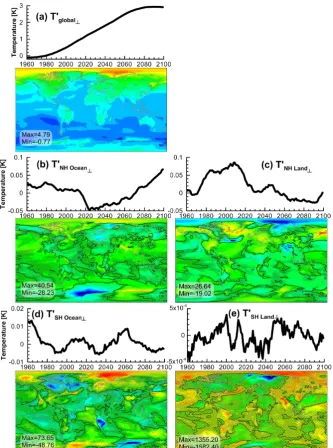
TheTx0 time series in Eq. (3) are not independent from each other and, not surprisingly, are highly correlated. This lack of orthogonality in the basis functions of the regression model often results in the variance being assigned rather arbitrarily by the linear least squares algorithm amongst the five basis functions. As a result, fit coefficients can become very large, and sometimes negative, since the positive signal from one
Fig. 6. Plots of the orthogonalizedTx0⊥time series from the RCP 4.5 simulation ofTmax0 together with their
associated annual mean regression model fit-coefficients.⊥denotes that the basis functions have been
orthog-onalized. Double hatching shows where the coefficients are not statistically significantly different from zero at
the 1σlevel and single hatching where they are not different from zero at the 2σlevel. The thin black line on
each map indicates the 0.0 value. Minimum values are shown in blue and pass through cyan, green, yellow and
orange to maximum values in red (see lower left corner in each panel).
regression model fit-coefficient (
α
in Eq. (3)) is everywhere statistically significantly different from
zero, maximizing in the Arctic and with lowest values over the oceans consistent with what was
shown in Fig. 3. When the shape of a
F
i,j0time series (see Eq. (1)) is simply a linear scaling of
T
global0 ⊥, all higher order fit-coefficients are zero (the zero line in all Fig. 6 panels is indicated with
355
15
Fig. 6. Plots of the orthogonalisedTx0⊥ time series from the RCP 4.5 simulation ofTmax0 together with their associated annual mean
regression model fit coefficients.⊥denotes that the basis functions have been orthogonalised. Double hatching shows where the coefficients are not statistically significantly different from zero at the 1σ level and single hatching where they are not different from zero at the 2σlevel. The thin black line on each map indicates the 0.0 value. Minimum values are shown in blue and pass through cyan, green, yellow and orange to maximum values in red (see lower left corner in each panel).
basis function can offset the negative signal from another to track a small change in the predictand. In addition to preclud-ing a physical interpretation of the fit coefficients, this lack of orthogonality can result in unstable behaviour of the CPSM if theTx0 time series are obtained from an SCM which may have a slightly different distribution of heat content between ocean and land than in the AOGCM on which the CPSM was trained (hereafter referred to asTx0⊥). The non-orthogonality
of the basis functions also precludes a direct comparison of regression model fit coefficients obtained from training on AOGCM simulations from different emissions scenarios.
To circumvent these problems, theTx0 time series are or-thogonalised using a Gram–Schmidt orthogonalisation algo-rithm (Press et al., 1989) before they are used as basis func-tions in the regression model. This ensures that each addi-tional basis function only describes the variance not already
explained by the existing basis functions, and that coeffi-cients obtained from fits to different emissions scenarios are directly comparable.
4.3 Demonstration of the use of multiple basis functions
The five basis function time series, extracted from a HadGEM2-ES RCP 4.5 simulation, were smoothed and or-thogonalised and are shown together with their associated re-gression model fit coefficients in Fig. 6. The fit coefficients were derived globally at every grid point by applying the re-gression model toTmax0 , where theTmax0 time series were also extracted from the HadGEM2-ES RCP 4.5 simulation.
The apparent decadal variability seen in the four time se-ries displayed in Fig. 6 (excludingTglobal0 ⊥, where the sub-script⊥indicates that the basis function has been orthogo-nalised) should not be confused with unforced decadal-scale variability in the climate system but rather seen as subtle decadal-scale departures from the monotonically increasing Tglobal0 time series which may well be forced changes. Fig-ure 6a shows that for the primary predictor (Tglobal0 ⊥), the associated regression model fit coefficient (αin Eq. 3) is ev-erywhere statistically significantly different from zero, max-imizing in the Arctic and with lowest values over the oceans consistent with what was shown in Fig. 3. When the shape of aFi,j0 time series (see Eq. 1) is simply a linear scaling of Tglobal0 ⊥, all higher order fit coefficients are zero (the zero line in all Fig. 6 panels is indicated with a thin black line). Care must be taken when attributing cause and effect in Fig. 6. For example, in this simulation, additional predictive power appears to be gained from the TNH Ocean0 ⊥ time series over the Arctic Ocean but also, interestingly, over the Southern Ocean where a longitudinal dipole in response to the orthog-onalisedTNH Ocean0 ⊥ is apparent. Does this suggest that the Northern Hemisphere ocean is a driver of variability inTmax0 off the Antarctic coast? This is unlikely. Rather the variability inTmax0 off the Antarctic coast, over and above what would be expected from changes inTglobal0 ⊥, is correlated with changes in the orthogonalisedTNH Ocean0 ⊥time series. Had the basis functions been orthogonalised in a different order, it is likely that different conclusions would be drawn.
While additional basis functions may provide additional predictive power (see below), the need to orthogonalise these basis functions obfuscates a physical interpretation of what sources of variability they represent. The exact morphology of the fit coefficients shown in Fig. 6 is also likely to be sim-ulation dependent and dependent on the degree of smoothing applied to theTx0 time series. Analyses with access to an en-semble of simulations made under the same boundary condi-tions might provide more robust results.
4.4 Assessing the value of using multiple basis functions
Two different versions of the CPSM were trained on Tmax0 and Tmin0 time series obtained from the HadGEM2-ES
Fig. 7. Histograms of the ratios of the SSR values for the five basis functions CPSM (SSR5) to the one basis
function CPSM (SSR1) forTmax0 (upper panel) andTmin0 (lower panel). The SSR ratios were determined for
every grid point by dividing SSR5 by SSR1. The grid points and corresponding SSR ratios were assigned to be
located over land or ocean and those values are shown in the histograms. SSR ratios shown here are based on
all three RCP simulations, where the regression model has been trained separately on each RCP scenario.
(which is the more traditional version of the CPSM) is used to explore the remaining methodological
issues addressed in this paper.
5 Scenario dependence
The key assumption of the pattern-scaling approach is that the relationship between the predictors 395
and the predictands is linear, i.e. the regression model fit-coefficients should, ideally, be robust
properties of the climate system and should not depend on GHG emissions scenarios or vary with
time. To test these assumptions, regression model fit-coefficients were derived using all three RCP
simulations available from the HadGEM2-ES model where onlyTglobal0 was used as the predictor
time series. The seasonal cycles of these α fit-coefficients, together with their 1σ uncertainties, 400
17
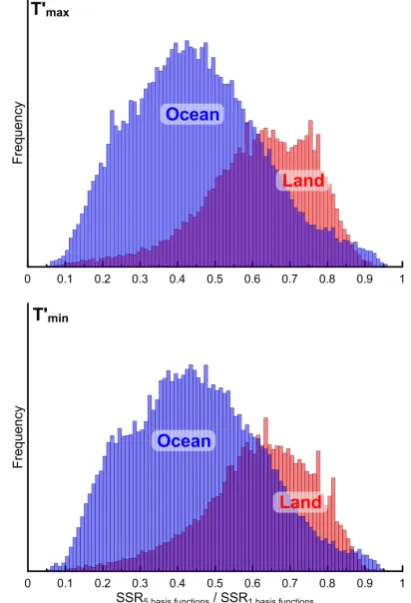
Fig. 7. Histograms of the ratios of the SSR values for the five basis
functions CPSM (SSR5) to the one basis function CPSM (SSR1) forTmax0 (upper panel) andTmin0 (lower panel). The SSR ratios were determined for every grid point by dividing SSR5 by SSR1. The grid points and corresponding SSR ratios were assigned to be located over land or ocean and those values are shown in the his-tograms. SSR ratios shown here are based on all three RCP simu-lations, where the regression model has been trained separately on each RCP scenario.
simulations. In the first version onlyTglobal0 was used as a pre-dictor whereas in the second all fiveTx0⊥were used as pre-dictors. To derive a globally applicable measure of the dif-ferences between the two model constructs, the sum of the squares of the residuals (SSR) (i.e. the differences between the HadGEM2-ES time series and the time series produced from the regression model) were calculated for each model construct. For each AOGCM grid cell, the SSR value, calcu-lated from the CPSM with five basis functions (SSR5) was divided by the SSR value calculated from the model with a single basis function (SSR1). This was done for each of the three RCP scenarios for which simulations were available. The calculated SSR ratios for every grid point were assigned to be located either over land or ocean and the results forTmax0 andTmin0 , for all RCP scenarios, are shown in the histograms in Fig. 7.
By using the hemispheric annual mean temperatures over land and ocean as predictors in addition to the global an-nual mean surface temperature, the SSR over land is typi-cally reduced by 25 % to 35 %, for bothTmax0 andTmin0 . Over the oceans, however, the SSR is typically reduced by about 50 % to 60 % when using additional information about hemi-spheric ocean and land temperatures as predictors. The re-sults suggest that while adding more basis functions to the regression model makes a physical interpretation of the as-signment of variability across the different basis functions difficult to interpret, it does result in a CPSM that is better able to track subtle changes inTmax0 and Tmin0 that are not simple linear scalings ofTglobal0 . Whether that additional skill is physically meaningful or just a statistical artefact requires further investigation. For the remainder of this paper the sin-gle basis function version of the CPSM (which is the more traditional version of the CPSM) is used to explore the re-maining methodological issues addressed in this paper.
5 Scenario dependence
The key assumption of the pattern-scaling approach is that the relationship between the predictors and the predictands is linear, that is, the regression model fit coefficients should, ideally, be robust properties of the climate system and should not depend on GHG emissions scenarios or vary with time. To test these assumptions, regression model fit coefficients were derived using all three RCP simulations available from the HadGEM2-ES model where onlyTglobal0 was used as the predictor time series. The seasonal cycles of theseαfit coef-ficients, together with their 1σuncertainties, for four selected sites forTmax0 and for four selected sites forTmin0 (one site in common), are shown in Fig. 8.
The two Arctic sites showαpeaking in October or Novem-ber during the onset of sea-ice formation suggesting that long-term changes in sea ice in this season may be driving the large sensitivity ofTmax0 andTmin0 toTglobal0 . Interior sites in Greenland and Siberia showαpeaking around the begin-ning and end of winter suggesting that long-term changes in snow cover and hence surface albedo at these times may be driving the high values inα. At the beginning and end of the winter, the magnitudes ofαat both sites over the Arctic Ocean are greater than the magnitudes over the two interior sites. This amplified seasonal change in α over the Arctic Ocean indicates that the long-term changes in sea-ice extent and concentration have a stronger impact on the sensitivity ofT0
maxandT
0
mintoT
0
globalthan surface albedo changes over
land at high latitudes. The Southern Hemisphere mid-latitude site selected (Alexandra) showsαpeaking in summer (De-cember to February; see also Fig. 4) for bothTmax0 andTmin0 with the seasonal cycle inαbeing slightly more pronounced for Tmax0 . At the high southern latitude site over Antarctic sea ice (Weddell Sea),αpeaks in July/August which might be related to changes in sea-ice extent. Over the Antarctic
Fig. 8.αfit-coefficients forTmax0 (left column) andT 0
min(right column) at seven selected sites (the Alexandra,
New Zealand, site is examined for bothT0
maxandTmin0 ) derived by fitting the regression model to output from three simulations of the HadGEM2-ES model based on the RCP emissions scenarios denoted in the legend. The
solid lines show the regression model coefficients while the shaded regions bordered by dashed lines show the
1σuncertainties on the fit-coefficients. The horizontal dashed black line marks the zero line. Note the different scales on the y-axes.
19
Fig. 8. αfit coefficients forTmax0 (left column) and Tmin0 (right
column) at seven selected sites (the Alexandra, New Zealand, site is examined for bothTmax0 andTmin0 ) derived by fitting the regression
model to output from three simulations of the HadGEM2-ES model based on the RCP emissions scenarios denoted in the legend. The solid lines show the regression model coefficients while the shaded regions bordered by dashed lines show the 1σ uncertainties on the fit coefficients. The horizontal dashed black line marks the zero line. Note the different scales on theyaxes.
continental site, both the seasonal amplitude and absolute magnitude ofαare smaller than over the Weddell Sea. This suggests that long-term changes in sea-ice albedo also drive the changes inTmax0 andTmin0 in the Antarctic, though to a lesser extent than in the Arctic.
To estimate the extent to which theαfit coefficients differ amongst the three different emissions scenarios, the trend in αacross the three RCP scenarios was determined for every grid point and month, respectively. Global maps of the trend inα(in units of radiative forcing (W m−2) associated with each of the RCPs) for the predictandTmax0 for four selected months are shown in Fig. 9. Ifαdoes not change across dif-ferent RCP simulations, all values in Fig. 9 would be zero.
Fig. 9.
The trend in
α
for
T
max0across the three RCP scenarios from which the
α
values were derived (see
colour scale on right). Regions of dense stippling show where the trend is not statistically significantly different
from zero at the 1
σ
level and less dense stippling shows where the trend is significant at the 1
σ
level but not
at the 2
σ
level. Unstippled regions show where the trend is significant at the 2
σ
level. White dots show the
location of the sites presented in Fig. 8.
seasonality of the amplifying/damping processes in the response patterns, is beyond the scope of
this paper.
6
The use of multiple simulations for training
440
Where the regression model fit-coefficients do not show a strong dependence on the emissions
sce-nario (see Sect. 5 above) it is conceivable to derive the regression model fit-coefficients from all
available scenarios at once, rather than from a single scenario. As described above and in
Ap-pendix A, three different simulations were available to derive the regression model fit-coefficients.
Two different approaches for making use of multiple simulations to derive the regression model
445
fit-coefficients are described and assessed in Sects. 6.1 and 6.2. Previous studies have found that
uncertainties in fields derived using pattern-scaling are much greater when scaling from low to high
emissions scenarios than when scaling from high to low scenarios (Huntingford et al., 2000; Mitchell
et al., 2003). It is therefore important to include AOGCM simulations from high emissions scenarios
when training the regression model.
450
20
Fig. 9. The trend inαforTmax0 across the three RCP scenarios from which theαvalues were derived (see colour scale on right). Regions of dense stippling show where the trend is not statistically significantly different from zero at the 1σlevel and less dense stippling shows where the trend is significant at the 1σlevel but not at the 2σ level. Unstippled regions show where the trend is significant at the 2σ level. White dots show the location of the sites presented in Fig. 8.
In most regions of the world, particularly over the North-ern Hemisphere land and the Arctic in January and Octo-ber, the trend inαis statistically significantly different from zero at the 2σ level (unstippled regions in Fig. 9). These re-sults indicate that the coefficients are dependent on the emis-sions scenario, and non-linearities between the predictor and predictand exists. Those non-linearities are most pronounced at high northern latitudes in January and October. In Octo-ber, in the Arctic, theα coefficients decrease with increas-ing GHG concentrations (reflected in the negative trend in αin Fig. 9). This suggests that there are processes at work which damp the response ofTmax0 to changes inTglobal0 with increasing radiative forcing. In January, on the other hand, αincreases with increasing GHG concentrations, amplifying the response ofTmax0 to changes inTglobal0 . The strength of this amplification in mid-winter is somewhat weaker than the damping in autumn. Over the oceans and most regions of the Antarctic, the small trend inαis not statistically significantly different from zero at the 2σ level, indicating that the coeffi-cients are independent of the emissions scenario from which they were derived. Whatever processes are causing the non-linear behaviour between the predictor and predictand, they do not influence the behaviour ofTmax0 over the ocean and most parts of the Antarctic. An investigation of the causes
of these non-linearities, and the seasonality of the amplify-ing/damping processes in the response patterns, is beyond the scope of this paper.
6 The use of multiple simulations for training
Where the regression model fit coefficients do not show a strong dependence on the emissions scenario (see Sect. 5 above), it is conceivable to derive the regression model fit coefficients from all available scenarios at once, rather than from a single scenario. As described above and in Ap-pendix A, three different simulations were available to de-rive the regression model fit coefficients. Two different ap-proaches for making use of multiple simulations to derive the regression model fit coefficients are described and assessed in Sects. 6.1 and 6.2. Previous studies have found that un-certainties in fields derived using pattern scaling are much greater when scaling from low to high emissions scenarios than when scaling from high to low scenarios (Huntingford et al., 2000; Mitchell, 2003). It is therefore important to in-clude AOGCM simulations from high emissions scenarios when training the regression model.
6.1 The super-ensemble approach
In the super-ensemble approach, the available time series of Tmax0 ,Tmin0 andTglobal0 required to train the regression model are each sequentially concatenated and a single set of re-gression model fit coefficients is derived (Ruosteenoja et al., 2007). The implicit assumption in this approach is that the regression model fit coefficients do not depend significantly on the scenario on which they are derived (i.e. that the de-pendence ofTmax0 andTmin0 onTglobal0 is largely linear). This assumption was tested in Sect. 5. The advantage of such an approach is that many more data are available for deriving the fit coefficients and therefore, more statistically robust re-sults are obtained. If the simulations used for the fitting are based on a number of different emissions scenarios, the re-sultant regression model fit coefficients will be less sensitive to any specific scenario. Furthermore, fitting to a number of simulations reduces the likelihood of generating geospatial structure in the fit coefficients (see Sect. 2.6) that may re-sult from multi-decadal variability in any specific simulation as discussed further in Sect. 6.3. If, however, the regression fit coefficients are simulation/scenario dependent, the uncer-tainty on the fit coefficients will increase when they are ob-tained from a super-ensemble fit.
As detailed above, to use the CPSM in application mode, the fit coefficients derived by fitting to multiple simulations can then be applied toTglobal0 time series obtained from, for example, SCM output to produce the final anomaly fields for any prescribed emissions scenario (provided as input to the SCM) and time.
6.2 The weighted contributions approach
In the weighted contributions approach, multiple sets of re-gression model fit coefficients are obtained by fitting Eq. (1) individually to the available simulations that are based on different emissions. When the CPSM is used in application mode, and the fit coefficients are applied toTglobal0 , the mul-tiple sets of regression model coefficients result in mulmul-tiple realisations of theTmax0 andTmin0 fields. A weighted sum of these fields then produces a single time series ofTmax0 and Tmin0 fields. The weights are calculated using
Wi=
AWi
PY
y=1(Tglobal SCM0 (y)−T
0
global AOGCMi(y))
2, (4)
where AWi are prescribed a priori weights that, if desired,
can be used to give a regression coefficient set greater em-phasis in the derivation of the surface climate variable fields, Tglobal SCM0 are the global mean temperature anomalies from the prescribed SCM simulation,Tglobal AOGCM0 are the global mean temperature anomalies from the AOGCM simulation used to derive that particular set of regression model co-efficients, and Y is the total number of years for which bothTglobal SCM0 andTglobal AOGCM0 are available. The weights
are normalised to sum to 1.0. In this approach, fields gen-erated using regression model fit coefficients derived from an AOGCM simulation whereTglobal0 is very similar to the Tglobal0 from the SCM, will be given greater weight than fields generated using regression fit coefficients derived from an AOGCM simulation which was more different. The final anomaly fieldV0is then calculated using
V0(y, m)=
N
X
k=1
Wk×F0(y, m)k, (5)
whereNis the number of simulations available for deriving the regression model fit coefficients andF0are the anomaly fields derived from the application of the regression model using theNsets of fit coefficients.
6.3 Relative merits of super-ensemble and weighted
contribution approaches
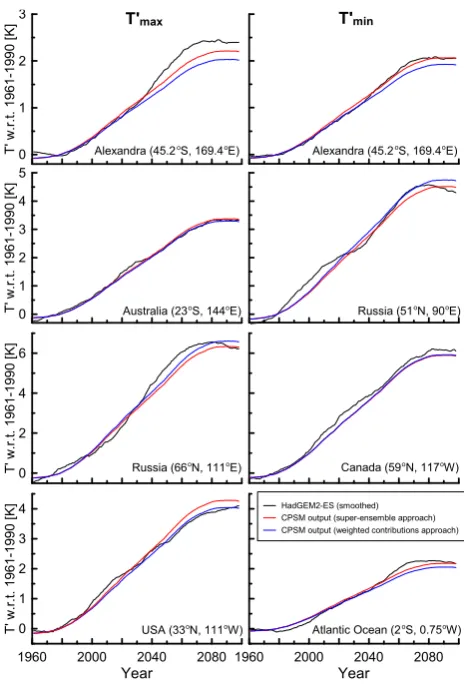
To explore the relative performance of the super-ensemble and weighted contribution approaches, these two methods were applied for training the CPSM.Tmax0 andTmin0 time se-ries from HadGEM2-ES simulations based on RCP 2.6 and RCP 8.5 emissions were used to derive the fit coefficients for (i) training the regression model using the super-ensemble approach (Sect. 6.1) and (ii) training the regression model on RCP 2.6 and RCP 8.5 separately resulting in two sets of coefficients (Sect. 6.2). These three sets of fit coefficients (one from the super-ensemble approach and two from the weighted contributions approach) were then used to model Tmax0 andTmin0 , where Tglobal0 from the HadGEM2-ES RCP 4.5 simulation was used as the predictor time series. As men-tioned in Sect. 3, in this study the focus is on exploring the methodological aspects of the pattern-scaling approach and therefore output from the same AOGCM (but different emis-sions scenario) is used in application mode instead of using time series from a SCM. By comparing time series generated by the CPSM with time series from the HadGEM2-ES RCP 4.5 simulation, a validation of the CPSM can be achieved. The Savitzky–Golay smoothedTmax0 andTmin0 annual mean time series from the raw HadGEM2-ES RCP 4.5 simulation are compared to the annual mean time series derived from the CPSM output for four selected locations and are shown in Fig. 10.
The results from the weighted contributions approach (blue line in Fig. 10) agree reasonably well with the re-sults derived from the super-ensemble approach (red line in Fig. 10) for both T0
max and T
0
min. Both the output from
the weighted contributions approach and from the super-ensemble approach reproduces the HadGEM2-ES time se-ries well for most of the selected sites. The largest differ-ences in the simulation ofTmax0 between the two methods, but also between the HadGEM2-ES time series and the CPSM output, occur over Alexandra, New Zealand. The increase inTmax0 at Alexandra ceaseth around 2070 but occurs later
1960 2000 2040 2080 Year 0 1 2 3 4 T ' w .r .t . 1 9 6 1 -1 9 9 0 [ K ] 0 2 4 6 T ' w .r .t . 1 9 6 1 -1 9 9 0 [ K ] 0 1 2 3 T ' w .r .t . 1 9 6 1 -1 9 9 0 [ K ] 0 1 2 3 4 5 T ' w .r .t . 1 9 6 1 -1 9 9 0 [ K ]
Australia (23oS, 144oE) Alexandra (45.2oS, 169.4oE)
Russia (66oN, 111oE)
USA (33oN, 111oW)
HadGEM2-ES (smoothed) CPSM output (super-ensemble approach) CPSM output (weighted contributions approach)
1960 2000 2040 2080
Year
Canada (59oN, 117oW) Russia (51o
N, 90o E)
Atlantic Ocean (2oS, 0.75oW) Alexandra (45.2oS, 169.4oE)
T'max T'min
Fig. 10.Annual meanT0
max(left column) andTmin0 (right column) time series from the HadGEM2-ES RCP
4.5 simulation (smoothed) compared to annual mean CPSM output based on the same emissions scenario using the regression model fit-coefficients from the super-ensemble (Sect. 6.1) and the weighted contributions (Sect. 6.2) approaches based on RCP 2.6 and RCP 8.5 training. Note the different scales on the y-axes.
obtained using the regression model fit-coefficients derived from the RCP 8.5 simulation. In contrast,
in the super-ensemble approach, the correlation betweenT0
maxandTglobal0 is driven primarily by the strongest signal which, in this study, comes from theT0
maxtime series obtained from the RCP 8.5
23
Fig. 10. Annual mean Tmax0 (left column) and Tmin0 (right col-umn) time series from the HadGEM2-ES RCP 4.5 simulation (smoothed) compared to annual mean CPSM output based on the same emissions scenario using the regression model fit coefficients from the super-ensemble (Sect. 6.1) and the weighted contributions (Sect. 6.2) approaches based on RCP 2.6 and RCP 8.5 training. Note the different scales on theyaxes.
in both the super-ensemble and weighted contribution ap-proach. Furthermore,Tmax0 warms faster than it would be ex-pected fromTglobal0 . Theα value for RCP 4.5 is effectively greater than for RCP 2.6 and RCP 8.5 (see Fig. 8) and, there-fore, when the training is performed on RCP 2.6 and RCP 8.5, the amplitude of theTmax0 signal is underestimated.
Since theTglobal0 time series from the RCP 4.5 simulation is more similar in magnitude to the RCP 2.6 simulation than the RCP 8.5 simulation, in the weighted contributions approach the fields derived from the RCP 2.6 derived fit coefficients (F0in Eq. 5) is weighted more than the fields obtained using the regression model fit coefficients derived from the RCP 8.5 simulation. In contrast, in the super-ensemble approach, the correlation between Tmax0 andTglobal0 is driven primar-ily by the strongest signal which, in this study, comes from theTmax0 time series obtained from the RCP 8.5 simulation. Therefore, if the evolution of the climate variable of interest
for RCP 2.6 emissions scenario is similar to the one from the RCP 4.5 emissions scenario, using the coefficients from the weighting contribution approach in the CPSM applica-tion will reproduce the evoluapplica-tion of the climate variable un-der RCP 4.5 better than the application of the super-ensemble coefficients (e.g. the USA site in Fig. 10). If, however, the evolution of the climate variable of interest for RCP 8.5 is similar to that from RCP 4.5, using the fit coefficients from the super-ensemble approach will reproduce the evolution of the climate variable slightly better (e.g.Tmin0 for Alexandra in Fig. 10).
To derive a more robust and global measure of how well the CPSM (based on (a) the weighted contribution, and (b) the super-ensemble approaches) can reproduce the RCP 4.5Tmin0 time series modelled by HadGEM2-ES when trained on the RCP 2.6 and RCP 8.5 simulations, time series ofTmin0 obtained from the CPSM were regressed against smoothed time series of the same variable from the AOGCM. The slopes of linear fits to the scatter plots of CPSM data against AOGCM data from the two approaches are shown in Fig. 11 together with the probability distribution function of the slopes (histogram in the rightmost panel of Fig. 11). If the Tmin0 time series from the CPSM and from the AOGCM out-put at each grid point showed the same secular variation, all values plotted in Fig. 11 would be 1.0.
The calculated slopes using results from both methods bracket the range 0.8 to 1.2 almost everywhere, with regions in the high northern and southern latitudes exhibiting slopes that are statistically significantly different from 1.0 at the 2σ level (hatched area in Fig. 11). The probability distribu-tion funcdistribu-tions of the slopes indicate that the super-ensemble approach seems to be marginally better in reproducing the AOGCM results than the individual weighting approach; the most likely value derived from a Gaussian fit to the his-tograms is 1.006±0.0991 for the super-ensemble approach compared 0.983±0.107 for the weighted contributions ap-proach.
The results presented here do not robustly discriminate between the super-ensemble and individual weighting ap-proaches. Which of the two approaches gives better agree-ment with the AOGCM signal depends on the location, for example, in the north-east of Scandinavia the individ-ual weighting approach reproduces the AOGCM time se-ries more accurately while over India the super-ensemble ap-proach might be a better choice.
7 Time dependence of the fit coefficients
The regression model fit coefficients should, ideally, not vary with time. However, non-linearities may result in fit coeffi-cients being different at the end of the period (e.g. through the 2080s) compared to the beginning of the period (e.g. the 2000s). To investigate whether the fit coefficients show any time dependence, they were expanded to include a linear