R E S E A R C H A R T I C L E
Open Access
Chinese version of narcolepsy severity
scale: a validation study
Hui Ouyang
1, Fang Han
2, Qiwen Zheng
3and Jun Zhang
1*Abstract
Background:The narcolepsy severity scale (NSS) was developed to measure the severity and consequences of symptoms in patients with narcolepsy. The scale has been validated in France, though no other studies have further validated this instrument. The current study aimed to present psychometric properties and describe the score distribution of the Chinese-NSS.
Methods:One hundred twenty-two patients with narcolepsy (41 females and 81 males; mean age 26.14 ± 15.40 years) participated in the study. All patients completed the Chinese-NSS. Cronbach’sα, item-total score correlations, exploratory factor analysis (EFA), and correlations between NSS total scores and clinical or sleep parameters were then calculated.
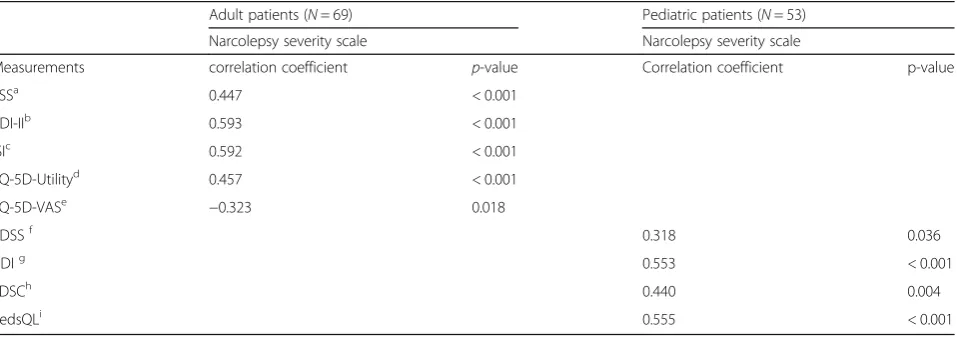
Results:EFA yielded a three-factor model. Internal consistency was acceptable (Cronbach’sα= 0.799). The NSS total score had significant correlations with the Epworth sleepiness score (0.447), pediatric daytime sleepiness scale (0.318), the insomnia severity index (0.592), Beck depression inventory (0.593), EurQol five dimensions-utility (0.457), EurQol five dimensions -VAS (−0.323), the sleep disturbance scale for children (0.440), the children depression inventory (0.553), and the pediatric quality of life inventory (0.555) total scores, demonstrating acceptable convergence as predicted.
Conclusions:The current study is the first validation study of the narcolepsy severity scale in an Asian population. The findings validated the Chinese-narcolepsy severity scale in a Chinese population with acceptable psychometric properties. There are minor differences between our results and those of the original study due to cultural
differences.
Keywords:Symptom evaluation, Reliability, Validity, Psychometric, Questionnaire
Background
Narcolepsy is a life-long neurological disorder with onset primarily during childhood and adolescence [1, 2]. Worldwide, the prevalence of narcolepsy ranges from 0.002 to 0.167%. The main symptoms of narco-lepsy are excessive daytime sleepiness (EDS), cata-plexy, sleep paralysis, hallucinations, and disrupted
nighttime sleep [3–5]. Patients with narcolepsy also
suffer from other symptoms including mood disorders and behavioral and attention disorders [6] .
Most subjective tests that are currently used to evalu-ate the severity of symptoms [7–9], such as the Epworth sleepiness score (ESS) and the pediatric daytime
sleepiness scale (PDSS) mainly focus on EDS. Other symp-toms of narcolepsy are often not properly monitored. To overcome this limitation, Dauvilliers [9] et al. developed the Narcolepsy Severity Scale (NSS) in 2017 to measure the severity of the five main symptoms of narcolepsy. This scale, which consists of 15 items, primarily assesses the frequency and severity of excessive daytime sleepiness, cataplexy, hypnagogic hallucinations, sleep paralysis, and disrupted nighttime sleep. The NSS shows good psycho-metric properties (internal consistency, convergent valid-ity, and structural validity) and has been shown to be able
to detect changes in French narcolepsy patients’
symp-toms following treatment [9]. As such, the NSS has the potential to be a valid and reliable screening instrument for assessing the symptoms of narcolepsy patients.
© The Author(s). 2019Open AccessThis article is distributed under the terms of the Creative Commons Attribution 4.0 International License (http://creativecommons.org/licenses/by/4.0/), which permits unrestricted use, distribution, and reproduction in any medium, provided you give appropriate credit to the original author(s) and the source, provide a link to the Creative Commons license, and indicate if changes were made. The Creative Commons Public Domain Dedication waiver (http://creativecommons.org/publicdomain/zero/1.0/) applies to the data made available in this article, unless otherwise stated.
* Correspondence:[email protected]
1Department of Neuromedicine, Peking University People’s Hospital, 11
Xizhimen South Street, Beijing, China
However, no other studies have further validated this instrument in clinical and research settings. It has also not been translated into Chinese and is somewhat diffi-cult to use with Chinese young patients because in China, people who are younger than 18 are not allowed
to drive. Thus, the item “To what extent these sudden
daytime sleep episodes affect your ability of driving?” is not suitable for China’s social environment. A process of cross-cultural adaptation and validation was necessary to further validate this instrument and ensure that it is suit-able for use in China. Thus, the current study aimed to: 1) translate and culturally adapt the NSS to the Chinese language; 2) test the preliminary validity and reliability of a version of the“Narcolepsy severity scale”(NSS) that has been translated into Chinese and adapted to evaluate the severity and consequences of symptoms in Chinese narcolepsy patients; 3) identify cut-off values to distin-guish between treated and non-treated patients. This scale, which is focused on the severity of narcolepsy symptoms, is expected to contribute to the assessment of narcolepsy symptoms and changes in symptoms after treatment in Chinese narcolepsy patients.
Methods
Ethical considerations
This study was approved by the local ethics committee and conducted in accordance with the guidelines of the Institutional Review Board of Peking University People’s Hospital, China. Written informed consent was obtained from all participants.
Participants
For this study, 122 consecutive patients with narcolepsy (41 females and 81 males; mean age 26.14 ± 15.40 years) were randomly selected from the sleep laboratory of the Peking University People’s Hospital, a unit that evaluates patients with sleep disorders and receives referrals from all over China. Thus, the selected sample can be consid-ered to adequately represent the Chinese narcolepsy population. The inclusion criteria were patients who were diagnosed with narcolepsy following the ICSD-3 criteria [10] and who were willing to participate in inter-views. Patients were excluded from the study if they could not fill out the questionnaire (for example, pa-tients who were younger than 8 or have serious
psychi-atric disorders). A total of 5–10 subjects were
recommended for each item to achieve the validity and reliability studies [11].
The study process
This study was conducted in three phases. In phase 1, the NSS was translated from English to Chinese. Phase 2 involved pre-testing the pre-final version of the trans-lated questionnaire. A validation study was carried out
in phase 3. This study spanned from June 2018 to May 2019.
Phase 1 (Translation and adaptation process).
The original English questionnaire [9] was translated following the translation, back translation, and cross-cultural adaptation processes recommended by Beaton et al. [12] and Guillemin et al. [13] to ensure that the contents and meanings were preserved. The forward translation was carried out by two translators, including a certified translator (linguist) and a clinician (for the medical terms), both of whom are bilingual, bicultural, native Chinese speakers. The translators worked inde-pendently to produce a Chinese version of the question-naire that was later back-translated to English. The translators worked independently from each other. An expert panel composed of the translators and the re-searchers met to compare the versions that had been translated into Chinese. The best translations were merged, after which a cultural adaptation of several of the terms that had given rise to discussion was carried out until a consensus was reached. At the end of this meeting, a final harmonized Chinese version of the NSS was obtained. Item 7 of the questionnaire was adapted
to “To what extent these sudden daytime sleep episodes
affect your ability of driving a car (for students:
class-room performance)?” to better fit the Chinese social
environment.
Phase 2 (Pre-test procedure).
Ten narcolepsy patients took the pre-test for the Chin-ese version of the NSS in order to discuss the pertinence of the items and to identify comprehension problems for narcolepsy patients. These patients were selected ran-domly from the target population. Face validity was con-firmed and wording and contents were checked in the pilot survey. Each patient was asked whether the words and terms used in the Chinese version were clear, rele-vant, and comprehensible. In this way, patients identified their difficulties and discussed them afterwards. Both adult patients and pediatric patients agreed that the NSS was straightforward and easy to understand. After the face validity measure, the evaluation committee com-posed of three translators and five neurologists met again and formulated the final Chinese version of the questionnaire (Chinese-NSS), considering several points that had led to questions from patients. This version had the same number of items and domains as the original version, with several minor adjustments. Finally, the ex-perts evaluated the content validity (items and domains) of the Chinese version.
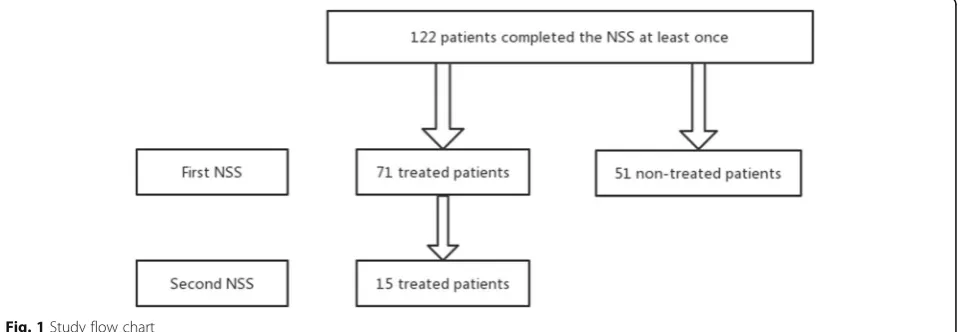
Phase 3 (Fig.1).
The NSS was later tested for its reliability and validity among 122 subjects in the same institute who were se-lected from the patients referred to the sleep laboratory
of the Peking University People’s Hospital. To be
in-cluded in the study, all patients were required to be able to write, read, and speak Chinese fluently. Pediatric
par-ticipants’ parents helped them complete the
question-naire to ensure that it was filled in properly. This study was conducted in a single center and the study partici-pants were patients diagnosed with narcolepsy. Accord-ing to the recommendations of Everitt [14], we opted for a sample size ranging from 100 to 200. Patients were asked to fill in the patient information sheet as well as
the NSS, which took them about 20–30 min to complete.
Total scale scores for the NSS, as well as the Epworth sleepiness score ESS [7], the insomnia severity index (ISI) [15], the Beck depression inventory (BDI) [16], the EurQol five dimensions (EQ-5D) [17], the PDSS [18], the sleep disturbance scale for children (SDSC) [19], the children depression inventory (CDI) [20], and the pediatric quality of life inventory (PedsQL) [21] were cal-culated according to standard scoring procedures.
Statistical methods
Statistical analyses were carried out using SPSS version 22.0. Test-retest reliability was conducted and internal consistency was assessed using the Cronbach’s alpha co-efficient. Demographic characteristics and clinical data were described using means and standard deviations for continuous variables and percentages or frequencies for categorical variables. The independent Student’s t-test was used to compare continuous variables between
inde-pendent groups, and the Chi-square or Fisher’s exact
tests were used for categorical variables. Associations be-tween continuous variables were assessed using the Spearman correlation coefficient. To analyze NSS factor structure, a principal components factor analysis was
conducted using a varimax rotation. Sampling adequacy was measured by calculating the Kaiser-Meyer-Olkin (KMO) index. Statistical significance was set atp< 0.05.
Results
Demographic and descriptive statistics
In total, 122 consecutive patients with narcolepsy were included in this study (53 pediatric patients and 69 adult patients), all of whom were Chinese. The mean age of the narcolepsy patients was 26.14 ± 15.40 years; 33.6%
were female (n= 41) and 66.4% were male (n= 81).
Among them, 78 were consecutive untreated and 44 were consecutive treated. Among the treated patients, 13 completed the NSS scale a second time after a median interval of 60 days (range: 14–128 days). According to the tests of normality (K-S test), the distribution of the total scores for the narcolepsy population was in line with normal distribution (p= 0.079). There were no dif-ferences in NSS scores between the total scores of the pediatric group and the adult group (26.12 + 8.04 and 28.41 + 12.25,p> 0.05).
Internal consistency
The Cronbach’sαvalue was 0.799 for the whole sample
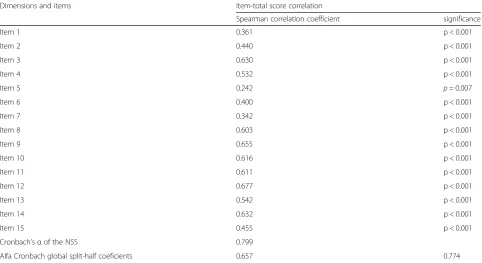
and ranged from 0.697–0.817 for the subscales (factors) measuring excessive daytime sleepiness (EDS), cataplexy, sleep paralysis, and hallucination. Correlations between individual items and the total score of the NSS were sig-nificant and positive in the whole sample. The correla-tions of individual items with the total score ranged from 0.242–0.677.
These results indicated an acceptable level of internal consistency (Table1and Table2).
Reproducibility
Fourteen of the treated patients completed the NSS scale a second time after a median interval of 60 days (range:
14–128 days) (unchanged drugs and dosages). The
Table 1Item-total score correlations and Cronbach’s Alpha of NSSa
Dimensions and items Item-total score correlation
Spearman correlation coefficient significance
Item 1 0.361 p < 0.001
Item 2 0.440 p < 0.001
Item 3 0.630 p < 0.001
Item 4 0.532 p < 0.001
Item 5 0.242 p= 0.007
Item 6 0.400 p < 0.001
Item 7 0.342 p < 0.001
Item 8 0.603 p < 0.001
Item 9 0.655 p < 0.001
Item 10 0.616 p < 0.001
Item 11 0.611 p < 0.001
Item 12 0.677 p < 0.001
Item 13 0.542 p < 0.001
Item 14 0.632 p < 0.001
Item 15 0.455 p < 0.001
Cronbach’sαof the NSS 0.799
Alfa Cronbach global split-half coeficients 0.657 0.774
a
NSSnarcolepsy severity scale
Table 2Narcolepsy severity scale items-Factor analysis
Items Communlities Factors
I II III
1 0.334 0.457
2 0.520 0.711
3 0.776 0.845
4 0.515 0.573
5 0.478 0.412
6 0.368 0.600
7 0.257 0.462
Cronbach’α 0.697
8 0.727 0.837
9 0.691 0.794
10 0.563 0.629
15 0.296 0.379
Cronbach’α 0.740
11 0.630 0.775
12 0.759 0.859
13 0.596 0.767
14 0.692 0.814
Cronbach’α 0.817
KMOa measure of sampling adequacy 0.728
Percentage of cumulative variance explained 0.55
investigators and test environments were exactly the same as in the patients’first completion of the question-naire. All of the patients that participated in the test-retest described their symptoms as stable and unchanged between the first and second measurements. In terms of the test-retest reliability of the Chinese-NSS, the reliabil-ity coefficient (intra-class correlation coefficients (ICC)) was 0.923 (95% CI: 0.779–0.975,p< 0.001).
Content validity
Face validity was confirmed and wording and contents were checked in the pilot study. The subjects agreed that the NSS was straightforward and easy to understand. After the face validity measure, the evaluation committee composed of the translators and neurologists met again and formulated the Chinese-NSS. Finally, the experts confirmed that the content validity of the Chinese ver-sion was good.
Structural validity
In the whole sample, the Kaiser-Meyer-Olkin (KMO) index was 0.728, confirming the sampling appropriate-ness, with sufficient association between variables to per-form factor analysis. Based on the scree plot and Kaiser’s eigenvalues-greater-than-one rule, the current study confirmed the validity of a three-factor model, with ei-genvalues higher than 1 that explained 54.6% of the total variance. FactorIwas composed of 4 items on sleep par-alysis and hallucinations (questions 11, 12, 13, and 14), factorII included 7 items on EDS (questions 1, 2, 3, 4, 5, 6, and 7), and factor III included 4 items on cataplexy
and nighttime sleep (question 8, 9, 10, and 15). Commu-nalities, which can be interpreted as the proportion of each variable’s variance that can be explained by factor analysis, were generally higher than 0.47 (0.478–0.776), except for items 1, 6, and 15. The item loading values ranged from 0.381–0.696.
Convergent validity
The convergent validity was calculated by comparing the correlations between NSS total scores and clinical or
sleep parameters using Spearman’s correlation
coeffi-cient. All of these instruments have been reported to have sufficient measurement properties in our target population. The NSS total score significantly and posi-tively correlated with ESS (p< 0.001), ISI (p< 0.001), BDI (p< 0.001), and EQ-5D (p= 0.001) in adult patients and
correlated with PDSS (p= 0.038), SDSC (p= 0.004), CDI
(p< 0.001), and PedsQL (p< 0.001) in pediatric patients. Descriptive statistics as well as the correlations between the NSS and other clinical or sleep parameters are
shown in Table3.
Discriminative validity
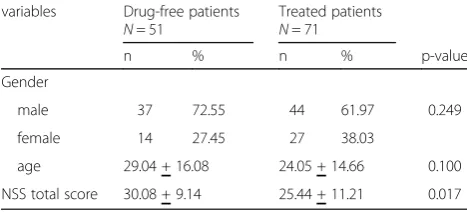
The results of the study with 51 drug-free patients and 71 treated patients showed that the NSS total score was significantly higher in the untreated than treated group (30.08 + 9.14 versus 25.44 + 11.21,p= 0.017). The range of the scores of the drug-free group was 9 to 55, while the range of the scores of the treated group was 4 to 51. The descriptive statistics are shown in Table4.
Table 3Association between narcolepsy severity scale total score and rating scale scores
Adult patients (N= 69) Pediatric patients (N= 53)
Narcolepsy severity scale Narcolepsy severity scale
Measurements correlation coefficient p-value Correlation coefficient p-value
ESSa 0.447 < 0.001
BDI-IIb 0.593 < 0.001
ISIc 0.592 < 0.001
EQ-5D-Utilityd 0.457 < 0.001
EQ-5D-VASe −0.323 0.018
PDSSf 0.318 0.036
CDIg 0.553 < 0.001
SDSCh 0.440 0.004
PedsQLi 0.555 < 0.001
a
ESSEpworth sleepiness score
b
BDI-IIBeck depression inventory-II
c
ISIthe insomnia severity index
d
EQ-5D-UtilityEurQol five dimensions-Utility
e
EQ-5D-VASEurQol five dimensions-visual analog scale
f
PDSSpediatric daytime sleepiness scale
g
CDIchildren depression inventory
h
SDSCsleep disturbance scale for children
i
Floor or ceiling effects
The distribution of the total scores for the narcolepsy population was near the center of the possible range of scores, without a ceiling effect. They ranged from 0 to 50. None of the patients reached the highest score (57), and only 0.8% of the patients reached the lowest score (0).
Discussion
To the best of our knowledge, this is the first study to examine the psychometric properties of a version of the NSS adapted for use in China. In our study, the questionnaire was slightly modified to ensure its suitability for the Chinese cultural context. We
con-ducted pre-test interviews to record patients’ facial
expressions and any misunderstandings of the scale. Through this procedure, the content of the question-naire was judged to be applicable to Chinese native speakers. In addition, the acceptability and compre-hension of the questionnaire have been confirmed.
This research examined the validity and reliability of the Chinese-NSS in the measurement of the main symptoms of narcolepsy and their changes after treat-ment. The measurement properties indicate that the Chinese version of the NSS is an effective and reliable tool for assessing the severity of narcolepsy symptoms and detecting changes in clinical symptoms after treatment. Children and adolescent patients also par-ticipated in this study, and there were no differences in the NSS scores of the pediatric and adult group. Hence, the results show that the questionnaire can be applied to juvenile patients, to a certain degree.
The reliability of the scale was assessed by internal
consistency using Cronbach’s alpha, item-total
corre-lations, and test-retest. The high Cronbach’s alpha co-efficient for the scale, the results of the test-retest, and the acceptable corrected item-total coefficients for all items confirmed that the Chinese version of the NSS has good internal consistency, with the correspondent items properly correlated. The item-total score correlation coefficients were acceptable,
being generally higher than 0.30 except for item 5. The results for internal consistency were similar to
those obtained in Dauvillier’s studies. The original
version of the questionnaire reported a lower item-total score correlation for item 5, but the researchers chose to keep this item because of its clinical signifi-cance [9]. The high correlation coefficient shows that the items of the scale have a strong correlation with the scale construct. Internal consistency of each
sub-dimension, which was represented by the Cronbach’s
alpha coefficients, ranged from 0.697–0.817. High
Cronbach’s alpha coefficients indicate that the
Chinese-NSS is structurally consistent and balanced [22]. The Cronbach’s alpha value of the original scale
was 0.799. Based on these results, the Cronbach’s
alpha values obtained by our study and by Dauvilliers et al. were consistent [23]. The results of the test-retest showed that the stability of responses to items was good. The results of reproducibility were similar to the original French version of the NSS.
Exploratory factor analysis was conducted to iden-tify potential sub-scales of the NSS. Through explora-tory factor analysis of the Chinese-NSS, 15 items of the scale were divided into three factors. The results of the exploratory factor analysis proved that the Chinese-NSS has acceptable structural validity. The three identified factors clarified 54.6% of the total variance, which is similar to the results of the ex-ploratory factor analysis of the original scale [9]. When the principal component analysis and varimax orthogonal rotation method were used to evaluate the factor loads of each item, the item load higher than 0.35. However, the results of our study differ slightly from those of the original version in terms of item
classification. The item “Currently, how disturbed is
your nighttime sleep?” was part of factor 3 in our
research but was included in factor 2 in the original study. Based on the grouping of items based on clin-ical expert criteria, disturbed nighttime sleep was not associated with any of the three factors, so this item is relatively independent from other items. On the other hand, the severity of disturbed nighttime sleep can both be associated with that of EDS and cataplexy, since they are all related to sleep instabil-ity. Therefore, the results of the factor analysis of our study and the original study, in which item 15 only partially overlapped with the assigned dimen-sions composing the scale, were reasonable and acceptable.
In line with the validation of the original version, there is a certain degree of differentiation of the scale because the total NSS score was significantly higher in the un-treated than un-treated group. However, the ability to dis-criminate between the two groups was limited. This may
Table 4The demographic and NSSatotal score of drug-free
and treated narcolepsy patients variables Drug-free patients
N= 51
Treated patients N= 71
n % n % p-value
Gender
male 37 72.55 44 61.97 0.249
female 14 27.45 27 38.03
age 29.04 + 16.08 24.05 + 14.66 0.100
NSS total score 30.08 + 9.14 25.44 + 11.21 0.017
a
be because some patients do not take drugs due to the mildness of their symptoms, and longitudinal studies should be performed in the future to evaluate the re-sponsiveness of patients before and after drug usage.
Ideally, criterion validity would be measured with a gold standard when it is available. However, adequate
tools that can be used as a “gold standard” to assess
narcolepsy severity are missing [24, 25]. The
conver-gent validity of the NSS was tested by analyzing the correlation between the scores of the NSS and those of other scales, showing statistically significant rela-tionships [7, 8, 26–28]. We found positive and signifi-cant correlations between the NSS and ESS, ISI, BDI, EQ-5D, PDSS, SDSC, CDI, and PedsQL. The higher the correlation, the more valid the measure is.
Although the psychometric characteristics of the Chinese-NSS were similar to those of the original ver-sion, our results indicated that differences existed be-tween the two versions due to cultural differences. First, the psychometric characteristics of the cataplexy-subscale (item 8–10) were better than items focusing on other symptoms of narcolepsy (EDS, sleep paralysis, and hallucination). This may be because there are more young narcolepsy patients in China than in European countries [29], and they usually have a higher frequency of cataplexy. Second, item 7 of the questionnaire was
changed to “To what extent these sudden daytime sleep
episodes affect your ability of driving a car (for students: classroom performance)?”to fit the Chinese social
envir-onment, thereby expanding the scope of the measure’s
application. The results of our study have demonstrated that slight adaptations and wording changes are unlikely to affect the global score. The psychometric properties of item 7 were generally similar to those of the original version, although there was a lower community in our study. These small differences may due to the Chinese social environment.
Some limitations of this study should be acknowl-edged. First, since narcolepsy is a rare disease and the collection of cases is very difficult, the sample size used in our study is limited. Hence, the scale should be ascer-tained in further clinical trials as well as longitudinal as-sessments. Second, the interval for test-retest reliability is relatively long. Although during this period, patients’ conditions are stable and medication is regular, an inter-val less than 2 weeks would be preferable. Third, only patients older than 8 years old were included in the study, so this questionnaire may not be applicable to very young children.
Conclusions
This is the second validation study of the NSS in the world and the first validation study of the NSS in the Asian population. The Chinese version of the NSS
evidenced suitable psychometric characteristics in terms of reliability and validity for Chinese narcolepsy patients. However, our results indicated that despite cultural dif-ferences, the NSS can be used in clinical evaluations and in monitoring symptoms and complications in narco-lepsy patients worldwide.
The Chinese version of the NSS is available as supple-mentary material. Supplesupple-mentary materials related to this article can be requested by emailing the author.
Abbreviations
AUC:Area under curve; BDI: Beck depression inventory; BIC: Bayesian Information Criterion; CDI: Children depression inventory;; CFA: Confirmatory factor analysis; CFI: Comparative Fit Index; EFA: Exploratory factor analysis; EQ-5D: EurQol five dimensions; ESS: Epworth sleepiness score; ISI: The insomnia severity index; NSS: Narcolepsy severity scale; PDSS: Pediatric daytime sleepiness scale; PedsQL: Pediatric quality of life inventory; RMR: Root mean square residual; RMSEA: Root-mean-square error of approximation; ROC: Receiver operating characteristic; SDSC: Sleep disturbance scale for children
Acknowledgements
The authors would like to thank those responsible in the institutions that authorized the collection of data. The patients who participated in this study also deserve our recognition and gratitude.
Authors’contributions
HO: conception and design of the study, acquisition and analysis of data, drafting of the manuscript. FH: acquisition of data, manuscript review. QZ: acquisition and analysis of data. JZ: conception and design of the study, manuscript review. All authors read and approved the final manuscript.
Funding
The authors received no financial support for the research, authorship, and/ or publication of this article.
Availability of data and materials
All experimental data and questionnaires within the article are available from the corresponding author upon reasonable request.
Ethics approval and consent to participate
This study was approved by the ethics committee of Peking University People’s Hospital, China. Written informed consent was obtained from all participants.
Consent for publication
Not applicable.
Competing interests
The authors declare that they have no competing interests.
Author details
1Department of Neuromedicine, Peking University People’s Hospital, 11
Xizhimen South Street, Beijing, China.2Department of Pulmonary Medicine, Peking University People’s Hospital, Beijing, China.3Department of
Epidemiology and Biostatistics, School of Public Health, Peking University Health Science Center, Beijing, China.
Received: 24 June 2019 Accepted: 11 December 2019
References
1. Partinen M, Kornum BR, Plazzi G, Jennum P, Julkunen I, Vaarala O. Narcolepsy as an autoimmune disease: the role of H1N1 infection and vaccination. Lancet Neurol. 2014;13(6):600–13.
2. Scammell TE. Narcolepsy. N Engl J Med. 2015;373(27):2654–62. 3. Dauvilliers Y, Arnulf I, Mignot E. Narcolepsy with cataplexy. Lancet. 2007;
4. Roth T, Dauvilliers Y, Mignot E, Montplaisir J, Paul J, Swick T, Zee P. Disrupted nighttime sleep in narcolepsy. J Clin Sleep Med. 2013;9(9):955–65. 5. Ohayon MM, Ferini-Strambi L, Plazzi G, Smirne S, Castronovo V. Frequency
of narcolepsy symptoms and other sleep disorders in narcoleptic patients and their first-degree relatives. J Sleep Res. 2005;14(4):437–45.
6. Lecendreux M, Lavault S, Lopez R, Inocente CO, Konofal E, Cortese S, Franco P, Arnulf I, Dauvilliers Y. Attention-deficit/hyperactivity disorder (ADHD) symptoms in pediatric narcolepsy: a cross-sectional study. Sleep. 2015;38(8): 1285–95.
7. Johns MW. A new method for measuring daytime sleepiness: the Epworth sleepiness scale. Sleep. 1991;14(6):540–5.
8. Mitler MM, Gujavarty KS, Browman CP. Maintenance of wakefulness test: a polysomnographic technique for evaluation treatment efficacy in patients with excessive somnolence. Electroencephalogr Clin Neurophysiol. 1982; 53(6):658–61.
9. Dauvilliers Y, Beziat S, Pesenti C, Lopez R, Barateau L, Carlander B, Luca G, Tafti M, Morin CM, Billiard M, et al. Measurement of narcolepsy symptoms: the narcolepsy severity scale. Neurology. 2017;88(14):1358–65.
10. Darien I. International classification of sleep disorders-third edition (ICSD-3). 3rded. Am Acad Sleep Med; 2014.
11. Hayran M HM.Basic statistics for medical researches Omega publication. 1rded. Omega publication; 2011.
12. Beaton DE, Bombardier C, Guillemin F, Ferraz MB. Guidelines for the process of cross-cultural adaptation of self-report measures. Spine. 2000;25(24):3186–91. 13. Guillemin F, Bombardier C, Beaton D. Cross-cultural adaptation of
health-related quality of life measures: literature review and proposed guidelines. J Clin Epidemiol. 1993;46(12):1417–32.
14. Everitt BS. Multivariate analysis: the need for data, and other problems. Br J Psychiatry. 1975;126:237–40.
15. Bastien CH, Vallieres A, Morin CM. Validation of the insomnia severity index as an outcome measure for insomnia research. Sleep Med. 2001;2(4):297–307. 16. Beck A SR, Brown G. Manual for the Beck depression inventory-II. 2rded. San
Antonio: Psychological Corporation; 1996.
17. EuroQol--a new facility for the measurement of health-related quality of life. Health Policy. 1990;16(3):199–208.
18. Drake C, Nickel C, Burduvali E, Roth T, Jefferson C, Pietro B. The pediatric daytime sleepiness scale (PDSS): sleep habits and school outcomes in middle-school children. Sleep. 2003;26(4):455–8.
19. Bruni O, Ottaviano S, Guidetti V, Romoli M, Innocenzi M, Cortesi F, Giannotti F. The sleep disturbance scale for children (SDSC). Construction and validation of an instrument to evaluate sleep disturbances in childhood and adolescence. J Sleep Res. 1996;5(4):251–61.
20. Kovacs M. The Children's depression, inventory (CDI). Psychopharmacol Bull. 1985;21(4):995–8.
21. Varni JW, Seid M, Rode CA. The PedsQL: measurement model for the pediatric quality of life inventory. Med Care. 1999;37(2):126–39.
22. Rassart J, Luyckx K, Oris L, Goethals E, Moons P, Weets I. Coping with type 1 diabetes through emerging adulthood: longitudinal associations with perceived control and haemoglobin A1c. Psychol Health. 2016;31(5):622–35. 23. Shaw KL, Southwood TR, McDonagh JE. Development and preliminary
validation of the‘Mind the Gap’scale to assess satisfaction with transitional health care among adolescents with juvenile idiopathic arthritis. Child Care Health Dev. 2007;33(4):380–8.
24. Thorpy MJ, Dauvilliers Y. Clinical and practical considerations in the pharmacologic management of narcolepsy. Sleep Med. 2015;16(1):9–18. 25. Barateau L, Lopez R, Dauvilliers Y. Treatment options for narcolepsy. CNS
drugs. 2016;30(5):369–79.
26. Carskadon MA, Dement WC, Mitler MM, Roth T, Westbrook PR, Keenan S. Guidelines for the multiple sleep latency test (MSLT): a standard measure of sleepiness. Sleep. 1986;9(4):519–24.
27. Manly T, Robertson IH, Galloway M, Hawkins K. The absent mind: further investigations of sustained attention to response. Neuropsychologia. 1999; 37(6):661–70.
28. van der Heide A, van Schie MK, Lammers GJ, Dauvilliers Y, Arnulf I, Mayer G, Bassetti CL, Ding CL, Lehert P, van Dijk JG. Comparing treatment effect measurements in narcolepsy: the sustained attention to response task, Epworth sleepiness scale and maintenance of wakefulness test. Sleep. 2015; 38(7):1051–8.
29. Han F: Narcolepsy in China: when the east meets the west. Sleep Med 2014, 15(6):605–606
Publisher’s Note