World Maritime University
The Maritime Commons: Digital Repository of the World
Maritime University
World Maritime University Dissertations Dissertations
2000
Women in the maritime industry : a review of
female participation and their role in Maritime
Education and Training in the 21st century
Hannah Aba AggreyWorld Maritime University
Follow this and additional works at:http://commons.wmu.se/all_dissertations Part of theGender and Sexuality Commons
This Dissertation is brought to you courtesy of Maritime Commons. Open Access items may be downloaded for non-commercial, fair use academic purposes. No items may be hosted on another server or web site without express written permission from the World Maritime University. For more Recommended Citation
Aggrey, Hannah Aba, "Women in the maritime industry : a review of female participation and their role in Maritime Education and Training in the 21st century" (2000).World Maritime University Dissertations. 383.
WORLD MARITIME UNIVERSITY
Malmö, SwedenWOMEN IN THE MARITIME INDUSTRY:
A review of female participation, and their role in Maritime
Education and Training (MET) in the 21
stCentury
By
HANNAH ABA AGGREY
Ghana
A dissertation submitted to the World Maritime University in partial fulfilment of the requirements for the award of the degree of
MASTER OF SCIENCE
in
MARITIME EDUCATION AND TRAINING (Nautical)
2000
DECLARATION
I certify that all the material in this dissertation that is not my own work has been identified, and that no material is included for which a degree has previously been conferred on me.
The contents of this dissertation reflect my own personal views, and are not necessarily endorsed by the University.
_______________________ HANNAH ABA AGGREY
Supervised by:
PETER M. MUIRHEAD
Professor of Maritime Education & Training World Maritime University
Assessor:
Ms. LYNDELL LUNDAHL Student Services Officer World Maritime University
Co-assessor:
Dr. CATHERINE J. VAN METE Educational Consultant
ACKNOWLEDGEMENTS
All glory and honour be to the Lord Jesus Christ for the great things bestowed upon her children and herself.
The author would like to express her deepest gratitude to The Tokyo Foundation for the scholarship they provided for the course at the World Maritime University (WMU) and the love they showed to her on the trip to Japan.
She is very grateful to the following:
The Ghana Ports and Harbours Authority for providing transportation to Malmö, Sweden;
The Head of Nautical Department, Captain George Darkey who raised the idea of WMU and Dr. V. E. B. Maclean Acting Principal of the Regional Maritime Academy who nominated her for the course at WMU;
Professor Peter Muirhead, course professor and supervisor of this work whose encouraging ideas and support led to the completion of this project;
Ms. Susan Wangeci-Eklow and Ms. Cecilia Denne, WMU’s library Staff, who gave their enthusiastic and ever-ready co-operation, concern and support in getting material/information for the work;
Captain Jan Horck, lecturer of WMU, who helped with the external contacts and the distribution of the questionnaires;
Ms. Lyndell Lundahl, who helped with the information about Sweden;
Professor Toshio Hikima Associate Professor of WMU who helped with all the information from Japan.
ABSTRACT
Title of Dissertation: Women in the Maritime Industry: A Review of Female Participation
and their Role in Maritime Education and Training (MET) in the 21st Century.
Degree: MSc
The maritime industry is one of the special sectors, which worldwide, humanity has accepted as being a job for men, thereby making it difficult for women to penetrate and function very easily within the industry as in the norm.
This dissertation examines the background history of the employment of women in the maritime industry and reviews some of the difficulties, problems and hindrances encountered by women in the industry. It identifies international and national initiatives to encourage the participation of women in the industry with particular focus on MET.
Selected areas and institutions of the industry are surveyed and the current and future roles of women are examined. A number of questionnaires and interviews were carried out with women role models and some general maritime workers and the results analyzed.
The concluding chapter draws conclusions and makes recommendations on how more women could be encouraged into the maritime industry.
TABLE OF CONTENTS
Declaration ii
Acknowledgements iii
Abstract iv
Table of Contents v
List of Tables viii
List of Figures ix
List of Abbreviations x
CHAPTERS
1. INTRODUCTION
1.1 Background to the study 1
1.2 Aims and objectives 3
1.3 Proposed methodology and literature review 4
1.4 Limitations 5
1.5 An overview of women in the maritime industry 5
1.6 Early records 5
1.7 Later initiatives 6
1.8 Associated sectors 8
2. DIFFICULTIES AND HINDRANCES FOR WOMEN
2.1 Gender discrimination; societal views 9
2.2 Family roles and traditional views 16
2.5 Promotion and job opportunities 23
2.6 Education and funding difficulties 24
2.7 Summary 25
3. INTERNATIONAL AND NATIONAL INITIATIVES
3.1 The United Nations 27
3.1.1 International Labour Organization 31
3.1.2 International Maritime Organization 36
3.2 A National view – Ghana 41
3.2.1 Sweden 46
3.3 Organizational views 47
3.4 An Educational view 51
3.5 Summary 55
4. WOMEN IN THE MARITIME INDUSTRY
4.1 Background to the survey 58
4.2 Who, where, what, why, and how 59
4.3 Pilots 63
4.4 Shipping Industry 64
4.5 Ports 66
4.6 Maritime Lawyers 68
4.7 Fisheries 68
4.8 Maritime Education and Training 69
4.9 Summary 76
5. ANALYSIS OF THE QUESTIONNAIRES
5.1 Respondents 78
5.3 Results 79
5.4 Summary of findings 81
6. CONCLUSIONS AND RECOMMENDATIONS
6.1 Conclusions 84
6.2 Recommendations 89
6.3 Recommendations for potential maritime women 92
REFERENCES 94
APPENDICES
Appendix 1 First female mariners from USMMA 101
Appendix 2 Sample of interview conducted 102
Appendix 3 Opinion survey questionnaire 106
Appendix 4 Gender management issues questionnaire 107
Appendix 5 Poster (Maritime Opportunity) 108
Appendix 6 Employment situation of graduates from TUMM 109
LIST OF TABLES
Table 1.1 Distribution of women seafarers in parts of Europe 7 Table 2.1 Recruiting advertisement of Regional Maritime Academy 16
Table 3.1 Special fellowship program for women 40
Table 3.2 WMU enrollment by gender 52
Table 4.1 Enrollment of women by discipline at WMU 70
Table 4.2 Number of female enrollments at MIWB 73
LIST OF FIGURES
Figure 1.1 First female captain – Anna Schetinina 6 Figure 3.1 Recruiting advertisement of Ghana Nautical College 42
Figure 3.2 First female ship’s captain in Ghana 45
Figure 3.3 Victoria Drummond award to Captain Margaret Pidgeon 50
Figure 3.4 Female enrollment growth at WMU 52
Figure 3.5 WMU students on field studies 53
Figure 3.6 Students of WMU at lectures 54
Figure 4.1 The Remarkable Victoria Drummond 62
Figure 4.2 First Swedish female pilot 64
Figure 4.3 Ms Rose Karikari 67
Figure 4.4 First female in Maritime Education and Training 69
Figure 4.5 “Corporate power” 71
Figure 4.6 Female enrollment in MIWB 73
Figure 4.7 Maritime Women 77
LIST OF ABBREVIATIONS
BSL Black Star Line
CDG Carl Duisberg Gesellschaft
CEDAW Convention on the Elimination of Discrimination against Women CEO Chief Executive Officer
DMA Danish Maritime Authority DNU Danish Navigators’ Union EEC European Economic Committee
E/m E-mail
GMDSS Global Maritime Distress Safety System ILO International Labour Organization
IMCO The Inter-Governmental Maritime Consultative Organization IMLI International Maritime Law Institute
IMO International Maritime Organization
INSTRAW International Research and Training Institute for the Advancement of Women
ITF International Transport Workers Federation
KMA Kalmar Maritime Academy
KUMM Kobe University of Mercantile Marine MBE Member of the (Order of the) British Empire MET Maritime Education and Training
MIWB Maritime Instituut “Willem Barentsz” MMI Merchant Maritime Institute
NMD Norwegian Maritime Directorate NTSB National Transportation Safety Board P/c Personal Communication
STME Science, Technology and Mathematics Education TC Technical Co-operation
TUMM Tokyo University of Mercantile Marine
TV Television
UN United Nations
UNDP United Nations Development Program
UNIDO Unit for the Integration of Women into Industrial Development UNIFEM United Nations Development Fund for Women
USMMA United States Merchant Marine Academy
WID Women in Development
WISTA Women’s International Shipping and Trading Association WMU World Maritime University
WOMEMP International Programme for More and Better jobs for Women WTUC Women Trade Union Congress
CHAPTER 1
INTRODUCTION
1.1 Background to the study
18And the Lord God said, “It is not good that the man
should be alone; I will make him a helper suitable for him.” … 23Adam said, “This is now the bone of my bones, and flesh of my flesh; she shall be called Woman, because she was taken out of Man” (Genesis 2: 18, 23).
This is God’s foresight for man, and man’s appreciation. The Maritime Industry is used to describe things relating to the sea, ships, shore-based people, institutions, facilities that make sea transport possible and the people who sail the ships.
opportunities; one need not go to sea to be in the Maritime Industry. There are career opportunities covering the design and building of ships, maritime environment/resources management and protection, training of personnel in the maritime industry, marine insurance, maritime law, ports and harbour management and administration and managing of internal water resources.
The Maritime Industry is accepted as a male dominated environment, which is viewed with skepticism, all because it is men who started it. One should not forget, however, the fact that there is a link between man and woman from creation. Naturally, there is the tendency for men to protect women as all male species do. However, that of the human male has turned to over protectiveness over the years, which is viewed as gender imbalance/inequality.
The effort by international organizations is to achieve an effective balance, and it is nevertheless a step in the right direction for the whole world. Generations ago, traditionally, the key role for women was as mothers and teachers of primary school children, but this is history now. A woman no longer wants to be the “ little homemaker” while her husband “brings home the bacon” from the sea. There is the need for education and training to encourage females into this industry and change the human perspective that the maritime industry is a job for men only. Education does not only involve the provision of knowledge but also a change in attitude.
This dissertation has been inspired by the fact that in 1999, IMO took account of its 10 years of Women in Development Programme, the integration of women into the maritime sector, the objectives and aims and its achievements over the past decade.
secure equal access and highlight the role of women in the seafaring profession and to promote their greater participation in maritime training and at all levels in the maritime industry.
Last but not the least the writer’s professional interest with 20 years at sea motivated her to undertake this project in a way to encourage female participation in the maritime industry. It is a good job with a good salary, a means of providing foreign currency, which helps alleviate poverty among families in the developing world; where women play an important financial role in the running of the family. The side issues are that one sees different countries while being exposed to people of different cultures and backgrounds, all broadening one’s knowledge. There is no reason why women should not participate in, and benefit from, employment such as the shipping industry. Participation by more women in the maritime industry (seafaring) in this decade will be beneficial to the society as a whole. It will be a form of partial solution to the problem of shortages of officers, which is anticipated to rise to 46,000 within this decade (Telegraph, May 2000).
1.2 Aims and objectives
This research aims at encouraging more women into the maritime industry, by way of letting more people get to know about those women who have made it in the maritime world. It also aims to encourage those who want to retire from sea to consider imparting their experience and knowledge to the younger generation by having a look at the maritime institutions to become lecturers.
The objectives of this dissertation are:
2. To review difficulties, problems and hindrances encountered by women in the maritime industry.
3. To identify international and national initiatives to encourage the participation of women in the industry with particular focus on maritime education and training (MET).
4. To survey selected areas of the industry in order to examine and analyze the current and future roles of women.
5. To draw conclusions and make proposals for the increased participation of women in the maritime industry.
1.3 Proposed methodology and literature review
Star Line were approached to know how the intake of women in Ghana began. Various divisions such as Ghana Ports and Harbours, Shipper’s Council, Shipowners Association and Ministry of Transport were contacted.
1.4 Limitations
Some difficulties were encountered, resulting in a lack of response to some questionnaires, as well as the demands of the topic in viewing it in a worldwide context. This was further aggravated by the limited time made available for the research.
1.5 An overview of women in the maritime industry
Women in the maritime industry were unheard off, even though it was back in the 19th century when women started contributing towards the existence of this industry; as lighthouse keepers, stewardesses, officers and radio operators. It was not until the United Nations declared 1976-1985 as the Decade for Women, in an effort to promote and encourage Women in Development (WID) for more equitable and sustainable development. The Beijing Conference on Women in 1995 put women from all quarters of life into the limelight of the world. The majority of women then employed at sea were in the catering service department and their voices could not be heard (Tansey, 1999). IMO in its efforts to promote women in the maritime industry sought-other ways and means of encouraging women into the senior management level (see paragraph 3.1.2).
1.6 Early records
with Victoria Drummond serving as a marine engineer during the Second World War (WW2) (Drummond, 1994).
Figure 1.1: First female captain - Anna Schetinina
(Source: IMO News)
1.7 Later initiatives
It was divulged that most, if not all the countries that got women involved in the industry around the 1970’s was a result of an act passed by Parliament, the effect of the UN promotion (see paragraph 3.1). From the Scandinavian region are Sweden, Norway, Denmark and Finland. In 1976 Ghana and Australia followed, then came New Zealand.
Table 1.1: Distribution of women seafarers in parts of Europe Country Total No. of
seafarers
Women Seafarers Percent %
Belgium 1,350 60 4.4
Denmark 9,809 1,478 15.1
Finland 5,218 294 5.6
Germany 17,178 920 5.3
Italy 25,000 300 1.2
Sweden 15,117 3,518 23.3
UK 31,392 1,463 4.7
Total 105,064 8,033 7.6%
(Source: Zhao. M, June 1998)
In addition, in Latvia, Australia and New Zealand women’s share of the total seafaring workforce were: 5%, 2.6 to 3%, and 0.03% respectively.
rather been an increase. On one hand, this could be the employment situation, such as that of the Tokyo University of Mercantile Marine, (see appendix 6).
1.8 Associated sectors
CHAPTER 2
DIFFICULTIES AND HINDRANCES FOR WOMEN
2.1 Gender discriminations; societal views
Women working in a non-traditional job may encounter special problems because of the fact that they are “women” in a man’s world.
For example, looking at seafaring, it could be that perhaps some men traditionally have gone to sea to get away from women, or expect women to stay at home and depend on men. Others may be of the view that women are more fragile than men may and should not do this sort of work or live in this environment. Some assume that the ship is like a floating prison. Women have a view that, for equality sake, they would like to also enjoy part of the greener ocean. The picture presented however is that women will not be welcome in shipping.
Some people are also of the opinion that women cannot do jobs involving strength and heavy mechanical work. Thanks to the advancement of technology the demand for physical power has been turned into a growing demand for brainpower. The former need was one of the reasons why only a small number of women were taken onboard the training ship, of the Danish Maritime Authority (Hansen, 1998).
A recent article in TradeWinds (February 2000) is of the opinion that “shipping is still a man’s world”. It further mentions that few women choose it as a career and those who do, find themselves “ hitting glass ceilings” at the middle management level in some countries. These are countries where women’s equality is not well understood.
The author of this project wonders why, in maritime accidents it is always said that about 80% of the causes are human error (Pourzanjani, 2000). Why not ‘male’ error? For one is bound to ask how many women are the causes of such accidents. One thing, which should not be forgotten, is the fact that most women who have entered into this industry have made it to the top with excellence. It is well known for some men to be poor maritime managers.
York (1999) stated that Lesley Riddoch, in an article in the Guardian was of the view that “part of equality is the right to make mistakes and that women should be judged as people. Like people generally some would turn out not making it to the top” (The “Gender”, p. 56).
Referring to the same TradeWinds article above, further down the writer mentions Anette Olsen of the Fred Olsen group, Anne Oian head of Den norske Bank’s maritime section, Louise Rossi head of the International Underwriters Association as outstanding, Megan Tudall and Anna Polemis Alisafakis, directors well known in the maritime industry in the Baltic. He is of the view that it is because they are daughters of prominent shipping executives. He does not want to call ‘a spade a spade’. Literature about these women did not say whether they are the only children of their parents. Even if they are it takes interest, knowledge and hardwork to achieve what they have. Their fathers being in the business could be an encouraging factor but not the sole reason behind their success (“Future or Fantasy”, 1990).
The same article in TradeWinds, (February 2000) issue stated “women are better off in the maritime law and some shore jobs, than in shipbroking, being a ship owner and seafaring”. This is not the fact, women in the maritime industry, as a whole have this problem to settle be it ashore or afloat since there are many people with the idea that the sea is for men. Ms Solveig Anderson, Attorney-at-law with Fred Olsen & Co, admitted that it is much harder to become a partner if you are a woman. “Men in power give away cases to men they know, who then get to be made partners” (Spinke-Hvas, 1998, p. 15).
There are quite a good number of women shipowners, brokers and masters in the system. This can increase greatly; it is a matter of society changing its views about which job is good for a woman and which is for men. “It is sad to note that there are still no female judges in the maritime courts” (“Women on the bench”, 1999, 40). This is not something that has to do with qualification or experience, but is something associated with the case Ms Anderson was referring to as mentioned above.
Wives of shipbrokers have learnt to tolerate this and what stops husbands from doing the same in the advancement of their wives. This is a problem facing women wanting to share or make good use of their God given wisdom in the maritime industry. Diversity as most people are aware is the key to survival of the species ‘women’.
The pool of opinion is that although there is discrimination against women everywhere in the maritime industry, much of it is afloat, a sector of the industry where some people including some women see it as a ‘taboo’ for a woman to venture. Surprisingly enough the ship is term ‘she’. So why this cry? Is it because in magnetism it is said unlike poles attract, whilst like poles repel. This is a good analogy in looking at the relationship of women and the ship.
Gender discrimination can be grouped under two main divisions. There is the one, which will be termed the ‘hidden discrimination’ and the other the ‘open discrimination’.
The ‘hidden’ is where women are not given normal tasks as their male counterparts, with the idea to keep them from dirty or dangerous work. This is typical on board ship, when female cadets are asked to clean the navigating bridge whilst the men will be cleaning the cargo holds after discharging a dirty cargo for example coal. In the offices, when it comes to doing some heavy physical work it is the men, but come party time it is the lady manageress who has to do the work.
Then comes ‘open discrimination’ where women are challenged to prove their capability, by having to work harder. Women are seen putting in about 50% more than men are. This could be some of the causes of the high rate of mortality in women in jobs, which are mostly men dominated. “The death rate of women in such jobs is about three times that of the general female population” according to Denmark’s Institute of Maritime Medicine. Dr Hamsen of this institute reported of two cases where the dangerous work done by the women resulted in their death because they had to carry out orders (Hansen, 1998).
One common problem facing women is that of sexual harassment, which makes some women live in isolation on board and some drop out of their career. More than 80% of the questionnaires answered by women made mention of it in some form.
The Collins Cobuild English dictionary defines sexual harassment as, “repeated unwelcome sexual comments, looks, or physical contact, usually by men against women” (Sinclair, Fox & Bullon, 1999).
However, this is a problem not talked off publicly because of its after effect. Most of the women who fall victim to it never complain, unless to very close friends. All they do is keep it to themselves and solve it in their own way. Since seeking for help could worsen the case or lead to another problem.
has been made about sexual harassment in the maritime sector and it is being handled by the Women Trade Union Congress (WTUC).
Hansen (1998) in the shipping professional quotes the women of the Danish Navigators’ Union (DNU) at a meeting with the union officials, the first of its kind, saying that in the only instance where sexual harassment was mentioned, the response was to transfer the female navigator. This to some extent will not solve the problem, as the man stayed on the ship and could probably carry on his ‘bad’ behavior towards a new victim.
The union women of DNU are aware that women are not treated equally with their male counterparts. They see the need for change in several areas but they want the changes to take place quietly. The members are of the opinion that to call for attention to their problems could backfire. This may in some case lead to formation of further obstacles when applying for jobs. The women of DNU are quoted also as saying, “feminism in the name of equality does not belong in the maritime world”.
To assume it is an abomination for a woman to go to sea is a form of discrimination against women and is a problem in most developing countries. Consider the case of Myrna Galang Daite, the first female officer to be admitted to the Philippines Merchant Marine Academy. The male students held a protest rally over the college’s decision to accept women (“First Philippine woman”, Jan/Feb 2000).
Ms Berg. When the ambassador finally told him who she was, he was very embarrassed and eventually shook her hand.
This very important man, by his behavior, showed he has preconceived notions or ideas about women. He therefore was not expecting to see any woman at that level of management. Such is the level where the International Maritime Organization (IMO) dreams of seeing women in the next decade of the maritime industry.
Most maritime advertisements do not include any flavor to attract women. A critical look at table 2:1 compared with figure 3:1 goes to prove this fact. The initial advertisement, which seems encouraging, has the word ‘females may also apply’. This was published only once in the national newspapers, whilst the recent one appeared for a whole week. Perhaps it could be the reason for the unavailability of the 1976 data. It was with toil that the 1977 publication was obtained from the national archives.
Table 2.1: Recruiting advertisement of Regional Maritime Academy
(Source: RMA Administration records)
Religion, tradition and cultural, social and customary patterns influence women’s status in some societies.
One of the interviewees, a senior lecturer at the Regional Maritime Academy, explains that the situation with society was created thousands of years ago, through harmful traditional and cultural practices, a combination of deep-rooted psychological, sexual and cultural beliefs in the third world. Women in some societies are regarded as inferior to men. On this basis, some parents refuse to send their female children to school, as a waste of money and time. They believe the end result for a girl is to be taken away into marriage. This has a negative effect on the development of women. Societal discrimination has a damaging effect on the mentality of women, such that some women in this 21st century, at the mention of some careers, term them to be “for men”.
Therefore, one can imagine what a woman has to go through to settle with the family if they do not accept the concept, especially within families and communities where the concept of equality for women is not very much accepted. A woman, born in a farming village in Germany, remembers when her parents learnt that she wanted to go to sea, they thought she was crazy. The villagers also said that they should stop her from doing so. Another German second officer from Berlin recalls, “my parents called me insane when they found out that I wanted to become a captain” (Zhao, 1998).
Ms Linda Ho, married with three children, when asked how she ties the knot between career and raising a family said “a supportive husband and able wife alleviate much of the pressure”. Ms Ho admitted she had to compromise somewhere, by cutting down on socializing (“Future or Fantasy”, 1990, 9).
For most of the women, good grandparents have helped managing between their profession and the family. Others also appreciate the fact that they are blessed with good, understanding and supportive husbands (Karikari, 1999).
Women managers in maritime offices, doing a lot of travelling, are also faced with such problems. Shipping per say is a 24-hour business, making it hard for a woman with a family. “Travelling is a major headache and I do a lot of it” says Emi Marcantonaki, a member of the Union of Greek Shipowners’ foreign affairs committee, “but I have made it up till now”. Director of the International European Economic Committee (EEC) department, Dr Bredima-Savopoulou, a mother of two, considers travelling to be the biggest headache for women in shipping (“Future or Fantasy”, 1990).
All these women, having to maintain their families and making it in their career, have proved to be good managers.
2.3 At sea - the attitude of crews and officers in the male world
Secondly, the rumour on board which is commonly known, as the “galley radio” is a problem, which can even break marriages. However, with the few women who are able to stand against this sort of attack, it makes them strong and carefree in the system.
A saying the author remembers at sea by Captain Georgina H. Nortey, one of the interviewees was:
“… most men will help you to climb the ladder when you are younger and a colleague. However, you may meet one or two, who will put impediments in your way by way of spreading bad news via the ‘galley radio’. Do not waste your sleeping time on such men. They tend to be roaring lions with no teeth, your presence only helps to prove their insecurity and they find you as a threat…”
The moment the relieving officer is a woman, the ‘galley radio’ will commence transmission. “They want to take our jobs, we will see” and somewhat more discouraging behaviors. A German third officer had this experience, before joining the ship everybody knew that the relieving officer was a woman, from the out going mate who had a telex from the office. This woman clearly felt unwanted when she got on board the ship, only to be informed about the cause later.
Just imagine how it feels like, for a female chief officer, having her master’s certificate to be told to her face by her ship’s captain, “I do not want you on board. You are here to take my job away” (Zhao, 1998).
The exhibiting of pornographic posters, video films and computer screen displays, also contribute to the harassment that women have to endure on board ship. This is because women are ‘uncomfortable’, embarrassed and disgusted about such things. Therefore, women who are not used to this keep to their cabins rather than making friends. It even becomes more serious when at some stage of friendship, sex becomes the main issue (Zhao, 1998).
Another problem for men as well as women is the lack of discipline over proper dressing. The habit of tying their towels around their waist and coming out of their cabins in only underwear, is a habit difficult for some men to forgo. It is embarrassing for the women and it makes some men also feel bad afterwards.
After a long sea passage of about twenty to thirty days, boredom is mostly the initiator of all problems that sets in. Under such stressful circumstances, the true character of some men are revealed and this leads to another perceived problems that is, the so called interaction with their ‘female friends’ at ports of call. While the married men feel impeded by the presence of their female counterparts on board and would therefore want to be sneaky about their extra-marital activities, the younger and unmarried males care less. The presence of women on board ships has helped improve the atmosphere and the general hygiene.
2.4 Company attitudes of having women employed
To some companies, it was just to make a name for themselves, especially those of the developing world. However the Scandinavians and some of the developed countries still have their doors open to women; a small percentage of women yet are attracted into the maritime industry.
Most of the shipowners’ associations do not intend to employ women. According to Zhao (1998), some companies go to the extent of telling women applicants that “so far as there are men, that is fine with them”. Maritime institutions providing maritime education are ready to train women for both ashore and afloat, but are unable because the funds which came from the shipping companies initially are not forthcoming. Others are no longer helping with the training of cadets, which affects women more. All that is heard from these companies are advertisements seeking for officers, forgetting that an officer needs to go through cadetship training before becoming one.
The working conditions of some of the shipping companies do not favor women. A recent issue of ITF seafarers’ bulletin 14/2000 under the article ‘The dark side of the cruise ship industry’ is a proof. Thanks to the safety management system (ISM Code) and the International Labour Organization (ILO), the working conditions of men and women workers have improve and made better.
Although researchers have proved that it will be good to have two women at least on board ships, this has been ignored. Hardly will the shipping companies do it, for the betterment of women on board to share company with a fellow woman. This in a way would have taken some of the loneliness away and combated prejudice and isolation. Thompson (2000), is of the view that “women need women to hang out with”, but this desire is not yet accepted by shipping companies, which is one of the reasons why some women drop out of the industry.
With some shipping companies, extra requirement is demanded from women applicants. For example, asking a Spanish woman to pass an English examination before she would be employed, later only to learn that she is the only person on board her ship who could speak English among the male counterparts (Zhao, 1998).
What others do is that, the moment a woman applies for application forms, quickly it is the catering form that is sent back to her. Although the letter will be stating the job title, just because most women are hired as waitresses or utility personnel for luxury line operators (Tansey, 1999).
Finally, the last but not the least, it has long been known that women mariners earn less than their counterparts the men. In Australia by 1973 whilst stewardesses were earning $32/week, the stewards had $42.35 (Payne, 1993).
Sweden is known to have the world’s most equal distributions of income, but the level of women wages lays behind those for men
(http://www global/human_rights/1997_hrp_report/sweden.html).
2.5 Promotion and job opportunities
Truly there is a large discrepancy between men and women when it comes to promotions. Most women leave or change jobs in this industry because they are kept at a level for so long, which is not the case with their male counterparts they started work with, having the same qualification and experience.
Zhao (1998) stated that, out of 1,603 German captains, only four are women. The strong BP shipping fleet has only one woman chief officer. According to Hansen (1998) in the Shipping Professional, the Danish had only one woman promoted to the rank of captain at that time, although today the total has now gone up to three from the interviews conducted. Although there are many women with their masters’ certificate and have many years of experience.
The women of the Danish Navigators’ Union (DNU) expressed how difficult it is for a woman navigator to get a job ashore, unlike their male counterparts. Their union office they say is no exception to this act.
me to become a captain, but it will take a longer time. If there is a man and a women, they will always give it to the man”. The second one said, “I think if you are the first female you might be more lucky to be promoted so that they can show, ‘we have got the first female captain’. So long as they have one the chances of the rest becomes very slim” (Zhao, 1998).
A typical case of frustration some women have to go through is to be kept on part-time pay for two academic years, after the initial promise that the condition will change six months later. The author went through this personal experience. Therefore, as soon as the opportunity for advanced training at the World Maritime University came, she could not miss it in order to make good use of it.
In some cases, some companies are reluctant to hire female seafarers. This comes from the vessel calling at ports in the Middle East, India and Pakistan, where there is different cultural and religious conception about women.
2.6 Education and funding difficulties
To start with in most developing countries, the ‘girl child’ is not given even the basic education. This is one major shortcoming with the female educated population. As such, only a small number of women qualify to enter the secondary and technical colleges to make it to the higher levels such as the maritime universities. In the more advanced countries, the avenues are there, but only few women try it, mostly in the legal, administration and agency sectors.
University (WMU), where special funds are reserved for women, and the IMO International Maritime Law Institute (IMLI) which allocates 50% of the vacancies to women with funding from IMO. Most maritime institutes lack such facilities, which encourage women.
In interviews with Captain D. Ferguson, commandant and dean of foreign affairs of the United States Merchant Marine Academy with 25 years experience and Ms Kuijper Heeres of Maritime Institute Willem Barentssz-Terschelling Holland, lecturer with 30 years experience, both shear the view that: “Very often, the classes with girls tend to do better, because the girls work harder and the boys do not want to lag behind”. Therefore the chances are ready and ripe for women to be admitted but just few show interest in the maritime industry.
2.7 Summary
The special constraints facing women in the maritime industry are the main reasons why only a smaller percentage of the work force is made up of women. The way some writers insinuate against women with their articles and comments is one form.
The traditional, religious, social and customary way of viewing the maritime industry (sea) as a place where females cannot be, has a particularly strong influence on women’s status and participation in the development of the world as a whole.
CHAPTER 3
INTERNATIONAL AND NATIONAL INITIATIVES
3.1 The United Nations
According to the Basic facts about United Nations (1998), it is an international organization, which came into existence on the 24 October 1945. It had an initial membership of 50 countries, with one of its objectives being to solve economic, social and cultural problems and to promote human rights.
Research work revealed the social and economic role played by women in development and established evidence of the discrimination against women. Equality for women became a target for the United Nations (UN) work. This led to the establishment of the Commission on the Status of Women in 1946, barely a year after its formation, to deal with women’s issues.
Decade at a conference held in Mexico City in 1975. In 1979, the Convention on the Elimination of Discrimination against Women (CEDAW) was enforced, with the introduction of guidelines and laws for the advancement of women.
The United Nations continued with a series of conferences: Copenhagen in 1980, Nairobi 1985 and in 1995 the most popular conference, the Fourth World Conference on Women in Beijing. It was indeed a conference with a difference; during which the commission attached a form of warning to all concerned. It stated “…failure of societies to achieve true gender equality would result in slow economic and diminished social and political development, misuse of human resources and reduced progress for society…” (Basic Facts about UN, 1998, p. 237).
The result of which has become the turning point for women and the world as a whole, a breakthrough campaign that has made people aware that “women’s rights are human rights”.
To some extent the Beijing conference came to eradicate certain traditional or customary practices, cultural and religious activities which deprived the rights of women, which was a common practice in most of the developing countries, but yet they claimed to be members of the United Nations enjoying its food and other aids.
The following are the action plan adapted at Beijing, by the Fourth World Conference on Women:
3. Inequalities in health status, and unequal access to and inadequate health-care services;
4. Violence against women;
5. Effects of armed or other kinds of conflict on women;
6. Inequality between men and women in the sharing of power and decision-making at all levels;
7. Inequality in women’s access to and participation in the definition of economic structures and policies and the production process itself; 8. Insufficient mechanisms at all levels to promote the advancement of
women;
9. Lack of awareness of, and commitment to, internationally and nationally recognized women’s human rights;
10.Insufficient mobilization of mass media to promote women’s positive contribution to society;
11.Lack of adequate recognition and support for women’s contribution to managing natural resources and safeguarding the environment;
12.The girl child
(UN Basic Facts, p. 236).
Actually, some of the points highlighted above need serious consideration, for example the girl child. If she is not well educated, women cannot make up a better percentage of the managerial level of decision making in the development of a nation.
The bible in Genesis tells us that, during creation after Adam God created Eva, man therefore is to be paired with woman to balance the equation of creation.
To improve the quality of life for women the United Nations set up a development fund known as the United Nations Development Fund for Women (UNIFEM) and an International Research and Training Institute for the Advancement of Women (INSTRAW).
These women organizations have helped to improve the quality of life for many thousands of women and their families. By gaining access to well-paid jobs and receiving the respect due to women, it has also contributed to the advancement of women, enhanced their active and equal participation in development, and has raised the awareness to attain gender equality (UN, 1998).
The United Nations (UN) organization employed a special adviser on gender issues and advancement of women. Poverty boils out on women in most developing world, as women are the main pillars behind the economic and social development of their families. Therefore drawing on this analogy there is bound to be a poverty problem, if the pillar is being discriminated against or deprived of her human rights.
3.1.1 International Labour Organization (ILO)
The International Labour Organization (ILO) is one of United Nations (UN) specialized agencies. Aware of the conditions of women in society, the ILO decided to tackle the issue by promoting justice and improving the working conditions of men and women. A reflection of this is found in its 1919 Constitution
the Declaration of Philadelphia which states that:
“…all human beings, irrespective of race, creed or sex, have the right to pursue their material well-being and their spiritual development in conditions of freedom and dignity, of economic, economic security and equal opportunity…”
Clearly this declaration explicitly confirms and elaborates the idea of the principle of the ILO. According to the ILO’s mandate in 1999, the organization ironically viewed this principle in three main ways.
• Firstly as a matter of human rights: thus, the fight against discrimination based on sex.
• Secondly as social justice and poverty alleviation: by improving women’s access to employment, training, and their conditions of work and social protection.
• Thirdly from the side of social and economic development: by way of promoting the participation of women in decision-making.
women. Yet, ILO has its representatives in sectors like the maritime industry, where a sea going division of it is believed to be for men.
Before the UN’s declarations of the Decade for Women (1976-1985), ILO took bold steps to strengthen its concept of equality by some declarations and resolutions, which affected not only the labour field but also the whole status of women. These are as follows:
1. The declaration on equality of opportunity and treatment for women workers.
2. The plan of action on the equality of opportunity and treatment. 3. The resolution concerning ILO action for women workers.
The aim of these declarations and resolutions is to bridge-up the gap of equality between men and women.
As its contribution, during the Mexico World Conference on Women, ILO presented its declaration number one and resolution three above, which the organization adopted in 1975. The International Labour Organization made it known during the deliberation at the conference that discrimination was still going on against women workers. This it noted does not encourage economic development, social uplifting, and the rights of humanity, in the society as a whole. The ILO further noted that the transitional period for effective action of equality “should not be regarded as discrimination”
(http://www.ilo.org/public/english/140femme/mandat/ind-mand.htm).
levels of the working force. It expressed the need for governments to establish national legislation to protect women, in the light of the conditions that persisted in their various countries, and consider offering equal opportunities in the areas of education and training, employment, treatment and job promotion. Under employment and training, the International Programme for More and Better jobs for Women (WOMEMP) was formed. This became ILO’s platform on which to act upon the Beijing Plan of Action.
“Under more jobs”
• There was the creation of employment.
• Development of human resource.
• Equality of opportunity.
• Different methods of poverty alleviation applied.
“Better jobs”
• Equal pay for women as for men.
• Protection for the vulnerable workers.
“On the National level”
• Promotion of representation by women at all levels of decision-making.
• Social supports to enable women to harmonize work and family responsibilities.
“International level”
• Preparing and disseminating information, guidelines and best practices.
In 1985, the International Labour Organization made another resolution on equal opportunities and equal treatment for men and women in employment. This was to improve especially the conditions of employment, work and life of women in the developing countries, to the extent of outlining a set of measures for national as well as the ILO to abide by.
The organization started by advocating for equal access to employment and training for women, making sure the principle of equal remuneration for equal value of work is implemented. It touched on improving the working conditions of women in particular and sought for adequate maternity protection and benefits. Equal treatment in social security coverage, and its extension to all categories of workers.
The International Labour Organization as much as it could, tried to harmonize the family and job responsibilities, ensuring the full participation of women in decision-making processes at all levels and improve the database to reflect more fully the contribution of women.
During the research, it was revealed through personal interviews conducted, that there are even still some organizations and countries whereby as soon as a woman proceeds on maternity leave that is the end of her employment. Is child bearing not a human right? If so, then why should the woman suffer for this? If there is equality, which some people claim to be in existence, then the husband or the man responsible for the pregnancy should also lose his job. Maybe there is the need for a change of mind for humanity.
The resolution, concerning ILO action for women workers (1991), is an affirmation of its principles. It requested governments to include more women in delegations sent to ILO conferences and meetings. They should also ensure that the legislative instrument made on equality of opportunity is effective, including rectification of relevant conventions connected with women and the policy of free choice of employment.
Employers’ and workers’ organizations and representatives were asked to remove discrimination in recruitment, promotion and training. Job evaluation and standards should be free from sex prejudice. Also all must abide by the principle of equal remuneration for work of equal value, and all other payments, such as overtime and bonus should be on an equal basis.
In its Revised Version on the Maternity Protection Convention (1952), the International Labour Organization recommended maternity leave, on production of a medical certificate, with a minimum duration of twelve weeks.
The woman should be entitled to medical benefits, which should include pre-natal and post-natal as a right to all women whether married or unmarried.
In its Article 5, ILO entitles a nursing mother to interrupt her work at times laid down by the national regulations. For example, in Ghana a nursing mother starts work at 10 a.m. and finishes at 3 p.m. It further states under no circumstance, should a woman on maternity leave be given a dismissal note.
“old system” that the best place for women is the kitchen, typical of the developing world. However, there is the hope of some that, in the decade to come the ‘technological wind blowing’ will help change the minds of most people.
3.1.2 International Maritime Organization (IMO)
The International Maritime Organization (IMO) is said to be “mother and father” of the maritime industry. IMO is the United Nations specialized agency responsible for maritime affairs, with a mission statement of capacity building for safer shipping and cleaner oceans (Edwards, 1999).
Formerly known as The Inter-Governmental Maritime Consultative Organization (IMCO), it was “adopted” by the United Nations at its conference held on 6 March 1948 and entered into force on the 7 March 1958. The actual work began on 6 March 1959 and the name (IMCO) was changed to International Maritime Organization (IMO) in 1982 (Bosquez, 1999).
The objective of the integration of women, into all levels of political, economic and social development, has been a matter of concern within the family of the United Nations. Therefore, when 1976 to 1985 was declared United Nations Decade for Women, IMO implemented programs to achieve the advancement of women and promote gender equality in the maritime industry. The whole International Maritime Organization’s (IMO) program on women is under the Technical Co-operation Projects (T C).
According to the technical committee (TC 36/10), the Unit for the Integration of Women into Industrial Development, (UNIDO) assisted WID with the drafting of a consolidated medium-term plan of action.
The main objectives of Women in Development Program (WID) are as follows:
1. To integrate women into mainstream maritime activities.
2. To improve women’s access to maritime training and technology. 3. To increase the percentage of women at the senior management level
within the maritime sector.
4. To promote women’s economic self-reliance, including access to employment.
the vacancies for women. IMO encourages member states to nominate females for recruiting on special missions (Tansey, 1999).
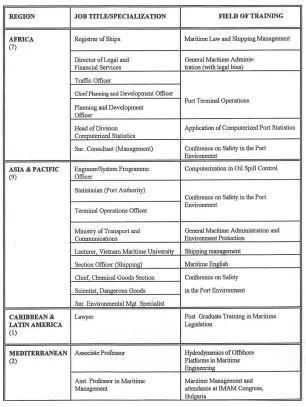
Women in Development (WID) organized workshop/seminars for the advancement of women at the Alexandria Maritime Training Academy and the Cape Verde Maritime Training Institute, under the organization of the Association of African Maritime Training Institutes.
Information from IMO resolution 46/100 states that, the General Assembly revised its target to increase the number of women in the senior level to 35%, a way of promoting equal treatment for men and women in the IMO secretariat. This is showing leadership by example.
Currently the International Maritime Organization (IMO) has a professional women staff level of 30.6%, making it a leader among the family of the United Nations (Tansey, 1999).
In 1988, 1990 and 1993 the Norwegian Government hosted in Oslo a series of meetings for the IMO committee on Women in Development (WID), to prepare “Strategies for WID”, a medium term plan of action with the help of UNIDO.
appointment and promotion. Another application was the establishment of an information network with women’s associations in member states, and the contact with the Women’s International Shipping and Trading Association (WISTA), WMU/IMLI women graduates.
During the 23rd session of the Sub-Committee on Standards of Training and Watchkeeping, WID presented its training policy for women. It was at this time that they suggested amendments to the STCW Convention on the role of women in the seafaring profession. Wherever it was written “he and she” it should read “he/she” and following on “his/her”. The definition of seafarers should include both men and women mariners (TC Article II Regulation 1/1).
Article XI under the Technical Co-operation promotion included this quote “special consideration should be given to promote the training and participation of women as seafarers”.
The Women in Development Program (WID) succeeded in securing funds for its gender-specific fellowships in November 1992, followed by the endorsement of the committee’s medium-term plan of action for 1992-1995. Eleven women from different parts of the world had scholarships for advance training in different maritime fields (TC, 41/9, Annex, 1995).
Table 3.1: Special fellowship program for women
(Source: IMO TC 44/9 Annex)
addresses the system-wide implementation of gender-related recommendations emanating from global conferences (TC, 48/8, 2000).
3.2 A National view - Ghana
There were no laws discriminating against women in Ghana because of the democratic government ruling, so women were found in most sectors of the economy, but with a low profile until the Beijing conference on women in 1995.
The government of Ghana, soon after the declaration of the International Women’s Decade (1976-1985), gave an open directive that everybody whether man or woman had the right to choose any type of job or profession. With all the democratic air blowing around us from our colonial masters the British, it was not known that the Ghana Air Force had women pilots until after the United Nations Beijing women’s conference.
The National Shipping Line (Black Star Line) in conjunction with the Regional Maritime Academy (then Ghana Nautical College) advertised for recruitment of women cadets into the Merchant Navy. This was in 1976, the first time the application invited women to apply, as can be seen from the original advert in figure 3.1. In fact, this is the advert for 1977 since the 1976 advert was not available at the Ghana national archives.
private shipping companies responding to the call, but the majority of vacancies went to men.
Figure 3.1: Recruiting advertisement of Ghana Nautical College
(Source: Daily Graphic, 1977)
where the female population was already encouraging, they were asked to form associations like the nurses’ and teachers’ associations. Since the number of ladies in the merchant navy was small, they joined the Ghana Merchant Navy Officers’ Association. April 21st 1975 saw the formation of National Council on Women and Development in Ghana. This became the main umbrella for women’s advancement, until the formation of the 31st December Women’s Movement 10 years ago.
Female journalists like Schandorf A. E and Akoto K. K. started publishing books like “Women in Ghana” stressing the need for privileged women to go out and educate their unfortunate counterparts. Kate Abbam’s monthly journal Obaa Sima (Ideal Woman) with articles likes “Where are our women leaders”? “The old order must change” were motivating. In those articles every sector of the economy, including the little known maritime industry was touched. Sayings like “…the time has come when the concept that every woman is inferior must change…” (Abbam, 1987/88, II).
After the fourth United Nations conference on women held in Beijing in 1995, the 31st December Women’s Movement took the mantle of the ‘Girl Child’, the last point on the list of the Beijing action plan. This is the women’s wing of the ruling party in Ghana, it therefore has much influence and support from women. Through local outlets, parents were encouraged to “Send their girl child to school”. This was all over the radio, television studios and in the national newspapers in Ghana.
The organization of workshops and seminars on the ‘girl child’ started throughout the country. The Government of Ghana instituted the Professional Women’s Week, on the second week of March coinciding with the UN’s Day for Women’s Rights.
Then came the formation of Science, Technology and Mathematics Education (STME) empowering the girl child for the next millenium in 1997. Right from the primary to senior secondary schools, the ‘girl child’, is made aware that science and mathematics are the bases for all professions’, this was achieved through the effort of the 31st December Women’s Movement. Individual organizations started awarding scholarships to girls offering science and mathematics in the secondary schools.
Figure 3.2: First female ship’s captain in Ghana
3.2.1 Sweden
The World Maritime University is situated in this Scandinavian country. The constitution of Sweden provides for equal rights for all its citizens. This is a country with nine years basic compulsory schooling for all at the expense of the state. As such in 1996/97, the women enrolled in the undergraduate studies were (57%) about 300,400 and about 17,000 (37%) for post-graduate studies
(http://www.si.se/eng/esverige/higher.html).
A study conducted by the United Nations Development Program (UNDP) ranked Sweden the highest on equality for women, with salaries averaging only 70 percent of men’s. In addition, the law prohibits sexual harassment. There is a government recommendation that any employer who does not take action to prevent harassment at its work place, will be obliged to pay damages to the victim
(http://www.state.gov/www/global/human.html).
Throughout the 1990s, employment among women went down lower than men, especially in male-dominated occupations. The reason was that a greater number of women left the labour market to pursue studies.
(http://www.si.se/eng/esverige/laborma.html).
Childcare in Sweden has two objectives. “One is to make it possible for parents to combine parenthood with employment or studies. The other is to support and encourage children’s development and learning and help them grow up under conditions that are conducive to their well-being”
A woman expecting her child in Sweden can start her maternity leave 60 days before birth. In all there is 450 days spread over both parents. The father must take 30 days to help care for the child or lose this entitlement. During the initial 360 days 80% of the women’s salary is paid by the government to her and the remaining 90 days she receives 60 Kronor ($US 7) per day. The employer on the other hand is obliged to keep her position of employment for at least one year after her leave. If the family is able to plan such that their second child comes at the interval of two and half years, the whole process of right is enjoyed again (Swedish social handbook, 2000). Most of these conditions apply to the other Scandinavian countries; this is why the majority of women in the maritime industry of the management level are from this region. “It is not surprising to find the Scandinavians taking the honors”.
(http://www.tradewinds.no/news/art.cgi?a=11683).
3.3 Organizational views
The International Transport Workers’ Federation (ITF) since 1981 established a trust fund for men and women at sea, known as the ITF Seafarers’ Trust. This is for the spiritual, moral and physical welfare of seafarers. In its pipeline, ITF is coming out soon in 2000 with a journal known as ITF Women. This is to enhance the imagination of its women; including sea ladies as well as its new structures for women (ITF News, 6/1999).
The Women’s International Shipping and Trading Association (WISTA), is an umbrella organization for women involved in shipping and trade related business throughout the world. One of its aims is for its members to develop professionally, providing information, exchanging knowledge and experiences and making new contacts. In September 1999, WISTA members at a meeting with Mr. Mark Brownrigg, Director of Shipping Policy, at the United Kingdom’s (UK) Chamber of Shipping, posed this question. “What special incentive will there be (as part of UK’s tonnage tax policy), for female seafarers”? His reply was “we welcome anyone with the right qualification” (“Gathering of women”, 1999, p. 46).
The writer is of the strong view that statements such as above require those women in the maritime industry to talk with the men they are working with, to know their intentions and plans for women, so that the women can talk to the young ones to come into the maritime industry based on the promises and future plans awaiting women.
The Mission to Seamen on April 4, 2000 will modernize its flying angel logo and change its name to The Mission to Seafarers. This has come about because they have realized that the mission is serving both men and women seafarers (Flying Angel News, 12/1999-2/2000).
According to Fairplay, January 2000; California’s Mercy High School says, “A women’s place is at sea”. Therefore, they organized two full months at sea on their topsail schooner Californian, owned by the Nautical Heritage Society of Californian for twelve girls at a time. Before that, the girls have a month of training and orientation, then a month of skill implementation on their return.
Wavelength journal is always trying to encourage women that they may meet their partners at sea, by publishing weddings between seafarers on board their Princess fleets.
The United Kingdom National Union of Marine Aviation and Shipping Transport Officers (NUMAST), has adopted an award scheme in honor of Victoria Drummond of blessed memory, the first woman to become an engineer officer in the United Kingdom merchant navy. After her death in 1978, NUMAST decided to make an award every four years to “the woman” who achieves distinction in seafaring. Figure 3.3 shows Captain Margaret Pidgeon of New Zealand, the award winner for 1999, flanked by from the left IMO Secretary-General Mr. W. A. O’Neil, NUMAST General - Secretary Mr. Brian Orrell and John Epson, NUMAST Council Chairman.
Figure 3.3: Victoria Drummond award to Captain Margaret Pidgeon (Source: IMO News, 1999)
The Shipping Professional magazine devoted nineteen pages of its 4/1998 issue to women in shipping with encouraging pictures of some women role models in the maritime industry. Its first assuring words are “Shipping is a unique industry, and those who choose careers in shipping tend to reflect its special international nature”.
Harriet Colfax, keeper of Michigan city light had to walk up an elevated walkway over 500 meters even at the age of eighty and escape being blown over side in bad weather.
3.4 An educational view
There can be no discussion about institutional initiatives on women in the maritime industry without the mentioning of World Maritime University (WMU). It will look like a ship without a captain floating all by herself. For the whole maritime community worldwide is benefiting from the work WMU is doing, serving the international maritime community.
The World Maritime University was established in 1983 by IMO in Malmö, Sweden, as an international maritime training institution for the training of senior specialist maritime personnel. The University offers MSc and Postgraduate Diploma courses in:
• Maritime Safety and Environmental Protection
• Maritime Administration
• Maritime Education and Training
• Port Management
• Shipping Management
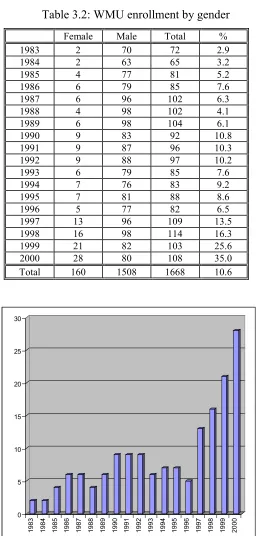
Table 3.2: WMU enrollment by gender
Female Male Total %
1983 2 70 72 2.9
1984 2 63 65 3.2
1985 4 77 81 5.2
1986 6 79 85 7.6
1987 6 96 102 6.3
1988 4 98 102 4.1
1989 6 98 104 6.1
1990 9 83 92 10.8
1991 9 87 96 10.3
1992 9 88 97 10.2
1993 6 79 85 7.6
1994 7 76 83 9.2
1995 7 81 88 8.6
1996 5 77 82 6.5
1997 13 96 109 13.5
1998 16 98 114 16.3
1999 21 82 103 25.6
2000 28 80 108 35.0
Total 160 1508 1668 10.6
Figure 3.4: Female enrollment growth at WMU
(Source: WMU Academic Registrar 2000) 0 5 10 15 20 25 30
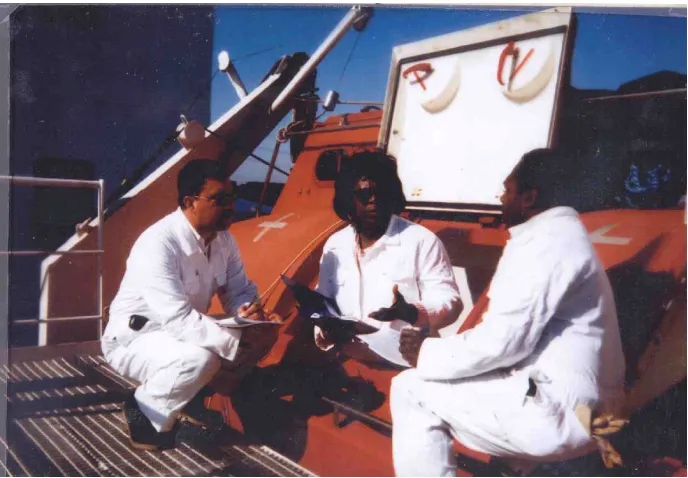
Practicing equal opportunities is WMU policy. In its Academic Handbook on page five (5) it is stated, “…has adopted an equal opportunities policy and positively welcomes applications from women, who are currently under-represented in the field of…” This is really an encouraging piece of advertisement with these pictures as shown below and figure 3.6.
Figure 3.5: World Maritime University students on field studies (Source: WMU 2000 Handbook)
Figure 3.6: Students of WMU at lectures (Source: WMU 2000 Academic Handbook)
Is pregnancy or child bearing something that should keep women from advancing professionally? No is the answer, and WMU has proved this from this case study. In 1999 a brilliant and qualified lady marketing officer, from one of the developing countries had to come to the university although she was expecting. The authorities in her country did not have any idea about it, since it was in the early stages. They would have stopped her from coming she says. Determined as she was, she started the academic work normally until the natural time of weakness. She then informed the authorities of WMU, who informed her donors Carl Duisberg Gesellschaft (CDG). An agreement was reached that, on condition that she performed very well by the end of the first semester, she would come to continue her studies the following year. She had an excellent grade at the end of the semester. This lady now has her baby boy and is back doing her Port Management Course.
women going on maternity leave will have a change of mind after reading the method adopted by WMU. It is one of the ideas from the International Labour Organization principles put into action by the World Maritime University.
3.5 Summary
There is clear evidence from the research work that, international organizations like the UN, ILO, and IMO have used the most machinery available to solve economic, social and cultural problems and promote human rights through the means of treaties, signed instruments and formation of policies, declaration, resolutions and conventions. These are all attempts to:
1. Fight discrimination against women.
2. Improve women’s access to employment, training, social protection and conditions of work
3. Promote the participation of women at decision-making level.
The United Nation’s declaration of 1976 to 1985 as International Women’s Decade and 8 March as UN’s Day for Women’s Rights and International Peace are two of the proofs.
requesting governments to include more women in delegations sent to ILO conferences, meetings, and rectification of conventions connected with women and the policy of free choice of employment. Together this reflects an indication of the serious attention being paid by the UN and its associated bodies to the matter.
The IMO aims specifically at:
1. Integrating women into mainstream maritime activities.
2. Improving women’s access to maritime training and technology.
3. Increasing the percentage of women at the senior management level within the maritime sector, through its Technical Co-operation Women in Development programme.
This is supported by the decision to provide special funds for the training of women in the maritime sector and the employment of a shipping analyst and a specialist in gender development to study the potential for women in the maritime industry. The establishment of WMU and IMLI in Malmö-Sweden and Malta respectively, and having 30.6% of professional women as members of the staff are important steps in this process.
Looking at it from the national level, countries like Ghana, Sweden, Australia, United States of America and Norway just to mention a few have taken bold steps to help integrate women into the managerial level of the maritime industry. This is being achieved by way of promoting legislation which empowers women to choose any job of interest and the governments abiding strictly by ILO resolutions, (refer to paragraph 3.1.1).
various means are helping promote the advancement of women into the decision making level of the maritime industry.