Geschke Center
Master's Theses Theses, Dissertations, Capstones and Projects
Winter 12-18-2015
The German Army at a Crossroads of
Modernization
Sarah E. Liebig
University of San Francisco, [email protected]
Follow this and additional works at:https://repository.usfca.edu/thes
Part of theCultural History Commons,Defense and Security Studies Commons,International and Area Studies Commons, and theMilitary History Commons
This Thesis is brought to you for free and open access by the Theses, Dissertations, Capstones and Projects at USF Scholarship: a digital repository @ Gleeson Library | Geschke Center. It has been accepted for inclusion in Master's Theses by an authorized administrator of USF Scholarship: a digital repository @ Gleeson Library | Geschke Center. For more information, please [email protected].
Recommended Citation
THE GERMAN ARMY AT A CROSSROADS OF MODERNIZATION In Partial Fulfillment of the Requirements for the Degree
MASTER OF ARTS in
INTERNATIONAL STUDIES
by
SARAH LIEBIG December 1, 2015
UNIVERSITY OF SAN FRANCISCO
Under the guidance and approval of the committee, and approval by all the members, this thesis project has been accepted in partial fulfillment of the requirements for the degree.
APPROVED:
_________________________________ ___________
Advisor Date
_________________________________ ___________
Academic Director Date
_________________________________ ___________
i
Contents
Abstract………....………..ii
Chapter One: Introduction……….1
Thesis……….3
Research Significance………4
Chapter Two: History of the Bundeswehr………...….…..6
Establishment of the Bundeswehr……….….6
The Bundeswehr in a Unified Germany……….…9
Innere Führung………..10
Chapter Three: Modernization………...16
What is Modernization?...16
Why Modernization Matters………..17
The White Paper 2006………...19
Public Reception………28
Chapter Four: The Bundeswehr Today………..32
9/11 and the New War on Terror………...32
Cyber Security and Cyber Warfare……….………...35
Ursula von der Leyen……….38
The Attractiveness Campaign………42
German-Russian Relations, the Ukraine and Syria………....47
Chapter Five: Conclusion………..53
Bibliography………..60
Tables
Table 1………...23ii
Abstract
Chapter One
Introduction
The modernization of the German Bundeswehr in recent years has been the subject of fierce debates both within Germany and in the international arena. The problems and challenges have arisen from international demands, as well as domestic reforms, which continue to place demands on the German army in a variety of areas, such as public support, questions about the role of the German army in international affairs and the future reform of a modernized German military establishment.
Germany is one of the richest countries in the world and is seen therefore as both a regional and global power. When thinking about the role that Germany currently plays in global politics it can be hard to remember that just seventy years ago, the end of World War II left the country in ruins and divided into two antagonistic states. As far as
development is concerned, the economic and political growth Germany (namely West Germany) achieved in the decades immediately following the war is noteworthy. Within twenty years, West Germany re-established its democratic government and ensured economic stability. What sets Germany apart from the rest of the global powers is its
defense policy, structure of the military and the unique constitutionally grounded relationship it has with the German people. In the last century, the world has gone through a number of geopolitical transformations, especially when it comes to
geopolitics. We are now in an age of globalization and national borders are not as solid as before. The dissolution of national borders and the depth of transnational alliances have set the stage for a competitive and potentially unstable geopolitical future.
German government’s interest in taking on a more active role in global defense and a call from Germany’s allies, such as the United States and other NATO member states, for Germany to take on a larger role in the realm of global defense has catalyzed a number of changes within Germany’s defense policy and the structuring if its military, the
Bundeswehr. The restructuring and transformation is aimed at modernizing the Bundeswehr in order to keep up with the rest of the global powers and to ensure that Germany can retain at least an economic hegemonic role.
When the Bundeswehr was established in 1955, the concept of Innere Führung was enacted as an attempt to connect the Bundeswehr with the German people and eradicate any gaps between the military and civil society. Innere Führung translates roughly to leadership and civic education and utilizes the idea of the citizen in uniform to form a relationship between the military and German society. The concept was largely successful due to the structuring of the Bundeswehr as conscription military, which allowed for Bundeswehr personnel to be citizens in uniform rather than a force of professional soldiers. In 2011, as a result of the transformation process the Bundeswehr was restructured to be volunteer-only with the intent of creating a professionalized military, which poses a potential risk to the established civil-military relationship. Since the end of World War II, the German people have maintained a pacifist perspective on international intervention by the Bundeswehr. They have generally approved of
military, and maintaining the close relationship between the Bundeswehr and the German people.
Military and defense reform are complicated, vast and take years to enact. Since 2003, global events have occurred that I hypothesize, may change German opinion of the Bundeswehr and their international involvement, setting the stage for more support. Today, the world is threatened by attacks from terrorist groups and now there is the devastating and overwhelming migrant crisis throughout the world, many of who are seeking refuge and asylum within Germany. The reforms set forth for the Bundeswehr and Germany’s defense policy are more important now than ever.
Thesis
In the following chapters I attempt to answer a number of questions, including:
What does it mean to modernize a military? How far is the German government willing to go? How far are the German people willing to be pushed? How do the current global crises affect the German public’s opinions on the Bundeswehr’s increased international involvement? To answer these questions, I will provide a history of the Bundeswehr since 1955, including an examination of the concepts of Innere Führung and Citizen in
Uniform, and their crucial role in both the establishment of the Bundeswehr and in the relationship between the military and the German people. Military experts in the
worked out the details of how to launch the army.1
The concept of "inner guidance" refers to the consciousness of the German solider as a citizen in uniform, in other words a democratic commitment to the new republic, rather than a closed cadre of soldiers, who in the past took an oath to the Kaiser, or most recently, to Hitler.2
I will then move on to address what it means for Germany to modernize its military, summarize the reforms from the White Paper 2006 on German Security Policy and the future of the Bundeswehr, and examine public reception to those reforms. Lastly, I will discuss the current global events, and the role that Germany and the Bundeswehr play.
Germany’s recent history has played a significant role in the Bundeswehr’s relationship with greater civil society, and in my opinion the relationship played a crucial role in the rebuilding of the country, its reunification and its transnational relationships since World War II. That said, the policy decisions Germany makes and the sacrifices that it is willing to make, whether it is failing to meet some of the international demands, or increasing the gap between the Bundeswehr and the German people will have an impact on Germany’s relationship internally and internationally and could have serious implications in the future for Germany’s regional and global hegemony.
Research Significance
not take as a global power. Considering Germany’s modern history, the need for a connection between the Bundeswehr and the German people runs deep and is seen as a necessity. It can be argued that the close civil-military relationship, which differs from that which defines other powers, such as the United States, has helped to contribute to the rebuilding of German democracy and its stabilization not just as a country, but also as a regional and global player. Germany has the power to decide the role that it wants to take in the future, but it will be a balancing act between international demands and
Chapter Two
History of the Bundeswehr
Establishment of the Bundeswehr
At the end of World War II, the allied forces consisting of the United States, Great Britain, France and the Soviet Union, made the decision to completely demilitarize Germany and divide it into two. West Germany would operate under the supervision of the Western Alliance and East Germany under that of the Soviet Union. By default, East and West Germany aligned with their supervising powers, creating an apparent cultural and political division between the countries.
With the Cold War brewing, the two Germanys served as a strategic buffer zone between east and west. The Western Alliance saw the opportunity to rearm West
Germany in order to create back-up defense forces against the Soviet Union. The idea of rearmament was not popular in West Germany, but Chancellor Konrad Adenauer
recognized the rebuilding of the German army as a point of negotiation for the country with the Western Alliance. Adenauer engaged in negotiations with the supervisory powers in order to achieve sovereignty in exchange for the development of German armed forces. In addition to creating a more robust defense force for the Western Alliance, a major goal was to create a common European Defense force, although the French National Assembly vetoed this idea.
On February 26, 1954 the West German Bundestag contemplated the concept of reinstating the armed forces. To do so, the German Basic Law would have to be
The scope of exclusive legislative jurisdiction of the Federation were extended to include defence including compulsory military service of men who have completed their 18th year of age and protection of the civilian population (Article 73);
The constitutional amendment procedure was facilitated in particular with respect to international treaties serving the defence of the Federal Republic (Art. 79 para. 1 sentence 2)
Treaties on the EDC were declared compatible with the Basic Law (Art. 142a) (Uhde 2013).
President Theodor Heuss signed the law in to effect on March 26, 1954. Just a few months later at the Nine Power Conference in London from September 28 – October 3, 1954 Germany was invited to “accede to the Brussels Pact and to NATO”.4
The Federal Republic of Germany (West Germany) joined NATO and the
Western European Union in May 1955. Six months after joining NATO and the WEU, on November 12, 1955 the new German armed forces came into being (they would not officially be called the Bundeswehr until the passing of the Legal Status of Military Personnel Act of April 1956) and on November 21, 1955 the first 101 volunteers were appointed.5 The proposed “plan was to place under NATO command 12 Army divisions within three years and, one year later, 22 air wings as well as naval forces equipped with 172 ships and boats”.6 The total allotment of troops was set at 500,000, with an additional 105,000 troops for national territorial purposes.7
providing for their rights as citizens (directly tied to the concept of the citizen in
uniform). Crucial to Innere Führung’s role in the Bundeswehr is that, “conscience was to take precedence over obedience where orders contravene the law and diminish human dignity”.8 This both allowed and encouraged German soldiers to operate on a basis of morality and ethics. The concept of Innere Führung and the citizen in uniform created a checks-and-balances system for the armed forces and served as a mechanism to prevent the military from operating independently from the rest of the country by ensuring its integration into German society.
Major concerns surrounding rearmament centered on the involvement of former Wehrmacht personnel in the establishment of the new military forces. Many Germans wanted a clean separation from the World War II era and that included the employment of individuals who had served under the regime. In an attempt to curb these concerns, Adenauer called for the creation of a selection board for anyone applying to be a colonel or higher, as a way to screen personnel on and individual basis on their involvement in the atrocities during the NAZI period. Although some remained unsettled, the former officers and higher ranked personnel from the Wehrmacht were necessary for structure and training of the newly established forces.
divisions was not placed under NATO control until 1965; the process took significantly longer than the projected three years.10
The Bundeswehr served as a defensive ally for fellow NATO members, serving under the organization’s strategy of “massive retaliation”. Despite Germany’s
renouncement of “nuclear, biological and chemical weapons, the Bundeswehr was equipped with carrier systems for nuclear warheads at the insistence of its NATO
allies”.11 Eventually NATO shifted their strategy to one of “Dêtente” or flexible response. Throughout NATO defense strategy developments such as the hair directive of 1971 and the NATO double-track decision of 1979, the German forces remained reliable allies, despite unease and uncertainty amongst the troops.12 At the end of the day, integration of the conscript defense forces into German society was considered successful.
The Bundeswehr in a Unified Germany
By 1989 and the fall of the Eastern Bloc, the Bundeswehr finally reached 500,000 personnel. On October 3, 1990 the Germanys reunited after a period of forty-five years of division. Upon reunification, 90,000 military and 47,000 civilian personnel from the East German National Volksarmee (NVA) joined the 500,000 military and 170,000 civilian Bundeswehr personnel.13 Officially, the NVA disbanded just one day earlier on October 2, 2015, but the Bundeswehr absorbed the people, weapons and supplies.
mobile and flexible military force for operations, while retaining its capacity for national defense”.15
The Bundeswehr continued to go through processes of transformation and restructuring, often with specific end goals in mind. In the early 1990s, troops were divided into Crisis Response Forces (CRF) and Main Defense Forces (MDF), but with lack of funding, Bundeswehr personnel decreased from 370,000 to 340,000.16 While this period of transformation was necessary, the ever-changing global security threats and the Bundeswehr’s involvement in the Balkans demonstrated to both Germany and its allies that further reorganization and reforms were necessary.
The driving forces for decisions made by states is a combination of maintaining international relationships aimed at acquiring power, security and wealth and their doctrine. According to NATO, doctrine is the “fundamental principles by which military forces guide their actions in support of objectives”.18
While NATO’s definition is directed at a state’s military, it can be applied to the decisions of the state on a larger scale. It is essentially the values by which the state operates in order to achieve a particular goal. Doctrine connects theory and implementation, and works hand-in-hand with the state’s ideology.19
The relationship between doctrine and ideology is tied together by the culture of the nation and the region. While culture is a subjective term and the task of constructing a definition has historically been no small feat,20 in the context of this thesis, the culture, and consequently ideology and doctrine held in Germany, in regards to international involvement and policy-making, have been dictated by the nation’s history, past decisions and relations. The constructs and policy developments are a reflection of the culture, ideology and doctrine that emerged in response to the events, which transpired during the Weimar Republic and more devastatingly, the Third Reich.
Samuel P. Huntington claims that civil-military relations are, “the principle
institutional component of military security policy”.22
These relations provide a necessary
“balance between social values and military function to effectively respond to societal
imperatives (social forces and ideologies) on one hand and functional imperatives
(security threats) on the other.23
For the German Bundeswehr, this balance is carried out
through Innere Führung, which rests at the core of the Bundeswehr and dictates the
civil-military relationship embedded into German society.24
There is no English translation of
Innere Führung that truly encapsulates the essence of the phrase, although the widely accepted translation is to leadership and civic education. Per the Federal Defense
Ministry, it is best explained as the military being tightly bound with society and its
values. The idea is that by minimizing the gap between greater society and military
institutions, a mutual understanding, greater adaptability and overall effective security
measures will be successfully realized.25
Innere Führung allows for a distinct differentiation between old and new, and serves as a mechanism that is intended to prevent the military from operating
independently from the state and greater German society. The differentiation clearly has
to do with the word "Führer," which carries such heavy baggage from the Nazi period.
Inner guidance has to do with individual conscience, as opposed to outward blind
obedience to a leader. The term amounts to a moral force, not of professional soldiers, but
of citizens in uniform who are entitled to the same rights and moral obligations as
non-military personnel. One of the main goals of Innere Führung is to integrate the non-military
into society and create a harmonious relationship between the two. As a method of
way commanders lead must take account of the prevalent social and political conditions experienced by military personnel”.26
Additionally, the concept of a citizen in uniform together with continuous civic education and training cultivates a force that requires soldiers to constantly re-evaluate their role as an individual in both the military and German society. This acknowledgement of one’s role and place results in, “the necessary assuredness and the ability to make sound judgments” in both combat and non-combat situations.27
The Bundeswehr’s philosophy of Innere Führung enables the preservation of the citizen in uniform by granting the rights to, “active and passive franchise, the rights to information, and free expression of opinion, and the rights of free association and
petition”.28
Huntington argued that to “create a democratic army, an ideologically motivated force embodying subjective rather than objective civilian control” would “reduce the fighting effectiveness of the new army”.29
While Huntington’s argument sounds logical, the Bundeswehr and Innere Führung reflect more closely Morris Janowitz’s theory on constabulatory forces. For Janowitz, the military that serves more as a national police force and is integrated in society proved to be more effective both in operations and with civilian control.30
Innere Führung’s integration of the military into civil society adheres to Janowitz’s assumptions and the idea that, “only those solders who respect the same set of values as their society are capable of defending that very society”.31
At the time of the establishment of the Bundeswehr, Innere Führung was carried
out through the practice of conscription. All males over the age of 18 were required to
complete a term of military service. One main reason the conscription method worked for
force, as is written in the Basic Law, Article 87a. The extent of the Bundeswehr’s
jurisdiction was aiding police forces in times of defense or tension, but only under the
direction and discretion of the Bundestag or Bundesrat. The period of divided Germanys
beginning in 1945 was a period of redevelopment and rebuilding. In order to establish the
country as strong, trustworthy and eventually once again sovereign, economic, political
and eventually defensive stability needed to be achieved. After ten years picking up the
pieces of the horrific war, both domestically and internationally and relying on foreign
militaries and governments to protect the country and its people, it was time for Germany
to take a stand and declare who it wanted to be and where it wanted to sit in the world
order. The use of Innere Führung as the foundational concept upon which the
Bundeswehr was to be established, demonstrated to the German people, as well as the rest
of the world, the role the country would take on internationally.
A number of scholars argue that the civil-military relationship in Germany is at
risk and that this increasing gap is a consequence of the engagement in international
combat missions such as in Kosovo in the 1990s and more recently, in Afghanistan. 32
Another factor, which can be perceived as having a negative effect on the civil-military
relationship, is the shift, beginning in 2011, from conscription military to volunteer-only
forces.33
This shift raises the foundational question of whether this is an attempt to
maintain a positive relationship during a period of reform and perhaps an increase in
international combat missions, allowing for the justification that members of the armed
forces chose to enlist. Citing Thomas E. Ricks, Tomas Kucera discusses “a civil-military
cultural gap” in the United States after the abolishment of the draft due to a decrease in
interaction between civilians and military personnel.34
same could happen in Germany. Kucera argues, “soldiers should accept civilian values
and integrate with society, otherwise they are alienated from the society and from the
Chapter Three
Modernization
What is Modernization?Governments, militaries and policies are in a constant state of transformation. As
things work, or do not work, institutions and law makers attempt to make adjustments or
improvements. Although transformation can be categorized as progress, it can often
happen too little too late. The German Bundeswehr has been continuously transforming
since its inception, but now it is enacting great reforms to ideally close the policy and
capability gap between itself and the militaries of its allies.
The term modernizing is a bit troubling since it is not entirely clear what is meant
in the scope of a military. An evaluation of the Bundeswehr would leave many with the
assurance that it is in fact “modernized”, and while in terms of technology and what its
structure looks like, it is a modernized military force. That being said, the Bundeswehr is
an institution founded primarily for defense, not for international offensive combat
missions, and definitely not for the type of ever changing warfare that many of
Germany’s allies have encountered in the last half-century.
For the purposes of this paper modernizing the Bundeswehr refers to the
restructuring of the institution itself and the policy changes that transition the
Bundeswehr from being a purely peace-building institution to an armed force that is fully
equipped and willing to take part in international missions as needed by its allies, whether
it be NATO, the European Defense Council or individual countries such as the United
States. The new policies essentially expand the Bundeswehr’s mandate and aide in the
preparation of the troops to take part in such potential missions. Aspects of the
German soldier and to be a part of the Bundeswehr has a different meaning and a
different expectation. Modernizing the Bundeswehr means making it look and act (within
reason) as their allies do, it is a way to elevate it in the world order in means of defense and increase its credibility as a physical ally willing send competent troops.
Why is Modernization Matters
Much like with people, relationships between nations are nothing short of crucial. When these relationships are positive, the parties involved are referred to as allies. The
assumption is that alliances are formed based on a commonality of a goal, interest, ideal or enemy. With that said, there is a mutual understanding that, “I’ll scratch your back if you scratch mine”. As an old adage in foreign policy goes, “nations do not have
permanent friends, only permanent interests”.
During Germany’s period of division East and West German alliances developed
almost naturally by default. East Germany aligned with the Soviet Bloc and eventually became a part of the Warsaw Pact. West Germany then aligned with the Western
alliances of the United States, Great Britain and France; eventually finding its place as a
member of NATO.
At the end of the Cold War and after the fall of the Soviet Union, East and West
Germany were reunited, a new government was established, but the East German Volksarmee was absorbed into the West German Bundeswehr. After reunification Germany retained its alliances and position in NATO.
Throughout the Cold War, West Germany provided political and financial support to its allies, namely the United States. This policy and approach worked during a period
economic support proved to not be enough for Germany’s allies. Post-reunification,
tragic and violent armed conflicts arose throughout the world in Rwanda, the Balkans,
Israel and Palestine, and in the Middle East during the Gulf Wars. Germany’s defense
policy maintained that the Bundeswehr would only get involved in NATO and UN
mandated missions as a humanitarian force. That policy sent troops to Kosovo in the
mid-1990s during the Serb-Kosovar conflict. While carrying out their peace-building mission,
the deployed troops engaged in armed combat for the first time since the Bundeswehr’s
establishment in 1955. What Germany gained from that mission was the knowledge that
the Bundeswehr was not as equipped for armed combat as it should be.
As previously discussed above, Germany traditionally only provided economic
and political backing to its allies during times of conflict. As the global political climate
shifted, so did the opinion of Germany’s allies. Providing funding demonstrated limited
support, while its allies were risking lives, Germany was hiding behind its pocketbook.
Germany had seats on the European Defense Council, as well as NATO, but had
the inability to demonstrate efficiency and aptitude in armed conflict. As conflicts
continued to unfold and escalate, Germany’s allies decided to call on Germany to
modernize its forces to a level that would prove the country to be a viable ally if need be.
By the time of reunification, Germany had once again established itself amongst
the world powers. The array of armed conflicts that occurred post-reunification sparked a
desire by Germany to become more involved in global defense and policy. The
mechanism through which the country could maintain their foothold would be by
involvement in future combat missions, but also demonstrate to its allies and the world
that it was ready and fully capable to do so.
The White Paper 2006
The German Federal Ministry of Defense’s White Paper 2006 publication outlines
the country’s security and defense policies for the future. Prior to this publication, the last
White Paper was released twelve years earlier. According to a press release by the
German Missions in Australia, the drafting of the newest White Paper has just finished
and is on track to be released mid-2016. While the 2006 White Paper does not account
for many current instances or situations, which have occurred in the almost ten years
since it’s publication, the information included outlines many aspects of the recent
modernization process of the Bundeswehr and is therefore a significant document in the
context of this thesis.
The White Paper 2006 is divided into two parts, the first focusing on German
security policy and the country’s memberships in various international organizations such
as the North Atlantic Treaty Organization (NATO), the European Union (EU), United
Nations (UN) and the Organization for Security and Cooperation in Europe (OSCE). The
second part focuses on the Bundeswehr, changes within the armed forces, and its role in
German security policy. At the point of the White Paper’s publication, global security
issues had been transforming to where international terrorism and weapons of mass
destruction (WMD) served as the front-runners in terms of security risks for Germany
and the international community as a whole. The overarching goal of the German security
policy was to develop a multi-lateral, inter-ministerial networked security system aimed
internationally. The importance of international partnerships and alliances is a core
concept throughout the publication, the German government acknowledges that
Germany’s security and development is linked to that of Europe and the entire world. The
country’s intentions to remain a capable ally to other members of its various international
organizations are outlined and emphasized, as is its collaborative movement toward
peace.36
NATO, the EU and the UN have all transformed to adapt to new challenges and
risks and their member nations are expected to follow suit, Germany’s adaptation reforms
included the transitioning of the Bundeswehr into a expeditionary organization.37 The
country’s security policy, as outlined in the 2006 White Paper, heavily emphasizes
networked security systems and claims it is the most effective and encompassing strategy
to modern security threats.
According to the publication, Germany’s international partnerships, specifically
the country’s membership to NATO, are fundamental to German security policy and
therefore it is imperative that the transatlantic relationship with the United States be
continuously deepened and fostered.38 In addition to the active role that Germany plays in
NATO, it is also a prominent member of the European Union and aims to pursue the
strengthening of European stability, as well as a stronger partnership with Russia. Aside
from the country’s role in the two separate organizations, the White Paper stresses that
NATO and the EU are complementary to one another and that it will remain Germany’s
policy to cultivate a deeper relationship between the two in order to, “lead to closer
cooperation and greater efficiency, avoid duplication and fortify European and
focusing on conflict prevention at root causes, exacerbating networked security both inter-ministerial within Germany and through regional and global partnerships and alliances.
The second portion of the 2006 White Paper is dedicated specifically to the Bundeswehr. In this document, the German government outlined five major aims of the
Bundeswehr:
1. To guarantee the capacity for action in the field of foreign policy 2. To contribute towards European and global security
3. To maintain national security and defense 4. To provide assistance in the defense of our allies
5. To foster multinational cooperation and integration (White Paper 2006, p 9). The Bundeswehr’s central task is defined as being national and collective defense and its mission is influenced by the values, goals and interests put forth in the German Basic Law. As a consequence of the radically changed security risks, internal and external security has become severely intertwined therefore supporting Germany’s policy for networked and collective defense. The publication dictates the primary tasks of the Bundeswehr as international conflict prevention, supporting Germany’s allies, protecting
Germany and its people, rescue and evacuation in the event of disaster, partnership and cooperation, and subsidiary assistance.40 Internal terrorist threats would traditionally be handled by the land authorities, but the outlined security policy of this publication permits the deployment of Bundeswehr personnel should the situation necessitate and asserts that the federal government wishes to expand the constitutional framework for the use of the armed forces.41
be deployed out of area for the purposes of collective security (Article 24 (2) of the Basic Law).42 This ruling provides the Bundeswehr with the legal backing to participate in international security and prevention operations in concert with its allies and defense partners. In order for troops to be deployed to out of area operations, permission must be granted to the Bundeswehr by the Bundestag on a case-by-case basis. The specifics and parameters of the relationship between the armed forces and parliament are clarified in The Parliamentary Participation Act. The scope of Bundeswehr employment is explicitly outlined in Article 24 (2), Article 87a (2), (3), (4) and Article 35 (2), (3) of the German Basic Law. The Bundeswehr has been reorganized to encompass three groups of forces: response, stabilization and support. As of the White Paper 2006, the goal for 2010 is to have a total of active personnel will be 252,500 with 2,500 reservists and 75,000 civilians.43
Essential to the armed forces is the concept of Innere Führung, and its
relationship with conscription. According to the White Paper, “Innere Führung stands for the realisation that the capability to act on security matters requires a successful
Article 24 Article87a Article 35
(2) With a view to maintaining peace, the Federation may enter into a system of mutual collective security; in doing so it shall consent to such limitations upon its sovereign powers as will bring about and secure a lasting peace in Europe and among the nations of the world.
(2) Apart from defence the Armed Forces may be employed only to the extent expressly permitted by this Basic Law
(2)(…) in order to respond to a grave accident or a natural disaster, a Land may call for the assistance of police forces of other Laender of personnel and facilities of other administrative authorities of the Armed Forces, or of the Federal Border Police.
(3) During a state of defence or state of tension the Armed Forces shall have the power to protect civilian property and to perform traffic control functions to the extent necessary to accomplish their defence mission. Moreover, during a state of defence or a state of tension, the Armed forces may also be authorized to support police measures for the protection of civilian property: in this event the Armed Forces shall cooperate with the competent authorities.
(3) If the natural disaster or accident endangers the territory of more than one Land, the Federal Government, insofar as is necessary to combat the danger, may instruct the Land
governments to place police forces at the disposal of other Laender, and may deploy units of the Federal Border Police or the Armed Forces to support the police. Measures taken by the Federal Government pursuant to the first sentence of this
paragraph shall be rescinded at any time at the demands of the Bundesrat, and in any event as soon as the danger is removed. (4) In order to avert an imminent
danger to the existence or free democratic basic order of the Federation or of a Land, the Federal Government, if the conditions referred to in
paragraph (2) of Article 91 obtain and the police forces and the Federal Police Force prove inadequate, may employ the Armed Forces to support the police and the Federal Border Police in protecting civilian property and in combating organized armed insurgents. Any such employments of the Armed Forces shall be discontinued if the Bundestag or the Bundesrat so demands.
The importance of conscription to the Bundeswehr is heavily emphasized in the
White Paper, as is the Federal Government’s intention to preserve the practice (although
it is important to note that conscription ended in 2011). The conscription process was an
integral part of the civil-military relationship in Germany. It not only guaranteed the
personnel necessary for potential operations, but also allowed for a well-rounded armed
force as a result of the various backgrounds and wide range of education the conscripts
embodied. In the 2005 Coalition Agreement, the intent of the Federal Government to
continue the conscription was outlined and at the time of this publication, the Federal
Minister of Defense called for an increase of conscripts by more than 6,500 in one year.45 According to section 3.6 of the White Paper, many of the reforms set forth have a
financial basis. Since reunification, defense spending continued to be cut and the
restructuring of the Bundeswehr is aimed at creating the most cost effective and efficient
force as possible. Joint operations with Germany’s European and transatlantic alliances
will help to ease the financial burden of the Bundeswehr and contracting with the private
sector will ease the strain on Bundeswehr personnel.46
The Bundeswehr recognizes that, “only Nations with a strong defense industry
have the appropriate clout in Alliance decisions” and therefore intends to expand the
industry within Germany.47 The idea is that by minimizing the outsourcing of defense technology, Germany will be able to build up the domestic industry and consequently
gain decision-making leverage within NATO. Reiterating one of the main thematic
threads of the White Paper 2006, section 3.7 on Armaments emphasizes collaboration and
the deepening of partnerships between nations and alliance organizations. In this section,
with nations both in and out of NATO, as long as they hold common goals and defense
policies.48
The last section in Chapter Three of the White Paper 2006 focuses on the
restructuring of the Bundeswehr. According to this section NATO and the EU determined
deficiencies in the defense strategies of member nations and urged those states to take the
necessary steps to eradicate those deficiencies.49 For the Bundeswehr this meant
developing restructuring and procurement strategies, which would lead the German
armed forces to both meet international alliance and defense demands, as well as falling
within budgetary constraints. After the enactment of the restructuring set forth in this
document, the majority of the Bundeswehr will consist of stabilization forces with a goal
of having the capability of deploying up to 14,000 troops in up to five operations at one
time.50 To meet the operational requirements of Germany’s partner organizations, the
Bundeswehr is proposed to provide up to 15,000 troops to the NATO response force, up to 18,000 to the European Union Headline Goal and up to 1,000 troops to the United
Nations Stand by Arrangement System.51 The cumulative goal for the year 2010, as
outlined by the White Paper is 327,500 Bundeswehr personnel consisting of 252,500
military personnel and 75,000 civilian posts.52 Of military personnel, troops will be
divided into three categories of force: 35,000 response forces, 70,0000 stabilizations
forces and 147,000 support forces.53
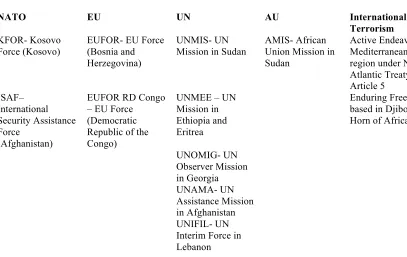
Chapter Four of the White Paper 2006 details the current operations in which the
missions, EU missions, UN missions, African Union (AU) missions, or against
international terrorism.54
NATO EU UN AU International
Terrorism KFOR- Kosovo
Force (Kosovo)
EUFOR- EU Force (Bosnia and Herzegovina)
UNMIS- UN Mission in Sudan
AMIS- African Union Mission in Sudan
Active Endeavour- Mediterranean region under North Atlantic Treaty Article 5 ISAF– International Security Assistance Force (Afghanistan)
EUFOR RD Congo – EU Force (Democratic Republic of the Congo)
UNMEE – UN Mission in Ethiopia and Eritrea
Enduring Freedom- based in Djibouti, Horn of Africa
UNOMIG- UN Observer Mission in Georgia UNAMA- UN Assistance Mission in Afghanistan UNIFIL- UN Interim Force in Lebanon
Table 2: Bundeswehr Operations Abroad (White Paper 2006 p. 73)
The detailed transformation process of the German armed forces is described in
Chapter Five of the White Paper 2006. The goal of the transformations was to create an
armed force, which is capable of achieving constant adaptability to changing security
situations and operational needs.55 All areas of the Bundeswehr were subjected to
transformation reforms including the improvement of concept development and
experimentation, network-enabled operations, force categories and the expansion of
military capabilities. The capabilities of the Bundeswehr are set to include command and
control, intelligence collection and reconnaissance, mobility, effective engagement,
support and sustainability and survivability and protection.56 In order to reach the
networking to maximize joint operability; optimize the collection and analysis of
situational information through the Bundeswehr’s Military Intelligence Organization;
achieve sufficient mobility capabilities; display force, spatial, temporal and informational
adequacies; provide support to personnel taking part in domestic and international
operations; and ensuring the protection and safe transport of personnel and materials.57
The transformation of the Bundeswehr outlined in the White Paper is laid out to adhere to
policies set forth by NATO and the EU.58
The organization of the Federal Ministry of Defense and the Bundeswehr is
intended to streamline duties and administrative tasks. In the context of the Army, Air
Force and Naval forces, the aim of the command organization is to increase force
capability and operation flexibility while achieving maximum effectiveness.59 The Joint
Support Services are configured to minimize strain on the various branches of the armed
forces by providing services such as logistical support, military intelligence, military
police and joint training through a centralized source; the Armed Forces Office.60 Similar
to the Joint Support Services, the German Joint Medical Service, provide an array of
health services to all areas of the armed forces, with the exception of a handful of
specialized forces and institutes within the armed forces.61 Other offices under the
Federal Ministry of Defense consist of the Federal Defense Administration, which is
required by German Basic Law Article 87b to operate independent of the armed forces;
the military legal system containing a civilian structure; and the availability of chaplain
services for personnel.62
While the organizational and capabilities structure of the German armed forces
personnel. Civilian personnel cuts as a result of budget cuts account for 80% of personnel
reductions in the Bundeswehr since 1991 and at the time of the publication of this document, there remained 177,000 civilian employees with further reductions projected
to leave 75,000 civilians by 2010.63 Outlined in Chapter Seven are ways in which the
Bundeswehr attempts to increase recruitment, namely of temporary volunteers and non-commissioned offices (NCOs) who offer a wide spectrum of experiences and education;
by balancing the income discrepancy between East and West German personnel; offering
a supplemental stipend for foreign deployment; the offering of comprehensive benefits
for personnel who took part in foreign operations; and the family and work harmony
provided by employment in the Bundeswehr.64 As of 2006, the Bundeswehr consisted of
regular and temporary volunteers of various vocations and ages, which were closely
monitored and kept in harmony; Basic and Extended Service Conscripts, which aid in
easing the training obligations of the Bundeswehr through the wide-range of educational achievements of conscripted personnel; reservists, numbering up to 100,000; and civilian
personnel.65
It has been almost ten years since the publication of this White Paper and the
2016 White Paper will not made accessible until mid-2016 with a more updated Germany
Security Policy and Military organization. Despite the lack of publicly accessible
government documents deliberately outlining the contemporary security policy within
Germany, overt changes, such as the end of conscription prove that the policies in
Germany have continued to adapt as security threats and challenges transfigure.
The reforms published in the White Paper 2006 were aimed as ensuring the
operational capabilities of the Bundeswehr in potential situations for the future. The
reforms, which began in 2003, were implemented shortly after the start of Germany’s
involvement in NATO operations in Afghanistan. Since the end of World War II,
Germans have maintained a pacifist attitude when it comes to involvement in
international conflict.66 According to the 2007 Global Peace Index (GPI), Germany
ranked as the twelfth most peaceful nation out of the 121 analyzed.67 Between 2005 and
2007, Bundeswehr reforms were being carried out and the nation’s involvement in the
NATO ISAF mission continued to grow. The reforms, while maintaining Innere Führung
and trying to preserve the citizen in uniform led to a shift in the capabilities of the
Bundeswehr, which to caused it to cross over into uncharted territory operationally, but
also in terms of social perception and acceptance. The response of the German public to
the reforms is tied together with the views on Germany’s international involvement at the
time.
According to a poll conducted in 2005, 80% of Germans polled held a positive
view of the Bundeswehr, 60% believed that the German armed forces had a positive
impact internationally, and only 34% opposed NATO’s ISAF in Afghanistan.68 In the
same survey, 53% of those questioned, supported keeping conscripted service for the
Bundeswehr, which according to the White Paper 2006 was cornerstone to the goal of
Innere Führung.69 Despite the high support for the continuation of conscription, just one
year earlier, of the 150,000 Germans up for conscripted service, 80,000 objected to
military service.70 While these numbers demonstrate overall support for the Bundeswehr,
Only 29% of Germans fully supported the Bundeswehr, with 79% claiming they were happy with the work being done by the armed forces.71 The majority polled believed that
the Bundeswehr should protect Germany against external threats, but believed that Germany should focus its attention on domestic issues; a reported 35% supported
executing an active foreign policy.72
The reluctance of the German people to become involved with international
conflicts could have been due to a number of reasons, ranging from a true culture of
pacifism to a lack of security concerns.73 In 2006, Minister of Defense, Franz-Josef Jung
expressed concern that the German public may not fully understand the current and
potential security threats to the nation.74 The changes in global security challenges left
nations, such as Germany to navigate the unknown and develop policy in preparation of
situations, which had not previously been encountered. The support demonstrated by the
German people toward the Bundeswehr, reflects the good deeds and intentions of the armed forces, such as delivering humanitarian aid and assisting in case of natural
disasters. The Bundeswehr was created in a way that emulated the German culture and perspective; the reforms published in the White Paper did not overtly impose on that
essence, leading to the continuation of support of the Bundeswehr as an institution. As the German government attempted to prepare to take on future challenges and assert itself as
a capable ally, the German people also were thrown into an unfamiliar situation.
Reluctance of international involvement had been the trend since the end of World War
II, supporting combat operations abroad and inserting themselves into conflicts which
In 2010, the Bundeswehr underwent another set of reforms to help reduce the cost
of the operation of the armed forces. The major components were: eliminating
conscripted service, reducing military and civilian personnel, closing thirty-one and
downsizing ninety Bundeswehr bases, reducing personnel within the Defense Ministry,
and cutting defense projects by billions.75 As of 2014, the Bundeswehr had 5,000 soldiers
deployed in international operations, yet the German public’s attitude toward
international involvement remained similar to that between 2005 and 2007.76 In a survey
conducted by the Federal Foreign Office, two-thirds of those polled were against more
international involvement.77 In another poll, only 20% of Germans believed Germany
should take on more responsibility within NATO and 58% expressed their belief that
conflicts should be solved through diplomacy and money rather than military force.78
Almost a decade after the initial surveys, the German public’s resistance to engage in
international conflicts lingers.
The reforms set forth by Karl-Josef Jung and Thomas de Maiziére have targeted
the increase of capabilities and economic efficiency of the armed forces and the Ministry
of Defense. The former Ministers of Defense attempted to make changes while trying to
preserve the constitutional relationship between the German people and the Bundeswehr,
but as new challenges emerge and the Bundeswehr adapts to tackling them, the
civil-military relationship is also transitioning and adapting to the new roles being taken on by
Chapter Four
The
Bundeswehr
Today
9/11 and the New War on Terror
The terrorist attacks on the United States on September 11, 2001 marked a shift in
global security and the types of threats to nation states. In response to the devastating
attacks, the United States and its allies took up arms against terrorism to reinstate world
security. Fourteen years after the attacks, troops from around the world remain deployed
and engaged in conflict and rebuilding missions in Afghanistan and Iraq, and have
support missions and intelligence units across the globe. The War on Terror has expanded
to encapsulate terrorism in all its guises throughout the world. As a member of NATO,
Germany has been involved in anti-terror strategies from the beginning, the country’s
military involvement has been a careful balance between supporting and defending its
NATO allies and aligning with the views of domestic public opinion. The fight against
terrorism is comprehensive and does not solely rely on military force. Countries around
the world partake in domestic and international operations in order to combat and prevent
terrorist threats.
After the attacks on 9/11, the United States called upon the North Atlantic Treaty
Article 5, which requires all NATO states to come to the aid of any member who invokes
the article. An attack on one, in other words, is an attack on all. In December 2001,
German parliament approved Bundeswehr contribution to NATO’s International Security
Assistance Force (ISAF) in Afghanistan.79 The German chancellor at the time, Gerhard
Schröder, originally gained German public support for his stance against the invasion of
Afghanistan but was forced to undergo a vote of confidence for then supporting the
for support for the war in Iraq, which is also known as “Operation Iraqi Freedom”. After
the country’s involvement in Afghanistan, Germany chose to withhold support to the
United States for a war in Iraq.81 The sentiment expressed in Germany and the rest of
Europe was that the United States was ignoring the concerns of its allies, while making
unilateral decisions.82 Despite the variances in strategic opinions, Germany intends to
provide ceaseless support to NATO and its other allies in the international fight against
terrorism.83
After initial deployment for Operation Enduring Freedom in 2001 to dislodge the
Taliban, the Bundeswehr took over the Provincial Reconstruction Team (PRT) in the
Kunduz province in Afghanistan, as well as the ISAF Regional Command (RC) North in
Mazar-i-Sharif in the northern part of the country in 2003.84 The role of the German
armed forces during this time was to support reconstruction in the region, under a very
ambiguous mandate; this resulted in the Bundeswehr providing neither direct security nor
reconstruction.85 As of 2014, there remained 1,800 Bundeswehr soldiers deployed in
Afghanistan under ISAF.86
In addition to the troop contribution in Afghanistan, NATO nations also partook
in establishing a number of groups and offices to aid in the war against terrorism. In
2004, NATO established the Defense Against Terrorism Programme of Work
(DAT-POW) to carry out a wide range of projects to combat terrorist activities.87 Projects are
aimed at ensuring the capability to protect against chemical, biological, nuclear and
radiological attacks; maintaining up-to-date and secure technology; and the maintenance
of infrastructure.88 The Centre of Excellence-Defense Against Terrorism (COE- DAT)
contribute both financial and personnel support.89 Additionally, there is also a NATO
Terrorism Threat Intelligence Unit, as well as a NATO Cooperative Cyber Defense
Center of Excellence. The global strategy against fighting terrorism has been through
comprehensive networked defense, between individual nations, alliances, as well as
international organizations such as NATO, the UN, the EU and OSCE.
Within Germany, defenses against terrorism have also been developed and
continue to adapt to changing security threats and conditions. In Berlin, there is the Joint
Counter-Terrorism Centre (GTAZ), which services as an operational communications
platform for the cooperation of forty domestic security agencies.90 Staying true to the
country’s emphasis on networked security, the GTAZ is operated by the cooperation of
representatives from agencies such as the Federal Office for Protection of the
Constitution, Military Counter Intelligence Service and criminal police offices of federal
states. As a mechanism to improve communication between types of agencies of GTAZ,
two analysis units have been created; the Intelligence Information and Analysis Unit
(NIAS) and the Police Information and Analysis Unit (PIAS), which work together to
form working groups aimed at counter-terrorism.91 To effectively battle terrorist threats,
domestically and internationally Germany has employed an approach encompassing the
use of military forces through NATO, police forces, economic and civil components to
ensure the safety of its people and those of its allies.92
Today, Germany continues the fight against global terrorist groups such as the
Islamic State. In an attempt to assist affected areas, such as Iraq, the Bundeswehr has
provided Iraqi military and Kurdish fighters with arms and is in the process of training
strives to gain more territory and recruit members from all over the world, Germany and
its allies continue to adapt their counter-terrorism strategies to address and predict
potential attacks.
On Friday November 13, 2015, a horrifying terrorist attack was carried out in
Paris, France at six different locations throughout the city, almost simultaneously. The
attacks left at least 129 dead, hundreds wounded and at least 100 in critical condition.94 In
response, over 150 raids have been carried out in France and Belgium.95 The international
community has shown unwavering support to France and the United States and Germany
have claimed to stand in solidarity with France in the aftermath of this event.96 While the
fight on terror has not ceased, this attack has revitalized international collaborative
conversations to adequately respond and effectively fight international terrorism. The
global response to this devastating attack and the repercussions that will follow continue
to unfold. NATO nations, including Germany have demonstrated willingness to
comprehensively support France during this time, including but not limited to military
support.
Cyber Security and Cyber Warfare
The world has grown increasingly smaller with the use of the Internet, but it has
exposed vulnerabilities in both the spheres of civil society and government. IT networks
have improved the collaboration between government agencies and transnational
partnerships. The accessibility to information has exponentially increased, and economic
possibilities broadened. While the Internet has had many positive influences on the
world, it also has the potential to pose multiple security threats. Cyber norms and policies
required states and international actors to establish cyber security protocol in attempts to
counter ever-increasing cyber threats.
Cyber attacks are of great risk because they are low risk and high reward to the
perpetrators but high risk to the targets. Individuals, corporations and governments can all
be targets of cyber crime but attacks on government and state entities can be particularly
dangerous because attacks on a network that houses military, transportation,
telecommunication or to the power grid information could have wide spread and
devastating impacts.97 NATO’s Tallinn Manual, a nonbinding document compile by experts on cyber security defines a cyber attack as, “a cyber operation, whether offensive
or defensive that is reasonably expected to cause injury or death to a person or damage or
destruction to objects”.98 Cyber threats range from cyber crime, which is a broad term and can target any entity or individual; to cyber terrorism, aimed at inciting terror on a
group or state; to cyber warfare, which is characterized by a state targeting the IT
networks or cyber security of another state.99
In addition to working with international organizations such as the EU and
NATO, Germany is a part of a bilateral cooperative with the United States regarding
cyber security and regulation. The goals of this partnership are to ensure internet freedom
and regulation, enhance partnerships in the private sector as well as with other nations in
the hopes of creating cyber regulatory norms for government while maintaining freedom
and innovation.100 The two countries are working together to expand communication on
cyber security to more effective fight cyber crime and detect potential threats.101 Borders do not confine cyber space and therefore the development of solutions to ensure global
Transnational security measures and cooperation are imperative to the prevention
of cyber attacks and cyber warfare, but so are internal collaborative partnerships, which is
why Germany continues to develop its own cyber security. One mechanism established
by the German government in 2011 is the Nationales Cyber-Abwehrzentrum (National
Cyber Defense Center), which works to maximize the cooperation between agencies in
the prevention and response of cyber threats.102 Goals of Germany’s international cyber
polices are to optimize potential freedoms through Internet use, prevent cyber attacks,
maximize economic opportunities and improve diplomatic and international
communication.103 Essential to an effective cyber policy is finding a balance between
regulation and freedom, and collaborative work to prevent attacks through innovative
military capacities.104 Similar to the federal government’s establishment of GTAZ for
counter-terrorism, the Joint Internet Centre (GIZ) promotes cooperation and working
groups between various federal ministries such as the Federal Criminal Police Office and
the Military Counterintelligence Service.105 GIZ operates to monitor the online activities
of extremists and potential terrorists in order to identify and intercept possible threats.106
The creation of these various offices within the federal government ensure the application
of cyber-security policies and while providing the opportunity for the adaptation of
responses as threats manifest and transform.
Adapting to cyber security threats and demands is a relentless task, which can be
difficult to sustain. The German Defense Ministry is in the process of writing the White
Paper 2016 on German security policy, and in doing so, an expert workshop on
cyber-security was held in recent months in attempt to develop the best cyber cyber-security policy
Bundeswehr IT centers, the construction and adoption of cyber warfare policies is
ongoing.108 Currently in effect are the international rules on cyber warfare published
under former minister Thomas de Maiziére, adhering to the NATO Tallinn Manual which
advises that cyber conflict must abide by international law and the international laws of
war.109
Cyber security, whether it is an individual attack, cyber terrorism or cyber warfare
is of high priority in German and international security spheres. Cyber threats can be very
volatile and have the potential to be devastating on various levels. Developing effective
and comprehensive cyber and defense policies remain in the early stages, as cyber threats
pose a relatively new global security challenge. The German military and government, in
partnership with international organizations continue to work to improve policy and adapt
as threats escalate.
Ursula von der Leyen
During each term of Angela Merkel’s chancellorship, she has appointed a new
Federal Defense Minister amidst the extensive reforms to the Bundeswehr. In 2013, at the
beginning of her third term, Merkel appointed Ursula von der Leyen to Federal Minister
of Defense, and appointed former minister, Thomas de Maiziere as her Federal Minister
of the Interior. Von der Leyen, a member of the Christian Democratic Union (CDU) has
the reputation of being a radical reformer. This reputation and her political resume set the
stage for von der Leyen to drive home the reforms set in place during the previous
decade.
Before entering politics, Ursula von der Leyen studied economics, completed a
Masters in Public Health.110 In addition to her professional career, she is also a married
mother of seven children. She has been criticized as both a mother and a politician, but
despite push back, von der Leyen has held a number of roles in both local and federal
government and is now the first female Federal Minister of Defense in Germany. Leading
up to her appointment as the Federal Minister of Defense, von der Leyen was active in
her local government in Hannover, served on the Land Parliament in Lower Saxony, then
as the Minister for Social Affairs, Women, Family Affairs and Health of Lower
Saxony.111 Transitioning into the federal realm in 2004, von der Leyen continues to be a
member of the CDU Presidium, was appointed by Merkel as the Federal Minister for
Family Affairs, Senior Citizens, Women and Youth in 2005, and began her tenure as a
member of the Bundestag and was then Merkel’s appointee as the Federal Minister of
Labour and Social Affairs in 2009. Her ambitions, drive and success in previous positions
have led many to speculate that she could potentially be Merkel’s successor as
Chancellor. Von der Leyen’s main objective as Federal Minister of Defense is to reform
the Bundeswehr, a process that had been ongoing for almost a decade when von der
Leyen took office in 2013.
Von der Leyen and the armed forces are faced with a number of obstacles, the
most prevalent being functional and financial shortcomings. In September 2014, a series
of transportation mishaps occurred while trying to deliver arms to security forces in Iraq
and revealed the dilapidated state of many of the Bundeswehr’s air transportation
vehicles.112 German defense specialist Thomas Weigold said that equipment shortfalls are
a result of a policy, which maximized the use of military equipment with little
in operation for up to fifty years.113 Online news magazine SpiegelOnline reported that
only one of four submarines is operational, 110 of 180 Boxers are deployable, two of
thirty-three helicopters operational, and these numbers do not clarify whether the
equipment is fully or partially operational.114 Due to its shortcomings in capabilities,
Germany was unable to meet the 2014 NATO Defense Planning Process target and as a
result would have been unable to assist its NATO allies should the situation arise.115
NATO urges member states to spend at least 2% of their annual GDP on defense, in 2014
Germany only spent 1.29% of GDP but according to some government sources, Germany
plans to increase defense spending by 6.2% in the next five years.116
Despite political opposition and equipment deficiencies, Defense Minister von der
Leyen appears motivated to continue the modernization of the Bundeswehr and increase
international involvement. According to former Commissioner for the Armed Forces,
Hellmut Königshaus, since von der Leyen entered office, there seems to be a shift in the
attitude of the Bundeswehr and the defense minister is more open and receptive to
concerns regarding the state of the Bundeswehr.117Von der Leyen is an avid supporter of
coalition and partnerships and firmly supports NATO as an active alliance. She strives for
a more unified Europe and stands steadfastly behind international law. In an article
published in The Guardian, Joachim Koschnicke identified von der Leyen as, “one of the
more popular politicians” but her seemingly radical reforms and opinions could result in
stark opposition, even from within her party.118
Since her appointment in 2013, Ursula von der Leyen has taken steps toward
further reformation of the German armed forces. She is facing criticism as well as,
a severe deficit of volunteers since the end of the conscription in 2011. Despite these set
backs, perhaps one of the most drastic steps has been the launch of an attractiveness
campaign to attract young Germans to join the military. The objective of this campaign is
to improve the work-life balance of military personnel. Many of the Bundeswehr reforms
were focused on structure and efficiency; von der Leyen seeks to reform the
personnel/personal aspect of the Bundeswehr. In order to do this, the armed forces will be
made more family-friendly and she seeks to appeal to young people to join the German
professional army and therefore must make it competitive and comparable to companies
aiming to do the same. The specifics of von der Leyen’s reforms for attractiveness will be
discussed in the following chapter.
In line with the objectives outlined in the White Paper 2006 for the Bundeswehr,
von der Leyen has been vocal about European and transatlantic defense partnerships. In
March 2015, at the tenth Brussels forum, von der Leyen called for a European army as a
way to increase stability, as well as European and transatlantic security.119 After asserting
that Western countries and their democratic values are a target for groups such as the
Islamic State, she displayed the needs to cultivate deeper alliances through the already
established organizations of the EU, NATO and the OSCE; this includes partnerships
between these organizations.120 Von der Leyen believes in the need for a unified
European army to ensure stability and support the already unified market and currency,
and the openness of borders and the migration between them. The final point of her
statement in Brussels was the progress that the Bundeswehr has already made toward
these goals, such as the Franco-German Brigade, a German decision of the Dutch