62 |
P a g e
Asian Journal of Pharmaceutical Science & Technology
e-ISSN: 2248 – 9185
www.ajpst.com
Print ISSN: 2248 – 9177
FORMULATION AND EVALUATION OF MIGLITOL SUSTAINED
RELEASE TABLETS
*Rangasamy Manivannan, Kotha Aravind Kumar, Bandaru Lakshmi Narayana Rao and
Palnati Venkata Krishna Reddy
Department of Pharmaceutics, JKKMMRF’S, Annai JKK Sampooraniammal College of Pharmacy, Ethirmedu, Komarapalayam-638183, Namakkal, Tamilnadu, India.
ABSTRACT
The purpose of the present study was to develop sustained release tablets of Miglitol, an anti-diabetic drug which are designed for better management of diabetes mellitus to minimize side effects, to improve patient compliance and preventing the fluctuation of therapeutic concentration of the drug in the body. The Miglitol sustained release tablets (F1 – F7) were prepared by wet granulation method using HPMC K15M and Hydroxy methyl cellulose E5 polymers in different ratios of (1:1, 1:2 and 1:3). Granules were performed by Preformulation studies. The Miglitol sustained release tablets were evaluated for hardness, friability, weight variation, drug content and In-vitro dissolution study. The Miglitol sustained release tablets showed drug release from 28.68 to 97.43% of drug at the end of 24thhr byin-vitrodissolution study. The formulation F7 was selected as an optimized formulation because it gives the best result in terms of drug release in sustained release manner. The kinetic release treatment showed that the release of drug follows zero order kinetic (R2 value as 0.985), korsemeyer equation gave value of (R2= 0.950) which was close to one indicating that the drug was released by zero order kinetic and Short term stability studies indicated that there is no appreciable changes in the drug content and in vitro drug release rates of optimized formulation F7.
Key words: Miglitol, HPMC K15M, HMC E5, Wet Granulation Method, Sustained Release.
INTRODUCTION
Most conventional oral drug products, such as tablets and capsules, are formulated to release the active drug immediately after oral administration, to obtain rapid and complete systemic drug absorption [1]. Sustained release delivery systems can achieve predictable and reproducible release rates, extended duration of activity for short half - life drugs, decreased toxicity, and reduction of required dose, optimized therapy and better patient compliance [2]..Diabetes mellitus is a condition in which a person has a high blood sugar level, either because the body doesn’t produce enough insulin, or because body cells don’t properly respond to the insulin that is produced. Insulin is a hormone produced in the pancreas which enables body cells to absorb glucose, to turn into energy. If the body cells do not absorb the glucose, the glucose accumulates in the blood, leading to vascular, nerve, and other complications [3]. Miglitol is an oral alpha-glucosidase inhibitor for use in the management of non-insulin-dependent diabetes mellitus (NIDDM). The biological half-life of miglitol is 2 hrs. The elimination half - life of miglitol from plasma is
approximately 2 hours. Miglitol is used along with a proper diet and exercise program to control high blood sugar in people with type 2 diabetes [4].
The objective of the present work is to develop a sustained release tablets for the drug miglitol for the better management of the disease, to minimize side effect as well as to improve patient compliance and preventing the fluctuation of the therapeutic concentration of the drug in the body.
MATERIAL AND METHODS Materials
Miglitol obtained from Zhejiang Jiuzhou Pharmaceutical co. ltd., china. HPMCK15M and Hydroxyl Methyl CelluloseE5 were procured from SD Fine chem, Mumbai. Microcrystalline cellulose from Yarrow Chem, Mumbai and all other ingredients used were of analytical grade.
Preparation of Miglitol Sustained Release Tablets
The Miglitol sustained release tablets were
63 |
P a g e
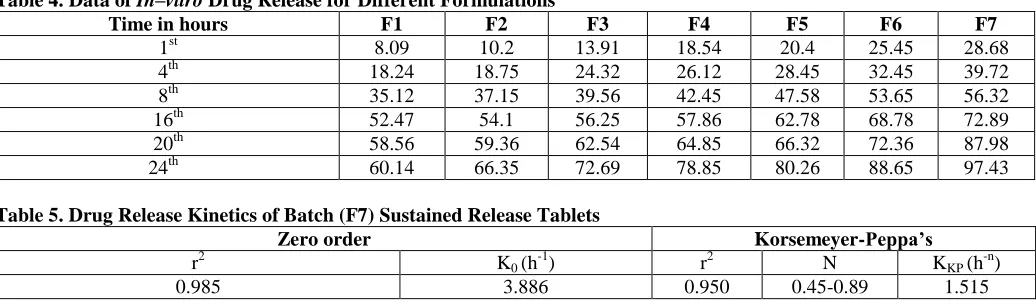
prepared by wet granulation method. The composition ofvarious formulations is given (Table no:1). Miglitol, HPMC K15M, Hydroxyl Methyl Cellulose E5, Micro Crystalline Cellulose, Lactose and Sodium starch glycollate mixed and passed through 60 mesh. All the sifted ingredients were mixed thoroughly until to get the uniform blend. And passed the granules to sieve no: 40 and after dried in hot air oven. Previously dried granules were lubricated by adding the magnesium stearate. Compressed the granules with the help of 10mm punch size and finally coat the tablets with the solution of opadry.
Micromeritic properties
The angle of repose was measured by using funnel method, which indicate the flowability of the granules. Loose bulk density and tapped density was measured using the formula: LBD= weight of the powder/ volume of packing. TBD= weight of the powder / tapped volume of the packing. Compressibility index of the granules was determined by using the formula: CI (%) = [(TBD-LBD/TBD] X 100. The physical properties of the granules were shown in table 2 [5].
Evaluation of tablets
All prepared tablets were evaluated for its assay, weight variation, hardness, Friability thickness and diameter.
Thickness
Thickness was measured using a calibrated screw gauge meter. Five tablets of the formulation were picked randomly and thickness was measured individually.
Hardness
The hardness of the tablets was determined using Monsanto Hardness tester. It is expressed in kg/cm2. Six tablets were randomly picked from each formulation and the mean and standard deviation values were calculated.
Friability
A friability test was conducted on the tablets using a Roche friabilator. Twenty tablets were selected from each batch and any loose dust was removed with the help of a soft brush. The tablets were initially weighed (Winitial) and transferred into friabilator. The drum was rotated at 25 rpm for 4 minutes after which the tablets were removed. Any loose dust was removed from the tablets as before and the tablets were weighed again (Wfinal). The percentage friability was then calculated by,
% F = {1-(Wt/W)} ×100 Where,
% F = Friability in percentage W = Initial weight of tablets
Wt= Weight of tablets after revolution
Weight variation
Twenty tablets were randomly selected from each batch and individually weighed. The average weight and standard deviation of 20 tablets was calculated. The batch passes the test for weight variation. If not more than two of the individual tablet weight deviate from the average weight.
Assay test
Few tablets were weighed and triturate from that transfer an accurately weighed partition of the powder equivalent about 100mg of Miglitol at 100ml volumetric flask containing buffer solution and then concentration is measured at max 272nm.
In vitro drug release study
Dissolution studies were carried out for all formulations using USP-II paddle method and 900ml of pH 6.8 phosphate buffer as the dissolution medium. The medium was allowed to equilibrate to temp of 370C±0.50c. Tablet was placed in the vessel and the vessel was covered the apparatus was operated for 24 hrs in pH 6.8 phosphate buffer at 50 rpm. At definite time intervals of 5ml of the aliquot of sample withdrawn periodically and the volume replaced with equivalent amount of the fresh dissolution
medium. The samples were analyzed
spectrophotometrically at 272 nm using UV- spectrophotometer.
Fourier Transforms Infra-Red (FTIR) Spectroscopy
FTIR study was carried out to check compatibility of drug with polymers. Infrared spectrum of Miglitol was determined on Fourier transform Infrared Spectrophotometer using KBr dispersion method. The absorption maximums in spectrum obtained with the substance being examined correspond in position and relative intensity to those in the reference spectrum.
Drug release kinetics
For finding pout the mechanism of drug release from tablets, the dissolution data obtained from the drug release were treated with the different release kinetics equations are Zero order release equation, First order equation, Higuchi’s square root of time equation, Korsemeyer and peppas equation [6].
Stability Study
64 |
P a g e
RESULTS AND DISCUSSION Compatibility study
Spectra of the pure drug, excipients were recorded in between 200-400 nm. The FT – IR spectral analysis showed that there is no appearance or disappearance of any characteristic peaks of pure drug Miglitol with the polymers which confirms the absence of chemical interaction between drug and polymers.
Micromeritic properties
Granules of all the formulations were subjected for various pre-compression evaluations such as angle of repose, bulk and tapped density, compressibility index and hausner’s ratio. Results of all the pre-compression parameters performed on granules for formulations shown in (Table 2).The angle of repose was found to be in the range of 25° to 29°, thus indicating that the flow properties were good. Compressibility index was found to be in the range of 17.95 to 21.73%, it indicates the good flow properties. Hausner’s ratio was more than 1.25 for all the batches indicating good flow properties.
Evaluation of physical parameters
From the physical parameters (Table no.3) of each batch, it was concluded that the tablets of all batches had desirable physical characteristics. Results of Hardness of various batches of prepared formulations (2.5 - 4.5 kg / sq cm.) and Friability (0.02 – 0.07 %) indicates that the tablets having sufficient strength to withstand physical abrasion. Tablets of all batches pass the weight variation test as per the limits prescribed in IP. (5% deviation is allowed for average weight of tablet X ≥ 380 mg).
In vitro drug release study
The migltiol sustained release tablets were prepared by using polymers such as HPMC K15M,
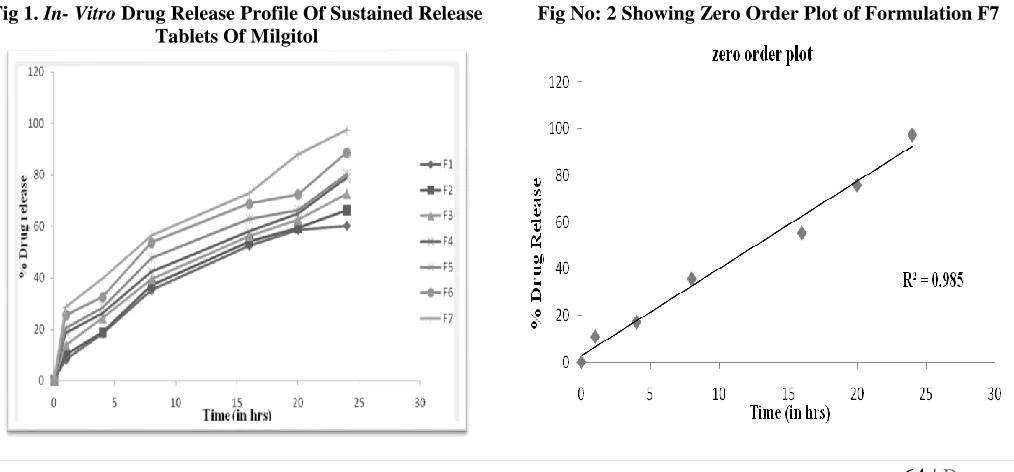
Hydroxy Methyl Cellulose E5 were used in different proportions in 1:1, 1:2, 1:3 ratios and these tablets were done in vitro dissolution studies from F1 to F7. The release profile of Miglitol sustained release tablets from different batches of formulated tablets were illustrated in Table 4and plotted in Figure 1. It is due to the reason that used concentrations of polymers have increased the viscosities of formulations which lead to the sustained-release of drug. But the formulation F-7 shown maximum amount of drug release i.e. 97.43 % for a period of 24 hours in a sustained-manner and hence was considered as the best formulation. It was also found to be optimum for stability studies.
Drug kinetics study
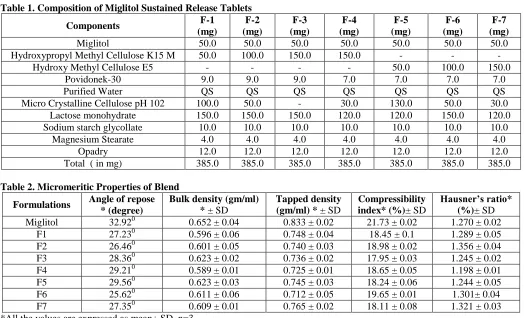
The kinetic data of all the formulations are graphically represented in Figures 2-3. In order to determine the mechanism of drug release form the formulations, the in-vitro dissolution data was fitted to Zero order and Korsemeyer peppa’splot was drawn for optimized formula and interpretation of release exponent value (n) was calculated. The results of R2 for zero and Korsemeyer peppa’s were obtained as 0.985 and 0.950 respectively. Based on that we have confirmed that the optimized formulation followed zero order release. Zero order model was applied to the in-vitro release data, linearity was obtained with high ‘r’ value indicating that drug release from the sustained-release tablets through concentration independent.
Stability studies
Stability studies were shows no major difference was found between evaluated parameters before and after storage and all are in acceptable limits. The tablets showed satisfactory physical stability at 400C ± 20C/ 75 % ±5% RH for 60 days.
Fig 1. In- Vitro Drug Release Profile Of Sustained Release Tablets Of Milgitol
65 |
P a g e
Fig 3. Showing Korsemeyer Peppa’s Plot of Formulation F7
Table 1. Composition of Miglitol Sustained Release Tablets
Components F-1
(mg)
F-2 (mg)
F-3 (mg)
F-4 (mg)
F-5 (mg)
F-6 (mg)
F-7 (mg)
Miglitol 50.0 50.0 50.0 50.0 50.0 50.0 50.0
Hydroxypropyl Methyl Cellulose K15 M 50.0 100.0 150.0 150.0 - - -
Hydroxy Methyl Cellulose E5 - - - - 50.0 100.0 150.0
Povidonek-30 9.0 9.0 9.0 7.0 7.0 7.0 7.0
Purified Water QS QS QS QS QS QS QS
Micro Crystalline Cellulose pH 102 100.0 50.0 - 30.0 130.0 50.0 30.0
Lactose monohydrate 150.0 150.0 150.0 120.0 120.0 150.0 120.0
Sodium starch glycollate 10.0 10.0 10.0 10.0 10.0 10.0 10.0
Magnesium Stearate 4.0 4.0 4.0 4.0 4.0 4.0 4.0
Opadry 12.0 12.0 12.0 12.0 12.0 12.0 12.0
Total ( in mg) 385.0 385.0 385.0 385.0 385.0 385.0 385.0
Table 2. Micromeritic Properties of Blend
Formulations Angle of repose
* (degree)
Bulk density (gm/ml) * ± SD
Tapped density (gm/ml) * ± SD
Compressibility
index* (%)± SD
Hausner’s ratio*
(%)± SD
Miglitol 32.920 0.652 ± 0.04 0.833 ± 0.02 21.73 ± 0.02 1.270 ± 0.02
F1 27.230 0.596 ± 0.06 0.748 ± 0.04 18.45 ± 0.1 1.289 ± 0.05
F2 26.460 0.601 ± 0.05 0.740 ± 0.03 18.98 ± 0.02 1.356 ± 0.04
F3 28.360 0.623 ± 0.02 0.736 ± 0.02 17.95 ± 0.03 1.245 ± 0.02
F4 29.210 0.589 ± 0.01 0.725 ± 0.01 18.65 ± 0.05 1.198 ± 0.01
F5 29.560 0.623 ± 0.03 0.745 ± 0.03 18.24 ± 0.06 1.244 ± 0.05
F6 25.620 0.611 ± 0.06 0.712 ± 0.05 19.65 ± 0.01 1.301± 0.04
F7 27.350 0.609 ± 0.01 0.765 ± 0.02 18.11 ± 0.08 1.321 ± 0.03
*All the values are expressed as mean± SD, n=3.
Table 3. Evaluation Studies of Different Formulations (F1 – F7)
Formulations Weight variation
(in mg)± SD
Thickness (in mm)± SD
Diameter in (mm)± SD
Hardness (in kg/cm2)± SD
Friability (%) ± SD
F1 376.2 ± 5.06 3.95 ± 0.25 9.58 ± 0.20 3.5 ±0.01 0.07% ± 0.01
F2 374.3 ± 5.01 3.98 ± 0.40 9.58 ± 0.09 3.9 ±0.3 0.02% ± 0.02
F3 375.5 ± 4.45 3.60 ± 0.20 9.57 ± 0.06 3.7 ± 0.2 0.03% ± 0.04
F4 365.1 ± 6.40 4.89 ± 0.29 9.58 ± 0.02 4.5 ± 0.4 0.05% ± 0.01
F5 370.2 ± 5.25 4.70 ± 0.30 9.58 ± 0.20 4.2 ± 0.3 0.02% ± 0.04
F6 369.4 ± 4.20 4.15 ± 0.45 9.57 ± 0.11 3.8 ± 0.8 0.04% ± 0.05
F7 372.5 ± 3.10 3.97 ± 0.50 9.58 ± 0.10 3.9 ± 0.1 0.02% ± 0.06
66 |
P a g e
Table 4. Data of In–vitro Drug Release for Different Formulations
Time in hours F1 F2 F3 F4 F5 F6 F7
1st 8.09 10.2 13.91 18.54 20.4 25.45 28.68
4th 18.24 18.75 24.32 26.12 28.45 32.45 39.72
8th 35.12 37.15 39.56 42.45 47.58 53.65 56.32
16th 52.47 54.1 56.25 57.86 62.78 68.78 72.89
20th 58.56 59.36 62.54 64.85 66.32 72.36 87.98
24th 60.14 66.35 72.69 78.85 80.26 88.65 97.43
Table 5. Drug Release Kinetics of Batch (F7) Sustained Release Tablets
Zero order Korsemeyer-Peppa’s
r2 K0 (h
-1
) r2 N KKP (h
-n )
0.985 3.886 0.950 0.45-0.89 1.515
CONCLUSION
In the present study the attempt was made to formulated and evaluated Miglitol 50 mg sustained release
tablet was once a day. And finally it’s selected as better patient compliance and effective therapy.
REFERENCES
1. Chein YW, Lin S. In Encyclopedia of Pharmaceutical Technology, 2nd Ed., Marcel Dekker Inc. New York, 230-234.
2. Gilbert SB, Christopher TR. Modern Pharmaceutics, Sustained and Controlled -release drug-delivery systems, 4th Ed, 2002, 405-409
3. Atulkathriya, Tank HM – Anti diabetic drug and its delivery system. International Journal of pharmacy research of technology, 2, 2012, 7-14.
4. Fernado E, Conchita B. Efficacy and tolerability of miglitol in treatment of patients with non-insulin dependent diabetes mellitus. Current therapeutic research, 1995, 258-268.
5. Cooper J, Gunn C. Powder flow and compaction. In: Carter SJ. Tutorial pharmacy. NewDelhi, CBS Publishers and distributors, 1986, 211-33.
6. Leon S, Susanna P, Andrew BC. Applied Biopharmaceutics and Pharmacokinetics, Modified-Release Drug Products, 5th Edition, 2004, 535.