Detection and Grading of Knee Joint
Cartilage Defect using Multi-Class
Classification in Vibroarthrography
N. Befrui
1, J. Elsner
2, A. Flesser
3, J. Huvanandana
2, O. Jarrousse
1,2, T. L. Le
1,
M. Müller
2, W. H. W. Schulze
1,2,4, S. Taing
2and S. Weidert
11Trauma Surgery Department, Ludwig-Maximilians-University Hospital, Munich, Germany 2Munich Innovation Labs, Grünwald, Germany
3CPE GmbH, Willich, Germany
4Evolunis UG, Knesebeck, Germany
Contact: Nima Befrui: [email protected]
Abstract
Vibroarthrography describes the detection of joint pathologies by analysis of vibrations emitted during joint movement. In our study, 30 healthy volunteers and 39 patients with various degrees of chondromalacia or osteoarthritis were selected and accelerometers and piezoelectric sensors were placed on prominent bone structures of patients’ knee joints (patella, lateral and medial tibial plateau) in order to measure the structure-borne noise during active extension and flexion of the joint. After semi-automatic signal segmentation had been applied to isolate flexion and extension cycles, features based on relative high-frequency components were generated. Using machine learning with a linear support vector machine, these signals were classified as healthy, exhibiting chondromalacia °II-IV or osteoarthritis. 84% of healthy subjects were identified correctly, while the classification accuracy for individual stages of chondromalacia or osteoarthritis ranged from 11% (CM °II) to 50% (CM °III). In order to make results easily interpretable without resorting to machine learning techniques, we propose a normalized score between 0 and 1 and show that this "v-score" for flexion and extension significantly correlates with the achieved multi-class classification. Vibroarthrography may qualify as potent screening tool for the detection and grading of joint cartilage defects and aid physicians in the choice and estimation of urgency of further diagnostic and therapeutic decisions.
Sciences Volume 2, 2018, Pages 6–11
Introduction
The progressive degeneration of articular cartilage known as chondromalacia and the pathological consequent reactions of bony structures in osteoarthrosis are among the leading causes of pain and disability in the middle-aged and elderly demographic and may lead to severe impairments in activities of daily life [1,2]. Early detection of such joint pathologies are of great importance to aid physicians with diagnostic and therapeutic decisions in early stages of cartilage degeneration. Current imaging modalities however either depict anatomical joint pathologies present only in later stages of osteoarthrosis (X-ray) or are prone to low inter observer reliability besides their high costs and low availability (MRI) [3]. Although previous VAG-studies demonstrated its capabilities in binary classification of joints as either healthy or pathological [4,5], there is limited data on the possibility of estimating the severity of cartilage damage. The grade of chondromalacia however is an essential information for any physician deciding upon further diagnostics and treatment options for his patient. The aim of our study was to evaluate Vibroarthrography (VAG) as a diagnostic tool for articular degeneration of the knee joint in respect to the correct identification of various grades of chondromalacia and osteoarthritis.
Methods
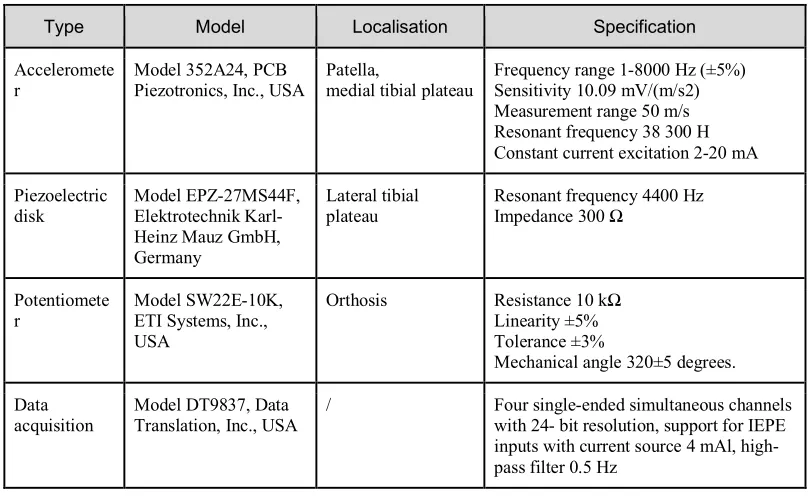
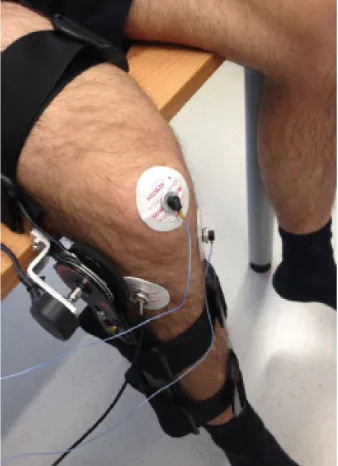
The measurement system we established was comprised of 3 acoustic sensors mounted to the skin above selected prominent bony structures of the knee joint and dedicated to the recording of vibrations emitted from the joint during movement: one accelerometer on the patella, another accelerometer on the medial tibial plateau and a piezoelectric disk on the lateral tibial plateau. Joint angle was measured during motion by a potentiometer mounted to a knee orthosis. The VAG and knee angle signals were acquired simultaneously via a four-channel data acquisition unit at 16 kHz sampling rate and 24 bits/sample. 39 patients presented with history of chondromalacia (‘CM’) or osteoarthrosis (‘OA’) and evidence of articular cartilage degeneration of the knee in recent MRI; further 30 healthy volunteers participated in the study, resulting in a total case number of 59 ‘healthy’ and 40 ‘pathological’ joints analyzed. Severity of cartilage degeneration in the ‘pathological’ knees was as follows: CM °II: n=3; CM °III: n=12; CM °IV: n=16; manifest osteoarthrosis: n=9)
machine learning algorithm, was then used to classify the feature vectors derived from the VAG-signals according to standardized grading of cartilage degeneration as healthy, chondromalacia °II-IV or osteoarthrosis. For easy interpretation of results, we propose a normalized score between 0 and 1 for flexion and extension correlating with the achieved multi-class classification.
Type Model Localisation Specification
Acceleromete
r Model 352A24, PCB Piezotronics, Inc., USA Patella, medial tibial plateau Frequency range 1-8000 Hz (±5%) Sensitivity 10.09 mV/(m/s2) Measurement range 50 m/s Resonant frequency 38 300 H Constant current excitation 2-20 mA
Piezoelectric disk
Model EPZ-27MS44F, Elektrotechnik Karl-Heinz Mauz GmbH, Germany
Lateral tibial plateau
Resonant frequency 4400 Hz Impedance 300 Ω
Potentiomete
r Model SW22E-10K, ETI Systems, Inc., USA
Orthosis Resistance 10 kΩ
Linearity ±5% Tolerance ±3%
Mechanical angle 320±5 degrees.
Data acquisition
Model DT9837, Data Translation, Inc., USA
/ Four single-ended simultaneous channels with 24- bit resolution, support for IEPE inputs with current source 4 mAl, high-pass filter 0.5 Hz
Fig. 1: Sensor measurement setup with accelerometers and the piezoelectric disk mounted to the patella, medial and lateral tibial plateau respectively via ECG-pads. The knee orthosis is fitted with a potentiometer constantly measuring the joint angle.
Results
Fig. 2: Multi-class classification accuracy. Patients were classified as 'healthy', exhibiting chondromalacia °II - °IV or osteoarthritis.
Discussion
cartilage defects and aid physicians in the choice and estimation of urgency of further diagnostic and therapeutic decisions.
References
1 Buckwalter, J. A., and H. J. Mankin. "Articular cartilage: degeneration and osteoarthritis, repair, regeneration, and transplantation." Instructional course lectures 47 (1998): 487-504.
2 Jackson, Douglas W., Timothy M. Simon, and Harold M. Aberman. "Symptomatic articular cartilage degeneration: the impact in the new millennium." Clinical Orthopaedics and Related Research® 391 (2001): S14-S25.
3 Menashe, L. et al., “The diagnostic performance of MRI in osteoarthritis: a systematic review and meta-analysis”Osteoarthritis and Cartilage 20.1 (2012): 13-21
4 Moussavi, Zahra MK, et al. "Screening of vibroarthrographic signals via adaptive segmentation and linear prediction modeling." IEEE transactions on biomedical engineering 43.1 (1996): 15.
5 Befrui, N., Elsner, J., Flesser, A., Huvanandana, J., Jarrousse, O., Le, T. N., ... & Weidert, S. Vibroarthrography for early detection of knee osteoarthritis using normalized frequency features.
Medical & biological engineering & computing (2018) 1-16.
6 Pihlajamäki, Harri K., et al. "Reliability of clinical findings and magnetic resonance imaging for the diagnosis of chondromalacia patellae." JBJS 92.4 (2010): 927-934.