Beata Kowalska-Krochmal
1, Ewa Dworniczek
1, Izabela Dolna
1, Alicja Seniuk
1,
Jacek Bania
2, Ewa Wałecka
2, Ewa Wrzyszcz
1Antibiotic Susceptibility Levels of Clinical
Enterococcus
spp
.
Strains, Including Those Resistant
to Glycopeptides and High Concentrations
of Aminoglycosides
Ocena stopnia wrażliwości na antybiotyki
klinicznych szczepów z rodzaju
Enterococcus
,
w tym opornych na glikopeptydy i duże stężenia aminoglikozydów
1 Department of Microbiology, Wroclaw Medical University, Poland2 Department of Food Hygiene and Consumer Health Care, Wroclaw University of Environmental and Life
Sciences, Poland
Abstract
Background. The increased proportion of enterococci in infections and their growing resistance to antibiotics call for the need to ensure constant monitoring of the microorganisms’ sensitivity.
Objectives. To assess the degree of sensitivity of clinical Enterococcus species to antibiotics.
Material and Methods. The MIC values of five antibiotics (ampicillin, tetracycline, norfloxacin, vancomycin, tei-coplanin) were determined using the agar dilution method and the E-test for 300 Enterococcus strains, including 191 E. faecalis and 109 E. faecium strains. Enterococcal resistance to high concentrations of gentamicin was deter-mined using the disk-diffusion method.
Results. Among the 300 tested Enterococcus strains there were 28 glycopeptide-resistant enterococci (GRE) strains (9.3%), including 26 E. faecium and 2 E. faecalis strains; 57.6% of the strains were high-level gentamicin resistant (HLGR) strains, constituting 85% of the E. faecium group and 42% of the E. faecalis group. The MIC50 and MIC90
values (in µg/ml) of the five tested antibiotics for the E. faecalis and E. faecium strains were, respectively, ampicillin: 0.5 and 2 (E. faecalis), 12 and > 256 (E. faecium); tetracycline: 32 and 128, 1 and 12; norfloxacin: 4 and 256, > 256 and > 256; vancomycin: 1 and 2, 2 and 256; and teicoplanin: 0.5 and 1, 0.75 and 3. The MICs of vancomycin and teicoplanin of the GRE strains were, respectively, ≥128 and ≥32 for E. faecium and > 256 and ≥ 48 for E. faecalis.
Conclusions. The considerable sensitivity of the E. faecium strains to tetracycline, including also GRE and HLGR strains, creates a possibility to use antibiotics of the tetracycline group in the treatment of infections caused by strains of that species (Adv Clin Exp Med 2010, 19, 2, 155–162).
Key words: Enterococcus spp., minimal inhibitory concentration of antibiotics, GRE, HLAR.
Streszczenie
Wprowadzenie. Wzrastający udział enterokoków w zakażeniach i ich narastająca oporność na antybiotyki stwarza konieczność stałego monitorowania wrażliwości tych drobnoustrojów.
Cel pracy. Ocena stopnia wrażliwości na antybiotyki klinicznych szczepów Enterococcus.
Materiał i metody. Określono metodą seryjnych rozcieńczeń w agarze i metodą E-testów wartość MIC 5 antybio-tyków (ampicylina, tetracyklina, norfloksacyna, wankomycyna, teikoplanina) dla 300 badanych szczepów pacior-kowców z rodzaju Enterococcus, w tym 191 E. faecalis i 109 E. faecium. Metodą dyfuzyjno-krążkową oceniono oporność enterokoków na duże stężenia gentamycyny.
Wyniki. Wśród 300 badanych enterokoków było 28 szczepów GRE (9,3%), w tym 26 E. faecium i 2 E. faeca-lis. Stwierdzono 57,6% szczepów HLGR, w grupie E. faecium stanowiły one 85%, a w grupie E. faecalis – 42%. Wartości MIC50 i MIC90 5 badanych antybiotyków dla szczepów E. faecalis oraz E. faecium wynosiły odpowiednio:
Adv Clin Exp Med 2010, 19, 2, 155–162 ISSN 1230-025X
ORIGINAL PAPERS
Bacteria of the genus Enterococcus have in recent years become one of the most common etiological agents of nosocomial infections. These bacteria are typical opportunistic pathogens caus-ing infections in patients with impaired immu-nity, especially in immunosuppressed and surgical patients, catheterized patients, persons with seri-ous injuries or burns, and patients treated long-term with antibiotics. Clearly the most frequent enterococcal infections are urinary tract infections (UTIs), often taking the form of chronic and recur-ring infection. The above relates in particular to patients with pathological and anatomical changes who may develop a generalized infection or endo-carditis. Enterococci may cause meningitis in neo-nates and infants. Although they are characterized by low pathogenicity, enterococcalspecies are the thirdmost frequent etiological agent of nosocomi-al infections. Infections caused by multi-resistant strains, especially by glycopeptide-resistant strains, pose a serious therapeutic problem. Because of the increasing resistance of enterococci, it seems rea-sonable to monitor their susceptibility to antibi-otics used in anti-enterococcal therapy. The goal of this study was to assess the degree of antibiotic susceptibility of clinical Enterococcus strains.
Material and Methods
Drug susceptibility of 300 species of the genus Enterococcus was evaluated, including 191 E. faeca-lis and 109 E. faecium strains. The strains were iso-lated in 2006–2008 from various clinical samples taken from the patients of Wrocław hospitals and clinics. Of the 191 E. faecalis strains, 80 were iso-lated from urine, 47 from pus and wound swabs, 20 from the lower respiratory tract, 20 from blood, 1 from cerebrospinal fluid, 6 from peritoneal fluid, and 22 from other samples (such as cervical smears and vaginal swabs). Of the 109 E. faecium strains, 39 were isolated from urine, 20 from pus and swabs, 12 from blood, 3 from cerebrospinal fluid, 12 from peritoneal fluid, 10 from the lower respi-ratory tract, and 13 from other clinical samples.
Antibiotic susceptibility was determined using the agar dilution method (ampicillin, tetracycline,
fluoroquinolone, vancomycin) and the E-test (tei-coplanin), while resistance to high concentrations of gentamicin was assessed using the disk-diffusion method. The tests and the interpretation of results were performed in accordance with CLSI guide-lines [1]. Glycopeptide resistance genes (vanA-G) were analyzed by multiplex PCR in accordance with Depardieu et al. [2].
Results
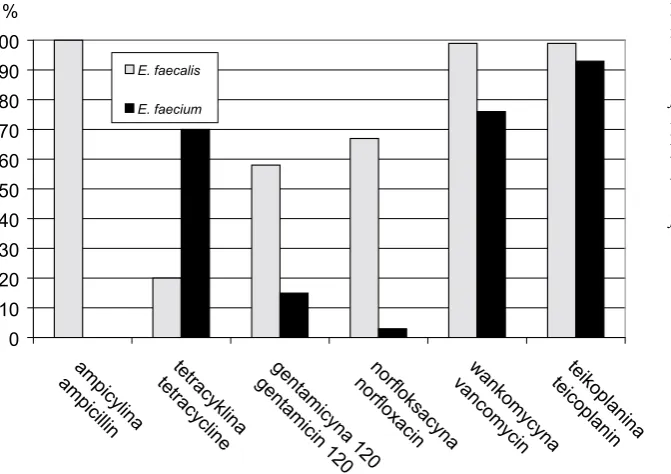
Drug susceptibility to five antibiotics deter-mined on the basis of MIC values for the 191 tested E. faecalis strains and 109 E. faecium strains is shown in Fig. 1. All E. faecalis strains showed susceptibility to ampicillin, while in the E. fae-cium group all strains were ampicillin resistant. In comparison with the E. faecium strains, the E. faecalis strains were characterized by a much higher susceptibility to glycopeptides (76 and 99%, respectively, of the strains were susceptible to vancomycin and 93 and 99% were resistant to teicoplanin) and to norfloxacin (3 and 69%), but a lower susceptibility to tetracycline (70 and 25%, respectively). The E. faecium strains were found to be much more resistant to high concentrations of gentamicinthan the E. faecalis strains(85 and 42%, respectively).
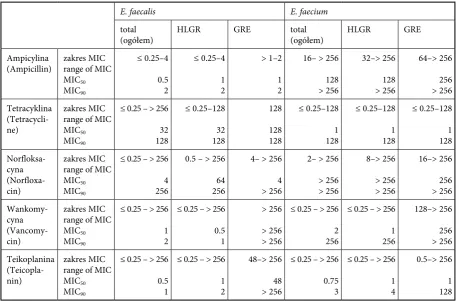
Tables 1–3 show the MIC values of the five antibiotics for the tested E. faecalis and E. faecium strains. Table 1 presents the results for all the test-ed strains and the next two tables show the results for the high-level gentamicin-resistant (HLCR) strains (Table 2) and the glycopeptide-resistant enterococcal (GRE) strains (Table 3). Table 4 includes the range of MIC values and the MICs for 50 and 90% of the tested population (MIC50
and MIC90). As can be seen in Tables 1 and 4, the
range of MIC values of ampicillin for the E. fae-calis strainswas from ≤ 0.25 to 4 µg/ml, while for as much as 34.6% of the tested strains the values did not exceed 0.25 µg/ml, and for the E. faecium strains it was from 16 to > 256 µg/ml and as much as 80.7% of the strains were highly resistant, with MIC values > 64 µg/ml. The range of MIC val-ues of tetracycline for both bacterial groups was
ampicylina 0,5 i 2 µg/ml; 12 i > 256 µg/ml, tetracyklina 32 i 128 µg/ml; 1 i 12 µg/ml, norfloksacyna 4 i 256 µg/ml; > 256 i > 256 µg/ml, wankomycyna 1 i 2 µg/ml; 2 i 256 µg/ml, teikoplanina 0,5 i 1 µg/ml; 0,75 i 3 µg/ml. Wartość MIC wankomycyny i teikoplaniny szczepów GRE wynosiła odpowiednio: ≥ 128 i ≥32 µg/ml dla E. faecium oraz > 256 i ≥48 µg/ml dla E. faecalis.
Wnioski. Znacząca wrażliwość na tetracyklinę szczepów E. faecium, w tym także GRE i HLGR, stwarza możliwość zastosowania antybiotyków z grupy tetracyklin w leczeniu zakażeń wywołanych przez szczepy tego gatunku (Adv Clin Exp Med 2010, 19, 2, 155–162).
similar (from ≤ 0.25 to 256 µg/ml for E. faecalis and up to 128 µg/ml for E. faecium), but for the prevailing majority of E. faecalis strains (71.1%) it was between 8 and 128 µg/ml, while in as much as
66.1% of the tested E. faecium population the MIC values did not exceed 1 µg/ml. The range of MIC values of norfloxacin for E. faecalis and E. faecium strains was respectively ≤ 0.25 to 256 µg/ml and
Fig. 1. Antibiotic susceptibil-ity (%) of clinical strains of
Enterococcus faecalis (N = 191) and Enterococcus faecium (N = 109)
Ryc. 1. Lekowrażliwość (%) klinicznych szczepów
Enterococcus faecalis (N = 191) and Enterococcus faecium (N = 109)
0 10 20 30 40 50 60 70 80 90 100
ampicylin
a
ampicillin tetracyklin
a tetracyclin
e
gentamicyna 120 gentamicin 12
0
norfloksacyn
a
norfloxacin wankomycyn
a vancomyci
n
teikoplanina teicoplani
n
%
E. faecalis
E. faecium
Table 1. Comparison of range of antibiotic MIC for E. faecalis and E. faecium strains
Tabela 1. Porównanie zakresów wartości MIC antybiotyków dla E. faecalis i E. faecium
Zakres wartości (Range of) MIC µg/ml
Ampicylina
(Ampicillin) Tetracyklina(Tetracycline) Norfloksacyna(Norfloxacin) Wankomycyna(Vancomycin) Teikoplanina(Teicoplanin)
E.
faecalis E. faecium E. faecalis E. faecium E. faecalis E. faecium E. faecalis E. faecium E. faecalis E. faecium
N = 191 N = 109 N = 191 N = 109 N = 191 N = 109 N = 191 N = 109 N = 191 N = 109
% % % % % % % % % %
≤ 0.25 34.6 0.0 5.8 25.7 0.5 0.0 11.5 8.3 13.6 4.6
> 0.25–0.5 17.3 0.0 4.7 19.3 3.1 0.0 26.7 42.2 39.3 16.5
> 0.5–1 16.8 0.0 9.4 21.1 2.6 0.0 44.5 22.9 28.8 50.5
> 1–2 30.9 0.0 0.5 0.0 37.2 0.9 14.1 0.9 15.2 15.6
> 2–4 0.5 0.0 0.0 3.7 25.1 1.8 2.1 1.8 2.1 5.5
> 4–8 0.0 0.0 7.9 0.9 2.1 1.8 0.0 0.0 0.0 0.0
> 8–16 0.0 0.9 18.8 3.7 0.5 1.8 0.0 0.0 0.0 0.0
> 16–32 0.0 2.8 22.0 11.9 1.0 1.8 0.0 0.0 0.0 2.8
> 32–64 0.0 15.6 16.2 1.8 5.2 1.8 0.0 0.0 0.5 0.9
> 64–128 0.0 38.5 14.1 11.9 8.9 11.0 0.0 0.9 0.0 1.8
> 128–256 0.0 24.8 0.5 0.0 13.1 13.8 0.0 14.7 0.0 0.0
> 256 0.0 17.4 0.0 0.0 0.5 65.1 1.0 8.3 0.5 1.8
> 1 to > 256 µg/ml, with MIC values not exceeding 4 µg/ml for 69% of the E. faecalis strains and above 128 µg/ml for as much as 78.9% of the E. faecium strains. The ranges of the MIC values for both gly-copeptides were identical (≤ 0.25 to > 256 µg/ml), with MIC values of vancomycin and teicoplanin not exceeding 1 µg/ml obtained, respectively, in 82.7 and 81.7% of the tested E. faecalis population and in 73.4% and 71.6% of the E. faecium popula-tion. For the vancomycin-resistant strains in the E. faecalis group (2 strains), these values exceeded 256 µg/ml and for E. faecium (26 strains) they were at least 128 µg/ml. For strains resistant to teico-planin they were 48 and > 256 µg/m in E. faecalis and for E. faecium from 32 to 256 µg/ml.
For the HLGR and GRE strains (Tables 2 and 3), the MIC values of the tested antibiotics were usually higher. As indicated in Table 2, significant differences were observed among the bacteria with high resistance to gentamicin, mainly in E. faecalis. In comparison with the total number of the tested bacteria of the above species, the HLGR strains were found to have a higher percentage of strains with MIC of ampicillin > 1 to 4 µg/ml (46.3 and 31.4%, respectively). Also, the above strains were
more resistant to tetracycline, with the percentages of tetracycline-resistant strains at 96.4 and 79.5% respectively, and the percentage of E. faecalis with an MIC value of 128 µg/ml was also higher (21.3 and 14.1%, respectively). HLGR E. faecalis strains were also close to twice more frequently resistant to fluoroquinolone than the tested strains as a whole (55.5 vs. 29.2%) and they demonstrated higher MIC values (≥ 128: 47.6 vs. 22.5%). As many as 23 HLGR strains were in the group of 26 glycopeptide-resistant E. faecium strains.
Table 3 shows the degree of susceptibility of glycopeptide-resistant strains to the tested anti-biotics. Of the 300 tested enterococcal strains, 28 were found to be resistant to glycopeptides, including 26 E. faecium and 2 E. faecalis strains. Simultaneous resistance to both glycopeptides was observed in 8 E. faecium and in 2 E. faecalis strains; the remaining strains were resistant only to van-comycin while maintaining their susceptibility to teicoplanin. Strains resistant to glycopeptides were characterized by high resistance to vancomycin and a slightly lower resistance to teicoplanin, with MIC values of ≥ 128 and ≥ 48 µg/ml for E. fae-calis and > 256 and > 64 µg/ml for E. faecium. Table 2. Comparison of range of antibiotic MIC for high level aminoglycosides resistant Enterococcus strains
Tabela 2. Porównanie zakresu wartości MIC antybiotyków dla szczepów Enterococcus opornych na wysokie stężenia amino-glikozydów
Zakres wartości (Range of value) MIC µg/ml
Ampicylina
(Ampicillin) Tetracyklina(Tetracycline) Norfloksacyna(Norfloxacin) Wankomycyna(Vancomycin) Teikoplanina(Teicoplanin)
E.
faecalis E. faecium E. faecalis E. faecium E. faecalis E. faecium E. faecalis E. faecium E. faecalis E. faecium
N = 80 N = 93 N = 80 N = 93 N = 80 N = 93 N = 80 N = 93 N = 80 N = 93
% % % % % % % % % %
≤ 0.25 26.3 0 1.3 30.1 0.0 0.0 12.5 7.5 2.5 2.2
> 0.25–0.5 13.8 0.0 0.0 18.3 2.5 0.0 23.8 41.9 41.3 16.1
> 0.5–1 13.8 0.0 2.5 19.4 1.3 0.0 53.8 22.6 35.0 51.6
> 1–2 45.0 0.0 0.0 0.0 23.8 0.0 7.5 1.1 18.8 16.1
> 2–4 1.3 0.0 0.0 3.2 17.5 0.0 1.3 1.1 1.3 5.4
> 4–8 0.0 0.0 7.5 1.1 0.0 1.1 0.0 0.0 0.0 0.0
> 8–16 0.0 0.0 28.8 4.3 0.0 2.2 0.0 0.0 0.0 0.0
> 16–32 0.0 3.2 25.0 11.8 1.3 2.2 0.0 0.0 0.0 3.2
> 32–64 0.0 12.9 13.8 1.1 6.3 2.2 0.0 0.0 0.0 1.1
> 64–128 0.0 39.8 21.3 10.8 20.0 12.9 0.0 1.1 0.0 2.2
> 128–256 0.0 23.7 0.0 0.0 26.3 15.1 0.0 16.1 0.0 0.0
> 256 0.0 20.4 0.0 0.0 1.3 64.5 1.3 8.6 1.3 2.2
Glycopeptide-resistant E. faecalis strains were resistant to tetracycline and one of them also to norfloxacin and high concentrations of gentami-cin. All vancomycin-resistant E. faecium strains were at the same time resistant to norfloxacin, with 23 of them resistant to gentamicin and 10 to tetracycline.
A comparison of the MIC50 and MIC90 values
for the E. faecalis and E. faecium groups (Table 4) shows that the most important differences con-cerned tetracycline and norfloxacin. Although the MIC90 values for the two enterococci groups were
identical, the MIC50 values differed significantly
and for tetracycline for the total of E. faecalis and E. faecium strains they were, respectively, 32 and 1 µg/ml, and for norfloxacin 4 and > 256 µg/ml.
Discussion
As reported in literature sources, E. faecalis and E. faecium constitute 80–90% of all entero-cocci isolated from patients, with E. faecalis strains
isolated much more frequently than E. faecium [3–5]. E. faecalis strains are largely susceptible to ampicillin, although some sources report the appearance of resistant strains producing beta-lactamase [6]. E. faecalis lack of susceptibility to ampicillin is also explained by their reduced affinity to beta-lactams (PBP4) [7]. Most authors, however, are of the opinion that the resistance to ampicillin determined in these strains is a result of incorrect identification [8]. In the present study, no strains resistant to ampicillin were found in the group of 191 E. faecalis strains and no GRE strains were found to be resistant. E. faecium strains are mostly resistant to ampicillinand this resistance is associated with changes in penicillin-binding proteins [9]. In the tests described in this paper, all the E. faecium strains were ampicillin resistant. Enterococci of these species are characterized by significant resistance to most antibiotics, which is dangerous because although they are isolated from patients less frequently, they include more GRE strains. In the group of 109 E. faecium strains they constituted 28%, with a prevailing number
Table 3. Range of antibiotic MIC for glycopeptide resistant Enterococcus strains
Tabela 3. Rozklad wartości MIC antybiotyków dla szczepów Enterococcus opornych na glikopeptydy Rozkład
wartości (Range of value) MIC µg/ml
Wankomycyna
(Vancomycin) Teikoplanina(Teicoplanin) Norfloksacyna(Norfloxacin) Ampicylina(Ampicillin) Tetracyklina(Tetracycline)
E.
fae-calis E. fae-cium E. fae-calis E. fae-cium E. fae-calis E. fae-cium E. fae-calis E. fae-cium E. fae-calis E. fae-cium
N = 2 N = 26 N = 2 N = 26 N = 2 N = 26 N = 2 N = 26 N = 2 N = 26
n % n % n % n % n %
≤ 0.25 23.1
> 0.25–0.5 11.5 7.7
> 0.5–1 38.5 1 26.9
> 1–2 19.2 1
> 2–4 1 3.8
> 4–8
> 8–16 3.8 3.8
> 16–32 11.5 7.7
> 32–64 1 3.8 11.5
> 64–128 3.8 7.7 19.2 2 23.1 2 26.9
> 128–256 61.5 26.9 26.9
> 256 2 34.6 1 7.7 1 50.0 38.5
N – liczba szczepów badanych.
n – liczba szczepów o określonej wartości MIC (E. faecalis). % – odsetek szczepów o określonej wartości MIC (E. faecium). N – number of examined strains.
of strains with the Van B phenotype, which is characterized by resistance to vancomycin with maintained susceptibility to teicoplanin. Both gly-copeptide-resistant E. faecalis strains belonged to the Van A phenotype, characterized by resistance to both vancomycin and teicoplanin. Among the vancomycin-susceptible strains of the E. faecalis group in comparison with the E. faecium group, a larger percentage of strains was observed char-acterized by MIC values in the range 2–4 µg/ml (16.2 and 2.7%, respectively). Despite the fact that they are characterized by higher drug resistance, in this study the E. faecium strains were found to be more susceptible to tetracycline than E. faecalis (70 and 25% of sensitive strains, respectively). The percentage of tetracycline-resistant HLGR E. fae-cium strains was the same as for the total of the tested strains of the same species, although strains resistant to high concentrations of gentamicin had slightly higher MIC values. A high percentage of GRE strains was also susceptible to tetracycline (60%), although twice as many strains with high resistance (MIC = 128 µg/ml) were observed. In comparison with the E. faecalis strains, significant susceptibility to tetracycline of E. faecium strains,
also including GRE strains, has also been reported by other authors [3, 8, 10, 11].
The tested enterococci groups differed in their susceptibility to fluoroquinolons, with the per-centage of susceptible strains at 69% for E. faecalis and 3% for E. faecium. Similar differences in the susceptibility of these enterococci were observed by other authors [11, 12]. Compared with the total number of tested strains of that species, HLGR E. faecalis strains were found to be more resistant to norfloxacin (29.2 and 55.5% of resistant strains, respectively) and at the same time strains with high (MIC ≥ 128 µg/ml) susceptibility to norfloxa-cin were observed twice as frequently. Data from Italy [10] indicate that 50% of HLGR E. faecalis strains were resistant to ciprofloxacin.
Multi-resistant Enterococcus strains, includ-ing HLGR and GRE strains, have been more and more frequently isolated in various European countries as well as outside Europe [3, 8, 10, 11]. GRE strains are isolated very infrequently in Scandinavia, with about only two resistant strains reported in 2007, both isolated at an ICU. In other European countries the percentage of such strains is much higher, especially in the E. fae-Table 4. Minimal inhibitory concentration (MIC) of antibiotic for total examined Enterococcus and GRE and HLAR strains
Tabela 4. Wartości MIC ogółu badanych szczepów Enterococcus oraz szczepów GRE i HLAR
E. faecalis E. faecium
total
(ogółem) HLGR GRE total(ogółem) HLGR GRE
Ampicylina
(Ampicillin) zakres MICrange of MIC MIC50 MIC90 ≤ 0.25–4 0.5 2 ≤ 0.25–4 1 2 > 1–2 1 2
16– > 256
128 > 256 32–> 256 128 > 256 64–> 256 256 > 256 Tetracyklina (Tetracycli-ne) zakres MIC range of MIC MIC50 MIC90
≤ 0.25 – > 256
32 128 ≤ 0.25–128 32 128 128 128 128 ≤ 0.25–128 1 128 ≤ 0.25–128 1 128 ≤ 0.25–128 1 128 Norfloksa-cyna (Norfloxa-cin) zakres MIC range of MIC MIC50 MIC90
≤ 0.25 – > 256
4 256
0.5 – > 256
64 256
4– > 256
4 > 256
2– > 256
> 256 > 256 8–> 256 > 256 > 256 16–> 256 256 > 256 Wankomy-cyna (Vancomy-cin) zakres MIC range of MIC MIC50 MIC90
≤ 0.25 – > 256
1 2
≤ 0.25 – > 256
0.5 1
> 256
> 256 > 256
≤ 0.25 – > 256
2 256
≤ 0.25 – > 256
1 256 128–> 256 256 > 256 Teikoplanina (Teicopla-nin) zakres MIC range of MIC MIC50 MIC90
≤ 0.25 – > 256
0.5 1
≤ 0.25 – > 256
1 2
48–> 256
48 > 256
≤ 0.25 – > 256
0.75 3
≤ 0.25 – > 256
1 4
0.5–> 256
1 128 HLGR – szczepy oporne na wysokie stężenie gentamycyny.
cium group isolated from blood, and in Israel it was as high as 45.7%, in Cyprus 40%, in Portugal 33.7%, in Ireland 30.9%, in Greece 29.1%, in the Czech Republic 13.7%, and in Germany 13% [6]. Most often, high resistance to glycopep-tides is observed, with MICs of vancomycin at ≥ 128 µg/ml [3,13,14], except for Scandinavia, where not only GRE strains are isolated rarely, but they are also characterized by a low degree of resistance with MIC at 8–16 µg/ml [4]. Most often, resistance to vancomycin is associated with resistance to ampicillin and carbapenems, a phe-notype characteristic of E. faecium strains. The above may serve as an explanation for the glyco-peptide resistance observed in the strains of these species. According to the most recent research, the global proliferation of vancomycin-resistant E. faecium strains is associated with the pres-ence of a set of genes in the genome of strains of that species designated as clonal complex-17 (CC17), conditioning the resistance to ampicillin and often also to fluoroquinolons, as well as Esp protein synthesis [3, 6, 9, 15].
The source of proliferation of resistant strains is not only people, but also animals and products
of animal and plant origin. The use of antibiotics in animal husbandry has contributed to the selection of multi-resistant strains in the community envi-ronment. The banning of avoparcin as a feed addi-tive in 1997 significantly contributed to a reduction in the frequency with which VRE strains were iso-lated. However, the use of other antibiotics such as tetracyclines or chinolons may still cause a growth in the number of resistant strains. As has been demonstrated by authors in Portugal [16] in tests conducted in 1999–2001, poultry samples includ-ed multi-resistant Enterococcus strains, including strains resistant to vancomycin (48%) and to high concentrations of gentamicin (34%). This indi-cates a need for more rigorous restrictions on the use of antibiotics in animal husbandry.
In conclusion, E. faecium strains are becom-ing a serious therapeutic problem because of mul-tidrug resistance with an increasing frequency of glycopeptide resistance. The considerable sensitiv-ity of E. faecium strains to tetracycline, including also GRE and HLGR strains, creates a possibility to use antibiotics of the tetracycline group in the treatment of infections caused by strains of that species.
References
[1] Performance standards for antimicrobial susceptibility testing; sixteenth informational supplement. National Committee for Clinical Laboratory Standard Institution M100–S16, 2006, 26, 3.
[2] Depardieu F, Perichon B, Courvalin P: Detection of the alphabet and identification of Enterococci and Staphylococci at the species level by multiplex PCR. J Clin Microbiol 2004, 42, 5857–5860.
[3] Coque TM, Willems RJL, Fortun J, Top J, Diz S, Loza E, Canton R, Baquero F: Population structure of
Enterococcus faecium causing bacteremia in a Spanish University hospital: setting the scene for a future increase in vancomycin resistance. Antimicrob Agents Chemother 2005, 49, 2693–2700.
[4] Claesson C, Hallgren A, Nilsson M, Svensson E, Hanberger H, Nilsson LE: Susceptibility of staphylococci and enterococci to antimicrobial agents at different ward levels in four north European countries. Scand J Infect Dis 2007, 39, 1002–1012.
[5] Mohanty S, Jose S, Singhal R, Sood S, Dhawan B, Das BK, Kapil A: Species prevalence and antimicrobial suscep-tibility of enterococci isolated in a tertiary care hospital of North India. Southeast Asian J Trop Med Public Health 2005, 36, 962–965.
[6] Leavis HL, Bonten MJM, Willems RJL: Identification of high-risk enterococcal clonal complexes: global disper-sion and antibiotic resistance. Curr Opin Infect Dis 2006, 9, 454–460.
[7] Metzidie E, Manolis EN, Pournaras S, Sofianou D, Tsakris A: Spread of unusual penicillin- and imipenem-resis-tant but ampicillin-susceptible phenotype among Enterococcus faecalis clinical isolates. J Antimicrob Chemother 2006, 57, 1.
[8] Brown DFJ, Hope R, Livermore DM, Brick G, Broughton K, George RC, Reynolds R: Non-susceptibility trends among enterococci and non-pneumococcal streptococci from bacteraemias in the UK and Ireland, 2001–06. J Antimicrob Chemother 2008, 62, suppl. 2, ii75–ii85.
[9] Oteo J, Cuevas O, Navarro C, Aracil B, Campos J: Trends in antimicrobial resistance in 3469 enterococci iso-lated from blood (Earss experience 2001–06, Spain) increasing ampicillin resistance in Enterococcus faecium. J Antimicrob Chemother 2007, 3, 1044–1045.
[10] Zarrilli R, Tripodi MF, Popolo AD, Fortunato R, Bagattini M, Crispino M, Florio A, Triassi M, Utili R:
Molecular epidemiology of high-level aminoglycoside-resistant enterococci isolated from patients in university hospital in southern Italy. J Antimicrob Chemother 2005, 56, 827–835.
[11] Oh WS, Ko KS, Song JH, Lee MY, Park S, Peck KR, Lee NY, Kim ChK, Lee H, Kim SW, Chang HH, Kim YS, Jung SI, Son JS, Yeom JS, Ki H K, Woo GJ: High rate of resistance to quinupristin-dalfopristin in Enterococcus faecium clinical isolates from Korea. Antomicrob Agents Chemother 2005, 49, 5176–5178.
[13] Hsieh YCh, Ou TY, Teng SO, Lee WCH, Lin YCh., Wang JT, Chang SCh, Lee WS: Vancomicin-resistant entero-cocci in a tertiary teaching hospital in Taiwan. J Microbiol Immunol Infect 2009, 42, 63–68.
[14] Draghi DC, Sheehan DJ, Hogan P, Sahm DF:In vitro activity of linezolid against key Gram-positive organisms isolated in the United States: results of the LEADER 2004 surveillance program. Antimicrob Agents Chemother 2005, 49, 5024–5032.
[15] Top J, Willems R, Velden S, Asbroek M, Bonten M: Emergence of clonal Complex 17 Enterococcus faecium in the Netherlands. J Clin Microbiol 2008, 46, 214–219.
[16] Novais C, Coque TM, Costa MJ, Sousa JC, Baquero F, Peixe LV: High occurrence and persistence of antibiotic-resistant enterococci in poultry food samples in Portugal. J Antimicrob Chemother 2005, 56, 1139–1143.
Address for correspondence:
Beata Kowalska-Krochmal Department of Microbiology Wroclaw Medical University Chałubińskiego 4
50-367 Wrocław Poland
Tel.: +48 71 784 13 05 E-mail: [email protected] Conflict of interest: None declared Received: 18.01.2010