© 2014 Agung Endro Nugroho et al. This is an open access article distributed under the terms of the Creative Commons Attribution License -NonCommercial-ShareAlikeUnported License (http://creativecommons.org/licenses/by-nc-sa/3.0/).
Journal of Applied Pharmaceutical Science Vol. 4 (09), pp. 030-035, September, 2014 Available online at http://www.japsonline.com
DOI: 10.7324/JAPS.2014.40906 ISSN 2231-3354
Blood Glucose Reduction by Combination of Andrographis paniculata
(Burm. f.) Ness Herbs and Azadirachta indica A. Juss Leaves in
Alloxan-Induced Diabetic Rats
Agung Endro Nugroho
1, Kurnia Rahayu Purnomo Sari
1, Anggit Listyacahyani Sunarwidhi
2, Sudarsono
3 1Department of Pharmacology and Clinical Pharmacy, Faculty of Pharmacy, Universitas Gadjah Mada, Yogyakarta, Indonesia. 2
Department of Pharmaceutical Biology, Faculty of Pharmacy, Universitas Gadjah Mada, Yogyakarta, Indonesia.
ARTICLE INFO ABSTRACT
Article history:
Received on: 11/05/2014 Revised on: 01/06/2014 Accepted on: 17/06/2014 Available online: 27/09/2014
Andrographis paniculata (Burm. f.) Ness and Azadirachta indica A. Juss are Indonesian local plants that are
potentially developed as antihyperglycemic agents. This study was aimed to explore antihyperglycemic effect of herbal extract combination of A. paniculata (Burm. f.) Ness and A. indica A. Juss in alloxan-induced rats compared to single extract treatment. Diabetic condition was induced with an intraperitoneal injection of 150 mg/kgBW alloxan monohydrate in the rats. After stable diabetic condition, the rats were administered either with single or extract combination for 15 consecutive days. Blood glucose profiles in both preprandial and postprandial were monitored at the day of 5, 10, and 15. Analysis of blood glucose level was performed using colorimetric method of GOD-PAP. In the study, preprandial and postprandial blood glucose levels of alloxan-induced rats could be decreased after administration of the herbal extract combination of A. paniculata (Burm. f.) Ness and A. indica A. Juss. The extract combination exhibited higher hypoglycemic effects than this of the single extract treatment. In conclusion, the combination of A. paniculata (Burm. f.) Ness and A. indica A. Juss is potential to develop as an antidiabetic agent.
Key words:
diabetes mellitus, alloxan,
Andrographis paniculata and
Azadirachta indica
INTRODUCTION
Diabetes mellitus (DM) is a degenerative disease related to metabolic disorder and marked with hyperglycemic condition that leads to health complications. Each year, number of diabetic patient is increasing and effective therapy to control blood glucose level is required to prevent further complication. Besides, innovation in DM therapy with minimal side effect is interesting due to long-term drug administration. Thus, exploration of new agent that is able to correct hyperglycemic condition with minimal side effect from natural source is urgently needed. One approach for treating DM is use of traditional medicine. To date, the use of single medicinal plant has not shown satisfactory results. Therefore, the attemps to combine several antidiabetic drugs are interesting to be developed. Andrographis paniculata (Burm. f.) Ness (known as sambiloto) dan Azadirachta indica A. Juss
.
* Corresponding Author
Prof. Agung Endro Nugroho, M.Sc, PhD, Department of Pharmacology and Clinical Pharmacy, Faculty of Pharmacy, Universitas Gadjah Mada, Sekip Utara Yogyakarta, Indonesia 55281, Telp: (0274)543120, Fax : (0274)543120. Email : [email protected]
(known as Mimba) are widely used in Indonesian society for treating various diseases including diabetes melitus (Niranjan et al., 2010; Biswas et al., 2002). Several in vivo studies have been done to explore pharmacological activities of A. paniculata in controlling blood glucose level using diabetic-induced models. Ethanolic extract of A. paniculata was reported to lower blood glucose level in both streptozotocin (STZ)-diabetic rats and high fructose-fat fed rats. The extract also succeeded to increase GLUT-4 level (Yu et al, 2003; Zhang and Tan, 2000; Nugroho et al., 2012). Reportedly, A.
paniculata exhibited insulin-releasing actions on BRIN-BD11 cells,
a pancreatic cell line expressing insulin and glucokinase (Wibudi
et al., 2008). Reportedly, A. indica exhibited antidiabetic activities
in several diabetic model in rats. The A. indica leaves extract inhibited the generation of superoxide anion and hydroxyl free radical in diabetic rats.The oxidative stress has a main role in pathogenesis of diabetes mellitus (Shrivastava et al., 2012).It indicates that A.indica is potential to prevent further complications
of diabetes. In addition, A. indica leaves extract also inhibited the activities of alpha-amylase and alpha-glucosidase, enzymes having
The abundance of A. paniculata and A. indica as natural sources of antihyperglycemic agent become primary consideration for further exploration as a herbal combination agent in reducing blood glucose level. In this study, ethanolic extracts of A. paniculata
herbs and A. indica leaves were combined and evaluated for their anti-diabetic effect in alloxan-induced diabetic rats.
MATERIALS AND METHODS
Materials
Alloxan and glibenclamide were purchased from Sigma Chemical Co. (St.Louis, MO, USA). Glucose level were measured using colorimetric method (GOD-PAP) with glucose oxidase and
4-aminoantipyrine (DiaSys, Diagnostic Systems GmbH,
Holzheim, Germany). Sodium carboxymethyl cellulose and glucose were obtained from E. Merck, Darmstadt, Germany. All other reagents were high-grade qualified materials.
Animals
Wistar rats (2-3 month old) weighing 150-200 g used in the study were maintained on a constant temperature (22 ± 2 °C) and a constant relative humidity (55 ± 10%) and automatically controlled 12:12 h light-dark cycle (light on at 07:00 a.m.). They were fed with a standard laboratory food and water at libitum. Ethical clearance for the animal study was obtained from Research Ethics Committee, Integrated Research and Testing Laboratory Universitas Gadjah Mada, Indonesia.
Preparation of ethanolic extract
A. paniculata (Burm. f.) Ness and A. indica A. Juss were
collected from Sleman, Yogyakarta during October 2013. Plant authentication was performed at Department of Pharmaceutical Biology, Faculty of Pharmacy, Universitas Gadjah Mada, Indonesia. The voucher specimen was stored in a herbarium of the department. The dried leaves were powdered and then stored in an airtight container for further use.
The plant was dried and powdered separately, extracted by maseration using 70% (v/v) ethanol for 24 hours with ratio of 1:10. After twice re-extraction, collected filtrate was evaporated under reduced pressure to get a viscous extract. The extracts of A.
paniculata and A. indica A. Juss were processed into dried
extracts, then mixed with ratio by 1:1.
Phytochemical analysis
Analysis of ethanolic extract of A. paniculata was performed using a stationary phase of silica gel 60 F254 and a mobile phase of chloroform-ethyl acetate-methanol-acetic acid (7:2:0,5:0,5 v/v). Detection of androgapholide content in spot was
performed under UV wavelength 254 nm. Standard
androgapholide and Andrographis paniculata (Burm. f.) Ness extract were prepared in methanol solvent at concentration of 1 mg/ml and 4 mg/ml, respectively. Quantitative analysis was performed by measuring spot intensity in TLC scanner at wavelength of 230 nm. In the phytochemical analysis of A. indica
ethanolic extratct, TLC method using stationary phase of silica gel 60 F254 and a mobile phase of n-butanol-acetic acid-water (4:1:5 v/v) was used. Rutin was applied as a marker compound and spot detection was performed under UV 254 and UV 366 nm. Quantitative analysis of rutin content in the extract was performed using spot scanning at wavelength of 364 nm.
Induction of hyperglycemia
The rats were induced by an intraperitoneal injection of alloxan monohydrate to achieve hyperglycemic condition at single dose of 150 mg/kgBW. Control group rats were treated with saline solution. Hyperglycemic condition was determined at 72 hours after induction by measuring preprandial and postprandial blood glucose levels. Rats with blood glucose level >216 mg/dL (>12 mmol/L) were categorized as diabetic condition and compared to blood glucose level of normal control group.
Experimental design
The rats were divided into several groups as follows: A. Group I (diabetic control) : alloxan-induced diabetic rats
received vehicle solution 0.5% CMC-Na;
B. Group II (positive control) : diabetic rats received oral hypoglycemic drug, glibenclamide dose 4.5 mg/kgBW, orally, once daily;
C. Group III : diabetic rats received single A. paniculata
extract 200 mg/kgBW orally, twice daily;
D. Group IV : diabetic rats received single A. indica extract 200 mg/kgBW orally, twice daily;
E. Group V : diabetic rats received herbal extract
tcombination dose 200 mg/kgBW, orally, twice daily; F. Group VI : diabetic rats received herbal extract
combination dose 400 mg/kgBW, orally, twice daily; G. Group VII : diabetic rats received herbal extract
combination dose 800 mg/kgBW, orally, twice daily.
All treatments in each group were administered for 15 consecutive days and blood glucose levels, both preprandial and postprandial were measured at the day of 5, 10, and 15. The preprandial blood sample was collected from retro-orbital plexus after 12 hours fasting. Two hours after glucose administration of 1.75 gr/kgBW, blood was collected for determination of postprandial blood glucose level. Blood sample was incubated at room temperature for 30 minutes. Serum was separated from other blood component by centrifugation at 5000 rpm for 10 min at 25oC. The blood glucose level in the serum was analyzed
spectrophotometrically by oxidase-peroxidase (GOD-PAP)
method using biochemical diagnostic kit (DiaSys, Holzheim, Germany)
Statistical analysis
statistically using ANOVA followed by LSD test. P-values less than 0.05 were considered significant.
RESULTS
Phytochemical analysis of A. paniculata
Based on phytochemical analysis using
TLC-densitometry method, ethanolic extract of A. paniculata showed positive content of andrographolide (Fig. 1). Qualitative detection under UV 254 exhibited a same spot with standard andrographolide (hRf 53). Furthermore, quantitative analysis confirmed the content of andrographolide by 16.17% using TLC scanner at wavelength of 230 nm.
(a) (b) (c)
Fig. 1: TLC profile of ethanolic extract Andrographis paniculata (Burm. f.)
Ness. TLC method was performed using a stationary phase of silica gel 60 F254 and a mobile phase of chloroform-ethyl acetate-methanol-acetic acid (7:2:0,5:0,5 v/v). Spot detection (a) under UV 366nm, (b) under UV 254 after AlCl3 spraying, and (c) under UV 366 after AlCl3 spraying
(a) (b) (c)
Fig. 2: TLC profile of ethanolic extract Azadirachta indica A. Juss. TLC
method was performed using a stationary phase of silica gel 60 F254 and a mobile phase of n-butanol-acetic acid-water (4:1:5 v/v). Spot detection (a) under UV 366nm, (b) under UV 254 after
AlCl3 spraying, and (c) under UV 366 after AlCl3 spraying.
Phytochemical analysis of A. indica
Phytochemical analysis of ethanolic extract of A. indica
was performed using rutin. The content of standard compound was determined based on rutin concentration in A. indica extract (Fig. 2). Qualitative detection was observed under UV 254 and UV 366
and showed the presence of rutin in A. indica extract. Further analysis using AlCl3 spray exhibited higher intensity of rutin spot
that was detected under UV 254 and UV 366. Quantitative analysis of rutin concentrationin extract using TLC scanner at wavelength of 364 nm resulted in rutin level of 2.86%
Effect on blood glucose levels
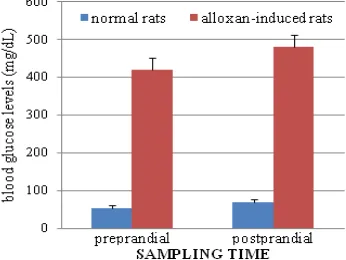
Both preprandial and postprandial blood glucose levels raised significantly after single dose administration of alloxan (150 mg/kgBW) intraperitoneally in rats. Determination of blood glucose level was performed at 72 hours after alloxan induction. Figure 3 shows that alloxan-induced group had higher blood glucose level in comparison to normal control group.
Fig. 3: Profile of preprandial and postprandial blood glucose levels in rats after
alloxan induction in comparison to normal control group. Data represent mean±SEM, and are five to six independent experiments. *P<0.05 compared to the control value.
Fig. 4: Hypoglycemic activities (%) of all treatments. Dose 1-3 are 200, 400 and 800 mg/kg BW, respectively. Data represent mean±SEM, and are four to five independent experiments. *P<0.05 compared to the control value.
As a control, there was no significant change in blood glucoce level after treatment CMC-Na (fig 4). As shown in table 1-2 and figure 4, administration of combination of A. paniculata
and A. indica for 15 days reduced preprandial and postprandial
blood glucose levels in alloxan-induced diabetic rats. In comparison to single ethanolic extract of A. paniculata or A.
indica, the combination exhibited higher activity to reduce blood
The reduction of blood glucose level was enhanced as increased dose of combination treatment as shown in group VI (combination 400 mg/kgBW) and group VII (combination 800 mg/kgBW). At the highest combination dose, blood glucose level preprandial and postprandial was reduced by 58.121% and 62.839%, respectively. However, the effect of blood glucose reduction at highest combination administration was still lower than this of standard diabetic drug, glibenclamide, that reduced preprandial blood glucose by 68.782% and postprandial blood glucose by 70.25%.
DISCUSSION
Incidence of diabetes mellitus is associated with oxidative stress that leads to production of reactive oxygen species (ROS), peroxide, and disturbance of antioxidant enzyme (Baynes, 1991; Pari and Latta, 2005). Poor healthy lifestyle that followed by high exposure of oxidant compounds may induce metabolic disorder and stress, then unfortunately caused severe diabetes mellitus.
Alloxan (2,4,5,6-tetraoxypyrimidine;
2,4,5,6-pyrimidinetetrone) belongs to derivate compound of oxidized pyrimidine that often used as induction compound in diabetes model (Rohilla and Ali, 2012). It selectively destructs β cells of Langerhans islets. Inside the pancreatic β-cells, alloxan promotes production of superoxide radical and ROS that lead to DNA damage in these cells (Ebelt et al., 2000; Szkudelski, 2001; Das et al., 2012). Alloxan-induced DM resembles clinical DM that is caused by negative impact of high oxidant compound and producing free radical to damage β cells of Langerhans islets. In the study, by an intraperitoneal administration of alloxan monohydrate (150 mg/kgBW), rats developed diabetes likewise in patients as shown by increased preprandial and postprandial blood glucose levels (>100% in comparison to normal control).
Reportedly, A. paniculata exhibited potent antidiabetic activities in various diabetic conditions in rats (Zhang et al., 2000;
Yu et al., 2003; Nugroho et al., 2012). Previously, this
extract decreased the levels of blood glucose, triglyceride, and LDLin high-fat-fructose-fed rat. However, this extract did not influence the serum cholesterol and rat body weight (Nugroho et al., 2012). Its aqueous leaf extract (400 mg/kg BW, po) also succeeded to decrease the blood glucose levels and increase the activity of superoxide dismutase (SOD) and catalase in in STZ-induced diabetic rats (Dandu and Inamdar, 2009). Superoxide dismutase and catalaseas well as glutathione peroxidase play a main role as antioxidant enzymes and can protect against free radicals that contribute in oxidative stress. The oxidative stress has a main role in development of diabetes complications (Giacco and Brownlee; 2010).
The antidiabetic activities of A. paniculata mainly contributed by its active compounds mainly andrographolide.In addition, andrographolide is a main constituent and abundance in this herb (Cheung et al., 2001; Pholphana et al., 2004). Andrographolide was reported to improve the uptake of glucose in isolated soleus muscle of STZ-diabetic rats. This compoundcould increase the mRNA and protein levels of GLUT4 (Yu et al., 2003;
Yu et al., 2008). In the previous study, andrographolide was able
to recover insulai Langerhans, increase density and morphology of β cell thus promote insulin expression that lead to lower blood glucose both preprandial and postprandial in STZ-induced diabetic neonatal rats (Nugroho et al., 2014). In the study, the contennt of andrographolide in the ethanolic extract of A. paniculata was 16.17%.
A. indica was reported to show antidiabetic activities in
several diabetic model in rats. The A. indica leaf extract succeeded to inhibit the generation of superoxide anion and hydroxyl free radical in diabetic rats (Shailey and Basir, 2012). The oxidative stress contributes in the pathogenesis of diabetes mellitus and its further complications (Shrivastava et al., 2012). A. indica leaves extract also inhibited the activities of amylase and
alpha-Table. 1: The effect of Andrographis paniculata (Burm. f.) Ness extract, Azadirachta indica A. Juss extract, their combination, and glibenclamide treatments on
preprandial blood glucose level. Dose 1-3 are 200, 400 and 800 mg/kg BW, respectively.
Treatment
Blood glucose levels (mg/dL) Baseline
(before alloxan administration)
Observation time (after alloxan administration)
Day 0 Day 5 Day 10 Day 15
Glibenclamide 43.103 ± 2.31 468.315 ± 1.10 297.267 ± 6.69 229.234 ± 4.75 176.818 ± 3.87
A. paniculata extract 43.916 ± 2.06 468.919 ± 1.02 421.429 ± 9.26 361.613 ± 7.89 306.664 ± 6.45
A. indica extract 46.254 ± 2.10 270.148 ± 1.06 247.938 ± 1.07 223.341 ± 9.9 214.593 ± 8.91
Combination dose 1 28.802 ± 3.99 472.157 ± 8.84 363,156 ± 6.10 321.239 ± 6.03 290.833 ± 5.26 Combination dose 2 49.195 ± 2.17 306.061 ± 9.64 248,725 ± 9.20 205.419 ± 8.1 169.912 ± 5.35 Combination dose 3 54.988 ± 4.47 305.214 ± 8.93 220,734 ± 8.21 196.196 ± 6.81 163.698 ± 4.63
Table. 2: The effect of Andrographis paniculata (Burm. f.) Ness extract, Azadirachta indica A. Juss extract, their combination, and glibenclamide treatments on
postprandial blood glucose level. Dose 1-3 are 200, 400 and 800 mg/kg BW, respectively.
Treatment
Blood glucose levels (mg/dL) Baseline
(before alloxan administration)
Observation time(after alloxan administration)
Day 0 Day 5 Day 10 Day 15
Glibenclamide 70.353 ± 0.86 496.626 ± 1.04 351.104 ± 9.83 309.137 ± 8.73 199.583 ± 3.74
A. paniculata extract 74.975 ± 4.04 542.663 ± 1.06 445.458 ± 9.45 427.956 ± 9.22 337.945 ± 6.25
A. indica extract 70.947 ± 2.01 320.765 ± 1.19 274.407 ± 1.09 247.253 ± 1.05 250.453 ± 1.03
glucosidase, enzymes having important role in glucose absorption (Kazeemet al., 2013).
Besides, active compounds of A. indica are also reported to reduce blood glucose levels. There are several active compounds of A. indica that are responsible for antidiabetic activity, such as quercetin, rutin, and nimbidin (Biswas et al., 2004). Reportedly, rutin, a glycoside of flavonoid quercetin,was able to reverse islet pancreas morphology, oxidative, and glycemia in diabetic rats. Oral administration of rutin also lowered fasting blood glucose level, glycosylated hemoglobin as well as induced insulin, C-peptide, hemoglobin, and protein (Kamalakkannan and Prince, 2006). In the study, the ethanolic extract of A. indica
contained rutin as phytochemical marker compound by 2.86%. Moreover, quercetin exhibited potent antioxidant that protects the body from diabetic complication induced by ROS (Lakhanpal and Rai, 2007; Nugroho et al., 2013).
Each ethanolic extract used in this study possessed active compounds that were well-reported to reduce blood glucose level. Furthermore, herbal extract combination showed synergistic effect in lowering blood glucose level in alloxan-induced diabetic rats, even at 200 mg/kgBW (lowest dose in the study). However, the dose used to achieve the optimum effect was obtained at dose of 800 mg/kg BW.Therefore, the next step is to fractionate and purify the extracts so that the dose of the combination can be reduced. Combination of ethanolic extracts of A. paniculata and A. indica
provides various anti-diabetic compounds. The diversity of active compounds in the herbal extract comination may synergistically increase antihyperglycemic effect and may give an alternative in diabetes therapy. However, exploration related to the mechanism of action of each active compound from ethanolic extract remains to be elucidated.
CONCLUSION
In conclusion, combination of Andrographis paniculata
(Burm. f.) Ness and Azadirachta indica A. Juss exhibited higher effect in lowering blood glucose levels, both preprandial and postprandial in comparison to single extract administration in alloxan-induced rat. In conclusion, the combination is potential to develop as an antidiabetic agent.
ACKNOWLEDGEMENT
We thank the Faculty of Pharmacy Universitas Gadjah Mada for facilitating some part of the study. We also thank the DP2M DIKTI (Directorate of Higher Education) Ministry of Education, Indonesia through “Hibah Unggulan Perguruan Tinggi” Research Grant 2012 for financial support in the study.
REFERENCES
Akter R, Mahabub-Uz-Zaman M, Rahman Md. S, Khatun MA, Abdullah AM, Ahmed NU, Islam F. Comparative Studies on Antidiabetic Effect with Phytochemical Screening of Azadirachta indica and
Andrographis paniculata. Journal of Pharmacy and Biological Sciences.
2013;5(2):2278-3008.
Baynes JW. Role of Oxidative Stress in Development of Complications in Diabetes. Diabetes. 1991; 40:405-412.
Biswas K, Chattopadhyay I, Banerjee RK, Bandyopadhyay U. Biological Activities and Medicinal Properties of Neem (Azadirachta
indica).Curr Sc. 2002; 82:1336-1345.
Cheung HY, Cheung CS, Kong CK. Determination of bioactive diterpenoids from Andrographis paniculata by micellar electrokinetic chromatography. J Chromatogr A. 2001;930:171.
Dandu AM, Inamdar NM. Evaluation of beneficial effects of antioxidant properties of aqueous leaf extract of Andrographis paniculata
in STZ-induced diabetes. Pak J Pharm Sci. 2009; 22(1):49-52.
Das J, Vasan V, Sil, PC. Taurine exerts hypoglycemic effect in alloxan-induced diabetic rats, improves insulin-mediated glucose transport signaling pathway in heart and ameliorates cardiac oxidative stress and apoptosis.Toxicol. Appl. Pharmacol.2012; 258:296-308.
Ebelt H, Peschke D, Bromme HJ, MorkeW, Blume R, Peschke E. Influence of Melatonin on Free Radical-Induced Changes in Rat Pancreatic Beta-Cell In Vitro.J. Pineal. Res.2000; 28:65-72.
Giacco F, Brownlee M. Oxidative stress and diabetic complications.Circ Res. 2010;107(9):1058-70
Kamalakannan N, Prince PS. Antihyperglycaemic and Antioxidant Effect of Rutin, A Polyphenolic Flavonoid, In Streptozotocin Induced Diabetic Wistar Rats.Basic and Clin. Pharmacol., Toxicol. 2006; 98(1): 97-103.
Kazeem MI, Dansu TV, Adeola SA.Inhibitory effect of
Azadirachta indica A. juss leaf extract on the activities of alpha-amylase
and alpha-glucosidase. Pak J Biol Sci. 2013;16(21):1358-62.
Lakhanpal, P, Rai DK. Quercetin: a versatile flavonoid. Internet Journal of Medical Update. 2007;2(2):22-37.
Niranjan A, Tewari SK, Lehri A. Biological Activities of Kalmegh (Andrographis paniculata Nees).Indian J. Nat. Prod. Res. 2010;1(2):125-135.
Nugroho AE, Andrie M, Warditiani NK, Siswanto E, Pramono S, Lukitaningsih E. Antidiabetic and antihiperlipidemic effect of
Andrographis paniculata (Burm. f.) Nees and andrographolide in
high-fructose-fat-fed rats. Indian J Pharmacol. 2012;44(3):377-81.
Nugroho AE, Kusumaramdani G, Widyaninggar A, Anggoro DP, Pramono S. Antidiabetic effect of combination of n-hexane insoluble fraction of ethanolic extract of A. paniculata with other traditional medicines.International Food Research Journal. 2013;21(2):785-789.
Nugroho AE, Rais IR, Setiawan I, Pratiwi PY, Hadibarata T, Tegar M, Pramono S.Pancreatic effect of Andrographolide isolated from
Andrographis paniculata (Burm. f) Ness.Pakistan Journal of Biological
Sciences,2014;17(1):22-31.
Pari L, Latha M. Antidiabetic Effect of Scoparia dulcis: Effect on Lipid Peroxidation in Streptozotocin Diabetes.Gen. Physiol. Biophy.2005;24:13-26.
Pholphana N, Rangkadilok N, Thongnest S, Ruchirawat S, Ruchirawat M, Satayavivad J. Determination and variation of three active diterpenoids in Andrographis paniculata (Burm.f.) Nees. Phytochem Anal. 2004; 15:365.
Rohilla A, Ali S. Alloxan Induced Diabetes: Mechanism and Effect.Int J Res Pharm Biomed Sci.2012;3:819-823.
Shailey S, Basir SF.Strengthening of antioxidant defense by
Azadirachta indicain alloxan-diabetic rat tissues. J Ayurveda Integr Med.
2012; 3(3):130-5.
Shrivastava A, Chaturvedi U, Sonkar R, Khanna AK, Saxena JK, Bhatia G.Antioxidant effect of Azadirachta indica on high fat diet induced diabeticCharles Foster rats.Appl Biochem Biotechnol. 2012; 167(2):229-36.
Szkudelski T. The Mechanism of Alloxan and Streptozotocin Action in B Cells of The Rat Pancreas.Physiol. Res. 2001; 50:536-546.
Wibudi A, Kiranadi B, Manalu W, Winarto A, Suyono S. The traditional plant, Andrographis paniculata (Sambiloto), exhibits insulin-releasing actions in vitro. Acta Med Indones. 2008; 40(2):63-68.
Yu BC, Chang CK, Su CF, Cheng JT. Mediation of beta-endorphin in andrographolide-induced plasma glucose-lowering action in type I diabetes-like animals. Naunyn Schmiedebergs Arch Pharmacol. 2008 Jun;377(4-6):529-40.
Zhang XF, Tan BK. Antihyperglycaemic and Anti-oxidant Properties of Andrographis paniculata in Normal and Diabetic Rats, Clin. Exp. Pharmacol. Physiol. 2000;27:358-363.
How to cite this article:
Agung Endro Nugroho, Kurnia Rahayu Purnomo Sari, Anggit Listyacahyani Sunarwidhi, Sudarsono. Blood Glucose Reduction by Combination of Andrographis paniculata (Burm. f.) Ness Herbs
and Azadirachta indica A. Juss Leaves in Alloxan-Induced