Performance and Energy Optimization of the Terasort Algorithm by Task
Self-Resizing
Jie Song
1, Shu Xu
1, Li Zhang
1, Claus Pahl
3, Ge Yu
2Software College1, School of Information Science and Engineering2, Northeastern University,
No.11, Lane 3, WenHua Road, HePing District, Shenyang, Liaoning, China
Irish Centre for Cloud Computing and Commerce IC4, Dublin City University, Dublin 9, Ireland3
e-mail: [email protected]
http://dx.doi.org/10.5755/j01.itc.44.1.5772
Abstract. In applications of MapReduce, Terasort is one of the most successful ones, which has helped Hadoop to win the Sort Benchmark three times. While Terasort is known for its sorting speed on big data, its performance and energy consumption still can be optimized. We have analyzed the characteristics of Terasort and have identified the existence of idle nodes, which does not only waste energy but also loses performance. Therefore, we optimize Terasort through a single-task distributed algorithm and a task self-resizing algorithm to save time and reduce the energy that is consumed by map nodes and reduce nodes, which is caused by task schedule and waiting for input data. The algorithm proposed in this paper has proved to be effective in optimizing performance and energy consumption through a series of experiments. It can also be adapted to other applications in the MapReduce environment.
Keywords: Big Data; Energy Consumption; MapReduce; Terasort; Task Resizing.
1. Introduction
Two important indicators of algorithm quality are time complexity and space complexity. Nowadays, energy consumption has become a third important indi-cator because of the non-negligible energy consumed by IT equipment [1]. In 2010, energy consumption of data centers has accounted for 1.3% of the world’s total electricity consumption, and is expected to increase in the next five years by 56% [2]. Consequently, the storage, time and energy consumption of algorithms should be properly analyzed and estimated.
Sorting is an algorithm that puts elements of a list in a certain order [3]. Sorting is the most widely used type of algorithm across various applications. For example, the web correlation sorting algorithm of search engines can decide whether users could find the desired information in the page [4]. Meanwhile, sorting is a common task for program designers, and the choice of the sorting algorithm will directly affect the time, storage and energy consumption of applications.
In this paper, we study on the performance and energy optimization of Terasort [5]. Terasort as a sor-ting algorithm is an important application of MapRe-duce and has become a contributor to big data appli-cations. In 1998, Jim Gray created the Sort Benchmark, which defines a large data set with 100 byte data records. Sorting algorithms are evaluated on the time
they use to sort the data and write to disk completely [6]. In 2008, Terasort won the first prize of the 1TB sort benchmark, taking 209 seconds, nearly 90 seconds faster than the previous year’s record holder. In 2009, with a cluster of 1460 nodes, Terasort won again by sorting 1TB data in 62 seconds [7]. In 2013, Terasort won again with a cluster of 2100 nodes, sorting 1.42TB of data in one minute [6].
Terasort is successful in sorting big data, but we still believe that its performance and energy consumption can be optimized because in Terasort the performance is decreased and energy is wasted while some nodes are idle. In MapReduce, there are two main reasons for idleness. Firstly, in MapReduce, there are two kinds of tasks: map tasks (mappers for short) and reduce tasks (reducers for short). Although Terasort has optimized the data transfer between mappers and reducers to guarantee the parallelism of reducers, reducers do not start until all mappers are complete, which causes the idleness of nodes while reducers wait for mappers. Secondly, the mapper size could be reduced to ensure that all mappers are executed synchronously and
reducers are started as simultaneously as possible. However, this will add more costs to task scheduling, which means sometimes nodes are idle because they are waiting for scheduled mappers.
In this paper, we propose that one and only mapper
nodes will not wait for new tasks, and that a mapper
can change the size of processing data dynamically to adjust its size by itself to ensure that all mappers
complete simultaneously and, consequently, reducers
do not wait on mappers any more. We focus on three aspects. Firstly, a mapper is allocated to a node once with a proper initial size by the single-task distribution algorithm. Secondly, a mapper is given priority on processing; the first is local data, then in-rack data and remote data. Thirdly, a self-resizing algorithm adjusts the size of the mappers, which are represented by the number of data blocks that should be processed, to ensure the parallelism of mappers. There are some challenges to implement these approaches. Firstly, we need to define abstractions to model the task and its data, the parallelism and the execution cost. Secondly, there are a number of combinations of the initial task distribution. Thus, we need to provide a method to find the best one efficiently. Thirdly, we need to design an efficient self-resizing algorithm that is self-motivated and decentralized to ensure the parallelism among nodes and that aims to reduce the resizing cost. Finally, we need to ensure fault tolerance if there is only one
mapper for a node, because fault tolerance cannot be guaranteed by task replication and recovery. Optimiza-tion algorithms such as Genetic Algorithms (GA), Particle Swarm Optimization (PSO) and Ant Colony Optimization (ACO) are suitable to solve this problem, but they are too expensive to be adopted in real-time task distribution and self-resizing.
The remainder of this paper is organized as follows. Section 2 introduces MapReduce and Terasort and analyzes the disadvantages of Terasort as our moti-vation. Section 3 proposes single-task distribution and self-resizing algorithms to improve the performance and decrease the energy consumption of Terasort, describes the task model and algorithms, and then gives a detailed example. In Section 4, the effectiveness of the proposed algorithms is proven by experiments. Section 5 introduces related work. In Section 6, conclu-sions and future work are summarized.
2. Background and Motivation
In this section, firstly, we introduce the structure and execution process of the MapReduce framework. Secondly, we describe the core of Terasort and empha-size its two technical difficulties, which make Terasort different from other sorting algorithms. Finally, we analyze the disadvantages of Terasort and put forward the basic ideas and steps of our proposed algorithms.
2.1. MapReduce
In MapReduce, the computation is moved closer to where the data are located. A MapReduce job is divided into tasks, map tasks (mappers) and reduce tasks (reducers). All mappers and reducers are performed on nodes in parallel. Both input and output of mappers and reducers are key-value pairs. < 𝐾𝑒𝑦𝑀𝐼𝑛, 𝑉𝑎𝑙𝑢𝑒𝑀𝐼𝑛> and
< 𝐾𝑒𝑦𝑀𝑂𝑢𝑡, 𝑉𝑎𝑙𝑢𝑒𝑀𝑂𝑢𝑡> are the input and output format of mappers, respectively; < 𝐾𝑒𝑦𝑅𝐼𝑛, 𝑉𝑎𝑙𝑢𝑒𝑅𝐼𝑛> and <
𝐾𝑒𝑦𝑅𝑂𝑢𝑡, 𝑉𝑎𝑙𝑢𝑒𝑅𝑂𝑢𝑡> are the input and output format of
reducers, respectively. 𝐾𝑒𝑦𝑀𝑂𝑢𝑡 should be implicitly converted to 𝐾𝑒𝑦𝑅𝐼𝑛 , and 𝑉𝑎𝑙𝑢𝑒𝑅𝐼𝑛 is the collection of
𝑉𝑎𝑙𝑢𝑒𝑀𝑂𝑢𝑡. Reducers would not start until the slowest
mapper is complete, and the job is accomplished when the slowest reducer has completed. The parallelism is decreased if mappers (reducers) do not finish synchronously.
MapReduce splits the input data set into 𝑀 subsets (where 𝑀 is larger than the number of nodes), and each subset is the input of one mapper. The mapper reads each record of the subset, processes it and outputs
< 𝐾𝑒𝑦𝑀𝑂𝑢𝑡, 𝑉𝑎𝑙𝑢𝑒𝑀𝑂𝑢𝑡> pairs as the intermediate result. A "split" function partitions the intermediate records into 𝑅 disjoint buckets by applying a hash func-tion to 𝐾𝑒𝑦𝑀𝑂𝑢𝑡 of each output record. Each bucket is written to the local disk where the mapper is executed. The input dataset is mapped to 𝑀 × 𝑅 intermediate files when the 𝑀 mappers terminate. All < 𝐾𝑒𝑦𝑀𝑂𝑢𝑡,
𝑉𝑎𝑙𝑢𝑒𝑀𝑂𝑢𝑡> pairs with the same value of 𝐾𝑒𝑦𝑀𝑂𝑢𝑡, let this be the j-th bucket, are stored in file 𝐹𝑖𝑗(1 ≤ 𝑖 ≤ 𝑀,
1 ≤ 𝑗 ≤ 𝑅).
The second phase of a MapReduce job executes 𝑅 reducers, where 𝑅 is typically the number of nodes. The input for each reducer 𝑅𝑗 consists of the files
𝐹𝑖𝑗(1 ≤ 𝑖 ≤ 𝑀). These files are transferred over the network from the mappers’ local disks. Note that again all output records from the maps with the same hash value are consumed by the same reducer, regardless of which mapper produced the data. Each reducer
processes or combines the records assigned to it in some way, and then writes records to an output file (in the distributed file system), which forms part of the computation’s final output.
2.2. Terasort
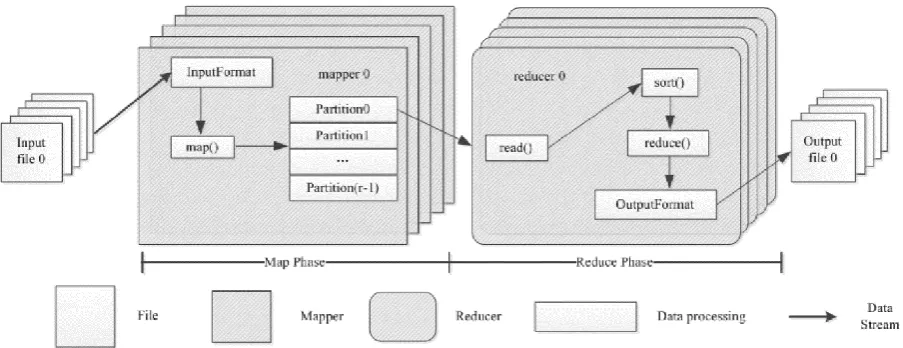
Terasort is an application of the MapReduce programming model based on the Hadoop platform. The core of Terasort is its map stage. As shown in Fig. 1, each mapper divides the data into 𝑅 data blocks, where all data in the i-th (𝑖 > 0) block are larger those that in the (𝑖 + 1)-th block. At the reduce stage, the i-th
reducer processes (sorts) all mapper’s i-th blocks. Thus, the results of the i-th reducer will be larger than those of the (𝑖 + 1)-th one. Finally, it outputs all of the
reducers’ results sequentially, which are the sorting results [5]. As shown in Fig. 1, we assume that there is a data set whose range of value is distributed from 1 to 100 on average. If there are 5 reducers in the MapReduce cluster, then the range of Partition0 will be [1, 20], and so on. After all data have been partitioned, the data in a Partition will be sent to a specific reducer
whose number is the same as the corresponding
some detailed features, which are not the emphasis of Terasort, are abbreviated in this paper.
Terasort has two technical difficulties. Firstly, it adopts a sampling technique to determine the ranges of
𝑅 blocks. Data sampling is performed before mappers
start. It samples data from the input data first, then sorts the data, and divides them into 𝑅 blocks. After finding the upper and lower limits of each block (break-point), these break-points are stored in a distributed cache. Secondly, Terasort adopts tries to quickly determine which block a record belongs to. A ’trie’ [8,9], also known as digital tree or radix tree or prefix tree, is an ordered tree data structure that is used to store a dynamic set or an associative array. Tries treat a record as a sequence of characters, and unlike a binary search tree, no node in a trie stores the key associated with that
node. Instead, its position in the tree defines the key with which it is associated. All descendants of a node have a common prefix of the sequence associated with that node, and the root is associated with the empty sequence. In tries, the time of finding a sequence does not depend on the number of the tree’s nodes, but rather the length of the sequence [5].
First, a Terasort mapper reads the break-points of each block from the distributed cache and builds a trie accordingly. Leaves of a trie stand for reducers. When data are processed, for each record, the reducer it belongs to can be determined by querying the trie. For example, if break-points are "abc", "dab" and "ddd" for 4 blocks (reducers), the trie in Terasort is built as shown in Fig. 2. For a string "daz", z > b, according to the trie, it belongs to the 3rd block.
Figure 1. Structure of Terasort algorithm
2.3. Motivation
In Terasort, only when all i-th blocks of the mappers
have been processed, the i-th reducer can start sorting. Therefore, if there is one mapper executing more quickly than others, the reducers will still have to wait for the other mappers, which wastes energy and decreases performance. To address this problem, we can reduce the waiting time by decreasing the size of the split (mapper). Assuming that the split size is 64MB, in the worst case all mappers are waiting for the processing of 64MB data. In some special applications with simple maps or less data, small splits may improve parallelism, but will lead to more scheduling costs. We can take 1TB input data as an example. If the split size is 64MB, the total scheduling time is 16384, and suppose a single scheduling cost unit is 0.01 seconds, the total time waiting for the task is about 164 seconds. Assuming that the idle power consumption of a computer is 40 watt, then there is an energy waste of 6560 joule, which should not be ignored.
We also noticed that the time complexity of a trie query is O(M) (where M is the length of the sequence), which means that the cost of processing each record in
a mapper is a constant related to the performance of node. In Terasort, every record in the mapper should be processed, so the cost of a mapper is linear to its data size. If a mapper can adjust the processing data size according to its current processing speed and the unprocessed data, it may guarantee the synchronization of mappers without additional centralized scheduling cost. Furthermore, data also no longer have to be divided into many splits (mappers), which can also save task scheduling time. Based on this idea, the task distribution and self-resizing algorithms in the paper are proposed as follows:
Step 1: Each node is assigned one and only mapper, and data are assigned to mappers fairly by single task distribution algorithm.
Step 2: All mappers process their assigned data until one mapper is complete.
Step 3: The fastest mapper resizes its assigned data block itself by snatching data from an unfinished
mapper. The speed of processing local data is faster than that of processing remote data, which has to be considered as well.
Step 4: Step 3 will be repeated until all the mappers
have completed.
The above approach avoids negative effects on per-formance and energy consumption introduced by sche-duling, and ensures the parallelism among mappers and minimizes waiting time for reducers, i.e., this approach optimizes Terasort in both performance and energy consumption.
3. Schedule Model and Algorithm
In this paper, Terasort is optimized by minimizing the time of "nodes waiting for tasks" and "reducer
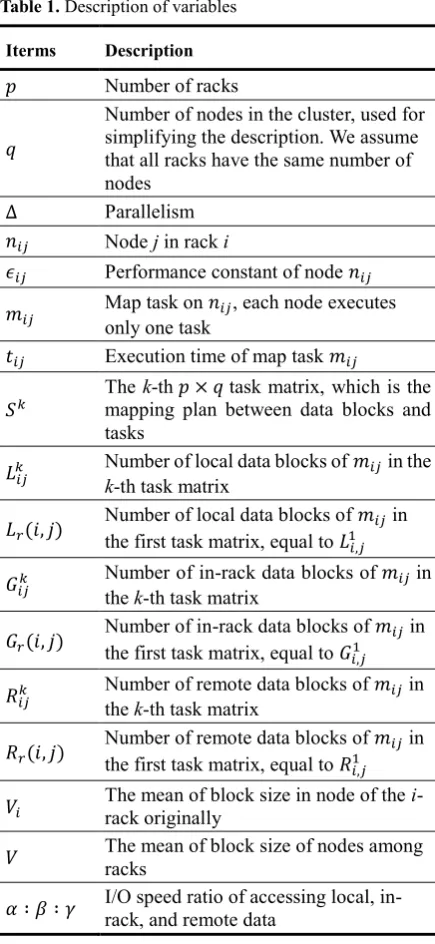
waiting for inputs". The first issue is addressed by single-task distribution, while the second is addressed by task self-resizing. In a traditional MapReduce cluster, a job is submitted into the job queue first and next divided into a number of tasks, which are then distributed to nodes according to a certain algorithm. When a task is complete in a slave node, the master node will distribute a new task and repeat the cycle until the job is complete. Each task has a fixed size and the distribution algorithm can guarantee that the task is distributed to the node which is closest to the data, while the parallelism of the mapper is ensured by assigning a smaller task size (64MB as default). Fault-tolerance is supported through a replication mecha-nism. Single-task distribution can minimize the schedu-ling cost, but it is difficult to determine the task size and ensure task replication due to the unbalanced data distribution and heterogeneous nodes. The parallelism of mappers does not improve either if they only process the pre-assigned data. Thus, we adopt the task self-resizing mechanism to solve these problems. The varia-bles used in this section are given in Table 1.
3.1. Model
Firstly, we define the task model and the targets of resizing. Then we define the algorithms for single-task distribution and task self-resizing. Note that in this section the task mentioned refers to the map task.
Definition 1. Data Block: A data block is a partition of the processed data in a map task. The size of a task is represented as the number of its blocks. Let 𝑚𝑖𝑗 be a map task on the j-th node of the i-th rack, and 𝐿𝑖𝑗, 𝐺𝑖𝑗 and 𝑅𝑖𝑗 be the number of local, in-rack (regional) and remote data blocks it contains, respectively.
Table 1. Description of variables
Iterms Description
𝑝 Number of racks
𝑞
Number of nodes in the cluster, used for simplifying the description. We assume that all racks have the same number of nodes
Δ Parallelism
𝑛𝑖𝑗 Node j in rack i
𝜖𝑖𝑗 Performance constant of node 𝑛𝑖𝑗
𝑚𝑖𝑗 Map task on only one task 𝑛𝑖𝑗, each node executes
𝑡𝑖𝑗 Execution time of map task 𝑚𝑖𝑗
𝑆𝑘 The k-th
𝑝 × 𝑞 task matrix, which is the mapping plan between data blocks and tasks
𝐿𝑘𝑖𝑗
Number of local data blocks of 𝑚𝑖𝑗 in the
k-th task matrix
𝐿𝑟(𝑖, 𝑗)
Number of local data blocks of 𝑚𝑖𝑗 in the first task matrix, equal to 𝐿1𝑖,𝑗
𝐺𝑖𝑗𝑘
Number of in-rack data blocks of 𝑚𝑖𝑗 in the k-th task matrix
𝐺𝑟(𝑖, 𝑗)
Number of in-rack data blocks of 𝑚𝑖𝑗 in the first task matrix, equal to 𝐺𝑖,𝑗1
𝑅𝑖𝑗𝑘
Number of remote data blocks of 𝑚𝑖𝑗 in the k-th task matrix
𝑅𝑟(𝑖, 𝑗)
Number of remote data blocks of 𝑚𝑖𝑗 in the first task matrix, equal to 𝑅𝑖,𝑗1
𝑉𝑖
The mean of block size in node of the i -rack originally
𝑉 The mean of block size of nodes among racks
𝛼 ∶ 𝛽 ∶ 𝛾 I/O speed ratio of accessing local, in-rack, and remote data
Definition 2. Task Matrix: The task matrix 𝑆 = [𝑠𝑖𝑗 ]𝑝×𝑞represents the distribution of a job’s data block in the cluster. Each element in task matrix 𝑠𝑖𝑗 re-presents the data size of the task on the j-th (1 ≤ 𝑗 < 𝑞) node of the i-th (1 ≤ 𝑖 < 𝑝 ) rack. The data size is represented by the number of local, in-rack and remote data blocks, denoted by 𝑠𝑖𝑗 =< 𝐿𝑖𝑗, 𝐺𝑖𝑗, 𝑅𝑖𝑗 >. 𝑠𝑖𝑗 is null if there is no such node in that rack.
𝑆0 is the initial task matrix in which all 𝐺
𝑖𝑗 = 𝑅𝑖𝑗 =
𝑠0= [
< 5,0,0 > < 6,0,0 > < 7,0,0 > < 8,0,0 > < 3,0,0 > < 4,0,0 > < 5,0,0 > 𝑛𝑢𝑙𝑙 < 5,0,0 >
< 2,0,0 >
< 5,0,0 > < 3,0,0 >
< 5,0,0 > < 5,0,0 > 𝑛𝑢𝑙𝑙 𝑛𝑢𝑙𝑙
] (1)
The task matrix should be implemented as a jagged array because racks contain different numbers of nodes. To simplify the model and algorithm description, we assume that there are 𝑞 racks and 𝑝 nodes in each rack. However, our approach is also suitable for a jagged task matrix.
Definition 3.Parallelism: The parallelism Δ of the map phase is evaluated as the total difference between the maximum execution time of the task and that of the others, meaning how long the other tasks are waiting for the slowest one. This can also represent the wasted energy. Let 𝑚𝑝𝑞 be the slowest task, then parallelism is defined as in equation (2), with Δ ∈ (0, 1].
Δ−1= 1 + ∑ (𝑡𝑝𝑞− 𝑡𝑖𝑗) 𝑝,𝑞
𝑖=1,𝑗=1 (2)
Definition 4. Single-Task Distribution: Single-task distribution is a process of dividing a job into tasks and distributing tasks to the nodes after the job is submitted. One node has one and only one task, and all data blocks are assigned to tasks to ensure the maximum parallelism.
If we execute Terasort with 𝑆0, the parallelism of the mappers is related to the data placement on nodes. A balanced data distribution across nodes will lead to a higher parallelism, while the worst situation is that the slowest node processes the maximum data and other nodes remain idle until it has completed. In big data environments, it is difficult to ensure parallelism through the pre-defined and balanced data placement. In single-task distribution we assume that the cluster is homogeneous. Thus, the performance of the map task is only related to the number of data blocks it processes and whether these blocks are local, in-rack or remote data blocks.
The single-task distribution algorithm transforms
𝑆0 to 𝑆1 on the assumption that the performance of each node is equal. It is easy to prove that if ∀𝑠𝑖𝑗 and
𝑠𝑎𝑏∈ 𝑆, 𝛼𝐿𝑖𝑗+ 𝛽𝐺𝑖𝑗+ 𝛾𝑅𝑖𝑗 = 𝛼𝐿𝑎𝑏+ 𝛽𝐺𝑎𝑏+ 𝛾𝑅𝑎𝑏, then parallelism is maximal. However, the performance of each node varies and is unknown before it is executed. During the execution, to improve the parallelism, 𝑆1 will be transformed to 𝑆2 , 𝑆3 and 𝑆𝑘 through the task self-resizing algorithm. The definition of self-resizing is given below.
Definition 5. Task self-resizing: Task self-resizing is an algorithm invoked by a task when it completes earlier than others, in order to adjust its size dynami-cally according to the current task matrix. The task size is presented as the size and location of the data that the task should process.
Task self-resizing is an effective algorithm to maxi-mize the parallelism among mappers. Each time the task self-resizing algorithm is invoked, 𝑆𝑘 will be tran-sformed to 𝑆𝑘+1 correspondingly (𝑘 = 0, 1, 2, 3 …). In
every transformation, 𝐿𝑖𝑗𝑘 , 𝐺𝑖𝑗𝑘 , 𝑅𝑖𝑗𝑘 are adjusted, and based on 𝑆𝑘 , 𝑆𝑘+1 satisfies Δ𝑘 < Δ𝑘+1 and
∑ (𝐿𝑘+1𝑖𝑗 + 𝐺𝑖𝑗𝑘+1+ 𝑅𝑖𝑗𝑘+1) 𝑝,𝑞
𝑖=1,𝑗=1
= ∑ (𝐿𝑘𝑖𝑗+
𝑝,𝑞
𝑖=1,𝑗=1
𝐺𝑖𝑗𝑘 + 𝑅𝑖𝑗𝑘).
The goal of self-resizing is to make the execution time of each task approximately equal. Therefore, we need to consider the regularity of the execution time of a task. It depends on the node’s performance, the num-ber of data blocks, the blocks’ location and the task (algorithm) complexity. In addition, the node’s perfor-mance is a constant and the data block size and location are adjusted by the self-resizing algorithm. The task complexity varies because of varying functionalities. The complexity of a mapper may change with the characteristics of input data, which results in more difficulty to define the execution-time function of a task. Fortunately, because of the specifics of Terasort, there is only one query of a trie in a map task, and the time complexity of this query depends only on the height of the tree, which is constant. Consequently, the time complexity O(M) is unchanged for any data, and we can define the execution time 𝑡𝑖𝑗 of task 𝑚𝑖𝑗 as
𝑡𝑖𝑗 = ε𝑖𝑗× (α𝐿𝑖𝑗+ β𝐺𝑖𝑗+ γ𝑅𝑖𝑗) (3) Equation (3) is an expression of the time consump-tion of task 𝑚𝑖𝑗 running on 𝑛𝑖𝑗, which is the j-th node in the i-th rack. 𝛼 ∶ 𝛽 ∶ 𝛾 denotes the I/O speed ratio of accessing local, in-rack or remote data. 𝜀𝑖𝑗 is a performance constant defined by multiplying node performance and task complexity. Equation (4) defines
𝑡𝑖 as the execution time of tasks in the i-th rack and t as the execution time of all tasks.
ij q
j
i
t
t
1
max
ip
i
t
t
1
max
(4)In Terasort, whether it is multiple-task distribution or single-task distribution, the results of the mappers
are unchanged. Similarly, the task self-resizing does not cause the output errors. According to equation (4), the time consumption of the map phase is equal to the time consumption of the slowest mapper, so we can accele-rate the slowest task and optimize both time and energy consumption of Terasort in the map phase. Moreover, in a MapReduce cluster, due to hardware and network problems, a task failure is treated as a normal phenome-non. When a task fails, single-task distribution causes the loss of the corresponding results, requiring the task’s re-distribution. If the size of new task and the aborted one are the same, then in the most cases, the new task would not catch up with the other tasks because of its delay. Therefore, there is no guarantee of fault tolerance because the execution time of the map phase depends on the execution time of the last aborted and restarted task. As this is time-consuming, task resizing needs to be adapted to task failures.
toleran-ce can be implemented by recovery or replication me-chanisms. A traditional Terasort adopts the replication mechanism provided by MapReduce framework. It starts a larger number of redundant tasks and if there is one task completed, its replicates are abandoned. The replication mechanism is simple, but it wastes resour-ces and affects performance. The MapReduce frame-work cannot adopt the recovery mechanism because the mechanism needs set up checkpoints for each task and replicate the necessary intermediate results as a backup. For the traditional Terasort, it is equally difficult. On the one hand, there are too many tasks to afford setting a check-point one by one; on the other hand, it is also costly to remotely backup the task’s intermediate out-puts which are stored locally. However, the single-task distribution approach makes the recovery mechanism possible. In Terasort, the mapper then adds to each data a tag with its domain and sends it to the corresponding reducer. The number of reducers is certain, so the
mapper does not write intermediate results to the local disk, but to the remote disk of the reducer directly [5]. This technology has been presented in [10]. Based on this, we do not need to backup intermediate results, and what we need to record are only the data blocks which have been processed. When a task fails, some appro-priate adjustments in task resizing are made to other running tasks, rather than starting a new task. The resizing algorithm is described in detail in the next section.
3.2. Algorithms
From the previous section we know that there is one and only one map task on each node. The size of a map task is the number of data blocks it should process, where the data blocks could be local, in-rack or remote. The goal of the single-task distribution and task self-resizing algorithms is maximizing the parallelism in the map phase by changing the task size itself before it is complete.
The single-task distribution algorithm calculates 𝑆1 according to 𝑆0 by re-distributing data blocks to each task fairly. The basic idea is as follows: firstly, we adjust the data blocks of tasks rack-by-rack to make sure that tasks in the same rack are completed at the same time, and then we carry out the same operation across the racks by treating racks as tasks (nodes) in the same rack.
A row of the task matrix stands for tasks running in the same rack. ∀𝑖 ∈ [1, 𝑝], we consider tasks from 𝑚𝑖10 to 𝑚𝑖𝑞0 . They are sorted according to their size increasingly. Without loss of generality, let 𝑚𝑖10 contain the fewest data blocks and 𝑚𝑖𝑞0 contains the most data blocks, i.e., 𝐿0𝑖1= min (𝐿0𝑖1, 𝐿0𝑖2… 𝐿0𝑖𝑞) , 𝐿0𝑖𝑞=
max (𝐿0𝑖1, 𝐿0𝑖2… 𝐿0𝑖𝑞) and 𝑉𝑖= 1
𝑞∑ 𝐿𝑖1 0 𝑞
𝑗=1 . If there are k tasks whose blocks are fewer than those of 𝑉𝑖, then 𝑚𝑖10 to 𝑚𝑖𝑘0 can be treated as a virtual task 𝑚𝑖𝑤0 , and the others can be treated as a virtual task 𝑚𝑖𝑣0 which has
𝐿0𝑖𝑤 and 𝐿0𝑖𝑣 local data blocks respectively, i.e., 𝐿0𝑖𝑤 =
∑ 𝐿0𝑖𝑗 𝑘
𝑗=1
, 𝐿0𝑖𝑣 = ∑ 𝐿0𝑖𝑗 𝑞
𝑗=𝑘+1
. Thus, the task distribution problem in the i-th rack can be changed to "how many data blocks of 𝑚𝑖𝑣0 should be moved to 𝑚𝑖𝑤0 to ensure two virtual tasks can be completed simultaneously". Let 𝑚𝑖𝑤0 process 𝑥 data blocks of
𝑚𝑖𝑣0. Then, we obtain equation (5):
0 , ) ( ) ( , ) ( 0 , , 1 0 0 0 1 0 0 1 0 1 0 0 1 1 1 1 1 0 1 1 0 1 iv iw iv iv iv iw iv iw iw iw iw iv iv iv iw iw iv iv iv iw iw iw G L L L L L L G L L L L x G L G L G x L L x G L L
(5)
To ensure the parallelism of inner tasks in virtual tasks 𝑚𝑖𝑤0 and 𝑚𝑖𝑣0 , ∀𝑔 ∈ [1, 𝑘] 𝑚𝑖𝑔0 gets
𝑉𝑖−𝐿𝑖𝑔0
∑𝑘 (𝑉𝑖−𝐿𝑖𝑗0) 𝑗=1
× 𝑥 from 𝑚𝑖𝑣0 proportionally. ∀𝑢 ∈ [𝑘 +
1, 𝑞] 𝑚𝑖𝑢0 provides
𝐿𝑖𝑢0−𝑉𝑖 ∑ (𝐿0𝑖𝑗−𝑉𝑖)
𝑞 𝑗=𝑘+1
× 𝑥 data blocks to
𝑚𝑖𝑤0 . Regularly, the task order for receiving blocks is from 𝑚𝑖10 to 𝑚𝑖𝑘0 , and the task order for providing blocks is from 𝑚𝑖𝑞0 to 𝑚𝑖𝑘+10 . Thus, it is ensured that
𝑚𝑖10 gets more blocks, 𝑚𝑖𝑞0 gives more blocks, which is consistent with the actual situation. To summarize:
𝐿1𝑖𝑔= 𝐿𝑟(𝑖, 𝑔)
𝐿𝑟(𝑖, 𝑔) = {
𝐿0𝑖𝑔 (𝑔 ≤ 𝑘)
𝐿0𝑖𝑔−
𝐿𝑖𝑔0−𝑉𝑖
∑ (𝐿𝑖𝑗0−𝑉𝑖) 𝑞
𝑗=𝑘+1
× 𝑥 (𝑔 > 𝑘)(6)
𝐶𝑖𝑔1 = 𝐺𝑟(𝑖, 𝑔) =
{
𝑉𝑖− 𝐿0𝑖𝑔
∑ (𝑉𝑖− 𝐿0𝑖𝑗) 𝑘
𝑗=1
(𝑔 ≤ 𝑘)
0 (𝑔 > 𝑘)
𝑅𝑖𝑔1 = 𝑅𝑟(𝑖, 𝑔) = 0
Through equation (6), the parallelism of tasks in each rack is ensured, but the workload among racks is still unbalanced. Here, we treat tasks in the same rack as a virtual task, and then the problem of "parallelism of racks" is changed to the problem of "parallelism of tasks in the same rack", so that the operations defined in equation (6) are also suitable for these virtual tasks.
The rack that has fewer local data blocks in 𝑆0 is assigned some local data blocks from other racks as remote data blocks. Let 𝑉 =1
𝑝∑ 𝐿𝑟(𝑖, 𝑗)
𝑝,𝑞
𝑖=1,𝑗=1 be the average number of data blocks in a rack. Here, we still assume that there are c racks whose total data blocks are less than 𝑉. Then, these racks can be treated as a virtual task 𝑚𝑤0 and the other racks be treated as a virtual task 𝑚𝑣0 . They have 𝐿𝑤0 and 𝐿0𝑣 local data blocks, respectively, 𝐿0𝑤= ∑ 𝐿𝑟(𝑘, 𝑗)
𝑐,𝑞
∑𝑝,𝑞𝑘=𝑐+1,𝑗=1𝐿𝑟(𝑘, 𝑗). By the same approach, we can calculate how many data blocks are assigned to a rack as remote blocks, and how many data blocks a task in the rack provide proportionally, and how many remote data blocks a task in the rack receive proportionally. The deduction is abbreviated here, and for ∀ℎ ∈ [1, 𝑝],
∀𝑔 ∈ [1, 𝑞], 𝑆1 is given as in equation (7):
𝐿0𝑤= ∑ 𝐿𝑟(𝑘, 𝑗) 𝑐,𝑞
𝑘=1,𝑗=1 , 𝐿𝑣
0 = ∑𝑝,𝑞 𝐿𝑟(𝑘, 𝑗)
𝑘=𝑐+1,𝑗=1
𝐺𝑤0 = ∑ 𝐺𝑟(𝑘, 𝑗)
𝑐,𝑞
𝑘=1,𝑗=1 , 𝐺𝑣
0= ∑𝑝,𝑞 𝐺𝑟(𝑘, 𝑗)
𝑘=𝑐+1,𝑗=1
𝑥 =𝛼×(𝐿𝑣0−𝐿𝑤0)+𝛽×(𝐺𝑣0−𝐺𝑤0)
𝛼+𝛾
𝐿1ℎ𝑔= {
𝐿𝑟(ℎ, 𝑔) (ℎ ≤ 𝑐) 𝐿𝑟(ℎ, 𝑔) − (𝐿𝑟(ℎ,𝑔)−𝑉)×𝑥
∑𝑝 (∑𝑞𝑗=1𝐿𝑟(𝑘,𝑗)−𝑉) 𝑘=𝑐+1
(ℎ > 𝑐)
𝐺ℎ𝑔1 = 𝐺𝑟(ℎ, 𝑔)
𝑅ℎ𝑔1 = {
𝑉−𝐿𝑟(ℎ,𝑔) ∑𝑐 (𝑉−∑𝑞𝑗=1𝐿𝑟(𝑘,𝑗))
𝑘=1
× 𝑥 (ℎ ≤ 𝑐)
0 (ℎ > 𝑐)
(7)
Single-task distribution transforms 𝑆0 to 𝑆1 , and then 𝑆1 is distributed to each node and referred to by the self-resizing algorithm. After single-task distribu-tion, all tasks finish at the same time if the nodes are homogeneous. However, the nodes are normally hete-rogeneous. To ensure parallelism, we need a self-resizing algorithm to adjust the data blocks of the faster tasks. A self-resizing algorithm is invoked by the task itself when all its data blocks in 𝑆1 have been processed, and it transforms 𝑆1 to 𝑆2 by snatching one more data block from other tasks, and then 𝑆2 to 𝑆3 analogously. After k times self-resizing, all tasks are completed at 𝑆𝑘 . The basic ideas of the selfresizing algorithm are the following: each task processes local data blocks preferentially; the faster tasks process as many remote data blocks as possible, or process the in-rack data blocks if there is not a remote one available. The slower tasks process as many local data blocks as possible. With this approach, we minimize the possibi-lity that all the other tasks wait for the slowest task to process the last unprocessed remote data block.
In Terasort, the speed of a map task is unrelated to the data features it processes, so theoretically all tasks complete simultaneously, otherwise a task completes earlier if it is running on a higher-performance node, at which time this task should snatch a data block from a slower task. The rules of snatching are as follows:
(1) If task i has some local data blocks which are assigned to other tasks in 𝑆0 , then these data blocks should be snatched first and processed locally;
(2) Task i randomly snatches a remote data block from another in-rack task j if possible. Remote data blocks of task j are also remote data blocks of task i
because tasks i and j are in the same rack.
(3) If there is no further remote data block in the in-rack tasks, task i randomly snatches a remote data block from another remote task j if possible. Here, the remote
data block of j is from one of the tasks that are in the same rack as task i, i.e., it is an in-rack data block for task i.
(4) If there is no further in-rack data block that has been assigned to out-rack tasks, task i randomly snatches a remote data block from another remote task
j if possible. This data block is also a remote data block of task i.
(5) If there is no task containing a remote data block, task i randomly snatches an in-rack data block from any other in-rack task.
(6) If there is no in-rack task containing an in-rack data block, task i randomly snatches an in-rack data block from any other remote task.
(7) If there is no remote task containing an in-rack data block, task i randomly snatches a local data block of any other in-rack task.
(8) If there is no in-rack task containing any unprocessed data block, task i randomly snatches a local data block from any other remote task, until all tasks are complete.
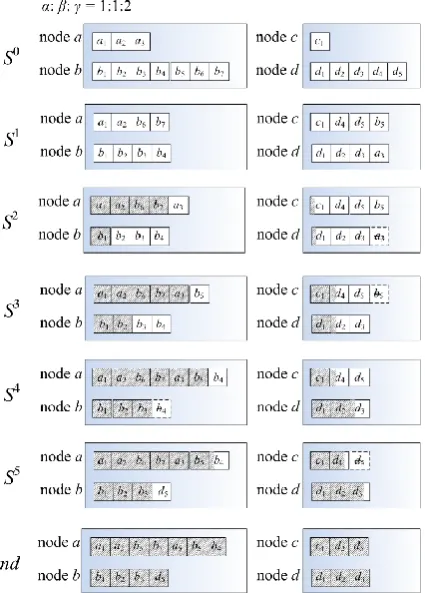
Figure 3. An example of the data processing steps in the map phase. There are one step of single-task distribution
and four steps of self-resizing. The small boxes refer to data blocks. It can be distinguished whether a data block is local, in-rack or remote from its id. A shadow
boxed (or part of box) means that the data block has been processed
ratio of local data, in-rack data and remote data is 1:1:2. After the single-task distribution, the initial task matrix is 𝑆1, and four self-resizing steps are shown in Fig. 3. In Fig. 3, each row represents a task matrix of mappers
when the proposed algorithms are executed. After the single-task distribution, 𝑆0 has changed to 𝑆1, block 𝑎
3 was moved to node 𝑑, while 𝑏6 and 𝑏7 were distributed to node 𝑎, and 𝑏5, 𝑑4 and 𝑑5 were distributed to node
𝑐. Then, after task 𝑎 completed, the node 𝑎 found block
𝑎3 and snatched it according to the first rule of the selfresizing algorithm. Before all the tasks were complete, each step satisfied the self-resizing algorithm. Noticing that tasks 𝑎 and 𝑏 were faster than tasks 𝑐 and 𝑑, nodes 𝑎 and 𝑏 contain more data blocks than nodes 𝑐 and 𝑑.
The self-resizing algorithm ensures that the possibility of processing remote data blocks by faster asks is higher than that for slower tasks. It improves both the performance and parallelism of Terasort.
4. Experiments
We built a Hadoop MapReduce cluster with 12 computers and compared the performance and energy consumption between the original Terasort and the optimized Terasort. Details of the testbed are shown in Table 2.
Table 2. Description of the testbed
Iterms Description
Node
1 master node and 11 slave nodes. Homogeneous computers. Intel Core i5-2300 2.80GHz, 8GB memory, 1TB hard disk, onboard video, audio and network card. 1000Mb network.
Operating
System CentOS 5.6, Linux 2.6.18 Kernel MapReduce
Platform Hadoop 1.0.4
Energy Consumption Measuring approach
PowerBay power-meter
(http://www.northmeter.com/index-en.html), power precision ±0.01 0.1W, maximum 2200W, measurement frequency 1.5-3 second. Obey specification
GB/T17215-2003. In addition, to avoid accidental error, the experiments are performed 10 times, and the results shown below are the mean values.
System Information Collecting Tool
SAR
Test cases
Test cases with different data size run under the original Terasort [11] and the optimized Terasort, and data are randomly distributed on the nodes.
Case A: 3 GB per node Case B: 5 GB per node Case C: 10 GB per node
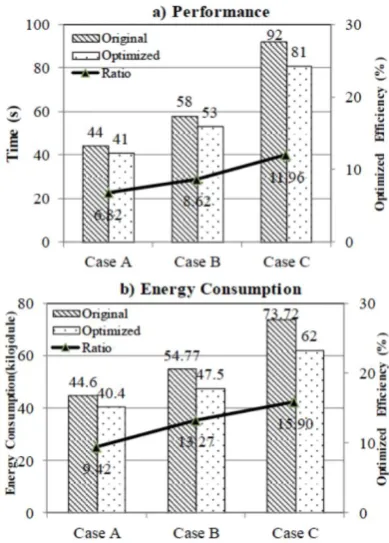
As shown in Fig. 4, the total time consumption of sorting the same data size by the original and optimized Terasort is different. The optimization effects are also different across the different cases. In case A, the optimized efficiency (the ratio between reduced value and original value) of time consumption and that of energy consumption are 6.32% and 9.42%, respec-tively. In case B they rise to 8.62% and 13.27%, respectively. In case C they continuously rise to 11.96% and 15.90%, respectively. The optimized Terasort sorts faster than the original one, and also consumes less energy. The original Terasort also considers the different processing capacities of different nodes, but does not consider the consumption of time and energy during scheduling and node idleness. Consequently, the optimized Terasort gains better performance and energy efficiency. The optimization is more obvious when more data are involved.
From the optimized efficiency (black line) in Fig. 4, we know that there is a positive linear correlation between the superiority of the optimized Terasort and the data size. This means that when sorting really big data sets, the optimization effect of time and energy consumption is more obvious. Our testbed is a homogeneous cluster. However, the optimization effect of the proposed approach is more significant in a heterogeneous cluster because in a heterogeneous cluster, the self-resizing algorithm adjusts the number of data blocks, while the original MapReduce adjusts the number of tasks (splits). Obviously, the former has a finer adjusting granularity.
Figure 4. Comparison between time consumption and
From Fig. 4, we can see that time consumption is positively related to energy consumption. It can be concluded that in a MapReduce Terasort, performance improvement is in accordance with the energy consumption optimization. There are two main opinions about the relationship between performance and energy consumption of a distributed application. On the one hand, it is generally believed that when more nodes are involved, jobs are executed faster while more energy is consumed. On the other hand, the waiting time is reduced so that both performance and energy consumption are optimized. For example, nodes are idle while waiting for the scheduled tasks, or the CPU is idle while waiting for I/O operations. These negatively affect both performance and energy efficiency. Our experiment proves the latter in Terasort. Moreover, the experimental results prove that the mean of the improved time consumption is 9%, while the mean of the improved energy consumption is 12%. Generally, multiplying time and power is energy consumption. Even if we assume power to be almost constant, the energy consumption is still optimized as a consequence of the reduction in time consumption (optimization by 9%).
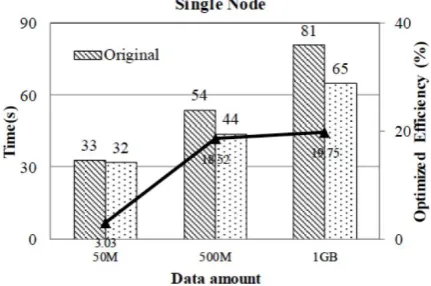
To prove that minimizing the scheduling time and waiting time of a reducer is the main reason of optimi-zation, we designed two additional experiments. The first one logs the execution time of each mapper and calculates Δ (see Definition 3) of the original Terasort and the optimized Terasort. The parallelism Δ of the optimized Terasort is 4.31 times larger than that of the original one in case 𝐶 , proving that the optimized Terasort has better parallelism. In the second experi-ment, we executed the original Terasort and the optimi-zed Terasort on a single node. In that situation, there is no reducer waiting for mappers, so the optimization is the result of saving the task scheduling time.
The results shown in Fig. 5 are in accordance with those shown in Fig. 4. The total time taken by sorting the same data size under two kinds of Terasort is different. The optimization effects are also different among the different cases. In case 𝐴, due to the small dataset, the optimization is not significant, but for case
𝐵, the optimized efficiency is as significant as 18.52% and for case 𝐶 the optimized efficiency is stable at 19.75%. Moreover, the optimized efficiency is better than that in Fig. 4 because in the original Terasort, the node is both JobTracker and Task-Tracker, so the scheduling cost is much higher than that of the optimized Terasort.
In conclusion, we have proven that the optimized Terasort reduces the time and energy consumption caused by the scheduling and node waiting. That is to say, compared with the original one, the single-task distribution and self-resizing algorithms improve the performance and reduce the energy consumption of Terasort.
5. Applications
The proposed approach can be applied not only in Terasort, but also in many other applications whose task complexity is only related to the data size, but not data distribution or other features. Terasort has two important operations, one is sampling and building the trie tree, the other one is marking records. Their performance only depends on the data mount. Besides Terasort, there are also many MapReduce applications with these characteristics. Taking Join and PageRank algorithms as examples, the mappers read and parse all inputs and send them to reducers. In general MapReduce applications, the data size is main effect of performance, but not data distribution, especially in the big data environment. Thus, the proposed approach has a wide applicability.
The proposed approach could be applied in any master-slave based distributed environment, in which computations are moved to the data side. For example, in Yarn, although it divides the JobTracker into
ApplicationMaster and ResourceMaster to decrease the burden of the JobTracker, the scheduling algorithm also causes the non-ignorable lack of performance and waste of energy. Improving parallelism is a general requirement of parallel computing. The proposed algorithm also contributes to the parallelism guarantee of other parallel computing systems.
Figure 5. Time consumption of the original and the optimized Terasort, and the optimized efficiency. The environment in the experiment is a single node ’cluster’, which means that there is only one mapper and one reducer,
Δ = 1, i.e., the reducer will not wait for the mapper
6. Related Work
Terasort or other MapReduce applications from this perspective.
Nowadays, improving performance and reducing energy consumption are the two trends of MapReduce optimization in big data environments. Generally, there are two research directions, the one is performance and energy consumption optimization from the job and task perspective, and the other one is data processing optimization from the scheduling perspective.
For example, He [14], Zhou [15] and Babu [16] focus on performance optimization. He [14] divides a job into several small jobs, and when one job is complete, all its related data are deleted in order to reduce the size of intermediate data saved on the local disk in a reasonable level. However, we would get a wrong order if the input is divided in the sort algorithm. Zhou [15] adopts a < 𝑘𝑒𝑦1, 𝑘𝑒𝑦2, 𝑣𝑎𝑙𝑢𝑒 > triple instead of a < 𝑘𝑒𝑦, 𝑣𝑎𝑙𝑢𝑒 > pair and adds a key-value routing strategy to improve the efficiency of MapReduce. However, the mapper is required to send the < 𝑘𝑒𝑦1, 𝑘𝑒𝑦2, 𝑣𝑎𝑙𝑢𝑒 > triples to the JobTracker, which increases the burden of the master node. Babu [16] adjusts the MapReduce parameters to implement automatic optimization, but it is difficult to determine the highly-impact parameters with additional operations, which means that time and energy are wasted.
Meanwhile, many papers [17-20] focus on reducing the energy consumption. Wirtz and Ge[17] consider how MapReduce efficiency changes with two runtime configurations: resource allocation that changes the number of available concurrent tasks and DVFS (Dynamic Voltage and Frequency Scaling) that adjusts the processor frequency according to the workloads. Wirtz [18] proposes a centric data movement approach and present an analytical framework with methods and metrics for evaluating costly built-in data movements in MapReduce. Chen [19] considers that interactive jobs operate on a small fraction of the data and, thus, can be served by a small pool of dedicated machines. The less time-sensitive jobs can run on the rest of the cluster in a batch fashion. Lang and Patel [20] focus on developing a framework for systematically considering various MapReduce node power-down strategies and their impact on the overall energy consumption and workload response time. However, this research focuses on resource allocation and task scheduling (see next paragraph). In our approach, we adopt a task self-tuning strategy. We adjust the size of multiple tasks dynamically, which makes our approach different from existing work.
Other works adjust the task execution by optimizing the scheduling algorithm. These works follow two main ideas. One is to adjust the running order of multiple tasks. For example, FIFO is the default scheduling algorithm in Hadoop MapReduce, while Facebook and Yahoo engineers put forward new scheduling algo-rithms called Fair Scheduling [21] and Capacity Scheduling [22]. The two have been widely recognized and are adopted in practice. The other one is the
optimization by task allocation, which determines where the task is distributed and how much resources should be allocated to the task. Wang [23] proposes a task scheduling model using an effective genetic algorithm with practical encoding and decoding methods and specially designed genetic operators. Yong [24] proposes a dynamic slot mechanism to save energy and improve performance. However, an experimental verification is lacking here. Zhou [25] proposes an energy-efficient scheduling policy, called green scheduling, which relaxes fairness slightly to create as many opportunities as possible for overlapping resource complementary tasks. Here, a quantitative analysis is also lacking. Our scheduling approach is different from these, as it places an emphasis on the task size and highlights the reduction of nodes waiting times, ensuring data locality and parallelism. Our approach is designed for Terasort and other applications whose tasks have fixed time- complexity and data-size-determined performance.
7. Conclusions and Future work
This paper proposes a single-task distribution and a task self-resizing algorithm to reduce execution time and energy consumption of Terasort. In contrast to other task scheduling approaches, we focus on minimizing the time of mappers waiting for a task and the time of reducers waiting for the mappers’ outputs. In the experiments, we compared our improved Terasort and the original one. The results show that with our algorithms the execution time and energy consumption of Terasort are reduced.
Two conclusions can be drawn from our work. The first is that time and energy are wasted in M n MapReduce applications because of nodes waiting for inputs. This problem was solved by adopting coarsely granular tasks. The second is that the performance and energy consumption of MapReduce applications is closely related to the parallelism among nodes. Parallelism could have been ensured by adopting finely granular tasks, which is however inconsistent with the first issue. Thus, another, adopted option is adjusting the size of tasks dynamically to maximize parallelism. Our future work will focus on how to adapt the single-task distribution and task self-resizing algo-rithms to other MapReduce applications. We will furthermore consider the parallelism of reducers.
Acknowledgements
References
[1] C. Lei, L. Luo, W. Wu. Cloud computing based cluster energy monitoring and energy saving method study.
Computer Applications and Software, 2011, Vol. 28, 239–242.
[2] J. Koomey. Growth in data center electricity use 2005 to 2010. Technical report, Oakland, Analytics Press, CA, 2011.
[3] V. Estivill-Castro, D. Wood. A survey of adaptive sorting algorithms. ACM Computing Surveys, 1992, Vol. 24, 441–476.
[4] M. Ajtai, J. Komlós, E. Szemerédi. An O(n log n) sorting network. In: Proceedings of the 15th Annual ACM Symposium on Theory of Computing, New York, USA, 1983, pp. 1–9.
[5] Owen O’Malley. Terabyte sort on apache hadoop.
Technical report, Yahoo, 2008.
[6] Sort benchmark. http://sortbenchmark.org.
[7] Owen O’Malley. Winning a 60 Second Dash with a Yellow Elephant. Technical report, Yahoo, 2009. [8] Trie. http://en.wikipedia.org/wiki/Trie.
[9] Black, E. Paul. Trie, dictionary of Algorithms and Data Structures. Technical report, National Institute of Standards and Technology, USA, 2010.
[10] W. Zhang, C. Jie, Y. Wang. MapReduce programing
framework operation method based on pipeline commu-nication. Patent, http://www.google.com/patents/CN10 1996079A.
[11] Hadoop Terasort Example. http://hadoop.apache.org/
docs/current/api/org/apache/hadoop/examples/terasort/ package-summary.html.
[12] C. Bunse, H. Höpfner, S. Roychoudhury,
E. Mansour. Energy efficient data sorting using standard sorting algorithms. Software and Data Technologies, 2011, Vol. 50, 247–260.
[13] A. Beckmann, U. Meyer, P. Sanders, J. Singler. Energy-efficient sorting using solid state disks. Sustain-able Computing: Informatics and Systems, 2011, Vol. 1, No. 2, 151–163.
[14] R. He. The performance Optimization and Improve-ment of MapReduce in Hadoop. Unpublished.
[15] F. Zhou. An improved MapReduce parallel programing
model. Science & Technology Association Forum, 2009, Vol. 2, 65–66.
[16] S. Babu. Towards automatic optimization of
MapReduce programs. In: Proceedings of the 1st ACM symposium on Cloud computing, New York, USA, 2010, pp. 137–142.
[17] T. Wirtz, R. Ge. Improving MapReduce energy effi-ciency for computation intensive workloads. In: Pro-ceedings of Green Computing Conference and Work-shops, Orlando, FL, 2011, pp. 1–8.
[18] T. Wirtz, R. Ge, Z. Zong, Z. Chen. Power and energy characteristics of MapReduce data movements. In:
Proceedings of the 1st ACM symposium on Cloud computing, Arlington, Virginia, 2011, pp. 1–8. [19] Y. P Chen, S. Alspaugh, D. Borthakur, R. Katz.
Energy efficiency for large-scale MapReduce work-loads with significant interactive analysis. In: Procee-dings of the 7th ACM European conference on Compu-ter Systems, Bern, Switzerland, 2012, pp. 43–56. [20] W. Lang, J. M. Patel. Energy management for
Map-Reduce clusters. In: Proceedings of the VLDB En-dowmen, 2010, Vol. 3, pp. 129–139.
[21] M. Isard, V. Prabhakaran, J. Currey, U. Wieder, K. Talwar, A. Goldberg. Quiney: Fair scheduling for distribured computing clusters. In: Proceedings of the ACM SIGOPS 22nd symposium on Operating systems principles, Big Sky, Montana, 2009, pp. 261–276. [22] M. Zaharia, D. Borthakur, J. S. Sarma, K.
Elme-leegy, S. Shenker, I. Stoica. Job Scheduling for Multi- User MapReduce Clusters. EECS Department, Univer-sity of California, Berkeley, 2009.
[23] X. Wang, Y. Wang, H. Zhu. Energy-efficient task scheduling model based on MapReduce for cloud com-puting using genetic algorithm. Journal of Computers, 2012, Vol. 7, No. 12, 2962–2970.
[24] M. Yong, N. Garegrat, S. Mohan. Towards a resource
aware scheduler in hadoop. In: Proceedings of the 2009 IEEE International Conference on Web Services, Los Angeles, CA, USA, 2009, pp. 102–109.
[25] T. Zhu, C. Shu, H. Yu. Green scheduling: A scheduling policy for improving the energy efficiency of fair sche-duler. In: Proceedings of the 2011 IEEE International Conference on Parallel and Distributed Computing, Applications and Technologies, Tainan, Taiwan, 2011, pp. 319–326.