The Thirty-Third AAAI Conference on Artificial Intelligence (AAAI-19)
Long Short-Term Memory with Dynamic Skip Connections
Tao Gui, Qi Zhang, Lujun Zhao, Yaosong Lin, Minlong Peng, Jingjing Gong, Xuanjing Huang
Shanghai Key Laboratory of Intelligent Information Processing, Fudan University School of Computer Science, Fudan University
Shanghai Insitute of Intelligent Electroics & Systems 825 Zhangheng Road, Shanghai, China
{tgui16, qz, ljzhao16, mlpeng16, yslin18, jjgong, xjhuang}@fudan.edu.cn
Abstract
In recent years, long short-term memory (LSTM) has been successfully used to model sequential data of variable length. However, LSTM can still experience difficulty in capturing long-term dependencies. In this work, we tried to allevi-ate this problem by introducing a dynamic skip connection, which can learn to directly connect two dependent words. Since there is no dependency information in the training data, we propose a novel reinforcement learning-based method to model the dependency relationship and connect dependent words. The proposed model computes the recurrent transi-tion functransi-tions based on the skip connectransi-tions, which pro-vides a dynamic skipping advantage over RNNs that always tackle entire sentences sequentially. Our experimental results on three natural language processing tasks demonstrate that the proposed method can achieve better performance than ex-isting methods. In the number prediction experiment, the pro-posed model outperformed LSTM with respect to accuracy by nearly 20%.
Introduction
Recurrent neural networks (RNNs) have achieved signifi-cant success for many difficult natural language processing tasks, e.g., neural machine translation (Sutskever, Vinyals, and Le 2014), conversational/dialogue modeling (Serban et al. 2016), document summarization (Nallapati et al. 2016), sequence tagging (Santos and Zadrozny 2014), and docu-ment classification (Dai and Le 2015). Because of the need to model long sentences, an important challenge encoun-tered by all these models is the difficulty of capturing long-term dependencies. In addition, training RNNs using the “Back-Propagation Through Time” (BPTT) method is vul-nerable to vanishing and exploding gradients.
To tackle the above challenges, several variations of RNNs have been proposed using new RNN transition func-tional units and optimization techniques, such as gated re-current unit (GRU) (Chung et al. 2014) and long short-term memory (LSTM) (Hochreiter and Schmidhuber 1997). Re-cently, many of the existing methods have focused on the connection architecture, including “stacked RNNs” (El Hihi and Bengio 1996) and “skip RNNs” (Chang et al. 2017). Zhang et al. (2016) introduced a general formulation
Copyright c2019, Association for the Advancement of Artificial
Intelligence (www.aaai.org). All rights reserved.
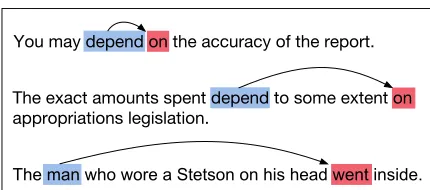
The exact amounts spent depend to some extent on appropriations legislation.
You may depend on the accuracy of the report.
The man who wore a Stetson on his head went inside.
Figure 1: Examples of dependencies with variable length in the language. The same phrase “depend on” in different sen-tences would have dependencies with different lengths. The use of clauses also makes the dependency length uncertain. Therefore, the models using a plain LSTM or an LSTM with fixed skip connections would be difficult to capture such in-formation.
for RNN architectures and proposed three architectural complexity measures: recurrent skip coefficients, recurrent depth, and feedforward depth. In addition, the skip coeffi-cient is defined as a function of the “shortest path” from one time to another. In particular, they found empirical evidence that increasing the feedforward depth might not help with long-term dependency tasks, while increasing the recurrent skip coefficient could significantly improve the performance on long-term dependency tasks.
K=1 K=2 K=k
LSTM LSTM LSTM LSTM
Agent Agent Agent
h1<latexit sha1_base64="9d9AtoY1+JMq1YbLJyyi5JMUeJg=">AAAB7HicbVBNS8NAEJ3Ur1q/qh69LBbBU0lEqN4KXjxWMG2hDWWznbRLN5uwuxFK6G/w4kERr/4gb/4bt20O2vpg4PHeDDPzwlRwbVz32yltbG5t75R3K3v7B4dH1eOTtk4yxdBniUhUN6QaBZfoG24EdlOFNA4FdsLJ3dzvPKHSPJGPZppiENOR5BFn1FjJHw9ybzao1ty6uwBZJ15BalCgNah+9YcJy2KUhgmqdc9zUxPkVBnOBM4q/UxjStmEjrBnqaQx6iBfHDsjF1YZkihRtqQhC/X3RE5jradxaDtjasZ61ZuL/3m9zEQ3Qc5lmhmUbLkoygQxCZl/ToZcITNiagllittbCRtTRZmx+VRsCN7qy+ukfVX33Lr3cF1r3hZxlOEMzuESPGhAE+6hBT4w4PAMr/DmSOfFeXc+lq0lp5g5hT9wPn8AtRGOkw==</latexit><latexit sha1_base64="9d9AtoY1+JMq1YbLJyyi5JMUeJg=">AAAB7HicbVBNS8NAEJ3Ur1q/qh69LBbBU0lEqN4KXjxWMG2hDWWznbRLN5uwuxFK6G/w4kERr/4gb/4bt20O2vpg4PHeDDPzwlRwbVz32yltbG5t75R3K3v7B4dH1eOTtk4yxdBniUhUN6QaBZfoG24EdlOFNA4FdsLJ3dzvPKHSPJGPZppiENOR5BFn1FjJHw9ybzao1ty6uwBZJ15BalCgNah+9YcJy2KUhgmqdc9zUxPkVBnOBM4q/UxjStmEjrBnqaQx6iBfHDsjF1YZkihRtqQhC/X3RE5jradxaDtjasZ61ZuL/3m9zEQ3Qc5lmhmUbLkoygQxCZl/ToZcITNiagllittbCRtTRZmx+VRsCN7qy+ukfVX33Lr3cF1r3hZxlOEMzuESPGhAE+6hBT4w4PAMr/DmSOfFeXc+lq0lp5g5hT9wPn8AtRGOkw==</latexit><latexit sha1_base64="9d9AtoY1+JMq1YbLJyyi5JMUeJg=">AAAB7HicbVBNS8NAEJ3Ur1q/qh69LBbBU0lEqN4KXjxWMG2hDWWznbRLN5uwuxFK6G/w4kERr/4gb/4bt20O2vpg4PHeDDPzwlRwbVz32yltbG5t75R3K3v7B4dH1eOTtk4yxdBniUhUN6QaBZfoG24EdlOFNA4FdsLJ3dzvPKHSPJGPZppiENOR5BFn1FjJHw9ybzao1ty6uwBZJ15BalCgNah+9YcJy2KUhgmqdc9zUxPkVBnOBM4q/UxjStmEjrBnqaQx6iBfHDsjF1YZkihRtqQhC/X3RE5jradxaDtjasZ61ZuL/3m9zEQ3Qc5lmhmUbLkoygQxCZl/ToZcITNiagllittbCRtTRZmx+VRsCN7qy+ukfVX33Lr3cF1r3hZxlOEMzuESPGhAE+6hBT4w4PAMr/DmSOfFeXc+lq0lp5g5hT9wPn8AtRGOkw==</latexit><latexit sha1_base64="9d9AtoY1+JMq1YbLJyyi5JMUeJg=">AAAB7HicbVBNS8NAEJ3Ur1q/qh69LBbBU0lEqN4KXjxWMG2hDWWznbRLN5uwuxFK6G/w4kERr/4gb/4bt20O2vpg4PHeDDPzwlRwbVz32yltbG5t75R3K3v7B4dH1eOTtk4yxdBniUhUN6QaBZfoG24EdlOFNA4FdsLJ3dzvPKHSPJGPZppiENOR5BFn1FjJHw9ybzao1ty6uwBZJ15BalCgNah+9YcJy2KUhgmqdc9zUxPkVBnOBM4q/UxjStmEjrBnqaQx6iBfHDsjF1YZkihRtqQhC/X3RE5jradxaDtjasZ61ZuL/3m9zEQ3Qc5lmhmUbLkoygQxCZl/ToZcITNiagllittbCRtTRZmx+VRsCN7qy+ukfVX33Lr3cF1r3hZxlOEMzuESPGhAE+6hBT4w4PAMr/DmSOfFeXc+lq0lp5g5hT9wPn8AtRGOkw==</latexit> h0
<latexit sha1_base64="X16T19p8Viasqsmv80z1rcdyigY=">AAAB7HicbVBNS8NAEJ3Ur1q/qh69LBbBU0lEqN4KXjxWMG2hDWWznbRLN5uwuxFK6G/w4kERr/4gb/4bt20O2vpg4PHeDDPzwlRwbVz32yltbG5t75R3K3v7B4dH1eOTtk4yxdBniUhUN6QaBZfoG24EdlOFNA4FdsLJ3dzvPKHSPJGPZppiENOR5BFn1FjJHw9ydzao1ty6uwBZJ15BalCgNah+9YcJy2KUhgmqdc9zUxPkVBnOBM4q/UxjStmEjrBnqaQx6iBfHDsjF1YZkihRtqQhC/X3RE5jradxaDtjasZ61ZuL/3m9zEQ3Qc5lmhmUbLkoygQxCZl/ToZcITNiagllittbCRtTRZmx+VRsCN7qy+ukfVX33Lr3cF1r3hZxlOEMzuESPGhAE+6hBT4w4PAMr/DmSOfFeXc+lq0lp5g5hT9wPn8As4yOkg==</latexit><latexit sha1_base64="X16T19p8Viasqsmv80z1rcdyigY=">AAAB7HicbVBNS8NAEJ3Ur1q/qh69LBbBU0lEqN4KXjxWMG2hDWWznbRLN5uwuxFK6G/w4kERr/4gb/4bt20O2vpg4PHeDDPzwlRwbVz32yltbG5t75R3K3v7B4dH1eOTtk4yxdBniUhUN6QaBZfoG24EdlOFNA4FdsLJ3dzvPKHSPJGPZppiENOR5BFn1FjJHw9ydzao1ty6uwBZJ15BalCgNah+9YcJy2KUhgmqdc9zUxPkVBnOBM4q/UxjStmEjrBnqaQx6iBfHDsjF1YZkihRtqQhC/X3RE5jradxaDtjasZ61ZuL/3m9zEQ3Qc5lmhmUbLkoygQxCZl/ToZcITNiagllittbCRtTRZmx+VRsCN7qy+ukfVX33Lr3cF1r3hZxlOEMzuESPGhAE+6hBT4w4PAMr/DmSOfFeXc+lq0lp5g5hT9wPn8As4yOkg==</latexit><latexit sha1_base64="X16T19p8Viasqsmv80z1rcdyigY=">AAAB7HicbVBNS8NAEJ3Ur1q/qh69LBbBU0lEqN4KXjxWMG2hDWWznbRLN5uwuxFK6G/w4kERr/4gb/4bt20O2vpg4PHeDDPzwlRwbVz32yltbG5t75R3K3v7B4dH1eOTtk4yxdBniUhUN6QaBZfoG24EdlOFNA4FdsLJ3dzvPKHSPJGPZppiENOR5BFn1FjJHw9ydzao1ty6uwBZJ15BalCgNah+9YcJy2KUhgmqdc9zUxPkVBnOBM4q/UxjStmEjrBnqaQx6iBfHDsjF1YZkihRtqQhC/X3RE5jradxaDtjasZ61ZuL/3m9zEQ3Qc5lmhmUbLkoygQxCZl/ToZcITNiagllittbCRtTRZmx+VRsCN7qy+ukfVX33Lr3cF1r3hZxlOEMzuESPGhAE+6hBT4w4PAMr/DmSOfFeXc+lq0lp5g5hT9wPn8As4yOkg==</latexit><latexit sha1_base64="X16T19p8Viasqsmv80z1rcdyigY=">AAAB7HicbVBNS8NAEJ3Ur1q/qh69LBbBU0lEqN4KXjxWMG2hDWWznbRLN5uwuxFK6G/w4kERr/4gb/4bt20O2vpg4PHeDDPzwlRwbVz32yltbG5t75R3K3v7B4dH1eOTtk4yxdBniUhUN6QaBZfoG24EdlOFNA4FdsLJ3dzvPKHSPJGPZppiENOR5BFn1FjJHw9ydzao1ty6uwBZJ15BalCgNah+9YcJy2KUhgmqdc9zUxPkVBnOBM4q/UxjStmEjrBnqaQx6iBfHDsjF1YZkihRtqQhC/X3RE5jradxaDtjasZ61ZuL/3m9zEQ3Qc5lmhmUbLkoygQxCZl/ToZcITNiagllittbCRtTRZmx+VRsCN7qy+ukfVX33Lr3cF1r3hZxlOEMzuESPGhAE+6hBT4w4PAMr/DmSOfFeXc+lq0lp5g5hT9wPn8As4yOkg==</latexit> h2<latexit sha1_base64="uubW29OB2YVvfx9J0KHde9IHi6Y=">AAAB7HicbVBNS8NAEJ3Ur1q/qh69LBbBU0mKoN4KXjxWMG2hDWWz3bRLN5uwOxFK6G/w4kERr/4gb/4bt20O2vpg4PHeDDPzwlQKg6777ZQ2Nre2d8q7lb39g8Oj6vFJ2ySZZtxniUx0N6SGS6G4jwIl76aa0ziUvBNO7uZ+54lrIxL1iNOUBzEdKREJRtFK/niQN2aDas2tuwuQdeIVpAYFWoPqV3+YsCzmCpmkxvQ8N8UgpxoFk3xW6WeGp5RN6Ij3LFU05ibIF8fOyIVVhiRKtC2FZKH+nshpbMw0Dm1nTHFsVr25+J/XyzC6CXKh0gy5YstFUSYJJmT+ORkKzRnKqSWUaWFvJWxMNWVo86nYELzVl9dJu1H33Lr3cFVr3hZxlOEMzuESPLiGJtxDC3xgIOAZXuHNUc6L8+58LFtLTjFzCn/gfP4AtpaOlA==</latexit><latexit sha1_base64="uubW29OB2YVvfx9J0KHde9IHi6Y=">AAAB7HicbVBNS8NAEJ3Ur1q/qh69LBbBU0mKoN4KXjxWMG2hDWWz3bRLN5uwOxFK6G/w4kERr/4gb/4bt20O2vpg4PHeDDPzwlQKg6777ZQ2Nre2d8q7lb39g8Oj6vFJ2ySZZtxniUx0N6SGS6G4jwIl76aa0ziUvBNO7uZ+54lrIxL1iNOUBzEdKREJRtFK/niQN2aDas2tuwuQdeIVpAYFWoPqV3+YsCzmCpmkxvQ8N8UgpxoFk3xW6WeGp5RN6Ij3LFU05ibIF8fOyIVVhiRKtC2FZKH+nshpbMw0Dm1nTHFsVr25+J/XyzC6CXKh0gy5YstFUSYJJmT+ORkKzRnKqSWUaWFvJWxMNWVo86nYELzVl9dJu1H33Lr3cFVr3hZxlOEMzuESPLiGJtxDC3xgIOAZXuHNUc6L8+58LFtLTjFzCn/gfP4AtpaOlA==</latexit><latexit sha1_base64="uubW29OB2YVvfx9J0KHde9IHi6Y=">AAAB7HicbVBNS8NAEJ3Ur1q/qh69LBbBU0mKoN4KXjxWMG2hDWWz3bRLN5uwOxFK6G/w4kERr/4gb/4bt20O2vpg4PHeDDPzwlQKg6777ZQ2Nre2d8q7lb39g8Oj6vFJ2ySZZtxniUx0N6SGS6G4jwIl76aa0ziUvBNO7uZ+54lrIxL1iNOUBzEdKREJRtFK/niQN2aDas2tuwuQdeIVpAYFWoPqV3+YsCzmCpmkxvQ8N8UgpxoFk3xW6WeGp5RN6Ij3LFU05ibIF8fOyIVVhiRKtC2FZKH+nshpbMw0Dm1nTHFsVr25+J/XyzC6CXKh0gy5YstFUSYJJmT+ORkKzRnKqSWUaWFvJWxMNWVo86nYELzVl9dJu1H33Lr3cFVr3hZxlOEMzuESPLiGJtxDC3xgIOAZXuHNUc6L8+58LFtLTjFzCn/gfP4AtpaOlA==</latexit><latexit sha1_base64="uubW29OB2YVvfx9J0KHde9IHi6Y=">AAAB7HicbVBNS8NAEJ3Ur1q/qh69LBbBU0mKoN4KXjxWMG2hDWWz3bRLN5uwOxFK6G/w4kERr/4gb/4bt20O2vpg4PHeDDPzwlQKg6777ZQ2Nre2d8q7lb39g8Oj6vFJ2ySZZtxniUx0N6SGS6G4jwIl76aa0ziUvBNO7uZ+54lrIxL1iNOUBzEdKREJRtFK/niQN2aDas2tuwuQdeIVpAYFWoPqV3+YsCzmCpmkxvQ8N8UgpxoFk3xW6WeGp5RN6Ij3LFU05ibIF8fOyIVVhiRKtC2FZKH+nshpbMw0Dm1nTHFsVr25+J/XyzC6CXKh0gy5YstFUSYJJmT+ORkKzRnKqSWUaWFvJWxMNWVo86nYELzVl9dJu1H33Lr3cFVr3hZxlOEMzuESPLiGJtxDC3xgIOAZXuHNUc6L8+58LFtLTjFzCn/gfP4AtpaOlA==</latexit> y2
<latexit sha1_base64="HrE5VO+SmgHMHdj5qNUNFxIp46s=">AAAB7HicbVBNS8NAEJ3Ur1q/qh69LBbBU0mKoN4KXjxWMG2hDWWz3bRLN5uwOxFK6G/w4kERr/4gb/4bt20O2vpg4PHeDDPzwlQKg6777ZQ2Nre2d8q7lb39g8Oj6vFJ2ySZZtxniUx0N6SGS6G4jwIl76aa0ziUvBNO7uZ+54lrIxL1iNOUBzEdKREJRtFK/nSQN2aDas2tuwuQdeIVpAYFWoPqV3+YsCzmCpmkxvQ8N8UgpxoFk3xW6WeGp5RN6Ij3LFU05ibIF8fOyIVVhiRKtC2FZKH+nshpbMw0Dm1nTHFsVr25+J/XyzC6CXKh0gy5YstFUSYJJmT+ORkKzRnKqSWUaWFvJWxMNWVo86nYELzVl9dJu1H33Lr3cFVr3hZxlOEMzuESPLiGJtxDC3xgIOAZXuHNUc6L8+58LFtLTjFzCn/gfP4A0J6OpQ==</latexit><latexit sha1_base64="HrE5VO+SmgHMHdj5qNUNFxIp46s=">AAAB7HicbVBNS8NAEJ3Ur1q/qh69LBbBU0mKoN4KXjxWMG2hDWWz3bRLN5uwOxFK6G/w4kERr/4gb/4bt20O2vpg4PHeDDPzwlQKg6777ZQ2Nre2d8q7lb39g8Oj6vFJ2ySZZtxniUx0N6SGS6G4jwIl76aa0ziUvBNO7uZ+54lrIxL1iNOUBzEdKREJRtFK/nSQN2aDas2tuwuQdeIVpAYFWoPqV3+YsCzmCpmkxvQ8N8UgpxoFk3xW6WeGp5RN6Ij3LFU05ibIF8fOyIVVhiRKtC2FZKH+nshpbMw0Dm1nTHFsVr25+J/XyzC6CXKh0gy5YstFUSYJJmT+ORkKzRnKqSWUaWFvJWxMNWVo86nYELzVl9dJu1H33Lr3cFVr3hZxlOEMzuESPLiGJtxDC3xgIOAZXuHNUc6L8+58LFtLTjFzCn/gfP4A0J6OpQ==</latexit><latexit sha1_base64="HrE5VO+SmgHMHdj5qNUNFxIp46s=">AAAB7HicbVBNS8NAEJ3Ur1q/qh69LBbBU0mKoN4KXjxWMG2hDWWz3bRLN5uwOxFK6G/w4kERr/4gb/4bt20O2vpg4PHeDDPzwlQKg6777ZQ2Nre2d8q7lb39g8Oj6vFJ2ySZZtxniUx0N6SGS6G4jwIl76aa0ziUvBNO7uZ+54lrIxL1iNOUBzEdKREJRtFK/nSQN2aDas2tuwuQdeIVpAYFWoPqV3+YsCzmCpmkxvQ8N8UgpxoFk3xW6WeGp5RN6Ij3LFU05ibIF8fOyIVVhiRKtC2FZKH+nshpbMw0Dm1nTHFsVr25+J/XyzC6CXKh0gy5YstFUSYJJmT+ORkKzRnKqSWUaWFvJWxMNWVo86nYELzVl9dJu1H33Lr3cFVr3hZxlOEMzuESPLiGJtxDC3xgIOAZXuHNUc6L8+58LFtLTjFzCn/gfP4A0J6OpQ==</latexit><latexit sha1_base64="HrE5VO+SmgHMHdj5qNUNFxIp46s=">AAAB7HicbVBNS8NAEJ3Ur1q/qh69LBbBU0mKoN4KXjxWMG2hDWWz3bRLN5uwOxFK6G/w4kERr/4gb/4bt20O2vpg4PHeDDPzwlQKg6777ZQ2Nre2d8q7lb39g8Oj6vFJ2ySZZtxniUx0N6SGS6G4jwIl76aa0ziUvBNO7uZ+54lrIxL1iNOUBzEdKREJRtFK/nSQN2aDas2tuwuQdeIVpAYFWoPqV3+YsCzmCpmkxvQ8N8UgpxoFk3xW6WeGp5RN6Ij3LFU05ibIF8fOyIVVhiRKtC2FZKH+nshpbMw0Dm1nTHFsVr25+J/XyzC6CXKh0gy5YstFUSYJJmT+ORkKzRnKqSWUaWFvJWxMNWVo86nYELzVl9dJu1H33Lr3cFVr3hZxlOEMzuESPLiGJtxDC3xgIOAZXuHNUc6L8+58LFtLTjFzCn/gfP4A0J6OpQ==</latexit>
y1<latexit sha1_base64="7vhfex+qjf/rjdzznPZYm/LBAQQ=">AAAB7HicbVBNS8NAEJ3Ur1q/qh69LBbBU0lEUG8FLx4rmFpoQ9lsN+3SzSbsToQQ+hu8eFDEqz/Im//GbZuDtj4YeLw3w8y8MJXCoOt+O5W19Y3Nrep2bWd3b/+gfnjUMUmmGfdZIhPdDanhUijuo0DJu6nmNA4lfwwntzP/8YlrIxL1gHnKg5iOlIgEo2glPx8U3nRQb7hNdw6ySrySNKBEe1D/6g8TlsVcIZPUmJ7nphgUVKNgkk9r/czwlLIJHfGepYrG3ATF/NgpObPKkESJtqWQzNXfEwWNjcnj0HbGFMdm2ZuJ/3m9DKProBAqzZArtlgUZZJgQmafk6HQnKHMLaFMC3srYWOqKUObT82G4C2/vEo6F03PbXr3l43WTRlHFU7gFM7BgytowR20wQcGAp7hFd4c5bw4787HorXilDPH8AfO5w/PGY6k</latexit><latexit sha1_base64="7vhfex+qjf/rjdzznPZYm/LBAQQ=">AAAB7HicbVBNS8NAEJ3Ur1q/qh69LBbBU0lEUG8FLx4rmFpoQ9lsN+3SzSbsToQQ+hu8eFDEqz/Im//GbZuDtj4YeLw3w8y8MJXCoOt+O5W19Y3Nrep2bWd3b/+gfnjUMUmmGfdZIhPdDanhUijuo0DJu6nmNA4lfwwntzP/8YlrIxL1gHnKg5iOlIgEo2glPx8U3nRQb7hNdw6ySrySNKBEe1D/6g8TlsVcIZPUmJ7nphgUVKNgkk9r/czwlLIJHfGepYrG3ATF/NgpObPKkESJtqWQzNXfEwWNjcnj0HbGFMdm2ZuJ/3m9DKProBAqzZArtlgUZZJgQmafk6HQnKHMLaFMC3srYWOqKUObT82G4C2/vEo6F03PbXr3l43WTRlHFU7gFM7BgytowR20wQcGAp7hFd4c5bw4787HorXilDPH8AfO5w/PGY6k</latexit><latexit sha1_base64="7vhfex+qjf/rjdzznPZYm/LBAQQ=">AAAB7HicbVBNS8NAEJ3Ur1q/qh69LBbBU0lEUG8FLx4rmFpoQ9lsN+3SzSbsToQQ+hu8eFDEqz/Im//GbZuDtj4YeLw3w8y8MJXCoOt+O5W19Y3Nrep2bWd3b/+gfnjUMUmmGfdZIhPdDanhUijuo0DJu6nmNA4lfwwntzP/8YlrIxL1gHnKg5iOlIgEo2glPx8U3nRQb7hNdw6ySrySNKBEe1D/6g8TlsVcIZPUmJ7nphgUVKNgkk9r/czwlLIJHfGepYrG3ATF/NgpObPKkESJtqWQzNXfEwWNjcnj0HbGFMdm2ZuJ/3m9DKProBAqzZArtlgUZZJgQmafk6HQnKHMLaFMC3srYWOqKUObT82G4C2/vEo6F03PbXr3l43WTRlHFU7gFM7BgytowR20wQcGAp7hFd4c5bw4787HorXilDPH8AfO5w/PGY6k</latexit><latexit sha1_base64="7vhfex+qjf/rjdzznPZYm/LBAQQ=">AAAB7HicbVBNS8NAEJ3Ur1q/qh69LBbBU0lEUG8FLx4rmFpoQ9lsN+3SzSbsToQQ+hu8eFDEqz/Im//GbZuDtj4YeLw3w8y8MJXCoOt+O5W19Y3Nrep2bWd3b/+gfnjUMUmmGfdZIhPdDanhUijuo0DJu6nmNA4lfwwntzP/8YlrIxL1gHnKg5iOlIgEo2glPx8U3nRQb7hNdw6ySrySNKBEe1D/6g8TlsVcIZPUmJ7nphgUVKNgkk9r/czwlLIJHfGepYrG3ATF/NgpObPKkESJtqWQzNXfEwWNjcnj0HbGFMdm2ZuJ/3m9DKProBAqzZArtlgUZZJgQmafk6HQnKHMLaFMC3srYWOqKUObT82G4C2/vEo6F03PbXr3l43WTRlHFU7gFM7BgytowR20wQcGAp7hFd4c5bw4787HorXilDPH8AfO5w/PGY6k</latexit> y0
<latexit sha1_base64="pT+SB/JYt4zONwRg7WouQYd8G98=">AAAB7HicbVBNS8NAEJ3Ur1q/qh69LBbBU0lEUG8FLx4rmFpoQ9lsN+3SzSbsToQQ+hu8eFDEqz/Im//GbZuDtj4YeLw3w8y8MJXCoOt+O5W19Y3Nrep2bWd3b/+gfnjUMUmmGfdZIhPdDanhUijuo0DJu6nmNA4lfwwntzP/8YlrIxL1gHnKg5iOlIgEo2glPx8U7nRQb7hNdw6ySrySNKBEe1D/6g8TlsVcIZPUmJ7nphgUVKNgkk9r/czwlLIJHfGepYrG3ATF/NgpObPKkESJtqWQzNXfEwWNjcnj0HbGFMdm2ZuJ/3m9DKProBAqzZArtlgUZZJgQmafk6HQnKHMLaFMC3srYWOqKUObT82G4C2/vEo6F03PbXr3l43WTRlHFU7gFM7BgytowR20wQcGAp7hFd4c5bw4787HorXilDPH8AfO5w/NlI6j</latexit><latexit sha1_base64="pT+SB/JYt4zONwRg7WouQYd8G98=">AAAB7HicbVBNS8NAEJ3Ur1q/qh69LBbBU0lEUG8FLx4rmFpoQ9lsN+3SzSbsToQQ+hu8eFDEqz/Im//GbZuDtj4YeLw3w8y8MJXCoOt+O5W19Y3Nrep2bWd3b/+gfnjUMUmmGfdZIhPdDanhUijuo0DJu6nmNA4lfwwntzP/8YlrIxL1gHnKg5iOlIgEo2glPx8U7nRQb7hNdw6ySrySNKBEe1D/6g8TlsVcIZPUmJ7nphgUVKNgkk9r/czwlLIJHfGepYrG3ATF/NgpObPKkESJtqWQzNXfEwWNjcnj0HbGFMdm2ZuJ/3m9DKProBAqzZArtlgUZZJgQmafk6HQnKHMLaFMC3srYWOqKUObT82G4C2/vEo6F03PbXr3l43WTRlHFU7gFM7BgytowR20wQcGAp7hFd4c5bw4787HorXilDPH8AfO5w/NlI6j</latexit><latexit sha1_base64="pT+SB/JYt4zONwRg7WouQYd8G98=">AAAB7HicbVBNS8NAEJ3Ur1q/qh69LBbBU0lEUG8FLx4rmFpoQ9lsN+3SzSbsToQQ+hu8eFDEqz/Im//GbZuDtj4YeLw3w8y8MJXCoOt+O5W19Y3Nrep2bWd3b/+gfnjUMUmmGfdZIhPdDanhUijuo0DJu6nmNA4lfwwntzP/8YlrIxL1gHnKg5iOlIgEo2glPx8U7nRQb7hNdw6ySrySNKBEe1D/6g8TlsVcIZPUmJ7nphgUVKNgkk9r/czwlLIJHfGepYrG3ATF/NgpObPKkESJtqWQzNXfEwWNjcnj0HbGFMdm2ZuJ/3m9DKProBAqzZArtlgUZZJgQmafk6HQnKHMLaFMC3srYWOqKUObT82G4C2/vEo6F03PbXr3l43WTRlHFU7gFM7BgytowR20wQcGAp7hFd4c5bw4787HorXilDPH8AfO5w/NlI6j</latexit><latexit sha1_base64="pT+SB/JYt4zONwRg7WouQYd8G98=">AAAB7HicbVBNS8NAEJ3Ur1q/qh69LBbBU0lEUG8FLx4rmFpoQ9lsN+3SzSbsToQQ+hu8eFDEqz/Im//GbZuDtj4YeLw3w8y8MJXCoOt+O5W19Y3Nrep2bWd3b/+gfnjUMUmmGfdZIhPdDanhUijuo0DJu6nmNA4lfwwntzP/8YlrIxL1gHnKg5iOlIgEo2glPx8U7nRQb7hNdw6ySrySNKBEe1D/6g8TlsVcIZPUmJ7nphgUVKNgkk9r/czwlLIJHfGepYrG3ATF/NgpObPKkESJtqWQzNXfEwWNjcnj0HbGFMdm2ZuJ/3m9DKProBAqzZArtlgUZZJgQmafk6HQnKHMLaFMC3srYWOqKUObT82G4C2/vEo6F03PbXr3l43WTRlHFU7gFM7BgytowR20wQcGAp7hFd4c5bw4787HorXilDPH8AfO5w/NlI6j</latexit>
x0
<latexit sha1_base64="9gMEVXI5nPy8/zVrqdImqNvyYh4=">AAAB7HicbVBNS8NAEJ3Ur1q/qh69LBbBU0lEUG8FLx4rmLbQhrLZTtqlm03Y3Ygl9Dd48aCIV3+QN/+N2zYHbX0w8Hhvhpl5YSq4Nq777ZTW1jc2t8rblZ3dvf2D6uFRSyeZYuizRCSqE1KNgkv0DTcCO6lCGocC2+H4dua3H1FpnsgHM0kxiOlQ8ogzaqzkP/Vzd9qv1ty6OwdZJV5BalCg2a9+9QYJy2KUhgmqdddzUxPkVBnOBE4rvUxjStmYDrFrqaQx6iCfHzslZ1YZkChRtqQhc/X3RE5jrSdxaDtjakZ62ZuJ/3ndzETXQc5lmhmUbLEoygQxCZl9TgZcITNiYgllittbCRtRRZmx+VRsCN7yy6ukdVH33Lp3f1lr3BRxlOEETuEcPLiCBtxBE3xgwOEZXuHNkc6L8+58LFpLTjFzDH/gfP4AzAyOog==</latexit><latexit sha1_base64="9gMEVXI5nPy8/zVrqdImqNvyYh4=">AAAB7HicbVBNS8NAEJ3Ur1q/qh69LBbBU0lEUG8FLx4rmLbQhrLZTtqlm03Y3Ygl9Dd48aCIV3+QN/+N2zYHbX0w8Hhvhpl5YSq4Nq777ZTW1jc2t8rblZ3dvf2D6uFRSyeZYuizRCSqE1KNgkv0DTcCO6lCGocC2+H4dua3H1FpnsgHM0kxiOlQ8ogzaqzkP/Vzd9qv1ty6OwdZJV5BalCg2a9+9QYJy2KUhgmqdddzUxPkVBnOBE4rvUxjStmYDrFrqaQx6iCfHzslZ1YZkChRtqQhc/X3RE5jrSdxaDtjakZ62ZuJ/3ndzETXQc5lmhmUbLEoygQxCZl9TgZcITNiYgllittbCRtRRZmx+VRsCN7yy6ukdVH33Lp3f1lr3BRxlOEETuEcPLiCBtxBE3xgwOEZXuHNkc6L8+58LFpLTjFzDH/gfP4AzAyOog==</latexit><latexit sha1_base64="9gMEVXI5nPy8/zVrqdImqNvyYh4=">AAAB7HicbVBNS8NAEJ3Ur1q/qh69LBbBU0lEUG8FLx4rmLbQhrLZTtqlm03Y3Ygl9Dd48aCIV3+QN/+N2zYHbX0w8Hhvhpl5YSq4Nq777ZTW1jc2t8rblZ3dvf2D6uFRSyeZYuizRCSqE1KNgkv0DTcCO6lCGocC2+H4dua3H1FpnsgHM0kxiOlQ8ogzaqzkP/Vzd9qv1ty6OwdZJV5BalCg2a9+9QYJy2KUhgmqdddzUxPkVBnOBE4rvUxjStmYDrFrqaQx6iCfHzslZ1YZkChRtqQhc/X3RE5jrSdxaDtjakZ62ZuJ/3ndzETXQc5lmhmUbLEoygQxCZl9TgZcITNiYgllittbCRtRRZmx+VRsCN7yy6ukdVH33Lp3f1lr3BRxlOEETuEcPLiCBtxBE3xgwOEZXuHNkc6L8+58LFpLTjFzDH/gfP4AzAyOog==</latexit><latexit sha1_base64="9gMEVXI5nPy8/zVrqdImqNvyYh4=">AAAB7HicbVBNS8NAEJ3Ur1q/qh69LBbBU0lEUG8FLx4rmLbQhrLZTtqlm03Y3Ygl9Dd48aCIV3+QN/+N2zYHbX0w8Hhvhpl5YSq4Nq777ZTW1jc2t8rblZ3dvf2D6uFRSyeZYuizRCSqE1KNgkv0DTcCO6lCGocC2+H4dua3H1FpnsgHM0kxiOlQ8ogzaqzkP/Vzd9qv1ty6OwdZJV5BalCg2a9+9QYJy2KUhgmqdddzUxPkVBnOBE4rvUxjStmYDrFrqaQx6iCfHzslZ1YZkChRtqQhc/X3RE5jrSdxaDtjakZ62ZuJ/3ndzETXQc5lmhmUbLEoygQxCZl9TgZcITNiYgllittbCRtRRZmx+VRsCN7yy6ukdVH33Lp3f1lr3BRxlOEETuEcPLiCBtxBE3xgwOEZXuHNkc6L8+58LFpLTjFzDH/gfP4AzAyOog==</latexit>
x1
<latexit sha1_base64="BSo1sbtbY8nJyLPqZlWO7YzZ22g=">AAAB7HicbVBNS8NAEJ3Ur1q/qh69LBbBU0lEUG8FLx4rmLbQhrLZTtqlm03Y3Ygl9Dd48aCIV3+QN/+N2zYHbX0w8Hhvhpl5YSq4Nq777ZTW1jc2t8rblZ3dvf2D6uFRSyeZYuizRCSqE1KNgkv0DTcCO6lCGocC2+H4dua3H1FpnsgHM0kxiOlQ8ogzaqzkP/Vzb9qv1ty6OwdZJV5BalCg2a9+9QYJy2KUhgmqdddzUxPkVBnOBE4rvUxjStmYDrFrqaQx6iCfHzslZ1YZkChRtqQhc/X3RE5jrSdxaDtjakZ62ZuJ/3ndzETXQc5lmhmUbLEoygQxCZl9TgZcITNiYgllittbCRtRRZmx+VRsCN7yy6ukdVH33Lp3f1lr3BRxlOEETuEcPLiCBtxBE3xgwOEZXuHNkc6L8+58LFpLTjFzDH/gfP4AzZGOow==</latexit><latexit sha1_base64="BSo1sbtbY8nJyLPqZlWO7YzZ22g=">AAAB7HicbVBNS8NAEJ3Ur1q/qh69LBbBU0lEUG8FLx4rmLbQhrLZTtqlm03Y3Ygl9Dd48aCIV3+QN/+N2zYHbX0w8Hhvhpl5YSq4Nq777ZTW1jc2t8rblZ3dvf2D6uFRSyeZYuizRCSqE1KNgkv0DTcCO6lCGocC2+H4dua3H1FpnsgHM0kxiOlQ8ogzaqzkP/Vzb9qv1ty6OwdZJV5BalCg2a9+9QYJy2KUhgmqdddzUxPkVBnOBE4rvUxjStmYDrFrqaQx6iCfHzslZ1YZkChRtqQhc/X3RE5jrSdxaDtjakZ62ZuJ/3ndzETXQc5lmhmUbLEoygQxCZl9TgZcITNiYgllittbCRtRRZmx+VRsCN7yy6ukdVH33Lp3f1lr3BRxlOEETuEcPLiCBtxBE3xgwOEZXuHNkc6L8+58LFpLTjFzDH/gfP4AzZGOow==</latexit><latexit sha1_base64="BSo1sbtbY8nJyLPqZlWO7YzZ22g=">AAAB7HicbVBNS8NAEJ3Ur1q/qh69LBbBU0lEUG8FLx4rmLbQhrLZTtqlm03Y3Ygl9Dd48aCIV3+QN/+N2zYHbX0w8Hhvhpl5YSq4Nq777ZTW1jc2t8rblZ3dvf2D6uFRSyeZYuizRCSqE1KNgkv0DTcCO6lCGocC2+H4dua3H1FpnsgHM0kxiOlQ8ogzaqzkP/Vzb9qv1ty6OwdZJV5BalCg2a9+9QYJy2KUhgmqdddzUxPkVBnOBE4rvUxjStmYDrFrqaQx6iCfHzslZ1YZkChRtqQhc/X3RE5jrSdxaDtjakZ62ZuJ/3ndzETXQc5lmhmUbLEoygQxCZl9TgZcITNiYgllittbCRtRRZmx+VRsCN7yy6ukdVH33Lp3f1lr3BRxlOEETuEcPLiCBtxBE3xgwOEZXuHNkc6L8+58LFpLTjFzDH/gfP4AzZGOow==</latexit><latexit sha1_base64="BSo1sbtbY8nJyLPqZlWO7YzZ22g=">AAAB7HicbVBNS8NAEJ3Ur1q/qh69LBbBU0lEUG8FLx4rmLbQhrLZTtqlm03Y3Ygl9Dd48aCIV3+QN/+N2zYHbX0w8Hhvhpl5YSq4Nq777ZTW1jc2t8rblZ3dvf2D6uFRSyeZYuizRCSqE1KNgkv0DTcCO6lCGocC2+H4dua3H1FpnsgHM0kxiOlQ8ogzaqzkP/Vzb9qv1ty6OwdZJV5BalCg2a9+9QYJy2KUhgmqdddzUxPkVBnOBE4rvUxjStmYDrFrqaQx6iCfHzslZ1YZkChRtqQhc/X3RE5jrSdxaDtjakZ62ZuJ/3ndzETXQc5lmhmUbLEoygQxCZl9TgZcITNiYgllittbCRtRRZmx+VRsCN7yy6ukdVH33Lp3f1lr3BRxlOEETuEcPLiCBtxBE3xgwOEZXuHNkc6L8+58LFpLTjFzDH/gfP4AzZGOow==</latexit> x2<latexit sha1_base64="Jh+d1dqdROS9Xlkvz4Ncl4/mIRI=">AAAB7HicbVBNS8NAEJ34WetX1aOXxSJ4KkkR1FvBi8cKpi20oWy2m3bpZhN2J2IJ/Q1ePCji1R/kzX/jts1BWx8MPN6bYWZemEph0HW/nbX1jc2t7dJOeXdv/+CwcnTcMkmmGfdZIhPdCanhUijuo0DJO6nmNA4lb4fj25nffuTaiEQ94CTlQUyHSkSCUbSS/9TP69N+perW3DnIKvEKUoUCzX7lqzdIWBZzhUxSY7qem2KQU42CST4t9zLDU8rGdMi7lioacxPk82On5NwqAxIl2pZCMld/T+Q0NmYSh7Yzpjgyy95M/M/rZhhdB7lQaYZcscWiKJMEEzL7nAyE5gzlxBLKtLC3EjaimjK0+ZRtCN7yy6ukVa95bs27v6w2boo4SnAKZ3ABHlxBA+6gCT4wEPAMr/DmKOfFeXc+Fq1rTjFzAn/gfP4AzxaOpA==</latexit><latexit sha1_base64="Jh+d1dqdROS9Xlkvz4Ncl4/mIRI=">AAAB7HicbVBNS8NAEJ34WetX1aOXxSJ4KkkR1FvBi8cKpi20oWy2m3bpZhN2J2IJ/Q1ePCji1R/kzX/jts1BWx8MPN6bYWZemEph0HW/nbX1jc2t7dJOeXdv/+CwcnTcMkmmGfdZIhPdCanhUijuo0DJO6nmNA4lb4fj25nffuTaiEQ94CTlQUyHSkSCUbSS/9TP69N+perW3DnIKvEKUoUCzX7lqzdIWBZzhUxSY7qem2KQU42CST4t9zLDU8rGdMi7lioacxPk82On5NwqAxIl2pZCMld/T+Q0NmYSh7Yzpjgyy95M/M/rZhhdB7lQaYZcscWiKJMEEzL7nAyE5gzlxBLKtLC3EjaimjK0+ZRtCN7yy6ukVa95bs27v6w2boo4SnAKZ3ABHlxBA+6gCT4wEPAMr/DmKOfFeXc+Fq1rTjFzAn/gfP4AzxaOpA==</latexit><latexit sha1_base64="Jh+d1dqdROS9Xlkvz4Ncl4/mIRI=">AAAB7HicbVBNS8NAEJ34WetX1aOXxSJ4KkkR1FvBi8cKpi20oWy2m3bpZhN2J2IJ/Q1ePCji1R/kzX/jts1BWx8MPN6bYWZemEph0HW/nbX1jc2t7dJOeXdv/+CwcnTcMkmmGfdZIhPdCanhUijuo0DJO6nmNA4lb4fj25nffuTaiEQ94CTlQUyHSkSCUbSS/9TP69N+perW3DnIKvEKUoUCzX7lqzdIWBZzhUxSY7qem2KQU42CST4t9zLDU8rGdMi7lioacxPk82On5NwqAxIl2pZCMld/T+Q0NmYSh7Yzpjgyy95M/M/rZhhdB7lQaYZcscWiKJMEEzL7nAyE5gzlxBLKtLC3EjaimjK0+ZRtCN7yy6ukVa95bs27v6w2boo4SnAKZ3ABHlxBA+6gCT4wEPAMr/DmKOfFeXc+Fq1rTjFzAn/gfP4AzxaOpA==</latexit><latexit sha1_base64="Jh+d1dqdROS9Xlkvz4Ncl4/mIRI=">AAAB7HicbVBNS8NAEJ34WetX1aOXxSJ4KkkR1FvBi8cKpi20oWy2m3bpZhN2J2IJ/Q1ePCji1R/kzX/jts1BWx8MPN6bYWZemEph0HW/nbX1jc2t7dJOeXdv/+CwcnTcMkmmGfdZIhPdCanhUijuo0DJO6nmNA4lb4fj25nffuTaiEQ94CTlQUyHSkSCUbSS/9TP69N+perW3DnIKvEKUoUCzX7lqzdIWBZzhUxSY7qem2KQU42CST4t9zLDU8rGdMi7lioacxPk82On5NwqAxIl2pZCMld/T+Q0NmYSh7Yzpjgyy95M/M/rZhhdB7lQaYZcscWiKJMEEzL7nAyE5gzlxBLKtLC3EjaimjK0+ZRtCN7yy6ukVa95bs27v6w2boo4SnAKZ3ABHlxBA+6gCT4wEPAMr/DmKOfFeXc+Fq1rTjFzAn/gfP4AzxaOpA==</latexit> xt<latexit sha1_base64="EK+1WjIeMUMnWAEPGD4Z6LfWmvs=">AAAB7HicbVBNS8NAEJ3Ur1q/qh69LBbBU0lEUG8FLx4rmLbQhrLZbtqlm03YnYgl9Dd48aCIV3+QN/+N2zYHbX0w8Hhvhpl5YSqFQdf9dkpr6xubW+Xtys7u3v5B9fCoZZJMM+6zRCa6E1LDpVDcR4GSd1LNaRxK3g7HtzO//ci1EYl6wEnKg5gOlYgEo2gl/6mf47Rfrbl1dw6ySryC1KBAs1/96g0SlsVcIZPUmK7nphjkVKNgkk8rvczwlLIxHfKupYrG3AT5/NgpObPKgESJtqWQzNXfEzmNjZnEoe2MKY7MsjcT//O6GUbXQS5UmiFXbLEoyiTBhMw+JwOhOUM5sYQyLeythI2opgxtPhUbgrf88ippXdQ9t+7dX9YaN0UcZTiBUzgHD66gAXfQBB8YCHiGV3hzlPPivDsfi9aSU8wcwx84nz8zb47m</latexit><latexit sha1_base64="EK+1WjIeMUMnWAEPGD4Z6LfWmvs=">AAAB7HicbVBNS8NAEJ3Ur1q/qh69LBbBU0lEUG8FLx4rmLbQhrLZbtqlm03YnYgl9Dd48aCIV3+QN/+N2zYHbX0w8Hhvhpl5YSqFQdf9dkpr6xubW+Xtys7u3v5B9fCoZZJMM+6zRCa6E1LDpVDcR4GSd1LNaRxK3g7HtzO//ci1EYl6wEnKg5gOlYgEo2gl/6mf47Rfrbl1dw6ySryC1KBAs1/96g0SlsVcIZPUmK7nphjkVKNgkk8rvczwlLIxHfKupYrG3AT5/NgpObPKgESJtqWQzNXfEzmNjZnEoe2MKY7MsjcT//O6GUbXQS5UmiFXbLEoyiTBhMw+JwOhOUM5sYQyLeythI2opgxtPhUbgrf88ippXdQ9t+7dX9YaN0UcZTiBUzgHD66gAXfQBB8YCHiGV3hzlPPivDsfi9aSU8wcwx84nz8zb47m</latexit><latexit sha1_base64="EK+1WjIeMUMnWAEPGD4Z6LfWmvs=">AAAB7HicbVBNS8NAEJ3Ur1q/qh69LBbBU0lEUG8FLx4rmLbQhrLZbtqlm03YnYgl9Dd48aCIV3+QN/+N2zYHbX0w8Hhvhpl5YSqFQdf9dkpr6xubW+Xtys7u3v5B9fCoZZJMM+6zRCa6E1LDpVDcR4GSd1LNaRxK3g7HtzO//ci1EYl6wEnKg5gOlYgEo2gl/6mf47Rfrbl1dw6ySryC1KBAs1/96g0SlsVcIZPUmK7nphjkVKNgkk8rvczwlLIxHfKupYrG3AT5/NgpObPKgESJtqWQzNXfEzmNjZnEoe2MKY7MsjcT//O6GUbXQS5UmiFXbLEoyiTBhMw+JwOhOUM5sYQyLeythI2opgxtPhUbgrf88ippXdQ9t+7dX9YaN0UcZTiBUzgHD66gAXfQBB8YCHiGV3hzlPPivDsfi9aSU8wcwx84nz8zb47m</latexit><latexit sha1_base64="EK+1WjIeMUMnWAEPGD4Z6LfWmvs=">AAAB7HicbVBNS8NAEJ3Ur1q/qh69LBbBU0lEUG8FLx4rmLbQhrLZbtqlm03YnYgl9Dd48aCIV3+QN/+N2zYHbX0w8Hhvhpl5YSqFQdf9dkpr6xubW+Xtys7u3v5B9fCoZZJMM+6zRCa6E1LDpVDcR4GSd1LNaRxK3g7HtzO//ci1EYl6wEnKg5gOlYgEo2gl/6mf47Rfrbl1dw6ySryC1KBAs1/96g0SlsVcIZPUmK7nphjkVKNgkk8rvczwlLIxHfKupYrG3AT5/NgpObPKgESJtqWQzNXfEzmNjZnEoe2MKY7MsjcT//O6GUbXQS5UmiFXbLEoyiTBhMw+JwOhOUM5sYQyLeythI2opgxtPhUbgrf88ippXdQ9t+7dX9YaN0UcZTiBUzgHD66gAXfQBB8YCHiGV3hzlPPivDsfi9aSU8wcwx84nz8zb47m</latexit> yt
<latexit sha1_base64="qGSo7TI0l9EX8Xk/wTOjxFwJUhs=">AAAB7HicbVBNS8NAEJ3Ur1q/qh69LBbBU0lEUG8FLx4rmFpoQ9lsN+3SzSbsToQQ+hu8eFDEqz/Im//GbZuDtj4YeLw3w8y8MJXCoOt+O5W19Y3Nrep2bWd3b/+gfnjUMUmmGfdZIhPdDanhUijuo0DJu6nmNA4lfwwntzP/8YlrIxL1gHnKg5iOlIgEo2glPx8UOB3UG27TnYOsEq8kDSjRHtS/+sOEZTFXyCQ1pue5KQYF1SiY5NNaPzM8pWxCR7xnqaIxN0ExP3ZKzqwyJFGibSkkc/X3REFjY/I4tJ0xxbFZ9mbif14vw+g6KIRKM+SKLRZFmSSYkNnnZCg0ZyhzSyjTwt5K2JhqytDmU7MheMsvr5LORdNzm979ZaN1U8ZRhRM4hXPw4ApacAdt8IGBgGd4hTdHOS/Ou/OxaK045cwx/IHz+QM0947n</latexit><latexit sha1_base64="qGSo7TI0l9EX8Xk/wTOjxFwJUhs=">AAAB7HicbVBNS8NAEJ3Ur1q/qh69LBbBU0lEUG8FLx4rmFpoQ9lsN+3SzSbsToQQ+hu8eFDEqz/Im//GbZuDtj4YeLw3w8y8MJXCoOt+O5W19Y3Nrep2bWd3b/+gfnjUMUmmGfdZIhPdDanhUijuo0DJu6nmNA4lfwwntzP/8YlrIxL1gHnKg5iOlIgEo2glPx8UOB3UG27TnYOsEq8kDSjRHtS/+sOEZTFXyCQ1pue5KQYF1SiY5NNaPzM8pWxCR7xnqaIxN0ExP3ZKzqwyJFGibSkkc/X3REFjY/I4tJ0xxbFZ9mbif14vw+g6KIRKM+SKLRZFmSSYkNnnZCg0ZyhzSyjTwt5K2JhqytDmU7MheMsvr5LORdNzm979ZaN1U8ZRhRM4hXPw4ApacAdt8IGBgGd4hTdHOS/Ou/OxaK045cwx/IHz+QM0947n</latexit><latexit sha1_base64="qGSo7TI0l9EX8Xk/wTOjxFwJUhs=">AAAB7HicbVBNS8NAEJ3Ur1q/qh69LBbBU0lEUG8FLx4rmFpoQ9lsN+3SzSbsToQQ+hu8eFDEqz/Im//GbZuDtj4YeLw3w8y8MJXCoOt+O5W19Y3Nrep2bWd3b/+gfnjUMUmmGfdZIhPdDanhUijuo0DJu6nmNA4lfwwntzP/8YlrIxL1gHnKg5iOlIgEo2glPx8UOB3UG27TnYOsEq8kDSjRHtS/+sOEZTFXyCQ1pue5KQYF1SiY5NNaPzM8pWxCR7xnqaIxN0ExP3ZKzqwyJFGibSkkc/X3REFjY/I4tJ0xxbFZ9mbif14vw+g6KIRKM+SKLRZFmSSYkNnnZCg0ZyhzSyjTwt5K2JhqytDmU7MheMsvr5LORdNzm979ZaN1U8ZRhRM4hXPw4ApacAdt8IGBgGd4hTdHOS/Ou/OxaK045cwx/IHz+QM0947n</latexit>
<latexit sha1_base64="qGSo7TI0l9EX8Xk/wTOjxFwJUhs=">AAAB7HicbVBNS8NAEJ3Ur1q/qh69LBbBU0lEUG8FLx4rmFpoQ9lsN+3SzSbsToQQ+hu8eFDEqz/Im//GbZuDtj4YeLw3w8y8MJXCoOt+O5W19Y3Nrep2bWd3b/+gfnjUMUmmGfdZIhPdDanhUijuo0DJu6nmNA4lfwwntzP/8YlrIxL1gHnKg5iOlIgEo2glPx8UOB3UG27TnYOsEq8kDSjRHtS/+sOEZTFXyCQ1pue5KQYF1SiY5NNaPzM8pWxCR7xnqaIxN0ExP3ZKzqwyJFGibSkkc/X3REFjY/I4tJ0xxbFZ9mbif14vw+g6KIRKM+SKLRZFmSSYkNnnZCg0ZyhzSyjTwt5K2JhqytDmU7MheMsvr5LORdNzm979ZaN1U8ZRhRM4hXPw4ApacAdt8IGBgGd4hTdHOS/Ou/OxaK045cwx/IHz+QM0947n</latexit>
ht k
<latexit sha1_base64="yUVvjjeJSzSuGb7nECUw9IyviWo=">AAAB7nicbVBNS8NAEJ3Ur1q/qh69LBbBiyURQb0VvHisYD+gDWWz3bRLNpuwOxFK6I/w4kERr/4eb/4bt20O2vpg4PHeDDPzglQKg6777ZTW1jc2t8rblZ3dvf2D6uFR2ySZZrzFEpnobkANl0LxFgqUvJtqTuNA8k4Q3c38zhPXRiTqEScp92M6UiIUjKKVOuNBjhfRdFCtuXV3DrJKvILUoEBzUP3qDxOWxVwhk9SYnuem6OdUo2CSTyv9zPCUsoiOeM9SRWNu/Hx+7pScWWVIwkTbUkjm6u+JnMbGTOLAdsYUx2bZm4n/eb0Mwxs/FyrNkCu2WBRmkmBCZr+TodCcoZxYQpkW9lbCxlRThjahig3BW355lbQv655b9x6uao3bIo4ynMApnIMH19CAe2hCCxhE8Ayv8Oakzovz7nwsWktOMXMMf+B8/gBPaY+C</latexit>
<latexit sha1_base64="yUVvjjeJSzSuGb7nECUw9IyviWo=">AAAB7nicbVBNS8NAEJ3Ur1q/qh69LBbBiyURQb0VvHisYD+gDWWz3bRLNpuwOxFK6I/w4kERr/4eb/4bt20O2vpg4PHeDDPzglQKg6777ZTW1jc2t8rblZ3dvf2D6uFR2ySZZrzFEpnobkANl0LxFgqUvJtqTuNA8k4Q3c38zhPXRiTqEScp92M6UiIUjKKVOuNBjhfRdFCtuXV3DrJKvILUoEBzUP3qDxOWxVwhk9SYnuem6OdUo2CSTyv9zPCUsoiOeM9SRWNu/Hx+7pScWWVIwkTbUkjm6u+JnMbGTOLAdsYUx2bZm4n/eb0Mwxs/FyrNkCu2WBRmkmBCZr+TodCcoZxYQpkW9lbCxlRThjahig3BW355lbQv655b9x6uao3bIo4ynMApnIMH19CAe2hCCxhE8Ayv8Oakzovz7nwsWktOMXMMf+B8/gBPaY+C</latexit>
<latexit sha1_base64="yUVvjjeJSzSuGb7nECUw9IyviWo=">AAAB7nicbVBNS8NAEJ3Ur1q/qh69LBbBiyURQb0VvHisYD+gDWWz3bRLNpuwOxFK6I/w4kERr/4eb/4bt20O2vpg4PHeDDPzglQKg6777ZTW1jc2t8rblZ3dvf2D6uFR2ySZZrzFEpnobkANl0LxFgqUvJtqTuNA8k4Q3c38zhPXRiTqEScp92M6UiIUjKKVOuNBjhfRdFCtuXV3DrJKvILUoEBzUP3qDxOWxVwhk9SYnuem6OdUo2CSTyv9zPCUsoiOeM9SRWNu/Hx+7pScWWVIwkTbUkjm6u+JnMbGTOLAdsYUx2bZm4n/eb0Mwxs/FyrNkCu2WBRmkmBCZr+TodCcoZxYQpkW9lbCxlRThjahig3BW355lbQv655b9x6uao3bIo4ynMApnIMH19CAe2hCCxhE8Ayv8Oakzovz7nwsWktOMXMMf+B8/gBPaY+C</latexit>
<latexit sha1_base64="yUVvjjeJSzSuGb7nECUw9IyviWo=">AAAB7nicbVBNS8NAEJ3Ur1q/qh69LBbBiyURQb0VvHisYD+gDWWz3bRLNpuwOxFK6I/w4kERr/4eb/4bt20O2vpg4PHeDDPzglQKg6777ZTW1jc2t8rblZ3dvf2D6uFR2ySZZrzFEpnobkANl0LxFgqUvJtqTuNA8k4Q3c38zhPXRiTqEScp92M6UiIUjKKVOuNBjhfRdFCtuXV3DrJKvILUoEBzUP3qDxOWxVwhk9SYnuem6OdUo2CSTyv9zPCUsoiOeM9SRWNu/Hx+7pScWWVIwkTbUkjm6u+JnMbGTOLAdsYUx2bZm4n/eb0Mwxs/FyrNkCu2WBRmkmBCZr+TodCcoZxYQpkW9lbCxlRThjahig3BW355lbQv655b9x6uao3bIo4ynMApnIMH19CAe2hCCxhE8Ayv8Oakzovz7nwsWktOMXMMf+B8/gBPaY+C</latexit>
Agent
ht 1 ht
xt
xt Sample
Hidden state distribution
Reward
ht 1
LSTM
ht k
<latexit sha1_base64="yUVvjjeJSzSuGb7nECUw9IyviWo=">AAAB7nicbVBNS8NAEJ3Ur1q/qh69LBbBiyURQb0VvHisYD+gDWWz3bRLNpuwOxFK6I/w4kERr/4eb/4bt20O2vpg4PHeDDPzglQKg6777ZTW1jc2t8rblZ3dvf2D6uFR2ySZZrzFEpnobkANl0LxFgqUvJtqTuNA8k4Q3c38zhPXRiTqEScp92M6UiIUjKKVOuNBjhfRdFCtuXV3DrJKvILUoEBzUP3qDxOWxVwhk9SYnuem6OdUo2CSTyv9zPCUsoiOeM9SRWNu/Hx+7pScWWVIwkTbUkjm6u+JnMbGTOLAdsYUx2bZm4n/eb0Mwxs/FyrNkCu2WBRmkmBCZr+TodCcoZxYQpkW9lbCxlRThjahig3BW355lbQv655b9x6uao3bIo4ynMApnIMH19CAe2hCCxhE8Ayv8Oakzovz7nwsWktOMXMMf+B8/gBPaY+C</latexit>
<latexit sha1_base64="yUVvjjeJSzSuGb7nECUw9IyviWo=">AAAB7nicbVBNS8NAEJ3Ur1q/qh69LBbBiyURQb0VvHisYD+gDWWz3bRLNpuwOxFK6I/w4kERr/4eb/4bt20O2vpg4PHeDDPzglQKg6777ZTW1jc2t8rblZ3dvf2D6uFR2ySZZrzFEpnobkANl0LxFgqUvJtqTuNA8k4Q3c38zhPXRiTqEScp92M6UiIUjKKVOuNBjhfRdFCtuXV3DrJKvILUoEBzUP3qDxOWxVwhk9SYnuem6OdUo2CSTyv9zPCUsoiOeM9SRWNu/Hx+7pScWWVIwkTbUkjm6u+JnMbGTOLAdsYUx2bZm4n/eb0Mwxs/FyrNkCu2WBRmkmBCZr+TodCcoZxYQpkW9lbCxlRThjahig3BW355lbQv655b9x6uao3bIo4ynMApnIMH19CAe2hCCxhE8Ayv8Oakzovz7nwsWktOMXMMf+B8/gBPaY+C</latexit>
<latexit sha1_base64="yUVvjjeJSzSuGb7nECUw9IyviWo=">AAAB7nicbVBNS8NAEJ3Ur1q/qh69LBbBiyURQb0VvHisYD+gDWWz3bRLNpuwOxFK6I/w4kERr/4eb/4bt20O2vpg4PHeDDPzglQKg6777ZTW1jc2t8rblZ3dvf2D6uFR2ySZZrzFEpnobkANl0LxFgqUvJtqTuNA8k4Q3c38zhPXRiTqEScp92M6UiIUjKKVOuNBjhfRdFCtuXV3DrJKvILUoEBzUP3qDxOWxVwhk9SYnuem6OdUo2CSTyv9zPCUsoiOeM9SRWNu/Hx+7pScWWVIwkTbUkjm6u+JnMbGTOLAdsYUx2bZm4n/eb0Mwxs/FyrNkCu2WBRmkmBCZr+TodCcoZxYQpkW9lbCxlRThjahig3BW355lbQv655b9x6uao3bIo4ynMApnIMH19CAe2hCCxhE8Ayv8Oakzovz7nwsWktOMXMMf+B8/gBPaY+C</latexit>
<latexit sha1_base64="yUVvjjeJSzSuGb7nECUw9IyviWo=">AAAB7nicbVBNS8NAEJ3Ur1q/qh69LBbBiyURQb0VvHisYD+gDWWz3bRLNpuwOxFK6I/w4kERr/4eb/4bt20O2vpg4PHeDDPzglQKg6777ZTW1jc2t8rblZ3dvf2D6uFR2ySZZrzFEpnobkANl0LxFgqUvJtqTuNA8k4Q3c38zhPXRiTqEScp92M6UiIUjKKVOuNBjhfRdFCtuXV3DrJKvILUoEBzUP3qDxOWxVwhk9SYnuem6OdUo2CSTyv9zPCUsoiOeM9SRWNu/Hx+7pScWWVIwkTbUkjm6u+JnMbGTOLAdsYUx2bZm4n/eb0Mwxs/FyrNkCu2WBRmkmBCZr+TodCcoZxYQpkW9lbCxlRThjahig3BW355lbQv655b9x6uao3bIo4ynMApnIMH19CAe2hCCxhE8Ayv8Oakzovz7nwsWktOMXMMf+B8/gBPaY+C</latexit>
Word Embedding LSTM
Softmax
ht<latexit sha1_base64="RTZU/IBBNRdeCulLKNopIkCtPBY=">AAAB7HicbVBNS8NAEJ3Ur1q/qh69LBbBU0lEqN4KXjxWMG2hDWWz3bRLN5uwOxFK6G/w4kERr/4gb/4bt20O2vpg4PHeDDPzwlQKg6777ZQ2Nre2d8q7lb39g8Oj6vFJ2ySZZtxniUx0N6SGS6G4jwIl76aa0ziUvBNO7uZ+54lrIxL1iNOUBzEdKREJRtFK/niQ42xQrbl1dwGyTryC1KBAa1D96g8TlsVcIZPUmJ7nphjkVKNgks8q/czwlLIJHfGepYrG3AT54tgZubDKkESJtqWQLNTfEzmNjZnGoe2MKY7NqjcX//N6GUY3QS5UmiFXbLkoyiTBhMw/J0OhOUM5tYQyLeythI2ppgxtPhUbgrf68jppX9U9t+49XNeat0UcZTiDc7gEDxrQhHtogQ8MBDzDK7w5ynlx3p2PZWvJKWZO4Q+czx8a747W</latexit><latexit sha1_base64="RTZU/IBBNRdeCulLKNopIkCtPBY=">AAAB7HicbVBNS8NAEJ3Ur1q/qh69LBbBU0lEqN4KXjxWMG2hDWWz3bRLN5uwOxFK6G/w4kERr/4gb/4bt20O2vpg4PHeDDPzwlQKg6777ZQ2Nre2d8q7lb39g8Oj6vFJ2ySZZtxniUx0N6SGS6G4jwIl76aa0ziUvBNO7uZ+54lrIxL1iNOUBzEdKREJRtFK/niQ42xQrbl1dwGyTryC1KBAa1D96g8TlsVcIZPUmJ7nphjkVKNgks8q/czwlLIJHfGepYrG3AT54tgZubDKkESJtqWQLNTfEzmNjZnGoe2MKY7NqjcX//N6GUY3QS5UmiFXbLkoyiTBhMw/J0OhOUM5tYQyLeythI2ppgxtPhUbgrf68jppX9U9t+49XNeat0UcZTiDc7gEDxrQhHtogQ8MBDzDK7w5ynlx3p2PZWvJKWZO4Q+czx8a747W</latexit><latexit sha1_base64="RTZU/IBBNRdeCulLKNopIkCtPBY=">AAAB7HicbVBNS8NAEJ3Ur1q/qh69LBbBU0lEqN4KXjxWMG2hDWWz3bRLN5uwOxFK6G/w4kERr/4gb/4bt20O2vpg4PHeDDPzwlQKg6777ZQ2Nre2d8q7lb39g8Oj6vFJ2ySZZtxniUx0N6SGS6G4jwIl76aa0ziUvBNO7uZ+54lrIxL1iNOUBzEdKREJRtFK/niQ42xQrbl1dwGyTryC1KBAa1D96g8TlsVcIZPUmJ7nphjkVKNgks8q/czwlLIJHfGepYrG3AT54tgZubDKkESJtqWQLNTfEzmNjZnGoe2MKY7NqjcX//N6GUY3QS5UmiFXbLkoyiTBhMw/J0OhOUM5tYQyLeythI2ppgxtPhUbgrf68jppX9U9t+49XNeat0UcZTiDc7gEDxrQhHtogQ8MBDzDK7w5ynlx3p2PZWvJKWZO4Q+czx8a747W</latexit><latexit sha1_base64="RTZU/IBBNRdeCulLKNopIkCtPBY=">AAAB7HicbVBNS8NAEJ3Ur1q/qh69LBbBU0lEqN4KXjxWMG2hDWWz3bRLN5uwOxFK6G/w4kERr/4gb/4bt20O2vpg4PHeDDPzwlQKg6777ZQ2Nre2d8q7lb39g8Oj6vFJ2ySZZtxniUx0N6SGS6G4jwIl76aa0ziUvBNO7uZ+54lrIxL1iNOUBzEdKREJRtFK/niQ42xQrbl1dwGyTryC1KBAa1D96g8TlsVcIZPUmJ7nphjkVKNgks8q/czwlLIJHfGepYrG3AT54tgZubDKkESJtqWQLNTfEzmNjZnGoe2MKY7NqjcX//N6GUY3QS5UmiFXbLkoyiTBhMw/J0OhOUM5tYQyLeythI2ppgxtPhUbgrf68jppX9U9t+49XNeat0UcZTiDc7gEDxrQhHtogQ8MBDzDK7w5ynlx3p2PZWvJKWZO4Q+czx8a747W</latexit>
Hidden State
State Set
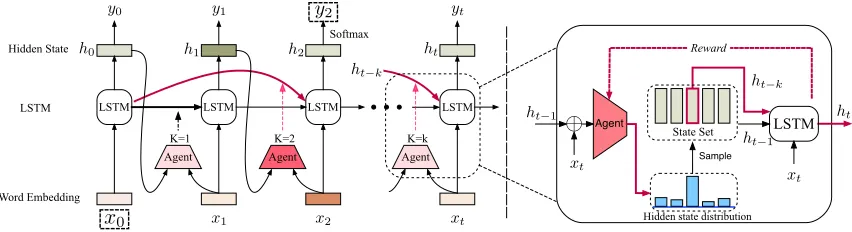
Figure 2: Architecture of the proposed model. At time stept, the agent selects one of the past few states based on the current
inputxtand the previous hidden stateht−1. The agent’s selections will influence the log-likelihood of the ground truth, which
will be a reward or penalty to optimize the agent. Take the phrase “depend to some extent on” as an example, the agent should learn to select the hidden state from “depend” not “extend” to predict “on,” because selecting “depend” receives a larger reward.
To overcome this limitation, in this paper, we consider the sequence modeling problem with dynamic skip connections. The proposed model allows “LSTM cells” to compute recur-rent transition functions based on one optimal set of hidden and cell states from the past few states. However, in gen-eral, we do not have the labels to guide which two words should be connected. To overcome this problem, we pro-pose the use of reinforcement learning to learn the depen-dent relationship through the exploring process. The main benefit of this approach is the better modeling of depen-dencies with variable length in the language. In addition, this approach also mitigates vanishing and exploding gradi-ent problems with a shorter gradigradi-ent backpropagation path. Through experiments, We find the empirical evidences (see
Experiments and Appendix1) that our model is better than
that using attention mechanism to connect two words, as re-ported in (Deng et al. 2018). Experimental results also show that the proposed method can achieve competitive perfor-mance on a series of sequence modeling tasks.
The main contributions of this paper can be summarized as follows: 1) we study the sequence modeling problem in-corporating dynamic skip connections, which can effectively tackle the long-term dependency problems; 2) we propose a novel reinforcement learning-based LSTM model to achieve the task, and the proposed model can learn to choose one op-timal set of hidden and cell states from the past few states; and 3) several experimental results are given to demonstrate the effectiveness of the proposed method from different as-pects.
Approach
In this work, we propose a novel LSTM network, which is a modification to the basic LSTM architectures. By using dy-namic skip connections, the proposed model can choose an optimal set of hidden and cell states to compute recurrent
transition functions. For the sake of brevity, we useStateto
represent both the hidden state and cell state. Because of the non-differentiability of discrete selection, we adopted rein-forcement learning to achieve the task.
1
Please refer to https://arxiv.org/abs/1811.03873
Model Overview
Taking language modeling as an example, given an
in-put sequence x1:T with length T, at each time step t,
the model takes a word embedding xt as input, and aims
to output a distribution over the next word, which is
de-noted by yt. However, in the example shown in Figure 2,
in standard RNN settings, memorizing long-term
depen-dency (depend ...7→on) while maintaining short-term
mem-ory (to7→some7→extent) is difficult (Chang et al. 2017).
Hence, we developed a skipping technique that learns to
choose the most relevantStateat time stept−3to predict
the word “on” to tackle the long-term dependency problem. The architecture of the proposed model is shown in
Fig-ure 2. At time stept, the agent takes previous hidden state
ht−1as input, and then computes the skip softmax that
deter-mines a distribution over the skip steps between 1 andK. In
our setting, the maximum size of skipKis chosen ahead of
time. The agent thereby samples from this distribution to
de-cide whichStateis transferred to a standard LSTM cell for
recurrent transition computation. Then, the standard LSTM
cell will encode the newly selectedStateandxtto the
hid-den stateht. At the end of each time step, each hidden state
htis further used for predicting the next word based on the
same method as standard RNNs. Especially, such a model can be fully applied to any sequence modeling problem. In the following, we will detail the architecture and the training method of the proposed model.
Dynamic Skip with REINFORCE
The proposed model consists of two components: (1) a
pol-icy gradient agent that repeatedly selects the optimalState
from the historical State set, and (2) a standard LSTM
cell (Hochreiter and Schmidhuber 1997) using a newly
se-lectedState to achieve a task. Our goal for training is to
optimize the parameters of the policy gradient agentθa,
to-gether with the parameters of standard LSTM and possibly
other parameters including word embeddings denoted asθl.
The core of the proposed model is a policy gradient agent.
Sequential wordsx1:T with lengthT correspond to the
se-quential inputs of one episode. At each time step t, the
at(transferring a certainStateto a standard LSTM cell).
Then, the standard LSTM cell uses the newly selectedState
to achieve the task. The model’s performance based on the current selections will be treated as a reward to update the parameters of the agent.
Next, we will detail the four key points of the agent,
in-cluding the environment representationst, the actionat, the
reward function, and the recurrent transition function.
Environment representation.Our intuition in formulating
an environment representation is that the agent should se-lect an action based on both the historical and current infor-mation. We therefore incorporate the previous hidden state
ht−1and the current inputxtto formulate the agent’s
envi-ronment representation as follows:
st=ht−1⊕xt,
where⊕refers to the concatenation operation. At each time
step, the agent observes the environmentstto decide an
ac-tion.
Actions. After observing the environment st, the agent
should decide whichStateis optimal for the downstream
LSTM cell. Formally, we construct aStatesetSK, which
preserves theKrecently obtainedState, and the maximum
size K is set ahead of time. The agent takes an action by
sampling an optimalStateinSKfrom a multinomial
distri-butionπK(k|st)as follows:
P =sof tmax(M LP(st))
πK(k|st) =P r(K=k|st) =
K Y
i=1
p[ik=i],
(1)
where[k = i]evaluates to 1 ifk = i,0 otherwise.M LP
represents a multilayer perceptron to transformstto a vector
with dimensionalityK, and thesof tmaxfunction is used to
transform the vector to a probability distributionP.piis the
i-th element inP. Then, theStatet−k is transferred to the
LSTM cell for further computation.
Reward function. Reward function is an indicator of the
skip utility. A suitable reward function could guide the agent to select a series of optimal skip actions for training a bet-ter predictor. We capture this intuition by setting the reward to be the predicted log-likelihood of the ground truth, i.e., R= logP r(ˆyT|hT). Therefore, by interacting with the
en-vironment through the rewards, the agent is incentivized to select the optimal skips to promote the probability of the ground truth.
Recurrent transition function. Based on the previously
mentioned technique, we use a standard LSTM cell to
en-code the selected Statet−k, where k ∈ {1,2, ..., K}. In
the text classification experiments, we found that adding
the additional immediate previous state Statet−1 usually
led better results, although Statet−1 is a particular case
of Statet−k. However, in our sequence labeling tasks, we
found that just usingStatet−k is almost the optimal
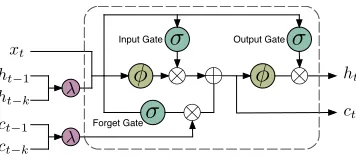
solu-tion. Therefore, In our model, we use a hyperparameterλto
incorporate these two situations, as shown in Figure 3.
For-⌦
⌦
⌦
ht 1
ht k
ct k
ct 1
xt
ht
ct
Forget Gate
Input Gate Output Gate
Figure 3: Schematic of the recurrent transition function en-coding both the selected hidden/cell states and the previous
hidden/cell states.λrefers to the functionλa+ (1−λ)b.σ
andφrefer to the sigmoid and tanh functions, respectively.
mally, we give the LSTM function as follows:
e
ht−1=λht−k+ (1−λ)ht−1
e
ct−1=λct−k+ (1−λ)ct−1
gt
it
ft
ot
=
Wgx,Whg Wix,Whi Wfx,Wfh Wox,Who
•
x
t
e ht−1
+
bg bi bf bo
ct =φ(gt)σ(it) +ect−1σ(ft) ht =σ(ot)φ(ct),
(2)
wherek∈ {1,2, ..., K}.φis thetanhoperator, andσis the
sigmoid operator.and• represent the Hadamard
prod-uct and the matrix prodprod-uct, respectively. We assume thaty
is one of{g, i, f, o}. The LSTM hasNh hidden units and
Nx is the dimensionality of word representationxi. Then,
Wyx ∈ RNh×Nx,Wy
h ∈ RNh×Nh, andby ∈ RNh are the
parameters of the standard LSTM cell.
Training Methods
Our goal for training is optimizing the parameters of the
pol-icy gradient agentθa, together with the parameters of
stan-dard LSTM and possibly other parameters denoted as θl.
Optimizingθlis straightforward and can be treated as a
clas-sification problem. Because the cross entropy lossJ1(θl)is
differentiable, we can apply backpropagation to minimize it as follows:
J1(θl) =−[yilog ˆyi+ (1−yi) log(1−yˆi)], (3)
whereyˆiis the output of the model.
The objective of training the agent is to maximize the ex-pected reward under the skip policy distribution plus an en-tropy regularization (Nachum et al. 2017).
J2(θa) =Eπ(a1:T)[R] +H(π(a1:T)), (4)
where π(a1:T) = QTt=1P r(at|st;θa), and R =
logP r(ˆyT|hT). H(π(a1:T)) = −Eπ(a1:T)[logπ(a1:T)] is
Task Dataset Level Vocab #Train #Dev #Test #class
Named Entity Recognition CoNLL2003 word 30,290 204,567 51,578 46,666 17
Language Modeling Penn Treebank word 10K 929,590 73,761 82,431 10K
Sentiment Analysis IMDB sentence 112,540 21,250 3,750 25,000 2
Number Prediction synthetic word 10 100,000 10,000 10,000 10
Table 1: Statistics of the CoNLL2003, Penn Treebank, IMDB, and synthetic datasets.
Because of the non-differentiable nature of discrete skips, we adopt a policy gradient formulation referred to as
REIN-FORCE method (Williams 1992) to optimizeθa:
∇θaJ2(θa) =Eπ(a1:T)[
T X
t=1
∇θalogP r(at|st;θa)∗
(R−
T X
t=1
logP r(at|st;θa)−1)].
(5)
By applying the above algorithm, the loss J2(θa) can be
computed by standard backpropagation. Then, we can get the final objective by minimizing the following function:
J(θa, θl) =
1
M[
M X
m=1
(J1(θl)−J2(θa))], (6)
whereM denotes the quantity of the minibatch, and the
ob-jective function is fully differentiable.
Experiments and Results
In this section, we present the experimental results of the proposed model for a variety of sequence modeling tasks, such as named entity recognition, language modeling, and sentiment analysis. In addition to the evaluation matrices for each task, in order to better understand the advantages of our model, we visualize the behavior of skip actions and make a comparison about how the gradients get changed be-tween the LSTM and the proposed model. In addition, we also evaluate the model on the synthetic number prediction tasks, and verify the proficiency in long-term dependencies. The datasets used in the experiments are listed in Table 1.
General experiment settings.For the fair comparison, we
use the same hyperparameters and optimizer with each base-line model of different tasks, which will be detailed in each experiment. As for the policy gradient agent, we use single layer MLPs with 50 hidden units. The maximum size of skip
Kand the hyperparameterλare fixed during both training
and testing.
Named Entity Recognition
We now present the results for a sequence modeling task, Named Entity Recognition (NER). We performed exper-iments on the English data from CoNLL 2003 shared task (Tjong Kim Sang and De Meulder 2003). This data set contains four different types of named entities: loca-tions, persons, organizaloca-tions, and miscellaneous entities that do not belong in any of the three previous categories. The corpora statistics are shown in Table 1. We used the
Model F1
Huang, Xu, and Yu (2015) 90.10
Chiu and Nichols (2015) 90.91±0.20
Lample et al. (2016) 90.94
Ma and Hovy (2016) 91.21
Strubell et al. (2017)† 90.54±0.18
Strubell et al. (2017) 90.85±0.29
LSTM, fixed skip = 3 (Zhang et al. 2016) 91.14
LSTM, fixed skip = 5 (Zhang et al. 2016) 91.16
LSTM with attention 91.23
LSTM with dynamic skip 91.56
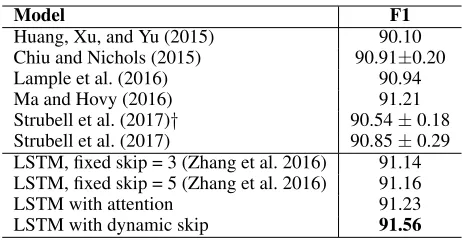
Table 2: F1-measure of different methods applied to the CoNLL 2003 dataset. The model that does not use character
embeddings is marked with†. “LSTM with attention” refers
to the LSTM model using attention mechanism to connect two words.
BIOES tagging scheme instead of standard BIO2, as previ-ous studies have reported meaningful improvement with this scheme (Lample et al. 2016; Ma and Hovy 2016).
Following (Ma and Hovy 2016), we use 100-dimension
GloVe word embeddings2 and unpretrained character
em-beddings as initialization. We use a forward and backward
new LSTM layer withλ = 1, K = 5and a CRF layer to
achieve this task. The reward is probability of true label se-quence in CRF. We use early stopping based on performance on validation sets. Ma and Hovy (2016) reported the “best” result appeared at 50 epochs and the model training required 8 hours. In our experiment, because of more exploration, the “best” result appeared at 65 epochs, the proposed method training required 9.98 hours.
Table 2 shows the F1 scores of previous models and our model for NER on the test dataset from the CoNLL 2003 shared task. To our knowledge, the previous best F1 score (91.21) was achieved by using a combination of bidirec-tional LSTM, CNN, and CRF to obtain both word- and character-level representations automatically (Ma and Hovy 2016). By adding a bidirectional LSTM with a fixed skip, the model’s performance would not improve. By contrast, the model using dynamic skipping technique improves the performance by average of 0.35%, and error reduction rate is more than 4%. Our model also outperforms the attention model, because the attention model employs a determinis-tic network to compute an expectation over the alignment
variable, i.e., logf(H,Ek[k]), not the expectation over the
features, i.e., logEk(H, k). However, the gap between the
above two expectations may be large (Deng et al. 2018). Our
2
Model Dev.(PPL) Test(PPL) Size
RNN (Mikolov and Zweig 2012) - 124.7 6 m
RNN-LDA (Mikolov and Zweig 2012) - 113.7 7 m
Deep RNN (Pascanu et al. 2013) - 107.5 6 m
Zoneout + Variational LSTM (medium) (Merity et al. 2016)† 84.4 80.6 20 m
Variational LSTM (medium) (Gal and Ghahramani 2016)† 81.9 79.7 20 m
Variational LSTM (medium, MC) (Gal and Ghahramani 2016)† - 78.6 20 m
Regularized LSTM (Zaremba, Sutskever, and Vinyals 2014)†‡ 86.2 82.7 20 m
Regularized LSTM, fixed skip = 3 (Zhang et al. 2016)† 85.3 81.5 20 m
Regularized LSTM, fixed skip = 5 (Zhang et al. 2016)† 86.2 82.0 20 m
Regularized LSTM with attention† 85.1 81.4 20 m
Regularized LSTM with dynamic skip,λ=1, K=5† 82.5 78.5 20 m
CharLM (Kim et al. 2016)†‡ 82.0 78.9 19 m
CharLM, fixed skip = 3 (Zhang et al. 2016)† 83.6 80.2 19 m
CharLM, fixed skip = 5 (Zhang et al. 2016)† 84.9 80.9 19 m
CharLM with attention† 82.2 79.0 19 m
CharLM with dynamic skip,λ=1, K=5† 79.9 76.5 19 m
Table 3: Perplexity on validation and test sets for the Penn Treebank language modeling task.PPLrefers to the average
per-plexity (lower is better) in ten runs. Size refers to the approximate number of parameters in the model. The models marked
with†have the same configuration which features a hidden size of 650 and a two layer LSTM. The models marked with‡are
equivalent to the proposed model with hyperparametersλ= 0, andK= 1.
LSTM
LSTM with dynamic skip
A
ve
rage
G
rad
ie
n
t N
or
m
0 0.002 0.004 0.006 0.008 0.010 0.012 0.014 0.016 0.018 0.020
Time Step
0 1 2 3 4 5 6 7 8 9 10 11 12 13 14 15 16 17 18 19 20
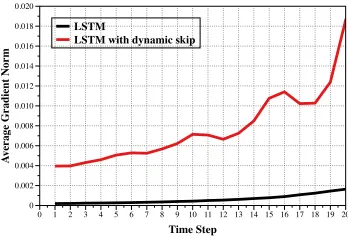
Figure 4: Normalized long-term gradient values
∂LT
∂ht
tested on CoNLL 2003 dataset. At the initial time steps, the proposed model still preserves effective gradients, which is hundreds of times larger than those in the standard LSTM, indicating that the proposed model have stronger ability to capture long-term dependency.
model is equivalent to the “Categorical Alignments” model in (Deng et al. 2018), which can effectively tackle the above deficiency. The detailed proof is given in Appendix.
In Figure 4, we investigate the problem of vanishing gra-dient by comparing the long-term gragra-dient values between standard LSTM and the proposed model. Following (Mu-jika, Meier, and Steger 2017), we compute the average
gra-dient norms
∂LT ∂ht
of the loss at time T with respect to
hidden statehtat each time stept. We visualize the gradient
norms in the first 20 time steps by normalizing the average gradient norms by the sum of average gradient norms for all time steps. Evidently, at the initial time steps, the pro-posed model still preserves effective gradient backpropaga-tion. The average gradient norm in the proposed model is
hundreds of times larger than that in the standard LSTM, in-dicating that the proposed model captures long-term depen-dencies, whereas the standard LSTM basically stores short-term information (Mujika, Meier, and Steger 2017). The
same effect was observed for cell statesct.
Language Modeling
We also evaluate the proposed model on the Penn Treebank language model corpus (Marcus, Marcinkiewicz, and San-torini 1993). The corpora statistics are shown in Table 1. The model is trained to predict the next word (evaluated on per-plexity) in a sequence.
To exclude the potential impact of advanced models, we restrict our comparison among the RNNs models. We repli-cate settings from Regularized LSTM (Zaremba, Sutskever, and Vinyals 2014) and CharLM (Kim et al. 2016). The above networks both have two layers of LSTM with 650 units, and the weights are initialized uniformly [-0.05, +0.05]. The gradients backpropagate for 35 time steps using stochastic gradient descent, with a learning rate initially set to 1.0. The norm of the gradients is constrained to be below five. Dropout with a probability of 0.5 on the LSTM input-to-hidden layers and the input-to-hidden-to-output softmax layer is ap-plied. The main difference between the two models is that the former model uses word embeddings as inputs, while the latter relies only on character-level inputs.
78 79 80 81 82 83
84 Attention Connection
Dynamic Skip Zaremba et al., 2014
PPL
K
2 3 4 5 6 7 8 9 10 78
79 80 81 82 83
84 Attention Connection Dynamic Skip Zaremba et al., 2014
PPL
λ
0.1 0.2 0.3 0.4 0.5 0.6 0.7 0.8 0.9 1
Figure 5: Test set perplexities (lower is better) on Penn
Tree-bank language model corpus with standard deviation forK
from 2 to 10 withλ= 0.5(left), andλfrom 0.1 to 1.0 with
K= 5(right).
... seek to prevent executive branch officials from ... from
... who devote most of their time to practicing ... ... taking flights from san francisco late yesterday to ...
to
to
k=4
k=4
k=3
(1)
(2)
(3)
Prediction Probability: LSTM 0.03, LSTM with dynamic skip 0.21
Prediction Probability: LSTM 0.04, LSTM with dynamic skip 0.31
Prediction Probability: LSTM 0.33, LSTM with dynamic skip 0.91
Figure 6: Examples of the proposed model applied to lan-guage modeling.
powerful (Zhang et al. 2016), whereas in a complex lan-guage environment, the fixed skip length is constrained by its inability to take advantage of the dependencies with vari-able lengths.
Hence, by adding a dynamic skip on the recurrent con-nections to the LSTM, our model can effectively tackle the above problem. Both the models with dynamic skip connec-tions outperform baseline models, and the best model is able to improve the average test perplexity from 82.7 to 78.5, and 78.9 to 76.5, respectively. We also investigated how the
hy-perparametersλandKaffect the performance of proposed
model as shown in Figure 5.λis a weight to balance the
utility between the newly selectedStateand the previous
State.Krepresents the size of the skip space. From both
figures we can see that, in general, the proposed model with
largerλandKvalues should obtain betterPPL, while
pro-ducing a larger variance because of the balance favoring the
selectedStateand a larger searching space.
To verify the effectiveness of dynamic skip connections, we visualize the behavior of the agent in a situation where it predicts a preposition based on a long-term dependency. Some typical examples are shown in Figure 6. From the fig-ure, we can see that in the standard LSTM setting, predicting the three prepositions in the figure is difficult just based on
the previous State. By introducing the long-term and the
most relevant State using dynamic skip connections, the
proposed model is able to predict the next word with bet-ter performance in some cases.
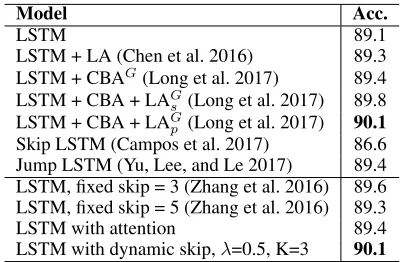
Model Acc.
LSTM 89.1
LSTM + LA (Chen et al. 2016) 89.3
LSTM + CBAG(Long et al. 2017) 89.4
LSTM + CBA + LAGs (Long et al. 2017) 89.8
LSTM + CBA + LAGp (Long et al. 2017) 90.1
Skip LSTM (Campos et al. 2017) 86.6
Jump LSTM (Yu, Lee, and Le 2017) 89.4
LSTM, fixed skip = 3 (Zhang et al. 2016) 89.6
LSTM, fixed skip = 5 (Zhang et al. 2016) 89.3
LSTM with attention 89.4
LSTM with dynamic skip,λ=0.5, K=3 90.1
Table 4: Accuracy on the IMDB test set.
Sentiment Analysis on IMDB
Two similar works to ours are Jump LSTM (Yu, Lee, and Le 2017) and Skip LSTM (Campos et al. 2017), which are excellent modifications to the LSTM and achieve great per-formance on text classification. However, the above model cannot be applied to some sequence modeling tasks, such as language modeling and named entity recognition, because the jumping characteristics and the nature of skipping state updates make the models cannot produce LSTM outputs for skipped tokens and cannot update the hidden state, respec-tively. For better comparison with the above two models, we apply the proposed model to a sentiment analysis task.
The IMDB dataset (Maas et al. 2011) contains 25,000 training and 25,000 testing movie reviews annotated into
positive or negative sentiments, where the average length
of text is 240 words. We randomly set aside about 15% of the training data for validation. The proposed model, Jump LSTM, Skip LSTM, and LSTM all have one layer and 128 hidden units, and the batch size is 50. We use pretrained word2vec embeddings as initialization when available, or
random vectors drawn fromU(−0.25,+0.25). Dropout with
a rate of 0.2 is applied between the last LSTM state and the classification layer. We either pad a short sequence or crop a
long sequence to 400 words. We setλandKto 0.5 and 3,
respectively.
The result is reported in Table 4. Chen et al. (2016) em-ployed the idea of local semantic attention to achieve the task. Long et al. (2017) proposed a cognition based attention model, which needed additional eye-tracking data. From this result, we can see that our model also exhibits a strong per-formance on the text classification task. The proposed model is 1% better than the standard LSTM model. In addition, our model outperforms Skip LSTM and Jump LSTM mod-els with accuracy at 90.1%. Therefore, the proposed model not only can achieve sequence modeling tasks such as lan-guage modeling and named entity recognition, but it also has a stronger ability for text classification tasks than Jump LSTM and Skip LSTM.
Number Prediction with Skips
sequence length 11
Model Dev. Test
LSTM 69.6 70.4
LSTM with attention 71.3 72.5
LSTM with dynamic skip,λ=1, K=10 79.6 80.5
LSTM with dynamic skip,λ=0.5, K=10 90.4 90.5
sequence length 21
Model Dev. Test
LSTM 26.2 26.4
LSTM with attention 26.7 26.9
LSTM with dynamic skip,λ=1, K=10 77.6 77.7
LSTM with dynamic skip,λ=0.5, K=10 87.7 88.5
Table 5: Accuracies of different methods on number predic-tion dataset.
Le 2017), we also investigate a new task, where the network
is given a sequence ofLpositive integersx0:T−1, and the
label isy =xxT−1. Here are two examples to illustrate the
idea:
input1: 8, 5, 1,7, 4, 3. label: 7
input2: 2, 6,4, 1, 3, 2. label: 4
As the examples show,xT−1 is the skipping signal that
guides the network to introduce thexT−1-th integer as the
input to predict the label. The ideal network should learn to ignore the remaining useless numbers and learn how to skip from the training data.
According to above rule, we generate 100,000 training, 10,000 validation, and 10,000 test examples. Each example
with a lengthT = 11is formed by randomly sampling 11
numbers from the integer set{0,1, ...,9}, and we set xx11
as the label of each example. We use ten dimensional one-hot vectors to represent the integers as the sequential inputs of LSTM or Dynamic LSTM, of which the last hidden state is used for prediction. We adopt one layer of LSTM with 200 hidden neurons. The Adam optimizer (Kingma and Ba 2014) trained with cross-entropy loss is used with 0.001 as the default learning rate. The testing result is reported in Ta-ble 5. It is interesting to see that even for a simple task, the LSTM model cannot achieve a high accuracy. However, the LSTM with dynamic skip is able to learn how to skip from the training examples to achieve a much better performance. Taking this one step further, we increase the difficulty of the task by using two skips to find the label, i.e., the label is
y=xx0, x0 =xx
T−1. To accord with the nature of skip, we
forcex0< xT−1, Here is an example:
input: 8,5, 1, 7, 1, 3, 3, 4, 7, 9, 4. label: 5
Similar to the former method, we construct a dataset with the same size, 100,000 training, 10,000 validation, and
10,000 test examples. Each example with lengthT = 21
is also formed by randomly sampling 21 numbers from the
integer set{0,1, ...,9}. We use the same model trained on
the dataset. As the Table 5 shows, the accuracy of the LSTM with dynamic skip is vastly superior to that of LSTM.
There-fore, the results indicate that the Dynamic LSTM is able to learn how to skip.
Related Work
Many attempts have been made to overcome the difficulties of RNNs in modeling long sequential data, such as gating mechanism (Hochreiter and Schmidhuber 1997; Chung et al. 2014), Multi-timescale mechanism (Chung, Ahn, and Ben-gio 2016). Recently, many works have explored the use of skip connections across multiple time steps (Zhang et al. 2016; Chang et al. 2017). Zhang et al. (2016) introduced
the recurrent skip coefficient, which captures how quickly
the information propagates over time, and found that raising the recurrent skip coefficient can mostly improve the per-formance of models on long-term dependency tasks. Note that previous research on skip connections all focused on a fixed skip length, which is set in advance. Different from these methods, this work proposed a reinforcement learning method to dynamically decide the skip length.
Other relevant works that introduce reinforcement learn-ing to recurrent neural networks are Jump LSTM (Yu, Lee, and Le 2017), Skip RNN (Seo et al. 2017), and Skim RNN (Seo et al. 2017). The Jump LSTM aims to reduce the computational cost of RNNs by skipping irrelevant informa-tion if needed. Their model learns how many words should be omitted, which also utilizes the REINFORCE algorithm. Also, the Skip RNN and Skim RNN can learn to skip (part of) state updates with a fully differentiable method. The main differences between our method and the above meth-ods are that Jump LSTM can not produce LSTM outputs for the skipped tokens and the Skip (Skim) RNN would not update (part of) hidden states. Thus three models would be difficult to be used for sequence labeling tasks. In contrast to them, our model updated the entire hidden state at each time step, and can be suitable for sequence labeling tasks.
Conclusions
In this work, we propose a reinforcement learning-based LSTM model that extends the existing LSTM model with dynamic skip connections. The proposed model can dynam-ically choose one optimal set of hidden and cell states from the past few states. By means of the dynamic skip connec-tions, the model has a stronger ability to model sentences than those with fixed skip, and can tackle the dependency problem with variable lengths in the language. In addition, because of the shorter gradient backpropagation path, the model can alleviate the challenges of vanishing gradient. Ex-perimental results on a series of sequence modeling tasks demonstrate that the proposed method can achieve much better performance than previous methods.
Acknowledgments
References
Campos, V.; Jou, B.; Gir´o-i Nieto, X.; Torres, J.; and Chang, S.-F. 2017. Skip rnn: Learning to skip state updates in
re-current neural networks.arXiv preprint arXiv:1708.06834.
Chang, S.; Zhang, Y.; Han, W.; Yu, M.; Guo, X.; Tan, W.; Cui, X.; Witbrock, M.; Hasegawa-Johnson, M. A.; and Huang, T. S. 2017. Dilated recurrent neural networks. In Advances in Neural Information Processing Systems, 76–86.
Chen, H.; Sun, M.; Tu, C.; Lin, Y.; and Liu, Z. 2016. Neural sentiment classification with user and product attention. In EMNLP 2016, 1650–1659.
Chiu, J. P., and Nichols, E. 2015. Named entity
recognition with bidirectional lstm-cnns. arXiv preprint
arXiv:1511.08308.
Chung, J.; Ahn, S.; and Bengio, Y. 2016.
Hierarchi-cal multisHierarchi-cale recurrent neural networks. arXiv preprint
arXiv:1609.01704.
Chung, J.; Gulcehre, C.; Cho, K.; and Bengio, Y. 2014. Em-pirical evaluation of gated recurrent neural networks on
se-quence modeling. arXiv preprint arXiv:1412.3555.
Dai, A. M., and Le, Q. V. 2015. Semi-supervised sequence
learning. InNIPS, 3079–3087.
Deng, Y.; Kim, Y.; Chiu, J.; Guo, D.; and Rush, A. M. 2018.
Latent alignment and variational attention. arXiv preprint
arXiv:1807.03756.
El Hihi, S., and Bengio, Y. 1996. Hierarchical recurrent
neural networks for long-term dependencies. InAdvances
in neural information processing systems, 493–499.
Gal, Y., and Ghahramani, Z. 2016. A theoretically grounded
application of dropout in recurrent neural networks. InNIPS,
1019–1027.
Hochreiter, S., and Schmidhuber, J. 1997. Long short-term
memory.Neural computation9(8):1735–1780.
Huang, Z.; Xu, W.; and Yu, K. 2015. Bidirectional
lstm-crf models for sequence tagging. arXiv preprint
arXiv:1508.01991.
Kim, Y.; Jernite, Y.; Sontag, D.; and Rush, A. M. 2016.
Character-aware neural language models. InAAAI, 2741–
2749.
Kingma, D. P., and Ba, J. 2014. Adam: A method for
stochastic optimization.arXiv preprint arXiv:1412.6980.
Lample, G.; Ballesteros, M.; Subramanian, S.; Kawakami, K.; and Dyer, C. 2016. Neural architectures for named entity
recognition.arXiv preprint arXiv:1603.01360.
Long, Y.; Qin, L.; Xiang, R.; Li, M.; and Huang, C.-R. 2017. A cognition based attention model for sentiment analysis. In EMNLP 2017, 462–471.
Ma, X., and Hovy, E. 2016. End-to-end sequence labeling
via bi-directional lstm-cnns-crf. InACL, volume 1, 1064–
1074.
Maas, A. L.; Daly, R. E.; Pham, P. T.; Huang, D.; Ng, A. Y.; and Potts, C. 2011. Learning word vectors for sentiment
analysis. InACL, 142–150.
Marcus, M. P.; Marcinkiewicz, M. A.; and Santorini, B. 1993. Building a large annotated corpus of english: The
penn treebank. Computational linguistics19(2):313–330.
Merity, S.; Xiong, C.; Bradbury, J.; and Socher, R.
2016. Pointer sentinel mixture models. arXiv preprint
arXiv:1609.07843.
Mikolov, T., and Zweig, G. 2012. Context dependent
recur-rent neural network language model. SLT12:234–239.
Mujika, A.; Meier, F.; and Steger, A. 2017. Fast-slow
recur-rent neural networks. InNIPS, 5917–5926.
Nachum, O.; Norouzi, M.; Xu, K.; and Schuurmans, D. 2017. Bridging the gap between value and policy based
re-inforcement learning. InNIPS, 2775–2785.
Nallapati, R.; Zhou, B.; Gulcehre, C.; Xiang, B.; et al. 2016. Abstractive text summarization using sequence-to-sequence
rnns and beyond. arXiv preprint arXiv:1602.06023.
Pascanu, R.; Gulcehre, C.; Cho, K.; and Bengio, Y. 2013.
How to construct deep recurrent neural networks. arXiv
preprint arXiv:1312.6026.
Santos, C. D., and Zadrozny, B. 2014. Learning
character-level representations for part-of-speech tagging. In
ICML-14, 1818–1826.
Seo, M.; Min, S.; Farhadi, A.; and Hajishirzi, H. 2017.
Neural speed reading via skim-rnn. arXiv preprint
arXiv:1711.02085.
Serban, I. V.; Sordoni, A.; Bengio, Y.; Courville, A. C.; and Pineau, J. 2016. Building end-to-end dialogue systems
us-ing generative hierarchical neural network models. InAAAI,
volume 16, 3776–3784.
Strubell, E.; Verga, P.; Belanger, D.; and McCallum, A. 2017. Fast and accurate entity recognition with iterated
di-lated convolutions. InEMNLP 2017, 2670–2680.
Sutskever, I.; Vinyals, O.; and Le, Q. V. 2014. Sequence
to sequence learning with neural networks. InNIPS, 3104–
3112.
Tjong Kim Sang, E. F., and De Meulder, F. 2003. Introduc-tion to the conll-2003 shared task: Language-independent
named entity recognition. InHLT-NAACL 2003-Volume 4,
142–147.
Williams, R. J. 1992. Simple statistical gradient-following
algorithms for connectionist reinforcement learning. In
Re-inforcement Learning. Springer. 5–32.
Yu, A. W.; Lee, H.; and Le, Q. 2017. Learning to skim text.
InACL (Volume 1: Long Papers), volume 1, 1880–1890.
Zaremba, W.; Sutskever, I.; and Vinyals, O. 2014.
Re-current neural network regularization. arXiv preprint
arXiv:1409.2329.
Zhang, S.; Wu, Y.; Che, T.; Lin, Z.; Memisevic, R.; Salakhutdinov, R. R.; and Bengio, Y. 2016. Architectural
complexity measures of recurrent neural networks. InNIPS,