Volume 3, Issue 3, March 2014
Page 575
ABSTRACTUCT
A nominal composition Bi1.5 (CuPb)0.5Sr2Ca2Cu3O10+δ Wasprepared by powder technology and press it as pellet of diameter 1.3
cm in order to study the behavior of complex dielectric constant and a.c. conductivity at different temperatures.The behavior of complex dielectric constant and overall response of conductivity for Bi1.5 (CuPb)0.5Sr2Ca2Cu3O10+δ as pellets were measured
within frequency range 100HZ to10MHZ. and temperatures range (293-433) K0 it was found that the dielectric constant Sharply decreases with increasing frequency in low frequency region while the slightly decreasing in the high frequency region. The obtained experimental results of ε1 depend upon temperature at lower frequencies more than at higher frequencies. The sharply decrease of dielectric loss 2 was noticed at low frequency range ,but at high frequency range the samples showed a fluctuation with frequency.
The conductivity tot( for all samples increases as frequency becomes greater than 4000Hz .In this case the conductivity is proportional to s,
which means that a.c. conductivity dominates at higher frequencies in the range (4000Hz-10MHz).
For a lower frequencies in the range (100Hz-4000Hz), tot() becomes less dependent with frequency because d.c. component of conductivity dominates in this range of frequency . The plot ln & Ln () shows the increasing of conductivity with frequency and gives straight lines. The slope of the straight line for the high frequency region is s = 0.869 at room temperature while at temperature (433k) the slope value becomes s = 1.321 , the data suggest that s increases with temperature.The variation of s with temperature suggests that ac conduction is due to the correlated barrier hopping. These dada confirmed that this compound has good stability at low frequencies for waveguide and is a useful as dielectirc material at high frequencies.
Keywords: Materials,Dielectric constants,Bi compound,HighTemperature Superconductor.
1. INTRODUCTION
Bismuth strontium calcium copper oxide, or BSCCO ( pronounced "bisko"), is a family of high temperature superconductors having the generalized chemical formula Bi2Sr2Can-1CunO2n+4+δ with n=2 being the most commonly
studied compound but n=3 have also received significant attention [1]. Powder as bulk has polycrystalline structure (orthorhombic ) as indicated by recent research Oday[2]. He reported that its crystal structures is orthorhombic of Bi-based superconductors consist of two generic building blocks: the vital, superconducting copper-oxide layers or planes, and the insulating block layers which can act as electronically active charge-reservoirs for hole or electron donation to the copper-oxygen layers. In the present work we studied the affect of temperatures and frequencies on behavior of complex dielectric constant and ac conductivity for BSCCO compound of Bi1.5 (CuPb)0.5Sr2Ca2Cu3O10+δ.
2.EXPERIMENTAL
Samples of Bi1.5(CuPb)0.5Sr2Ca2Cu3O10+δ were prepared by solid state reaction method. First of all the molar ratios of
high purity powders of Bi2O3, Pb3O4, Sr(NO3)2, CaCO3 and CuO were adjusted, mixed using agate mortar. This mixture
was then controller type [calcined in a tube furnace under atmospheric conditions that has programmable Eurotherm 818P] for 20-24 hours at 800oC with a rate of 2oC/min. Then pressed into pellets of 1.3 cm in diameter and (0.25-0.28) cm thick a, by using manually hydraulic press type (SPECAC) under pressure of 0.5GPa. These pellets were sintered in air atmosphere at sintering temperature Ts= 860 oC for 140 h with a rate of 2oC/min by using furnace that has
programmable controller type [Eurotherm 818P]. Then the pellets cooled to room temperature with the same rate of heating.
To study a.c. conductivity and the behavior of the dielectric constant , Bi1.5(CuPb).5Sr2Ca2Cu3O10+δ as pellet was put
between two cu electodes into electrical oven which is connected to LCR system of a programmable (pM 60304 Philibs) in order to measure the capacitance C and the conductance G as a function of temperatures and frequencies.
3. RESULTS AND DISCUSSION
3.1 Dielectric Behavior with Frequency And Temperature
AC conductivity and dielectric behavior of
Bi
1.5
(CuPb)
0.5
Sr
2
Ca
2
Cu
3
O
10+δ
Compound prepared by powder technology
Bushra Salman Mahdi
Volume 3, Issue 3, March 2014
Page 576
We have studied the frequency-dependence of dielectric constant of Bi1.5(CuPb).5Sr2Ca2Cu3O10+δ as pellets. Themeasurements were carried out through the temperature range (293 – 433) K and frequency range from 0.1 kHz to 4 MHz. In general the complex relative dielectric permittivity is given by the equation [3]:
εr(ω) = ε1(ω)-iε2(ω) …………. (1)
(εr = ε / ε0 ; where ε0 = 8.85x10¹²F/m is the permittivity of free space and ω is the angular frequency) .
The dielectric constant є1 was calculated from the equation:
є1 = C/Co ………… …(2)
where Cois the geometrical capacitance of the sample ( Co = єo A/d , where d is the thickness of the sample and A is the
cross sectional area ) .
Also the dielectric loss є2 was calculated from the equation :
є2 = G/ wCo ……….(3)
From figure 1, a sharply decrease in dielectric constant was observed with the increase in frequency for all temperatures because at lower frequencies, the compound exhibits different types of polarizations (i.e. interfacial, dipolar, atomic, ionic, and electronic) [4].The slightly decreasing of the ε1 in the high frequency region can be related to the partially
blocked of charge carrier near the electrodes[5].
0 200 400 600 800 1000 1200 1400
6 7 8 9 10 11 12 13 14 15 16
dielectric
constant
Ln(ω)
T=293 K
T=303 K
T=313 K
T=333 K
Fig.1.Dielectric constant as a function of frequency for Bi1.5 (CuPb)0.5Sr2Ca2Cu3O10+δ pellet.
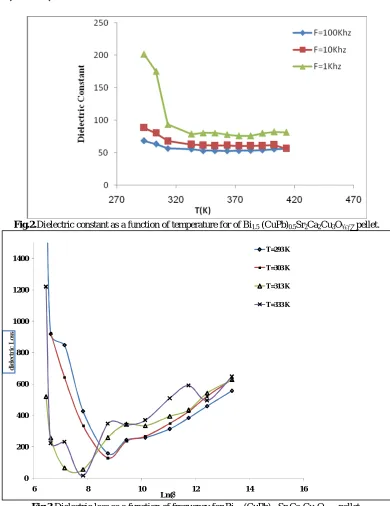
Figuer 2 represents the variation of dielectric constant as a function of temperature at selected frequencies(1kHz,10kHz,100kHz).the sharp decrease of dielectric constant with the increase of temperature has been observed in the early steps of measurement for the selected frequencies .however the starting values of ε1 for the three
frequencies are different .the samples with frequencies(10kHz,100kHz) behaved almost similarly with the variation of temperature, but at 1kHz showed much higher initial values than those ,this means that the obtained experimental results of ε1 depend upon temperature at lower frequencies more than at higher frequencies.The interpretation of this behavior is
Volume 3, Issue 3, March 2014
Page 577
Fig.2.Dielectric constant as a function of temperature for of Bi1.5 (CuPb)0.5Sr2Ca2Cu3O10+δ pellet.
0 200 400 600 800 1000 1200 1400
6 8 10 12 14 16
d
ie
le
ct
r
ic
L
o
ss
Ln(ω)
T=293 K
T=303 K
T=313 K
T=333 K
Fig.3.Dielectric loss as a function of frequency for Bi1.5 (CuPb)0.5Sr2Ca2Cu3O10+δ pellet.
3.2 A.C. Conductivity
Fig .4 shows the frequency dependence of the overall response of conductivity σ (ω) at different temperatures in the range 293K-433K for Bi1.5(CuPb).5Sr2Ca2Cu3O10+δ as bulk. The overall response of conductivity follows the equation:
σ (ω) = σd.c. + A ωs ………(4)
where A ωs
represents the a.c. conductivity which obeys the Almond-West universal power law in the form of σa.c. = A ωs ,
where A is constant and s is the frequency exponent [8] :
Volume 3, Issue 3, March 2014
Page 578
0.00E+001.00E-05 2.00E-05 3.00E-05 4.00E-05
5 7 9 11 13 15
σ
(
Ω
.c
m
)
Ln(ω)
t=293K
t=313K
t=333K
t=453K
Fig.4. Frequency dependence of overall response of conductivity for Bi1.5 (CuPb)0.5Sr2Ca2Cu3O10+δ pellet at different
temperatures.
Values of the frequency exponent s can be determined from the slope of the linear part of Fig.5 in the region between(4-100) KHz The exponent swas found to increase as the value of temperatures changed from 293k to 433k as shown in Fig 6. The variation of s with temperature suggests that ac conduction is due to the correlated barrier hopping.
-20 -15 -10
6 7 8 9 10 11 12 13 14 15 16
L
n
(
σ
)
Ln (ω)
T=293 k T=313 k T=333 k T=343 k T=373 k T=393 k
Fig.5. Lgarithmic scale of A.C conductivity as a function of frequency
Volume 3, Issue 3, March 2014
Page 579
The exponent s is supposed to satisfy the condition 0 < s < 1 however, experimental values of s higher than 1 are founded in this work. These values were attributed tolocalized hopping and/or reorientation motion. The motion of mobile ions from site to site with quantum mechanical tunneling between asymmetric double-well potential was proposed to investigate the observed high values of s, especially in polycrystalline compound of different grains sizes [5].
Fig.7 shows the plot of Ln σ versus the inverse of temperature for Bi1.5(CuPb).5Sr2Ca2Cu3O10+δ as bulk at high
frequencies .The pattern of temperature dependent conductivity plots can be said to follow the Arrhenius behavior [10]: σ = σ
ο exp (-EA/kT) ……… (5)
where σ
ο is the pre-exponential factor, EA is the activation energy, k is Boltzmann constant and T is absolute temperature .
-18 -17 -16 -15 -14 -13 -12 -11 -10 -9 -8
2.4 2.5 2.6 2.7 2.8 2.9 3 3.1 3.2 3.3 3.4 3.5
L
n(
σ
)
1000/T (1/K)
F=1000 HZ F= 4000 Hz F=20000 Hz F=40000 Hz F=100000 Hz
Fig.7. Temperature dependence of the electrical conductivity for Bi1.5 (CuPb)0.5Sr2Ca2Cu3O10+δ pellet.
From equation 5 the activation energy E
A can be calculated from the slope of the linear part at low temperatures for all
frequencies in Fig. 7 which shows Frequency dependence of the activation energy . It can be observed that the activation energy values increases with the increase of frequency as shown in Fig. 8. indicates values of activation energy as a function of frequencies.
0 0.005 0.01 0.015 0.02 0.025 0.03 0.035 0.04 0.045 0.05
0 20000 40000 60000 80000 100000 120000
A
ct
iv
at
io
n
E
n
e
e
rg
y(
e
v)
f (Hz)
Volume 3, Issue 3, March 2014
Page 580
4. CONCLUSIONS
The compound has dielectric properties at room temperature. The obtained experimental results of ε1 depend upon
temperature at lower frequencies more than at higher frequencies. Samples of Bi1.5 (CuPb)0.5Sr2Ca2Cu3O10+δ prepared
by solid state thermo-chemical reaction. The sharply decrease of dielectric loss 2 was noticed at low frequency range ,but at high frequency range the samples showed a fluctuation with frequency. At higher frequencies the samples showed a fluctuation with frequency,wich can be considered as order-disorder transition. This type of variation was observed in some of the dielectrics . The conductivity tot( for all samples increases as frequency becomes greater than 4000Hz .In this case the conductivity is proportional to s, which means that a.c. conductivity dominates at higher frequencies in the range (4000Hz-10MHz).The frequency exponent was calculated from ac conductivity data .The mechanism of ac conductivity results is matched with the correlated barrier hopping model CBH. These dada confirmed that this compound has good stability at low frequencies for waveguide and is a useful as dielectirc material at high frequencies.
References
[1] H. Maeda, Y. Tanaka, M. Fukutumi, and T. Asano,A New High-TcOxide Superconductor without a Rare Earth
Element,Jpn. J. Appl. Phys., 27,pp. L209–L210,1988.
[2] O. Salim, effect of cu dopant on Tc of Bi2-xCuxPb0.3Sr2Ca2Cu3O10+ᵟ Superconductors ,D.M. Thesis,Baghdad
Unversity,College of scince,2009 .
[3] Nor Hazlizaaini Basri and N.S. Mohamed , Solid State Science and Technology, 17, 1 ,pp 63-72 .2009.
[4] W. Kim,Ch. Ahn ,J.Kima,T.song, Low-frequency dielectric relaxation and ac conduction of SrBi2Ta2O9 thin film
grown by pulsed laser deposition Applied Physics Letters , 80 ,pp 21 , 2002. .
[5] Lanj A,Sharma S& Pode R,Synthesis and Optical Characterization of Copper Oxide Nanoparticles, Advances in Applied Science Research,1,pp.36-40,2010.
[6] J.Robertson,Physics of amorphous conducting oxides,J.Non-Cryst.Solids,354,pp.2791,2008.
[7] R.Choudhary,R.Palai,S.Sharma,Structural,Dielectric and Electrical Properties of Lead Cadmium Tungstate ceramics Materials Science and Engineering,B77,pp.235-240,2000.
[8] J. Won Kim and C.Won Ahn,Surface Properties of Indium Doped CdSno4,Applied Physics
Letters,80,21,pp.4006-4010,2002.
[9] A.Baeraky,Microwave measurements of Dielectric Properties of Zinc Oxide at High Temperature Egypt.,J.Solids,30,pp.13,2007.
[10] Dillip K.Pradhan,Chinese,Dielectric Behavior Of ZnMnO4 J.Phys.,47,6,pp.780,2008.