DEMOGRAPHIC RESEARCH
VOLUME 28, ARTICLE 4, PAGES 77-136
PUBLISHED 11 JANUARY 2013
http://www.demographic-research.org/Volumes/Vol28/4/ DOI: 10.4054/DemRes.2013.28.4
Research Article
Spatial continuities and discontinuities in two
successive demographic transitions: Spain and
Belgium, 1880-2010
Ron Lesthaeghe
Antonio Lopez-Gay
© 2013 Lesthaeghe & Lopez-Gay.
This open-access work is published under the terms of the Creative Commons Attribution NonCommercial License 2.0 Germany, which permits use, reproduction & distribution in any medium for non-commercial purposes, provided the original author(s) and source are given credit.
1 Background 78
2 The RWA model of innovation and diffusion of new behavioral
forms 79
3 From the FDT to the SDT: The Belgian example revisited 84
3.1 The three secularization waves in Belgium: 1750-1970 85
3.2 Spatial continuity: Indicators and covariates for the Belgian
example 92
3.3 Statistical results for the Belgian example 94
3.3.1 Factor 1: Successive demographic innovations and long term
spatial continuity 95
3.3.2 Factor 2: Historical illegitimacy in fertility and the urban-industrial
connection 97
3.3.3 Factor 3: SDT fertility postponement 99
3.4 The Belgian experience in a nutshell 101
4 From FDT to SDT: The Spanish experience 102
4.1 The Spanish spatial secularization pattern 103
4.2 The demographic dimensions of the FDT and the SDT in Spain 109
4.3 Statistical results for the Spanish example 110
4.3.1 The FDT marital fertility transition 110
4.3.2 The FDT nuptiality system 113
4.3.3 The “illegitimacy” dimension of the FDT 115
4.3.4 The postponement dimension of the SDT 116
4.3.5 The “non-conformism” dimension of the SDT 119
5 A common multivariate analysis strategy for both countries 120 5.1 The principal components of the independent variables sets in
Belgium and Spain 121
5.2 Conclusions: Back to the RWA paradigm 126
6 Acknowledgements 128
References 129
Spatial continuities and discontinuities in two successive
demographic transitions: Spain and Belgium, 1880-2010
Ron Lesthaeghe1 Antonio Lopez-Gay2
Abstract
This is a study of how the synergisms between cultural and structural factors, which played a major role during the historical fertility and nuptiality transition (first demographic transition or FDT), have continued to condition demographic innovations connected to the “second demographic transition” (SDT). The continuity or discontinuity from the “first” to the “second” demographic transition is studied for spatial aggregates over more than a century in two national contexts, i.e. Belgium and Spain. Special attention is paid to the role of successive secularization waves in shaping the geographical patterns of both transitions. The study also shows that the maps of the two aspects of the SDT, i.e. the “postponement” and the “non-conformism” transitions respectively, are shaped by different determinants. Explanations are offered using the “Ready, Willing, and Able” paradigm, which allows us to uncover the different conditioning and limiting factors involved. The “non-conformist” transitions (control of marital fertility during the FDT and rise of cohabitation and non-conventional family formation during the SDT) more closely mirror the history of secularization and the “Willingness” condition, whereas the fertility postponement aspect of the SDT mainly reflects female education and employment, or the “Readiness” condition. This generalization holds in both countries. However, in Belgium spatial continuity from FDT to SDT is connected to stable patterns of secularization, whereas in Spain it is linked to long standing differences with respect to female literacy and education.
1 Emeritus professor Vrije Universiteit (VUB), and Royal Academy of Sciences, Brussels. Support for his
work in Barcelona came from AGUAR, Generalitat de Catalunya. E-mail: [email protected].
1. Background
Several books and articles belonging to the so-called “Princeton Fertility Project” (especially: Livi-Bacci 1971, 1977, Lesthaeghe 1977, Lesthaeghe and Wilson 1986) are often cited as “cultural” corrections or complements to the classic economic and structural interpretations that dominate studies of historical fertility decline. One of the sources of inspiration (if not the main one) of the Princeton Fertility Project was without doubt William Leasure’s doctoral dissertation (1962) on the Spanish fertility transition. In this thesis Leasure showed that the classic indicators of urbanization and industrialization largely failed to account for the regional diversity in Spain’s fertility decline, and that regional and linguistic particularisms prevailed. This convinced A. J. Coale that it would be worthwhile to extend this Spanish investigation to the rest of Europe. The “Princeton Project” gradually emerged as a result, not as a cohesive project with preconceived objectives, but as a mere collection of empirical contributions from a variety of authors. Most of the research belonging to the Princeton project was performed during the late 1960s and through the 1970s, and several other and similar investigations were conducted during the following decades, including major further major studies on Spain and Prussia (e.g., Reher and Iriso-Napal 1989, Galloway et al. 1994, Galloway 2009).
Roughly 30 years after the completion of the Princeton studies, new demographic features have emerged with respect to household formation and fertility, and these are by now often collectively referred to as the “Second demographic transition” (SDT) (Lesthaeghe and van de Kaa 1986). The SDT has two main dimensions: (i) the “postponement transition”, referring to the upward shifts in ages at marriage and at first and subsequent births, and (ii) the “non-conformism transition”, pointing at the growth of unconventional forms of household formation (rise of cohabitation, of fertility among cohabitants, of single parent households, of same sex households, and of reconstituted families based on cohabitation).
The succession of two waves of demographic innovation, referred to here as the first and second demographic transitions (FDT and SDT), begs the question of long-term spatial continuity (e.g., Lesthaeghe and Neels 2002). More specifically, the question is addressed as to whether or not the leading regions during the FDT innovation would also be the leading ones at the onset of the SDT. Spatial continuity from FDT to SDT would be testimony as to the persistence of such long-term regional subcultures, whereas discontinuity would be pointing at new and recent developments in the structural and cultural determinants of the SDT3.
3 It should be stressed that at no point do we extrapolate the results of our correlation analysis from the
In order to study the nature of cultural-structural synergisms over time and space, use will be made of A. J. Coale’s set (1973) of preconditions for innovation, otherwise known as the “Ready, Willing, and Able” trio (RWA). The empirical data will come from two countries: Belgium and Spain. Both countries are characterized by a high degree of both socio-economic and cultural (linguistic and political) heterogeneity, and hence they are ideal settings for studying regional (dis)continuities in demographic developments.
Furthermore, we shall pay special attention to a reconstruction of the spatial aspects of secularization in both countries, as these are intimately linked to the willingness condition in the RWA framework.
To sum up, the three objectives are:
(i) to contribute to studies of historical continuity of demographic patterns; (ii) to obtain historical insights into the “genesis” of the SDT;
(iii) to use the Boolean nature of the RWA paradigm to explain both continuities in some features and discontinuities with respect to others.
2. The RWA model of innovation and diffusion of new behavioral
forms
At the end of the Princeton European Fertility Project that studied the historical fertility and nuptiality transitions, A.J. Coale (1973) came up with a succinct and catchy formulation of the three preconditions for a demographic transition to occur. This clearly superseded the more detailed narratives offered by the Princeton project’s various country studies, but caught the gist of their findings. Firstly, according to Coale, any new form of behavior must yield benefits that outweigh the costs or disadvantages. If there is no such economic advantage (= “Readiness” or R), then that new form of behavior will not be attractive and there will not be a breakthrough. Secondly, the new form must be “legitimate”, i.e. it must be culturally and ethically acceptable. If the new form of behavior runs counter to prevailing beliefs or to religious or moral rules, then the condition of “Willingness” (=W) will not be met. Thirdly, there must be adequate means (e.g., of a technical or legal nature) to implement the new form. This is the
“Ability” condition (=A). The three preconditions must be met jointly for a success S (i.e. a breakthrough of a new behavioral form) to occur:
S = R AND W AND A or S=RWA
where AND is the logical “and” or conjunction. Any failure of satisfying merely one of the three conditions results in an overall failure, i.e., there will be no adoption or breakthrough or transition to that new behavioral form. In other words, there are three necessary conditions, but a single one is not sufficient. The model is not one with separate, additional effects, but a Boolean one focusing on synergistic combinations instead (cf. Ragin 1987). The RWA model can be specified at the micro level as well, and this will bring out a few extra features dealing with the dynamics of innovation processes in general and of demographic transitions in particular (Lesthaeghe and Vanderhoeft 1999). These will be explained now in greater detail.
We assume that any individual or household i would have its own set of three scores for, respectively, Ri, Wi, and Ai. These scores range in intensity from zero to unity. Zero then means: no perceived advantage at all (R=0), not acceptable on moral, religious, or other cultural grounds (W=0), and no means of implementation (A=0). Unity corresponds to: numerous advantages completely outweigh any disadvantages (R=1), perfectly morally and culturally acceptable (W=1), and no technical or legal barriers (A=1). A score of 0.5 corresponds to a point of indecision. The condition for a success is satisfied when all three scores move beyond that mid-way point, and are hence larger than 0.5. Another way of stating this is that each individual or household has a minimum score MINi which is the smallest of the three component scores Ri, Wi,
or Ai:
MINi= Minimum(Ri,Wi,Ai)
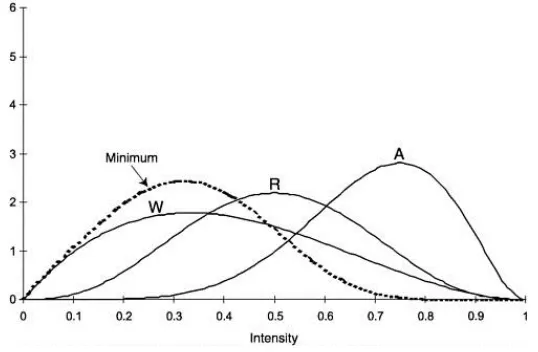
Figure 1: RWA model – examples of the location of the Ri, Wi, and Ai distributions together with that of the distribution of their minima (MINi)
Note: Location of W (left), R (middle), and A (right) at one point in time (second example) and location of the distribution of the minimum (Ri, Wi, Ai) (= dotted line).
In the first example, several cases have passed the 0.5 score on R or W or A, but nobody satisfies the RWA configuration where all three conditions are being met simultaneously. This can be seen from the distribution of minima, which does not have an upper tail that has moved beyond the 0.5 value. In the second example most actors know about proper ways of implementing the new form of behavior so that the distribution of A has already shifted to the right on the 0-1 intensity scale. With respect to readiness, the modal category is undecided (score 0.5) with half the population still not seeing a decisive advantage. But the majority in this example considers the new form of behavior as ethically or culturally unacceptable. The distribution of the scores that are the smallest of the previous three is located quite a bit further to the left than any of the other three distributions and only a small fraction has crossed the 0.5 point. Hence, few people have made a transition to a new form of behavior. I n t hi s e xa mp l e non-willingness obviously contributes disproportionately to the lower minima, and is therefore a dominant bottleneck factor or inhibitor.
During a process of change, all four frequency distributions move from the low end to the high end of the intensity scale on the horizontal axis, with the distribution of the minima always trailing behind. The R, W, and A distributions can follow their own pace, and as they shift their variances will also tend to expand. At the outset variances are low since the vast majority has low scores on all distributions, and at the end of the transition variances will again diminish as more and more persons end up with high scores for every precondition. Mid-way, variances are the highest, and the same holds for the distribution of minima. Moreover, it is likely that at that time the MIN distribution also comes close to adopting a bell-shaped curve. If this occurs, then our RWA model will produce a growth curve of adopters of new behavioral forms that closely resembles Verhulst’s logistic curve (elongated S-curve). Many innovations and their diffusion, from gothic cathedrals to engines, from epidemics to rumors, follow such a logistic growth curve. Furthermore, the logistic curve for an older innovation tends to taper off and reach a saturation-level of no further expansion when new and better technologies or innovations start growing and replacing it. Also, the latest innovation can entirely wipe out the older pattern, and in this instance there is a new transition. And, if such transitions succeed each other, there is no problem with numbering them as a simple means of identification.
contraceptive and reproductive technology, for instance, have opened up avenues for new interventions, and in this case A is the leading condition. Similarly, some cultures may have no objections to many forms of contraception and commonly accept abortion, and then the W-distribution will not be trailing behind the other two. To sum up, the sub-model with R being the leading condition and with cultural and/or technological lags may be frequently encountered, but it is by no means the only possibility.
For each of the three diffusion patterns with respect to R, W, and A, we should expect there to be at least one focus of initial innovation from which the diffusion occurs until it meets social barriers. These barriers can be social class distinctions, cultural obstacles (e.g., religious differences), or communication barriers (e.g., linguistic borders). From that point on, socio-economic, cultural, and spatial variables observable at the macro level (e.g., for spatial units) will emerge as determinants of the process of differential s p a t i a l diffusion (cf. Bocquet-Appel and Jakobi 1996).
To sum up: at present we have a model of innovation based on Coale’s initial model of three preconditions and capable of producing a logistic growth curve for any new form of behavior. Each of the three preconditions can be “individualized” and translated back to the macro-level in the form of shifting distributions. Moreover, these shifts and especially differences in the pace of the shifts can be linked to mechanisms of social and spatial diffusion of the “contagion” type, in which network contacts are essential. Then social group and/or geographical patterns emerge in which innovating groups or regions lead the way, and in which others follow depending on the strength of various types of barriers. Such barriers can exist with respect to any of the three preconditions, but since the MIN-distribution in the RWA- model is the crucial one, it suffices for only one of the three preconditions to be obstructed for the diffusion of the new behavioral form to be stopped or delayed at such a social or spatial barrier. This has important consequences:
1. Those in the vanguard of a transition must score high on all three conditions and this will set them apart from the others, for whom at least one condition is not being met.
2. Conversely, if one of the three distributions substantially lags behind the others, then many MIN-scores will be determined by the bottleneck condition, and the best correlates of the outcome will be indicators of that barrier.
Any one of these three can come up with strong “correlational” results, but the irony is that “victory” for a discipline can be claimed following the identification of a type of regressor (e.g., economic, structural, cultural…) with the largest and most significant coefficients, when in fact such statistical predictors c o u l d merely identify the slowest moving condition in an innovation and diffusion process4. The earlier types of analysis with “the buck stops at socio-economic structure” in sociology and social history and the subsequent “cultural turn” in the social sciences (see Sewell 2005, esp. chapters 1 and 2) just lead from one form of reductionist fallacy to another. The RWA model simply recognizes that processes of social change are the outcomes of (i) socio-economic structures with their specific configurations of opportunities and constraints AND (ii) of the adaptive capacity of cultural scripts of legitimation, AND (iii) of policies affecting the technical and legal environments. The AND is again the logical conjunction, and the factors that cause leads and lags over time can vary widely. Some configurations are remarkably recurrent ones, but others can indeed be totally “historically idiosyncratic”.
3. From the FDT to the SDT: The Belgian example revisited
There are several reasons for revisiting the issue of historical spatial continuity in Belgium. The first one is that we now possess many more SDT indicators than could be used in the 2002 Lesthaeghe and Neels article. We owe this to Neels’ fertility reconstructions of 2006 for both cohorts and cross-sections on the basis of the 1990 census, and to the Gadeyne et al. reconstruction of cohabitation trends and differentials starting from a retrospective question in the 2001 census. The second reason is that Neels (2006) showed that the Belgian SDT has two components with different spatial patterns: marriage postponement and premarital cohabitation followed the older historical pattern of demographic innovation, but fertility postponement did not. Also, in the US there was a partial disconnection in the spatial incidence of the fertility postponement and the non-conformity dimensions of the SDT, respectively (Lesthaeghe and Neidert 2006). More specifically, the states in the lower half of the two distributions were the same, but those at the vanguard differed: the North Atlantic states were the leading ones with respect to fertility postponement, whereas several western and Pacific states were leaders with respect to cohabitation.
4 An example will elucidate this point. Suppose that everyone satisfies the R condition, but many would not
Before turning to statistical analyses of the Belgian data, a short digression is necessary to elucidate the secularization history of the country. This history contains a few features that are essential to the understanding of the role of the W-factor and its relation to socio-economic structural determinants.
3.1 The three secularization waves in Belgium: 1750-1970
As in much of Western Europe, the first signs of secular, rationalist thinking emerged with the Enlightenment during the second half of the 18th century. It was essentially an elite phenomenon (e.g., in Freemason lodges), but capable of being one of the driving forces of the Brabant Revolution of 1789, or the first attempt at establishing Belgian independence. This first wave of secularization gained much wider popular support during the French Revolution, and many urban parishes, especially in Liège, failed to observe the marriage ban during the so-called “closed periods” of Lent and Advent. Also, during the Napoleonic period and the period of reunification with the Netherlands (1815-1830), Catholicism remained under state control, but this did not imply that the secular ideas had penetrated in all regions of the country. As became very clear at the time of the Belgian independence in 1830 and with the concomitant Catholic restoration, numerous areas in the Dutch-speaking northern half of the country had remained staunchly loyal to Catholic clergy and doctrine.
Map 1: Marriages during Lent and Advent (MLA-index) in Belgian arrondissements, 1841-1847 (quintiles)
system (Catholic versus Liberal) was the staunch competition between the Catholic schools and the secular state or municipal schools. Jesuit and episcopal colleges of secondary education and the Catholic University of Louvain (reopened in 1830) produced the elites for the Catholic pillar, whereas the State universities of Ghent and Liège and the small Free(thinker) university of Brussels remained secular strongholds.
After 1860 a third “pillar” was added, corresponding to the rising importance of the Socialist Party. This generated a second secularization wave in all major industrial and urban areas as well. The MLA map for 1860-1865 clearly shows how the three major Walloon industrial arrondissements (Mons, Charleroi, Liège) and the arrondissement of Brussels have MLA values in excess of 60, which is already indicative of a major weakening of the ecclesiastic ban. By 1881-1884 only five Walloon arrondissements have values below 60, whereas there are only two Flemish ones with values above 60.
The double origin of secularization in Belgium before 1900 not only implies a leading position for Wallonia, but also that both rural and industrial or urban arrondissements are present in the upper half of the secularization distribution. In other words, there is only a modest positive correlation between secularization and industrialization/urbanization, which is a statistical bonus (low multicollinearity) when
it comes to measuring the separate effects of secularization versus
industrialization/urbanization upon, for instance, the speed of the marital fertility decline (Lesthaeghe 1977: 196-220; Lesthaeghe and Wilson 1986: 261-292).
Map 3: Marriages during Lent and Advent (MLA index) in Belgian arrondissements, 1881-1884 (quintiles)
Until the 1960s the map of secularization remains very stable in Belgium, as can be gleaned from the correspondence between the MLA map for 1881-1884, the map of the secular vote (% Socialist + Communist + Liberal) in 1919 (first elections based on universal male suffrage), the map for the secular vote in 1958, i.e. at the time of the last
“school war”5, and the 1964 map of percentages of adults absent during the annual Sunday Mass census (see maps 4, 5, and 6). Noteworthy in this series of secularization maps is that the least secularized arrondissements are all located in Flanders and form two clusters: a western one in the province of West Flanders (arrondissements of Ypres, Diksmuide, Tielt, Roeselare) and an eastern one comprising the whole of the province of Limburg (arrondissements of Hasselt, Maaseik, Tongeren) and the adjacent Campine area (arrondissement of Turnhout). Moreover, as can be seen in Map 2, these two persistently Catholic regions were already in evidence from the 1860s onward. Equally noteworthy, however, is that the eastern cluster of Flemish arrondissements remained strongly attached to the Catholic Church till the 1960s, despite its industrialization after World War I, i.e. along the Antwerp-Liège axis (Albert canal) and the Limburg coal fields.
Map 4: Secular vote for liberal, socialist, and communist parties, 1919 (quintiles)
5 The 1958 “school war” erupted as a result of the Liberal-Socialist government’s attempt at restructuring the
Map 5: Secular vote for liberal, socialist, and communist parties, 1958 (quintiles)
Map 6: Sunday mass absenteeism among the adult population (15+), 1964 (quintiles)
3.2 Spatial continuity: Indicators and covariates for the Belgian example
To illustrate the spatial continuity over a period of almost a century and a half, we will resort to a series of both FDT and SDT indicators for the 41 (and later 43) Belgian arrondissements. The correlation matrix for these demographic indicators is subsequently analyzed via a classic Principal Component Analysis6, which extracts three orthogonal factors (Varimax rotation) that jointly account for 80% of the total variance contributed by the entire pool of indicators. The next step consists of linking these demographic factors to a series of covariates of both a structural and a cultural nature in order to identify the best correlates.
The subset of demographic indicators related to the FDT contains all the Princeton indirectly standardized measures of marital fertility (Ig), of proportions married (Im), and of non-marital fertility (Ih) (Coale 1965: 207), computed for all the census dates between 1880 and 19707. In addition, we also use the percentage of the total marital fertility decline that had already been completed by 1910 (delta Ig 1880-1910, Lesthaeghe 1977:109). Equally belonging to the FDT, but to its later years, are measures for the cohort of women born in 1931-1935, since the events of interest would typically have taken place in the late 1950s and the 1960s. For this cohort use is made of their mean age at first birth, their percentage of non-marital births, and their
6 In all instances where Principal Component Analysis (PCA) is used, axis rotations are orthogonal, and the
resulting factors are uncorrelated dimensions. All factors (= principal components in our case) with eigenvalues larger or equal to unity were retained. We use the terms “principal component”, “factor” and “dimension” interchangeably. The term “factor” loading refers to the correlation coefficient between the factor and the indicator variable. Factors are composite measures or underlying dimensions of a set of indicators. Factors are constructed in such a way that they have means of zero and standard deviations of unity. Maps that present these factors use standard deviations as units of measurement, and divide the scale in quintiles.
7 The Princeton indicators are all indirectly standardized measures, because of the absence of numbers of
births broken down by age of the mother in most historical series of European countries. The Princeton indices all use Hutterite marital fertility schedules by age, h(a), to capture “natural fertility”, i.e. very high fertility in the absence of contraception. The four indices are:
* Index of marital fertility Ig = observed legitimate births / Sum M(a).h(a) where M(a) is the number of married women by age, typically recorded in censuses. Age groups start at 15 and end at 49.
* Index of overall fertility If = observed births (all)/ Sum W(a).h(a), where W(a) are all women by age. * Index of illegitimate fertility Ih = observed extra-marital births/ Sum U(a).h(a), where U(a) are unmarried women by age.
* Index of proportions married Im = Sum M(a).h(a)/Sum W(a).h(a), or proportions married weighted by Hutterite fertility.
With these indices If = Ig.Im + Ih(1-Im) or in the instance of very low extra-marital fertility, If = Ig.Im. This allows for a simple decomposition of overall fertility If into a marital fertility and a nuptiality component respectively.
percentages of ever divorced. Finally, four more indices, all measured in 1960-1962, pick up relevant information for the end of the FDT: the total first marriage rate (TFMarR), the total fertility rate (TFR), the mean age at first birth, and the percentage of the TFR that was realized after age 30 (capturing mainly higher order parities and unplanned births during the pre-pill era).
The subset of SDT demographic indicators pertains to the rise of divorce, the postponement of marriage and fertility, and the rise of cohabitation and of non-marital births (mainly among cohabitants). For the periods 1969-1971, 1979-1981, and 1998-2000 use is made of the classic total fertility rates (TFR), the mean age at first birth, and the percentage of the TFR occurring after age 30. For the years 1970, 1981, 1991, and 1999 we possess the total first marriage rates TFMarR and the total first cohabitation rates TFCohabR. The latter could be computed from the 2000 census information on the year that first premarital cohabitation was initiated and the year of birth of the female respondents (see Gadeyne et al. forthcoming). Further information on cohabitation is available in the form of percentages cohabiting among women aged 20-24 and 25-29 measured in the 1990 census, and also as an indirectly age standardized index for 2000, along with similar indices for proportions married and divorced (Deboosere et al. 2009). Furthermore, information has been added pertaining to the cohort of women born in 1961-1965 and mainly occurring in the 1980s and 1990s: age at first birth, percent non-marital births, and proportions ever divorced (Neels 2006)
The socio-economic covariates essentially capture the processes of
industrialization and urbanization, the degrees of literacy, and, for the second half of the 20th century, the rise of female secondary and higher education, along with their labor force participation. More specifically, for the periods 1880, 1890, 1900, and 1910 use is made of the percentages of the male labor force in agriculture (and for 1910 also in agriculture plus cottage industries), an index of urbanization and industrialization, and the literacy rate for the population aged 15-55 (Lesthaeghe 1977 160 ff.). This series continues with the urban percentages from 1920 to 1970. For the female cohorts born in 1931-1935 and in 1961-1961 we have the proportions ever worked. For the older cohort, educational achievement is measured as the percentage at least completing full secondary education, and for the younger as the percentage having a post-secondary degree (Neels 2006: 87-88, 188-189).
the region (monolingual - Dutch or Flemish in the North, French or Walloon in the South). A low degree of language homogeneity captures the presence of linguistic minorities in a given region. These were either the original population (e.g., Flemings in Brussels, German speakers in the arrondissements of Bastogne and Verviers) or immigrants (e.g., Flemings in Wallonia). The use of languages was no longer recorded after World War II, as being too sensitive politically.
3.3 Statistical results for the Belgian example
The statistical analysis consists of two steps. First, the set of demographic indicators mentioned above is being reduced to a much smaller set of dimensions (PCA, Varimax, orthogonal factor rotation). Second, the best social and cultural correlates of each of the demographic dimensions are identified. This gives a succinct description of the underlying structure of the entire correlation matrix.
The three dimensions are clearly identifiable and tell the three basic stories. Factor 1 is the long-term continuity dimension of demographic innovations. This dimension identifies the leading and lagging regions with respect to fertility control and contraception during the FDT. But it continues to reflect a subset of SDT indicators, and more particularly all those associated with the weakening of the marriage institution: the rise of divorce, postponement of marriage, increasing cohabitation, and parenthood within the cohabitation context.
Factor 2 reflects the historical rise and later decline of “traditional” non-marital fertility. This factor no longer has demographic indicators after the 1960s, which means that non-marital fertility from then onwards takes place in an entirely different context. This discontinuity essentially reflects the shift away from illegitimacy of non-marital births, not legalized by shotgun marriages and occurring to single women or adulterous married women, to extra-marital births mainly among cohabitants.
Factor 3 has no clear deeper historical roots, but is a novelty typical of the SDT: postponement of parenthood among all types of couples. As already shown by Neels (2006), the SDT in Belgium has two separate components, one related to divorce, marriage, and cohabitation, and one related to postponement of parenthood. These two components have different geographies. The former reflects the long-term innovation dimension (see Factor 1), but the latter has a geography of its own.
3.3.1 Factor 1: Successive demographic innovations and long term spatial continuity
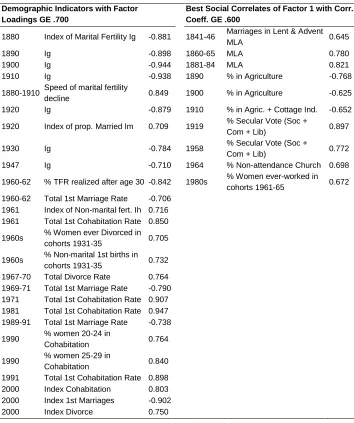
Table 1 presents the long-term continuity dimension of innovation. High scores on this dimension for arrondissements reflect the presence of a leading position throughout the whole period from the 1870s until 2000, whereas low scores identify the arrondissements that were slow in adopting the innovations of both FDT and SDT. The left side of the table contains the best indicators of dimension one with their factor loadings (or correlation coefficients) of 0.700 or better. The right hand panel lists all the structural and cultural correlates of dimension 1 with correlation coefficients of 0.600 or better.
The prime continuity dimension exhibited in Table 1 has factor loadings on an impressively long series of demographic indicators related to the FDT: all indicators related to the historical marital fertility control, the departure from the restrictive Malthusian marriage system, and even the continued higher fertility past age 30 in the pre-pill early 1960s. The series then continues with indicators pertaining to the SDT; the rise of divorce, but above all the postponement of marriage in favor of premarital cohabitation. And by the 1990s procreation among cohabitants has joined the set as well. Note, however, the absence of the measures of fertility postponement.
Aside from the 19th century indicators of proportions of the male labor force in agriculture and cottage industries, all the best correlates of the demographic spatial continuity dimension are indicators of progressing secularization, already starting with the MLA index of 1841-1846 and continuing uninterrupted until the 1960s with the percentages absent from Sunday Mass. Also note that indicators of urbanity or industrialization after 1920 are not in this set. Within the RWA framework this is strongly indicative of the fact that it was the W-condition that was the limiting one. In other words, essentially the moral and religious objections to two entirely new forms of behavior, i.e. controlling fertility through contraception and replacing marriage by cohabitation, were constituting the decisive limiting conditions that shaped the geography of these successive demographic innovations.
Table 1: Long term continuity with respect to demographic innovations in Belgian arrondissements, 1841 – 2000 (principal component analysis results -- Factor 1)
Demographic Indicators with Factor Loadings GE .700
Best Social Correlates of Factor 1 with Corr. Coeff. GE .600
1880 Index of Marital Fertility Ig -0.881 1841-46 Marriages in Lent & Advent
MLA 0.645
1890 Ig -0.898 1860-65 MLA 0.780
1900 Ig -0.944 1881-84 MLA 0.821
1910 Ig -0.938 1890 % in Agriculture -0.768
1880-1910 Speed of marital fertility
decline 0.849 1900 % in Agriculture -0.625 1920 Ig -0.879 1910 % in Agric. + Cottage Ind. -0.652
1920 Index of prop. Married Im 0.709 1919 % Secular Vote (Soc +
Com + Lib) 0.897
1930 Ig -0.784 1958 % Secular Vote (Soc +
Com + Lib) 0.772 1947 Ig -0.710 1964 % Non-attendance Church 0.698
1960-62 % TFR realized after age 30 -0.842 1980s % Women ever-worked in cohorts 1961-65 0.672 1960-62 Total 1st Marriage Rate -0.706
1961 Index of Non-marital fert. Ih 0.716 1961 Total 1st Cohabitation Rate 0.850
1960s % Women ever Divorced in
cohorts 1931-35 0.705
1960s % Non-marital 1st births in
cohorts 1931-35 0.732 1967-70 Total Divorce Rate 0.764 1969-71 Total 1st Marriage Rate -0.790 1971 Total 1st Cohabitation Rate 0.907 1981 Total 1st Cohabitation Rate 0.947 1989-91 Total 1st Marriage Rate -0.738
1990 % women 20-24 in
Cohabitation 0.764
1990 % women 25-29 in
Finally, the map also clearly shows the two Flemish regions that were systematically at the tail end of the innovation distribution. These correspond entirely with the zones that had the longest resistance to the first two secularization waves, i.e. the West Flemish zone with Ieper, Diksmuide, Tielt, and Roeselare, and the Limburg-Campine zone with Hasselt, Maaseik, Tongeren, and Turnhout (see maps 1 through 6).
Map 7: Factor 1 (quintiles): Long-term continuity dimension in FDT and SDT innovation in Belgian arrondissements, 1880-2000
3.3.2 Factor 2: Historical illegitimacy in fertility and the urban-industrial connection
married (Im) but lower fertility (see Table 2). Also noteworthy is the fact that there are no demographic indicators measured after 1980 loading on this factor. Hence it is fair to state that this dimension is more a historical one and unrelated to the SDT. Equally remarkable is that, also on the side of its correlates, only indicators of urbanity are identified up until 1970. Finally, note that the negative correlation with adult literacy in 1880 stems from the fact that the Belgian industrial poles of the 19th century, but to some degree also the larger urban ones, were attracting illiterate immigrant populations. But after World War II this negative relationship between literacy and urbanity was being reversed in tandem with the growth of the tertiary sector in the economy.
Table 2: The historical dimension of non-marital fertility in Belgian
arrondissements, 1841-2000 (principal component analysis results - Factor 2)
Demographic Indicators with Factor Loadings GE .700
Best Social Correlates of Factor 2 with Corr. Coeff. GE .600
1880 Index non-marital fertility Ih 0.837 1880 % literate -0.621
1890 Ih 0.891 1890 % urban 0.711
1900 Ih 0.923 1900 % urban 0.756
1910 Ih 0.901 1910 % urban 0.790
1920 Ih 0.931 1910 % literate -0.633
1930 Ih 0.838 1920 % urban 0.720
1947 Index of non-marriage Im 0.713 1930 % urban 0.726
1970 Im 0.785 1947 % urban 0.694
1970 Index of marital fertility Ig -0.796 1950s cohort 1931-35 with higher sec educ 0.628 1969-71 TFR -0.773 1970 % urban 0.685
1979-81 TFR -0.734
with historically negative migration rates, a feature that contributed to the strengthening of their rural character. Finally, it is impossible not to notice that the language border plays no role here whatsoever.
Map 8: Factor 2 (quintiles): Pre - World War II “illegitimate” fertility in Belgian arrondissements and its historical urban-industrial connection
3.3.3 Factor 3: SDT fertility postponement
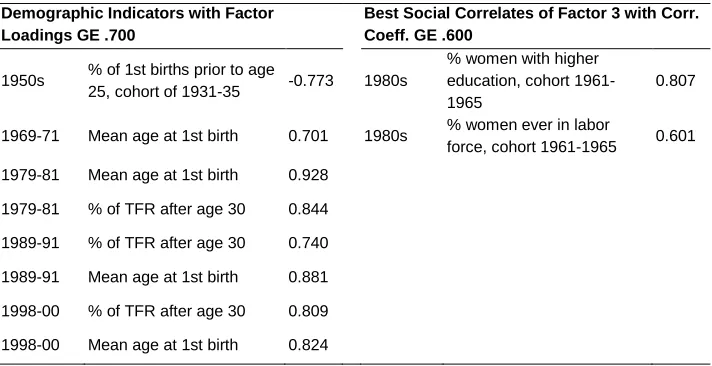
postponement and subsequent fertility recuperation at later ages. Not surprisingly, these areas are also identified by two structural features: high post-secondary female education and high female employment rates for the cohorts born in the 1960s.
Table 3: SDT fertility postponement dimension in Belgian arrondissements 1950-2000 (principal components analysis results - Factor 3)
Demographic Indicators with Factor Loadings GE .700
Best Social Correlates of Factor 3 with Corr. Coeff. GE .600
1950s % of 1st births prior to age
25, cohort of 1931-35 -0.773 1980s
% women with higher education, cohort 1961-1965
0.807
1969-71 Mean age at 1st birth 0.701 1980s % women ever in labor
force, cohort 1961-1965 0.601 1979-81 Mean age at 1st birth 0.928
1979-81 % of TFR after age 30 0.844
1989-91 % of TFR after age 30 0.740
1989-91 Mean age at 1st birth 0.881
1998-00 % of TFR after age 30 0.809
1998-00 Mean age at 1st birth 0.824
3.4 The Belgian experience in a nutshell
The FDT in Belgium has two main components: (i) control over the level of marital fertility and (ii) the historical bulge and subsequent decline in “illegitimate” fertility.
Map 9: Factor 3 (quintiles) -- the fertility postponement aspect of the SDT in Belgian arrondissements
cohabitation (SDT) were in the respective time periods viewed as “unconventional” or even “immoral”.
The contrast is provided by the other aspect of the SDT; i.e. the fertility postponement component. This feature exhibits a totally different geographical pattern, with female advanced education and concomitant employment emerging as the best spatial correlates. Hence there is no trace here of the operation of the W-condition, and this is quite logical since postponing parenthood is not behavior that directly violates moral or religious prescripts. As a consequence, the geography of fertility postponement mirrors the R-condition, since better educated and employed women were typically in the vanguard of the postponement transition (cf. Neels 2006, for individual level data).
4. From FDT to SDT: The Spanish experience
The comparison of Belgium and Spain allows for a more revealing study of cultural and linguistic factors involved in the FDT and SDT. Both countries share a Catholic tradition and have similar roots of secularization (Enlightenment, Marxism), and both are linguistically heterogeneous. Yet in a host of other characteristics they are quite different. To start with, Belgium was the first continental country to move through the Industrial Revolution, whereas Spain was near the tail end of the distribution in this respect. In fact only two Spanish areas had an earlier 19th century industrial development, Catalonia with textiles and the Basque country with metal industries. Secondly, Spanish landholding systems were characterized by the juxtaposition of “minifundios” of less than one hectare and permitting subsistence farming only, and “latifundios” or large agricultural enterprises operated by day laborers. Despite agricultural reforms, this duality survived well into the 20th century, and it is one of the causes of another major distinction, i.e. political polarization. Indeed, despite a grounding of politics in similar religious and ideological divisions, political history is far more turbulent in Spain than in Belgium. Starting with the guerilla war against Napoleon there was a steady growth of polarization between Catholic and secular factions, culminating in the Spanish Civil War. Thereafter both cultural and technical developments were slow for most of the Franco era (1939-1975), i.e. until at least 1965, whereas the rest of Western Europe was building new industrial and infrastructural capacities on the ruins of World War II. In fact it is not until the end of the Franco era, the constitution of 1978, and EU membership that Spain is propelled at high speed into late 20th century economic, technical, and cultural modernity.
4.1 The Spanish spatial secularization pattern
Just as in Belgium (then known as the Austrian Low Countries), the start of secularization in Spain is linked to the Enlightenment and to the “enlightened despotism” of the last two 18th century monarchs (Carlos III and IV). During their reign the Jesuits were expelled (1767), the church was forced to sell off land and loan the proceeds to the state, and the private organizations to stimulate economic, philosophical, and scientific development were officially sponsored. These organizations, called Sociedades Economicas de Amigos del Pais, received legal licenses to foster their activities both in Spain and the colonies. After the guerilla war with the Napoleonic forces, Spain adopted a liberal constitution in 1812.
During the first half of the 19th century Spanish liberalism replaced the Ancien Régime through political struggles, revolutions, and civil wars. After the first Carlist war in 1840 and the traditionalists’ defeat, the church’s role in politics, economics, and social works was further reduced. By 1843 many episcopal sees were vacant, cathedral chapters were controlled by laymen, most male religious orders were banned, and more church property had been sold to service the public debt. Moreover, the tithes were abolished, priest became civil servants, and there was no curtailment of anticlerical urban riots.
Under the reign of Isabel II (1843-1868) and later under that of her son Alfonso XII (1874-1885) and during the dictatorship of Primo de Rivera (1921-1930) the church gradually recovered. During that period the main interruption was the First Republic of 1873-1874, but that only constituted a brief intermezzo. However, by the end of the 19th century there is a further polarization of the political spectrum. Not only were the Socialists present on the Left, but so also were more radical factions with anarchist philosophies. Similarly, fascists enlarged the extreme Right, hitherto mainly made up of the strongly Catholic Carlists. Hence, at the turn of the century the extremist forces were growing that led to the events of the 1930s, i.e. the Second Republic and the Civil War.
census of 1887 (Reher et al. 1993), or the number of inhabitants per seminarist in dioceses in 1963, show almost exactly the same areas as being Catholic strongholds. At the other end of the distribution there is a large north eastern zone of strong secularization, made up of Catalonia and adjacent Huesca and Zaragoza plus Rioja, and a large southern zone covering Andalusia (with the exception of Cordoba) and adjacent Badajoz, Ciudad Real, and Alicante. Also the western half of Galicia (A Coruña, Pontevedra) distinguishes itself by higher levels of non-adherence to the marriage ban than its Catholic hinterland. Finally, the Canary Islands equally fall in the top quintile of non-observance of the marriage ban.
Map 10: Index of marriages during Lent (ML) in Spanish provinces (quintiles), 1900-1901
Further into the 20th century other indicators of secularization were constructed. For the Second Republic use was made of the percentage in each province of the elected diputados for the Left in 1931 and 1936 and for the Right in 1933 and 1936. Centrist diputados were left out in setting up these indicators. For the post-Franco era the indices are the percentage vote for the Left in the 1977 election (including regional leftist parties) and the percentage of marriages that were only civil marriages in 2001 and 2009. Together with the ML-index for 1900-1901, these seven indicators were
Index of Marriages in Lent
subjected to a Principal Component Analysis to extract the underlying orthogonal (i.e. uncorrelated) dimensions. It turns out that there is a clear distinction between a historical spatial dimension of “old secularization” and a newly emerging post-Franco “new secularization” with a different geography. The best indicators of the older pattern are, not surprisingly, the percentage of diputados for the Left in 1936 (factor loading or r = .853), for the Right in 1936 (-.757), percentage vote for the Left in 1977 (.704), the ML-index in 1900-01 (.671), the percentage of diputados for the Left in 1931 (.559), and for the Right in 1933 (-.505). The best indicators of the “new secularization” dimension are the percentages of civil marriages in 2009 (.947), in 2001 (.942), and the percentage of diputados for the right in 1933 (-.580). It can be noted that the 1977 election results were still correlated with the Second Republic political maps (see also Linz and Montero 1999), but that the 21st century indicators have become quite independent of the historical dimension.
The two factors of old and new secularization respectively are presented in Maps 11 and 12. Note that the scale of the principle components (factors) is expressed in standard deviations, and that the distribution has a mean of zero and a standard deviation of unity.
The comparison of Maps 10 and 11 show that the historical secularization dimension in Spain was quite stable until the 1970s. The core of the most Catholic area is made up of Castile and Leon and the provinces of Castile-La Mancha around Madrid together with Teruel. This large central zone spreads further out to include eastern Galicia (Lugo, Ourense), Cantabria (Santander), Navarra, and the northern Basque area (Bizkaia, Gipuzkoa). The most secular areas are again the whole of the South, the entire Mediterranean coast (but not the Baleares), inner Catalonia (Lleida), and northern Aragon (Huesca). Finally, there is a band of northern provinces that is situated in the central segment of the distribution of the historical secularization factor, and it is made up of western Galicia (A Coruña, Pontevedra), Asturias, Rioja, Alava, and Zaragoza.
Map 11: The historical secularization dimension in Spanish provinces (quintiles of factor values)
The map of 1887 for female illiteracy shows a similar pattern with levels below two thirds in Castile and Leon, Navara, Rioja, the whole of the Basque region, Santander, and eastern Asturias. By contrast, levels in excess of 85% of female illiteracy prevailed in the whole of Galicia and in the entire south-eastern segment of the country, roughly from Castellon to Almeria and further inland to Ciudad Real. In contrast to Belgium, where illiteracy disappeared almost entirely after the First World War, the Spanish low literacy zone persisted much longer (Vilanova-Ribas and Moreno-Julia 1992). Moreover, the concordance between higher literacy and better education on the one hand and Catholicism on the other meant that the civil service in Madrid and the elite of the Franco era were disproportionally overrecruited from Castile and Leon, thereby fuelling more antagonism between the political rightist center of the country and the more secular periphery. However, things changed after 1975.
As stated before, Spain underwent a rapid and profound transformation during the post-Franco era in just about every single domain of life, from economic modernization and rising standards of living to much more centrist politics and the total disappearance of the extreme Left and Right alike (Linz and Montero 1999). Obviously Spain had no
Factor score
more appetite for either the “nacionalcatolicismo” (Botti 1992) of Franco or for
adventures with the far Left. On the other hand, just like in Belgium, regionalist parties and movements gained both ground and influence with marked degrees of devolution of economic power and with linguistic and cultural autonomy as a result.
In tandem with the post-Franco modernization of its economic and social fabric, Spain also underwent a fast and profound new secularization wave. The proportion of practising Catholics (Mass at least a few times per month) drops from a plateau of no less than 90% during the 1950s and 1960s to just over 50% in only the five years between 1970 and 1975 (Requeña 2005). And from 1975 onward there is a further linear decline to less than 30% in 2002. The Spanish secularization is not only visible in the institutional spheres, but equally in profound changes with respect to individual ethics. For instance, to everybody’s amazement in the rest of Europe, Spain joined the vanguard countries in recognizing same sex marriages. It comes therefore as no surprise to witness a steady rise of marriages that have the civil part only and do away with the religious ceremony. For instance, for Spain as a whole, in 1976 barely 0.3% of marriages were civil ones only, but by 2000 this had grown to a quarter (24.1%) (INE, 2005), and by 2009 to more than half (54.9%) (INE website). In some provinces this figure exceeds 60% (Baleares, Barcelona, Girona, Gipuzkoa, Lleida, Las Palmas, Santa Cruz de Tenerife, Tarragona, and Valencia). Hence, with the disappearance of the old politico-religious cleavage, a new spatial pattern emerges for the latest secularization wave. This pattern is caught by the second principal component in our analysis, and it is shown in Map 12.
The most striking difference between Maps 11 and 12 is that the whole south is no longer a component of this late 20th and early 21st century secularization wave. This is a major factor in Spanish spatial cultural discontinuity. But, on the other hand, the old Catholic zones of Castile and Leon and Castile-La Mancha remained at the lower end of the distribution as well, so that there is one large contiguous area of slower than average “new secularization”, stretching from Burgos to Cadiz (north-south) and from Murcia to Caceres (east-west).
wave, but just in the middle of the distribution, and that the Canary Islands continue to be highly secularized provinces.
Map 12: The new secularization dimension in Spanish provinces (quintiles of factor values)
To sum up, one of the major differences between Belgium and Spain in recent secularization history is that the former country displays a high degree of continuity in the spatial pattern of secularization, whereas the latter exhibits a clear cleavage between the old secularization pattern and a new one that has emerged since the 1970s. This distinction is obviously related to the fact that Belgium has been a typical “consociational democracy” (Lijphart 1968), i.e. governed by political “pillars” which had to form coalition governments from the very onset in 1830. The country has an intact track record of negotiated pacts, deals, and compromises between political elites, and therefore, unlike Spain, less polarization and no open and virulent conflicts along the secularization dimension.
Factor score
4.2 The demographic dimensions of the FDT and the SDT in Spain
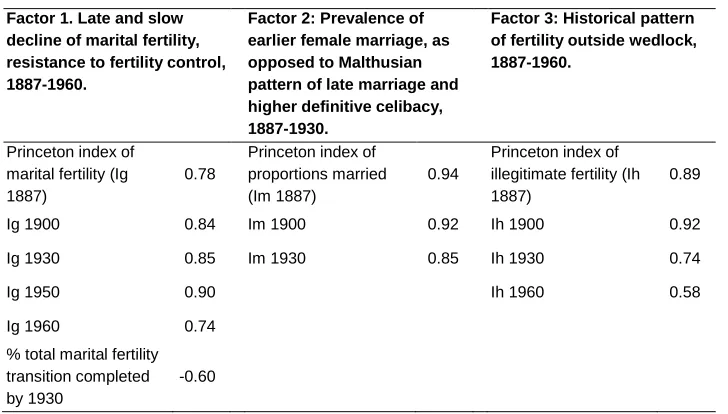
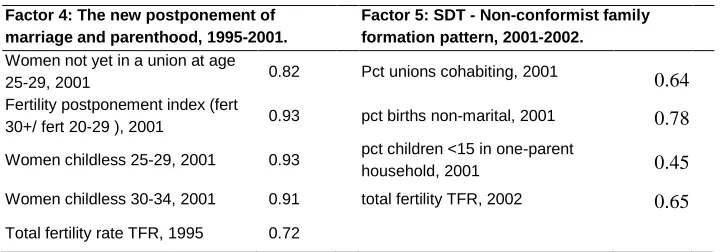
As in the Belgian analysis, use has again been made of a large set of demographic indicators for Spanish provinces, respectively measuring features of the first and second demographic transitions. The correlation matrix for the total of 24 demographic indicators was again analyzed by means of a Principal Component Analysis, and this set of indicators could be reduced to five basic dimensions, three of which capture the FDT and two the SDT. These 5 dimensions are described in Table 4.
Table 4: Indicators and dimensions of the first (FDT) and of the second demographic transition (SDT) in Spanish provinces
A. FDT – First demographic transition dimensions
Factor 1. Late and slow decline of marital fertility, resistance to fertility control, 1887-1960.
Factor 2: Prevalence of earlier female marriage, as opposed to Malthusian pattern of late marriage and higher definitive celibacy, 1887-1930.
Factor 3: Historical pattern of fertility outside wedlock, 1887-1960.
Princeton index of marital fertility (Ig 1887)
0.78
Princeton index of proportions married (Im 1887)
0.94
Princeton index of illegitimate fertility (Ih 1887)
0.89
Ig 1900 0.84 Im 1900 0.92 Ih 1900 0.92
Ig 1930 0.85 Im 1930 0.85 Ih 1930 0.74
Ig 1950 0.90 Ih 1960 0.58
Ig 1960 0.74
% total marital fertility transition completed by 1930
Table 4: (Continued)
B. SDT – Second demographic transition dimensions
Factor 4: The new postponement of marriage and parenthood, 1995-2001.
Factor 5: SDT - Non-conformist family formation pattern, 2001-2002. Women not yet in a union at age
25-29, 2001 0.82 Pct unions cohabiting, 2001 0.64
Fertility postponement index (fert
30+/ fert 20-29 ), 2001 0.93 pct births non-marital, 2001 0.78
Women childless 25-29, 2001 0.93 pct children <15 in one-parent
household, 2001 0.45 Women childless 30-34, 2001 0.91 total fertility TFR, 2002 0.65
Total fertility rate TFR, 1995 0.72
The dimensions described above in table 4 clearly show that we are essentially dealing with five different features. The resistance to fertility control, the pattern of early marriage, and the historical levels of extra-marital fertility are the three classic ingredients of the FDT, whereas the postponement of fertility and the rise of “non-conformist” family formation are the two SDT components.
4.3 Statistical results for the Spanish example
We shall now discuss the maps for each of the five demographic dimensions of the Spanish FDT and SDT, and make the link with a set of socio-economic and cultural spatial indicators.
4.3.1 The FDT marital fertility transition
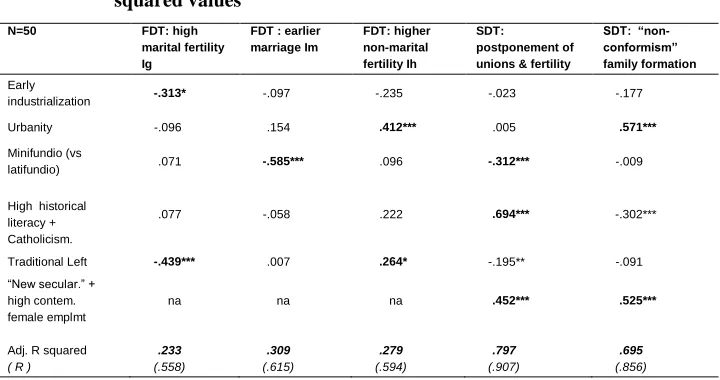
another strategy will be followed which will essentially eliminate the multicollinearity problem that affected the outcomes of earlier studies.8
Map 13 depicts the spatial pattern of the Spanish marital fertility transition. The factor captures the marital fertility levels as measured through the Princeton Ig measure, from 1887 through 1960, and the relative speed of the decline of marital fertility between 1887-1900 and 1930. For the last indicator, the Ig-levels at the onset were chosen to be either those for 1887 or for 1900, depending on which was highest. This choice was made in order to accommodate the fact that several provinces still had a fertility increase between 1887 and 1900. Furthermore, we take 1930 as a good approximation of the mid-transition point, since the 1920 Ig levels, as used by Reher and Iriso-Napal, are still very high. For instance, for the rural parts of provinces the mean Ig level was .66 in 1887, .68 in 1900, and still .62 in 1920. (Reher and Iriso-Napal 1989: 408). For Spain as a whole these values were respectively .65, .65, and .59. The value for 1930 is .54, which is still fairly high but about the halfway value between Ig = .65 in 1900 and .40 in 1960. (Coale and Treadway 1986: appendix table: 145).
Aside from Madrid, one major set of contiguous provinces stands out as the Spanish region with an early fertility decline. This zone comprises the entire Catalan-Valencian linguistic area, i.e. the three Catalan provinces, the three provinces of the Comunidad Valenciana, and the Baleares Islands. The three adjacent provinces of Aragon are also part of the faster fertility transition zone. In the top quintile we also find the two Canary Islands provinces. Spearheading the marital fertility decline were the provinces of Barcelona, Tarragona, and Castellon. Taking an Ig value of .30 (or 30 percent of Hutterite fertility) as the endpoint of the transition, these three provinces had already covered two thirds of the entire marital fertility transition by 1930.
The areas belonging to the latest and slowest quintiles are all located along a north-south axis stretching from Santander (Cantabria) to Badajoz, and comprising all of Castile and Leon and Extremadura. Navarra is also part of this slower zone, and so are Ciudad Real, Jaen, and Cordoba in the south. The following provinces had not even completed 10% of the transition by 1930: Avila, Burgos, Cordoba, Cuenca, Granada, Navarra, Salamanca, Segovia, and Zamora.
The best correlates of a fast marital fertility transition (the opposite to what is shown in the map above) were the following: the percentage employed in industries in 1900 (r = .425), the urban percentage in 1900 (.309), the percentage of diputados for the left in 1936 (.316) and for the right at the same elections (-.359). As expected, these correlations are all very modest, and that perfectly echoes the findings of Leasure (1962) and of Reher and Iriso-Napal (1989). In the analysis of the latter authors other
8 The articles by Reher and Iriso-Napal present both zero-order correlations (r) and standardized regression
variables have also been added, such as infant and childhood mortality rates, the presence of day laborers, and a measure of net migration. In accounting for the Ig-values of rural parts of provinces in 1920, they find correlations for these three extra indicators of, respectively, .304, -.341 and -.511.
Map 13: FDT - late and slow decline of marital fertility, 1887-1960
The positive correlation between higher marital fertility and higher infant and childhood mortality can be explained, as done by the authors, by the impact of breastfeeding differentials. Shorter durations of breastfeeding lead to both less spacing of births and higher fertility and to higher mortality prior to age 5. A breastfeeding map for Spain could further elucidate this point.9 The negative correlation with day laborers essentially captures the lower marital fertility in a number of southern provinces with agricultural structures dominated by latifundio. The negative correlation between net migration and marital fertility in rural areas points in the direction of selectivity, with traditionalism being reinforced by a loss of population. Reher and Iriso-Napal also find a negative correlation (-.503) between the leftist vote in 1936 and rural fertility levels,
9
For a further analysis of the link with infant mortality, see F. Gil-Alonso 2010.
Factor score
which is equally reflected in our findings for the marital fertility factor for provinces as a whole.
We also explored the effect of primogeniture as a characteristic of the inheritance system. The protection of property for the oldest son could indeed explain why Catalonia was so far ahead with its fertility decline. However, the map produced by Zapatero Molinero (1977: 19) shows that the primogeniture zone stretched westward to include Huesca, Navarra, and the Basque country as well. Furthermore an Asturian-Galician band also exists with a dominance of primogeniture or testamentary preference. Some of these regions (e.g., Huesca) were equally at the forefront of fertility control, but others were not at all (e.g., Navarra). Moreover, the three provinces with fast fertility decline in the Comunidad Valenciana all had equal division as the dominant inheritance principle.
The conclusion from this exploration is that there is a modest link of the Spanish marital fertility transition to industrialization, urbanization, and secularization, but that major regional particularities prevail, even if further controls are introduced for inheritance or land tenure systems.
4.3.2. The FDT nuptiality system
There are major differences between Belgium and Spain with respect to the historical patterns and changes in their respective nuptiality systems. Belgium fell entirely within the broader western European zone with the dominance of the Malthusian system of late and non-universal marriages during the 18th and 19th centuries. This was not the case for Spain, where the Malthusian system only prevailed in the Atlantic provinces (see Map 14 and Reher 1991). In these areas the Hutterite fertility weighted Princeton index Im of proportions of women married at ages 15 to 49 are in the range of .440 to .480 in 1887 (Reher et al. 1993: 227). At the other end of the spectrum, Im values in 1887 are as high as .680 in several Spanish provinces (e.g., Avila, Huesca, Segovia) (ibidem), which is indicative of much earlier marriage. By contrast, the Im levels for Belgian arrondissements in 1880 were systematically lower than those in Spain, and only in the .350 to .500 range, reflecting the impact of stronger Malthusian control.
a small increase from 24.4 in 1900 to 24.7 in 1930 (Muñoz-Perez and Recaño-Valverde 2011).
The spatial nuptiality pattern is shown in Map 14 and captures the Im values for 1887, 1900, and 1930. The best correlates of this map deal with the land tenure system. The minifundio indicator, i.e. percent of plots of less than one hectare in 1962 (INE, 1964) and the latifundio indicator of plots of over 100 hectares have correlation coefficients of -.594 and .395, respectively. This reflects the correspondence between late marriage and small-scale subsistence farming in Galicia and Asturias, and much earlier marriage among the rural proletariat in central and southern regions with large-scale agricultural enterprises. The correlation is not stronger because other areas existed with small scale farming along the Mediterranean coast, but these did not necessarily have the late nuptiality pattern (e.g. Alicante, Murcia).
Map 14: FDT - earlier female age at marriage, high proportion of women married 15-49, 1887-1930
But the land tenure system does not tell the whole story. At least as important, but connected to population pressure in densely populated rural areas, is the imbalance in the sex ratios at marriageable ages, say 20-29. This ratio of men 20-29 to women 20-29
Factor score
for all the Atlantic provinces, from Gipuzkoa to all of Galicia and also including Leon and Zamora, shows a large deficit of men, thereby reducing the marriage possibilities of women. Hence selective outmigration of men depressed the values of Im considerably. This feature, already described for 1887 (Reher et al. 1993), continued to exist well into the 20th century.
The Belgian values of Im in the arrondissements and towns show very similar effects of selective migration by gender and marital status (Lesthaeghe 1977: 80-87). Densely settled rural areas with cottage industries and small scale agriculture similarly lose young men and have the lowest Im values. The older urban areas, which offer employment opportunities for single women in textile industries, education, and domestic service, have higher overall female employment rates and a shortage of single men, which reduces the Im values as well. On the other hand, the new industrial towns with heavy industries and growing suburbs had ample male-oriented employment opportunities, a surplus of single men, and hence a favorable market for women, and much higher Im values as a result (often above .550) (Ibidem: 84-85).
To sum up, in Belgium the gradual abandonment of the late Malthusian marriage pattern was a major ingredient of the FDT and there is a steady drop in ages at marriage until the mid-1960s. In Spain, the situation is much more stable until the 1930s, and the decline in marital fertility is not really accompanied by a nuptiality transition as in northern or western Europe. Instead, nuptiality patterns partially continued to reflect the strong differences in land tenure systems, with later marriage in areas with peasant agriculture, and early marriage in areas with latifundio and a rural proletariat.
In both countries there were major additional “marriage market” effects caused by selective migration by gender and marital status. Whenever migration creates a surplus of young women, Im values are depressed, and the opposite holds when a surplus of young men is produced. There is a strong push for male outmigration in areas with small-scale peasant agriculture and high population densities, leading to low Im values, and hence the “land tenure – migration” link is of extra importance.
4.3.3 The “illegitimacy” dimension of the FDT