ISSN 0975-928X
Research Article
Combining ability analysis for yield, its contributing characters and fruit quality
parameters of exotic Tomato (
Lycopersicon esculentum
Mill.) breeding lines
*G. D. Katkar1, O. Sridevi1, P. M. Salimath1 and S.P. Patil2
1
Dept. of Genetics and Plant Breeding, University of Agriculture Sciences, Dharwad, Karnataka, 580 005 2
Department of Horticuture, College of Agriculture, UAS, Dharwad 580 005, Email: [email protected]
(Received: 09 Aug 2011; Accepted: 05 June 2012)
Abstract:
Combining ability of eleven diverse breeding lines/varieties for yield and its contributing characters was evaluated through a line × tester analysis. The results revealed that variance due to parents, line x tester, crosses and crosses vs. parents were found significant for all characters under study. Mean sum of squares due to female parents were found highly significant for total soluble solids and ascorbic acid content of fruits, while the variance due to male parents were non significant for all characters. The estimate of variance of gca and sca and their ratio indicated preponderance of non-additive gene action for all the traits. Based on mean performance and GCA effects, male parents CLN2123E and PT4722A were better for total fruit yield per plant and number of fruits per plant, while female parent Vaibhav was better for total fruit yield per plant.
Key words: (Solanum lycopersicum Mill.) Wetted, combining ability, gene action
Introduction
Combining ability has a prime importance in plant breeding since it provides information for the selection of parents and also provides information regarding the nature and magnitude of involved gene action. The knowledge of genetic structure and mode of inheritance of different characters helps breeders to employ suitable breeding methodology for their improvement (Kiani et al., 2007). The concept of combining ability was introduced by Sprague and Tatum (1942). They stated that general combining ability (GCA) is average performance of a parent in a series of crosses and specific combining ability (SCA) designates those cases in which certain combinations perform relatively better or worse than would be expected on the basis of average performance of lines involved. The variance of GCA includes additive and additive × additive portions, while SCA includes non-additive genetic portion. Hence, combining ability, which is important in the development of breeding procedures, is of notable use in crop hybridization either to exploit heterosis or to combine the favourable fixable genes. The purpose of the research work was to identify breeding lines/varieties having good combing ability effects for yield, its contributing characters and fruit quality characters viz., total fruit yield per plant, number of fruits per plant, average fruit weight, total soluble solids, ascorbic acid content of fruits and pH.
Material and Methods
The present study was carried out at Botanical Garden of the Department of Genetics and Plant Breeding, University of Agricultural Sciences, Dharwad during rabi 2009. The parental material used in the line × tester model, consisted of three lines viz., Pusa Rubi, Vaibhav and Arka Vikas and nineteen testers viz., CLN2545A, CLN2777A, CLN2498E, CLN2400A, CLN2123C, CLN2498D, CLN2777G, CLN2768A, CLN2777B, CLN2777C, CLN2123E, CLN2777H, CLN2026M, CLN2123D, CLN2545B, CLN2777F, PT4722A, CLN2400B and CLN2460E selected on the basis of diverse morphological characteristics. All genotypes were evaluated in a randomized block design with three replications. There were 10 plants per replication spaced at 60 × 60 cm. crop. Measurements were recorded according to “descriptors for tomato” proposed by IPGRI, Italy (Anon., 1996). Genotype means were used for the analysis of variance (Steel & Torrie, 1980). The combining ability analysis was carried out following Kempthorne (1957). Data were recorded on five randomly selected plants for characters under study.
Results and Discussion
ISSN 0975-928X
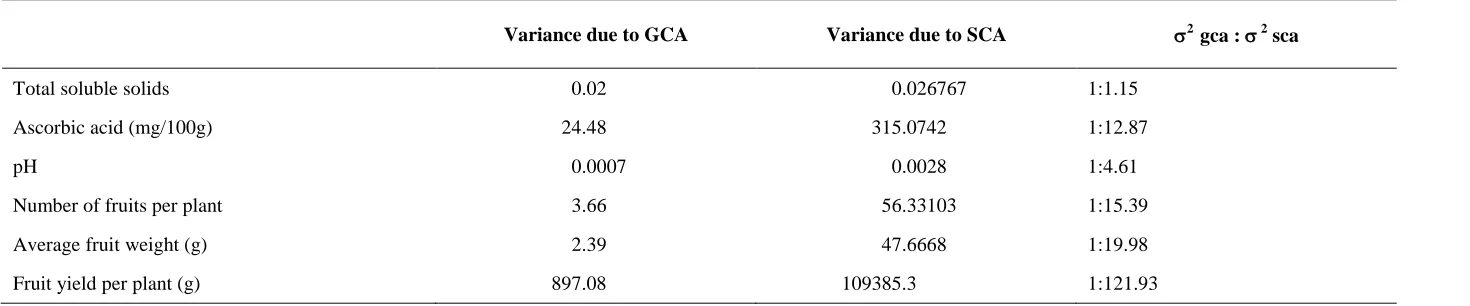
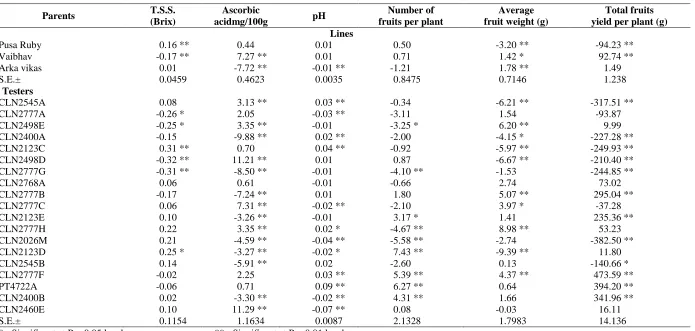
0.01 probability level. While variances due to crosses vs. parents showed significant for all characters except total soluble solids at 1 per cent probability. The presence of variability among 22 parental genotypes was further confirmed by significant differences due to GCA effects among traits (Table 2) and substantial variation also existed among 57 F1 hybrids due to SCA effect, which suggested the possibility of better selection of combination among hybrids for these traits. The analysis of variances for combining ability revealed that the SCA variances were greater than GCA variances for all characters (Table 2). These results suggested the contribution of heritable and non-heritable genetic causes in characters manifestation. However, higher values of variances due to SCA (σ2s) than variances due to GCA (σ2g) indicated that non-additive variances prevailed in genetic determination of days to flowering, number of flowers per cluster, number of marketable fruits per plant, fruit yield per plant, pericarp thickness, TSS and pH of juice. The ratio of σ2g/ σ2s (Table 2) being less than one, indicated the prevalence of over-dominance for these characters. Previous studies in tomato also indicated the predominance of non-additive gene action for number of fruits per plant (Dhaliwal et al., 2004, Saleem et al., 2009), fruit yield per plant (Dhaliwal et al., 2004, Kaur et al., 2004, Saleem et al., 2009) and average fruit weight (Dhaliwal et al.,, 2004, Saleem et al., 2009). Dominance gene action for these traits also were reported by (Srivastava et al., 1998; Dhaliwal et al., 2004; Thakur & Joshi, 2000; Bhatt et al., 2001). With regard to the estimates of GCA effects of parents (Table 3), among the male parents, CLN2777F exhibited significant desirable gca effect for fruit yield per plant, number of fruits per plant and average fruit weight. Significant desirable gca effect for fruit yield per plant and number of fruits per plant was also exhibited by male parent PT4722A. Male parent CLN2400B also proved to be a good combiner for fruit yield per plant, number of fruits per plant and pH. Significant desirable gca effect for ascorbic acid and pH was exhibited by CLN2460E. Parent CLN2498D showed significant gca effect for ascorbic acid, while CLN2123C for total soluble solids. Among the female parents, Vaibhav proved to be a good combiner for fruit yield per plant, average fruit weight and ascorbic acid, while Arka Vikas for average fruit weight and pH. In confirmation to the findings of Srivastava et al., (1998) and Dhaliwal et al., (2004) none of the parents was the best general
breeding. Therefore it is clear that a gene pool developed by intermating in the segregating population involving parental lines PT4722A, CLN2777F, CLN2400B, CLN2460E, CLN2498D, CLN2123C, Vaibhav and Arka Vikas is expected to offer maximum promise in genetically enhancement of fruit yield and quality parameters (Nadarajan and Gunasekaran, 2005).
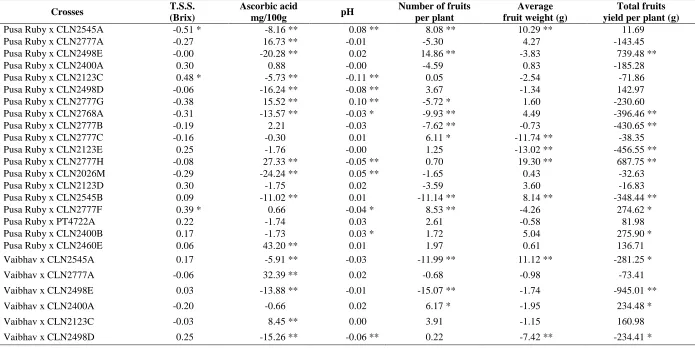
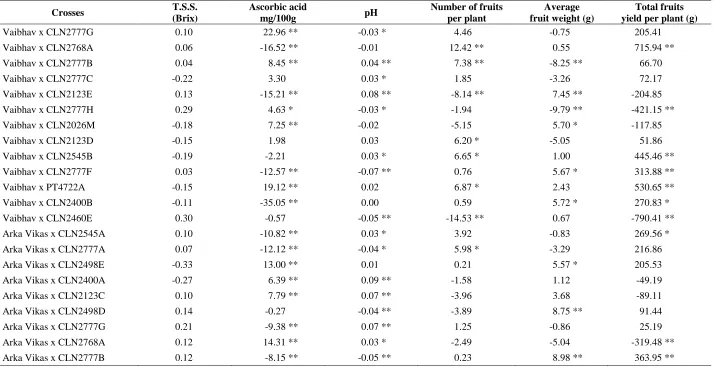
SCA involves non-additive effects and additive x dominance, dominance x dominance interactions, which are non-fixable or non-heritable and are of significance in hybrid breeding only(Table 4). So, SCA effects are useful to predict the potential of a particular cross in exploiting heterosis.
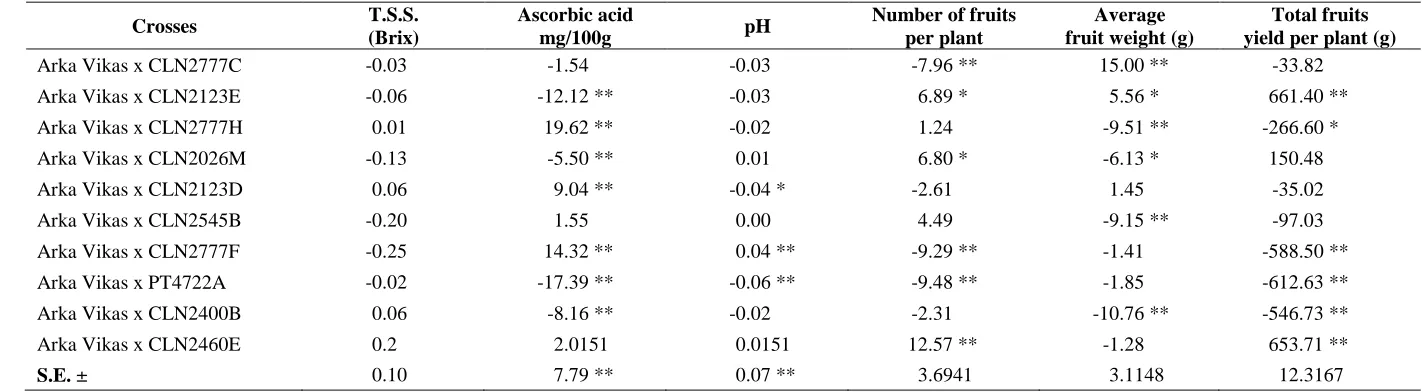
Among these 57 hybrids, Pusa Ruby x CLN2777H proved to be best combination for average fruit weight involved low x low (L x L) GCA parents, total fruit yield per plant (L x L), pH (L x H) and ascorbic acid content (L X H). Pusa Ruby x CLN2498E revealed high SCA effects for number of fruits per plant involved parents with low positive x low positive gca effect and total fruit yield per plant (L x L). Vaibhav x CLN2768A exhibited desirable SCA for number of fruits per plant (L x L) and total fruit yield per plant (H x L), while Arka Vikas x CLN2460E also exhibited desirable SCA for number of fruits per plant (L x L) and total fruit yield per plant (L x L). Arka Vikas x CLN2123E is proved to be good combination for total fruit yield per plant (L x H) and its contributing characters were number of fruits per plant (L x H) and average fruit weight (L x L). Vaibhav x PT4722A proved to be good combination for total fruit yield per plant (H x H), number of fruits per plant (L x H) and ascorbic acid content (H x L). The crosses having one parent with high gca effects and other parent with low gca effects are expected to throw desirable transgressive segregants if the additive genetic system present in high combiner and complementary epistatic effects act in same direction (Iqbal & Khan, 2003). This kind of situation was well reflected in above crosses.
ISSN 0975-928X
performance of series of crosses, the best combination were Pusa Ruby x CLN2777H, Pusa Ruby x CLN2498E, Vaibhav x CLN2768A, Arka Vikas x CLN2460E, Arka Vikas x CLN2123E, Vaibhav x PT4722A which can further be exploited for isolating superior segregants.
Acknowledgements: The authors are extremely grateful to AVRDC, Taiwan for providing materials for present study.
References
Anonymous. 1996. Descriptors for tomato (Lycopersicon spp.). IPGRI, Rome, Italy
Bhatt, R. P., Biswas, V. R. and Kumar, N. 2001. Heterosis, combining ability and genetics for vitamin C, total soluble solids and yield in tomato (Lycopersicon esculentum Mill) under open and protected environment. Indian J. Genet., 64(2):125-129.
Dhaliwal, M. S., Singh, S., Cheema, D. S. and Singh, P. 2004. Genetic analysis for important fruit characters of tomato by involving lines possessing male sterility genes. In: Acta Hort.,
637:123-131.
Hannan, M. M., Ahmed, M. B., Roy, U. K., Razvy, M. A., Haydar, A., Rahman, M. A., Islam, M. A. and Islam, R. 2007, Heterosis, combining ability and genetics for brix%, days to first fruit ripening and yield in tomato (Lycopersicon esculentum Mill.). Middle-East J. Scientific Res.,2 (3-4): 128-131.
Iqbal, M. Z. and Khan, S. A. 2003. Line x Tester analysis in true seed of potato (Solanum tubersum spp tubersum). Online J. Bio. Sci., 3(7): 674 680. Kaur, P., Dhaliwal, M. S. and Singh, S. 2004. Genetic
analysis of yield in tomato by involving genetic male sterile lines. Acta Hort.637:155-160. Kempthne, O. 1957. An introduction to genetic statistics.
John Willey and Sons, New York.
Kiani, G., Nematzadeh, G. A., Kazemitabar, S. K. and Alishah, O. 2007. Combining ability in cotton cultivars for agronomic traits. Int. J. Agric. Biol., 9: 521–2.
Nadarajan, N. and Gunasekaran, M. 2005. Quantitative Genetics and Biometrical Techniques in Plant Breeding. Kalyani Publ., New Delhi
Saleem, M. Y., Asghar, M., Ahsanul, M. H., Rafique, T., Kamran, A. and Khan, A. A. 2009. Genetic analysis to identify suitable parents for hybrid seed production in tomato (Lycopersicon esculentum Mill). Pakistan J. Bot., 41(3): 1107-1116.
Sprague, G. F. and Tatum, L. A. 1942. General vs. specific combining ability in single cross of corn. J. American Soc. Agron., 34: 923–32. Srivastava, J. P., Srivastava, B. P., Verma, H. P. S. and
Singh, H. 1998. Heterosis in relation to combining ability in tomato. Veg. Sci.
25(1):43-47.
Steel, R. G. D. and Torrie, J. H.1980. Principles and Procedures of Statistics. Mc Graw Hill Book Co., New York.
ISSN 0975-928X
Table 1: ANOVA for fruit yield and its contributing characters and fruit quality characters in tomato
Sources
Characters
Replication Parents Lines Testers L x T Crosses Crosses vs. parent Error
Degrees of freedom
2 21 2 18 36 56 1 156
T.S.S. (brix) 0.0538 0.34** 1.59** 0.3455 0.20* 0.29** 0.0854 0.1197
Ascorbic acid (mg/100g) 64.9417 612.62** 3209.59* 329.8866 961.90** 839.03** 935.21** 16.6773
pH 0.0004 0.0159** 0.047 0.0111 0.009** 0.0096** 0.1708** 0.0006
Number fruits per plant 4.11 194.71** 63.29 131.4272 209.71** 179.32** 324.47** 18.85
Average fruit weight (g) 20.64 465.37** 102.0527 477.4764 974.10** 210.84** 266.28** 27.2766
Total fruits yield per plant (g) 61392.54 117358.18** 20955.07 133731 15453.46** 608819.96** 742386.71** 33318.85
* - Significant at P = 0.05 level ** - Significant at P = 0.01 level
Table 2: Variance due to GCA and SCA effects for the characters studied in tomato
Variance due to GCA Variance due to SCA 2 gca : 2 sca
Total soluble solids 0.02 0.026767 1:1.15
Ascorbic acid (mg/100g) 24.48 315.0742 1:12.87
pH 0.0007 0.0028 1:4.61
ISSN 0975-928X
Table 3: General combining ability effects of parents for different parameters in tomato
Parents T.S.S. (Brix)
Ascorbic
acidmg/100g pH
Number of fruits per plant
Average fruit weight (g)
Total fruits yield per plant (g) Lines
Pusa Ruby 0.16 ** 0.44 0.01 0.50 -3.20 ** -94.23 **
Vaibhav -0.17 ** 7.27 ** 0.01 0.71 1.42 * 92.74 **
Arka vikas 0.01 -7.72 ** -0.01 ** -1.21 1.78 ** 1.49
S.E.± 0.0459 0.4623 0.0035 0.8475 0.7146 1.238
Testers
CLN2545A 0.08 3.13 ** 0.03 ** -0.34 -6.21 ** -317.51 **
CLN2777A -0.26 * 2.05 -0.03 ** -3.11 1.54 -93.87
CLN2498E -0.25 * 3.35 ** -0.01 -3.25 * 6.20 ** 9.99
CLN2400A -0.15 -9.88 ** 0.02 ** -2.00 -4.15 * -227.28 **
CLN2123C 0.31 ** 0.70 0.04 ** -0.92 -5.97 ** -249.93 **
CLN2498D -0.32 ** 11.21 ** 0.01 0.87 -6.67 ** -210.40 **
CLN2777G -0.31 ** -8.50 ** -0.01 -4.10 ** -1.53 -244.85 **
CLN2768A 0.06 0.61 -0.01 -0.66 2.74 73.02
CLN2777B -0.17 -7.24 ** 0.01 1.80 5.07 ** 295.04 **
CLN2777C 0.06 7.31 ** -0.02 ** -2.10 3.97 * -37.28
CLN2123E 0.10 -3.26 ** -0.01 3.17 * 1.41 235.36 **
CLN2777H 0.22 3.35 ** 0.02 * -4.67 ** 8.98 ** 53.23
CLN2026M 0.21 -4.59 ** -0.04 ** -5.58 ** -2.74 -382.50 **
CLN2123D 0.25 * -3.27 ** -0.02 * 7.43 ** -9.39 ** 11.80
CLN2545B 0.14 -5.91 ** 0.02 -2.60 0.13 -140.66 *
CLN2777F -0.02 2.25 0.03 ** 5.39 ** 4.37 ** 473.59 **
PT4722A -0.06 0.71 0.09 ** 6.27 ** 0.64 394.20 **
CLN2400B 0.02 -3.30 ** -0.02 ** 4.31 ** 1.66 341.96 **
CLN2460E 0.10 11.29 ** -0.07 ** 0.08 -0.03 16.11
S.E.± 0.1154 1.1634 0.0087 2.1328 1.7983 14.136
ISSN 0975-928X
Table 4: Specific combining ability effects of hybrids for different parameters in tomato
Crosses T.S.S.
(Brix)
Ascorbic acid
mg/100g pH
Number of fruits per plant
Average fruit weight (g)
Total fruits yield per plant (g)
Pusa Ruby x CLN2545A -0.51 * -8.16 ** 0.08 ** 8.08 ** 10.29 ** 11.69
Pusa Ruby x CLN2777A -0.27 16.73 ** -0.01 -5.30 4.27 -143.45
Pusa Ruby x CLN2498E -0.00 -20.28 ** 0.02 14.86 ** -3.83 739.48 **
Pusa Ruby x CLN2400A 0.30 0.88 -0.00 -4.59 0.83 -185.28
Pusa Ruby x CLN2123C 0.48 * -5.73 ** -0.11 ** 0.05 -2.54 -71.86
Pusa Ruby x CLN2498D -0.06 -16.24 ** -0.08 ** 3.67 -1.34 142.97
Pusa Ruby x CLN2777G -0.38 15.52 ** 0.10 ** -5.72 * 1.60 -230.60
Pusa Ruby x CLN2768A -0.31 -13.57 ** -0.03 * -9.93 ** 4.49 -396.46 **
Pusa Ruby x CLN2777B -0.19 2.21 -0.03 -7.62 ** -0.73 -430.65 **
Pusa Ruby x CLN2777C -0.16 -0.30 0.01 6.11 * -11.74 ** -38.35
Pusa Ruby x CLN2123E 0.25 -1.76 -0.00 1.25 -13.02 ** -456.55 **
Pusa Ruby x CLN2777H -0.08 27.33 ** -0.05 ** 0.70 19.30 ** 687.75 **
Pusa Ruby x CLN2026M -0.29 -24.24 ** 0.05 ** -1.65 0.43 -32.63
Pusa Ruby x CLN2123D 0.30 -1.75 0.02 -3.59 3.60 -16.83
Pusa Ruby x CLN2545B 0.09 -11.02 ** 0.01 -11.14 ** 8.14 ** -348.44 **
Pusa Ruby x CLN2777F 0.39 * 0.66 -0.04 * 8.53 ** -4.26 274.62 *
Pusa Ruby x PT4722A 0.22 -1.74 0.03 2.61 -0.58 81.98
Pusa Ruby x CLN2400B 0.17 -1.73 0.03 * 1.72 5.04 275.90 *
Pusa Ruby x CLN2460E 0.06 43.20 ** 0.01 1.97 0.61 136.71
Vaibhav x CLN2545A 0.17 -5.91 ** -0.03 -11.99 ** 11.12 ** -281.25 *
Vaibhav x CLN2777A -0.06 32.39 ** 0.02 -0.68 -0.98 -73.41
Vaibhav x CLN2498E 0.03 -13.88 ** -0.01 -15.07 ** -1.74 -945.01 **
Vaibhav x CLN2400A -0.20 -0.66 0.02 6.17 * -1.95 234.48 *
Vaibhav x CLN2123C -0.03 8.45 ** 0.00 3.91 -1.15 160.98
ISSN 0975-928X
Table 4: Contd..
Crosses T.S.S.
(Brix)
Ascorbic acid
mg/100g pH
Number of fruits per plant
Average fruit weight (g)
Total fruits yield per plant (g)
Vaibhav x CLN2777G 0.10 22.96 ** -0.03 * 4.46 -0.75 205.41
Vaibhav x CLN2768A 0.06 -16.52 ** -0.01 12.42 ** 0.55 715.94 **
Vaibhav x CLN2777B 0.04 8.45 ** 0.04 ** 7.38 ** -8.25 ** 66.70
Vaibhav x CLN2777C -0.22 3.30 0.03 * 1.85 -3.26 72.17
Vaibhav x CLN2123E 0.13 -15.21 ** 0.08 ** -8.14 ** 7.45 ** -204.85
Vaibhav x CLN2777H 0.29 4.63 * -0.03 * -1.94 -9.79 ** -421.15 **
Vaibhav x CLN2026M -0.18 7.25 ** -0.02 -5.15 5.70 * -117.85
Vaibhav x CLN2123D -0.15 1.98 0.03 6.20 * -5.05 51.86
Vaibhav x CLN2545B -0.19 -2.21 0.03 * 6.65 * 1.00 445.46 **
Vaibhav x CLN2777F 0.03 -12.57 ** -0.07 ** 0.76 5.67 * 313.88 **
Vaibhav x PT4722A -0.15 19.12 ** 0.02 6.87 * 2.43 530.65 **
Vaibhav x CLN2400B -0.11 -35.05 ** 0.00 0.59 5.72 * 270.83 *
Vaibhav x CLN2460E 0.30 -0.57 -0.05 ** -14.53 ** 0.67 -790.41 **
Arka Vikas x CLN2545A 0.10 -10.82 ** 0.03 * 3.92 -0.83 269.56 *
Arka Vikas x CLN2777A 0.07 -12.12 ** -0.04 * 5.98 * -3.29 216.86
Arka Vikas x CLN2498E -0.33 13.00 ** 0.01 0.21 5.57 * 205.53
Arka Vikas x CLN2400A -0.27 6.39 ** 0.09 ** -1.58 1.12 -49.19
Arka Vikas x CLN2123C 0.10 7.79 ** 0.07 ** -3.96 3.68 -89.11
Arka Vikas x CLN2498D 0.14 -0.27 -0.04 ** -3.89 8.75 ** 91.44
Arka Vikas x CLN2777G 0.21 -9.38 ** 0.07 ** 1.25 -0.86 25.19
Arka Vikas x CLN2768A 0.12 14.31 ** 0.03 * -2.49 -5.04 -319.48 **
ISSN 0975-928X
Table 4: Contd..
Crosses T.S.S.
(Brix)
Ascorbic acid
mg/100g pH
Number of fruits per plant
Average fruit weight (g)
Total fruits yield per plant (g)
Arka Vikas x CLN2777C -0.03 -1.54 -0.03 -7.96 ** 15.00 ** -33.82
Arka Vikas x CLN2123E -0.06 -12.12 ** -0.03 6.89 * 5.56 * 661.40 **
Arka Vikas x CLN2777H 0.01 19.62 ** -0.02 1.24 -9.51 ** -266.60 *
Arka Vikas x CLN2026M -0.13 -5.50 ** 0.01 6.80 * -6.13 * 150.48
Arka Vikas x CLN2123D 0.06 9.04 ** -0.04 * -2.61 1.45 -35.02
Arka Vikas x CLN2545B -0.20 1.55 0.00 4.49 -9.15 ** -97.03
Arka Vikas x CLN2777F -0.25 14.32 ** 0.04 ** -9.29 ** -1.41 -588.50 **
Arka Vikas x PT4722A -0.02 -17.39 ** -0.06 ** -9.48 ** -1.85 -612.63 **
Arka Vikas x CLN2400B 0.06 -8.16 ** -0.02 -2.31 -10.76 ** -546.73 **
Arka Vikas x CLN2460E 0.2 2.0151 0.0151 12.57 ** -1.28 653.71 **
S.E. ± 0.10 7.79 ** 0.07 ** 3.6941 3.1148 12.3167