P
age
21
Performance and Privatisation of State Level Public Enterprises in
Punjab
Sadhna
Department of Evening Studies, Panjab University, Chandigarh-160014 (India).
ABSTRACT
There has been massive expansion of state level public enterprises in Punjab. It is in this context the present study attempt to analyse the performance and privatisation of SLPEs from 1990-91 to 2009-10 by taking certain indicators. The secondary data is used for this and compound annual growth rate is extracted. SLPEs continue to increase along with investment. SLPEs are not producing satisfactory results. All enterprises have been incurring losses and accounts of all are in arrears for last so many years. Rate of return capital is far less than the rate capital employed. To response this, government of Punjab started the process of disinvestment with 6 enterprises in 1992. The privatisation in form of disinvestment process is moving at a very slow pace
Keywords:Massive; Indicators; Return; Losses; Disinvestment.
INTRODUCTION
In India, PEs operates primarily at two levels i.e. central level public enterprises (CLPEs) and state level public enterprises (SLPEs). CPSEs are set up for the rapid social-economic growth and development of the country. The purpose is to invest in major public sector projects like energy, transport and basic infrastructure, where private sector could not invest. On other hand, SLPEs which are established at smaller level entirely to promote industrial development, proper utilisation of natural as well as human resources, avail credit at cheaper rate, takeover sick industries and develop entrepreneurial class in the states. The present study deals with SLPEs in
Punjab. In pre-independence era, some of the princely states in Punjab used to operate a few
enterprises, mainly to distil and distribute liquor. Some utilities supplying water and electricity were also there in the erstwhile East Punjab. The state enterprises were run as departmental undertakings and not companies, statutory and non-statutory.
P
age
22
On 1 November, 1966, when the state of Punjab reorganized in its present form, there were 9 public enterprises6 in the state. These public enterprises were expected to encourage industrialization, redress regional imbalance, exploit local resources, generate employment and develop technical manpower. After reorganization, several public enterprises came up in the state. Efforts made by the successive governments to set up SLPEs for the development of infrastructure in different States/Union Territories (UTs), for supply of goods and services to the public at large, to take over sick units and provide direct and indirect employment to people, promote industry, provide credit at reasonable rate, lead to development of a particular region and create wealth for the society in general. As a result, SLPEs came up in the state and went to increase as shown in figue-1. SLPEs in Punjab consist of working companies7, non-working government companies8 and statutory corporations9.
Figure-1. Expansion of SLPEs
Source: CAG, Punjab, Various audit reports on state PSUs
OBJECTIVES OF THE STUDY
1. To analyse the performance of SLPEs and
2. To examine the process of disinvestment of SLPEs.
SOURCES OF DATA
P
age
23
Performance of State Level Public Enterprises (SLPEs) in Punjab: The growth/ performance
of SLPEs in Punjab can also be evaluated on the basis of some indicators as shown below:
1. Expansion of State Level Public Enterprises: Compound Annual Rate of Growth is calculated to analyse the expansion of public units in Punjab. During the sixteen years, i.e. from 1994-95 to 2009-10; government working companies decreased at a compound annual rate of growth -0.49 per annum. While the number of statutory corporations remained constant (from 1991-92 to 2009-10) as shown in figure-1.
2. Growth in Financial Investment: The financial investment in SLPEs (comprising paid up equity capital, share application and long term loans) grew from Rs. 5, 281.23 crore in 52 SLPEs (including 26 subsidiaries) in 1991-92 to Rs. 16,658.20 crore in 50 SLPEs in 2009-10. Investment has increased at a compound annual rate of growth by 5.86 per annum (See table-1).
Table-1. Financial Investment and Its Components (Rs. in crore)
Year Equity Capita
Long Term Loans
Share Application
Total Financial Investment
Amount of budgetary
outgo
Guarantee
1990-91 343.82 4937.41 - 5281.23 - -
1991-92 370.17 5541.79 - 5911.41 - -
1992-93 385.04 5756.56 - 6141.41 542.02 538.04
1993-94 2,051.65 5077.56 - 7129.21 501.19 1,007.84
1994-95 2063.41 5541.1 - 7604.51 648.22 1,428.77
1995-96 2090.96 6112.19 - 8203.51 461.36 2,589.74
1996-97 3289.54 5829.57 - 8203.51 1,614.54 2,151.25
1997-98 3254.32 6477.04 57.09 9119.11 1,146.21 4,589.94
1998-99 3279.1 8058.01 70.14 9788.37 594.87 3,057.35
1999-2000 3293.54 9056.73 86.51 11406.64 612.31 5,578.58
2000-01 3304.04 9464.77 21.26 12424.63 840.69 5,593.54
2001-02 3387.39 9958.82 32.98 12855.35 69.41 8,036.79
2002-03 3388.39 10346.16 58.23 13384 1,019.82 5,386.57
2003-04 3397.37 10368.94 67.95 13767.53 1,744.78 8,192.63
2004-05 3398.69 10556.84 100.51 13824.54 2,327.12 8,781.06
2005-06 3557.16 9389 108.51 14023.48 1,639.44 10,922.44
2006-07 4067.84 10858.82 106.05 12046.67 1,518.85 10,875.84
2007-08 3689.71 10185.82 - 14008.96 2,951.89 12,718.28
2008-09 3830.56 11756.98 - 14319.54 2,720.94 20,554.93
2009-10 3843.37 12814.83 - 16658.20 3,317.98 25,016.05
Total - - - - 24,271.64 1,37,019.64
P
age
24
3. Components of Financial Investment: The structure of financial investment in SLPEs has been changing over the year as shown in table-1. While the share of equity capital in total (financial) was 6.5 percent in 1990-91, it raised to 23.07 percent in 2009-10 as shown in table-1. The share of long term loans „on the other hand‟, declined from 93.48 percent in 1990-91 to 76.92 percent in 2009-10 investment. It shows that share of equity capital has increased at a compound annual rate of growth 11.07 per annum, and the loans by 5.12 per annum (see table-1).
4. Sources of Financial Investment: While the State Government continues to have the majority of equity holding in SLPEs, investment in terms of both equity capital and long term loans has been forthcoming from other parties as well as, such as Central Government, the financial institutions, banks, etc. A perusal of „sources of investment‟ over the years moreover shows a significant change in the investment pattern of SLPEs during 2000-01 to 2009-10. The share of State Government in total investment both equity and long term loans, stood at Rs.7,549.03 crore in 2009-10, whereas the share of Central Government in equity capital and loans stood at Rs.1,504.61 crore during the same year.
5. Amount of Budgetary Outgo and Guarantees: Amount of budgetary outgo in terms of grants, loans, subsides which are given by the state government to enterprises grew from Rs 542.02 crore in 1992-93 to Rs. 3,317 crore in 2009-10 by Rs. 2,775.96 crore as shown in table-1. Amount of budgetary outgo has grown at a CAGR of 5.12 per annum. The amount of guarantees increased from Rs. 538.04 crore as on 1992-93 to Rs. 25,016.65 crore in 2009-10 by Rs. 24,478 crore (see table-1). The amount of guarantees has increased at a CAGR 23.24 per annum.
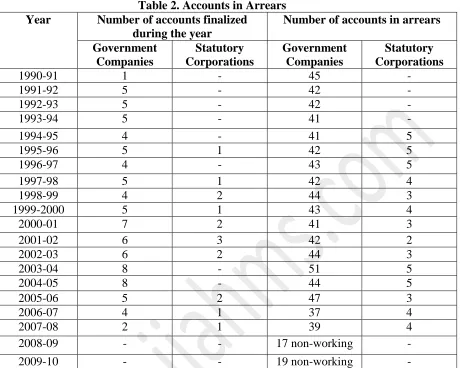
6. Accounts in arrears: The accounts of all the companies are in arrears from1990-91 to 2009-10, which shows the poor performance of public enterprises, represent in table-2. PSUs are unable to achieve their objectives. It is important that government have to take some steps to improve their efficiency. It is right step if government privatizes some public sector. As a result of privatization, financial burden on government will tend to reduce.
P
age
25
Table 2. Accounts in Arrears
Source: CAG, Punjab, various audit reports on state PSUs Table-3. Profit/Loss in SLPES in Punjab (Rs. in crore)
Year Enterprises Profit/loss Profit making enterprises Loss making enterprise
2001-02 25 -323.67 10 11
2002-03 27 -807.82 8 14
2003-04 26 -895.79 8 15
2004-05 29 -77.26 11 11
2005-06 27 -383.99 11 13
2006-07 27 -111.29 10 15
2007-08 29 -1859.56 12 14
2008-09 33 -1590.56 15 13
2009-10 31 -1200.59 15 11
Source: CAG, Punjab, Various audit reports on state PSU. Year Number of accounts finalized
during the year
Number of accounts in arrears
Government Companies
Statutory Corporations
Government Companies
Statutory Corporations
1990-91 1 - 45 -
1991-92 5 - 42 -
1992-93 5 - 42 -
1993-94 5 - 41 -
1994-95 4 - 41 5
1995-96 5 1 42 5
1996-97 4 - 43 5
1997-98 5 1 42 4
1998-99 4 2 44 3
1999-2000 5 1 43 4
2000-01 7 2 41 3
2001-02 6 3 42 2
2002-03 6 2 44 3
2003-04 8 - 51 5
2004-05 8 - 44 5
2005-06 5 2 47 3
2006-07 4 1 37 4
2007-08 2 1 39 4
2008-09 - - 17 non-working -
P age
26
Table-4. Finalisation of Accounts of Government Non-working Companies Year Number of
companies
Accounts in arrears
2001-02
28 Accounts of 27 companies were in arrears for period ranging from one
year to 28 years
2002-03
28 One company finalised its accounts and the accounts of companies were
in arrears for period ranging from 1 year to 29 years
2003-04
38 Out of 38, 2 companies finalised their accounts and the accounts of 11
companies were in arrears for period ranging from 1-30 years, 6 companies were under liquidation, 7 companies had issued notice for striking off their names from the register, 12 newly incorporated companies were not due.
2004-05
28 Out of 28, 2 companies finalised their accounts and five companies
finalised eight accounts for previous year. six companies are under liquidation. Accounts of 20 companies were in arrears ranging from 1-31 years.
2005-06
30 One company had finalised accounts. 7 companies are under liquidation.
one company yet to complete. 11 companies were likely to be dissolved. Accounts of 10 companies were in arrears from 1-15 years.
2006-07
19 7 companies out of 19 were under liquidation and 12 companies were
defunct. the accounts of all 12defunct companies were in arrears period ranging from 1-16 years
2007-08
17 7 companies were under liquidation and remaining 10 companies were
defunct. the accounts of 10 defunct companies were in arrears for period ranging from 1-17 years
2008-09
17 Out of 17 PSUs, 8 had into liquidation process. All the remaining 11
companies had arrears of accounts for period for 2-18 years
2009-10
19 Out of 19, 8 had gone into liquidation process. All the remaining 11
companies had arrears of accounts for 1-19years
Source: CAG, Punjab, Various audit reports on state PSUs
Table 5.Financial Position of Non-working Government Companies (Rs. in crore)
Year Paid-up-capital Net worth Cash loss Accumulated Loss
2000-01 - - - -
2001-02 26.17 (-)13.31 (-)7.29 40.91
2002-03 26.14 (-)17.72 (-)7.09 45.18
2003-04 22.59 (-)27.34 (-)4.99 52.91
2004-05 20.87 (-)29.87 (-)2.23 55.30
2005-06 30.56 (-)20.87 (-)2.01 56.40
2006-07 21.09 (-)30.39 (-)1.18 56.29
2007-08 21.04 (-)0.54 (-)3.02 (-)58.19
2008-09 - - - -
2009-10 - - - -
P
age
27
Tables 3, 4 and 5 show that, according to latest finalized accounts, the overall net loss of all SLPEs (aggregate net profit-aggregate net loss) stood at Rs.(-)1,200.89 crore in 2009-10 as compared to Rs. (-)323.67 crore during 2001-02 year. All the public enterprises taken together incurred loss for 8 years out of 9 years. This shows that only about one-third of PEs was making losses and rest of them was running in profits. This, indeed, presents a very glommy picture of the SLEPs in Punjab.
Figure-2. Aggregate Profit/Loss of SLPEs (Rs. in crore)
Source: CAG, Punjab, Various audit reports on state PSUs
8. Financial Results of Working Government Companies and Statutory Corporations for the Latest Year for which Accounts are Finalized: The profit of profit making SLPEs stood at Rs.71.97 crore in 2009-10 compared to Rs.54.15 crore in 2008-09. The loss of loss making state PSUs, on the other hand, stood at Rs. )1,296.28 crore in 2009-10 against Rs. (-)1,605.91 crore in 2008-09. At the aggregate level (aggregate profit- aggregate loss), the overall loss of all SLPEs stood at Rs. ) 1,210.61 crore in 2009-10 compared to Rs. (-)1,553.19 crore in 2008-09, decreased by Rs. 342.58 crore. In term of growth in profits, over the previous year, the best results were achieved by the service sector as shown in table-6.
Table-6. Financial Results of Working Government Companies and Statutory Corporations for the Latest Year for which Accounts are finalised (Rs. in crore) Sr. No Name of State Level Public Enterprise 31.3.2010 31.3.2009
I Agriculture
1 Punjab Agro Food Grains Corporation Limited 0.54 0.09
2 Punjab Agro Industries Corporation Limited 1.77 1.52
3 Punjab Agro Juice Limited (-)113.17 (-)3.57
4 Punjab Agro Power Corporation Limited D D
5 Punjab State Forest Development Corporation Limited 2.19 1.21
6 Punjab State Grains Procurement Corporation Limited (-)85.96 (-)69.77
P
age
28
8 Punjab Water Resources Management & Development
Corporation Limited
(-)2.92 (-)2.16
9 Punjab State Warehousing Corporation (-)84.58 (-)79.67
Sub total (-)178.08 (-)150.68
II Financing
1 Punjab State Industrial Development Corporation Limited (-)48.59 (-)48.93
2 Punjab Venture Capital 0.06 0.08
3 Punjab Venture Investors Trust Limited 0.01 0.01
4 Punjab Financial Corporation (-)3.01 14.26
5 Punjab Scheduled Caste Land Development & Finance
Corporation
8.24 0.13
Sub total (-)43.29 (-)34.45
III Infrastructure
1 Punjab Police Housing Corporation Limited B B
2 Punjab Small Industries and Export Corporation Limited 8.59 4.96
Sub total 8.59 4.96
IV Manufacturing
1 Consumer Electric (Punjab) Limited B B
2 Punjab Communication Limited 0.99 3.17
3 Punjab Recorder Limited (-)0.92 (-)0.92
4 Electronic System Punjab Limited closed (-)10.72
Sub total 0.07 (-)8.47
V Power
1 Gidderbaha Power Limited D -
2 Punjab Genco Limited 2.97 11.30
3 Nabha Power Limited Closed D
4 Punjab State Electricity Board (-)1041.10 (-)1389.60
Sub total (-)1038.13 (-)1378.30
VI Service
1 Gulmohar Tourist Complex Limited 0.06 (-)0.20
2 NeemChemli Tourist Complex limited - (-)0.01
3 Amritsar Hotel Limited closed (-)36
4 Punjab Information & Communication Technology Corporation
Limited
0.80 0.80
5 Punjab Police Security Corporation Limited - -
P
age
29
7 Punjab State Civil Supplies Corporation Limited 0.55 3.91
8 Punjab State Container & Warehousing Corporation Limited 12.66 10.12
9 Punjab Tourism Development Limited 27.50 0.35
10 PEPSU Roadways Transport Corporation (-)1.99 (-)1.78
Sub total 40.23 13.75
Grand Total (-)1210.61 (-)1553.19
Source: CAG, Punjab, various reports on state working PSUs
9. Top profit making SLPEs: Punjab Tourism Development Corporation (PTDC) maintained its top most rank, followed by Punjab State Container and Warehousing Corporation (PSCWC), and Punjab Small Industries and Export Corporation Limited (PSIECL) in 2009-10 which can be seen in figure-6. PTDC made a huge jump in profits i.e. Rs. 6.35 crore in 2008-09 to Rs. 27.50 crore in 2009-10.
Figure-3. Top Ten Profit Making Companies
Source: Source: CAG, Punjab, various reports on state working PSUs
P
age
30
Figure-4. Top Ten Loss Incurring SLPEs
Source: Source: CAG, Punjab, various reports on state working PSUs
11.Capital Employed10 and Return on Capital11 in SLPEs: Table-7 shows that return on capital is much less than as compared to capital employed. Amount of capital employed increased at an increasing rate but return on capital employed increased at a decrease rate which shows the poor performance of working PSUs in Punjab.
Table-7.Capital Employed and Return on Capital in SLPEs (Rs. in crore)
year Government PSUs (Rs. in crore) Statutory Corporations (Rs. in crore) Capital
Employed
Return on Capital Capital Employed
Return on Capital
1990-91 - - - -
1991-92 - - 3,158.35 238.93
1992-93 - - 3,846.75 187.43
1993-94 629.78 82.88 9,135.84 226.76
1994-95 865.12 109.32 3,941.25 368.58
1995-96 1,094.64 99.04 4,120.46 561.67
1996-97 1,145.23 80.36 12,069.9 482.58
1997-98 872.02 103.62 10,533.53 449.49
1998-99 1,029.55 139.69 10,838.88 558.28
1999-2000 1,557.52 206.27 12,197.36 703.06
2000-01 2,980.15 227.48 12,336.61 917.99
2001-02 5,960.67 301.32 12,378.5 1,259.92
2002-03 5,477.86 202.22 13,254.15 848.64
2003-04 5,434.76 223.39 14,925.27 725.54
2004-05 5,434.76 296.39 13,745.22 1,310.59
2005-06 3,358.14 324.45 12,898.69 -2,870.61
2006-07 3,2008.79 341.76 12,291.61 9,36.37
2007-08 3,674.62 377.85 13,315.82 -781.53
2008-09 4,631.59 - - -
2009-10 - - - -
P
age
31
Privatisation/Disinvestment of SLPEs of Punjab
The disinvestment exercise coincides with a phase in the development of the Punjab economy when it prosperous agriculture itself has became the cause of its downturn. It will, however be appropriate to trace the historical process of economic development in the state. The structural composition of the state‟s economy had changed since 1993-94. The share of the primary sector had come down from 46.13% in 1993-94 to 38.66% in 2000-01. The secondary sector increased its share from 21.77% to 24.9% in the same period. The share of tertiary sector increased from 32.1% in 1993-94 to 36.44% in 2000-01. The Government of Punjab was under fiscal stress since 1984-85, when it became a „Revenue Deficit State‟ from „Revenue Surplus State‟, for the first time. The revenue receipts in 90s increased by 2.85 times in comparison to increase in revenue expenditure by 3.11 times. Non-development expenditure increased from 23.4% in 1991-92 to 54.25% in 2000-01. The revenue deficit shot up from Rs. 480.87crore in 1991-92 to Rs. 2,486.38crore in 2000-01 and was expected to touch Rs.2,657crore by 31.3.2002. Salaries and retirement benefits to the state‟s employees were higher than those of the Central Government employees. The financial position of the state was such that its entire revenue receipts which include tax and non-tax revenue of the state, share of central taxes, plan grants for state plan schemes and centrally sponsored schemes, grants from Finance Commission and other non-plan grants did not suffice even to meet its committed expenditure on salaries, pensioners and pensioner benefits and servicing of debt (interest).
In the fiscal year 2000-01, the total revenue receipts were Rs. 7,136crore (excluding interest receipts from PSEB adjusted against rural electrification subsidy and including net receipts under lotteries), where, the expenditure on salaries & wages was Rs. 4,310crore, and debt servicing pre-empted Rs. 2,343crore. The total outstanding debt of the state was estimated at Rs. 33,153.33crore by 31.3.2002. While the government guarantees to the PSUs stood at Rs. 19,609.86crore by 31.3.2002(including the food credit limit sanctioned by the Reserve Bank of India). The public debt of the state amounted to 40.66% of the Gross State Domestic Product as on 31.3.2001. The state was further burdened with large borrowings by PSUs generally with the state guarantees. Often the debt raised by PSUs was used inefficiently. The state was deep into a trap and access to further market borrowings was well-high impossible for either the development role of the state or the commercial needs of its PSUs.The factors, which had been adversely impacting the State‟s fiscal over the last decade and a half were ever increasing salaries and wage bill of the employees, mounting debt burden, heavily subsidized social and economic services, slow growth of revenue and loss making Public Sector Undertakings.
Punjab‟s finances were afflicted both by structural problems and problems of cash-flow management. One of the first major manifestations of the problem came in April 1999, when
Punjab‟s overdraft with the Reserve Bank of India was of Rs. 775crore, for the 8th
P
age
32
subsidies, disinvestment, reform of tax regime, increase in various taxes, fees and sale of government land, improvement in management of public debt, with the aim to arrest growth in public debt, water charges for achieving economic pricing of irrigation, and reform of the power sector, with rationalization of power tariffs.
There were 39 Public Sector Undertakings (PSUs) and Apex Cooperative Institutions (ACIs) of Government of Punjab, where the State Government have any stake in the form of equity, debt or guarantee. Total amount of equity in these PSUs and Apex Cooperative Institutions was
Rs.3,369.80 crore as on 31stMarch, 2001. The total amount of loans outstanding taken from the
Government stood at Rs.4,864.25 crore as on 31.03.2001. The outstanding loans of other Institutions were Rs. 19,464.95 crore as on 31.03.2001, and out of these loans Rs. 18,707.12 crore was against government guarantee. In case of default it was the bounden duty of the State Government to repay the loan to the lenders. The State Government had decided that the PSUs and ACIs should give at least a modest return of 4% on the equity invested by the State Government. However, none of the PSUs except Punjab Small Industries and Export Corporation, HOUSEFED, MARKFED, Punjab State operative Bank, Punjab State Co-operative Agricultural Development Bank and MILKFED had paid any return upto 31.03.2001. The Government had so far received only a small amount of Rs. 8.40 crore as dividend on huge investment of over Rs. 3,300 crore in these PSUs and Co-operative Apex Institutions. The State Government constituted Disinvestment Commission to finalize a comprehensive disinvestments programme keeping in view the policies and priorities of the State Government.
The Government of Punjab decided in June 2002 that process of Disinvestment should be implemented through a new Directorate of Disinvestment to be set up in the Department of Finance. Accordingly, the existing Bureau of Public Enterprises in the Department of Finance was converted into Directorate of Disinvestment as on 11.7.2002.The organizational set-up of the Directorate of Disinvestment is headed by finance minister, and followed principal Secretary Finance & Disinvestment, Secretary-cum- Director Disinvestment, Additional Director Disinvestment, Joint Director (F&A), Section Officers, and Senior Assistant. The functions of erstwhile Bureau of Public Enterprises have also been assigned to the Directorate of Disinvestment.
Profile of Public Sector Undertakings in Punjab
P
age
33
Table 8. Number of Public Sector Undertakings
Sr. No. Description Number
1. Statutory Corporations 8
2. Statutory Board / Authorities 14
3. Corporations under Companies Act 18
4. Board and Corporations Under Societies Act 6
5. Apex Cooperative Institutions 9
6. Subsidiaries of PSUs 18
7. Miscellaneous entities 1
Total 74
Source: Directorate of Disinvestment, Punjab
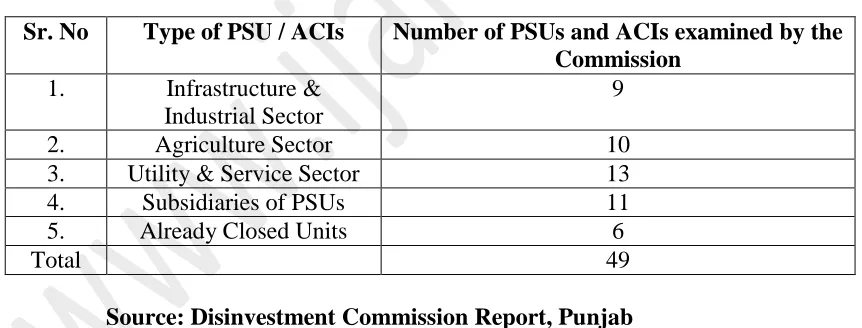
The Disinvestment Commission covered 29 PSUs along with their 11 subsidiaries, and 9 ACIs. No direct investment in the subsidiaries has been made by the State, whereas it invested in the share capital of 29 PSUs and9 ACIs. For the purpose of convenience and brevity, the commission has classified these PSUs / ACIs on the basis of their main activities and the current status into five categories (table-9).
Table 9.Classification of Examined PSUs / ACIs
Sr. No Type of PSU / ACIs Number of PSUs and ACIs examined by the Commission
1. Infrastructure &
Industrial Sector
9
2. Agriculture Sector 10
3. Utility & Service Sector 13
4. Subsidiaries of PSUs 11
5. Already Closed Units 6
Total 49
Source: Disinvestment Commission Report, Punjab
P
age
34
Table-10 State’s Share of Capital in PSUs/ACIs
Sr. No Source Share of Capital in 1987-88 Share of Capital in 2000-2001
1. State government 229.34 3,396.98
2. Others 34.87 190.62
3. Total 264.21 3,587.60
Source: Disinvestment Commission Report, Punjab
Table 11.Capital Employed, Net worth and Profitability of PSUs/ACIs
Sr. No Type of PSU / ACIs Total Capital Employed
Total Net Worth
Total net Profit/ Loss
1. Infrastructure & Industrial 585.57 (78.93) (138.30)
2. Agricultural 3,909.38 266.48 (42.15)
3. Utility & Service 8852.65 3,322.22 (5.14)
Total 13,347.6 3,509.77 (185.59)
Source: Disinvestment Commission Report, Punjab
The state Government identified six public sectors namely Punjab Film & News Corporation, PUNTEX, Punjab State Leather Development Corporation, Punjab State Hosiery & Knitwear Dev. Corporation, Punjab Women & Child Development Corporation (PUNWAC), and Punjab Poultry Development Corporation in 1992.Disinvestment Commission identified 6 more public enterprises for disinvestment namely Punjab Alkalies and Chemicals Ltd, Punjab Communications Limited, Punjab State Container & Warehousing Corporation, Punjab Tourism Development Corporation, Punjab Tractors Limited, and Punjab State Cooperative Spinning Mills Federation.
PSUs under Disinvestment:
Disinvestment process is moving at a very slow pace in Punjab. Six PSUs which were closed in 1992, but winding up of these PSUs is still in progress.
1. Punjab Communications Ltd (PUNCOM): As per decision of the Cabinet Committee on Disinvestment, disinvestment or revival is being restarted. Revival or disinvestment in this unit is under-process
2. Punjab Alkalies & Chemicals (PACL): As per decision of the Cabinet Committee on Disinvestment, the process of disinvestment in PACL has been started and M/S IFCI Ltd., New Delhi have been appointed as Global Advisors and M/S HemantSahai& Associates, New Delhi have been appointed as Legal Advisors. The technical/financial bids are being invited.
P
age
35
ToucheTohmastu India Pvt. Ltd, Gurgaon have been appointed as Global Advisors and M/S Khaitan& Co. New Delhi has been appointed as Legal Advisors. EOIs are being invited.
4. The Punjab State Federation of Co-operative Sugar Mills (SUGARFED):The disinvestment/liquidation/revival of sugar mills is being done by Department of Cooperation. 5. Punjab Tourism Development Corporation (PTDC):Govt. has decided not to disinvest the
remaining Tourist Complexes of PTDC.
6. Winding Up of Closed Units: The winding up of the PUNTEX, LEATHERA, HOSIERY & KNITWEAR, Punjab Film & News Corporation and Punjab Poultry Development Corporation is in progress.
7. Punjab State Cooperative Spinning Mills Federation (SPINFED): Winding up decision was taken on 30.4.2003. VRS has been given to all Head Office employees of SPINFED. Out of the 5 remaining Coop. Miils at Bathinda, Abohar, Goindwal, Kotkapura and Tappa, mills at Kotkapura, Tappa and Goindwal have been finally disposed off. Plant and machinery of Bathinda and Abohar Coop. Spg. Mills has been disposed off but the land is yet to be disposed off. This is being done by RCS and Department of Cooperation.
8. Electronic System Punjab Ltd. (ESPL):A subsidiary of PSIDC was set up in 1980 for developing and supplying mini/micro computer system and other peripheral systems etc. Cabinet Committee on Disinvestment has approved the liquidation of ESPL on 4.2.2004. Further action is under consideration.
9. Punjab Recorders Ltd. (PRL): A subsidiary of PICTCL was established in 1977 under Companies Act with the objective of manufacturing products for the use of Defense (Tank parts). Cabinet Committee on Disinvestment has approved the disinvestment in PRL on 4.2.2004. Further action is under consideration. We can conclude that only six PSUs were divested as on March 3.2002. After 10years disinvestment in any PSUs did not take place.
CONCLUSIONS
From above, it can be concluded that SLPEs are an integral part of any economy and have undoubtedly play a crucial role in the economic development. While, there has been massive
expansion of SLPEs in Punjab. Investment also went on increasing in SLPEs but the financial
performance of the total sector is not satisfactory. Accounts of all the SLPEs are in arrears period raging from 1 to 5 years, 1 to 7 years. To response this, government of Punjab started the process of disinvestment with 6 enterprises in 1992.The objective of disinvestment / privatization in Punjab are to finalize a comprehensive disinvestments programme keeping in view the policies
and priorities of the State Government, release the large amount of public resources locked up in
P
age
36
pace in Punjab. There is lack of political consensus. There is opposition to this process from the different groups of government and also from the opposition parties. After many years of disinvestment process, still only six PSUs are disinvested. Our government is not prepared to sell the share to any private sector and it misses the opportunity to sell a better price and thus causes delays. A part from causing delays in disinvestment, money raised by six PSUs is used for meeting budgetary debt. Government of Punjab needs to refocus, reshape its policies towards disinvestment.
DECLARATION
I sadhna here declared that this paper is original and not elsewhere submitted for publication.
ENDNOTES
1. Performance of Indian Public Enterprises Macro Report. A research study sponsored jointly
by International Development Research Centre Ottawa, Canada and Government of India, Standing Conference of Public Enterprises, First Floor, Chandralok, New Delhi.
2. A productive entity programme is an identifiable decision-making unit with an explicit or
extractable budget and which produces goods and / or services.
3. Ownership refers to more than percent of outstanding equity being held by a public authority,
either directly by the government or indirectly by public entities (including other public enterprises).
4. Control means the power to be involved or actual involvement in the management of the
enterprise through the appointment of top management i.e., members of the Board of Directors or Chief Executives.
5. Output is marked if sales cover more than 50 per cent of the current costs (current costs
refers to intermediate inputs plus returns to factor not owned by the enterprise, largely wages and rent.
6. Punjab Financial Corporation (PFC), Punjab State Small Industries Corporation (PSSIC), Punjab State Export Corporation (PSEC), Punjab State Industrial Development Corporation (PSIDC), PEPSU Road Transport Corporation (PRTC), Poultry Development Corporation (PPDC), Punjab Dairy Development Corporation (PDDC), Punjab Land Development and Reclamation Corporation (PLDRC) and Punjab Agro Industries Corporation (PAIC).
7. According to CAG, Punjab, “Working Government Companies refers to such companies
which are set up under the general law, viz. Indian Companies Act 1956”. It embodies features of a private limited company with whole of the capital stock or 51 per cent or more owned by the government. Examples of government working companies are Punjab Agro Food grains Corporation Limited, Punjab Agro Industries Corporation Limited, Punjab State Seeds Corporation, etc.
8. According to CAG, Punjab, “Non-working Government Companies are those which are
P
age
37
companies are Punjab Land Development and Reclamation Corporation Limited, Punjab Electro Optics Systems Limited, etc.
9. According to CAG, Punjab,” The Statutory Corporation (or Public Corporation) refers to
such organizations, which are incorporated under the special Acts of the Parliament/State Legislative Assemblies. Its management pattern, its powers and functions, the area of activity, rules and regulations for its employees and its relationship with government departments, etc. are specified in the concerned Act. It derives revenue from the sale of goods and services and can also borrow from the Government and from the public. Examples of statutory corporations are Punjab State Electricity Board, PEPSU Road Transport.
10.According to CAG, Punjab, Capital employed represents net fixed assets (including capital
work-in-progress) plus working capital except in finance companies and corporations where it represents a mean of aggregate of opening and closing balance of paid-up capital, free reserves, bonds, deposits and borrowings (including refinance).
11.According to CAG, Punjab, for calculating total return on capital employed, interest on
borrowed funds has been added to net profit/subtracted from the loss as disclosed in the profit and loss account.
REFERENCES
Government Publications:
i. Comptroller & Audit General of India (Punjab), Audit Reports 1990-91 to 2009-10
ii. Department of Disinvestment, Ministry of Finance, Government of India
iii. Department of Industries & Commerce, Punjab
iv. Directorate of Disinvestment, Punjab, Disinvestment Commission Report
v. Economic Survey, Government of Punjab, 2000-01 to 2010-11
vi. National Survey on State Level Public Enterprises (2006-07)
Web sites:
i. www.disinvest.nic.in
ii. www.pbcag.ac.in
iii. www.pbdisinvest.nic.in
iv. www.pbindustries.gov.in