Automated Multimedia Information Retrieval Using
Color and Texture Feature Techniques
Avinash N. Bhute, B.B. Meshram
Abstract — CBVR is a technique that utilizes the visual content of video, to search for similar videos in large-scale video databases, according to a user’s interest. The CBVR problem is motivated by the need to search the exponentially increasing space of image and video databases efficiently and effectively. The visual content of video is analyzed in terms of low-level features extracted from the video. These primarily constitute color, shape and texture features. In this paper, we propose the novel and interactive systems based on visual paradigm in which low level feature plays an important role in video retrieval. We implement and compare five color feature extraction algorithms, three texture feature extraction algorithms. For color feature extraction, the conventional Color Histogram (GCH, LCH), Color Moment, Color Coherence Vector, RGB Averaging method are implemented and compared. For texture feature extraction, Autocorrelation, Grey Level Co occurrence matrix, Edge Frequency are implemented and compared.
Keywords — CBVR, Color Feature, Multimedia Information Retrieval, Texture Feature, Video Retrieval.
I. INTRODUCTION
The increase in computing power and electronic storage capacity has lead to an exponential increase in the amount of digital content available to users in the form of images and video, which form the bases of many educational, entertainment and commercial applications [1]. Consequently, the search for relevant information in the large space of image and video databases has become more challenging. The main challenge lies in the reduction of the semantic gap between low-level features extracted from the image and high-level user semantics. How to achieve accurate retrieval results is still a challenging and an unsolved research problem. A typical video retrieval system includes four major components: I) Video Segmentation II) Feature extraction (usually in conjunction with feature selection), III) Key frame extraction and IV) Matching and retrieval [2].
In this paper, we study the first component; that of low-level feature extraction, and we attempt to answer the following question: What are the color and texture features that need to be extracted from an video, in order to achieve the highest retrieval performance, at a relatively low computational cost? The main contribution of this work is a comprehensive comparison of five color feature extraction approaches, four texture feature extraction approaches for CBVR. In section 2 we discuss the five color feature extraction techniques 1) Global Color Histogram (GCH) 2) Local Color Histogram (LCH), 3) Color Moment, 4) Color Coherence Vector, 5) RGB Averaging. In section 3, we discuss the three texture feature extraction techniques 1) Autocorrelation, 2) Grey Level Co occurrence matrix, 3)Edge Frequency. In section
4, we present the comparison of color, shape and texture methods. In section 6, we present the our experimental procedure and result and we conclude in section 7
II. BACKGROUND FOR
MULTIMEDIA
INFORMATION
RETRIEVAL
IBM’s QBIC [3] system is the first commercial CBIR system and probably the best known of all CBIR systems. QBIC supports users to retrieve images by color, shape and texture. QBIC provides several query methods: Simple, Multi-feature, and Multi-pass. In the Simple method, a query is processed using only one feature. A Multi-feature query involves more than one feature, and all features have equal weights during the search. A Multi-pass query uses the output of a previous query as the basis for further refinements. Users can draw and specify color and texture patterns in desired images. In QBIC, the color similarity is computed by quadratic metric using k-element color histograms, and the average colors are used as filters to improve query efficiency. Its shape function retrieves images by shape area, circularity, eccentricity, and major axis orientation. Its texture function retrieves images by global coarseness, contrast, and directionality features. An R*-tree is used as the underlying indexing structure to index multi-dimensional features. The online demo of QBIC is at: www.qbic.almaden.ibm.com.
Virage [32]. Another well-known commercial system is the VIR Image Engine from Virage, Inc [32]. This is available as a series of independent modules, which systems developers can build in to their own programs. This makes it easy to extend the system by building in new types of query interface, or additional customized modules to process specialized collections of images such as trademarks. Alternatively, the system is available as an add-on to existing database management systems such as Oracle or Informix. An on-line demonstration of the VIR
Image Engine can be found at
http://www.virage.com/online/. A high-profile application of Virage technology is AltaVista’s AV Photo Finder (http://image.altavista.com/cgi-bin/avncgi), allowing Web surfers to search for images by content similarity. Virage technology has also been extended to the management of video data; details of their commercial Videologger product can be found on the Web at http://www.virage.com/market/cataloger.html.
technology. It is marketed principally as an applications development tool rather than as a standalone retrieval package. Its best-known application is probably the Yahoo! Image Surfer, allowing content-based retrieval of images from the World-wide Web. Further information on Visual Retrieval Ware can be found at http://www.excalib.com/, and a demonstration of the Yahoo! Image Surfer at http://isurf.yahoo.com/. Excalibur’s product range also includes the video data
management system Screening Room
(http://www.excalib.com/products/video/screen.html). The Photobook [4] system, developed at the Massachusetts Institute of Technology, allows users to retrieve images by color, shape and texture features. This system provides a set of matching algorithms, including Euclidean, mahalanobis, divergence, vector space angle, histogram, Fourier peak, and wavelet tree distances, as distance metrics. In its most recent version, users can define their own matching algorithms. The system includes a distinct interactive learning agent (Four Eyes), which is a semi-automated tool and can generate query models based on example images provided by users. This allows users to directly address their query demands for different domains and, for each domain, users can obtain an optimal query model. The online demo can be seen at: http://www-hite.media.mit.edu/vismod/demos/photobook
Both VisualSEEK and WebSEEK[5] were developed at Columbia University. The VisualSEEK system is an image database system. It allows users to retrieve images using color, spatial layout, and texture features. Color Set and the Wavelet Transform based texture are used to represent these features. In addition, VisualSEEK allows users to form queries by specifying color regions and their spatial locations. WebSEEK is an image catalog and search tool for the web. This system provides a prototype to catalog images and videos on the web using a combination of the text-based processing and content-based visual analysis. The online demo can be seen at: http://disney.ctr.columbia.edu/webseek.
Retrieval Ware [6], developed by Excalibur Technologies Corp., lets users retrieve images by Color Content, Shape Content, Texture Content, Brightness, Color Structure, and Aspect Ratio. Users can adjust the weights of these features during the search process. The online demo can be seen at: http://vrw.excalib.com:8015/.
The IMatch [7] system allows users to retrieve images by color, texture, and shape. IMatch supports several query methods to query similar images: Color Similarity, Color and Shape (Quick), Color and Shape (Fuzzy), and Color Distribution. Color Similarity queries for images similar to an example image based on the global color distribution. Color and Shape (Quick) queries similar images for a given image by combining shapes, textures, and colors. Color and Shape (Fuzzy) performs additional steps to identify objects in example images. Color Distribution allows users to draw color distributions, or specify the overall percentage of one color in desired images. IMatch also supports non-CBIR features to identify images: binary identical images, duplicate images that have been resized, cropped, or saved in different file
formats, and images that have similar file names to the given images. Demos for IMatch can be downloaded from: www.mwlabs.de/download.htm.
III. COLOR
FEATURE
EXTRACTION
TECHNIQUES
Color is an important feature for image representation which is widely used in image retrieval. This is due to the fact that color is invariance with respect to image scaling, translation, and rotation [8]. The human eye is sensitive to colors, and color features are one of the most important elements enabling humans to recognize images [9]. Color features are, therefore, fundamental characteristics of the content of images.
A. Average RGB
Colors are commonly defined in three-dimensional color spaces. The color space models [22] can be differentiated as oriented and user-oriented. The hardware-oriented color spaces, including RGB and CMY are based on the three-color stimuli theory. The user-oriented color spaces, including HLS, HCV, HSV and HSB are based on the three human percepts of colors, i.e., hue, saturation, and brightness [11]. The RGB color space (see Figure 2.1) is defined as a unit cube with red, green, and blue axes; hence, a color in an RGB color space is represented by a vector with three coordinates. When all three values are set to 0, the corresponding color is black. When all three values are set to 1, the corresponding color is white [12]. The color histograms are defined as a set of bins where each bin denotes the probability of pixels in the image being of a particular color.
Fig.1. RGB Color Space
A color histogram H for a given image is defined as a vector:
H={ H[0],H[1], ………H[i]………….H[N]}
Where i represents a color in the color histogram and corresponds to a sub-cube in the RGB color space, H[i] is the number of pixels in color i in that image, and N is the number of bins in the color histogram, i.e., the number of colors in the adopted color model.
B. Global Color Histogram
Fig.2. Three images and their color histograms In the sample color histograms there are three bins: black, white, and gray. We note the color histogram of image A:{25% ,25%,50%},the color histogram of image B:{18.75%, 37.5%, 43.75%} and image C has the same color histogram as image B. If we use the Euclidean distance metric to calculate the histogram distance, the distance between images A and B for GCH is:
( , )= ( − )1 + ( − ) + ( − )1
(1) dGCH(A,B)=
((0.25 − 0.1875)2 + (0.25 − 0.375)2 + (0.5 − 0.4375)2)
=0.153
The distance between images A and C equals the distance between images A and B and the distance between images B and C is zero. The GCH is the traditional method for color-based image retrieval. However, it does not include information concerning the color distribution of the regions, so the distance between images sometimes cannot show the real difference between images.
C. Local Color Histogram
This approach (referred to as LCH)[13][14] includes information concerning the color distribution of regions. The first step is to segment the image into blocks and then to obtain a color histogram for each block. An image will then be represented by these histograms. When comparing two images, we calculate the distance, using their histograms, between a region in one image and a region in same location in the other image. The distance between the two images will be determined by the sum of all these distances. If we use the square root of Euclidean distance as the distance between color histograms, the distance metric between two images Q and I used in the LCH will be defined as:
( , ) = ∑ ∑ [ ] − [ ] (2) where M is the number of segmented regions in the images, N is the number of bins in the color histograms, and HkQ[i] HKI[i] is the value of bin i in color histogram
HkQH K
Iwhich represents the region k in the image Q(I).
The following examples use the same images A,B and C in Figure 2.3 to show how a LCH works and illustrate how we segment each image into 4 equally sized blocks. For the LCH, the distance between image A and B (see Figure 2.3) is calculated as follows:
Fig.3. Using LCH to compute the distance between images A & B dLCH(A,B) =1.768 & dGCH(A,B) =0.153
In some scenarios, using LCHs can obtain better retrieval effectiveness than using GCHs. The above examples show that the LCH overcomes the main disadvantage of the GCH, and the new distances between images may be more reasonable than those obtained using the GCH. However, since the LCH only compares regions in the same location, when the image is translated or rotated, it does not work well.
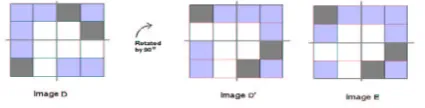
Fig.4. An example showing that the LCH fails to compare images D and E
For example, in Figure 2.4 if image ( is rotated by 90o), we get image D’. We can then see that image is very similar to image E with only two blocks being different. The distance between images D and E should equal to the distance between images D’ and E. However, using LCH, the distance between images D and E will be greater than the distance between images D’ and E. The reason for this discrepancy is that the LCH compares blocks only in the same location, but not necessarily in the proper locations. For example, using LCH, the north-west block in image D is compared with the north-west block in image E but, in fact, the north-west block in image D should be compared with the north-east block in image E. LCHs incorporate spatial information by dividing the image with fixed block segmentation. Some other approaches combine spatial information with color, using different partition schemes [23][24][25].
D.
Color Moment
distribution of color in an image can be interpreted as a probability distribution. Probability distributions are characterized by a number of unique moments. These are mean, standard deviation and skewness. Moments are calculated for each of these channels in an image. An image therefore is characterized by 9 moments where 3 moments for 3 color channels, which are as follows. Moment 1:Mean
= ∑
(3)Mean can be understood as the average color value in the i mage.
Moment 2: Standard Deviation
=
∑
−
(4)The standard deviation is the square root of the variance of the distribution.
Moment 3:Skewness
∑ − (5)
Skewness can be understood as a measure of the degree of asymmetry in the distribution.
A function of the similarity between two image distribut ions is defined as the sum of the weighted
differences between the moments of the two distributions. Formally this is:
( , ) = ∑ | − | + | − | +
| − | (6)
Where:
(H,I): are the two image distributions being compared i : is the current channel index (e.g. 1 = H, 2 = S, 3 = V) r : is the number of channels (e.g. 3)
Ei1Ei2: are the first moments (mean) of the two image distr
ibutions,σi1, σi2: are the second moments (std) of the two image distributions; si1 si2 are the third moments (skewness) of the two image distributions wi are the weights for each moment
E. Color Coherence Vector
In Color Coherence Vector approach[27], each histogram bin is partitioned into two types, coherent and incoherent. If the pixel value belongs to a large uniformly-colored region then is referred to coherent otherwise it is called incoherent. In other words, coherent pixels are a part of a contiguous region in an image, while incoherent pixels are not. A color coherence vector represents this classification for each color in the image [15].The coherence measure classifies pixels as either coherent or incoherent as shown in figure 5.9. Coherent pixels are a part of some sizable contiguous region, while incoherent pixels are not. A color coherence vector represents this classification for each color in the image.
Color coherence vector prevent coherent pixels in one image from matching incoherent pixels in another. This allows fine distinctions that cannot be made with color histograms.
IV. TEXTURE
FEATURE
EXTRACTION
TECHNIQUES
Texture refers to visual patterns with properties of homogeneity that do not result from the presence of only a single color such as clouds and water. Texture features typically consist of contrast, uniformity, coarseness, and density [17]. There are two basic classes of texture descriptors, namely, statistical model-based and transform-based. The former one explores the grey-level spatial dependence of textures and then extracts some statistical features as texture representation.
A. Autocorrelation
An important guide to the persistence in a time series is given by the series of quantities called the sample autocorrelation coefficients [31], which measure the correlation between observations at different times. The set of autocorrelation coefficients arranged as a function of separation in time is the sample autocorrelation function, or the acf. An analogy can be drawn between the autocorrelation coefficient and the product moment correlation coefficient. Assume N pairs of observations on two variables x and y. The correlation coefficient between x and y is given by
= ∑( ̅)( )
[∑( ̅) ] [∑( ) ] (7)
Where the summations are over the N observations. A similar idea can be applied to time series for which successive observations are correlated. Instead of two different time series, the correlation is computed between one time series and the same series lagged by one or more time units. For the first-order autocorrelation, the lag is one time unit. The first-order autocorrelation coefficient is the simple correlation coefficient of the first N −1observations, xt :t=1,2,...,N −1 and the next N
−1observations, xt, t= 2,3…….N .The correlation between xt and xt+1is given by
= ∑ ̅( ) ̅( )
∑ ̅( ) ∑ ̅( )
(8)
Where x(1) is the mean of the first N−1 observations and x(2) is the mean of the last N−1 observations. As the correlation coefficient given by (17) measures correlation between successive observations, it is called the autocorrelation coefficient or serial correlation coefficient. For N reasonably large, the difference between the sub-period means x(1) and x(2) can be ignored and r1can be
approximated by
=∑ ∑( ( ̅)( ̅) ̅) (9)
Where 1 N
t t
x x
is the overall mean.Equation can be generalized to give the correlation between observations separated by k time steps:
The quantity rk is called the autocorrelation coefficient
at lag k. The plot of the autocorrelation function as a function of lag is also called the correlogram.
It describes how pairs of pixels at particular displacements from each other are correlated. It's high where they're well correlated (and at (0,0), it's 1, since pixels are correlated perfectly with themselves) and low where they're poorly correlated.
B. Co-Occurrence Matrix
Gray-level co-occurrence approach uses Gray-Level Co-occurrence Matrices (GLCM)[18] whose elements are the relative frequencies of occurrence of grey level combinations among pairs of image pixels. The GLCM can consider the relationship of image pixels in different directions such as horizontal, vertical, diagonal, and anti-diagonal. The co-occurrence matrix includes second-order grey-level information, which is mostly related to human perception and the discrimination of textures.
For a position operator p, we can define a matrix Pijthat counts the number of times a pixel with grey-level i occurs at position p from a pixel with grey-level j. For example, if we have three distinct grey-levels 0, 1 and 2 and the position operator pis ”lower right”, the count matrixP of the image
0 0 0 1 2
1 1 0 1 1
2 2 1 0 0
1 1 0 2 0
0 0 1 0 1
Is P=
4 2 1 2 3 2 0 2 0
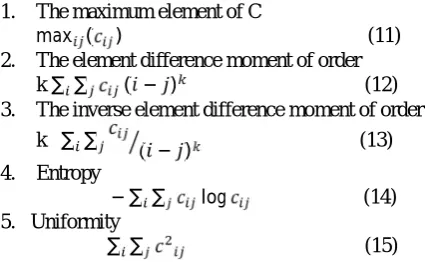
If we normalize the matrix P by total number of pixels so that each element is between 0 and 1 we get a Grey Level Co-occurrence Matrix C.
One can get various descriptors from C, these are as follows:
1. The maximum element of C
max ( ) (11)
2. The element difference moment of order k∑ ∑ ( − ) (12) 3. The inverse element difference moment of order
k ∑ ∑
( − ) (13)
4. Entropy
− ∑ ∑ log (14) 5. Uniformity
∑ ∑ (15)
C. Edge Frequency
The total length of all the edges in a region could also be used as a measure of the coarseness or complexity of a texture. Edges can be detected either as micro edges using small edge operator masks or as micro edges using large masks. Operators like Robert’s operator or sobel’s operator[19][20][21]can be used for this purpose. Using gradient as a function of distance between pixels is another option. The distance dependent texture description
function g(d) can be computed for any sub-image f defined in a neighborhood N for a variable distance d is
1 = | ( , ) − ( + , )| 2 = | ( , ) − ( − , )| 3 = | ( , ) − ( , + )|
G(d)=F1+F2+F3+F4 (16)
The function g(d) is similar to the negative autocorrelation function, its minimum corresponds to the maximum of the autocorrelation function and its maximum corresponds to the autocorrelation minimum.
V. COMPARISON OF
COLOR AND
TEXTURE
FEATURE
EXTRACTION
TECHNIQUES
Table1 Shows Prons and cons for color feature extraction techniques
Color Feature
Prons Cons
Global Color Histogram
Simple
Single Histogram
Fast Computation
High Dimensionality
Not capture the content Accurately
No Color Similarity Local Color
Histogram
Simple
Multiple Histograms
Fast Computation
Problem to calculate distance between images
Capture the content Accurately
Computationally expensive Color
Moment
Faster
overcome the quantization effect
If two images have only similar sub-region, their corresponding moments will be different. Color
coherence Vector
Large Uniformly-Colored Region
Contiguous Region
Simple And Faster
Allows Fine Distinctions
Prevent coherent pixels in one image from matching incoherent pixels of other
RGB Averaging
Robust
Simple
Not color space, its color Model
Table1 Prons and cons for color feature extraction techniques
VI. INTEGRATION
APPROACH
WITH
EXPERIMENTAL
RESULT
As Global color histogram method does not include information concerning the color distribution of the regions, Local Color Histogram fails when the image is translated or rotated, Color moment method do not encapsulate information about spatial correlation of colors. So to obtain the exact and accurate result from a video database we are using an integrated approach of color feature extraction methods where we are providing options to user to select any of combination of above described techniques. With this approach the feature vectors in different feature classes are combined into one overall feature vector. The system compares this overall feature vector of the query image to those of database images, using a predetermined similarity measurement. We are recommending here that to obtain a more relevant result user should select all the options provided in GUI.
The system is extracting the frames from a given video using Java Media Framework (JMF) Library. Input video supported by system are MPEG, AVI.
Kindly refer the Appendix A has 1. Video to Frame Extraction and 2. Video to Key Frame Extraction
After extraction of each frame from inputted video, System is extracting the key frames by using the clustering based on Average RGB value.
Appendix A: Table 1 shows the every 5th frame of inputted video i.e car1.avi. Table 2 shows the every even frame of inputted video i.e car2.avi. Table 3 shows every even frame of inputted video i.e car3.avi Table 4 shows the result of key frame extraction of Car1.avi, Car2.avi and Car3.avi. Table 5 shows Query video with Key frames
Fig.5. GUI at client side for search
VII. MATCHING AND
RETRIEVAL
In retrieval stage of a Video search system, features of the given query video is also extracted. After that the similarity between the features of the query video and the stored feature vectors is determined. That means that computing the similarity between two videos can be transformed into the problem of computing the similarity between two feature vectors [21]. This similarity measure is used to give a distance between the query video and a
candidate match from the feature data database as shown in Figure. 8.
Fig.6. Matching and retrieval of CBVR.
Kindly refer the Appendix B for color feature extraction Table 7 shows the behavior of color algorithms (CC: Color coherence, CM: color Moment, GC: Global color histogram, LC: Local color Histogram, AR: Average RGB) in response of query video (car4.avi). Appendix A
and B are find online at
http://www.vjti.ac.in/dept_comptech/Internet_&_Multime dia /anb.asp
Fig.7. Comparison of Color Feature Extraction Methods for query (car4.avi)
Fig.8. Comparison of Texture Feature Extraction Methods for query (car4.avi)
VIII. CONCLUSION
The main contribution of this work is a comprehensive comparison of state-of-the-art color and texture feature extraction techniques for Content based video retrieval.
VI. INTEGRATION
APPROACH
WITH
EXPERIMENTAL
RESULT
As Global color histogram method does not include information concerning the color distribution of the regions, Local Color Histogram fails when the image is translated or rotated, Color moment method do not encapsulate information about spatial correlation of colors. So to obtain the exact and accurate result from a video database we are using an integrated approach of color feature extraction methods where we are providing options to user to select any of combination of above described techniques. With this approach the feature vectors in different feature classes are combined into one overall feature vector. The system compares this overall feature vector of the query image to those of database images, using a predetermined similarity measurement. We are recommending here that to obtain a more relevant result user should select all the options provided in GUI.
The system is extracting the frames from a given video using Java Media Framework (JMF) Library. Input video supported by system are MPEG, AVI.
Kindly refer the Appendix A has 1. Video to Frame Extraction and 2. Video to Key Frame Extraction
After extraction of each frame from inputted video, System is extracting the key frames by using the clustering based on Average RGB value.
Appendix A: Table 1 shows the every 5th frame of inputted video i.e car1.avi. Table 2 shows the every even frame of inputted video i.e car2.avi. Table 3 shows every even frame of inputted video i.e car3.avi Table 4 shows the result of key frame extraction of Car1.avi, Car2.avi and Car3.avi. Table 5 shows Query video with Key frames
Fig.5. GUI at client side for search
VII. MATCHING AND
RETRIEVAL
In retrieval stage of a Video search system, features of the given query video is also extracted. After that the similarity between the features of the query video and the stored feature vectors is determined. That means that computing the similarity between two videos can be transformed into the problem of computing the similarity between two feature vectors [21]. This similarity measure is used to give a distance between the query video and a
candidate match from the feature data database as shown in Figure. 8.
Fig.6. Matching and retrieval of CBVR.
Kindly refer the Appendix B for color feature extraction Table 7 shows the behavior of color algorithms (CC: Color coherence, CM: color Moment, GC: Global color histogram, LC: Local color Histogram, AR: Average RGB) in response of query video (car4.avi). Appendix A
and B are find online at
http://www.vjti.ac.in/dept_comptech/Internet_&_Multime dia /anb.asp
Fig.7. Comparison of Color Feature Extraction Methods for query (car4.avi)
Fig.8. Comparison of Texture Feature Extraction Methods for query (car4.avi)
VIII. CONCLUSION
The main contribution of this work is a comprehensive comparison of state-of-the-art color and texture feature extraction techniques for Content based video retrieval.
0 5 10 15 20 25
0 5 10 15
VI. INTEGRATION
APPROACH
WITH
EXPERIMENTAL
RESULT
As Global color histogram method does not include information concerning the color distribution of the regions, Local Color Histogram fails when the image is translated or rotated, Color moment method do not encapsulate information about spatial correlation of colors. So to obtain the exact and accurate result from a video database we are using an integrated approach of color feature extraction methods where we are providing options to user to select any of combination of above described techniques. With this approach the feature vectors in different feature classes are combined into one overall feature vector. The system compares this overall feature vector of the query image to those of database images, using a predetermined similarity measurement. We are recommending here that to obtain a more relevant result user should select all the options provided in GUI.
The system is extracting the frames from a given video using Java Media Framework (JMF) Library. Input video supported by system are MPEG, AVI.
Kindly refer the Appendix A has 1. Video to Frame Extraction and 2. Video to Key Frame Extraction
After extraction of each frame from inputted video, System is extracting the key frames by using the clustering based on Average RGB value.
Appendix A: Table 1 shows the every 5th frame of inputted video i.e car1.avi. Table 2 shows the every even frame of inputted video i.e car2.avi. Table 3 shows every even frame of inputted video i.e car3.avi Table 4 shows the result of key frame extraction of Car1.avi, Car2.avi and Car3.avi. Table 5 shows Query video with Key frames
Fig.5. GUI at client side for search
VII. MATCHING AND
RETRIEVAL
In retrieval stage of a Video search system, features of the given query video is also extracted. After that the similarity between the features of the query video and the stored feature vectors is determined. That means that computing the similarity between two videos can be transformed into the problem of computing the similarity between two feature vectors [21]. This similarity measure is used to give a distance between the query video and a
candidate match from the feature data database as shown in Figure. 8.
Fig.6. Matching and retrieval of CBVR.
Kindly refer the Appendix B for color feature extraction Table 7 shows the behavior of color algorithms (CC: Color coherence, CM: color Moment, GC: Global color histogram, LC: Local color Histogram, AR: Average RGB) in response of query video (car4.avi). Appendix A
and B are find online at
http://www.vjti.ac.in/dept_comptech/Internet_&_Multime dia /anb.asp
Fig.7. Comparison of Color Feature Extraction Methods for query (car4.avi)
Fig.8. Comparison of Texture Feature Extraction Methods for query (car4.avi)
VIII. CONCLUSION
The main contribution of this work is a comprehensive comparison of state-of-the-art color and texture feature extraction techniques for Content based video retrieval.
Car1Car2 Car3
Car1 Car2 Car3
Car1 Car3
The color coherence vector and Autocorrelation, are yielding highest color and texture results respectively at the cost of higher computational complexity.
REFERENCES
[1] A. Bovik, Handbook of Image and Video Processing, 2nd Edition, Elsevier Academic Press, ISBN 0‐12‐119792‐1, pp. 993‐1013, 2005.
[2] Y. Rui, T. S. Huang and S. Chang, “Image Retrieval: Current
Techniques, Promising Directions and Open Issues ”,Journal of
Visual Communication and Image Representation, vol. 10, pp. 39‐62, March 1999.
[3] M. Flickher, H. Sawhney, W. Niblack, J. Ashley, Q. Huang, B. Dom, M. Gorkani, J. Hafner, D. Lee, D. Petkovicand D. Steele,
and P. Yanker. “Query by image and video content: The QBIC
system” In IEEE Computer, volume 38, pages 23-31, 1995.
[4] A. Pentland, R. W. Picard and S.Sclaroff,” Photobook: Content
-based manipulation of image databases”,SPIE storage and
Retrieval Image and video database II,No.2185,Feb 6-10,1994,San Jose.
[5] R. Smith and S.-F. Chang, "VisualSEEk: a Fully Automated Content-Based Image Query System, Proceedings", ACM Multimedia '96 Conference, Boston, MA, November 1996.
[6] Avi Rappoport URL
http://searchtools.com/tools/retrievalware.html The report is
availableonhttp://www.dtic.mil/cgi-bin/GetTRDoc?AD=ADA252509&Location= U2&doc=GetTRDoc.pdf
[7] http://www.photools.com
[8] Fariborz Mahmoud,JamshidShanbehzadeh et al”Image retrieval
based on shape similarity by edge orientation autocorrelogram”
Elsevier Ltd Journal Pattern Recognition Volume 36, Issue 8, August 2003, Pages 1725-1736 doi:10.1016/S0031-3203(03)00010-4
[9] Chabane Djeraba“Multimedia mining: a highway to intelligent multimedia documents” Kluwer Acdemic publisher,Netherlands, ISBN 1-4020-7247-3 pp 61-72.
[10] Shengjiu Wang, “A Robust CBIR Approach Using Local Color
Histograms”, technical report ,department of computer science, University of Alberta, Canada , 2001.
[11] [11] S. Oraintara and T. T. Nguyen, “Using Phase and
Magnitude Information of the Complex directional Filter Bank
forTexture Image Retrieval”, Proc. IEEE Int. Conf. on Image
processing, vol. 4, pp. 61‐64,Oct. 2007.
[12] Russell L. De Valois*, Karen K.De Valois, “A multi-stage color
model”,Vision research Volume 33, Issue 8, May 1993, Pages
1053-1065
[13] Shengjiu Wang, “ARobust CBIR Approach Using Local Color
Histograms”, technical report ,department of computer science,
University of Alberta, Canada , 2001.
[14] M. Bressan D. Guillamet J. Vitrià,“Using an ICA representation of local color Histograms for object recognition, Pattern Recognition ,Volume 36, Issue 3, March 2003, Pages 691-701
[15] J. Han and K. Ma, “Fuzzy Color Histogram and Its Use in Color
Image Retrieval”,IEEE Trans. On Image Processing, vol. 11, pp.
944–952, Aug. 2002.
[16] Y. Rui, T. S. Huang and S. Chang, “Image Retrieval: Current
Techniques, Promising Directions and Open Issues ”,Journal of
Visual Communication and Image Representation, vol. 10, pp. 39‐62, March 1999.
[17] A. Bovik, Handbook of Image and Video Processing, 2nd Edition, Elsevier Academic Press, ISBN 0‐12‐119792‐1, pp. 993‐1013, 2005.
[18] Robert M Haralick, K Shanmugam, Its'hak Dinstein (1973). "Textural Features for Image Classification". IEEE Transactions on Systems, Man, and Cybernetics SMC-3 (6): 610–621. [19] B. Jähne, H. Scharr, and S. Körkel. Principles of filter design. In
Handbook of Computer Vision and Applications. Academic Press, 1999.
[20] H. Farid and E. P. Simoncelli, Optimally Rotation-Equivariant Directional Derivative Kernels, Int'l Conf Computer Analysis of Images and Patterns, pp. 207--214, Sep 1997.
[21] H. Farid and E. P. Simoncelli, Differentiation of discrete multi-dimensional signals, IEEE Trans Image Processing, vol.13(4), pp. 496--508, Apr 2004.
[22] R. C. Gonzalez and R. E. Woods. Digital Image Processing. Addison-Wesley, Reading, MA, USA, 3rd edition, 1992. [23] J. Smith and S. Chang. Tools and techniques for color image
retrieval. In Proc. of the SPIE conference on the Storage and Retrieval for Image and Video Databases IV, pages 426–437, San Jose,CA, USA, 1996.
[24] M. A. Stricker and A. Dimai. Color indexing with weak spatial constraints. In Proc. of the SPIE conference on the Storage and Retrieval for Image and Video Databases IV, pages 29–40, San Diego,CA, USA, February 1996.
[25] W. Hsu, T. S. Chua, and H. K. Pung. An integrated color-spatial approach to content-based imageretrieval. In Proc. of the ACM Multimedia 95, pages 305–313, 1995.
[26] M. A. Stricker, M. Orengo. “Similarity of Color Images.” In
Storage and Retrieval for Image and Video Databases III, pp. 381-392. 1995.
[27] G. Pass, R. Zabih. “Histogram Refinement for Content-Based
Image Retrieval.” In IEEE Workshop on Applications of
Computer Vision, pp. 96-102, 1996
[28] M. Peura and J. Iivarinen, “Efficiency of simple shape
descriptors,” in Proc. 3rd International Workshop on Visual
Form IWVF3), May 1997.
[29] I. Young, J. Walker, and J. Bowie, “An analysis technique for
biological shape,”Comput. Graphics Image Processing, vol. 25,
pp. 357-370, 1974.
[30] Peura and J. Iivarinen, “Efficiency of simple shape descriptors,”
in Proc. 3rd International Workshop on Visual Form (IWVF3), May 1997.
[31] L. P. Honvitz and G. L. Shelton, “Pattern recognition using
autocorrelation,”Proc. IRE, vol. 49, pt. 1, pp. 175-185, January
1961.
AUTHOR
’
SPROFILE
Avinash N. Bhute
(ACM M’09, CSI M ’09, ISTE LM ’05) is Research
Scholar at VJTI Mumbai. He received his bachelor degree in Computer science and Engineering in 1999, M.Tech. 2005.He is Active Member of ACM, CSI, ISTE, and Indian Science Congress
Association. He has published the four Int’l Journal paper including
ACM TOMCCAP and IEEE Multimedia Trans, twenty international conferences, twelve national research paper till 2011. His current research interest includes Knowledge discovery in database, Web Mining, Pattern Recognizition, Computer Vision, Software engineering.
Dr. B.B.Meshram
(CSI LM’95, IE ’95) is Professor and head of
Computer Technology Department at VJTI, Matunga, Mumbai, Maharastra State, India. He received bachelor degree, Master degree and doctoral degree in computer engineering. He has participated in more than 25 refresher courses to meet the needs of current technology. He has chair more than 15 AICTE STTP Programs and conferences. He has received the appreciation for lecture at Manchester and Cardip University, UK. He has contributed more than 80 research papers at national, International Journals till 2011. He is life member of computer society of India and Institute of Engineers. His current research interests are in Databases, data warehousing, data mining, intelligent systems, pattern recognition, computer vision, Web Engineering and network security.
The color coherence vector and Autocorrelation, are yielding highest color and texture results respectively at the cost of higher computational complexity.
REFERENCES
[1] A. Bovik, Handbook of Image and Video Processing, 2nd Edition, Elsevier Academic Press, ISBN 0‐12‐119792‐1, pp. 993‐1013, 2005.
[2] Y. Rui, T. S. Huang and S. Chang, “Image Retrieval: Current
Techniques, Promising Directions and Open Issues ”,Journal of
Visual Communication and Image Representation, vol. 10, pp. 39‐62, March 1999.
[3] M. Flickher, H. Sawhney, W. Niblack, J. Ashley, Q. Huang, B. Dom, M. Gorkani, J. Hafner, D. Lee, D. Petkovicand D. Steele,
and P. Yanker. “Query by image and video content: The QBIC
system” In IEEE Computer, volume 38, pages 23-31, 1995.
[4] A. Pentland, R. W. Picard and S.Sclaroff,” Photobook: Content
-based manipulation of image databases”,SPIE storage and
Retrieval Image and video database II,No.2185,Feb 6-10,1994,San Jose.
[5] R. Smith and S.-F. Chang, "VisualSEEk: a Fully Automated Content-Based Image Query System, Proceedings", ACM Multimedia '96 Conference, Boston, MA, November 1996.
[6] Avi Rappoport URL
http://searchtools.com/tools/retrievalware.html The report is
availableonhttp://www.dtic.mil/cgi-bin/GetTRDoc?AD=ADA252509&Location= U2&doc=GetTRDoc.pdf
[7] http://www.photools.com
[8] Fariborz Mahmoud,JamshidShanbehzadeh et al”Image retrieval
based on shape similarity by edge orientation autocorrelogram”
Elsevier Ltd Journal Pattern Recognition Volume 36, Issue 8, August 2003, Pages 1725-1736 doi:10.1016/S0031-3203(03)00010-4
[9] Chabane Djeraba“Multimedia mining: a highway to intelligent multimedia documents” Kluwer Acdemic publisher,Netherlands, ISBN 1-4020-7247-3 pp 61-72.
[10] Shengjiu Wang, “A Robust CBIR Approach Using Local Color
Histograms”, technical report ,department of computer science, University of Alberta, Canada , 2001.
[11] [11] S. Oraintara and T. T. Nguyen, “Using Phase and
Magnitude Information of the Complex directional Filter Bank
forTexture Image Retrieval”,Proc. IEEE Int. Conf. on Image
processing, vol. 4, pp. 61‐64,Oct. 2007.
[12] Russell L. De Valois*, Karen K.De Valois, “A multi-stage color
model”,Vision research Volume 33, Issue 8, May 1993, Pages
1053-1065
[13] Shengjiu Wang, “ARobust CBIR Approach Using Local Color
Histograms”, technical report ,department of computer science,
University of Alberta, Canada , 2001.
[14] M. Bressan D. Guillamet J. Vitrià,“Using an ICA representation of local color Histograms for object recognition, Pattern Recognition ,Volume 36, Issue 3, March 2003, Pages 691-701
[15] J. Han and K. Ma, “Fuzzy Color Histogram and Its Use in Color
Image Retrieval”,IEEE Trans. On Image Processing, vol. 11, pp.
944–952, Aug. 2002.
[16] Y. Rui, T. S. Huang and S. Chang, “Image Retrieval: Current
Techniques, Promising Directions and Open Issues ”,Journal of
Visual Communication and Image Representation, vol. 10, pp. 39‐62, March 1999.
[17] A. Bovik, Handbook of Image and Video Processing, 2nd Edition, Elsevier Academic Press, ISBN 0‐12‐119792‐1, pp. 993‐1013, 2005.
[18] Robert M Haralick, K Shanmugam, Its'hak Dinstein (1973). "Textural Features for Image Classification". IEEE Transactions on Systems, Man, and Cybernetics SMC-3 (6): 610–621. [19] B. Jähne, H. Scharr, and S. Körkel. Principles of filter design. In
Handbook of Computer Vision and Applications. Academic Press, 1999.
[20] H. Farid and E. P. Simoncelli, Optimally Rotation-Equivariant Directional Derivative Kernels, Int'l Conf Computer Analysis of Images and Patterns, pp. 207--214, Sep 1997.
[21] H. Farid and E. P. Simoncelli, Differentiation of discrete multi-dimensional signals, IEEE Trans Image Processing, vol.13(4), pp. 496--508, Apr 2004.
[22] R. C. Gonzalez and R. E. Woods. Digital Image Processing. Addison-Wesley, Reading, MA, USA, 3rd edition, 1992. [23] J. Smith and S. Chang. Tools and techniques for color image
retrieval. In Proc. of the SPIE conference on the Storage and Retrieval for Image and Video Databases IV, pages 426–437, San Jose,CA, USA, 1996.
[24] M. A. Stricker and A. Dimai. Color indexing with weak spatial constraints. In Proc. of the SPIE conference on the Storage and Retrieval for Image and Video Databases IV, pages 29–40, San Diego,CA, USA, February 1996.
[25] W. Hsu, T. S. Chua, and H. K. Pung. An integrated color-spatial approach to content-based imageretrieval. In Proc. of the ACM Multimedia 95, pages 305–313, 1995.
[26] M. A. Stricker, M. Orengo. “Similarity of Color Images.” In
Storage and Retrieval for Image and Video Databases III, pp. 381-392. 1995.
[27] G. Pass, R. Zabih. “Histogram Refinement for Content-Based
Image Retrieval.” In IEEE Workshop on Applications of
Computer Vision, pp. 96-102, 1996
[28] M. Peura and J. Iivarinen, “Efficiency of simple shape
descriptors,” in Proc. 3rd International Workshop on Visual
Form IWVF3), May 1997.
[29] I. Young, J. Walker, and J. Bowie, “An analysis technique for
biological shape,”Comput. Graphics Image Processing, vol. 25,
pp. 357-370, 1974.
[30] Peura and J. Iivarinen, “Efficiency of simple shape descriptors,”
in Proc. 3rd International Workshop on Visual Form (IWVF3), May 1997.
[31] L. P. Honvitz and G. L. Shelton, “Pattern recognition using
autocorrelation,”Proc. IRE, vol. 49, pt. 1, pp. 175-185, January
1961.
AUTHOR
’
SPROFILE
Avinash N. Bhute
(ACM M’09, CSI M ’09, ISTE LM ’05) is Research
Scholar at VJTI Mumbai. He received his bachelor degree in Computer science and Engineering in 1999, M.Tech. 2005.He is Active Member of ACM, CSI, ISTE, and Indian Science Congress
Association. He has published the four Int’l Journal paper including
ACM TOMCCAP and IEEE Multimedia Trans, twenty international conferences, twelve national research paper till 2011. His current research interest includes Knowledge discovery in database, Web Mining, Pattern Recognizition, Computer Vision, Software engineering.
Dr. B.B.Meshram
(CSI LM’95, IE ’95) is Professor and head of
Computer Technology Department at VJTI, Matunga, Mumbai, Maharastra State, India. He received bachelor degree, Master degree and doctoral degree in computer engineering. He has participated in more than 25 refresher courses to meet the needs of current technology. He has chair more than 15 AICTE STTP Programs and conferences. He has received the appreciation for lecture at Manchester and Cardip University, UK. He has contributed more than 80 research papers at national, International Journals till 2011. He is life member of computer society of India and Institute of Engineers. His current research interests are in Databases, data warehousing, data mining, intelligent systems, pattern recognition, computer vision, Web Engineering and network security.
The color coherence vector and Autocorrelation, are yielding highest color and texture results respectively at the cost of higher computational complexity.
REFERENCES
[1] A. Bovik, Handbook of Image and Video Processing, 2nd Edition, Elsevier Academic Press, ISBN 0‐12‐119792‐1, pp. 993‐1013, 2005.
[2] Y. Rui, T. S. Huang and S. Chang, “Image Retrieval: Current
Techniques, Promising Directions and Open Issues ”,Journal of
Visual Communication and Image Representation, vol. 10, pp. 39‐62, March 1999.
[3] M. Flickher, H. Sawhney, W. Niblack, J. Ashley, Q. Huang, B. Dom, M. Gorkani, J. Hafner, D. Lee, D. Petkovicand D. Steele,
and P. Yanker. “Query by image and video content: The QBIC
system” In IEEE Computer, volume 38, pages 23-31, 1995.
[4] A. Pentland, R. W. Picard and S.Sclaroff,” Photobook: Content
-based manipulation of image databases”,SPIE storage and
Retrieval Image and video database II,No.2185,Feb 6-10,1994,San Jose.
[5] R. Smith and S.-F. Chang, "VisualSEEk: a Fully Automated Content-Based Image Query System, Proceedings", ACM Multimedia '96 Conference, Boston, MA, November 1996.
[6] Avi Rappoport URL
http://searchtools.com/tools/retrievalware.html The report is
availableonhttp://www.dtic.mil/cgi-bin/GetTRDoc?AD=ADA252509&Location= U2&doc=GetTRDoc.pdf
[7] http://www.photools.com
[8] Fariborz Mahmoud,JamshidShanbehzadeh et al”Image retrieval
based on shape similarity by edge orientation autocorrelogram”
Elsevier Ltd Journal Pattern Recognition Volume 36, Issue 8, August 2003, Pages 1725-1736 doi:10.1016/S0031-3203(03)00010-4
[9] Chabane Djeraba“Multimedia mining: a highway to intelligent multimedia documents” Kluwer Acdemic publisher,Netherlands, ISBN 1-4020-7247-3 pp 61-72.
[10] Shengjiu Wang, “A Robust CBIR Approach Using Local Color
Histograms”, technical report ,department of computer science, University of Alberta, Canada , 2001.
[11] [11] S. Oraintara and T. T. Nguyen, “Using Phase and
Magnitude Information of the Complex directional Filter Bank
forTexture Image Retrieval”,Proc. IEEE Int. Conf. on Image
processing, vol. 4, pp. 61‐64,Oct. 2007.
[12] Russell L. De Valois*, Karen K.De Valois, “A multi-stage color
model”,Vision research Volume 33, Issue 8, May 1993, Pages
1053-1065
[13] Shengjiu Wang, “ARobust CBIR Approach Using Local Color
Histograms”, technical report ,department of computer science,
University of Alberta, Canada , 2001.
[14] M. Bressan D. Guillamet J. Vitrià,“Using an ICA representation of local color Histograms for object recognition, Pattern Recognition ,Volume 36, Issue 3, March 2003, Pages 691-701
[15] J. Han and K. Ma, “Fuzzy Color Histogram and Its Use in Color
Image Retrieval”,IEEE Trans. On Image Processing, vol. 11, pp.
944–952, Aug. 2002.
[16] Y. Rui, T. S. Huang and S. Chang, “Image Retrieval: Current
Techniques, Promising Directions and Open Issues ”,Journal of
Visual Communication and Image Representation, vol. 10, pp. 39‐62, March 1999.
[17] A. Bovik, Handbook of Image and Video Processing, 2nd Edition, Elsevier Academic Press, ISBN 0‐12‐119792‐1, pp. 993‐1013, 2005.
[18] Robert M Haralick, K Shanmugam, Its'hak Dinstein (1973). "Textural Features for Image Classification". IEEE Transactions on Systems, Man, and Cybernetics SMC-3 (6): 610–621. [19] B. Jähne, H. Scharr, and S. Körkel. Principles of filter design. In
Handbook of Computer Vision and Applications. Academic Press, 1999.
[20] H. Farid and E. P. Simoncelli, Optimally Rotation-Equivariant Directional Derivative Kernels, Int'l Conf Computer Analysis of Images and Patterns, pp. 207--214, Sep 1997.
[21] H. Farid and E. P. Simoncelli, Differentiation of discrete multi-dimensional signals, IEEE Trans Image Processing, vol.13(4), pp. 496--508, Apr 2004.
[22] R. C. Gonzalez and R. E. Woods. Digital Image Processing. Addison-Wesley, Reading, MA, USA, 3rd edition, 1992. [23] J. Smith and S. Chang. Tools and techniques for color image
retrieval. In Proc. of the SPIE conference on the Storage and Retrieval for Image and Video Databases IV, pages 426–437, San Jose,CA, USA, 1996.
[24] M. A. Stricker and A. Dimai. Color indexing with weak spatial constraints. In Proc. of the SPIE conference on the Storage and Retrieval for Image and Video Databases IV, pages 29–40, San Diego,CA, USA, February 1996.
[25] W. Hsu, T. S. Chua, and H. K. Pung. An integrated color-spatial approach to content-based imageretrieval. In Proc. of the ACM Multimedia 95, pages 305–313, 1995.
[26] M. A. Stricker, M. Orengo. “Similarity of Color Images.” In
Storage and Retrieval for Image and Video Databases III, pp. 381-392. 1995.
[27] G. Pass, R. Zabih. “Histogram Refinement for Content-Based
Image Retrieval.” In IEEE Workshop on Applications of
Computer Vision, pp. 96-102, 1996
[28] M. Peura and J. Iivarinen, “Efficiency of simple shape
descriptors,” in Proc. 3rd International Workshop on Visual
Form IWVF3), May 1997.
[29] I. Young, J. Walker, and J. Bowie, “An analysis technique for
biological shape,”Comput. Graphics Image Processing, vol. 25,
pp. 357-370, 1974.
[30] Peura and J. Iivarinen, “Efficiency of simple shape descriptors,”
in Proc. 3rd International Workshop on Visual Form (IWVF3), May 1997.
[31] L. P. Honvitz and G. L. Shelton, “Pattern recognition using
autocorrelation,”Proc. IRE, vol. 49, pt. 1, pp. 175-185, January
1961.
AUTHOR
’
SPROFILE
Avinash N. Bhute
(ACM M’09, CSI M ’09, ISTE LM ’05) is Research
Scholar at VJTI Mumbai. He received his bachelor degree in Computer science and Engineering in 1999, M.Tech. 2005.He is Active Member of ACM, CSI, ISTE, and Indian Science Congress
Association. He has published the four Int’l Journal paper including
ACM TOMCCAP and IEEE Multimedia Trans, twenty international conferences, twelve national research paper till 2011. His current research interest includes Knowledge discovery in database, Web Mining, Pattern Recognizition, Computer Vision, Software engineering.
Dr. B.B.Meshram
(CSI LM’95, IE ’95) is Professor and head of