A Randomized Controlled Trial
WHAT’S KNOWN ON THIS SUBJECT: Hypertonic saline (3% and 5%), has been shown to improve clinical severity scores and reduce inpatient length of stay, and was associated with a trend toward lower admission rate in acute bronchiolitis.
WHAT THIS STUDY ADDS: We are not aware of any previous data using 7% hypertonic saline in bronchiolitis. Our results suggest that 7% saline does not lower clinical severity of illness, admission rate, or length of stay, when compared with normal saline.
abstract
BACKGROUND: Research suggests that hypertonic saline (HS) may improve mucousflow in infants with acute bronchiolitis. Data suggest a trend favoring reduced length of hospital stay and improved pul-monary scores with increasing concentration of nebulized solution to 3% and 5% saline as compared with 0.9% saline mixed with epineph-rine. To our knowledge, 7% HS has not been previously investigated.
METHODS: We conducted a prospective, double-blind, randomized controlled trial in 101 infants presenting with moderate to severe acute bronchiolitis. Subjects received either 7% saline or 0.9% saline, both with epinephrine. Our primary outcome was a change in bronchiolitis severity score (BSS), obtained before and after treatment, and at the time of disposition from the emergency department (ED). Secondary outcomes measured were hospitalization rate, proportion of admitted patients discharged at 23 hours, and ED and inpatient length of stay.
RESULTS:At baseline, study groups were similar in demographic and clinical characteristics. The decrease in mean BSS was not statistically significant between groups (2.6 vs 2.4 for HS and control groups, re-spectively). The difference between the groups in proportion of admitted patients (42% in HS versus 49% in normal saline), ED or inpatient length of stay, and proportion of admitted patients discharged at 23 hours was not statistically significant.
CONCLUSIONS:In moderate to severe acute bronchiolitis, inhalation of 7% HS with epinephrine does not appear to confer any clinically sig-nificant decrease in BSS when compared with 0.9% saline with epi-nephrine.Pediatrics2014;133:e8–e13
AUTHORS:Jonathan D. Jacobs, MD,a,bMegan Foster, PharmD, BCPS,cJim Wan, PhD,dand Jay Pershad, MD, MMMa
aDivision of Emergency Medicine, Department of Pediatrics, and
Departments ofcPharmacy anddPreventive Medicine,
Biostatistics and Epidemiology, University of Tennessee Health Science Center, Memphis, Tennessee; andbDivision of Emergency
Medicine, Department of Pediatrics, Le Bonheur Children’s Hospital, Memphis, Tennessee
KEY WORDS
7% hypertonic saline, acute bronchiolitis
ABBREVIATIONS
BSS—bronchiolitis severity score CI—confidence interval ED—emergency department HS—hypertonic saline
Dr Jacobs designed the study and the data collection instruments, coordinated and supervised data collection, and drafted the initial manuscript; Dr Foster assisted with randomization and masking of study drug in pharmacy; Dr Wan carried out the initial analyses and reviewed and revised the manuscript; Dr Pershad conceptualized the study design and critically reviewed the manuscript; and all authors approved the
final manuscript as submitted.
This trial has been registered at www.clinicaltrials.gov (identifier NCT01871857).
www.pediatrics.org/cgi/doi/10.1542/peds.2013-1646 doi:10.1542/peds.2013-1646
Accepted for publication Sep 19, 2013
Address correspondence to Jay Pershad, MD, Division of Emergency Medicine, Department of Pediatrics, Le Bonheur Children’s Hospital, Memphis, TN 38103. E-mail: jay.pershad@mlh. org
PEDIATRICS (ISSN Numbers: Print, 0031-4005; Online, 1098-4275). Copyright © 2014 by the American Academy of Pediatrics
FINANCIAL DISCLOSURE:The authors have indicated they have nofinancial relationships relevant to this article to disclose.
FUNDING:No external funding.
POTENTIAL CONFLICT OF INTEREST:The authors have indicated they have no potential conflicts of interest to disclose.
Acute viral bronchiolitis is the most common lower respiratory infection in infants and young children; the annual inpatient disease burden exceeds the cost of any respiratory disease in the United States among children younger than 2 years (excluding neonatal care).1
From 1980 to 1996, the rate of hospi-talization for bronchiolitis increased in the United States from 12.9 admissions per 1000 children to 31.2 admissions per 1000 children.2However, a recent
trend among US children between 2000 and 2009 suggests a significant decline in bronchiolitis hospitalizations to 14.9 per 1000 children. The use of mechan-ical ventilation and hospital charges for bronchiolitis significantly increased over this same period.3
Although several treatment strategies have been investigated, few have been shown to be effective. The mainstay of treatment remains supportive care with supplemental oxygen and hydra-tion as needed. Routine use of corti-costeroids or bronchodilators is not recommended.4 Similarly, in the 2006
bronchiolitis guidelines published by the American Academy of Pediatrics, routine use of bronchodilators is not recommended, although a trial of bron-chodilators is listed as an option, based on some evidence that epinephrine may be more efficacious compared with salbutamol and placebo in outpatients.5
However, conclusive evidence for effi -cacy ofb2-agonist therapy is lacking.
Nebulized hypertonic saline (HS) has shown promise as an alternative treat-ment option. It has been postulated that aerosolized HS hydrates the airway surface liquid, enhances mucociliary clearance by improving mucus flow, reduces edema of the airway wall by absorbing water from the mucosa and submucosa, and causes sputum in-duction and cough, which can help clear sputum and improve small airway ob-struction in acute bronchiolitis.6
A 2008 Cochrane database systematic review stated that nebulized 3% saline may significantly reduce the length of hospital stay and improve the clinical severity score in infants with acute viral bronchiolitis.7Since this review,
addi-tional studies have evaluated HS in infants with bronchiolitis: 1 in an am-bulatory setting, 3 in an emergency department (ED), and 5 in hospitalized patients.6,8–16All of these studies have
shown a reduction in pulmonary se-verity scores and/or a trend toward reduced admission rates in the HS group. Of note, all investigations to date have shown HS to be safe, with no patients experiencing decreased oxy-gen saturation, apnea, or cyanosis af-ter administration of the medication.
We are unaware of any study examining the role of 7% HS in the ED setting for treating bronchiolitis. Our primary hy-pothesis was that the higher concentra-tion of saline (7% HS) with epinephrine administered in the ED would confer a greater and more sustained decrease in bronchiolitis severity score (BSS) for infants and young children with acute bronchiolitis and, secondarily, decrease hospitalization rate, increase the discharge rate after a 23-hour in-patient hospital stay, and decrease hospital length of stay.
METHODS
Study Design
A double-blind, randomized, compara-tive, controlled trial was conducted in the ED of an urban tertiary care center, with an annual census of 70 000 patient visits. The institutional review board approved the study.
Patient Selection
Informed consent was obtained from a parent or legal guardian of each pa-tient enrolled in the study. Papa-tients age 6 weeks to#18 months presenting to the ED between October and March over a
2-year period (2010–2012) with bron-chiolitis (defined as viral respiratory illness andfirst episode of wheeze) and a BSS of$4 were eligible for the study. Exclusion criteria were a previous history of wheezing, any use of bron-chodilators within 2 hours of pre-sentation, gestational age#34 weeks, history of congenital heart disease or chronic pulmonary or chronic renal disease, oxygen saturation of#85% at the time of recruitment, severe disease requiring ICU admission, or inability to obtain informed consent. Depending on the availability of the principal inves-tigator (a pediatric emergency medi-cine fellow), a convenience sample was used to recruit patients. The ED physi-cians and staff were notified of the fellow’s hours of availability by way of a call schedule that was posted in the ED.
Study Protocol
Eligible patients were randomized to 1 of 2 groups in blocks of 10. The control group received an aerosol of 0.5 mL 2.25% racemic epinephrine with 3 mL 0.9% saline, and the study group re-ceived 0.5 mL 2.25% racemic epineph-rine with 3 mL 7% HS.
The treating clinician in the ED con-tacted the principal investigator who enrolled the participants within an hour of an eligible patient’s arrival. Care-giver consent was obtained before ad-ministration of inhaled therapy. The pharmacy department maintained a box in the ED holding sequentially num-bered, previously randomized concealed envelopes containing either the study (7% HS) or control (0.9% saline) medication. After initial screening and assessment and after consent was obtained, the patient was administered the medication via nebulization driven by 6 L per minute O2 flow. Research personnel, including the investigators, the treating physician, and staff who performed the BSS were kept blinded throughout the process.
tering the aerosol. If the patient was admitted or discharged before 4 hours, the second posttreatment score was recorded at the time of disposition. The treating ED clinician determined the
final disposition of the patient. If admitted, the patient continued to receive aerosols containing the same designated medication every 6 hours until discharge or 24 hours after the admission. Disposition was ascertained by reviewing the electronic medical record for the time the order for dis-charge was written by the treating clinician. Our protocol did not require any specific criteria for discharge.
A standardized data sheet was com-pleted after enrollment and during each patient’s stay in the ED or inpatient ward. Any cointerventions, such as ad-ditional bronchodilators, supplemental oxygen, intravenousfluids, or deep nasal suction, were at the discretion of the treating clinician. The clinician was free to withdraw the patient from the study if clinical deterioration warranted esca-lation of care or if adverse effects re-lated to the medication were observed.
Outcome Measures
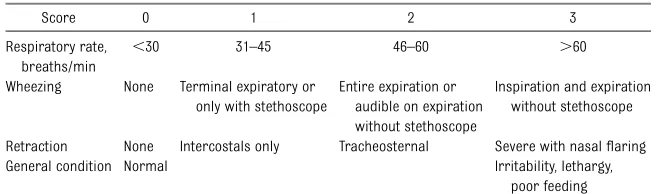
The BSS is an objective respiratory assessment tool that has been pre-viously validated (Table 1).17We used
a modified BSS, which has been used in our institution since 2006, to assess severity of illness in acute bronchiolitis (Table 2). A change in the modified BSS was the primary outcome.
Before study enrollment, we assessed correlation between the modified BSS and the BSS published by Wang et al.17
We assumed that these 2 measures are highly correlated, as high as correla-tion coefficient (r) = 0.85. The null hy-pothesis was that they were not as highly correlated, and could be r #
0.75. Assuming 5% significance level and 90% power, the estimated sample
size was 46 patients. The correlation between the BSS and the modified BSS was high, with anr= 0.91 (P,.0001).
Secondary outcome measures included hospitalization rate, discharge rate at 23 hours (observation status), and length of hospital stay.
Statistical Analysis
Using retrospective data from patients with a diagnosis of acute bronchiolitis who presented to our ED in 2010, we determined an SD of 3.4 in BSS. The sample size was calculated on the basis of an anticipated difference in BSS of 2 points between the study and control groups. Assuming a power of 80%,aof 0.05, and a 2-tailed test, estimated sample size was 47 patients per study group. Continuous variables were ex-amined by using Student t test. Di-chotomous variables were examined by using thex2or Fisher exact test.
RESULTS
Patient Characteristics
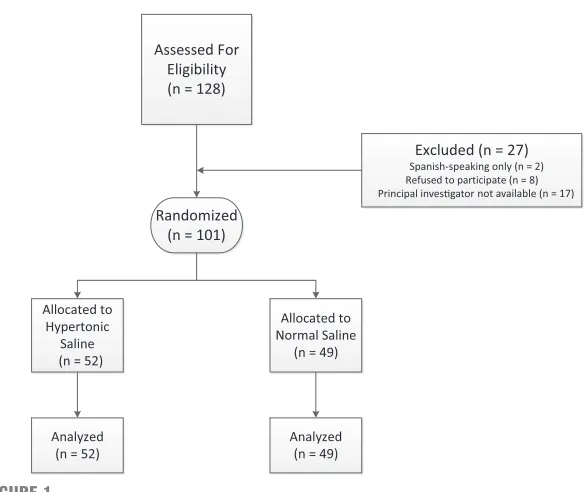
A total of 113 participants were ap-proached for consent. Of these, 101 pa-tients were enrolled into the study, 52 in the study group and 49 in the control group (Fig 1). Failure to recruit resulted from either refusal to consent or be-cause the guardian’s primary language was other than English. The 2 groups were similar in all clinical and histori-cal characteristics except that more patients in the control group had a family history of atopic disease than did those in the study group (67% vs
46%; Table 3). The difference in pro-portion of patients in the study and control groups who received albuterol (13% vs 18%; P = .5) and/or supple-mental oxygen (12% vs 25%;P= .08) as cointerventions was not statistically significant.
Clinical Outcomes
Although both groups demonstrated a decrease in BSS from baseline to ED disposition, the difference in BSSs be-tween the 2 groups was not statistically significant. No difference emerged af-ter 24 hours of inpatient treatment (Table 4).
There was no difference in proportion of patients admitted from the ED, dis-charged at 23 hours after admission, or inpatient length of stay between the 2 groups (Table 5). Neither group had any adverse effects.
Interobserver variability was assessed by having 2 groups of nurses and re-spiratory therapists record a BSS on a sample of 20 patients with bron-chiolitis. The Cohenkstatistic for level of agreement was 0.94.
DISCUSSION
Inhaled 7% HS with epinephrine was no better than normal saline with epi-nephrine in improvement of clinical score in patients with moderate to se-vere bronchiolitis. Further, there did not appear to be a decrease in admission rate, a lower discharge rate after 23 hours’ observation, or decrease in hospital length of stay.
Respiratory rate, breaths/min
,30 31–45 46–60 .60
Wheezing None Terminal expiratory or only with stethoscope
Entire expiration or audible on expiration without stethoscope
Inspiration and expiration without stethoscope Retraction None Intercostals only Tracheosternal Severe with nasalflaring General condition Normal Irritability, lethargy,
Our results are mixed when compared with other studies evaluating lower concentrations of nebulized HS to treat bronchiolitis. Most showed a reduction in either respiratory distress scores or hospital length of stay in the HS group6,8,12,16; others failed to show any
statistical difference between the 2 groups in terms of their primary outcomes.6,9,10,12,16Two of these
stud-ies, albeit underpowered, demon-strated a difference that favored HS but did not reach statistical signifi -cance.10,12When limiting the
compar-ison with studies initiated in the ED, Al-Ansari et al8evaluated 5% HS and
showed a lower mean severity score at 48 hours compared with normal saline (NS) (3.69 6 1.09 vs 4.12 6
1.11, P = .04; difference, 0.43; 95% confidence interval [CI] for the dif-ference 0.02 to 0.88). In contrast, Grewal et al10demonstrated no change
in mean respiratory score from base-line to 120 minutes (study group 4.39 versus control group 5.13; difference 0.74; CI–1.45 to 2.93).
Our results seem to be consistent with previous data on use of HS in patients with cysticfibrosis.18Studies of infants
with cysticfibrosis have shown that 7% HS is well tolerated and safe in this age group, although ineffective in reducing pulmonary exacerbations or improving lung function.
Although higher concentrations of sa-line have shown promise in a dose re-sponse pattern for improving mucociliary
clearance and maintaining lung func-tion in patients with cysticfibrosis, the safety and efficacy of inhaled therapy in patients younger than 6 years has been established only with 7% HS.19Hence,
we elected to study the role of 7% HS in our trial.
The variable results from studies con-ducted in the ED and outpatient setting with HS may be related to frequency of administration of the study drug and duration of therapy. We speculate that this may also explain the failure of our study to demonstrate a difference from baseline to ED disposition or after 24 hours of inpatient treatment with 7% HS. This hypothesis is supported by inpatient studies that showed a de-crease in either severity scores and/or hospital length of stay when HS was given more frequently from admission until discharge.6,11,16However, in both
inpatient and outpatient studies, an improvement in clinical scores was ob-served by study day 1.15,16,20Moreover,
because bronchiolitis tends to be a self-limiting illness, we felt that any im-provement noted after 24 hours of supportive care might reflect the natu-ral course of disease. The challenge in comparing these trials with our results is the heterogeneity of study design, respiratory assessment tools, and fre-quency and duration of inhaled therapy.
Our study had several limitations. We elected to evaluate change in bron-chiolitis score as our primary outcome. As others have suggested, it is unclear if this is a pertinent outcome in the context of a disease like viral bron-chiolitis.21Although we also compared
TABLE 2 Modified BSS
0 Points 1 Point 2 Points 3 Points Respiratory rate, breaths/minute ,40 40–50 50–60 .60 Breath sounds Clear End-expiratory wheeze/crackles Full expiratory wheeze/crackles Inspiratory/expiratory
wheeze/crackles Work of breathing None/mild Subcostal, intercostal Subcostal, intercostal, supraclavicular Global
Oxygen saturation $95% on room air 92% to 94% on room air 90% to 95% on,40% FIO2 ,90% on.40% FIO2
Mental status Awake and alert Fussy but consolable Fussy and inconsolable Lethargic
FIO2, fraction of inspired oxygen.
FIGURE 1
Encounterflow diagram.
admission rate, discharge rate at 23 hours, hospital length of stay, and safety profile, our study was not pow-ered for these outcomes.
The decision to discharge the patient was at the discretion of the treating clinician. Our protocol did not require that the patient meet specific discharge criteria nor did we specifically address readiness to discharge versus actual departure time. This may have led to variability in timing of patient disposition.
It has been suggested that by combining HS with inhaled epinephrine, the pres-ence of a confounding bronchodilator may have resulted in drug interaction that could mask the benefits of HS.21We
elected to include epinephrine because of its proven efficacy in acute bron-chiolitis and to mitigate against the theoretical risk of exacerbating bron-chospasm with the higher concentra-tion of HS. Further, most of the previous studies in bronchiolitis have used sim-ilar models, by using HS combined with a bronchodilator to demonstrate a clin-ical improvement.8–10,15,16,21 However,
HS appears to be safe when used alone to treat infants with bronchiolitis.11,12,22
Another limitation is that the modified BSS is not widely used and has not been externally validated.8 However, it has
been an established respiratory as-sessment tool in our institution for
ing systems for bronchiolitis, including oxygen saturation. Further, it demon-strated good interobserver agreement and was highly correlated with the BSS previously published.
Although we intended to recruit infants with severe bronchiolitis, our study pop-ulation primarily included children with moderate disease. Hence, our study cannot exclude potential benefit of in-haled 7% HS in infants with severe ill-ness. We also did not specify previous corticosteroid use as an exclusion cri-terion. Because corticosteroids have not been shown to be beneficial in bronchiolitis, and because patients with asthma or recurrent wheezing (a sub-group that may benefit from steroids) were systematically excluded, we do not believe that this was a significant con-founder. Of note, none of the partic-ipants in our study had received inhaled or oral corticosteroids.
Although informed consent was ob-tained before administration of inhaled therapy, we were unable to provide comparative information on time from admission to enrollment. Finally, al-though randomization ensured that the 2 groups were similar, because a con-venience sample was assessed, we cannot exclude enrollment bias.
CONCLUSIONS
Our study demonstrated no addi-tional clinical benefit from inhaled 7% HS with epinephrine when compared with normal saline with epinephrine. Although 7% HS appears safe, future, larger studies should focus on the safety and efficacy of HS when adminis-tered alone versus when combined with epinephrine.
Age, mo, mean6SD 6.063.9 5.663.3 Gender, male 36/52 (69%) 28/49 (57%) Weight, kg, mean6SD 7.562.1 7.462.0 Duration of symptoms, d, mean6SD 3.461.7 3.461.6 RSV positive 26/38 (68%) 15/30 (50%) Baseline BSS score, mean6SD 5.861.5 5.761.8 Albuterol use 7/52 (13%) 9/49 (18%) Supplemental oxygen 6/52 (12%) 12/48 (25%) Family history of atopy 24/52 (46%) 33/49 (67%) Eczema 13/52 (25%) 13/49 (27%)
RSV, respiratory syncytial virus.
TABLE 4 Primary Outcomes
HS, 7% Normal Saline, 0.9% Difference,PValue (95% CI) Change in BSS at ED disposition
(mean6SD)
2.661.9 2.462.3 0.21,
P= .61 (–0.61 to 1.03) Change in BSS afterfirst
nebulized treatment in ED disposition (mean6SD)
2.0661.7 2.061.9 0.06,
P= .87 (–0.67 to 0.78) Change in BSS for admitted patients
at 24 h (mean6SD)
3.162.5 3.761.9 20.6,
P= .37 (–2.0 to 0.78)
TABLE 5 Secondary Outcomes
HS,n= 52 Normal Saline,n= 49 PValue (95% CI) Length of stay in ED, h, mean6SD 4.160.9 3.964.0 .8 Proportion of patients admitted 22/52 (42%) 24/49 (49%) OR = 0.76 (0.35–1.7) Proportion of patients discharged at 24 h 3/21 (14%) 3/23 (13%) OR = 1.1 (0.2–6.2)
REFERENCES
1. Pelletier AJ, Mansbach JM, Camargo CA Jr. Direct medical costs of bronchiolitis hos-pitalizations in the United States. Pediat-rics. 2006;118(6):2418–2423
2. Shay DK, Holman RC, Newman RD, Liu LL, Stout JW, Anderson LJ. Bronchiolitis-associated hos-pitalizations among US children, 1980-1996.
JAMA. 1999;282(15):1440–1446
3. Hasegawa K, Tsugawa Y, Brown DF, Mansbach JM, Camargo CA Jr. Trends in bronchiolitis hospitalizations in the United States, 2000-2009.Pediatrics. 2013;132(1):28–36 4. Gadomski AM, Brower M. Bronchodilators
for bronchiolitis.Cochrane Database Syst Rev. 2010;(12):CD001266
5. American Academy of Pediatrics Sub-committee on Diagnosis and Management of Bronchiolitis. Diagnosis and manage-ment of bronchiolitis.Pediatrics. 2006;118 (4):1774–1793
6. Mandelberg A, Amirav I. Hypertonic saline or high volume normal saline for viral bronchiolitis: mechanisms and rationale.
Pediatr Pulmonol. 2010;45(1):36–40 7. Zhang L, Mendoza-Sassi RA, Wainwright C,
Klassen TP. Nebulized hypertonic saline solution for acute bronchiolitis in infants.
Cochrane Database Syst Rev. 2008;(4):
CD006458
8. Al-Ansari K, Sakran M, Davidson BL, El Sayyed R, Mahjoub H, Ibrahim K. Nebulized 5% or 3% hypertonic or 0.9% saline for treating acute bronchiolitis in infants. J Pediatr. 2010;157(4):630–634, 634.1
9. Anil AB, Anil M, Saglam AB, Cetin N, Bal A, Aksu N. High volume normal saline alone is as effective as nebulized salbutamol-normal saline, epinephrine-salbutamol-normal saline, and 3% saline in mild bronchiolitis.Pediatr Pulmonol. 2010;45(1):41–47
10. Grewal S, Ali S, McConnell DW, Vandermeer B, Klassen TP. A randomized trial of nebu-lized 3% hypertonic saline with epineph-rine in the treatment of acute bronchiolitis in the emergency department.Arch Pediatr Adolesc Med. 2009;163(11):1007–1012 11. Kuzik BA, Al-Qadhi SA, Kent S, et al.
Nebu-lized hypertonic saline in the treatment of viral bronchiolitis in infants. J Pediatr. 2007;151(3):266-270, 270.e1
12. Kuzik BA, Flavin MP, Kent S, et al. Effect of inhaled hypertonic saline on hospital ad-mission rate in children with viral bron-chiolitis: a randomized trial.CJEM. 2010;12 (6):477–484
13. Luo Z, Fu Z, Liu E, et al. Nebulized hypertonic saline treatment in hospitalized children with moderate to severe viral bronchiolitis.
Clin Microbiol Infect. 2011;17(12):1829–1833 14. Luo Z, Liu E, Luo J, et al. Nebulized hyper-tonic saline/salbutamol solution treatment in hospitalized children with mild to mod-erate bronchiolitis.Pediatr Int. 2010;52(2): 199–202
15. Sarrell EM, Tal G, Witzling M, et al. Nebulized 3% hypertonic saline solution treatment in ambulatory children with viral bronchiolitis decreases symptoms. Chest. 2002;122(6): 2015–2020
16. Tal G, Cesar K, Oron A, Houri S, Ballin A, Mandelberg A. Hypertonic saline/epinephrine treatment in hospitalized infants with viral bronchiolitis reduces hospitalization stay: 2 years’experience.Isr Med Assoc J. 2006;8(3): 169–173
17. Wang EE, Milner RA, Navas L, Maj H. Ob-server agreement for respiratory signs and oximetry in infants hospitalized with lower respiratory infections.Am Rev Respir Dis. 1992;145(1):106–109
18. Dellon EP, Donaldson SH, Johnson R, Davis SD. Safety and tolerability of inhaled hy-pertonic saline in young children with cystic fibrosis. Pediatr Pulmonol. 2008;43 (11):1100–1106
19. Goss CH, Ratjen F. Update in cysticfibrosis 2012.Am J Respir Crit Care Med. 2013;187 (9):915–919
20. Mandelberg A, Tal G, Witzling M, et al. Nebulized 3% hypertonic saline solution treatment in hospitalized infants with viral bronchiolitis.Chest. 2003;123(2):481–487 21. Mandelberg A, Amirav I. Hypertonic saline
in the treatment of acute bronchiolitis in the emergency department. Arch Pediatr Adolesc Med. 2010;164(4):395–396; author reply 396–397
22. Ralston S, Hill V, Martinez M. Nebulized hypertonic saline without adjunctive bron-chodilators for children with bronchiolitis.
Pediatrics. 2010;126(3). Available at: www. pediatrics.org/cgi/content/full/126/3/e520
DOI: 10.1542/peds.2013-1646 originally published online December 16, 2013;
2014;133;e8
Pediatrics
Services
Updated Information &
http://pediatrics.aappublications.org/content/133/1/e8
including high resolution figures, can be found at:
References
http://pediatrics.aappublications.org/content/133/1/e8#BIBL
This article cites 18 articles, 4 of which you can access for free at:
Subspecialty Collections
http://www.aappublications.org/cgi/collection/bronchiolitis_sub
Bronchiolitis
http://www.aappublications.org/cgi/collection/pulmonology_sub
Pulmonology
tatistics_sub
http://www.aappublications.org/cgi/collection/research_methods_-_s
Research Methods & Statistics
b
http://www.aappublications.org/cgi/collection/medical_education_su
Medical Education following collection(s):
This article, along with others on similar topics, appears in the
Permissions & Licensing
http://www.aappublications.org/site/misc/Permissions.xhtml
in its entirety can be found online at:
Information about reproducing this article in parts (figures, tables) or
Reprints
http://www.aappublications.org/site/misc/reprints.xhtml
DOI: 10.1542/peds.2013-1646 originally published online December 16, 2013;
2014;133;e8
Pediatrics
Jonathan D. Jacobs, Megan Foster, Jim Wan and Jay Pershad
7% Hypertonic Saline in Acute Bronchiolitis: A Randomized Controlled Trial
http://pediatrics.aappublications.org/content/133/1/e8
located on the World Wide Web at:
The online version of this article, along with updated information and services, is
by the American Academy of Pediatrics. All rights reserved. Print ISSN: 1073-0397.