http://dx.doi.org/10.9717/JMIS.2016.3.4.155
155
I. INTRODUCTION
Pulse-Coupled Neural Network (PCNN) [1][2] is a kind of neural network model composed of spiking neurons and local connections. The PCNN shows the temporary synchronous dynamics of neurons’ firings. By using the synchronous pulse dynamics of the PCNN, many engineering applications of the PCNN have been proposed especially in the fields of image processing, e.g., image
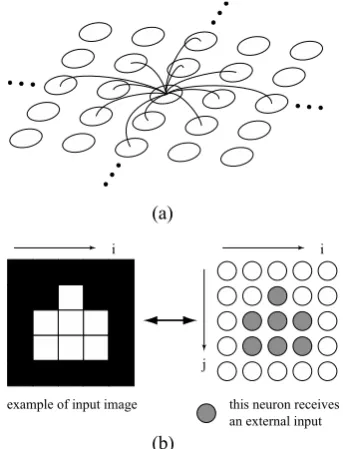
segmentation, edge detection, pattern recognition, image matching and so on [2]-[8], where the two-dimensional PCNN is used as shown in Fig.1.
The image matching method using the PCNN-Icon [3][7][8] is one of the valid applications of the PCNN. The PCNN-Icon is determined as the time series of the number of firing neurons. In this method the PCNN-Icon is used as an image feature amount, and a correlation coefficient of the PCNN-Icons form two images is used for the decision of their equality.
The PCNN has several parameters to be determined. It has been shown that the parameter learning based on the Genetic Algorithm [7][8][9] is effective in the method for the image matching.
In this study, we apply the two-dimensional PCNN to the similar image rating. In our method, the Genetic Algorithm
based method is used for the parameter learning. We evaluate the effectiveness of the parameter learning method by simulations. The results suggest the possibility of application to the similar image search and the category classification of images.
II. THE MODEL AND THE METHOD
2.1 Pulse Coupled Neural Network (PCNN)
Figure 1 shows the basic scheme of the image processing using two-dimensional PCNN. The spiking neurons in the PCNN are locally connected as shown in Fig. 1(a). The neuron in the PCNN and the pixel in the processing image are in one-to-one correspondence, and the intensity of the pixel can be neuronal external input as shown in Fig. 1(b). The neuron in the PCNN is composed of three parts, i.e.,
the feeding input, the linking input, and the pulse generator. Figure 2 shows a simple schematic of the neuron in the PCNN.
The Feeding input receives an external input such as an intensity of the corresponding pixel, and the linking input receives the inputs from other neurons. Assuming that the
neurons are arranged in a two-dimensional lattice so
as to correspond to the pixel of the image, the feeding input receives the external stimulus from the pixel ,
The Parameter Learning Method for Similar Image Rating Using
Pulse Coupled Neural Network
Hiroki Matsushima
1, Hiroaki Kurokawa
1, *Abstract
The Pulse Coupled Neural Network (PCNN) is a kind of neural network models that consists of spiking neurons and local connections. The PCNN was originally proposed as a model that can reproduce the synchronous phenomena of the neurons in the cat visual cortex. Recently, the PCNN has been applied to the various image processing applications, e.g., image segmentation, edge detection, pattern recognition, and so on. The method for the image matching using the PCNN had been proposed as one of the valuable applications of the PCNN. In this method, the Genetic Algorithm is applied to the PCNN parameter learning for the image matching. In this study, we propose the method of the similar image rating using the PCNN. In our method, the Genetic Algorithm based method is applied to the parameter learning of the PCNN. We show the performance of our method by simulations. From the simulation results, we evaluate the efficiency and the general versatility of our parameter learning method.
Key Words: Parameter learning, Pulse Coupled Neural Network, Similar image rating
Manuscript received December 15, 2016; Revised December 30, 2016; Accepted December 31, 2016. (ID No. JMIS-2016-0023)
Corresponding Author (*): Hiroaki Kurokawa, 1404-1 Katakura Hachioji Tokyo Japan, +81-42-637-2404, [email protected].
156 and pixels. Also the linking input receives the output of
neighboring neurons as shown in Fig. 1(a).
Fig. 1. The basic scheme of the image processing using PCNN
Fig. 2. The schematic of the neuron in the PCNN
In this study, we assume that the feeding input and linking-input at time step t are given by,
F
mn
t
X
mn255
(1)L
mn
t
L
mn
t
1
exp
1
L
V
LW
mn,ijY
ij
t
1
,
j
i
(2)where and are the parameters. The feeding input is a normalized intensity of the corresponding pixel. The linking input is updated with the neighboring neurons’
outputs. Synaptic weights , of the neuron and
neighboring neuron is given by,
W
mn,ij
t
1
hd
r
d
,
0
otherwise
.
(3)
In Eq. (3), d is given by,
d
i
m
2
j
n
2.
(4)In Eq. (3) and (4), r and h are the parameters. Note that the
neuron has no synaptic weight to itself.
The pulse generator calculates the internal state of the neuron. The internal state of the neuron at time step t
is given by,
U
mn
t
F
mn
t
1
L
mn
t
,
(5) where is the parameter. When the internal stateexceeds the threshold , neurons fires. Firing
condition of the neuron at the time step t is given by,
Y
mn
t
1
U
mn
t
T
mn
t
,
0
otherwise
.
(6)
In Eq. 6, is the threshold and it is given by,
T
mn
t
1
T
mn
t
exp
1
T
V
TY
mn
t
,
(7) where and are the parameters. The firing state of the neuron is obtained by calculation of Eqs. (1) to (7). The firing states of the neurons are synchronously updated at each time step. The time series of the number of firing neurons in the PCNN is called the PCNN-Icon. Figure3 shows examples of PCNN-Icons.In our previous study [7][8], these PCNN-Icons are used as an image feature amount for the image matching. As shown in Figure 3, similar PCNN-Icons are obtained from same images, even if, the image is rotated or reduced.
Fig. 3. Example of PCNN-Icon i
j i
this neuron receives an external input example of input image
(a) (b) 0 3000 6000 9000 12000
0 20 40 60 80 100
fi ri ng ne ur on TimeStep 0 20000 40000 60000
0 20 40 60 80 100
fi ri ng neu ro n TimeStep 0 20000 40000 60000
0 20 40 60 80 100
fi ri ng ne ur on TimeStep 0 3000 6000 9000 12000
0 20 40 60 80 100
fi ri ng ne ur on TimeStep 0 20000 40000 60000
0 20 40 60 80 100
fi ri ng neu ro n TimeStep 0 20000 40000 60000
0 20 40 60 80 100
http://dx.doi.org/10.9717/JMIS.2016.3.4.155
157 The parameters of the PCNN can be summarized to a set of seven parameters in Eqs. (1) to (7). The performance of the application depends on these parameters. In this study, we apply the parameter learning method based on the Genetic Algorithm to obtain appropriate values of these seven parameters.
2.2 Parameter Learning Method
In this section, we describe the PCNN parameter learning method using the Genetic Algorithm. The Genetic Algorithm is adaptive heuristic search algorithm based on the evolutionary ideas from a natural selection and an alternation of generations.
In our previous study [7][8], it has been proposed that the Genetic Algorithm based method of the PCNN parameter learning for the image matching. In this study, we apply the similar method to the similar image rating.
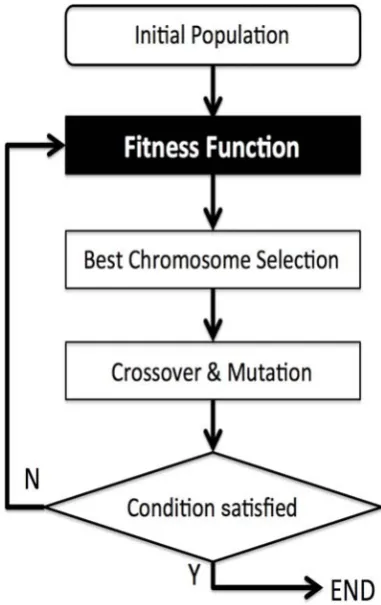
To apply the Genetic Algorithm to the parameters optimization, a set of real numbers of the seven PCNN parameters is defined as a chromosome. The procedure of the Genetic Algorithm is summarized as follows.
Step 1: Initialize the population
All of the chromosomes in the population are initialized randomly.
Step 2: Fitness Function
Calculate the fitness of each chromosome. If the fitness satisfies the condition, the parameters are obtained. In other case, go to step 3.
Step 3: Best Chromosome Selection
Select the best fitness chromosome, and send it to the next generation.
Step 4: Crossover and Mutation
The remaining chromosomes are modified by Crossover and Mutation. Modified chromosomes are sent to the next generation. Repeat this step until a number of the next generation chromosomes are full, then return to the step 2.
Figure4 shows a flow diagram of this procedure. In our method, the seven learning PCNN parameters are ,
, , , , , and in Eqs. (1) to (7). In our method, the number of chromosomes is 17, the crossover rate is 0.6, mutation rate is 0.3, and elitism and roulette selection are applied. The ranges of the real numbers are empirically assumed to be [0.0, 20.48]. Stop condition of the Genetic Algorithm is 1,000 iterations. The fitness is determined by
the correlation coefficient 0 1 of the
PCNN-Icons from image X and Y. The correlation coefficient is given by,
Fig. 4. Procedure of the Genetic Algorithm for the parameter learning
C
XY
t0
x
t
x
y
t
y
tmax
x
t
x
2t0
tmax
y
t
y
2t0
tmax
.
(8)
As shown in Eq. (8), is the normalized correlation coefficient, where and are the number of the firing neurons at the time step t. Also in Eq. (8), ̅ and are the
average of and through 0 to . We
assume that the is 100 in this study. The correlation range is normalized to [0.0, 1.0]. Also, the fitness is given by,
Fitness
C
eq
1
C
diff
.
(9)In Eq. (9), ∑ means the summation of correlation coefficients from the pairs of similar images, ∑ 1
158
Fig. 5. Similar images and non-similar images
Fig. 6. Test Images for the parameter learning
III. SIMULATION RESULTS
In this section, we show the simulation results of the similar image rating by our method. Figure 6 shows 18 test images used in the parameter learning. The set of these test images is composed of three similar image groups
i.e., the baseball bat, the piano, and the motorcycle. The
goal of this simulation is to find the similarity of the images in the same group by similar image rating. Figure 7 shows the results of the similar image rating
cell shows the correlation coefficient of the PCNN-icons from the 18 test images. Also, Figure 8 is the results from the PCNN with parameters obtained by our method. In these results, the colored cells show the top six of large correlation coefficient. From these results, we can find that our method can decide the appropriate parameters for the similar image rating.
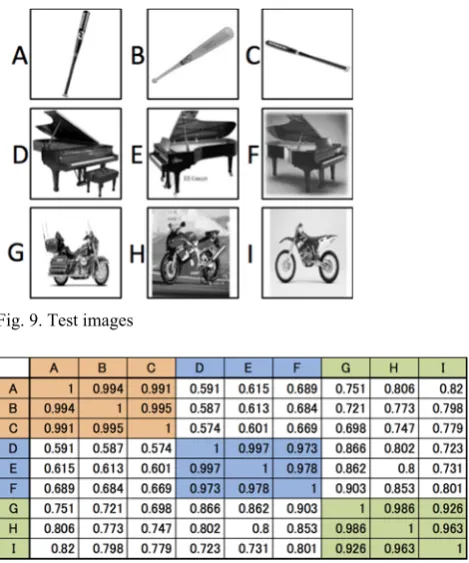
In order to show the general versatility of our parameter learning method, we show the results of similar image rating using unlearned images. Figure 9 shows nine test images for the simulation. Figure 10 shows the results of the similar image rating by the PCNN with learned parameters using the images shown in Figure 6. From the results, we can find that our method has general versatility for the similar image rating.
IV. CONCLUSION
In this study, we applied our Genetic Algorithm based PCNN parameter learning method to the similar image rating using the PCNN, and evaluate its performances by the simulation. The simulation results showed that our method can find similarity among the same group images, and it is applicable not only the learned images but also the unlearned images.
The technique of the similar image rating can be a component technology of the Content-Based Image Retrieval (CBIR). We will apply our method to the CBIR system and show its efficiency in our future work.
http://dx.doi.org/10.9717/JMIS.2016.3.4.155
159
Fig. 8. The results with the parameters by our method
Fig. 9. Test images
Fig. 10. The results using test images
REFERENCES
[1] R. Eckhorn, H. J. Reitboeck, M. Arndt, and P. Dicke, " Feature linking via synchronization among distributed assemblies," Neural Computation, Vol.2,
pp.293-307,1990.
[2]R. Eckhorn, "Neural Mechanisms of Scene Segmentati on: Recording from the Visual Cortex Suggest Basic C ircuits for Linking Field Model,” IEEE Trans. Neural
Network, vol.10, no.3, pp.464-479, 1999.
[3] J.L. Johnson and M.L. Padgett, “PCNN Models a
nd Applications,” IEEE Transactions on Neural Ne
twork, vol. 10, no. 3, pp.480-498, 1999.
[4] H.S. Ranganth and G. Kuntimad, “Image segment ation using pulse coupled neural networks,”
in Proceedings of the international Conference on N
eural Networks, Orlando, vol. 2, 1285–1290, 1994.
[5] T. Lindblad and J. M. Kinser, Image processing using
pulse-coupled neural networks, Springer-Verlag, 2005.
[6] H. Kurokawa, S. Kaneko, and M. Yonekawa, “A Color Image Segmentation using Inhibitory Connec ted Pulse Coupled Neural Network” in Proceedings of the international conference on Artificial neural
network, Limassol, pp.776-783, 2009.
[7] M. Yonekawa and H. Kurokawa, "The parameter opti mization of the pulse coupled neural network for the p attern recognition," in Proceedings of the international
conference on Artificial neural network, Thessaloniki
, pp.179-187, 2010.
[8] M. Yonekawa and H. Kurokawa, "An evaluation of the image recognition method using pulse coupled neural network," in Proceedings of the international confere
nce on Artificial neural networks, Espoo,
pp.217-224, 2011.
[9] A.H.Weight, "Genetic algorithms for real parameter optimization," Foundations of Genetic Algorithms, vol. 1,
160 Hiroki Matsushima received his
B.E. degree in computer science from Tokyo University of technology, Tokyo, Japan. He is currently a master course student in the graduate school at Tokyo University of technology. He is engaged in the research on an image processing using artificial neural networks.