© 2018, IRJET | Impact Factor value: 6.171 | ISO 9001:2008 Certified Journal | Page 4606
Attendance System based on Face Recognition
Venkata Kalyan Polamarasetty1, Muralidhar Reddy Reddem2, Dheeraj Ravi3,
Mahith Sai Madala4
1,2,3,4Student, Information Technology, Velagapudi RamaKrishna Siddhartha Engineering College, India
---***---ABSTRACT: Daily attendance marking is a common and
important activity in schools and colleges for checking the performance of students. Manual Attendance maintaining is difficult process, especially for large group of students. Some automated systems developed to overcome these difficulties, have drawbacks like cost, fake attendance, accuracy, intrusiveness. To overcome these drawbacks, there is need of smart and automated attendance system. Traditional face recognition systems employ methods to identify a face from the given input but the results are not usually accurate and precise as desired. The system described in this we aims to deviate from such traditional systems and introduce a new approach to identify a student using a face recognition system, the generation of a facial Model. This describes the working of the face recognition system that will be deployed as an Automated Attendance System in a classroom environment.
Keywords:Image processing, Expressions, HAAR features,
HOG features, Face Detection Method, Face Recognition Method, Features Extraction, Features Matching, Query Image, Bit- Byte Conversion Methods.
1. INTRODUCTION
Let us take an example of application to the theory we are proposing here. Taking attendance in the schools and colleges is being a waste of time and effort for both the students and lectures as well. Now a days biometric is more usage they are finger print recognition facial recognition iris scanning recognition voice recognition signature recognition etc. One of that biometric category is face detection and recognition. Based on the image we take security safety, attendances and some time it useful for decision also. Mostly this facial detection and recognition is decrease the manual work for human. Image capturing from camera or cc camera sometime this is also a streaming video from camera. Form that offline or online data, we capture the image after that applying the face detection techniques. Face detection is detecting the face location and presence of face in images. In this face detection we mostly see the nose, hair, ears, mouth, eyes and also different pose of faces in images. So many Face detection techniques, few of them is Viola Jones Face Detection Algorithm, (LBP), and Ada-Boost for Face Detection, SMQT Features and SNOW Classifier Method. After applying face detection techniques we detected the faces or objects in image and crop that image apply Face recognition technique. So many way to recognition the faces by applying Hog features, Haar features, Machine learning, deep leaning, classification techniques some other tech also used for recognition of the faces. Recognition of face we need
training data sets. Instances taking camera capture now check that image to database Images. Face recognition of different peoples based on the related images of that person image we need take images for before face recognition. In case if the image is not in data base then we store that image as new person in database. Next time same image of that new image person appear in image and recognition the face or else taking as new image and storing in database process is repeating. In this paper we selecting of the face recognition and detection giving result using MATLAB. This requires a high end specifications of a system in order get the better results. It won’t run on all the small specification systems. So, this can run only small database and compare them with the face required.
2. LITERATURE SURVEY
In [1] the author proposed that different types of face detection for detecting faces in different pose .Detecting face in different pattern based on techniques. Basic pattern for detecting face is nose, eyes, hair, ears and some time it based on tone of skin. Face detection is detecting face based on location of face and presences of face in images .Different types of detecting the face techniques they are Ada-Boost Algorithm for Face Detection, Viola Jones Face Detection Algorithm, SMQT Features and SNOW Classifier Method, Local Binary Pattern (LBP). Each have advantages and disadvantages discussed in that paper.
Xiang-Yu Li [2] the author proposed that recognition face using hog features and pca algorithms. By applying 0recognition algorithm to cropped faces images from that we get similarity b/w taken image and database image. In this paper PAC algorithm used for face detection and recognition. Arun Katara[3] the author shows that face recognition of facial of different person or student .from recognition attendances is upload to database using face detection and recognition of student or workers. From this manual work is decrease by human and automatically attendance system based on faces process done.
© 2018, IRJET | Impact Factor value: 6.171 | ISO 9001:2008 Certified Journal | Page 4607 3. Work Flow
Fig-3.1 Architectural Flow Chart
3.1 Training data
For the database, we need to capture the image from the webcam or the external camera. To do so, in Matlab, we need to install the drivers from the math works website based on the type of camera we are using. Next, we need at least 500 to 1000 captures of each person for getting higher percentage of accuracy and meet the purpose we are doing in this project. We can store the data in the form of separate folders distinguishing each person from others.
3.2 Image Capture
We need some HD camera in order to get results. We can capture the images from the video stream or by capturing each and every image from the webcam manually. Doing the frame capture from the stream of video will give us results in less time but we won’t be able to capture the face properly in case we lose light or something and if the face is not captured properly.
3.3 Face detection
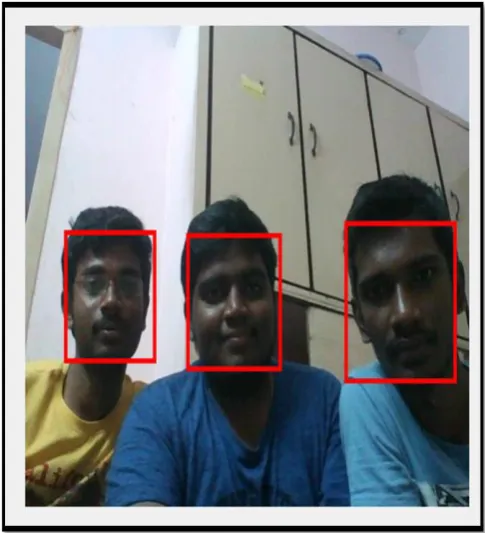
For face detecting, we can do it using the object cascading class and we use the b-box method. The detection of the face using the object cascading is bought from the most popular facial recognition model Viola Jones. In here, there are several objects are present. These are there in the form of small blocks containing them. They are taken through an image and are moved through each and every block of the image and are checked for overlapping through them. First we will convert the image from the red blue green to gray scale image. The faces from the image captured is to be collected. The captured faces are cropped into small images of resolution 112x92. It would be around 11 KB of size.
3.4 Face Recognition
The faces taken in the database are needed to loaded into our workspace. We will load the galleryimages into that.
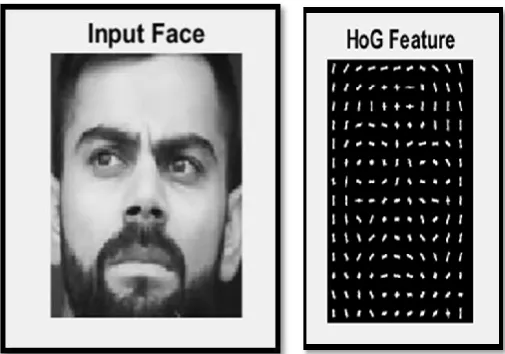
Now we need to split the data of each and every person into testing and training data. Let us take it in the ratio of 0.2:0.8 from the database. Now we will be extracting the HOG features of all the training individuals and store them in the form of bits and bytes. We need to fetch the cropped and gray scaled images. Now the training datasets are extracted with the HOG features and are stored with a count.
Fig-3.4.1 Hog Feature of the Input image
All the HOG features extracted are stored in the form of array index. The images in the database along with their labels are sent into features array to identify them separately (like indexing). The HOG features are sent along with the person Label to classify them and store them separately. The data is now classified using the predefined method of fitcecoc. This is completely done on the training data. Now we need take a fresh photo from webcam or any file and detect the faces, extract the HOG features and then compare that with the data classified. We need a predict method to compare an classified data with the data we need. Finally it returns a label to which the given data matches or nearly matched. To get better results we need a bigger training set.
3.6 Front end
In Matlab, we use an unique tool to design the user interface. Here we can create buttons and plots in order to get the image frame from the webcam. We can allot some callback functions in order to configure the camera from which we want take the image, capturing the image and saving the image. We can also use the edit boxes and static boxes in order to take the data from the user and display some content to the end users.
4. Result Analysis
[image:2.595.310.563.174.351.2]© 2018, IRJET | Impact Factor value: 6.171 | ISO 9001:2008 Certified Journal | Page 4608 Fig-4.1 Registration form
[image:3.595.37.289.83.284.2]Now we to get the pictures of the persons from the webcam or any other cams available like we used Logitech webcam here. Select the cam from which we need to take the image and start the camera. The camera is plotted in the axes and we can capture and save the images in the folder created automatically with the registered number we have entered in fig 4.1.
Fig-4.2 User Interface to select, capture and save the images in database
[image:3.595.311.554.411.678.2]After this the data is stored in the database. Now let us capture a picture from the webcam and see the results.
Fig-4.3 Interface to take attendance
Now let us click on the “Take Attendnce” and the camera starts and takes the image to give the results checking from the saved database
Fig-4.4 Input image
[image:3.595.46.277.419.603.2]© 2018, IRJET | Impact Factor value: 6.171 | ISO 9001:2008 Certified Journal | Page 4609
[image:4.595.85.553.37.626.2]
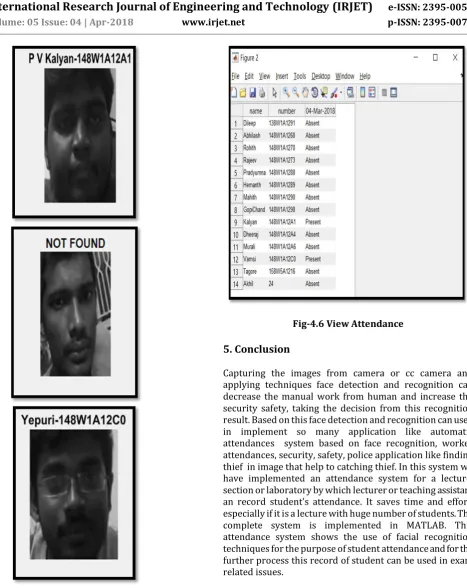
Fig-4.5 Output for the image in Fig 4.4
Found images are given their names and not found ones are as the image in the middle.
View Attendance
If we click on the View Attendance button in fig-4.3 we will logout as shown in fig-4.6. The attendance is viewed after capturing of the fig-4.. Initially all the members are marked absent.
Fig-4.6 View Attendance
5. Conclusion
Capturing the images from camera or cc camera and applying techniques face detection and recognition can decrease the manual work from human and increase the security safety, taking the decision from this recognition result. Based on this face detection and recognition can used in implement so many application like automatic attendances system based on face recognition, worker attendances, security, safety, police application like finding thief in image that help to catching thief. In this system we have implemented an attendance system for a lecture, section or laboratory by which lecturer or teaching assistant an record student’s attendance. It saves time and effort, especially if it is a lecture with huge number of students. The complete system is implemented in MATLAB. This attendance system shows the use of facial recognition techniques for the purpose of student attendance and for the further process this record of student can be used in exam related issues.
References
[1]A Study of Various Face Detection Methods , Ms.Varsha Gupta1 , Mr. Dipesh Sharma2,ijarcce vol.3 https://www.ijarcce.com/upload/2014/may/IJARCCE7G%2 0%20a%20varsha%20A%20Study%20of%20Various%20F ace.pdf
[image:4.595.92.229.80.625.2]© 2018, IRJET | Impact Factor value: 6.171 | ISO 9001:2008 Certified Journal | Page 4610 [3]Attendance System Using Face Recognition and Class
Monitoring System, Arun Katara1, Mr. Sudesh2, V.Kolhe3http://www.ijritcc.org/download/browse/Volume_ 5_Issues/February_17_Volume_5_Issue_2/1489565866_ 15-03-2017.pdf
[4] G. Yang and T. S. Huang, “Human face detection in complex background,” Pattern Recognition Letter, vol. 27, no.1, pp. 53-63, 1994.
[5] C. Kotropoulos and I. Pitas, “Rule-based face detection in frontal views,” Proc. Int’l Conf. Acoustics, Speech and Signal Processing, vol. 4, pp. 2537-2540, 1997.
[6] Xinjun Ma, Hongqiao Zhang, XinZang, “A face detection algorithm based on modified skin-color model”, CCC, vol. 1, pp. 3896-3900, IEEE, 2013
[7] V. Shehu and A. Dika, “Using Real Time Computer Algorithms in Automatic Attendance Management Systems.” IEEE, pp. 397 – 402, Jun. 2010.
[8] Prof. P.K Biswas, Digital Image Processing
[9] M. A. Turk and A. P. Pentland, “Face Recognition Using Eigenfaces”in Proc. IEEE Conference on Computer Vision and Pattern Recognition, pp. 586–591. 1991
[10] W. Zhao, R. Chellappa, P. J. Phillips, and A. Rosenfeld, “Face recognition: A literature survey,” ACM Computing Surveys, 2003, vol. 35, no. 4, pp. 399-458
[11] Bhumika G. Bhatt, Zankhana H. Shah “Face Feature Extraction Techniques: A Survey”, National Conference on Recent Trends in Engineering & Technology, 13-14 May 2011.