The Thirty-Third AAAI Conference on Artificial Intelligence (AAAI-19)
Knowledge Refinement via Rule Selection
Phokion G. Kolaitis,
1,2Lucian Popa,
2Kun Qian
21UC Santa Cruz,2IBM Research – Almaden
[email protected], [email protected], [email protected]
Abstract
In several different applications, including data transforma-tion and entity resolutransforma-tion, rules are used to capture aspects of knowledge about the application at hand. Often, a large set of such rules is generated automatically or semi-automatically, and the challenge is to refine the encapsulated knowledge by selecting a subset of rules based on the expected operational behavior of the rules on available data. In this paper, we carry out a systematic complexity-theoretic investigation of the fol-lowing rule selection problem: given a set of rules specified by Horn formulas, and a pair of an input database and an out-put database, find a subset of the rules that minimizes the to-tal error, that is, the number of false positive and false neg-ative errors arising from the selected rules. We first estab-lish computational hardness results for the decision problems underlying this minimization problem, as well as upper and lower bounds for its approximability. We then investigate a bi-objective optimization version of the rule selection prob-lem in which both the total error and the size of the selected rules are taken into account. We show that testing for mem-bership in the Pareto front of this bi-objective optimization problem is complete. Finally, we show that a similar DP-completeness result holds for a bi-level optimization version of the rule selection problem, where one minimizes first the total error and then the size.
Rules, typically expressed as Horn formulas, are ubiqui-tous in several different areas of computer science and ar-tificial intelligence. For example, rules are the basic con-struct of (function-free) logic programs. In data integration (Lenzerini 2002) and data exchange (Fagin et al. 2005), rules are known as GAV (global-as-view) constraints and are used to specify data transformations between a local (or source) schema and a global (or target) schema. In data mining, rules have many uses, including the specification of contextual preferences (Agrawal, Rantzau, and Terzi 2006; de Amo et al. 2015). In entity resolution, rules have been used to specify blocking functions (Bilenko, Kamath, and Mooney 2006) and entity resolution algorithms (Qian, Popa, and Sen 2017).
Often, a large set of rules is generated automatically or semi-automatically, and the challenge is to refine the encap-sulated knowledge by selecting a subset of rules based on the expected operational behavior of the rules on available
Copyright c2019, Association for the Advancement of Artificial Intelligence (www.aaai.org). All rights reserved.
data. Rule selection arises naturally in all aforementioned contexts and, in fact, in most contexts involving reasoning about data. Here, we present an example motivated by a real-life application in which we are building a knowledge base of experts in the medical domain, based on public data, and where entity resolution is one of the crucial first steps.
In entity resolution, the aim is to identify references of the same real-world entity across multiple records or datasets. Consider the scenario depicted in Figure 1, where the aim is to identify occurrences of the same author across research
publications from PubMed1. This entity resolution task
Emerg Radiol2010 Jan;17(1):65-7.
Acute gastric outlet obstruction …
PMID: 19132421 Morgan J1,Sadler MA.
1Dept. of Radiology, St Vincent's Hospital and Medical Center, New York, NY 10011
Clin Imaging2009, 33(1):67-9
Paratracheal air collection ...
PMID: 19135934
Morgan J1,Perone R,Yeghiayan P. 1St Vincent's Hospital and Medical Center, New York, NY, USA. Is Morgan J
same author?
YES/NO
Figure 1: An entity resolution task
can be modeled using a source schema that includes a
re-lationAuthorand a link schema that consists of a relation
SameAuthor. Sample facts (records) over the source and the link relations are given in Figure 2. As in the frameworks of Markov Logic Networks (Singla and Domingos 2006), Dedupalog (Arasu, Re, and Suciu 2009), and declarative en-tity linking (Burdick et al. 2016), explicit link relations are used to represent entity resolution inferences. In particular, theSameAuthorfact in Figure 2 represents that an
infer-ence was made to establish that the author in position1of
publication withpmid 19132421is the same as the
au-thor in position1of publication withpmid 19135934.
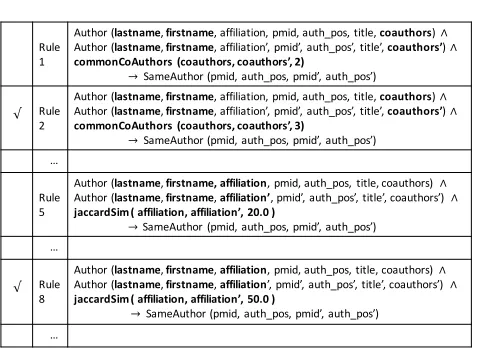
For a given entity resolution task, there is typically a large set of candidate rules that may apply on the input data to form matches among the entities. For our concrete scenario, Figure 3 gives a sample of candidate matching rules. These rules involve the alignment of relevant attributes
(e.g., lastname withlastname,affiliationwith
affiliation) and the subsequent application of simi-larity predicates, filters, and thresholds. The challenge is to find a subset of the candidate rules with the “right” combi-nations of predicates and thresholds that will lead to high
1
Author (lastname, firstname, affiliation, pmid, author_pos, title, coauthors) SameAuthor (pmid1, pos1, pmid2, pos2)
Author (“Morgan”, “J”, “Dept of Radiology …”, 19132421, 1, “Acute …”, “Morgan J; Sadler MA”) SameAuthor (19132421, 1, 19135934, 1)
Figure 2: Schemas and facts
Rule 1
Author (lastname, firstname, affiliation, pmid, auth_pos, title, coauthors) ∧ Author (lastname, firstname, affiliation’, pmid’, auth_pos’, title’, coauthors’) ∧
commonCoAuthors (coauthors, coauthors’, 2)
→SameAuthor (pmid, auth_pos, pmid’, auth_pos’)
√ Rule 2
Author (lastname, firstname, affiliation, pmid, auth_pos, title, coauthors) ∧ Author (lastname, firstname, affiliation’, pmid’, auth_pos’, title’, coauthors’) ∧
commonCoAuthors (coauthors, coauthors’, 3)
→SameAuthor (pmid, auth_pos, pmid’, auth_pos’) …
Rule 5
Author (lastname, firstname, affiliation, pmid, auth_pos, title, coauthors) ∧ Author (lastname, firstname, affiliation’, pmid’, auth_pos’, title’, coauthors’) ∧
jaccardSim ( affiliation, affiliation’, 20.0 )
→SameAuthor (pmid, auth_pos, pmid’, auth_pos’) …
√ Rule 8
Author (lastname, firstname, affiliation, pmid, auth_pos, title, coauthors) ∧ Author (lastname, firstname, affiliation’, pmid’, auth_pos’, title’, coauthors’) ∧
jaccardSim ( affiliation, affiliation’, 50.0 )
→SameAuthor (pmid, auth_pos, pmid’, auth_pos’) …
Figure 3: Candidate rules for an entity resolution task
precision and recall with respect to a given set of ground
truth data. As an example, both Rule 1andRule 2in
Figure 3 generate aSameAuthorlink between two author
occurrences on two different publications, provided that the last names and first names are identical and provided that there is a sufficient number of common coauthors on the two
publications. However,Rule 1, which checks for at least
two common coauthors, may turn out to be too imprecise
(i.e., may yield too many false positives), whileRule 2,
which checks for at least three common coauthors, may re-sult into fewer errors. Different rules may use different
pred-icates in their premises. For example,Rules 5-8exploit
the Jaccard similarity of affiliation, but have different
simi-larity thresholds. Only one of them (Rule 8, with
similar-ity threshold of 50%) may achieve high enough precision. Thus, the problem becomes how to select a set of rules that achieve high precision (i.e., minimize the number of false positives) and high recall (i.e., minimize the number of false negatives) with respect to a given set of ground truth data; furthermore, one would also like to select a compact (in terms of size) such set of rules.
Similar rule selection problems have been studied in sev-eral different contexts. In data exchange, (Kimmig et al.
2017) have investigated the mapping selection problem:
given a set C of rules expressing data transformations
be-tween a source and a target schema, and a pair(I, J)of a
source databaseI and a target databaseJ, find a subsetC0
of the rules that minimizes the sum of the false positive er-rors, the false negative erer-rors, and the sizes of the rules in
C0. (Sarma et al. 2010) have investigated theview selection
problem: given a materialized view V, a databaseD, and
a collectionS of sets of rules onD, find a set of rules in
S that is as “close” to the viewV and as compact as
pos-sible. In data mining, (Agrawal, Rantzau, and Terzi 2006; Davis, Schwarz, and Terzi 2009) investigated the prob-lems of selecting contextual preference rules and associa-tion rules; these problems can be cast as variants of the rule selection problem considered here.
Summary of Results We formalize the rule selection problem with rules specified by Horn formulas of first-order logic; the relation symbols in the premises of the Horn
for-mulas come from apremiseschema, while those in the
con-clusions come from a conclusion schema that is disjoint
from the premise schema. This formalization captures rule selection problems in a variety of contexts.
An input to the rule selection problem consists of a
fi-nite set C of rules and a pair(I, J)of a premise database
Iand a conclusion databaseJ that represents ground truth.
When a subsetC0ofCis evaluated on the premise instance
I, it produces a conclusion instance Eval(C0, I). The set
Eval(C0, I)\J is the set of the false positive errors, while
the setJ\Eval(C0, I)is the set of false negative errors. We
study the optimization problem MINRULE-SELECTFP+FNin
which, givenC,(I, J)as above, the goal is to find a subset
C0 of C so that the number of false positive and false
neg-ative errors is minimized. We also study the optimization
problem MINRULE-SELECTFPin which the goal is to find
a subsetC0 ofC so that the number of false positive errors
is minimized and there are no false negative errors (this is
meaningful whenJ ⊆Eval(C, I)).
To gauge the difficulty of these two optimization prob-lems, we first examine their underlying decision problems. We show that the decision problems involving a bound on
the error are NP-hard. We also show that theexactdecision
problems asking if the error is equal to a given value are DP-hard; in particular, they are both NP-hard and coNP-hard
(thus, unlikely to be in NP∪coNP). In view of these
hard-ness results, we focus on the approximation properties of the two rule selection optimization problems. We show that, in a
precise sense, MINRULE-SELECTFPhas the same
approxi-mation properties as the RED-BLUESET COVERproblem,
while MIN RULE-SELECTFP+FN has the same
approxima-tion properties as the POSITIVE-NEGATIVE PARTIALSET
COVERproblem. These results yield both polynomial-time
approximation algorithms and lower bounds for the approx-imability of our problems.
The preceding results focus on the minimization of the er-ror produced by the selected rules. What if one wants to also take the size of the selected rules into account? Since error and size are qualitatively incomparable quantities, it is not meaningful to add them or even to take a linear combination
of the two. Instead, we consider pairs of values(e, s)of
er-ror and size that arePareto optimal, that is, neither of these
values can be decreased without increasing the other value
at the same time. ThePareto frontof an instance is the set
carried out for rule selection problems in any of the con-texts discussed earlier. Here, we initiate such a study and
show that the following problem is DP-hard: given a setC
of rules, a pair(I, J)of a premise database and a
conclu-sion database, and a pair (e, s)of integers, does(e, s)
be-long to the Pareto front of MIN RULE-SELECTFP+FN? We
also show that a similar DP-hardness result holds for MIN
RULE-SELECTFP.
Finally, we investigate a bi-level optimization version of MINRULE-SELECTFP+FN, where one minimizes first the
to-tal error and then the size. We show that the following
prob-lem is DP-hard: given a set C of rules, a pair(I, J) of a
premise database and a conclusion database, and a pair(e, s)
of integers, isethe minimum possible error and issthe
min-imum size of subsets of rules having the minmin-imum error? We also show a similar DP-hardness result holds for the bi-level
optimization version of MINRULE-SELECTFP.
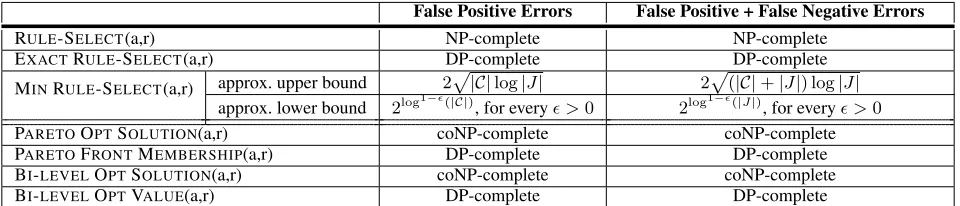
The main results of this paper are summarized in Table 1, which can be found in a subsequent section.
Related Work
We already mentioned that (Kimmig et al. 2017) studied the mapping selection problem in the context of data ex-change. In addition to considering rules specified by Horn formulas (GAV constraints in data exchange), they also con-sidered richer rules in which the conclusion involves exis-tential quantification over a conjunction of atoms (GLAV - global and local as view - constraints in data exchange). They established that the mapping selection problem is NP-hard even for GAV constraints, but did not explore approx-imation algorithms for this optimization problem; instead, they designed an algorithm that uses probabilistic soft logic (Bach et al. 2017) to solve a relaxation of the mapping se-lection problem and then carried out a detailed experimen-tal evaluation of this approach. Its many technical merits notwithstanding, the work of (Kimmig et al. 2017) suffers from a serious drawback, namely, the objective function of the mapping selection problem is defined to be the sum of the size of the rules and the error (the number of the false positives and the false negatives). As stated earlier, however, size and error are qualitatively different quantities, thus it is simply not meaningful to add them, the same way it is not meaningful to add dollars and miles if one is interested in a hotel room near the White House and is trying to minimize the cost of the room and the distance from the White House. This is why, to avoid this pitfall here, we first focus on error minimization alone and then study the Pareto optimality of pairs of size and error values.
In the rule selection problem, the aim is to select a set of rules from a larger set of candidate rules based on some given data. There is a large body of work on the problem of deriving a set of rules in data exchange and data integration
from just one or more givendata examples. There are
sev-eral different approaches to this problem, including casting it as an optimization problem (Gottlob and Senellart 2010; ten Cate et al. 2017), as a “fitting” problem (Alexe et al. 2011a; 2011b), as an interactive derivation problem (Boni-fati et al. 2017), or as a learning problem (ten Cate, Dalmau, and Kolaitis 2013; ten Cate et al. 2018). Clearly, this is a
related but rather different problem because, in contrast to the rule selection problem, no candidate rules are part of the input.
Basic Concepts and Algorithmic Problems
Schemas and InstancesAschemaRis a set{R1, . . . , Rk}of relation symbols, each with a specified arity
indicat-ing the number of its arguments. An R-instanceI is a set
{RI1, . . . , RIk}of relations whose arities match those of the
corresponding relation symbols. AnR-instancecan be
iden-tified with the set of allfactsRi(a1, . . . , am), such thatRi
is a relation symbol inRand(a1, . . . , am)is a tuple in the
relationRIi ofIinterpreting the relation symbolRi.
Rules. LetSandTbe two disjoint relational schemas. In the
rest of the paper, we will refer toSas thepremiseschema
and toTas theconclusionschema. AruleoverSandTis a
Horn formula of first-order logic of the form
∀x(ψ(x)→P(x)),
where the premiseψ(x)is a conjunction of atoms overSand
the conclusionT(x)is a single atom overTwith variables
among those inx. For example, the rule
∀x, y, z(E(x, z)∧E(z, y)→F(x, y))
asserts thatF contains all pairs of nodes connected via an
E-path of length2. For simplicity, we will be dropping the
universal quantifiers∀, so that the preceding rule about paths
of length2will be written as(E(x, z)∧E(z, y)→F(x, y)). The atoms in the premises may contain constants or they
may be built-in predicates, such asjaccardSim. However,
none of the lower-bound complexity results established here uses such atoms, while the upper-bound complexity results hold true even in the presence of such atoms, provided the built-in predicates are polynomial-time computable.
Thesizeof a ruleρ, denoted by|ρ|, is the number of atoms
in the premise ofρ. Thesizeof a collectionCof rules,
de-noted by|C|, is the sum of the sizes of the rules inC.
Data example.Adata exampleis a pair(I, J), whereIis
an instance over the premise schemaSandJ is an instance
over the conclusion schemaT.
Rule evaluation.Given a ruleρand an instanceI, we write
Eval(ρ, I)to denote the result of evaluating the premise of
ρonIand then populating the conclusion ofρaccordingly.
For example, ifρis the rule(E(x, z)∧E(z, y)→F(x, y))
andE is a graph, then Eval(ρ, E)is the set F consisting
of all pairs of nodes of E connected via a path of length
2. IfC is a set of rules, then Eval(C, I)is the set of facts
S
ρ∈CEval(ρ, I). In data exchange, computing Eval(C, I)
amounts to running thechaseprocedure (Fagin et al. 2005).
In general, given a collectionCof rules and an instanceI,
computing Eval(C, I)is an exponential-time task; the source
of the exponentiality is the maximum number of atoms in
the premises of the rules in C and the maximum arity of
the relation symbols in the conclusions of the rules. If, how-ever, both these quantities are bounded by constants, then
Eval(C, I)is computable in polynomial time, according to
Proposition 1. Let aandr be two fixed positive integers. Then the following problem is solvable in polynomial time: given an instanceIand a collectionCof rules such that the maximum number of atoms in the premises of rules inCis at mostaand the maximum arity of the relation symbols in the conclusions of these rules is at mostr, compute Eval(C, I). False positive errors and false negative errors. Given a
collectionCof rules and a data example(I, J), afalse
pos-itive erroris a factf in Eval(C, I)that is not inJ, while a
false negative erroris a factfinJ that is not in Eval(C, I).
We write FP(C,(I, J)) and FN(C,(I, J)) (or, simply, FP
and FN) for the set of false positive and false negative
er-rors with ofCwith respect to(I, J), that is,
FP=Eval(C, I)\J and FN=J\Eval(C, I).
We will focus on the following two optimization problems concerning the minimization of the number of errors.
Definition 1. [MINRULE-SELECTFP+FN]
Input: A setCof rules and a data example(I, J).
Goal: Find a subsetC∗⊆ Csuch that the sum of the number
of the false positive errors and the number of false negative
errors ofC∗with respect to(I, J), is minimized.
Afeasiblesolution of a given instanceC,(I, J)of MIN RULE-SELECTFP+FN(a,r) is a subset C0 of C. We write
ERRORFP+FN(C0,(I, J))to denote the errorof C0 with
re-spect to(I, J), i.e., the sum of the number of the false
posi-tive errors and the number of false negaposi-tive errors.
Definition 2. [MINRULE-SELECTFP]
Input: A setCof rules and a data example(I, J)such that
J ⊆Eval(C, I).
Goal: Find a subsetC∗ ⊆ C such that the number of false
negative errors is zero and the number of false positive errors
ofC∗with respect to(I, J)is minimized.
Afeasiblesolution of a given instanceC,(I, J)of MIN RULE-SELECTFP(a,r) is a subset C0 of C such that J ⊆
Eval(C0, I). Feasible solutions always exist becauseCis one.
We write ERRORFP(C0,(I, J))to denote theerrorofC0with
respect to(I, J), i.e., the number of the false positive errors.
We do not consider MINRULE-SELECTFN, i.e., the
opti-mization problem that aims to minimize the number of false negative errors. The reason is that there is a trivial solution to this problem, namely, we can select all the rules (if the number of false positive errors is not required to be zero) or select all the rules that produce no false positive errors (if the number of false positive errors is required to be zero).
To gauge the difficulty of solving an optimization prob-lem, one often studies two decision problems that underlie the optimization problem at hand: a decision problem about bounds on the optimum value and a decision problem about the exact optimum value. We introduce these two problems for each of the optimization problems in Definitions 1 and 2.
Definition 3. Given a setCof rules, a data example(I, J),
and an integerk,
• RULE-SELECTFP+FN asks: is there a subsetC0 ofCsuch
that ERRORFP+FN(C0,(I, J))≤k?
• EXACT RULE-SELECTFP+FN asks: is the optimum value
of MINRULE-SELECTFP+FNonCand(I, J)equal tok?
Definition 4. Given a setCof rules, a data example(I, J)
such thatJ⊆Eval(C, I), and an integerk,
• RULE-SELECTFPasks: is there a subsetC0 ⊆ Csuch that
the number of false negative errors ofC0 with respect to
(I, J)is zero and ERRORFP(C0,(I, J))≤k?
• EXACT RULE-SELECTFP asks: is the optimum value of
MINRULE-SELECTFPonCand(I, J)equal tok?
The Complexity of Error Minimization
We will investigate the computational complexity of the de-cision problems introduced in Definitions 3 and 4 by consid-ering parameterized versions of these problems with param-eters the maximum number of atoms in the premises of the rules and the maximum arity of the relation symbols in the conclusion of the rules.
Definition 5. Letaandrbe two fixed positive integers. • RULE-SELECTFP+FN(a,r) is the restriction of RULE
-SELECTFP+FN to inputs in which the maximum number
of atoms in the premises of rules in the given set C of
rules is at mostaand the maximum arity of the relation
symbols in the conclusions of these rules is at mostr.
• The decision problems RULE-SELECTFP(a,r), EXACT
RULE-SELECTFP+FN(a,r), EXACT RULE-SELECTFP(a,r),
MIN RULE-SELECTFP+FN(a,r), and MIN RULE
-SELECTFP(a,r) are defined in an analogous way.
Theorem 1. Let a and r be two fixed positive integers. The decision problems RULE-SELECTFP(a,r) and RULE
-SELECTFP+FN(a,r)areNP-complete.
Proof. (Sketch) Membership in NP follows easily from
Proposition 1. The NP-hardness of RULE-SELECTFP(a,r)
and RULE-SELECTFP+FN(a,r) is proved using a
polynomial-time reduction from SET COVER, a problem which was
among the twenty one NP-complete problems in Karp’s seminal paper (Karp 1972). The same reduction is used for
both RULE-SELECTFP(a,r) and RULE-SELECTFP+FN(a,r);
however, the argument for the correctness of the reduction
is different in each case. We give the argument for RULE
-SELECTFP+FN(a,r).
The SET COVER problem asks: given a finite set U =
{u1, . . . , um}, a collectionS ={S1, . . . , Sp}of subsets of
U whose union isU, and an integerk, is there a cover ofU
of size at mostk? (i.e., a subsetS0 ⊆ S such that the union
of the members ofS0is equal toU and|S0| ≤k.)
LetU = {u1, . . . , um},S = {S1, . . . , Sp},k be an
in-stance of SET COVER. For every i with 1 ≤ i ≤ p, we
introduce the ruleSeti(x)→B(x)and we letCbe the set
of all these rules. Thus, the premise schema consists of the
unary relation symbolsSeti,1≤i≤p, and the conclusion
schema consists of the unary relation symbolB. We
intro-ducepnew elementsa1, . . . , ap and construct the premise
instanceIwithSetI
i = Si∪ {ai},1 ≤ i ≤p(intuitively,
each new element ai encodes the index of the setSi). We
also construct the conclusion instanceJwithBJ=U.
We claim that there is a cover of U of size at most
k if and only if there is a subset C0 of C such that
False Positive Errors False Positive + False Negative Errors
RULE-SELECT(a,r) NP-complete NP-complete
EXACTRULE-SELECT(a,r) DP-complete DP-complete
MINRULE-SELECT(a,r) approx. upper bound 2
p
|C|log|J| 2p
(|C|+|J|) log|J|
approx. lower bound 2log1−(|C|), for every >0 2log1−(|J|), for every >0
PARETOOPTSOLUTION(a,r) coNP-complete coNP-complete
PARETOFRONTMEMBERSHIP(a,r) DP-complete DP-complete
BI-LEVELOPTSOLUTION(a,r) coNP-complete coNP-complete
BI-LEVELOPTVALUE(a,r) DP-complete DP-complete
Table 1: Summary of Results (C: set of input rules;J: input conclusion instance; approx. lower bounds assume that P6=NP)
U of size at most k, then there is a subset C0 of C
that has no false negative errors with respect to (I, J)
and is such that ERRORFP(C0,(I, J)) ≤ k. Therefore,
ERRORFP+FN(C0,(I, J)) = ERRORFP(C0,(I, J))≤k.
Con-versely, assume that there is a subset C0 of C such that
ERRORFP+FN(C0,(I, J))≤ k. If there are no false negative
errors, thenC0corresponds to a cover ofUof size at mostk.
So, assume there aretfalse negative errors, for somet >0.
These must result from elementsui1, . . . , uit ofU that are
not in any of the setsSjthat produce rulesSetj(x)→B(x)
inC0. For each such element, there is a set in S
contain-ing it; thus, the elementsui1, . . . , uit can be covered using
at mosttsets in S. LetC00 be the subset ofC obtained by
adding toC0 the rules arising from these sets. Clearly,C00
has no false negative errors, so it hastfewer negative errors
thanC0does and at mosttmore positive errors thanC0does
with respect to (I, J). Thus, ERRORFP+FN(C00,(I, J)) ≤
ERRORFP+FN(C0,(I, J)) ≤ k. It follows that the subsetC00
gives rise to a cover ofU of size at mostk. This completes
the proof that RULE-SELECTFP+FN(a,r) is NP-hard.
Next, we consider the problems EXACT RULE
-SELECTFP(a,r) and EXACT RULE-SELECTFP+FN(a,r).
The class DP consists of all decision problems that can be written as the conjunction of a problem in NP and a problem in coNP (Papadimitriou and Yannakakis 1982). The prototypical DP-complete problem is SAT-UNSAT:
given two Boolean formulasϕandψ, isϕsatisfiable and
ψ unsatisfiable? Furthermore, EXACT CLIQUE is
DP-complete: given a graph Gand an integer k, is the size of
the largest clique inGexactlyk? Note that a DP-complete
problem is both NP-hard and coNP-hard.
Theorem 2. Letaandrbe two fixed positive integers. The decision problems EXACT RULE-SELECTFP(a,r) and
EXACTRULE-SELECTFP+FN(a,r)areDP-complete.
Proof. (Hint)Using Proposition 1, it is easy to see that both
these problems are in the class DP. The problem EXACTSET
COVERasks: given a setU, a collectionSof subsets ofU,
and an integerk, is the size of smallest cover ofUexactlyk?
Using the DP-hardness of EXACT CLIQUEand reductions
in (Karp 1972), one can show that EXACT SET COVER is
DP-hard. Finally, the reduction in the proof of Theorem 1
is also a polynomial-time reduction of EXACTSET COVER
to both EXACT RULE-SELECTFP(a,r) and EXACT RULE
-SELECTFP+FN(a,r). Consequently, these two problems are
DP-complete.
In Theorems 1 and 2, the restriction to sets of rules with
a boundaon the number of premise atoms and a boundr
on the arity of relation symbols in the conclusion schema was used to obtain the complexity-theoretic upper bounds (membership in NP and, respectively, membership in DP).
The matching lower bounds hold true even ifa= 1andr=
1, because the rules used to prove NP-hardness in Theorem
1 and DP-hardness in Theorem 2 have the formSeti(x)→
B(x).
Observe also that, in the proofs of Theorems 1 and 2,
there is no fixed bound on thenumberof relation symbols
in the premise schema; instead, this number depends on the
size of the given instance of SET COVERand EXACT SET
COVER. If we also impose a fixed bound on the number of
relation symbols, then the rule selection problems trivializes because, in this case, there is a fixed number of rules. Our next result shows that the rule selection problems become intractable if we fix the premise schema (hence, we also fix the number of relation symbols occurring in it), but impose no bounds on the number of atoms in the premises of the rules.
Theorem 3. LetSbe a premise schema consisting of one unary and four binary relation symbols, and letTbe a target schema consisting of a single unary relation symbol.
If the rules contain an arbitrary finite number of atoms in their premises, thenRULE-SELECTFP isNP-hard andEX
-ACTRULE-SELECTFP isDP-hard. Similar results hold for
RULE-SELECTFP+FNandEXACTRULE-SELECTFP+FN.
Proof. (Hint) Assume that the premise schema Sconsists
of the unary relation symbolOneand binary relation
sym-bols S, Bit0, Bit1, Succ; assume also that the conclusion
schema consists of the unary relation symbol B. We
sim-ulate each ruleSeti(x)→B(x),1≤i≤p, via a ruleσi,p
that, intuitively, asserts that “if z = iandx ∈ Seti, then
x∈B”. Sincei≤p, we can writeiin binary notation using
dlogpebits. We encode this binary representation ofi via
a conjunction of premise atoms involving the binary
rela-tion symbolsBit0, Bit1, Succand the unary relation
sym-bolOne. A typical ruleσi,pis of the form
Bit0(i1, z)∧Bit1(i2, z)∧ · · · ∧Bit1(idlogpe, z)∧One(i1)
where the binary representation ofiusingdlogpebits gives
rise to the sequence of atomsBit0andBit1in the premise
of the rule. If an instance of SET COVERcontains a setU
and a collectionS ={S1, . . . , Sp}of subsets ofU, then we
construct a premise instanceIas follows:
• SI ={(x, i) :x∈Si∪ {ai},1≤i≤p}, where eachai
is a new element; • BitI
k={(j, i) :i≤p ∧ thej-th bit ofiisk},k= 0,1;
• OneI ={1};SuccI ={(j, j+1) : 1≤j≤ dlogpe−1}.
As a conclusion instance, we constructJwithBJ =U.
The Approximation of Error Minimization
The hardness results in Theorems 1 and 2 imply that, unless P=NP, there is no polynomial-time algorithm for solving
ex-actly the optimization problems MINRULE-SELECTFP(a,r)
and MIN RULE-SELECTFP+FN(a,r). As detailed in (Garey
and Johnson 1979), approximation algorithms offer a way to cope with the computational hardness of optimization prob-lems. In the case of minimization problems, the goal is to design a polynomial-time algorithm that, given an instance of the optimization problem at hand, returns a feasible solu-tion such that the the approximate value is less than or equal to a certain factor of the optimum value; in general, the fac-tor depends on the size of the instance. For example, there is
a polynomial-time algorithm that, given an instance(U,S)
of the MIN SET COVER problem, the algorithm returns a
cover whose size is less than or equal toln(|S|)times the
size of the optimal cover of the instance(U,S).
It is well known that different optimization problems may have widely different approximation properties; for
exam-ple, KNAPSACKis-approximable, for every > 0, while
MIN SETCOVERis not-approximable for any >0,
un-less P= NP (see (Arora and Barak 2009) for an exposition).
Letaandrbe two fixed positive integers. What are the
approximation properties of MINRULE-SELECTFP(a,r) and
MIN RULE-SELECTFP+FN(a,r)? At first sight and in view
of the reduction from SET COVER in Theorems 1 and 2,
one may guess that they ought to be the same as those of
MIN SETCOVER. As we shall see, though, the
approxima-tion properties of MIN RULE-SELECTFP+FN(a,r) appear to
be worse than those of MIN RULE-SELECTFP(a,r), which,
in turn, appear to be worse than those of MINSETCOVER.
Note that polynomial time reductions between two deci-sion problems need not preserve the approximation prop-erties of the corresponding optimization problems. For
ex-ample, SET COVERis polynomial-time reducible to NODE
COVER, yet MIN NODE COVER is constant-approximable,
but MINSETCOVERis not. There is, however, a finer notion
of polynomial-time reduction, calledL-reduction, that
pre-serves approximation properties between optimization prob-lems; this notion, which was introduced in (Papadimitriou and Yannakakis 1991), is defined next.
LetQandQ0be two optimization problems. We say that
QL-reduces toQ0 if there are two polynomial-time
algo-rithms f,g, and two positive constantsα,β such that for
every instanceIofQ, the following hold:
• Algorithmf produces an instanceI0 =f(I)ofQ0 such
that the optimum values optQ(I)ofQonIand optQ0(I0)
ofQ0onIandI0satisfy optQ(I)≤αoptQ0(I0).
• For every solution I0 of Q0 with value c0, algorithm g
produces a solutionI of Qwith valuec such that |c−
optQ(I)| ≤β|c0−optQ0(I0)|.
By Proposition 2 in (Papadimitriou and Yannakakis
1991), ifQreduces toQ0via anL-reduction in whichα= 1
andβ = 1, then every polynomial-time approximation
algo-rithm for Q0 with factor gives rise to a polynomial-time
approximation algorithm for Qwith the same factor. We
say that two optimization problemsQandQ0havethe same
approximation propertiesif there areL-reductions fromQ
toQ0and fromQ0toQin both of whichα= 1andβ = 1.
We now bring into the picture the RED-BLUE SET
COVER problem, a variant of MIN SET COVER that will
turn out to have the same approximation properties as MIN
RULE-SELECTFP(a,r). The properties of RED-BLUE SET
COVER were studied in (Carr et al. 2000), where both
up-per and lower bounds for its approximability were obtained; improved upper bounds were obtained in (Peleg 2007).
Definition 6. [RED-BLUESETCOVERproblem]
Input: Two disjoint sets R = {r1, . . . , rα} and B =
{b1, . . . , bβ}of “red” and “blue” elements, and a collection
S ={S1, . . . , Sm}of subsets ofR∪B.
Goal: Find a subsetS∗ ⊆ S that covers all blue elements,
but covers as few red elements as possible.
Theorem 4. Letaandrbe two fixed positive integers.MIN RULE-SELECTFP(a,r)andRED-BLUESETCOVERhave the same approximation properties. Consequently, the following hold true forMINRULE-SELECTFP(a,r).
• MINRULE-SELECTFP(a,r)is approximable within a fac-tor of2p|C|log|J|, where|C|is the number of input rules and|J|is the size of the input conclusion instanceJ.
• UnlessP=NP, for every >0, there is no polynomial time algorithm that approximates MIN RULE-SELECTFP(a,r) within a factor of2log1−(|C|), where|C|is as above.
Proof. (Sketch) We show that MIN RULE-SELECTFP(a,r)
reduces to RED-BLUESETCOVERvia aL-reduction with
α= 1andβ= 1. Given an instanceK= (C,(I, J))of MIN
RULE-SELECTFP(a,r), we construct the following instance
K0= (R, B,S)of RED-BLUESETCOVER.
We putB =J andR =Eval(C, I)\J. Thus, the blue
elements are the facts ofJ, while the red elements are the
facts of Eval(C, I)that are not inJ. We form the collection
Sconsisting of all sets Eval(r, I), whereris a rule inC.
It is easy to see that this is a L-reduction with α = 1
andβ = 1. Thus, every approximation algorithm for RED
-BLUESETCOVERgives rise to an approximation algorithm
for MIN RULE-SELECTFP(a,r) with the same
approxima-tion factor. In (Peleg 2007), a polynomial-time algorithm
with approximation factor of 2p|S|logβ for RED-BLUE
SET COVER is described, where S is the given collection
of sets andβ is the number of blue elements. This yields
a polynomial-time algorithm for MINRULE-SELECTFP(a,r)
Next, we show that RED-BLUE SET COVERreduces to MIN RULE-SELECTFP(a,r) via a L-reduction withα = 1
andβ = 1. Given an instanceK0 = (R, B,S) of RED
-BLUE SET COVER, we construct the following instance
K= (C,(I, J))of MINRULE-SELECTFP(a,r).
LetS ={S1, . . . , Sm}. The premise schema consists of
unary relation symbolsSeti,1≤i≤m, and the conclusion
schema consists of a unary relation symbolR. We putC =
{Seti(x)→R(x) : 1≤i≤m}. We construct the premise
instanceIby puttingSetIi =Si,1≤i≤m; we construct
the conclusion instanceJ by puttingRJ=B.
It is easy to see that this is a L-reduction withα = 1
andβ = 1. Thus, inapproximability results for RED-BLUE
SET COVER transfer to inapproximability results for MIN
RULE-SELECTFP(a,r). In (Carr et al. 2000), it was shown
that, unless P=NP, for every > 0, there is no polynomial
time algorithm that approximates RED-BLUESET COVER
within a factor of 2log1−(|S|). Thus, unless P=NP, for
ev-ery > 0, there is no polynomial time algorithm that
ap-proximates MIN RULE-SELECTFP(a,r) within a factor of
2log1−(|C|) .
Finally, we bring into the picture the POSITIVE
-NEGATIVEPARTIALSETCOVER(±PSC) problem, a
vari-ant of MINSETCOVERthat will turn out to have the same
approximation properties as MIN RULE-SELECTFP+FN(a,r).
The±PSC problem has been studied in (Miettinen 2008).
Definition 7. [POSITIVE-NEGATIVE PARTIAL SET
COVER]
Input: Two disjoint sets P andN of “positive” and
“neg-ative” elements, and a collection S = {S1, . . . , Sm} of
subsets ofP∪N.
Goal: Find a subsetS∗ ⊆ S that minimizes the sum of the
number of uncovered positive elements and the number of covered negative elements, i.e., the quantity
cost(S∗) =|P\(∪S∗)|+|N∩(∪S∗)|.
Theorem 5. Letaandrbe two fixed positive integers.MIN RULE-SELECTFP+FN(a,r)and±PSChave the same approx-imation properties. Consequently, the following hold true for
MINRULE-SELECTFP+FN(a,r).
• MIN RULE-SELECTFP+FN(a,r) is approximable within a factor of2p(|C|+|J|) log|J|, where|C|is the number of input rules and|J|is the size of the input conclusion instanceJ.
• Unless P=NP, for every > 0, there is no poly-nomial time algorithm that approximates MIN RULE -SELECTFP+FN(a,r) within a factor of 2log
1−(|J|)
, where
|J|is as above.
Proof. (Hint) The L-reductions between MIN RULE -SELECTFP+FN(a,r) and±PSC are the same as those between
MIN RULE-SELECTFP(a,r) and RED-BLUESETCOVERin
the proof of Theorem 4, but with the positive elements playing the role of the red elements and with the
nega-tive elements that of the neganega-tive elements. The upper
and lower bounds for the approximability of MIN RULE
-SELECTFP+FN(a,r) follow from such bounds for±PSC.
Bi-Objective and Bi-Level Minimization
The optimization problems MIN RULE-SELECTFP(a,r) and
MIN RULE-SELECTFP+FN(a,r) have a single objective,
namely, the minimization of the error. Thus, all feasible so-lutions of minimum error are optimal, even though they may differ in size. What if one is also interested in taking the size of the solution into account? Since error and size are qualitatively incomparable quantities, it is not meaningful to combine them into a single objective function by tak-ing, say, a linear combination of the two. Instead, we can cast the problem as a bi-objective optimization problem and
study the Pareto optimal solutionsthat strike the right
bal-ance between error and size by capturing the trade-offs be-tween these two quantities.
If(a, b)and(c, d)are two pairs of integers, then(a, b)≤
(c, d)denotes thata ≤ candb ≤ d, while(a, b) <(c, d)
denotes that(a, b)≤(c, d)and(a, b)6= (c, d).
Definition 8. [Pareto Optimal Solution and Pareto Front]
Let a and r be two fixed positive integers and let K =
(C,(I, J))be an instance of MINRULE-SELECTFP+FN(a,r).
• APareto optimal solution forK is a subsetC∗of C for
which there is no subset C0 ⊆ C such that (e0,|C0|) <
(e∗,|C∗|), wheree0 =ERROR
FP+FN(C0,(I, J))ande∗ =
ERRORFP+FN(C∗,(I, J)).
• The Pareto front of K is the set of all pairs (e∗, s∗) of
integers such that there is a Pareto optimal solutionC∗for
Kwith ERRORFP+FN(C∗,(I, J))) =e∗and|C∗|=s∗.
The preceding notions of Pareto optimal solution and Pareto membership front give rise to natural decision prob-lems. In what follows, we give the definitions for the param-eterized versions of these problems.
Definition 9. [Pareto Optimal Solution Problem]
Letaandrbe two fixed positive integers.
The PARETO OPT SOLUTION RULE-SELECTFP+FN(a,r)
problem asks: given an instanceK = (C,(I, J))of MIN
RULE-SELECTFP+FN(a,r), and a subsetC∗ofC, isC∗a Pareto
optimal solution forK?
Definition 10. [Pareto Front Membership Problem]
Letaandrbe two fixed positive integers.
The PARETO FRONT MEMBERSHIP RULE -SELECTFP+FN(a,r) problem asks: given an instance
K= (C,(I, J))of MINRULE-SELECTFP+FN(a,r) and a pair
(e, s)of integers, is(e, s)on the Pareto front ofK?
The decision problems PARETOOPTSOLUTIONRULE
-SELECTFP(a,r) and PARETOFRONTMEMBERSHIP RULE
-SELECTFP(a,r) are defined in an analogous manner.
Theorem 6. Letaandrbe two fixed positive integers. The following statements are true.
• The decision problemsPARETOOPTSOLUTIONRULE -SELECTFP(a,r) and PARETO OPT SOLUTION RULE
-SELECTFP+FN(a,r)arecoNP-complete.
• The decision problems PARETO FRONT MEMBERSHIP RULE-SELECTFP(a,r) and PARETO FRONT MEMBER
Proof. (Sketch) The coNP-hardness of the two Pareto op-timality problems is shown via reductions from the
coNP-complete problem SET-COVER OPTIMALITY: given a set
U, a collectionS = {S1, . . . , Sp}of subsets ofU whose
union isU, and a subsetS0ofS, isS0an optimal cover ofU?
The DP-hardness of the two Pareto front membership
prob-lems is shown via reductions from the EXACTSET COVER
problem, encountered in the proof of Theorem 2. In what
follows, we outline the reduction of EXACTSETCOVERto
PARETOFRONTMEMBERSHIPRULE-SELECTFP+FN(a,r).
LetU = {u1, . . . , um},S = {S1, . . . , Sp},kbe an
in-stance of EXACTSET COVER. For eachi,1 ≤i ≤p, we
introduce the ruleSeti(x)→B(x)and we letCbe the set
of all these rules. We introducepnew elementsa1, . . . , ap;
furthermore, for every elementuj ∈ U,1 ≤ j ≤ m, we
introducepnew elementsb1
j, . . . , b p
j, which can be thought
of as “clones” ofuj. We construct the premise instance I
withSetI
i =Si∪ {ai} ∪Suj∈Si{b 1
j, . . . , b p
j},1 ≤i≤p,
that is,SetIi consists ofai, the elements of the setSi, and
all their clones. We also construct the conclusion instanceJ
withBJ =U ∪S
uj∈U{b 1
j, . . . , b p
j}, that isB
J consists of
the elements ofU and all their clones. LetK = (C,(I, J))
be the resulting instance of MINRULE-SELECTFP+FN(a,r).
We claim that the optimum size of the SET COVER
in-stance (U,S) is k if and only if the pair (k, k) is on the
Pareto front of the instanceK. This claim follows by
com-bining the following two facts. First, there is a 1-1
corre-spondence between coversS0 of U and subsetsC0 ofC of
the same size that have no negative errors with respect to
(I, J); moreover, for such subsetsS0, we have that|S0| =
ERRORFP+FN(C0,(I, J)). Second, if a subsetC0ofCdoes not
correspond to a cover ofU, then ERRORFP+FN(C0,(I, J))≥
p+ 1 > k, sincek ≤pand, in this case, there are at least
p+ 1false positives arising from an uncovered element of
U and itsp-many clones.
For bi-objective optimization problems, one would ide-ally like to efficiently produce the Pareto front of a given in-stance. For some such problems, this is impossible because the size (i.e., the number of points) of the Pareto front can be exponential in the size of a given instance. In the case of the Pareto front of rule selection problems, the size of the Pareto front is polynomial in the size of any given instance; nonetheless, Theorem 6 implies the following result.
Corollary 1. Letaandrbe two fixed positive integers. Un-lessP=NP, there is no polynomial-time algorithm that, given an instance K of MIN RULE-SELECTFP(a,r) (or of MIN
RULE-SELECTFP+FN(a,r)), constructs the Pareto front ofK.
We conclude this section by identifying the complexity of the following two bi-level minimization problems in which one minimizes first for error and then for size.
Definition 11. [Bi-level Optimal Solution Problem]
Letaandrbe two fixed positive integers.
The BI-LEVELOPTSOLUTIONRULE-SELECTFP+FN(a,r)
problem asks: given an instanceK = (C,(I, J)) of MIN
RULE-SELECTFP+FN(a,r), and a subsetC∗ ofC, isC∗ a bi-level optimal solution? (i.e., is C∗ an optimal solution of
MIN RULE-SELECTFP+FN(a,r) that also has minimal size
among all such optimal solutions?)
Definition 12. [Bi-level Optimal Value Problem]
Letaandrbe two fixed positive integers.
The BI-LEVEL OPT VALUE RULE-SELECTFP+FN(a,r)
problem asks: given an instanceK = (C,(I, J))of MIN
RULE-SELECTFP+FN(a,r) and a pair (e, s) of integers, ise
the error of a bi-level optimal solution and issits size?
The decision problems BI-LEVEL OPT SOLUTION
RULE-SELECTFP(a,r) and BI-LEVEL OPT VALUE RULE
-SELECTFP(a,r) are defined in an analogous manner. Note
that if a pair(e, s)is a bi-level optimal value, then it is a
point on the Pareto front. Moreover,(e, s)is a special point
becauseeis the minimum possible error andsis the
min-imum size of subsets of the given set of rules having this
minimum errore.
The following result can be obtained by analyzing the proof of Theorem 6.
Corollary 2. Letaandrbe two fixed positive integers. The following statements are true.
• The decision problemsBI-LEVELOPTSOLUTIONRULE -SELECTFP(a,r) and BI-LEVEL OPT SOLUTION RULE
-SELECTFP+FN(a,r)arecoNP-complete.
• The decision problems BI-LEVEL OPT VALUE RULE -SELECTFP(a,r) and BI-LEVEL OPT VALUE RULE
-SELECTFP+FN(a,r)areDP-complete.
Concluding Remarks
We carried out a systematic complexity-theoretic investiga-tion of rule selecinvestiga-tion problems from several different an-gles, including an exploration of their complexity when they are cast as bi-objective optimization problems. A natu-ral next step is the implementation and experimental
eval-uation of the approximation algorithms for MIN RULE
-SELECTFP(a,r) and MIN RULE-SELECTFP+FN(a,r) based on
corresponding approximation algorithms for RED-BLUE
SET COVER and POSITIVE-NEGATIVE PARTIAL SET
COVER. Note that the approximation algorithms for the
lat-ter problems have been used for blocking function selection in entity resolution (Bilenko, Kamath, and Mooney 2006) and in view selection (Sarma et al. 2010). A different next step is to leverage the large literature on bi-objective opti-mization, including (Legriel et al. 2010), and design heuris-tic algorithms for approximating the Pareto front of rule se-lection problems.
Acknowledgment The research of Phokion Kolaitis was partially supported by NSF Grant IIS:1814152.
References
Agrawal, R.; Rantzau, R.; and Terzi, E. 2006. Context-sensitive ranking. In Chaudhuri, S.; Hristidis, V.; and
Poly-zotis, N., eds.,Proceedings of the ACM SIGMOD
Alexe, B.; ten Cate, B.; Kolaitis, P. G.; and Tan, W. C. 2011a.
Characterizing schema mappings via data examples. ACM
Trans. Database Syst.36(4):23:1–23:48.
Alexe, B.; ten Cate, B.; Kolaitis, P. G.; and Tan, W. C. 2011b. Designing and refining schema mappings via data examples. In Sellis, T. K.; Miller, R. J.; Kementsietsidis, A.; and
Vele-grakis, Y., eds.,Proceedings of the ACM SIGMOD
Interna-tional Conference on Management of Data, SIGMOD 2011, Athens, Greece, June 12-16, 2011, 133–144. ACM.
Arasu, A.; Re, C.; and Suciu, D. 2009. Large-Scale
Dedu-plication with Constraints using Dedupalog. InICDE, 952–
963.
Arora, S., and Barak, B. 2009.Computational Complexity
-A Modern -Approach. Cambridge University Press.
Bach, S. H.; Broecheler, M.; Huang, B.; and Getoor, L. 2017. Hinge-loss markov random fields and probabilistic
soft logic.Journal of Machine Learning Research18:109:1–
109:67.
Bilenko, M.; Kamath, B.; and Mooney, R. J. 2006.
Adap-tive blocking: Learning to scale up record linkage. In
Pro-ceedings of the 6th IEEE International Conference on Data Mining (ICDM 2006), 18-22 December 2006, Hong Kong, China, 87–96. IEEE Computer Society.
Bonifati, A.; Comignani, U.; Coquery, E.; and Thion, R. 2017. Interactive mapping specification with exemplar
tu-ples. InProceedings of the 2017 ACM International
Confer-ence on Management of Data, SIGMOD ’17, 667–682. New York, NY, USA: ACM.
Burdick, D.; Fagin, R.; Kolaitis, P. G.; Popa, L.; and Tan, W. 2016. A Declarative Framework for Linking Entities.
ACM Trans. Database Syst.41(3):17. Preliminary version appeared in ICDT, pages 25–43, 2015.
Carr, R. D.; Doddi, S.; Konjevod, G.; and Marathe, M. 2000.
On the red-blue set cover problem. InProceedings of the
Eleventh Annual ACM-SIAM Symposium on Discrete Algo-rithms, SODA ’00, 345–353. Philadelphia, PA, USA: Soci-ety for Industrial and Applied Mathematics.
ten Cate, B.; Kolaitis, P. G.; Qian, K.; and Tan, W. 2017. Ap-proximation algorithms for schema-mapping discovery from
data examples. ACM Trans. Database Syst. 42(2):12:1–
12:41.
ten Cate, B.; Kolaitis, P. G.; Qian, K.; and Tan, W. 2018. Active learning of GAV schema mappings. In den
Buss-che, J. V., and Arenas, M., eds., Proceedings of the 37th
ACM SIGMOD-SIGACT-SIGAI Symposium on Principles of Database Systems, Houston, TX, USA, June 10-15, 2018, 355–368. ACM.
ten Cate, B.; Dalmau, V.; and Kolaitis, P. G. 2013. Learning
schema mappings. ACM Trans. Database Syst.38(4):28:1–
28:31.
Davis, W. L.; Schwarz, P. M.; and Terzi, E. 2009. Find-ing representative association rules from large rule
collec-tions. InProceedings of the SIAM International Conference
on Data Mining, SDM 2009, April 30 - May 2, 2009, Sparks, Nevada, USA, 521–532. SIAM.
de Amo, S.; Diallo, M. S.; Diop, C. T.; Giacometti, A.; Li, D. H.; and Soulet, A. 2015. Contextual preference mining
for user profile construction. Inf. Syst.49:182–199.
Fagin, R.; Kolaitis, P. G.; Miller, R. J.; and Popa, L. 2005.
Data exchange: semantics and query answering.Theoretical
Computer Science336(1):89 – 124. Database Theory.
Garey, M. R., and Johnson, D. S. 1979. Computers and
Intractability: A Guide to the Theory of NP-Completeness. W. H. Freeman.
Gottlob, G., and Senellart, P. 2010. Schema mapping
dis-covery from data instances. J. ACM57(2):6:1–6:37.
Karp, R. 1972. Reducibility among combinatorial problems.
In Miller, R., and Thatcher, J., eds.,Complexity of Computer
Computations. Plenum Press. 85–103.
Kimmig, A.; Memory, A.; Miller, R. J.; and Getoor, L. 2017. A collective, probabilistic approach to schema mapping. In
2017 IEEE 33rd International Conference on Data Engi-neering (ICDE), 921–932.
Legriel, J.; Guernic, C. L.; Cotton, S.; and Maler, O. 2010. Approximating the pareto front of multi-criteria
optimiza-tion problems. In Esparza, J., and Majumdar, R., eds.,Tools
and Algorithms for the Construction and Analysis of Sys-tems, 16th International Conference, TACAS 2010,
Proceed-ings, volume 6015 of Lecture Notes in Computer Science,
69–83. Springer.
Lenzerini, M. 2002. Data integration: A theoretical perspec-tive. In Popa, L.; Abiteboul, S.; and Kolaitis, P. G., eds.,
Proceedings of the Twenty-first ACM SIGACT-SIGMOD-SIGART Symposium on Principles of Database Systems, June 3-5, Madison, Wisconsin, USA, 233–246. ACM. Miettinen, P. 2008. On the positive-negative partial set cover
problem.Information Processing Letters108(4):219 – 221.
Papadimitriou, C. H., and Yannakakis, M. 1982. The com-plexity of facets (and some facets of comcom-plexity). In Lewis, H. R.; Simons, B. B.; Burkhard, W. A.; and Landweber,
L. H., eds.,Proceedings of the 14th Annual ACM
Sympo-sium on Theory of Computing, May 5-7, 1982, San Fran-cisco, California, USA, 255–260. ACM.
Papadimitriou, C. H., and Yannakakis, M. 1991.
Opti-mization, approximation, and complexity classes. Journal
of Computer and System Sciences43(3):425 – 440.
Peleg, D. 2007. Approximation algorithms for the
label-covermax and red-blue set cover problems. Journal of
Dis-crete Algorithms5(1):55 – 64.
Qian, K.; Popa, L.; and Sen, P. 2017. Active learning for
large-scale entity resolution. In Proceedings of the 2017
ACM on Conference on Information and Knowledge Man-agement, CIKM ’17, 1379–1388. New York, NY, USA: ACM.
Sarma, A. D.; Parameswaran, A. G.; Garcia-Molina, H.; and Widom, J. 2010. Synthesizing view definitions from data.
In Segoufin, L., ed., Database Theory - ICDT 2010, 13th
International Conference, Proceedings, ACM International Conference Proceeding Series, 89–103. ACM.
Singla, P., and Domingos, P. 2006. Entity Resolution with