Available Online At www.ijpret.com
INTERNATIONAL JOURNAL OF PURE AND
APPLIED RESEARCH IN ENGINEERING AND
TECHNOLOGY
A PATH FOR HORIZING YOUR INNOVATIVE WORK
FACE DETECTION AND RECOGNITION USING MORPHOLOGICAL
SHARED-WEIGHT NEURAL NETWORK
TRIVENI K. PATIL1, PROF. BALASAHEB T. SALOKHE2
1. PG Students of Tatyasaheb Kore Institute of Engineering & Technology, Warananagar,
M.S., India.
2. Faculty in Tatyasaheb Kore Institute of Engineering & Technology, Warananagar, India.
Accepted Date:
27/02/2013
Publish Date:
01/04/2013
Keywords
Face recognition,
Neural Networks,
Multi-layer Perceptron,
masking,
Back-Propagation Neural
Network,
Morphological
Corresponding Author
Ms.Triveni K. Patil
Abstract
In this paper we introduce an algorithm based on the
morphological shared-weight neural network. A Logitech Quick
Cam is used to capture a gray scale image. The image is
processed by a morphological shared-weight neural network to
detect the human faces in the input image. Feature extraction
is performed on grayscale images using hit-miss transforms
that are independent of gray-level shifts. The output is then
learned by interacting with the classification process. The
feature extraction and classification networks are trained
together, allowing the MSNN to simultaneously learn feature
extraction and classification for a face. Detected faces are
matched against images of known candidates in a database
Available Online At www.ijpret.com INTRODUCTION
The subject of face detection and
recognition has recently gained a lot of
attention because of its many potential
applications (e.g. monitoring access to
restricted areas, image and video indexing,
etc.). Despite the fact that other
identification methods (e.g. fingerprints or
iris scans) can be more accurate, face
recognition has become a hot research
subject because it is noninvasive and seems
natural and intuitive to users [1]. The
approaches include template matching,
shape decomposition using morphological
operators, and feature vector extraction
using principal component analysis (PCA)
etc [1]. Many of these approaches are
sensitive to lighting of the input image and
the size and orientation of the faces. Many
approaches also require a time-consuming
preprocessing and/or normalization step
before the images are scanned for faces,
which makes them unsuitable for real time
implementation. A good face detection and
recognition system must be accurate but
also fast. The system we are describing in
this paper uses a shared-weight
morphological neural network (MSNN) in its
face detection phase. MSNNs have been
used in many automatic target recognition
applications and have shown to be
un-affected by variations in lighting level and
robust enough to handle some variation in
target size and/or orientation. MSNNs have
also been shown to detect targets that are
partially occluded [3].
Two main approaches formed the early
core techniques of facial feature analysis:
the geometrical approach and the pictorial
approach [5].The geometrical approach
uses spatial mapping of facial features.
Faces are classified according to
geometrical distances, perimeters, areas,
and angles determined from point to point.
We apply this technique to find the distance
between the left and the right eye.
II. NEURAL NETWORK
A neural network is an
information-processing system that has been developed
as generalizations of mathematical models
matching human cognition. They are
composed of a large number of
highly-interconnected processing units (neurons)
that work together to perform a specific
Available Online At www.ijpret.com network is a massively parallel distributed
processor that has a natural prosperity for
storing experimental knowledge [3]. It
resembles the brain in two respects:
Knowledge is acquired by the network
through a learning process; Inter-connected
connection strengths known as synaptic
weights are used to store the knowledge;
Each neuron has an internal state called its
threshold or activation function (or transfer
function) used for classifying vectors.
Neural classification generally comprises of
four steps:
Pre-processing- e.g., atmospheric
correction, noise suppression, band
rationing, Principal Component Analysis,
etc;
Training - selection of the particular
features which best describe the pattern;
Decision - choice of suitable method for
comparing the image patterns with the
target patterns;
Neural technology simulates the way
neurons work in the human brain. This is
seen as the main reason for its role in face
recognition [4]. A neural network has the
ability to adjust its weights according to the
differences it encounters during training. As
a result, it delivers high efficiency in the
classification of linearly as well as
nonlinearly separable classes [7].
III. SYSTEM ARCHITECTURE
The system is composed of three major
components: image capture, face detection,
and face recognition. Figure1 shows an
overview of the system and its three
components. First, a Logitech Quick Cam
captures an image which is converted into a
usable format for the next processing step
(face detection). The captured image is then
processed by an MSNN to determine likely
locations of faces in the image. The output
of the MSNN is interpreted through a
clustering algorithm that associates groups
of pixels and determines their centroids,
resulting in the coordinates of possible
faces in the input image. Each possible face
is extracted from the input image, the
average pixel value is adjusted to
compensate for lighting conditions, and the
resulting image is compared to the
database images. Based on the comparisons
Available Online At www.ijpret.com candidates are either labeled or discarded,
and the results are superimposed on the
original captured image
A. Image Capture
A Logitech Quick Cam for Notebooks Pro
webcam is used to capture 320×240
grayscale input images in ppm format. The
control of the camera operation is done
using functions from the Open CV package
which is a free, open source image
processing and computer vision library of C
functions that can be downloaded from the
web [6]. Once an image has been captured,
it is converted to pgm format required by
the MSNN code. An imaginary square
around a face from just above the eyebrows
to just below the mouth should ideally
occupy about 5-6% of the entire image
area. A greater variation will produce
acceptable results on occasion, but the
MSNN used to identify the location of faces
in the image looks for faces that are around
64×64 pixels in size (±13pixels).
B. Face Detection
The face detection phase of the system is
done using an MSNN. An MSNN takes a gray
scale image as input and produces n
outputs. Each output Oi represents the
network confidence that the input image
belongs to class i. The MSNN used in our
system has two output classes: face
and background. The MSNN is composed of
two stages: a feature extraction stage
followed by a classification stage. The
feature extraction stage can have one or
more layers and each layer can have one or
more feature maps. Each layer in this stage
performs feature extraction using the
morphological operation of gray-scale
hit-miss transform with a pair of structuring
elements. The output of the feature maps
can be sub-sampled, which results in
Available Online At www.ijpret.com layer. The output of the highest feature
layer provides the input for the
classification stage which is a standard
feed-forward neural network (Figure 2).
C. MODELING THE NEURAL NETWORK
The MSNN is a heterogeneous network
composed of two cascaded sub networks:
The feature extraction phase followed by
the training and classification phase. .
Modeling the training network involves the
development of learning algorithms
according to the desired behavior and the
functionality of the network.
While developing our MSNN model, the
following issues were our main concerns:
A. Complexity
How large is our image database? How
large should one image be? Should we
make them smaller or larger by resizing?
B. Performance and Reliability
We need to know which neural network is
reliable and learns fast. In terms of
classification quality, we have to know how
these various networks perform their
computations. Are these techniques
suitable for training digital images.
IV. IMPLEMENTATION RESULTS
A. Learning Rate-
The performance of the MSNN is very
sensitive to the proper setting of the
learning rate. It cannot be set too high;
otherwise, the network may oscillate and
become unstable. If the learning rate is too
small, the algorithm will take a longtime to
converge. Several trainings should be
performed using a variety of learning rates
before determining the optimum η.We
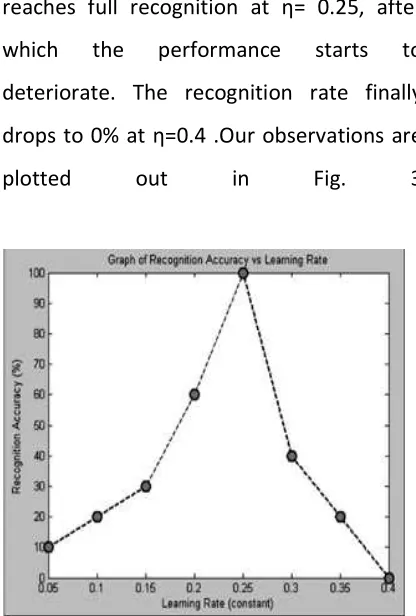
Available Online At www.ijpret.com ranging from 0.05 to 0.4, each time
increasing by 0.05. Recognition accuracy
increases with the learning constant until it
reaches full recognition at η= 0.25, after
which the performance starts to
deteriorate. The recognition rate finally
drops to 0% at η=0.4 .Our observations are
plotted out in Fig. 3
Fig. 3 Graph of recognition Accuracy vs.
leaning rate.
B. Number of Hidden Neurons-
In our experiments, we trained the MSNN
with different numbers of hidden units (5 to
40) and recorded their recognition rates.
For a network with 10 to 20 hidden
neurons, the recognition accuracy is 100%.
Any number of hidden units beyond 20 will
experience a gradual decrease in
performance, eventually hitting zero
recognition at 40 neurons. As the graph in
Fig. 4 indicates, efficiency increases as the
number of neurons increases from 5 to 10;
it remains constant between10 to 20
neurons, and drops drastically after that.
Although it is true that increasing the
number of hidden neurons can extract
more implicit information, an excessive
number may cause over fitting and high
generalization error. On the contrary, the
MSNN will not converge if the number of
hidden units is too small under fitting
results in high training and generalization
error.
Fig. 4 Graph of recognition Accuracy vs. NO
of Hidden Cells.
Available Online At www.ijpret.com Our experiment presents an MSNN-based
face detection and recognition system. The
system was shown to be reliable and fast
enough to detect and recognize faces of
fairly different sizes and under different
lighting conditions without the need of
computationally-costly pre-processing of
the input images. The extraction of facial
features .To increase the size range of faces
that can detected, we apply the MSNN to
input images at different resolutions.
REFERENCES
1. Y. Won et. al., Morphological
Shared-Weight Networks with Applications to
Automatic Target Recognition Electronics
and Telecommunications Research
Institute, Daejon, South Korea.
2. Y. Won and P. Gader, Morphological
Shared-Weight Neural Network for Pattern
Classification and Automatic Target
Detection, University of Missouri-Columbia,
1995.
3. A. Pentland and T. Choudhury, “Face
Recognition for Smart Environments,” IEEE
Computer, vol. 33, pp. 50–55, 2000
4. Face Recognition Using Morphological
Shared-weight Neural Networks World
Academy of Science, Engineering and
Technology 45 2008
5. T. Sim, R. Sukthankar, M. Mullin, and S.
Baluja, Memory-based Face Recognition for
Visitor Identification, The Robotics Institute,
Carnegie Mellon University, 2000.
6. Open CV image processing and computer
vision library
http://www.intel.com/technology/computi
ng/opencv/
7. G.J. Scott, J.M. Keller, M. Skubic, and R.H.
Luke, “Face Recognition for Homeland
Security: A Computational Intelligence
Approach,” Proc. IEEE Int’l Conference on