
Design, development and characterization of mouth dissolving tablets of cefixime
7
0
0
Full text
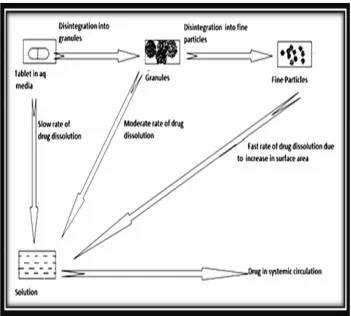
(2) 116 . Difficult to formulate a drug with poor wettability, slow dissolution into a tablet. Slow onset of action as compared to parenterals, liquid orals and capsules. The amount of liquid drug (eg. Vitamin E, Simethicone) that can be trapped into a tablet is very less. Difficult to swallow for kids, terminally ill and geriatric patients. Patients undergoing radiotherapy cannot swallow tablet5,9,10.. Mechanism of Tablet Disintegrants The tablet breaks to primary particles by one or more of the mechanisms (Fig.1) listed below 11-12, By capillary action By swelling Because of heat of wetting Due to disintegrating particle/particle repulsive forces Due to deformation Due to release of gases and By enzymatic action.. Materials and Methods. Cefixime was kindly provided by the Yarrow Chemicals Ltd., Mumbai, All other reagents and solvents used were of analytical grade. Preparation of Cefixime Mouth Dissolving Tablets The preparation of Cefixime mouth dissolving tablets was done by Wet Granulation13-14. Preparation of Wet Granulation The Wet granulation was done by two steps. They were Granulation and Lubrication. Granulation Weighed accurately all the raw materials. Mannitol, Starch, Lactose, Cross Povidone, Aspartame, and Talc were passed through 40 mesh and mixed thoroughly for 15 min. Add small quantity of purified water to make cohesive mass. Then pass through a 40 mesh. The wet granules were dried at 600C for 1 hour. Then dried granules were passed through the 30 mesh (table 1). Lubrication The drug content of Cefixime was added with Cross povidone by geometric mixing and passed through 100 mesh for 3 times. Aspartame, Mannitol, Talc, Magnesium sterate were passed through 40 mesh. Then these granules of lubrication and granulation were mixed thoroughly for 15 minute. Then compressed into tablet (table 2). The Various Characteristics of Blends Tested are as given below 15-18 1. Angle of Repose The frictional force in a loose powder can be measured by the angle of repose θ. It is defined as, the maximum angle Int. J. Pharm & Ind. Res. Vol - 01. possible between the surface of the pile of the powder and the horizontal plane. If more powder is added to the pile, it slides down the sides of the pile until the mutual friction of the particles producing a surface angle θ, is in equilibrium with the gravitational force. The angle of repose was determined by the funnel method suggested by Newman. Angle of repose is determined by the following formula, θ = Tan-1 (h/r). Where,. θ = Angle of repose h = height of the cone r = Radius of the cone base Angle of Repose less than 25° shows the free flowing of the material. 2. Bulk Density Density is defined as weight per unit volume. Bulk density (Pb) is defined as the mass of the powder divided by the bulk volume and is expressed as gm/cm3. The bulk density of a powder primarily depends on particle size distribution, particle shape and the tendency of particles to adhere together. There are two types of bulk density. The particles are pack in such a way so as to leave large gaps between their surfaces resulting in light powder of low bulk density. Here the smaller particles shift between the large particles resulting in heavy powder of high bulk density. Bulk density is very important in the size of containers needed for handling, shipping, storage of raw material and blend. It is also important in size blending equipment. A standard procedure used for obtaining bulk density or its reciprocal bulkiness is given below, A sample of about 50cm3 (blend) is carefully introduced in a 100 ml graduated cylinder. The cylinder is dropped onto a hard wood surface three times from a height of 1 inch at two second interval. The bulk density is then obtained by dividing the weight of sample in gms by final volume in cm 3. Where,. Pb =m/Vp Pb = Bulk Density m = Weight of sample in gm Vp = Final volume of blend in cm3. 3. Bulkiness Specific bulk volume or reciprocal of bulk density is called bulkiness or bulk. Bulkiness increases with a decrease in particle size. In mixture of material of different sizes, however the smaller particle shifts between the larger particles and tends to reduce the bulkiness. The bulkiness can be calculated by the following formula, Bulkiness = 1/Pb Where, Pb = Bulk Density. Loose Bulk Density It is defined as the ratio of weight of blend in gms to the loose bulk volume (untapped volume) in cm3. Loose bulk density (Pu) is given by, Issue - 02. Apr - Jun 2011.
(3) 117 Where. Pu = Weight in gms/Vb Vb = Bulk volume (untapped volume). 4. Void Volume The volume of the spaces is known as the void volume "V" and is given by the formula, Where. V = Vb-Vp Vb = Bulk volume (volume before tapping) Vp = True volume (volume after tapping). 5. Porosity The porosity (€) of powder is defined as the ratio of void volume to the bulk volume of the packaging. The porosity of the powder is given by €= Vb - Vp/ Vp = 1- Vp/Vb Porosity is frequently expressed in percentage and is given as %€ = (1 - Vp/ Vb) X 100 The porosity of powder indicates the types of packaging a powder undergoes when subject to vibrations, when stored or in tablet machine when passed through hopper or feed frame. 6. Percent Compressibility It is an important measure obtained from bulk density and is defined as, C= Pb-Pu /Pb x100 If the bed of particles is more compressible the blend will be less flowable and flowing materials.. Results and Discussion. Tablets from all the formulation were subjected to following quality control tests. General Appearance The general appearance of a tablet, its visual identity and over all "elegance" is essential for consumer acceptance. Include are tablet's size, shape, colour, presence or absence of an odour, taste, surface texture, physical flows, consistency and legibility of any identifying marking (table 5). Tablet Thickness It was done by Vernier callipers as per the procedure in the evaluation of Mouth dissolving tablets. The results were from the formulation I, II, III and got good results in formulation III. Uniformity of Weight I.P. procedure for uniformity of weight was followed (table 4), twenty tablets were taken and their weight was determined individually and collectively on a digital weighing balance. The average weight of one tablet was determined from the collective weight. The weight variation Int. J. Pharm & Ind. Res. Vol - 01. test would be a satisfactory method of determining the drug content uniformity (table 4). Tablet Hardness Hardness of tablet is defined as the force applied across the diameter of the tablet in the order to break the tablet. The resistance of the tablet to chipping, abrasion or breakage under condition of storage transformation and handling before usage depends on its hardness. Hardness of the tablet of each formulation was determined using Monsanto Hardness tester. Friability It is measured of mechanical strength of tablets. Roche friabilator was used to determine the friability by following procedure. A pre weighed tablet was placed in the fribaiator. Friabilator consist of a plastic-chamber that revolves at 25 rpm, dropping those tablets at a distance of 6 inches with each revolution. The tablets were rotated in the friabilator for at least 4 minutes. At the end of test tablets were dusted and reweighed, the loss in the weight of tablet is the measure of friability and is expressed in percentage as, % Friability = loss in weight / Initial weight x 100 It was done as per the procedure in the evaluation of MD tablets and the result was found to be 3% but slight deviations were present in all formulations. Average weight and Weight variation. The average weight of the MD tablets was found to be 1.275g and the uniformity of weight complies as per I.P Limits (±10%). Disintegration test The test was carried out on 6 tablets using the apparatus specified in I.P.1996 distilled water at 37ºC ± 2ºC was used as a disintegration media and the time in second taken for complete disintegration of the tablet with no palable mass remaining in the apparatus was measured in seconds. It was done by the disintegration apparatus as per the procedure in evaluation of MD tablets. The good result was found good in F3. Wetting time The method was followed to measure tablet wetting time. A piece of tissue paper (12 cm X 10.75 cm) folded twice was placed in a small Petri dish (ID = 6.5 cm) containing 6 ml of Sorenson's buffer pH 6.8. A tablet was put on the paper, and the time for complete wetting was measured. Three trials for each batch and the standard deviation were also determined. In vitro dispersion time In vitro dispersion time was measured by dropping a tablet in a beaker containing 50ml of Sorenson's buffer pH 6.8. Six tablets from each formulation were randomly selected and in vitro dispersion time was performed. It was done as per the procedure in evaluation of MD tablets. The good results were found in F3.. Issue - 02. Apr - Jun 2011.
(4) 118. Conclusion. The super disintegrants was reported as disintegrants were more effective with the Cefixime. This active drug is used for the treatment of a variety of infections caused by organisms. The super disintegrants are more of use with drug devoid of. any interactions. Formulation containing drug with super disintegrants showed rapid in-vitro dispersion time as compared to other formulations.. Figure 1 Schematic representation of tablet disintegration and Subsequent drug dissolution. Table 1 Granulation S. No. Int. J. Pharm & Ind. Res. Name of the ingredient. F1. F2. F3. 12. 12. 12. 1.. Mannitol (mg). 2.. Starch (mg). 25. 25. 25. 3.. Lactose (mg). 22.8. 29.8. 26.8. 4.. Cross Povidone (mg). 3. 3. 3. 5.. Aspartame (mg). 1.5. 1.5. 1.5. 6.. Talc (mg). 1.5. 1.5. 1.5. 7.. Purified water (ml). 5. 5. 5. Vol - 01. Issue - 02. Apr - Jun 2011.
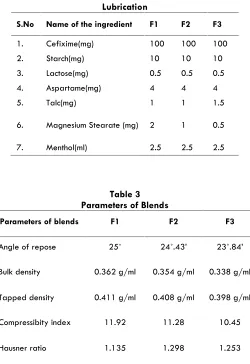
(5) 119. Table 2 Lubrication S.No. Name of the ingredient. F1. F2. F3. 1.. Cefixime(mg). 100. 100. 100. 2.. Starch(mg). 10. 10. 10. 3.. Lactose(mg). 0.5. 0.5. 0.5. 4.. Aspartame(mg). 4. 4. 4. 5.. Talc(mg). 1. 1. 1.5. 6.. Magnesium Stearate (mg). 2. 1. 0.5. 7.. Menthol(ml). 2.5. 2.5. 2.5. Table 3 Parameters of Blends Parameters of blends. F1. F2. F3. Angle of repose. 25˚. 24˚.43’. 23˚.84’. Bulk density. 0.362 g/ml. 0.354 g/ml. 0.338 g/ml. Tapped density. 0.411 g/ml. 0.408 g/ml. 0.398 g/ml. Compressibity index. 11.92. 11.28. 10.45. Hausner ratio. 1.135. 1.298. 1.253. Table 4 Drug content uniformity. Int. J. Pharm & Ind. Res. S.No. Average weight of Tablets (mg). Maximum percentage allowed. 1.. 130 or less. 10. 2.. 130-324. 7.5. 3.. More than 324. 5. Vol - 01. Issue - 02. Apr - Jun 2011.
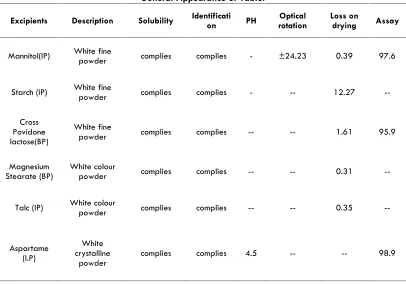
(6) 120. Table 5 General Appearance of Tablet Excipients. Description. Solubility. Identificati on. PH. Optical rotation. Loss on drying. Assay. Mannitol(IP). White fine powder. complies. complies. -. ±24.23. 0.39. 97.6. Starch (IP). White fine powder. complies. complies. -. --. 12.27. --. Cross Povidone lactose(BP). White fine powder. complies. complies. --. --. 1.61. 95.9. Magnesium Stearate (BP). White colour powder. complies. complies. --. --. 0.31. --. Talc (IP). White colour powder. complies. complies. --. --. 0.35. --. Aspartame (I.P). White crystalline powder. complies. complies. 4.5. --. --. 98.9. Table 6 Table of Tablet Parameters Parameters. F1. F2. F3. 2.006. 2.014. 2.022. 3.5. 3.3. 3.4. 3. 2.8. 3.1. 1.287. 1.262. 1.276. Drug content uniformity (mg). 85. 79. 87. Wetting time (sec). 21. 18. 14. In-vitro disintegration time (sec). 58. 51. 39. Uniformity in thickness (mm) Hardness (kg/cm3) Friability (%) Weight variation(mg). Int. J. Pharm & Ind. Res. Vol - 01. Issue - 02. Apr - Jun 2011.
(7) 121. References. 1. Tripathi KD., Essentials of Medicinal Pharmacology, 6th Edition, 2008, 706. 2. Anantha Lakshmi Pallikonda, Ravindar Bairam, Motilal M and Shubash Kumar M., Formulation and Evaluation of Mouth Dissolving Tablets, Scholar Research Library, 2(1) 2010, 342-346. 3. Tejvir Kaur, Bhawandeep Gill, Sandeep Kumar and Gupta G.D, Mouth Dissolving Tablets: A Novel Approach to Drug Delivery, Int.J.Curr.Pharm.Res., 3(3) 2011, 1-7. 4. Suresh Bandari, Rajendar Kumar M, Ramesh Gannu and Yamsani Madhusudan Rao, Orodispersible Tablets:An Overview, Asian Journal of Pharmaceutics, 2(1) 2008, 211. 5. Lachman L. Liberman H and Kanig J., The Theory and Practice of Industrial Pharmacy, 3rd Edition, Dec. 2009, 293-345. 6. Luca Dobetti , Fast-Melting Tablets:Developments and Technologies, Pharm. Tech., 2001, 44-50. 7. Kuchekar, B.S. Atul Badhan C & Mahajan H.S, Mouth dissolving tablets:A Novel Drug Delivery System, Pharma Times, 2003, 35, 7-9. 8. Allen L.V and Wang B., Particulate Support Matrix for making a rapidly dissolving tablet,1997, US Patent 5595761. 9. Chang R, Guo X, Burnside B.A and Couch R.A, A Review of Fast-dissolving tablets, Pharm. Tech., 24(6) 2000, 5258.. Int. J. Pharm & Ind. Res. Vol - 01. 10.Reddy L.H, Ghosh B.R, Fast dissolving drug delivery systems:A Review of the literature, Ind J. Pharm. Sci., 64(4) 2002, 331-336. 11.Banker G and Rhodes C, Drug and Pharmaceutical Sciences : Modern Pharmaceutics, 3rd Edition, vol.72, Dec 2009, 333-394. 12.Ferrari F, Investigation on Binding and Disintegration Properties of Pharmaceutical Materials, International Journal of Pharmaceutics, (13) 1996, 71-79. 13.Induwade N.H, Rajyagaru T.H and Nakhat P.D, Novel Approach-Fast Dissolving Tablets, Indian Drugs, 39(8) 2002, 405-409. 14.Virley P and Yarwood R.J, A Novel Fast Dissolving Dosage Forms, Manufacturing Chemist, (36) Feb. 1990, 36-37. 15.Patrick j Sinko, Martin,s Physical Pharmacy and Pharmaceutical Sciences, 5th Edition, 2006, 553-559. 16.Gold G, Danish F, Parrott E and Slatter G, Powder Flow Studies - Factors Affecting Flow of Lactose Granules, Journal of Pharmaceutical Sciences, 57(4) 1968, 667671. 17.Danish F and Parrott E, Flow rates of Solid Particulate Pharmaceuticals, Journal of Pharmaceutical Sciences, 60(4), 1971, 548-554. 18.Eves T, Jones T, Mechanism of Flow Improvement by Addition of Fine Particles to Bulk Solids, Journal of Pharmaceutical Sciences, 57(11) 1968, 2015-2016.. Issue - 02. Apr - Jun 2011.
(8)
Figure
Related documents
The moment that you use the word “God” with understanding, and belief, and knowing, you are setting up the greatest vibration that is known today, and the vibratory influence
BIOVIA Experiment is a first-in-class research and development-focused laboratory informatics system that enables R&D organizations to more efficiently manage, analyze and
should involve, treating promissory rights and obligations as subject to market norms, including norms permitting the purchase and sale of those rights and obligations.”
A case-controlled study of neonatal effects of maternal marijuana use in Jamaica, where marijuana use has cultural, medicinal, and religious links, found no
North America The United States maintains the highest worldwide member-to-vehicle ratios (40:1). North American average member-to-vehicle ratios are estimated at 35:1. North
To analyze the mechanism of drug release from the formulation, the dissolution profile of all the batches were fitted to zero order, first order, Higuchi and
