Design and Testing of a Remote Deployable Water Purification System
Powered by Solar Energy
Amber E. Keith, Jesse J. French
*Department of Mechanical Engineering, LeTourneau University, Longview, Texas, USA
Received 20 July 2017; received in revised form 05 September 2017; accepted 15 January 2018
Abstract
The design of an all-inclusive, self-sufficient, sustainable water purification system for application in
developing regions of the world can improve living conditions for people world-wide, especially in regions where
access to clean drinking water is limited or unavailable. According to the World Health Organization, the 2015
global census estimated that 663 million people worldwide live without access to safe drinking water sources [1]. An
estimated 315,000 children die each year from diarrheal diseases caused by lack of clean water and poor sanitation
[2]. Based on these statistics, an all-inclusive, self-sufficient, remote-deployable water purification system has been
designed, constructed, and tested to validate the concept of a renewable energy system.
The system is integrated into a standard 20-foot shipping container for ease of deployment worldwide. Once
situated in the operating area, the shipping container is used as the system shelter and solar panels are mounted to the
roof at a location-dependent fixed angle. The solar panels are connected to a battery bank which operates the system.
The water purification process utilizes a five-step progression which filters the contaminated freshwater, removing
suspended particles and bacteria from the water and purifying the water to the standards of the EPA Safe Drinking
Act [3].
Testing verifies the capability of the solar panels to generate enough electricity to power the system and
recharge the battery bank. The solar panel array has the rated power output of 2,320 Watts. The water purification
operates on a maximum of 97.9 Watts of available power. With the fully charged battery bank, the water purification
system can operate for 24-hours without additional solar input. With a freshwater source, the purification system can
yield up to 440 liters of water per hour.
Keywords: renewable energy, solar power, clean water, water purification, self-sufficient
1.
Introduction
Without water, a person will die of dehydration within three days [4]. Without water, crops cannot be grown and
starvation can result. Though over 70% of the Earth’s surface is covered in this vital source of life, clean drinking water is
scares [2]. Freshwater, water that is not full of dissolved salts, makes up only about 2.5% of the water source on the entire
planet [5]. Of that 2.5%, only about half of that is accessible for use [5]. According to the World Population Clock, there is
currently 7.5 billion people on the plant with a projected population reaching 8 billion by the year 2023 and 10 billion by t he
year 2056 [6]. Those 7.5 billion people must share the one percent of available freshwater on the world for drinking, cooking,
and cleaning. Unfortunately, the distribution of drinking water is not proportional to the distribution of the population [7].
Some areas enjoy a surplus of water, whereas others have significant shortages [7]. As can be seen in Fig. 1, the water
Fig. 1 Global water scarcity [9]
An estimated six to eight million people die from water-related diseases each year [10]. Inventor of the Segway, Dean
Kamen, once said, “We could empty half the hospital beds in the world by just giving people clean water” [11]. Dean Kamen
has gone on to design the SlingShot water purification system which uses a vapor distillation method to bring about this goal to
reduce the number of people in hospital beds, simply by improving access to clean water [11].
Water shortages are not the only shortage affecting the developing world. The International Energy Agency has estimated
that 1.2 billion people worldwide live without access to electricity [12]. Seventeen percent of the global population lives
without electricity, even for simple household illumination, cellphone charging, or computer use. By proving a system that
generates excess electricity after purifying water, two global issues can be solved with a single system.
2.
System Design
The Sustainable Purification System (SPS) is powered solely by renewable resources to provide access to clean drinking
water limited electricity to underdeveloped regions around the world. For simplicity of deployment and maintenance, the water
purification system has been designed to be chemical-free, since access to chemicals in remote locations would be nearly
impossible and not cost-effective. The minimum desiredpurified water output is 150 liters per day. This is a sufficient water
output for a 50-person community with the assumption that each resident receives 3-liters of purified water per day. Further
testing has been conducted to determine the exact potential output for the system based on optimum solarconditions and power
supplied from the battery bank.
The water purification system is powered by eight 290 Watt solar panels mounted on the roof of the shipping container.
The solar panels are mounted at a fixed angle of 30.0°. This angle was chosen based on the latitudinal position of the testing
location. Electricity generated by the solar panels is directed through a charge controller, which will either utilize the power for
pumping and purifying water or for charging the on-board battery bank. Excess electricity is available for system, lighting and
installed outlets for powering electronics such as cellphones. The SPS container can be seen in Fig. 2 with the solar array
mounted on the roof at the fixed angle. The system is monitored by the charge controller which is designed to keep the battery
bank from dropping below a 50% charge value in order to preserve the lifespan of the deep-cycle batteries. An Arduino-based
controller monitors the battery voltage and water levels in order to automatically produce water, as needed. If the battery bank
drops below 50% capacity, the Arduino controller will shut off the system to prevent over-discharge. The charge controller and
Fig. 2 Sustainable Purification System shipping container enclosure
Fig. 3 Arduino and charge controller setup for the Sustainable Purification System
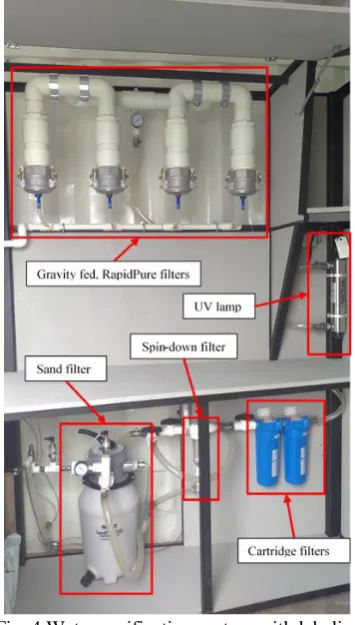
Fig. 4 Water purification system with labeling
The system design for purification is broken into three main sub-systems: pumping, purification, and storage. The five
stages of filters can be seen in Fig. 4. First, the water is pumped from the source; whether a deep or shallow well, river, lake, or
sea. The pump is a fully submerged pump that is coupled with a flow switch to turn off the pump when insignificant water is
available. Next, the water proceeds through the three-stage purification system: filtration, sterilization, and purification. The
entire design is constructed into a custom workbench to contain the components. The filtration stage includes three filters types:
sand, spin-down, and two cartridge filters. The water flows through the sand filter to remove large particulates, such as dirt and
leaves. This filter is designed to process up to 30,000 liters of water at up to 140 liters per minute. The spin-down filter is a
15-micron screen to remove particles left behind after the sand filter. The final stage is a set of cartridge filters remove down to
five microns and then one-micron sized particles. Any particulate remaining after the filtration stage is less than one micron in
size. For comparison, a human hair is about 75 microns in size [13].
Next is the sterilization phase. A UV lamp provides fluence to the water to kill bacteria and viruses. The bacteria and
viruses are not removed in this stage, just eradicated. In the final purification phase, the water passes through a RapidPure filter
To determine the system power requirements, the charge controller was set in the float state with the batteries fully
charged. This means that all power generated would be used for powering the system and not for additional charging of the
battery bank. To ascertain how much power was used by the system, the purification system cycled ten liters of water. The
charge controller displays the amperage draw of the system and the overall voltage. By knowing the amperage and voltage of
the system, the power draw can be calculated with Ohm’s Law: 𝑐𝑢𝑟𝑟𝑒𝑛𝑡 [𝐴] × 𝑣𝑜𝑙𝑡𝑎𝑔𝑒 [𝑉] = 𝑝𝑜𝑤𝑒𝑟 [𝑊].
Fig. 5 Digital flow meter installed in system between the purification system and storage tank
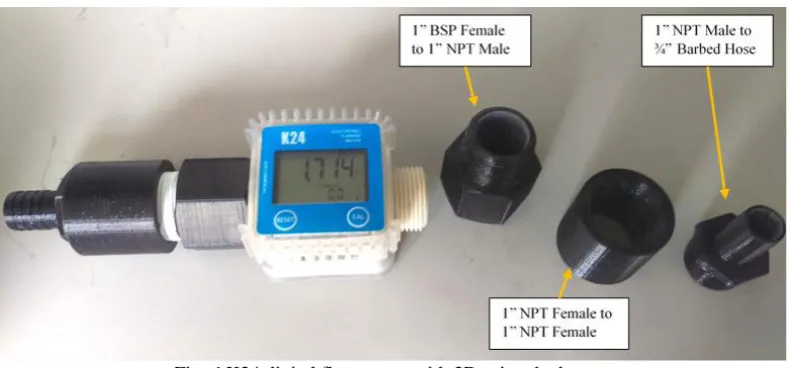
Fig. 6 K24 digital flow meter with 3D printed adapters
The pump is rated for a maximum flow rate of 7.0 liters per minute when the pump is at a head of 20 feet. This means that
if the pump is operating at peak performance, then in a single hour, the system should theoretically cycle 420 liters of water.
This provides three liters of water per resident for up to 140 people per hour. For flow rate testing, the K24 turbine digital flow
meter was placed in-line with the system between the RapidPure filters and the storage tank as seen in Fig. 5. The K24 digital
flow meter has one-inch British Standard Pipe (BSP) threads on both ends of the display for the inlet and outlet. The hose
between the final stage of the purification system and the storage tank is ¾ -inch clear tubing. The solution to convert the 1-inch
BST to 3/4-inch barb hose fitting was a series of three transition adapters. Since BSP is not a standard size available in the
The flowmeter displays the flow rate and number of liters that have passed through the system. During testing, the flow rate
was recorded periodically during a continuous twenty-minute system operation. The K24 digital flowmeter can be seen Fig. 6
in with the three types of transition adapters labeled.
4.
Results and Discussion
4.1 Water purification rates
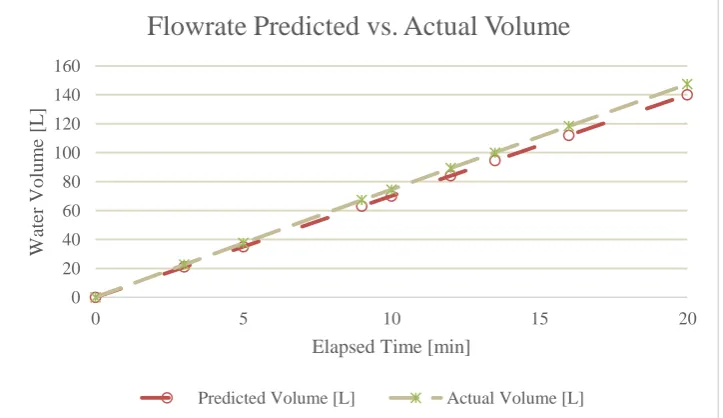
During testing for system operations, data was recorded for elapsed time and liters cycled. The digital flowmeter
displayed a consistent 7.1 liters per minute flow rate during the entire period. After an elapsed time of thirteen and a half
minutes, a full 100-liters had been processed through the system. At the conclusion of testing, 147.4 liters of water had been
purified. This is slightly higher than the predicted 140 liters from the expected flow rate. This testing was conducted under
optimum conditions since the overall head of the pump is less than 20 feet.
Extrapolating the testing results, it is estimated that the system can purify up to 440 liters per hour. If the system operates
for 8 hours a day, up to 3,520-liters water can successfully be purified in a single day of operations. Since the design parameter
is to provide 3-liters of clean drinking water to each resident, the current system is properly sized for a 1,000-person
community. The predicted verse the actual volume of purified water compared to elapsed time can be seen in Fig. 7. As shown
in the graph, the flow rate of the water purification is linear.
Fig. 7 Volume of purified water vs. elapsed time
4.2 Power consumption
Table 1 Current and power draw for system components
Control System UV Filter Pump Whole System
Current [A] 0.7 1.4 2.4 3.6
Voltage [V] 27.2 27.2 27.2 27.2
Power Draw [W] 19.04 38.08 65.25 97.92
The power system requires 24V of direct-current [DC] electricity. The charge controller displays a constant system
voltage of 27.2V, which is the charging voltage of the storage batteries. Table 1 shows a summary of the amperage and power
draw of different combinations of system components. The Arduino controller and charge controller are continuously operated,
so the current draw is constant at 0.7A. The 19W power draw from the control system is required for system monitoring and
operations. Most of the purification system is passive and does not require electricity; the UV filter being the only component
that requires power to function. With the UV filter operation and the pump turned off, the system requires 38W of power to 0 20 40 60 80 100 120 140 160
0 5 10 15 20
W ater Vo lu m e [L ]
Elapsed Time [min]
Flowrate Predicted vs. Actual Volume
Fig. 8 Power requirements as additional components are activated; cumulative effect on the overall power draw
The system power draw is significantly less than the overall power potential of the solar array. Excess power generated
can be utilized for charging the battery bank for use when the solar insolation is minimal. In the case where the battery bank is
already fully charged and the sun is out to continue generating power, excess electricity. Potentially, surplus power generated
could be utilized for charging cell phones or powering household lighting; however, first priority of the system is to keep the
battery bank at full charge in case of insufficient sun for power generation for operating the system.
5.
Conclusion
With the self-contained system integrated into the shipping container, the water purification system can be deployed, set
up, and operated wherever in the world there is a need for clean water and access to solar energy.
The current water purification system is operational and sufficient for providing clean drinking water to a small
community anywhere in the world provided there is an accessible source of fresh water for filtration. Through testing, it has
been demonstrated that the solar array provides more than sufficient power to operate the water purification system, with the
excess being used to charge the battery bank. With a fully charged battery bank, the system can be operated full 24-hour period
without solar input. This system can be designed and optimized for any application and for a variety of locations. The solar
array can be expanded and the fixed mounted angle of the panels is customized to the final destination, based on the latitude of
the location.
Through the research and development of the Sustainable Purification System, a practical system is built and tested which
is relevant to the global water crisis.
References
[1] WHO Library Cataloguing-in-Publication Data, “Progress on sanitation and drinking water-2015 update and MDG assessment,” pp. 17-35, 2015.
[2] “Statistics-the hard facts behind the crisis,” http://www.wateraid.org/what-we-do/the-crisis/statistics. February 24,2017. 0
10 20 30 40 50 60 70 80 90
Control System UV Filter Pump Whole System
P
o
w
er
Dr
aw
[
W
]
[3] “Safe drinking water act,” https://www.epa.gov/sdwa, 2002.
[4] C. Binns, “How long can a person survive without water? ” http://www.livescience.com/32320-how-long-can-a-person- survive-without-water.html, November 30, 2012.
[5] H. Perlman, “How much water is there on, in, and above the Earth ” http://water.usgs.gov/edu/earthhowmuch.html, December 2, 2016.
[6] “Current world population,” http://www.worldometers.info/world-population December 11, 2016.
[7] B. Chaouchi, A. Zrelli, and G. Slimane, “Desalination of brackish water by means of a parabolic solar concentrator,” Desalination, vol. 217, no. 1, pp. 118-126, 2007.
[8] “Water and poverty,” https://lifewater.org/blog/water-poverty/, December 26, 2017.
[9] Managing Water Under Uncertainty and Risk, The United Nations World Water Depvelopment Report 4, Paris, UNESCO, 2012.
[10] “Water facts and figures,” http://www.unwater.org/water-cooperation-2013/water-cooperation/facts-and-figures/en/, 2013.
[11] S. Nasr, “How the slingshot water purifier works,” http://science.howstuffworks.com/environmental/green-tech/ remediation/slingshot-water-purifier.htm, July 27, 2009.
[12] “Energy poverty,” http:// www.iea.org/topics/energypoverty/, January 10, 2017.
Copyright© by the authors. Licensee TAETI, Taiwan. This article is an open access article distributed under the terms and conditions of the Creative Commons Attribution (CC BY-NC) license
![Fig. 1 Global water scarcity [9]](https://thumb-us.123doks.com/thumbv2/123dok_us/9831068.1969243/2.595.130.463.112.282/fig-global-water-scarcity.webp)