R E S E A R C H
Open Access
Hybrid steepest iterative algorithm
for a hierarchical fixed point problem
Shamshad Husain
*and Nisha Singh
*Correspondence:
[email protected] Department of Applied Mathematics, Aligarh Muslim University, Aligarh, 202002, India
Abstract
The purpose of this work is to introduce and study an iterative method to approximate solutions of a hierarchical fixed point problem and a variational inequality problem involving a finite family of nonexpansive mappings on a real Hilbert space. Further, we prove that the sequence generated by the proposed iterative method converges to a solution of the hierarchical fixed point problem for a finite family of nonexpansive mappings which is the unique solution of the variational inequality problem. The results presented in this paper are the extension and
generalization of some previously known results in this area. An example which satisfies all the conditions of the iterative method and the convergence result is given.
MSC: 49J30; 49J40; 47H09; 47J20
Keywords: nonexpansive mapping; strongly monotone; variational inequalities; fixed point problem
1 Introduction
Throughout this paper, we always assume thatV is a real Hilbert space with the inner product·,·and the norm · , respectively. Let a nonlinear mappingS:V →V be a nonexpansive operator if
Su–Sv ≤ u–v, ∀u,v∈V.
A pointu∈Vis said to be a fixed point ofSprovidedSu=u. In this paper, we useF(S) to denote the fixed point set which is closed and convex, see [].
Let S:W →V be a nonexpansive mapping, whereW is a nonempty closed convex subset ofV. The hierarchical fixed point problem (in short, HFPP) is to findu∈F(S) such that
u–Su,v–u ≥, ∀v∈F(S). (.)
Many authors solve (.) by various methods, see [–] and the references therein.
Yaoet al. [] proposed the following iterative algorithm to solve HFPP (.):
⎧ ⎨ ⎩
vn=bnSun+ ( –bn)un,
un+=PW[ang(un) + ( –an)Svn], ∀n≥,
(.)
where{an}and{bn}are sequences in (, ) andg:W→Vis a contraction mapping, and the sequence{un}generated by (.) converges strongly toz∈F(S), which is also a unique solution of the variational inequality problem (VIP),i.e., to findz∈F(S) such that
(I–g)z,v–z≥, ∀v∈F(S). (.)
After that, Cenget al.[] introduced the following algorithm:
un+=PW
anρg(un) + (I–anμF)S(un)
, ∀n≥, (.)
whereFis a Lipschitz continuous and strongly monotone mapping,gis a Lipschitz contin-uous mapping. Compute an iterative sequence{un}generated by (.) converging strongly toz∈F(S), which is also a unique solution of the following variational inequality problem (VIP),i.e., to findz∈F(S) such that
ρg(z) –μF(z),v–z≥, ∀v∈F(S). (.)
By using aTn-mapping [], Yao [] proposed the following iterative method:
un+=ancg(un) +bun+
( –b)I–anA
Tnun, ∀n≥, (.)
wherec> ,Ais a strongly positive bounded linear operator andg:W→Vis a contrac-tion mapping.
Further, Cenget al. [] proposed explicit and implicit iterative schemes for finding a common solution for the set of fixed points of a nonexpansive mapping. Buong and Duong [] studied the explicit iterative algorithm for finding the approximate solution of a VIP defined over the set of common fixed points of a finite number of nonexpansive mappings:
uk+= –bk
uk+bkSkSkp· · ·Skuk, (.)
whereSk
i = ( –bik)uk+bkiSifor ≤i≤p,{Si} p
i= arep-nonexpansive mappings on a real
Hilbert spaceV,Sk=I–λkμF, andFis anη-strongly monotone andL-Lipschitz contin-uous mapping.
Very recently, Zhang and Yang [] studied the more general explicit iterative algorithm
uk+=akcg(uk) + (I–μakF)SpkSkp–· · ·Skuk, (.)
iterative sequence{uk}proposed by the iterative algorithm (.) that strongly converges to the solution of the VIP,i.e., to findz∈pi=F(Si) such that
(μF–γg)z,v–z≥, ∀v∈ p
i=
F(Si). (.)
Inspired and motivated by the recent research, we develop an iterative algorithm for a hierarchical fixed point problem of a finite family of nonexpansive mappings on the real Hilbert space. We generate a strong convergence theorem for the sequence considered by the generalized method. Numerical examples are also given for the theoretical verification of the algorithm. The algorithm and results presented in this paper improve and extend some recent corresponding algorithms and results; see [, ] and the references therein.
2 Preliminaries
We recall some concepts and results which are needed in the sequel.
Definition . LetS:W→Vbe a mapping which is said to be (i) monotone if
Su–Sv,u–v ≥, ∀u,v∈W;
(ii) strongly monotone if there exists a constantα> such that
Su–Sv,u–v ≥αu–v, ∀u,v∈W;
(iii) Lipschitz continuous if there exists a constantk> such that
Su–Sv ≤ku–v, ∀u,v∈W.
Ifk= , thenSis called nonexpansive.
Definition . A mappingg:W→Vis said to beσ-contraction if there exists a constant σ∈(, ) such that
gu–gv ≤σu–v, ∀u,v∈W.
Lemma .([]) Let F:W →V be anη-strongly monotone and k-Lipschitz continuous mapping and g:W→Vbe aτ-Lipschitz continuous mapping.Then the mappingμF–ρg is(μη–ρτ)-strongly monotone with conditionμη>ρτ≥,i.e.,
(μF–ρg)u– (μF–ρg)v,u–v≥(μη–ρτ)u–v, ∀u,v∈W.
Definition . A mappingT:V→Vis said to be an averaged mapping if it can be written as the average of the identityIand a nonexpansive mapping,i.e.,
T≡( –α)I+αS,
Lemma .([, ]) If the mappings{Si}pi=are averaged and have a common fixed point,
then
p
i=
F(Si) =F(SS· · ·Sp).
In particular,if p= ,we have F(S)∩F(S) =F(SS) =F(SS).
Lemma .([]) Let{αn}be a sequence of nonnegative real numbers such that
αn+≤( –wn)αn+tn,
where{wn} ∈(, )and{tn}is a sequence such that (i) ∞n=wn=∞;
(ii) lim supn→∞ tn
wn ≤or
∞
n=|tn|<∞. Thenlimn→∞αn= .
Lemma .([]) Let S:W →W be a nonexpansive mapping with F(S)=∅.Then the mapping I–S is demiclosed at,that is,if{un}is a sequence converging weakly to u and {(I–S)un}converges strongly to,then(I–S)u= .
Lemma .([]) Let F:W→Vbe anη-strongly monotone and k-Lipschitzian mapping. Letkη >μ> ,Q=I–λμF.Then Q is a( –λτ)-contraction mapping withmin{,τ}>λ>
,that is,
Qu–Qv ≤( –λτ)u–v, ∀u,v∈W,
whereτ = – –μ(η–μk)∈(, ].
Lemma . LetVbe a real Hilbert space.The following inequality holds:
u+v≤ u+ v,u+v, ∀u,v∈V.
3 Main results
In this section, we establish an iterative method for finding the solution of hierarchical fixed point problem (.).
LetW be a nonempty closed convex subset of a real Hilbert space V, and let{Si}pi=
bepnonexpansive mappings onW such that =pi=F(Si)=∅. LetF:W→W be an η-strongly monotone and k-Lipschitzian mapping andg :W →W be aτ-contraction mapping.
We consider the following hierarchical fixed point problem (in short, HFPP): findu∈ such that
ρg(u) –μF(u),v–u≤, ∀v∈ = p
i=
F(Si). (.)
Algorithm . Given arbitrarilyu∈W, compute sequences{un}and{vn}by the iterative schemes
⎧ ⎨ ⎩
vn=bnun+ ( –bn)SpnSnp–· · ·Snun,
un+=anρg(vn) +cnvn+ [( –cn)I–anμF]SnpSnp–· · ·Snvn, ∀n≥,
(.)
whereSn
i = ( –din)I+dinSianddin∈(, ) fori= , , . . . ,p, let the parameters satisfy
η
k > μ> and ντ >ρ> , whereν=μ(η–μk) and{an},{bn}and{cn}are sequences in (, ) satisfying the following conditions:
(i) limn→∞an= and ∞
n=an=∞and ∞
n=|an––an|<∞. (ii) {bn} ⊂[σ, )andlimn→∞bn=b< .
(iii) an+cn< andlimn→∞cn= . (iv) ∞n=|cn––cn|<∞and
∞
n=|din––dni|<∞fori= , , . . . ,p.
Lemma . Let u∗∈ . Then the sequences{un} and{vn}defined in Algorithm .are bounded.
Proof Letu∗∈ . So, we have
vn–u∗=bnun+ ( –bn)SpnSpn–· · ·Snun–u∗
=( –bn)SnpSpn–· · ·Snun–u∗
+bn un–u∗
≤( –bn)un–u∗+bnun–u∗
=un–u∗. (.)
From (.) and (.), we have
un+–u∗=anρg(vn) +cnvn+
( –cn)I–anμF
SnpSnp–· · ·Snvn–u∗ =an ρg(vn) –μF u∗
+cn vn–u∗
+( –cn)I–anμF
SnpSnp–· · ·Snvn –( –cn)I–anμF
SpnSpn–· · ·Snu∗ ≤anρg(vn) –μF u∗+cnvn–u∗
+( –cn)I–anμF
SnpSnp–· · ·Snvn –( –cn)I–anμF
SpnSpn–· · ·Snu∗ =anρg(vn) –μF u∗+cnvn–u∗
+ ( –cn)
I–anμF –cn
SnpSnp–· · ·Snvn–
I–anμF –cn
SnpSnp–· · ·Snu∗ ≤( –cn)
– anν
–cn
vn–u∗+cnvn–u∗+anρg(vn) –μF u∗
≤( –anν)un–u∗+anρg(vn) –g u∗+anρg u∗
–μF u∗ ≤( –anν)un–u∗+anρτvn–u∗+anρg u∗
–μF u∗ ≤ –an(ν–ρτ)un–u∗+anρg u∗
≤ –an(ν–ρτ)un–u∗+an(ν–ρτ)
ρg(u∗) –μF(u∗) (ν–ρτ)
≤maxun–u∗,
ρg(u∗) –μF(u∗) ν–ρτ
, (.)
where the third and fifth inequalities follow from (.) and the second inequality follows from Lemma ..
By induction onnand (.), we have
un–u∗≤max
un–u∗,
ν–τρ(ρg–μF)u
∗ forn= , , . . . andu
o∈K.
Hence, {un} is bounded; and consequently, we get {vn}, {Svn}, {Sun+}, Snun+,
SSnun+, . . . ,Snp–· · ·Snun+,SpSnp–· · ·Snun+,Spn––· · ·Sn–vn+SpSpn––· · ·Sn–vn+ Sn–
p–· · ·Sn–un+SpSpn––· · ·Sn–unand{g(vn)}are bounded. Lemma . Let{un}be a sequence generated by Algorithm..Then
(i) limn→∞un+–un= .
(ii) limn→∞un–SnpSnp–· · ·Snun= .
Proof From the sequence{vn}defined in Algorithm ., we have
vn–vn–=bnun+ ( –bn)SnpSpn–· · ·Snun
–bn–un–– ( –bn–)Spn–Snp––· · ·Sn–un–
=( –bn)SnpSnp–· · ·Snun–Snp–Spn––· · ·Sn–un–
– (bn–bn–)Snp–Spn––· · ·Sn–un–
+bn(un–un–) – (bn––bn)un–
≤ un–un–+|bn–bn–|Spn–Spn––· · ·Sn–un––un–
+ ( –bn)SnpSnp–· · ·Snun–Spn–Snp––· · ·Sn–un–. (.)
From the definition ofSinit follows that
SnSnvn–Sn–Sn–vn≤SnSnvn–SnSn–vn+SnSn–vn–Sn–Sn–vn ≤Snvn–Sn–vn+SnSn–vn–Sn–Sn–vn ≤ –dnvn+dnSvn– –dn–
vn–dn–Svn + –dnSn–vn+dnSSn–vn
– –dn–Sn–vn–dn–SSn–vn ≤dn–dn– vn+Svn
and from (.), we have
SnSnSnvn–Sn–Sn–Sn–vn
≤SnSnSnvn–SnSn–Sn–vn+SnSn–Sn–vn–Sn–Sn–Sn–vn ≤SnSnvn–Sn–Sn–vn
+ –dnSn–Sn–vn+dnSSn–Sn–vn – –dn–Sn–Sn–vn–dn–SSn–Sn–vn ≤dn–dn– vn+Svn
+dn–dn– Sn–vn+SSn–vn
+dn–dn– Sn–Sn–vn+SSn–Sn–vn. (.) By induction onp, it follows that
SpnSpn–· · ·Snvn–Spn–Snp––· · ·Sn–vn ≤dn–dn– vn+Svn
+dn–dn– Sn–
vn+SSn–vn
+· · ·+dnp–dnp– Snp––· · ·Sn–vn+SpSpn––· · ·Sn–vn. (.) Similarly,
SpnSpn–· · ·Snun–Spn–Snp––· · ·Sn–un ≤dn–dn– un+Sun
+dn–dn– Sn–un+SSn–un
+· · ·+dnp–dnp– Snp––· · ·Sn–un+SpSpn––· · ·Sn–un. (.) From (.), (.) and (.), it follows that
un+–un=anρg(vn) +cnvn+
( –cn)I–anμF
SnpSnp–· · ·Snvn –an–ρg(vn–) –cn–vn–
–( –cn–)I–an–μF
Snp–Snp––· · ·Sn–vn–
=anρ g(vn) –g(vn–)
+anρg(vn–) –an–ρg(vn–)
+cn(vn–vn–) +cnvn––cn–vn–
+ ( –cn)I–anμF
SpnSnp–· · ·Snvn –( –cn)I–anμF
Spn–Spn––· · ·Sn–vn–
+( –cn)I–anμF
Spn–Spn––· · ·Sn–vn–
–( –cn–)I–an–μF
Snp–Snp––· · ·Sn–vn–
=anρ g(vn) –g(vn–)
+ (an–an–)ρg(vn–)
+cn(vn–vn–) + (cn–cn–)vn–
+ ( –cn)I–anμF SnpSnp–· · ·Snvn–Snp–Spn––· · ·Sn–vn–
+ ( –cn)I–anμF
–( –cn–)I–an–μF
≤anρτvn–vn–+|an–an–|ρg(vn–)
+cnvn–vn–+|cn–cn–|vn–
+ ( –cn)
– anν –cn
SpnSpn–· · ·Snvn–Spn–Snp––· · ·Sn–vn + |cn–cn–|+|an–an–|μFSnp–Snp––· · ·Sn–vn–
≤(anρτ+cn)vn–vn–
+|an–an–| ρg(vn–)+μFSnp–Spn––· · ·Sn–vn–
+|cn–cn–| vn–+Spn–Spn––· · ·Sn–vn–
+ ( –cn)
– anν –cn
SpnSpn–· · ·Snvn–Spn–Snp––· · ·Sn–vn ≤ –an( –ρτ)
un–un–
+|an–an–| ρg(vn–)+μFSnp–Spn––· · ·Sn–vn–
+|bn–bn–|Snp–Spn––· · ·Sn–un––un–
+|cn–cn–| vn–+Spn–Spn––· · ·Sn–vn–
+ ( –cn)
– anν –cn
SpnSpn–· · ·Snvn–Spn–Snp––· · ·Sn–vn + ( –bn)SnpSnp–· · ·Snun–Spn–Spn––· · ·Sn–un
≤ –an( –ρτ)
un–un–
+|an–an–| ρg(vn–)+μFSnp–Spn––· · ·Sn–vn–
+|bn–bn–|Snp–Spn––· · ·Sn–un––un–
+|cn–cn–| vn–+Spn–Spn––· · ·Sn–vn–
+dn–dn– vn+Svn+un+Sun
+dn–dn– Sn–vn+SSn–vn+Sn–un+SSn–un +· · ·+dpn–dpn– Spn––· · ·Sn–vn+SpSnp––· · ·Sn–vn +Snp––· · ·Sn–un+SpSnp––· · ·Sn–un
≤ –an( –ρτ)
un–un–
+|an–an–| ρg(vn–)+μFSnp–Spn––· · ·Sn–vn–
+Snp–Snp––· · ·Sn–un––un–
+|cn–cn–| vn–+Spn–Spn––· · ·Sn–vn–
+dn–dn– vn+Svn+un+Sun
+dn–dn– Sn–vn+SSn–vn+Sn–un+SSn–un +· · ·+dpn–dpn– Spn––· · ·Sn–vn+SpSnp––· · ·Sn–vn +Snp––· · ·Sn–un+SpSnp––· · ·Sn–un
≤ –an( –ρτ)
+M |an–an–|+|cn–cn–|+dn–dn–
+dn–dn–+· · ·+dnp–dnp–,
where
M=max
sup n≥
ρg(vn–)+μFSpn–Snp––· · ·Sn–vn–
+Spn–Snp––· · ·Sn–un––un–,
sup n≥
Spn–Snp––· · ·Sn–vn–+vn–
,
sup n≥ vn
+Svn+un+Sun
,
sup n≥
Sn–vn+SSn–vn+Sn–un+SSn–un, sup
n≥
Spn––· · ·Sn–vn+SpSnp––· · ·Sn–vn
+Spn––· · ·Sn–un+SpSnp––· · ·Sn–un.
From conditions (i) and (iv) of Algorithm . and Lemma ., we have
lim
n→∞un+–un= . (.)
From (.), we have
un–SnpSpn–· · ·Snun≤ un–un++un+–SnpSpn–· · ·Snun ≤ un–un++anρg(vn) +cnvn
+( –cn)I–anμF
SnpSnp–· · ·Snvn–SnpSnp–· · ·Snun ≤ un–un++anρg(vn) –μFSpnSpn–· · ·Snvn
+cnvn–SnpSnp–· · ·Snvn
+SpnSpn–· · ·Snvn–SnpSnp–· · ·Snun
≤ un–un++anρg(vn) –μFSpnSpn–· · ·Snvn +cnvn–SnpSnp–· · ·Snvn+vn–un ≤ un–un++anρg(vn) –μFSpnSpn–· · ·Snvn
+cnvn–SnpSnp–· · ·Snvn
+bnun+ ( –bn)SpnSnp–· · ·Snun–un ≤ un–un++anρg(vn) –μFSpnSpn–· · ·Snvn
From (.), we have
bnSpnSnp–· · ·Snun–un≤ un–un++anρg(vn) –μFSpnSnp–· · ·Snvn +cnvn–SnpSnp–· · ·Snvn.
Since from (i), (ii), (iii) and (.), we have
lim n→∞un–S
n
pSnp–· · ·Snun= .
Lemma . Let
un=anρg(un) +cnun+
( –cn)I–anμF
SnpSnp–· · ·Snun. (.) Then unconverges strongly tou˜∈ as n→.
Proof Since{un}is bounded, we assume that{un} converges weakly to a pointu˜∈W. From Lemma ., we haveu˜∈ . Now, foru˜∈ , we get
un–u˜=anρg(un) +cnun+
( –cn)I–anμF
SpnSnp–· · ·Snun–u˜ ≤an ρg(un) –μF(u)˜
+cn(un–u)˜
+( –cn)I–anμF SnpSnp–· · ·Snun–SpnSpn–· · ·Snu˜
,un–u˜
=anρ g(un) –g(u)˜
,un–u˜
+an
ρg(u) –˜ μF(u),˜ un–u˜
+cnun–u,˜ un–u˜
+( –cn)I–anμF
SnpSnp–· · ·Snun–SpnSnp–· · ·Snu,˜ un–u˜
≤anρτun–u˜+an
ρg(u) –˜ μF(u),˜ un–u˜
+cnun–u˜+
( –cn)I–anμF
un–u˜ ≤ –an(μF–ρτ)
un–u˜ +an
ρg(˜u) –μF(˜u),un–u˜
.
Hence,
un–u˜ ≤ (μF–ρτ)
ρg(˜u) –μF(˜u),un–u˜
. (.)
Sinceunu, from (.) we obtain˜ un→ ˜u.
Theorem . The sequence{un}generated by Algorithm.converges strongly to z∈ = p
i=F(Si),which is also a unique solution of the HFPP
ρg(z) –μF(z),u–z≤, ∀u∈ .
Proof Letut∈W be a unique fixed point. Now, we claim that
lim n→∞sup
ρg(z) –μF(z),z–un
≤,
By using Lemma ., we get
un–ut=anρg(un) +cnun+
( –cn)I–anμF
SnpSnp–· · ·Snun–ut
=an ρg(un) –μF(ut)
+cn(un–ut)
+( –cn)I–anμF
SnpSnp–· · ·Snun –( –cn)I–anμF
SnpSnp–· · ·Snut
≤cn(un–ut) +
( –cn)I–anμF
SnpSnp–· · ·Snun –( –cn)I–anμF
SnpSnp–· · ·Snut
+ an
ρg(un) –μF(ut),un–ut
≤
cnun–ut+ ( –cn)
I–anμF –cn
SnpSnp–· · ·Snun
–
I–anμF –cn
SnpSnp–· · ·Snut
+ anρ
g(un) –g(ut),un–ut
+ an
ρg(ut) –μF(ut),un–ut
≤
cnun–ut+ ( –cn)
I– anν –cn
un–ut
+ anρτun–utun–ut+ an
ρg(ut) –μF(ut),un–ut
≤cnun–ut+ ( –cn–anν)un–ut
+ anρτun–ut + an
ρg(ut) –μF(ut),un–ut
≤ ( –anν)+ anρτ
un–ut+ an
ρg(ut) –μF(ut),un–ut
.
From the above we have
ρg(ut) –μF(ut),ut–un
≤An(t) an
un–ut,
whereAn(t) = [ – [( –anν)+ anρτ]]. Further,
lim n→∞sup
ρg(ut) –μF(ut),ut–un
≤An(t)
M, (.)
whereM> is a constant such thatM≥ un–ut. Taking thelim supast→ in (.), we get
lim n→∞sup
ρg(z) –μF(z),z–un
≤.
Now, we have to show thatun→z.
un+–z =anρg(vn) +cnvn+
( –cn)I–anμF
SnpSnp–· · ·Snvn–z =anρg(vn) +cnvn+
( –cn)I–anμF
SnpSnp–· · ·Snvn–z,un+–z
≤
an ρg(vn) –μF(z)
+cn(vn–z) + ( –cn)
I–anμF –cn
–
I–anμF –cn
SnpSpn–· · ·Snz
,un+–z
=anρ g(vn) –g(z)
,un+–z
+an
ρg(z) –μF(z),un+–z
+cnvn–z,un+–z+ ( –cn)
I–anμF –cn
SnpSnp–· · ·Snvn
–
I–anμF –cn
SnpSpn–· · ·Snz,un+–z
≤anρτvn–zun+–z+an
ρg(z) –μF(z),un+–z
+cnvn–zun+–z+ ( –cn–anν)vn–zun+–z
≤(anρτ+ –anν)vn–zun+–z+an
ρg(z) –μF(z),un+–z
≤ –an(ν–ρτ)
vn–zun+–z+an
ρg(z) –μF(z),un+–z
≤ –an(ν–ρτ)
un–zun+–z+an
ρg(z) –μF(z),un+–z
≤ ( –an(ν–ρτ))
un–z
+u
n+–z
+an
ρg(z) –μF(z),un+–z
.
Further,
–( –an(ν–ρτ))
un+–z≤
–an(ν–ρτ)
un–z
+an
ρg(z) –μF(z),un+–z
,
+an(ν–ρτ)
un+–z≤
–an(ν–ρτ)
un–z
+an
ρg(z) –μF(z),un+–z
,
which implies that
un+–z≤
–an(ν–ρτ) +an(ν–ρτ)
un–z
+
an +an(ν–ρτ)
ρg(z) –μF(z),un+–z
,
un+–z≤
– an(ν–ρτ) +an(ν–ρτ)
un–z
+
an(ν–ρτ) +an(ν–ρτ)
ν–ρτ
ρg(z) –μF(z),un+–z
.
Letwn= [+aann((νν––ρτρτ))] and
tn=
an(ν–ρτ) +an(ν–ρτ)
ν–ρτ
ρg(z) –μF(z),un+–z
.
We have∞n=an=∞andlimn→∞sup{ν–ρτρg(z) –μF(z),un+–z} ≤. It follows that
∞
n=wn=∞andlimn→∞supwtnn≤. Thus, all the conditions of Lemma . are fulfilled.
4 Examples
The following example ensures that all the conditions of Algorithm . and the conver-gence result are fulfilled.
Example . Letan=n,bn=n–n andcn=n. Then
lim n→∞an=
nlim→∞
n= ,
and
∞
n=
an=
∞
n=
n=∞.
The sequence{an}satisfies condition (i) of Algorithm .. Now we compute
an––an= (n– )–
n=
n– –
n
=
n(n– ).
So,
∞
n=
|an––an|<∞.
Similarly, we can show
∞
n=
|cn––cn|<∞.
The sequences{an},{bn}and{cn}satisfy conditions (i), (ii) and (iii). Letdi
n=nn+i fori= , . Then
∞
n=
din––din<∞.
Hence the sequence{di
n}also satisfies condition (iv) of Algorithm .. LetS,S:R→Rbe defined by
S(u) =sin
u
and
S(u) =
u
, ∀u∈R,
and let the mappingg:R→Rbe defined by
g(u) = u
+ , ∀u∈R.
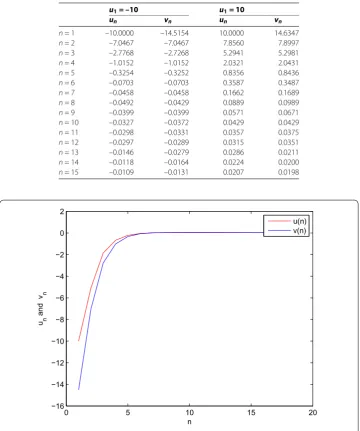
Table 1 The values ofunandvnwith the initial valuesu1= –10 andu1= 10
u1= –10 u1= 10
un vn un vn
n= 1 –10.0000 –14.5154 10.0000 14.6347
n= 2 –7.0467 –7.0467 7.8560 7.8997
n= 3 –2.7768 –2.7268 5.2941 5.2981
n= 4 –1.0152 –1.0152 2.0321 2.0431
n= 5 –0.3254 –0.3252 0.8356 0.8436
n= 6 –0.0703 –0.0703 0.3587 0.3487
n= 7 –0.0458 –0.0458 0.1662 0.1689
n= 8 –0.0492 –0.0429 0.0889 0.0989
n= 9 –0.0399 –0.0399 0.0571 0.0671
n= 10 –0.0327 –0.0372 0.0429 0.0429
n= 11 –0.0298 –0.0331 0.0357 0.0375
n= 12 –0.0297 –0.0289 0.0315 0.0351
n= 13 –0.0146 –0.0279 0.0286 0.0211
n= 14 –0.0118 –0.0164 0.0224 0.0200
n= 15 –0.0109 –0.0131 0.0207 0.0198
Figure 1 The convergence ofunandvnwith the initial valueu1= –10.
Further,
=
i=
F(Si) ={}.
Suppose that the mappingF:R→Ris defined by
F(u) = u, ∀u∈R.
Hence,Fis -strongly monotone and -Lipschitzian. Assume thatρ=
andμ=
and they satisfy <μ< η
k and ≤ρτ <ν, whereν=
Figure 2 The convergence ofunandvnwith the initial valueu1= 10.
All codes were written in Matlab, the values of{vn}and{un}with differentnare given in Table .
Remark . Table and Figures and show that the sequences{vn}and{un}converge to . Also,{} ∈ .
5 Conclusion
We have analyzed an iterative method for finding an approximate solution of hierarchical fixed point problem (.) and variational inequality problem (.) involving a finite family of nonexpansive mappings in a real Hilbert space. This method can be viewed as a mod-ification and improvement of some existing methods [, ] for solving the variational inequality problem and the hierarchical fixed point problem. Therefore, Algorithm . is expected to be widely applicable.
Competing interests
The authors declare that they have no competing interests.
Authors’ contributions
Both the authors contributed equally and approved the final manuscript.
Publisher’s Note
Springer Nature remains neutral with regard to jurisdictional claims in published maps and institutional affiliations.
Received: 20 July 2017 Accepted: 27 October 2017
References
1. Geobel, K, Kirk, WA: Topics in Metric Fixed Point Theory. Cambridge University Press, Cambridge (1990)
2. Yao, Y, Cho, YJ, Liou, YC: Iterative algorithms for hierarchical fixed points problems and variational inequalities. Math. Comput. Model.52(9-10), 1697-1705 (2010)
3. Crombez, G: A hierarchical presentation of operators with fixed points on Hilbert spaces. Numer. Funct. Anal. Optim.
27, 259-277 (2006)
4. Moudafi, A: Krasnoselski-Mann iteration for hierarchical fixed-point problems. Inverse Probl.23(4), 1635-1640 (2007) 5. Gu, G, Wang, S, Cho, YJ: Strong convergence algorithms for hierarchical fixed points problems and variational
6. Ceng, LC, Ansari, QH, Yao, JC: Iterative methods for hierarchical variational inequalities in Hilbert spaces. J. Optim. Theory Appl.151, 489-512 (2011)
7. Xu, HK: Viscosity method for hierarchical fixed point approach to variational inequalities. Taiwan. J. Math.14(2), 463-478 (2010)
8. Wang, Y, Xu, W: Strong convergence of a modified iterative algorithm for hierarchical fixed point problems and variational inequalities. Fixed Point Theory Appl.2013, Article ID 121 (2013)
9. Ansari, QH, Ceng, LC, Gupta, H: Triple hierarchical variational inequalities. In: Ansari, QH (ed.) Nonlinear Analysis: Approximation Theory, Optimization and Applications, pp. 231-280. Springer, New York (2014)
10. Takahashi, W, Atsushiba, S: Strong convergence theorems for a finite family of nonexpansive mappings and applications. Indian J. Math.41(3), 435-453 (1999)
11. Yao, Y: A general iterative method for a finite family of nonexpansive mappings. Nonlinear Anal.66, 2676-2678 (2007) 12. Ceng, LC, Khan, AR, Ansari, QH, Yao, JC: Viscosity approximation methods for strongly positive and monotone
operators. Fixed Point Theory10(1), 35-71 (2009)
13. Buong, N, Duong, LT: An explicit iterative algorithm for a class of variational inequalities in Hilbert spaces. J. Optim. Theory Appl.151, 513-524 (2011)
14. Zhang, C, Yang, C: A new explicit iterative algorithm for solving a class of variational inequalities over the common fixed points set of a finite family of nonexpansive mappings. Fixed Point Theory Appl.2014, Article ID 60 (2014) 15. Bnouhachem, A, Ansari, QH, Yao, JC: An iterative algorithm for hierarchical fixed point problems for a finite family of
nonexpansive mappings. Fixed Point Theory Appl.2015, Article ID 111 (2015)
16. Bnouhachem, A, Ansari, QH, Yao, JC: Strong convergence algorithm for hierarchical fixed point problems of a finite family of nonexpansive mappings. Fixed Point Theory17, 47-62 (2016)
17. Byrne, C: A unified treatment of some iterative algorithms in signal processing and image reconstruction. Inverse Probl.20, 103-120 (2004)
18. Combettes, PL: Solving monotone inclusions via compositions of nonexpansive averaged operators. Optimization
53, 475-504 (2004)
19. Xu, HK: Iterative algorithms for nonlinear operators. J. Lond. Math. Soc.66, 240-256 (2002)
20. Deng, BC, Chen, T, Li, ZF: Cyclic iterative method for strictly pseudononspreading in Hilbert spaces. J. Appl. Math.