A Novel Technique for Steganography Method Based on
Improved Genetic Algorithm Optimization in Spatial Domain
M. Soleimanpour*, S. Talebi* and H. Azadi-Motlagh*
Abstract: This paper devotes itself to the study of secret message delivery using cover image and introduces a novel steganographic technique based on genetic algorithm to find a near-optimum structure for the pair-wise Least-Significant-Bit (LSB) matching scheme. A survey of the related literatures shows that the LSB matching method developed by Mielikainen, employs a binary function to reduce the number of changes of LSB values. His method verifiably reduces the probability of detection and also improves the visual quality of stego images. However, his method still has room for improvement. In this paper, a dual-state scoring model, structured upon genetic algorithm is presented which assesses the performance of different orders for LSB matching and searches for a near-optimum solution among all the permutation orders. Experimental results confirm the superiority of the new approach compared to the Mielikainen’s pair-wise LSB matching scheme in terms of distortion.
Keywords: Genetic Algorithm, LSB Matching, Steganograghy.
1 Introduction1
Steganography is derived from the Greek words steganos meaning "covered or protected" and graphei meaning "writing". As defined by Cachin [1], steganography is the art and science of communicating in a way that the presence of a secret message apart from the identity of sender and intended recipient cannot be detected, in other words, it is a form of security through obscurity. Techniques to hide information have been in use for hundreds of years, but with the increasing use of file transfers in an electronic format, Steganography and watermarking are spearheading the enormous growth of advanced algorithms to hide important (secret) information in an undetectable and/or irremovable (secure) way in audio and video fields and they are, therefore, the main focus in any information concealment activity [2-4].
Images that are used for inserting and hiding secure data are called ‘cover images’ and the image in which secret bits are inserted is known as ‘stego image’.
Steganography platforms can be divided into two main categories, namely; spatial domain and transform domain. In the transform domain, Discrete Cosin Transform (DCT), Discrete Fourier Transform (DFT) and Discrete Wavelet Transform (DWT) are the most
Iranian Journal of Electrical & Electronic Engineering, 2013. Paper first received 28 Nov. 2012 and in revised form 12 Mar. 2013. * The Authors are with the Department of Electrical Engineering, Bahonar Univesity of Kerman, Kerman, Iran.
E-mails: [email protected] and [email protected].
common examples [5], being the preferred schemes due to lower computational complexities and higher resistances against compression which are key advantages.
In the DCT based steganography, the two key points to consider are; a- selection of DCT coefficients, i.e. the choice of higher frequencies makes presence of the image unrecognizable, and, b- magnitude of changes applied to DCT coefficients in order to insert signature in the image. Changes of the coefficients have an effect on the secrecy of signature and can even distort the image a great deal.
The first attempt in spatial domain is LSB substitution. LSB substitution steganography is a popular and simple technique that hides message bits in LSB of image pixels. It should be mentioned that the Mielikainen’s method reduces the probability of detection but simultaneously it decreases the visual quality of images. Therefore finding the best matching order based on the Mielikainen’s method principle in order to reduce the distortion of the stego images by applying the heuristic search algorithms such as Genetic algorithm [6], Particle Swarm Optimization (PSO) [7] for JPEG images, Immune Programming Algorithm (IP) [8] are proposed recently. In our proposed method, Genetic Algorithm (GA) is employed to inspect a score matrix in order to find the best LSB matching order. This method not only is an improvement on the Mielikainen’s method but also speeds up the algorithm and decreases probability of detection.
The rest of the paper is organized as follows:
In Section 2, an overview of other steganography methods is given. Section 3 details our proposed method. In Section 4, the experimental results are shown and discussed. Finally, the conclusions are presented in Section 5.
2 Review of Steganography Methods
Steganography, as a core of information hiding, is the art of embedding a secret message imperceptibly within the cover image (e.g, digital images in this paper). In steganography techniques, many different cover file formats can be used but because of wide spread application of digital images on the internet, they have become the most popular format [9].
Methods of image steganography can be divided into two groups: Transform Domain techniques and Spatial Domain methods [2]. In the Transform Domain technique, images are first transformed and then the message is embedded in the cover image [10].
The Transform Domain steganography methods hide messages in more significant areas of the cover image, and this requires the cover image to split into high, middle and low frequency components.
Since most of the signal energy is concentrated in the lower frequencies, which is very important in visibility, therefore, secret data is embedded in the higher frequencies in order to avoid image distortion.
Most Transform Domain methods are independent of the image format and as a result the embedded message may survive conversion between lossy and lossless compression [11].
Good security and robustness against statistical attacks and image manipulation are the most important advantages of these methods. However, high computational complexity is the main concerns here.
In the Spatial Domain methods, messages are embedded in the intensity of the pixels directly.
One of the popular methods is to embed secret messages into the cover image by directly manipulating the least-significant bit (LSB) plane [12, 13]. In LSB substitution, LSB bits of cover image is replaced with secret bits. One significant drawback of this method is that the secret message can be detected very easily [14]. Although it is not the best steganographic method, it is worth studying it because of its simplicity.
Because of high probability of detection in LSB substitution, a new method based on embedding the information into the cover image has been developed which is called LSB matching [12].
In the LSB matching method, first a matching process between the secret message and the cover image is performed and then embedding takes place based on the maximum similarity [15].
A survey of published literature shows that LSB matching is successful as a steganographic method prticularly for gray scale images at embedding rates [16-21]. However, the main disadvantage of this approach is that traditional detectors [22, 12] are not effective
(enough) against LSB replacement for LSB matching steganography.
The performance of the LSB matching technique has been further improved by the Mielikainen's method [23] in which the LSBs of the cover image are not just simply replaced with LSB of the secret message. In the Mielikaien's method, if the message bit does not match the LSB of the cover image then one is randomly either added or subtracted from the value of the cover pixel.
2.1 A Brief Review of the Mielikainen's Method
In this method, firstly, matrix of cover image H and secret message S are converted into streams of H0 and S0, respectively, as follows:
11 12 13 1
21 22 23 2
2 3
c
c
rc r r rc
h h h h
h h h h
h h h h
⎡ ⎤
⎢ ⎥
⎢ ⎥
⎢ ⎥
⎢ ⎥
⎣ ⎦
L L
M M M M M
L
[
h h h11 12 13Lh h h h1c 21 22 23Lh2cLh h hr1 r2 r3Lhrc]
then, each two consecutive elements in the streams of H0 and S0 are selected. Assume that the two cover pixels are xi and xi+1, and also that the two secret bits to be hidden are mi and mi+1.
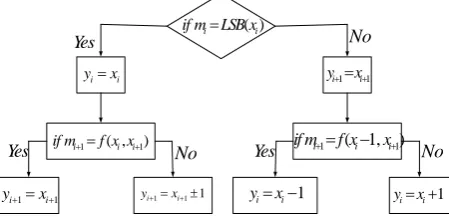
The method is performed as follows: first the value of secret bit mi is compared with the LSB of the first cover pixel xi If they are equal (mi=LSB(xi)), then the first cover pixel is kept unchanged, yi =xi, otherwise, the second cover pixel is kept, yi+1=xi+1. When yi =xi,
1 i
m+ is compared with f x x( ,i i+1) where f x x( ,i i+1) is defined as follows:
1 1
( , ) ( )
2 i
i i i
x f x x+ =LSB ⎡ ⎤⎢ ⎥+x+
⎣ ⎦ (1)
If they are equal, then yi+1=xi+1, otherwise, the second pixel yi+1 is calculated by randomly incrementing/decrementing the second cover pixelxi+1. If mi is not equal to LSB x( )i , then yi+1=xi+1. If
1 ( 1, 1)
i i i
m+ = f x − x+ , then the value of yi = −xi 1, otherwise, yi = +xi 1. The Mielikainen’s method is flowcharted in Fig. 1.
( )
i i
if m LSB x=
1 1 i i
y+=x+
i i
y =x
1 ( 1, 1)
i i i
if m+=f x− x+
1 ( , 1)
i i i
if m+=f x x+
1 1
i i
y+ =x+ yi+1=xi+1±1 yi= −xi 1 yi= +xi 1
Yes
No
No
No
Yes Yes
Fig. 1 Flowchart of Meilkainen's method
Although the Mielikainen’s method reduces the probability of detection but it may also distort stego images. The matching order of the secret data and cover image can be further adjusted to reduce the distortion of the stego images by applying the heuristic search algorithms such as Particle Swarm Optimization (PSO) [7] for JPEG images, Immune Programming Algorithm (IP) [8] or Genetic Algorithm Optimization priority adjustment process. In the next section the proposed method is described in greater detail.
3 Proposed Method
From the flowchart in Fig. 1, it can be stated that the best matching with fewer changes of the cover image is achieved when mi =LSB x( )i and mi+1= f x x( ,i i+1), which means values of stego pixel yiand yi+1 and cover pixel xi and xi+1 are equal, respectively, and as a result the difference between stego image and the cover image is minimal.
In our proposed method, a dual state-scoring, designated by Tiis used that operates as follows:
1. When two cover image pixels are similar to stego image pixels, score is T1.
2. When one of the stego image pixels changes relative to cover image, score is T2.
In order to show that keeping the cover pixel values unchanged is superior to letting them change, they must be assigned based on fewer changes of cover image. Now, in order to achieve this aim, T1 is assumed to be greater than T2, (T1>T2). In other words, pixel embedding without the requirement for LSB change is more desirable than embedding where change of LSB is required.
3.1 Score Matrix
In order to evaluate the performance of different matching order of secret image and cover image, a matrix called score matrix M is calculated.
Assume that S and H are the matrix of secret data and cover image, respectively. Firstly, by scanning S and H left-to-right and top-to-bottom, these matrices get converted into streams of H0and S0, respectively.
Then, for each two sequential pixels in the stream the value of T is first evaluated and then based on these calculations score matrix *
s h
L L
M is constructed as follows:
1 2 *
( , ) | ( , ) { , }
1 , 1
s h
L L
s h
m i j m i j T T M
i L j L
∈
⎧ ⎫
= ⎨ ≤ ≤ ≤ ≤ ⎬
⎩ ⎭ (2)
where m i j( , ) is the -th row and the j-th column element of this matrix M, Ls is the length of secret stream groups and Lh is the length of cover stream groups. In order to find the best matching order we need to choose Ls element in different row and columns from
the matrix M. It should be mentioned that only one element from each row and column must be selected [8].
Accordingly, an adjustment list is evaluated from these selected Ls elements, namely;
1 2
[ , ,..., ,..., ]
h
k L
J = j j j j , where index k indicates the
k-th column of M and k-the value of jk refers to the jk-th element of k-th column.
If Lh >Ls, it means that the cover stream is greater than the secret stream, then jk will be set to -1, declaring that the k-th group of the cover stream will not embed any secret information.
If Lh =Ls, it means that all the groups of the cover stream will embed their corresponding secret data and the adjustment list J does not have any -1 element.
It should be noted that many adjustment lists can be built by taking different elements and eventually the one with the highest score will be the best matching structure. The Heuristic search algorithm can be used to obtain the best adjustment list.
In this paper a genetic algorithm is exploited to find the optimal adjustment. For simplicity, the normalized total score of J is introduced as follows:
1
( ) m ( , ) |J
f J m i j
f
=
∑
(3)1 . m
s
f =L T (4)
where fm is the maximum value for the adjustment list.
3.2 Genetic Algorithm Strategy
Over the past several decades, population-based optimization search techniques, such as evolutionary algorithm [24], ant colony optimization [25], particle swarm optimization [26], gravitational search algorithm [27, 28], artificial bee colony [29], etc. [30, 31], have been applied to solve global optimization problems. Natural evolution or phenomena have been the motivation behind development of these algorithms.
Population-based algorithms offer a collection of potential solutions for a given problem where the operators act on population and produce collections of new solutions. This process is repeated until the stopping criteria are met.
The population-based optimization algorithms often perform well to approximate solutions to a wide range of problems [32-35]. GA is a heuristic search that mimics the process of natural evolution. This heuristic search is routinely adopted to generate useful solutions to optimization and search problems [36]. Genetic algorithms belong to the larger class of evolutionary algorithms (EA), which generate solutions to optimization problems using techniques inspired by natural evolution, such as mutation, selection and crossover.
Crossover and mutation are the processes for exploration and exploitation of the population. Selection is an act of picking out the best agent from the population according to the GA principles.
In the proposed method, in order to perform LSB matching, we use a GA strategy to find a near optimal adjustment list.
3.2.1 Initialization
At first, many individual solutions are randomly generated to form an initial population. As said before, we need to find the optimal adjustment list J in order to perform LSB matching so that the distortion of the stego image can be minimized. In the Genetic algorithm, the population represents the solution. Thus, for initialization, an initial population, P of N chromosome,
P i 1, . . . , N , is generated randomly.
3.2.2 Fitness Evaluation
The fitness of each individual in that population is evaluated based on fitness function.
3.2.3 Parent Selection
After fitness evaluation, parents are chosen based on their fitness. During each iteration, a percentage of the existing population is selected (which is called parents) to create a new population. Parents are selected through a fitness-based process, where fitter solutions (as measured by a fitness function) are typically more likely to be selected. The selection procedure picks out two parent chromosomes, based on their fitness values, which are then used by the crossover and mutation operators (described below) to produce two offspring for the new population. In this paper, roulette wheel is used for the selection procedure. In roulette wheel selection, individuals are given a probability of being selected that is directly proportionate to their fitness. Afterward, two individuals are chosen randomly, based on these probabilities, to produce new population.
3.2.4 Crossover
Crossover is one of the basic operators of GA which determine (define) the performance of GA. There are many ways for carrying out a crossover. Type and implementation of operators depend on the encoding as well as on the problem under study.
According to our experiment, one point crossover is the best choice in our case. In order to achieve this aim, a pair of chromosomes which has been selected in the selection step is used by crossover. At first, a random number between 0 and 1 is generated and compared to a parameter called the probability of crossover, P. If the random number is larger than P, then two parents are chosen randomly from the population P, and the left and right parts of these two agents are exchanged. On the other hand, if the random number is not larger than P, then crossover will not happen. The crossover probability can be changed from 0.0 to 1.0. Our
empirical studies have shown that better results are achieved by a crossover probability of 0.7, which implies that the probability of a selected chromosome surviving to the next iteration unchanged (apart from any changes arising from mutation) ranges from 0.3.
3.2.5 Mutation
Mutation like crossover is one of the basic operators of GA. Decision on the best method to implement mutation is again affected by the type of encoding as well as on the kind of problem at hand. In the mutation procedure, a random number between 0 and 1 is generated and compared to a parameter called probability of mutation, P . If the random number is larger than P , then a gene is selected randomly from the current population, P, and the genes on this population are changed, e.g. 0 becomes 1 and vice versa. Then this mutated gene will be placed back into population of the current generation. If the random number is less than P , no operation will be carried out.
In order to do mutation operator, each bit in each chromosome is checked for possible mutation by generating a random number between zero and one and if this number is less than or equal to the given mutation probability, e.g. 0.001, then the bit value is changed.
3.2.6 Generating a New Population
After the last three steps, new population is generated.
3.2.7 Stopping Criteria
The algorithm, previously described, carries out the steps one by one in sequence and when they have been performed it is said that one generation has passed. At the end of each generation Genetic algorithm checks stop criteria. Because of the nature of Genetic algorithms, most of the times it is not clear when the algorithm should stop, so the criterion is usually based on statistical information such as number of generation, fitness value of the best chromosome or average fitness value of chromosomes in the population, duration of evolution process and so on.
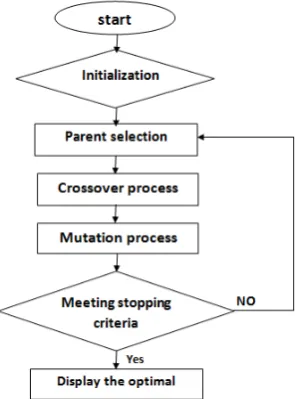
The flowchart of genetic algorithm is shown in Fig. 2. The basic steps for GA are described as shown in Fig. 2.
3.3 Improved Version of Genetic Algorithm
In order to match genetic algorithm by proposed problem a new kind of cross over and mutation are proposed. As it explained before, the proposed problem is finding a near optimal solution in a discrete search space. In this section, in order to simplify the problem, the problem is solved when size of secret image and cover image are equal. By this assumption, each chromosome in population is a disorder vector of number 1 to L .
Fig. 2 Flowchart of Genetic Algorithm
The most important issue in this problem is that testing every possibility for disordering a L number would be L math additions. As an example, a L 30 number would have to measure the total distance of be
2.65 1032 different disorder vector. Assuming a
trillion additions per second, this would take 252, 333, 390, 232, 297 years. Adding one more number would cause the time to increase by a factor of 31. Obviously, this is an impossible solution. This is the same problem, when we want to have a complete search in the steganography matching problem.
As it explained before, each chromosome is assumed as a disorder vector of number 1 to L . In the crossover step, after choosing two parents in order to create the children, every item in the parent's sequence after the crossover point is swapped. The difficulty in this problem is that every element can only be used once in a vector. In order to solve this issue, every element after the crossover point is checked. If the checked element is already existed in the child, a non-selected element is selected randomly.
The mutation step is also changed in this algorithm. As we cannot change the gene's bits as the usual traditional mutation does. Instead we must swap the order of just two elements in each chromosome.
By changing these two steps, the improved version of genetic algorithm is in an exact harmony by the proposed problem.
The pseudo code for constructing a stegano image is explained In the following steps:
a. Change the gray scale secret image into binary image
b. Evaluate the score matrix in accordance with (in relation to) the Mielikainen’s method.
c. Define the fitness function in order to calculate the adjustment list value.
d. Find the best adjustment list by using the genetic algorithm strategy.
e. Embed the secret data into the cover image in accordance with the adjustment list.
f. End.
3.4 Data Extraction
As said in [8], during the data extraction process knowing the adjustment list J in order to extract the data for receiver is essential. The steps in the algorithm can be summarized as follows:
Step 1. The stego stream 0 t
S will be arranged by
scanning the stego image St from top-to-bottom and from left-to-right.
Step 2. Each consecutive two elements of the stream
0 t
S is considered as a group. For the ith group of the stream the ith position of J has been checked. If the ith value is not -1, the value of second secret bit
1 i
m+ is calculated by using Eq. (1).
Step 3. If mi+1=LSB y( )i , the first secret bit miis mi+1. If mi+1 is not equal to LSB y( )i , then mi is calculated from mi = f y y( ,i i+1±1).
Step 4. When the entire secret bit groups have been extracted, the inverse manipulation of step 1 is executed in order to arrange the secret image.
4 Experimental Result
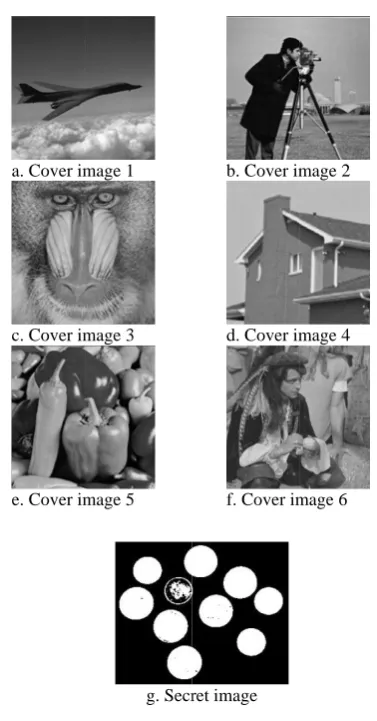
To validate the performance of the proposed method, several experimental results are presented and discussed in this section. In our experimental assessments all images are 256 gray levels of size 512 × 512. We take the images Jet, Cameraman, Baboon, House, Pepper and Man [8], separately shown in Figs. 3-a, b, c, d, e and f, as cover images. The image of Coins (Fig. 3-g) is taken as secret information. The size of the original secret images is 256 × 256 with 256 gray levels. In the proposed method the secret image needs to be a binary image, so as to allow the threshold value to be used to convert the gray scale image into a binary image. In this paper, an automatic thresholding is utilized to produce a binary image.
Table 1 displays PSNR values derived from the proposed method versus those obtained from the Mielikainen’s method. From the table, it is evident that the proposed method achieves higher PSNR values for different stego images compared with the Mielikainen's and as a result the visual quality of images processed by our scheme are better.
As mentioned before, when the difference between the LSB value of the stego image and cover image rises the visual quality of the stego image falls. Table 2 compares percentages of LSB position changes for different stego images. As can be seen from this table, LSB position changes less frequently for Jet, Cameraman, Baboon, House, Pepper and Man images as a result of employing the proposed method.
a. Cover im
c. Cover im
e. Cover im
Fig. 3 Images
Table 1 PSNR
Jet Cameram Baboon House Pepper Man
Table 2 Comp
Jet Cameram Baboon House Pepper Man From the since the p values and position, vis noticeably c matching ste mage 1 mage 3 mage 5 g. Secr
in our experim
R value compar Mielik
me 52.3
man 52.3
n 52.3
e 52.4
rs 52.4
52.4
parison of LSB Mielik me
15
man 15
n 15
e 14
rs 15
15
e above two proposed met reduces the sual quality o ompared with ganography.
b. Cover im
d. Cover im
f. Cover im
ret image ments rison kainen’s thod 36933 35057 37549 43724 42461 40562
changes (in per kainen’s thod 5.27 5.42 5.18 4.66 5.19 5.18
tables it can thod achieve
number of c of the stego h the origina
mage 2 mage 4 mage 6 Proposed method 53.15158 53.18642 53.31759 53.25734 53.22971 53.23653 rcentages) Proposed method 11.46 11.27 10.71 11.03 11.19 11.14
n be argued t s higher PS changes of L
images impr al pair-wise L
that SNR LSB rove LSB Fig and Fig b) I (in are aft pro of Sim yie var [21 exp the eva Mi cur det var dif It i imp sol HC ma foc a
g. 4 a) Image o d b) Image of C
a g. 5 a) Image o
Image of Peppe
Fig. 3 shows n this case) is e shown in Fi er data was e oposed metho the stego ima milar tests we elding the sam
4.2 Th
A review o riety of detec 1], Harmsen periments, fir en the calibra aluate the pe ielikainen’s an In Fig. 6, r rves using th tection has b riation of dete fferent method is clearly seen proved detect
As shown in lution reduce CF COM de atching and th cus on a region
of Cameraman Cameraman afte
of Peppers befo ers after embedd
4.1 Invisib
s the cover im the image of igs. 4-b and embedded into od. It can be s ages is not de ere also perfo me results.
e Probability
of the related ctors have bee [17] and Liu rstly, calibrate
ted adjacency erformance o nd the propose receiver opera he calibrated
een sketched ection probabi
ds as the detec n that the prop tion probabilit n Fig. 7, it can s the probab etectors comp
he Mielikaine n of interest th
before embedd er embedding se
b ore embedding
ding secret data
bility Test
mage and secr f a coin. The 5-b which w o the LSB pla
said that the v graded much rmed on the
y of Detection
d literature s en introduced u et al. [19, ed HCF COM y HCF COM f the LSB m ed methods. ating characte
HCF COM . The above ilities and fals ction threshol posed method ty.
n be seen that bility of dete mpared to bo en’s schemes he x-axis has b
b
ding secret data ecret data
b
secret data and a
ret data which stego images ere generated anes using the visual quality significantly. other images,
n Test
shows that a d by Westfeld 20]. In our M is used and is utilized to matching, the
eristic (ROC) for message plot displays se positive for ld is adjusted. d results in an
our proposed ction for the oth the LSB s. In order to been scaled. a d h s d e y . , a d r d o e ) e s r . n d e B o
Fig. 6 ROC cu
Fig. 7 ROC cu
Fig. 8 Fitnes probability
In Fig. 8 against prob seen in Fig. 8 the normalize
urves for calibra
urves for calibra
ss evalution fo
8, the sensitiv bability of cr
8 that when th ed value of fit
ated HCF COM
ated adjacency
or different va
vity of the p ossover is ill he value of P tness is maxim
M
HCF COM
alues of crosso
proposed meth lustrated. It w is close to 0.4 mized.
over
hod was 427
Fig pro
Fig
me cas wh it fun pro Th alg inc
on sho ind inc obt in t
com tha how und qua pro It c
g. 9 Fitness ev obability
g. 10 Convergen
Similarly, in ethod versus p
se, the best v hich may seem
was obtained nction. On the obability of herefore, in ord gorithm, the creased.
The converg generation is ows the best f dicates the av creasing the ge
tained. Fig. 10 the last 20 per
4.3
When the c mpared again at our approac wever, that th desirable effe ality of the im obability of de
can be conclu
valuation for
nce rate of prop
n Fig. 9, sen probability of
alue of P is m a large valu d because of e other hand, f trapping in der to increas
probability
gence rate of t s plotted in Fi
fitness value erage fitness enerations imp 0 also illustrat rcent of gener
Complexity
complexity of nst that of the ch is more co he Mielikainen fects, namely
mage and sim etection which uded that the
different value
posed method
nsitivity of t mutation is p s when it is c ue for mutatio f multimodali for this fitnes
local optim se the explorat of mutation
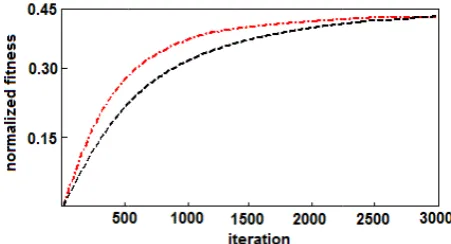
the proposed m ig. 10. Here,
so far and the value. As can proved score tes that all age ration.
y Comparison
f the propose e Mielikainen omplex. It sho n’s model suff
; it decrease multaneously h already has
proposed met
es of mutation
the proposed plotted. In this close to 0.901 on process but ity of fitness s function the ma are high. tion ability of n should be
method based the red curve e black curve n be seen, by values can be ents converge
n
ed method is n’s, it is seen ould be noted, ffers from two es the visual increases the been proved. thod achieves n
d s
t s e . f e
d e e y e e
s n , o l e . s
as a result of an extra complexity but it has more robust and higher visual quality, therefore it is an acceptable procedure which are advantages desired in steganography.
5 Conclusion
This paper presented a new LSB matching method based on Genetic algorithms. The proposed solution evaluated different LSB matching structures and devised a score-matrix system. The main advantages offered by this innovative scheme are higher PSNR values of stego images and a reduction in the number of changes of LSB position resulting in an improved visual quality of stego images. An examination of the simulation results also confirmed that the proposed technique outperforms many of the popular techniques put forward by Mielikainen and others. One drawback of this model as was revealed by experiments is that for some stego images the duration for calculating the score matrix is comparatively long. Authors are currently exploring new approaches to overcome this minor hitch.
References
[1] Cachin C., “An Information-Theoretic Model for Steganography”, Proceedings of 2ndWorkshop on Information Hiding, MIT Laboratory for Computer Science, pp. 306-318, 1998.
[2] Silman J., “Steganography and Steganalysis: An Overview”, SANS Institute, 2001.
[3] Sachnev V., Kim H. J., Nam J., Suresh S. and Shi Y. Q., “Reversibel watermarking algorithm using sorting and prediction”, IEEE Transactions on Circuits and Systems for Video Technology, Vol. 19, No. 7, pp. 989-999, 2009.
[4] Mohammadi S., Talebi S. and Hakimi A., “Two Novel Chaos-Based Algorithms for Image and Video watermarking”, Iranian Journal of Electrical & Electronic Engineering, Vol. 8, No. 2, pp. 97-107, 2012.
[5] Wang Y. and Moulin P., “Steganalysis of block-DCT image steganography”, IEEE workshop on Statistical Signal Processing, IEEE Computer Society Press, Los Alamitos, pp. 339-342, 2003. [6] Liu G., Zhang Z. and Dai Y., “GA-based
LSB-matching steganography to hold second-order statistics”, Proceedings of MINES'09 Los Alamitos IEEE Computer Society, pp. 510-513, 2009.
[7] Liu X. X. and Wang J. J., “A steganographic method based upon JPEG and swarm optimization algorithm”, Information Science, Vol. 177, No. 15, pp. 3099-3109, 2007.
[8] Xu H., Wang J. and Kim H. J., “Near-optimal solution to pair-wise LSB matching via an immune programming strategy”, Information Sciences, pp. 1201-1217, 2010.
[9] Fabien A. P., Ross J. Anderson and Markus G., “Information Hiding - A Survey”, Proceedings of the IEEE, special issue on Protection of Multimedia Content, pp. 1062-1078, 1999.
[10] Lee Y. K. and Chen L. H., “High capacity image steganographic model”, IEE Proceedings of Visual Image Signal Processing, Vol. 147, No. 3, pp. 288-294, 2000.
[11] Shi Y. Q. and Sun H., Image and Video Compression for Multimedia Engineering, CRC Press, Boca Raton London New York Washing, D.C., 2001.
[12] Ker A., “Improved detection of LSB steganography in grayscale image”, Lecture Notes in Computer Science, pp. 97-115, 2005.
[13] Mahdavi M., Samavi Sh., Zaker N. and Modarres-Hashemi M., “Steganalysis Method for LSB Replacement Based on Local Gradient of Image Histogram”, Iranian Journal of Electrical & Electronic Engineering, Vol. 4, No. 3, pp. 59-70, 2008.
[14] Chan C. K. and Chan L. M., “Hiding data in image by simple LSB substitution”, Pattern Recognition, Vol. 37, pp. 469-467, 2004.
[15] Chang C. C., Hsiao J. Y. and Chan C. S., “Finding optimal least-signification-bit substitution in image hiding by dynamic programming strategy'', Pattern Recognition, Vol. 36, pp. 1583-1595, 2003.
[16] Fridrich J., Soukal D. and Goljan M., “Maximum likelihood estimation of length of secret message embedding using y dynamic programming strategy”, Proceedings of SPIE Electronic Imaging 5681, 2005.
[17] Harmsen J. and Pearlman W., “Steganalysis of additive-noise modelable information hiding”, Proceedings of the SPIE Security Watermarking Multimedia Contents 5020, 2003.
[18] Ker A., “Steganalysis of LSB matching in grayscale images”, IEEE Signal Processing Letters, Vol. 12, No. 6, pp. 441-444, 2005.
[19] Liu Q. Z., Sung A. H., Xu J. Y. and Ribeiro B. M., “Image complexity and feature extraction for steganalysis of LSB matching steganography”, The 18th International Conference on Pattern Recognition, Vol. 2, pp. 267-270, 2006.
[20] Liu Q. Z., Sung A. H., Chen Z. X. and Xu J. Y., “Feature mining and pattern classification for steganalysis of LSB matching steganography in grayscale images”, Pattern Recognition, Vol. 41, No. 1, pp. 56-66, 2008.
[21] Westfeld A., “Detecting low embedding rates”, Lecture Notes in Computer Science 2578, pp. 324-339, 2002.
[22] Fridrich J., Goljan M. and Soukal D., “Higher-order statistical steganalysis of palette images”, Proceedings of the SPIE Security Watermarking Multimedia Contents 5020, 2003.
[23] Mielikainen J., “LSB matching revisited”, IEEE Sigal Processing Letters, Vol. 13, No. 5, pp. 285-287, 2006.
[24] Tu Z. and Lu Y., “A robust stochastic genetic algorithm (SGA) for global numerical optimization”, IEEE Transactions on Evolutionary Computation, Vol. 8, pp. 456-470, 2004.
[25] Baojiang Z. and Shiyong L., "Ant colony optimization algorithm and its application to neuro-fuzzy controller design", Journal of Systems Engineering and Electronics, Vol. 18, pp. 603-610, 2007.
[26] Hsieh S. T., Sun T. Y., Lin C. L. and Liu C. C., "Effective learning rate adjustment of blind source separation based on an improved particle swarm optimizer", IEEE Transactions on Evolutionary Computation, Vol. 12, No. 2, pp. 242-251, 2008.
[27] Rashedi E., Nezamabadi-pour H. and Saryazdi S., “GSA: a gravitational search algorithm”, Information Science, Vol. 179, No. 13, pp. 2232-2248, 2009.
[28] Moghadam M. S., Nezamabadi-Pour H. and Farsangi M. M., “A Quantum Behaved Gravitational Search Algorithm”, Intelligent Information Management, Vol. 4, No. 6, pp. 390-395, 2012.
[29] B. Akay and D. Karaboga, “A modified artificial bee colony algorithm for real-parameter optimization”, Information Sciences, Vol. 192, pp. 120-142, 2010.
[30] Reynolds R. G., "An introduction to cultural algorithms". Proceedings of the third annual conference on evolutionary programming, pp. 131-139, 1994.
[31] Soleimanpour-Moghadam M. and Nezamabadi-Pour H., “An improved quantum behaved gravitational search algorithm”, 20th Iranian Conference on Electrical Engineering, Iran, 2012.
[32] Sofge D., Jong K. De and Schultz A., “A blended population approach to cooperative coevolution for decomposition of complex problems”, in: Proceedings of the 2002 Congress on Evolutionary Computation, Vol. 1, pp. 413-418, 2002.
[33] Qiana B., Wanga L., Huanga D. X., Wangc W.L. and Wang X., "An effective hybrid DE-based algorithm for multi-objective flow shop scheduling with limited buffers", Computers & Operations Research, Vol. 36, pp. 209-233, 2009.
[34] Batenburg V. and Gultyaev P., “An APL-programmed genetic algorithm for the prediction of RNA secondary structure”, Journal of Theoretical Biology, Vol. 174, No. 3, pp. 269-280,1995.
[35] Blazewicz J., Formanowicz P., Kasprzak M., Markiewicz W.T. and Swiercz A., “Tabu search algorithm for DNA sequencing by hybridization with isothermic libraries”, Computational Biology and Chemistry, Vol. 28, No. 1, pp. 11-19, 2004. [36] Deb K., Pratap A., Agarwal S. and Meyarivan T.,
“A fast and elitist multi objective genetic algorithm”, IEEE Trans. on Evolutionary Computing, Vol. 6, No. 2, pp. 182-197, 2002.
Mohadeseh Soleimanpour received the BS and MS degrees both in communication engineering from the Bahonar University of Kerman, Kerman, Iran, in 2008 and 2011, respectively; she is currently a PhD candidate in Bahnonar University of Kerman. Her research interests include, image processing, wireless communications and soft computing.
Siamak Talebi received B.S. and M.S. degrees, both in Communication Engineering, from Isfahan University of Technology, in 1989 and 1992 respectively and a Ph.D. degree from the University of London (King’s College), in 2001. He is currently with the Department of Electrical Engineering at Shahid Bahonar University of Kerman, in Iran. He is also with the Advanced Communications Research Institute at Sharif University of Technology, Tehran, Iran. His research interests are wireless communications, cognitive radio, MIMO-OFDM and also video and image coding.
Hadi Azadi-Motlagh received the BS degree from Iran Jondi-Shapour Univeesity of Dezful, Dezful, Iran, in 2009, the MS degree from the Bahonar University of Kerman, Kerman, Iran 2011, in communication engineering. His research interests are in the areas of wireless communications and image processing.