Copyright © 2019 (Yotam Shmargad and Samara Klar). Licensed under the Creative Commons Attribution Non-commercial No Derivatives (by-nc-nd). Available at http://ijoc.org.
How Partisan Online Environments Shape
Communication with Political Outgroups
YOTAM SHMARGAD
1SAMARA KLAR
University of Arizona, USA
Social media provide opportunities to consume and share political news in echo chambers, but also to communicate with members of political outgroups. Exposure to political outgroups is often portrayed as the normatively desirable option, although empirically it has mixed effects. With an experimental study, we find that participants who regularly interact with political outgroups on social media share more politically moderate news articles when we assign them to an audience of mostly outgroup versus ingroup members. On the other hand, those who are accustomed to an online echo chamber subsequently polarize when faced with an outgroup audience. Our study holds implications for how a person’s online social setting can shape downstream political interactions, and, more broadly, our findings highlight the importance of incorporating pretreatment measures to understand how online environments influence political behavior.
Keywords: social media, political communication, echo chambers, partisanship
[It] affects most people intimately, person to person . . . with its power to turn the globe into a single echo chamber.
—McLuhan, 1964, p. 137
In 1964, Marshall McLuhan was using the term “echo chamber” to describe the effects of radio. While he viewed literature as uniquely capable of “dissolving the tribal” by “stressing fragmentation and specialization,” radio could “compress the world to village size,” ensuring that “everyone hears everything at the same time” (Schmidt, 2014, p. 119). Today, when we think about echo chambers, we tend to think of distinct and insular clusters of like-minded voices operating parallel to one another within the same medium. Contrary to McLuhan’s view of an echo chamber as a single unified global village, today’s echo
Yotam Shmargad: [email protected] Samara Klar: [email protected] Date submitted: 2018‒07‒25
1 The authors thank the editor and anonymous reviewers for their constructive reviews; as well as
chambers are typically defined by their tendency to fragment rather than unite. As Jamieson and Cappella describe the echo chamber, it is “a bounded, enclosed media space that has the potential to both magnify the messages delivered within it and insulate them from rebuttal” (Jamieson & Cappella, 2008, p. 76)— rebuttal, presumably, by outgroup members to whose views our echo chamber prohibits exposure.
Although there is considerable ongoing debate over the extent to which Americans are surrounded by like-minded individuals or are rather subjected to disagreeable views, there appears to be a normative preference for the latter. Mutz and Martin (2001, p. 97) summarize the many perceived benefits of exposure to cross-cutting views: it allows for alternative opinions to be effectively contrasted (Fishkin, 1991), for people to formulate their opinions while appreciating the perspective of others (Arendt, 1968; Benhabib, 1992), and for people to respect deliberative outcomes as rational, even when undesirable (Fearon, 1998). Yet, empirically, we also see a range of problematic outcomes when people find themselves surrounded by out-partisans: for example, heightened ingroup biases (Tajfel, 1982), greater animosity toward the outgroup (Brewer, 1999), and the reinforcement of existing views (Karlsen, Steen-Johnson, Wollebaek, & Enjolras, 2017). In this study, we examine a key individual-level factor that might determine the degree to which exposure to an outgroup moderates or radicalizes political behavior: previous encounters with diversity.
Building off work by scholars who study online networks, communication, and social identity theory, we anticipate that regular interactions with a political outgroup can lead individuals to develop particular responses when faced with outgroup members—specifically, to moderate the expression of their own political views. For those accustomed to echo chambers, however, we expect the opposite: that a sudden encounter with outgroup members will instead lead to more extreme political expressions. To test our hypotheses, we conducted an experiment in which we randomly assigned respondents to an online group that was composed mostly of in-party members or out-party members. We then provided respondents with an opportunity to share a political news article with their assigned group. We asked each participant to explain their motivations for choosing the article and measured their social attentiveness and their perceptions of how diverse or like-minded their own social media environments tend to be. We find that, among those who are socially attentive, online media environments are a key moderator in the relationship between outgroup exposure and subsequent reactions to it. This work clarifies when and why some people appear to moderate their views in the face of outgroups while others appear to steadfastly cling to their preexisting perspectives.
Echo Chambers on Social Media
For many Americans, the social media environment is a politically polarized one. Due in part to filtering algorithms that prioritize information that supports people’s preexisting beliefs (Bakshy, Messing, & Adamic, 2015), as well as people’s own desires for opinion reinforcement (Garrett, 2009a, 2009b; Iyengar & Hahn, 2009), information on social media is exchanged primarily among ideologically like-minded people— especially when it comes to politics (Barbera 2014; Barbera, Jost, Nagler, Tucker, & Bonneau, 2015). With a large sample of Twitter users, Conover et al. (2011) constructed a social network by linking people that share, or “retweet,” each other’s messages. They then analyzed the content of these Tweets to determine the political leaning of each user. The “retweet network” that emerged displays two distinct clusters: one composed of 93% right-leaning users and another of 80% left-leaning users. The takeaway, it might seem, is that social media environments are, to put it simply, echo chambers.
Yet online environments can also provide exposure to diverse opinions. For example, Gruzd and Roy (2014) argue that, while Twitter may have“pockets of polarization,” it also provides the “potential for cross-party, cross-ideological discourse” (p. 36) in part due to instances where political opponents share a common hashtag to discuss issues from opposing perspectives. Conover et al. (2011) also find diversity on Twitter when reconstructing their social network with links among users that mention, rather than retweet, each other. This “mention network,” the authors argue, demonstrates no partisan sorting whatsoever. Garrett (2009a) finds that people do not try to completely exclude opposing political perspectives when they are online and that there is little evidence that the Internet is used to create echo chambers (p. 279).
Online chat spaces similarly provide opportunities for diverse discussions and exposure to political outgroups, particularly when politics is not the main topic that drew participants together in the first place (Wojcieszak & Mutz, 2009), due to the limited ability for Internet users to draw social boundaries around themselves (Brundidge, 2010). Brundidge (2010), in fact, finds that Internet users are slightly more likely to be exposed to political outgroups than they would be in the absence of their online environment. Flaxman, Goel, and Rao (2016) similarly find that online social network use is associated with greater exposure to the less-preferred side of the political spectrum. Recently, some scholars have cast doubt on the extent to which online systems facilitate the creation of echo chambers in the first place (e.g., Dubois & Blank, 2018; Guess, Nyhan, Lyons, & Reifler, 2018).
Exposure to Political Outgroups
Growing scholarly attention on the degree to which social media environments are polarized is due to the fact that exposure to outgroups is viewed as highly consequential. A large body of literature, based largely on deliberative theory, suggests that exposure to outgroups can lead to tolerance (Mutz, 2002; Wojcieszak, 2010), moderate political views (Klar & Shmargad, 2017), and a greater willingness to engage with out-partisans in future interactions (Klar, 2014). Scholars therefore tend to view diverse exposure as normatively desirable (Garrett & Resnick, 2011).
outgroup can increase the salience of an individual’s pro-ingroup bias (Tajfel, 1982). When people engage in social comparison between their own group and another, animosity toward the outgroup grows even larger (Brewer, 1999). For social identity theorists, it is perhaps no surprise, then, that exposure to counter-attitudinal information can make strong partisans even more close-minded in their search for exclusively like-minded viewpoints (Weeks, Lane, Kim, Lee, & Kwak, 2017), that strong opponents to same-sex marriage become even more opposed after being exposed to supporters (Wojcieszak & Price, 2010), and that exposure to contradictory arguments, and also to arguments that present both sides of an issue, ultimately reinforces preexisting views and beliefs (although the former has more polarizing effects than the latter; see Karlsen et al., 2017).
Perhaps just as often, the empirical effects of exposure to political outgroups are mixed, even within a single study (e.g., Wojcieszak & Price, 2010). Mutz (2002) finds that exposure to incongruent viewpoints increases tolerance among people with high levels of perspective-taking abilities, but lowers tolerance among those who lack these skills. Robinson (2010) finds that incongruent exposure increases tolerance when the message comes from an ingroup member, but decreases tolerance when it comes from an outgroup member. Evidence from Klofstad, Sokhey, and McClurg (2013) demonstrates that different measures of disagreement even from within the same survey can lead to different conclusions regarding the consequence of disagreement for political attitudes and behaviors. Finally, some scholars find that exposure to an outgroup has no effect at all. For example, Warner (2010) shows that exposure to an ideologically mixed environment does not result in significant attitude change. These null findings, though, are few in number, and one might suspect that this may, in part, be due to a scholarly bias against publishing statistically insignificant results (Gerber, Green, & Nickerson, 2001).
Overall, then, we are left with a mixed bag: exposure to an outgroup might moderate political viewpoints, it might make them more extreme, or perhaps it might do nothing at all. In this study, we attempt to help clarify these effects by investigating how people’s own previous experiences with diversity might shape their reactions to political outgroups.
Pretreatment Effects, or How the Past Haunts Us
The way we react to stimuli in our environment depends very much on our previous experiences with such stimuli. “Connectionism,” Lupia and McCubbins (1998) explain, means that “people systematically attribute meaning to new or relevant objects by connecting them with objects, events, or people that they have encountered before” (p. 19). It allows us to understand complicated political or social dynamics based strictly on our previous experiences, without requiring any additional data. When we encounter something we have previously encountered, we react quite differently than we did during our very first encounter with that particular stimulus—back when it was novel.
must be “exposed and attentive to a communication akin to the treatment”; second, the pretreatment communication needs to influence participants’ opinions; and third, the effect of the pretreatment needs to be sustained “until the time of the experiment” (p. 876). Once researchers account for pretreatment effects, they may find that prior exposure has a big impact on subsequent behaviors. Indeed, in some cases, people may not even react to treatments that match those in their pretreatment environment—in particular, for example, when they are prone to form strong opinions (Druckman & Leeper, 2012). Slothuus (2016) finds that people who are politically aware are inoculated against partisan cues if they were previously exposed to partisan messages. Similarly, Linos and Twist (2017) find that researchers who expose respondents to Supreme Court rulings in an attempt to gauge their influence over public opinion err if they fail to consider respondents’ previous exposure to these rulings. When, in the course of an experiment, information is provided to people who have already received it through their own media consumption, additional exposure to this information can have no effect. Collectively, these studies demonstrate that pretreatment effects can help clarify why an experimental treatment might display inconsistent effects across different experimental samples.
Considering Variation in People’s Media Environments
We argue that interacting with members of a political outgroup is an acquired skill that shapes later interactions. Existing work tells us that contact with outgroup members can have lasting effects. For example, decades of research on contact theory demonstrates that people do not even need prolonged interactions with members of an outgroup to reduce prejudice against, and increase trust toward, its members—even mere exposure to outgroup members can have these effects (see Pettigrew, Tropp, Wagner, & Christ, 2011, for a review—in particular, p. 275 regarding the effects of mere exposure). Similarly, Page-Gould, Mendoza-Denton, Alegre, and Siy (2010) find that people who interact socially with members of an outgroup engage in more positive interactions with new outgroup members they subsequently encounter.
When it comes to political outgroups, it appears that exposure to members can lead to more moderate perspective-taking. Klar (2014) asked respondents to share political opinions in groups that varied in political composition and found that even these brief exposures to the outgroup led to more moderate opinions. Barbera (2015), with a longitudinal study of Twitter users, finds that exposure to a diverse set of contacts can make individuals express more moderate political views online. Lupton, Singh, and Thornton (2015) identify a mechanism that could be responsible for such findings: people who regularly interact with those who hold different views are better able to think of themselves in nonpartisan terms. In line with this work, we expect that an individual’s personal history of interacting with like-minded versus diverse contacts online will affect how he or she responds to political outgroups.
H1: When surrounded by out-partisans (as opposed to in-partisans), socially attentive individuals from diverse backgrounds will share more politically moderate information in order to accommodate their group.
H2: When surrounded by out-partisans (as opposed to in-partisans), socially attentive individuals from diverse backgrounds will share more information that is less aligned with their own views in order to accommodate their group.
Method2
We administered a survey experiment that assigned a random half of our sample to a political outgroup audience and half to a political ingroup audience. We then asked all respondents to choose a political news article to share with their assigned audience. We also measured each respondent’s social attentiveness and the partisan composition of their social media feeds. We now turn to describing this procedure and each variable of interest in more detail.
Procedure
In total, 139 students at a large research university participated in this study for course credit. In groups of 10 to 15, they showed up to a computer lab on campus to participate in the study. (We include demographics of the sample in the appendix.) They each sat at individual computer terminals where they completed an anonymous online survey. We first asked participants to provide their party identification. All respondents then read the following prompt: “The purpose of this study is for you to learn a few things about current events and for you to share information about current events with others. First, we will assign you to a group of fellow students. We will then ask you to select a news story that you think is worth sharing online with your group.”
The next screen displayed a demographic breakdown of the fictitious group to which the students had ostensibly been assigned (a debriefing at the end of the study explained the deception involved; we include it at the end of the Full Question Wording provided in the Appendix.) All groups were described as being composed of 20% freshmen, 15% sophomores, 35% juniors, and 30% seniors, as well as 70% in-state residents and 30% out-of-in-state residents. The groups varied, however, in their partisan composition. For respondents randomly assigned to the “ingroup treatment,” group members were described as 85% ingroup members (that is, Democrats for Democratic respondents and Republicans for Republican respondents), 10% outgroup members (that is, Republicans for Democratic respondents and Democrats for Republican respondents), and 5% Independents. For respondents that were randomly assigned to the “outgroup treatment,” group members were described as 85% outgroup members, 10% ingroup members, and 5% Independents.
After reading about their group, respondents were then shown five news headlines, all of which addressed health care. Underneath each headline, we provided the following information: the newspaper in
which the article appeared, a link to the full article (which respondents could choose to read), and an ideological rating of the article, as determined by the AllSides.com rating of media bias. AllSides.com is an online service that combines survey data, third-party evaluations, and reader feedback to rank news articles on a scale from 1 (most liberal) to 5 (most conservative). Respondents in our study were provided with a news article from each point on this spectrum, and the articles were presented in a randomized order for each respondent. (All headlines are included in the Full Question Wording in the Appendix.) Our main dependent variable of interest is the rating of the article that respondents chose to share with their group. We also asked respondents to indicate the degree to which the article aligned with their own beliefs. Their responses to this question ranged from 1 (“The article completely aligned with my beliefs”) to 7 (“The article completely contradicted my beliefs”). In addition, we asked respondents to tell us, in their own words, why they selected the particular article to share with their group. Respondents also completed a survey that measured their demographics, as well as these following two questions that we directly use in our analyses:
Social Media Environment: “Would you say that your connections on social media are mostly Democrats, mostly Republicans, or an even mix of both?” The response scale included: (1) Mostly Democrats; (2) Slightly more Democrats; (3) An even mix of both Democrats and Republicans; (4) Slightly more Republicans; and (5) Mostly Republicans. We combined this response with the respondent’s own party identification to create a variable that captures how politically like-minded each respondent’s social media connections are, ranging from 1 (most like-minded) to 5 (least like-minded).
Social Attentiveness: To measure the degree to which respondents are attentive to their social surroundings, we turned to a psychological trait known as monitoring (Snyder, 1974). The self-monitoring scale distinguishes high from low self-monitors; high self-self-monitoring individuals are “attentive to cues in social situations” (Snyder & Cantor, 1980, p. 223). Low self-monitors, on the other hand, “are not so concerned with constantly assessing the social climate around them” (Casciaro, 1998, p. 338). Given our interest in social attentiveness, we employed this widely used scale as a proxy. Respondents who scored higher on self-monitoring are those who base their behaviors on their social surroundings; we will refer to these respondents as “social attentives” or “high monitors.” Those who score lower on the self-monitoring scale base their behaviors on their own internal traits rather than their social surroundings; we refer to these respondents as “social inattentives” or “low self-monitors.” We measured self-monitoring with three survey items that are added together as a battery. Full question wordings are available in the appendix. We next turn to our analysis and results.
Analysis and Results
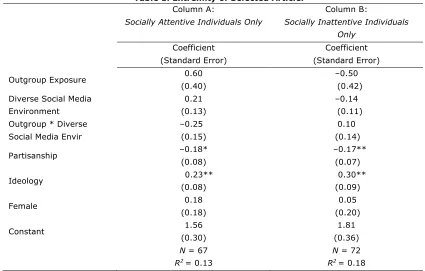
First, we analyze behavior among social attentives (those who score higher than the median on self-monitoring). Given that social attentiveness is not a randomly assigned trait, we include controls for the three traits that differ statistically among those who are attentive versus inattentive: partisanship (where higher values indicate more Republican), ideology (where higher values indicate more conservative), and gender (included as an indicator where 0 = male and 1 = female). (We include demographics of attentives versus inattentives in the Appendix.) We are also interested in how individuals’ own social media environment shapes their response to a political outgroup. We thus interact their rating of their social media environment (scored from most to least like-minded) with a dummy indicating whether they were randomly exposed to a political ingroup or outgroup. We present our results for socially attentive individuals in column A of Table 1.
Table 1. Extremity of Selected Article. Column A:
Socially Attentive Individuals Only
Column B:
Socially Inattentive Individuals Only
Coefficient (Standard Error)
Coefficient (Standard Error)
Outgroup Exposure 0.60
(0.40)
‒0.50 (0.42) Diverse Social Media
Environment
0.21 (0.13)
‒0.14 (0.11) Outgroup * Diverse
Social Media Envir
‒0.25 (0.15)
0.10 (0.14)
Partisanship ‒0.18*
(0.08)
‒0.17** (0.07)
Ideology 0.23**
(0.08)
0.30** (0.09)
Female 0.18
(0.18)
0.05 (0.20)
Constant 1.56
(0.30)
1.81 (0.36) N = 67
R2= 0.13
N = 72 R2= 0.18 *p < 0.05; **p < 0.01.
Note. This table demonstrates that as socially attentive individuals (column A) come from increasingly diverse social media environments, they are less likely to share politically extreme articles when they encounter political outgroup members online. For socially inattentive individuals (column B), social media environments have no influence over the extremity of articles they share with outgroup members.
inattentive. For these respondents, there is no significant interaction between the two constituent terms of interest. That is to say, the social media environments of these respondents play no role in how they react when encountering political outgroup versus ingroup members. Social inattentives thus do not appear to target their messages to the partisan makeup of their audience, while social attentives share more moderate news article to accommodate the outgroup.
To compare these two regressions (i.e., columns A and B of Table 1), we also estimate a model that includes a triple-interaction with social attentiveness (or a “difference-in-differences” test) in order to ensure that the difference in how attentive individuals react to the outgroup treatment is significantly different from how inattentive individuals react to the treatment. We display the results in Table 2.
Table 2. Extremity of Selected Article.
Coefficient (Standard Error)
Outgroup Exposure ‒2.24**
(0.88)
Diverse Social Media Environment ‒0.60**
(0.21)
Self-Monitoring ‒0.18*
(0.08)
Outgroup Exposure * Diverse Social Media Environment 0.73*
(0.31)
Outgroup Exposure * Self-Monitoring 0.35**
(0.12)
Diverse Social Media Environment * Self-Monitoring 0.09**
(0.03) Outgroup Exposure * Diverse Social Media Environment * Self-Monitoring ‒0.12**
(0.04)
Partisanship ‒0.17**
(0.05)
Ideology 0.27**
(0.06)
Female 0.07
(0.13)
Constant 2.83
(0.61) N = 137
R2= 0.20
*p < 0.05; **p < 0.01.
Note. This table demonstrates that there is a significant difference between how diverse social media environments affect inattentive versus attentive people’s reactions to outgroup versus ingroup members online.
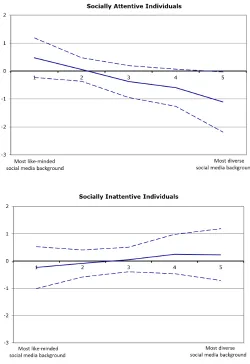
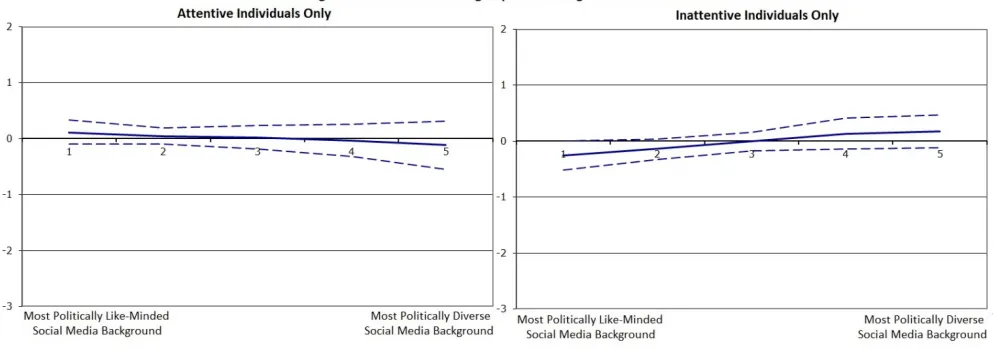
backgrounds respond. In Figure 1, we display the marginal effect of exposure to the outgroup on the extremity of the articles that respondents shared and how this varies with the diversity of their background. For the sake of clarity, we present socially attentive respondents (left panel) separately from socially inattentive respondents (right panel).3
Figure 1. Marginal effect of political group exposure on extremity of article shared, across respondents’ social media backgrounds.
3 Marginal effects in these graphs do not appear linear because the distribution of self-monitoring may be
Starting with socially attentive respondents (top panel), we can see that as their social media environments become increasingly diverse (i.e., as we move from left to right along the x-axis), the marginal effect of exposure to the outgroup on the political extremism of the article they shared becomes more negative. That is to say, attentive individuals from diverse backgrounds are increasingly unlikely to share politically extreme news articles when they encounter out-partisan members. One the other hand, the bottom panel demonstrates the lack of any significant marginal effect of outgroup exposure on the articles socially inattentive respondents chose to share. In particular, the political extremism of the article they chose does not vary as their own social media environments become more diverse.
Our second hypothesis states that attentive individuals from increasingly diverse backgrounds are less likely to share articles that align with their preexisting beliefs. To test this, we model responses to the following survey question: “Did the information in the article you selected align with your beliefs or did it contradict your beliefs?” The response scale ranged from “The article completely aligned with my beliefs” (1) to “The article completely contradicted my beliefs” (7), and, for ease of interpretability, we reverse-code the responses to this question so that greater values indicate greater alignment. We next turn to the results from estimating an OLS regression model that features this alternative dependent variable.
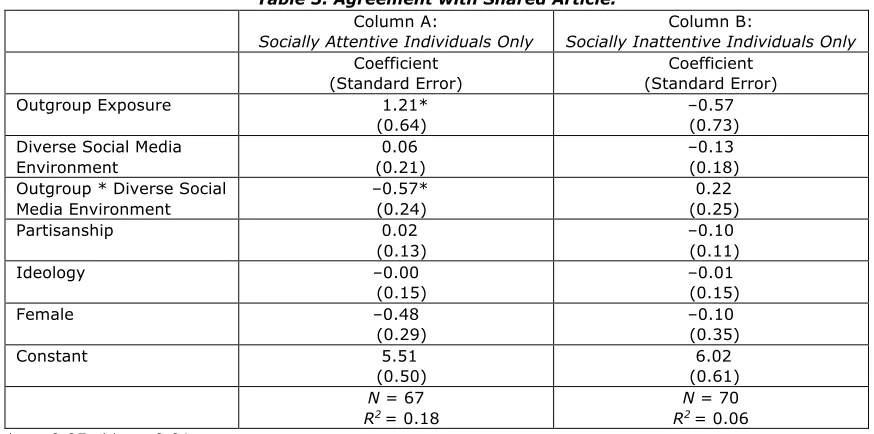
[image:11.612.88.525.394.611.2]We find nearly identical results when we analyze the respondents’ self-reported ideological congruence of the article as we do when analyzing the objective ideological rating of the article from AllSides.com. We present these results in Table 3, following.
Table 3. Agreement with Shared Article. Column A:
Socially Attentive Individuals Only
Column B:
Socially Inattentive Individuals Only Coefficient
(Standard Error)
Coefficient (Standard Error)
Outgroup Exposure 1.21*
(0.64)
‒0.57 (0.73) Diverse Social Media
Environment
0.06 (0.21)
‒0.13 (0.18) Outgroup * Diverse Social
Media Environment
‒0.57* (0.24)
0.22 (0.25)
Partisanship 0.02
(0.13)
‒0.10 (0.11)
Ideology ‒0.00
(0.15)
‒0.01 (0.15)
Female ‒0.48
(0.29)
‒0.10 (0.35)
Constant 5.51
(0.50)
6.02 (0.61) N = 67
R2= 0.18
N = 70 R2= 0.06 *p < 0.05; **p < 0.01.
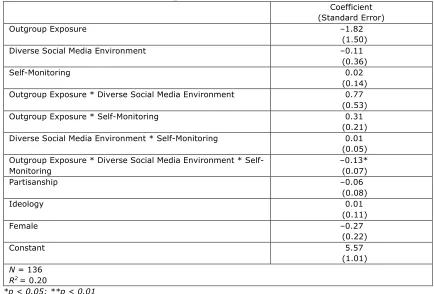
Among socially attentive respondents (column A), there is a significant and negative interaction between the diversity of respondents’ online environments and exposure to the political outgroup. Those who are used to a more diverse environment are less likely to share an article that aligns with their own views when encountering political outgroups. However, among the social inattentives (column B), online environments have no influence on the perceived agreeableness of the article they chose to share. Again, a difference-in-differences model that simultaneously includes our treatment, respondents’ backgrounds, and social attentiveness shows a significant difference between how attentive and inattentive individuals are shaped by their social media background when encountering diversity (see Table 4).
Table 4. Agreement with Shared Article.
Coefficient (Standard Error)
Outgroup Exposure ‒1.82
(1.50)
Diverse Social Media Environment ‒0.11
(0.36)
Self-Monitoring 0.02
(0.14) Outgroup Exposure * Diverse Social Media Environment 0.77
(0.53)
Outgroup Exposure * Self-Monitoring 0.31
(0.21)
Diverse Social Media Environment * Self-Monitoring 0.01
(0.05) Outgroup Exposure * Diverse Social Media Environment *
Self-Monitoring
‒0.13* (0.07)
Partisanship ‒0.06
(0.08)
Ideology 0.01
(0.11)
Female ‒0.27
(0.22)
Constant 5.57
(1.01) N = 136
R2 = 0.20
*p < 0.05; **p < 0.01
Note. This table demonstrates a significant difference between how diverse social media environments affect inattentive versus attentive people’s reactions to outgroup versus ingroup members online.
As individuals become more attentive and come from increasingly diverse backgrounds, exposure to the political outgroup has a significantly negative effect on their tendency to select an article that aligns with their beliefs.
Figure 2. Marginal effect of political outgroup exposure on selecting a like-minded article, across respondents’ social media backgrounds.
Open-Ended Responses
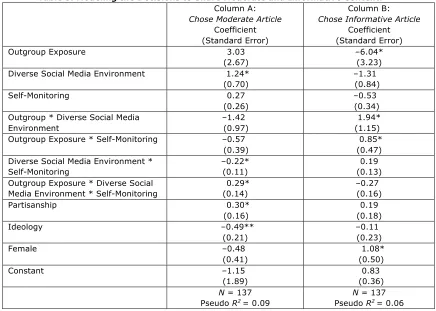
[image:14.612.88.524.333.644.2]We also asked our respondents to tell us, in their own words, why they selected the article to share. Two research assistants with no knowledge of the hypotheses underlying this study coded each respondent’s open-ended response for the following content: Does the respondent describe the article’s political moderation as a reason for choosing it? Does the respondent describe the article’s informative content as a reason for choosing it? We expect that, as socially attentive individuals come from more diverse backgrounds, they will be more likely to say they chose a moderate article when encountering diversity and less likely to say they chose an article that is substantively informative. To test this, we estimate two difference-in-differences specifications, this time substituting the dependent variable for an indicator capturing whether or not a respondent mentioned the article’s moderate content as a rationale for selecting it and (in a second model) an indicator capturing whether or not a respondent mentioned the article’s substantive content. The dependent variable is binary in this case, so we employ a logit model instead of an OLS regression. We provide the estimates of these specifications in Table 5. Column A provides the results when we use the “moderate” as the dependent variables, and column B provides the results for “informative content.”
Table 5. Modeling the Decisions to Share Moderate and Informative Content. Column A:
Chose Moderate Article Coefficient (Standard Error)
Column B: Chose Informative Article
Coefficient (Standard Error)
Outgroup Exposure 3.03
(2.67)
‒6.04* (3.23) Diverse Social Media Environment 1.24*
(0.70)
‒1.31 (0.84)
Self-Monitoring 0.27
(0.26)
‒0.53 (0.34) Outgroup * Diverse Social Media
Environment
‒1.42 (0.97)
1.94* (1.15) Outgroup Exposure * Self-Monitoring ‒0.57
(0.39)
0.85* (0.47) Diverse Social Media Environment *
Self-Monitoring
‒0.22* (0.11)
0.19 (0.13) Outgroup Exposure * Diverse Social
Media Environment * Self-Monitoring
0.29* (0.14)
‒0.27 (0.16)
Partisanship 0.30*
(0.16)
0.19 (0.18)
Ideology ‒0.49**
(0.21)
‒0.11 (0.23)
Female ‒0.48
(0.41)
1.08* (0.50)
Constant ‒1.15
(1.89)
0.83 (0.36) N = 137
Pseudo R2 = 0.09
Note. This table demonstrates that attentive individuals from diverse backgrounds are more likely to select moderate content to share when exposed to political outgroups (column A) and are marginally less likely to select articles they believe have informative content (column B).
[image:15.612.59.556.340.515.2]In column A, we see a significant and positive tendency for socially attentive respondents from diverse backgrounds to mention an article’s moderate content as a reason for selecting it when exposed to members of the political outgroup. In column B, we present estimates from our final model, which includes as the dependent variable an indicator of whether the respondent mentioned choosing an informative article in his or her open-ended response. When it comes to explaining one’s article choice as informative, we see only a very marginally significant and negative triple interaction coefficient (p = 0.1), suggesting just weak evidence that socially attentive respondents from diverse backgrounds are less likely to say they chose an informative article with an audience composed of political outgroup members. In Figure 3, we display the marginal effects of outgroup exposure on respondents’ likelihood of sharing an article for its moderate (top panels) or informative (bottom panels) content. These marginal effects were calculated for high and low self-monitors, across different social media backgrounds, and with the covariates held at their means.
Figure 3. Marginal effect of political outgroup on choosing a moderate article.
Overall, we find support for both of our main hypotheses. Socially attentive individuals from diverse backgrounds choose to share moderate information that aligns less with their own views when surrounded by out-partisans.
Discussion
diversity. When they are subsequently exposed to our outgroup treatment, they choose to share more moderate news articles. Those who are surrounded by echo chambers, on the other hand, respond to political outgroups by clinging to their preexisting views and sharing these views with a disagreeing audience. This finding can help us understand the conflicting evidence regarding the effect of exposure to cross-cutting views.
Our study reveals that individual-level variation in previous exposure to cross-cutting views shapes the relationship between exposure to political outgroups and ensuing reactions. This complements some existing work, for example by Turner and West (2011), who find that preparing people for contact with an outgroup (e.g., by asking them to first imagine a positive interaction) can improve their later encounters. Our study also helps clarify a body of conflicting evidence: some scholars show a moderating effect of exposure to diversity (e.g., Klar & Shmargad, 2017), others show a radicalizing effect (e.g., Weeks et al., 2017), while yet others find no effects at all (e.g., Warner, 2010).
We couch our experimental setting in a context of social media because it is a prolific and growing source of political information for individuals today. The degree to which this new media environment exposes people to echo chambers or cross-cutting views is the subject of ongoing debate. Both experimental (e.g., Arceneaux, Johnson, & Murphy, 2012; Knobloch-Westerwick & Meng, 2009) and observational evidence (Stroud, 2010) of selective exposure suggests that media effects generally occur most among people who actively choose to expose themselves to proattitudinal content (Hameleers, Bos, & de Vreese, 2018, p. 54). Other scholars, more recently, maintain that Americans’ media environments are in fact more diverse. For example, in a series of White Papers, Guess and his coauthors (2018) argue that, in fact, “behavioral data indicate that only a subset of Americans have news diets that are highly concentrated ideologically” (p. 15). Social media, in particular, these authors argue, can expose participants to cross-cutting content by way of “weak ties” (Granovetter, 1973; Guess et al., 2018, p. 26).
There are a number of limitations to our study that we wish to highlight. First, while our experiment randomly assigns respondents to outgroup and ingroup conditions, we do not randomize whether respondents’ social media connections consist of the former or the latter. Rather, our measure of respondents’ backgrounds instead relies on their own self-reports. In previous work, for example Klar and Shmargad (2017), scholars have randomly assigned people to social network conditions that persist over longer stretches of time. Such longitudinal experiments are needed to gauge how behaviors, such as responses to diverse encounters, are shaped over time. The intent of our current study is instead to reveal how submersion in particular online media environments can affect later behaviors, but future studies could randomly administer successive exposures to political outgroups in order to provide a more causal interpretation of how subsequent exposures are shaped by initial encounters with political diversity.
we argue that when deliberation is treated as a learned behavior rather than something that should happen “at first sight,” encounters with political outgroups can yield fruitful outcomes over the longer term.
References
Arceneaux, K., Johnson, M., & Murphy, C. (2012). Polarized political communication, oppositional media hostility, and selective exposure. Journal of Politics, 74, 174‒186.
Arendt, H. (1968). Between past and future. New York, NY: Viking Press.
Bakshy, E., Messing, S., & Adamic, L. A. (2015). Exposure to ideologically diverse news and opinion on Facebook. Science, 348, 1130‒1132.
Barbera, P. (2014). Birds of the same feather tweet together. Political Analysis, 23, 76‒91.
Barbera, P. (2015). How social media reduces mass political polarization. Evidence from Germany, Spain, and the United States. Unpublished manuscript, London School of Economics.
Barbera, P., Jost, J. T., Nagler, J., Tucker, J. A., & Bonneau, R. (2015). Tweeting from left to right: Is online political communication more than an echo chamber? Psychological Science, 26, 1‒12.
Benhabib, S. (1992). Situating the self. New York, NY: Routledge.
Brewer, M. B. (1999). The psychology of prejudice: Ingroup love or outgroup hate? Journal of Social Issues, 55, 429‒444.
Brundidge, J. (2010). Encountering difference in the contemporary public sphere. Journal of Communication, 60, 680‒700.
Casciaro, T. (1998). Seeing things clearly: Social structure, personality, and accuracy in social network perception. Social Networks, 20, 331‒351.
Conover, M. D., Ratkiewicz, J., Francisco, M., Goncalves, B., Menczer, F., & Flammini, A. (2011). Political polarization on Twitter. International Conference on Weblogs and Social Media, Barcelona, Spain, July 17-21, 2011.
Druckman, J. N., & Leeper, T. J. (2012). Learning more from political communication experiments: Pretreatment and its effects. American Journal of Political Science, 56, 875‒896.
Fearon, J. (1998). Deliberation as discussion. In J. Elster (Ed.), Deliberative democracy (pp. 44‒68). New York, NY: Cambridge University Press.
Fishkin, J. S. (1991). Democracy and deliberation. New Haven, CT: Yale University.
Flaxman, S., Goel, S., & Rao, J. (2016). Filter bubbles, echo chambers, and online news consumption. Political Opinion Quarterly, 80, 198‒320.
Gaines, B. J., Kuklinski, J. H., & Quirk, P. J. (2007). The logic of the survey experiment revisited. Political Analysis, 15, 1‒20.
Garrett, R. K. (2009a). Echo chambers online? Politically motivated selective exposure among Internet news users. Journal of Computer-Mediated Communication, 14, 265‒185.
Garrett, R. K. (2009b). Politically motivated reinforcement seeking: Reframing the selective exposure debate. Journal of Communication, 59, 676‒699.
Garrett, R. K., & Resnick, P. (2011). Resisting political fragmentation on the Internet. Daedelus, 140, 108‒120.
Gerber, A. S., Green, D. P., & Nickerson, D. (2001). Testing for publication bias in political science. Political Analysis, 9, 385‒392.
Gergen, K. J. (2008). Mobile communication and the transformation of the democratic process. In J. E. Katz (Ed.), The handbook of mobile communication studies (pp. 297–301). Cambridge, MA: MIT Press.
Gil de Zuniga, H., Correa, T., & Valenzuela, S. (2012). Selective exposure to cable news and immigration in the U.S.: The relationship between FOX News, CNN, and attitudes toward Mexican immigrants. Journal of Broadcasting & Electronic Media, 56, 597‒615.
Gottfried, J., & Shearer, E. (2017). News use across social media platforms 2017. Pew Research Center. Retrieved from https://www.journalism.org/2017/09/07/news-use-across-social-media-platforms-2017
Granovetter, M. (1973). The strength of weak ties. The American Journal of Sociology, 78, 1360‒1380.
Gruzd, A., & Roy, J. (2014). Investigating political polarization on Twitter: A Canadian perspective. Policy & Internet, 6, 28‒45.
Hameleers, M., Bos, L., & de Vreese, C. H. (2018). Selective exposure to populist communication: How attitudinal congruence drives the effects of populist attributions of blame. Journal of Communication, 68, 51‒74.
Iyengar, S., & Hahn K. S. (2009). Red media, blue media: Evidence of ideological selectivity in media use. Journal of Communication, 59, 19‒39.
Jamieson, K. H., & Cappella, J. N. (2008). Echo chamber: Rush Limbaugh and the conservative media establishment. Oxford, UK: Oxford University Press.
Karlsen, R., Steen-Johnson, K., Wollebaek, D., & Enjolras, B. (2017). Echo chamber and trench warfare dynamics in online debates. European Journal of Communication, 32, 257‒273.
Klar, S. (2014). Partisanship in a social setting. American Journal of Political Science, 58, 687‒704.
Klar, S., & Shmargad, Y. (2017). The effect of network structure on preference formation. Journal of Politics, 79, 717‒721.
Klofstad, C. A., Sokhey, A. E., & McClurg, S. D. (2013). Disagreeing about disagreement: How conflict in social networks affects political behavior. American Journal of Political Science, 57, 120‒134.
Knobloch-Westerwick, S., & Meng, J. (2009). Looking the other way: Selective exposure to attitude-consistent and counterattitudinal political information. Communication Research, 36, 426‒448.
Linos, K., & Twist, K. (2016). The Supreme Court, the media, and public opinion: Comparing experimental and observational methods. Journal of Legal Studies, 45, 223‒254.
Lupia, A., & McCubbins, M. (1998). The democratic dilemma: Can citizens learn what they need to know? New York, NY: Cambridge University Press.
Lupton, R. N., Singh, S. P., & Thornton, J. R. (2015). The moderating impact of social networks on the relationships among core values, partisanship, and candidate evaluations. Political Psychology, 36, 399‒414.
McLuhan, M. (1964). Radio: The tribal drum. AV Communication Review, 12, 133–145.
Mutz, D. C. (2002). Cross-cutting social networks: Testing democratic theory in practice. American Political Science Review, 96, 111‒126.
Page-Gould, E., Mendoza-Denton, R., Alegre, J. M., & Siy, J. O. (2010). Understanding the impact of cross-group friendship on interactions with novel outgroup members. Journal of Personality and Social Psychology, 98, 775–793.
Pettigrew, T. F., Tropp, L. R., Wagner, U., & Christ, O. (2011). Recent advances in intergroup contact theory. International Journal of Intercultural Relations, 35, 271‒280.
Prior, M. (2007). Post-broadcast democracy: How media choice increases inequality in political involvement and polarizes elections. New York, NY: Cambridge University Press.
Robinson, C. (2010). Cross-cutting messages and political tolerance: An experiment using evangelical protestants. Political Behavior, 32, 495‒515.
Schmidt, K. (2014). Radio voices: Reflections on McLuhan’s tribal drum. In C. Birkle, A. Krewani, & M. Kuester (Eds.), McLuhan’s global village today (pp. 117‒130). London, UK: Pickering & Chatto.
Slothuus, Rune. (2016). Assessing the influence of political parties on public opinion. Political Communication, 33, 302‒327.
Snyder, M. (1974). Self-monitoring of expressive behavior. Journal of Personality and Social Psychology, 30, 526‒537.
Snyder, M., & Cantor, N. (1980). Thinking about ourselves and others: Self-monitoring and social knowledge. Journal of Personality and Social Psychology, 39, 222‒234.
Stroud, N. J. (2010). Polarization and partisan selective exposure. Journal of Communication, 60, 556‒576.
Tajfel, H. (1982). Social psychology of intergroup relations. Annual Review of Psychology, 33, 1‒39.
Turner, R. N., & West, K. (2011). Behavioural consequences of imagining intergroup contact with stigmatized outgroups. Group Processes & Intergroup Relations, 15, 193‒202.
Warner, B. R. (2010). Segmenting the electorate: The effects of exposure to political extremism online. Communication Studies, 61, 430‒444.
Weeks, B. E., Lane, D. S., Kim, D. H., Lee, S. S., & Kwak, N. (2017). Incidental exposure, selective exposure, and political information sharing: Integrating online exposure patterns and expression on social media. Journal of Computer-Mediated Communication, 22, 363‒379.
Wojcieszak, M., & Mutz, D. C. (2009). Online groups and political discourse: Do online discussion spaces facilitate exposure to political disagreement? Journal of Communication, 59, 40‒56.
Wojcieszak, M., & Price, V. (2010). Bridging the divide or intensifying the conflict? How disagreement affects strong predilections about sexual minorities. Political Psychology, 31, 315‒339.
[image:21.612.105.515.250.398.2]Appendix
Table A2. Demographics of All Subjects (Column 1), of Socially Attentive Subjects (Column 2), and of Socially Inattentive Subjects (Column 3).
Column 1: All
Column 2: Socially Attentive
(above median)
Column 3: Socially Inattentive
(below median)
Percent Democrat 59.1 56.8 61.2
Percent Republican 29.6 30.0 29.3
Percent liberal 47.6 49.6 45.6
Percent conservative 24.2 24.1 24.3
Percent women 65.2 55.2 74.8
Mean age 21.0 21.1 20.9
Percent assigned to outgroup condition 50.7 52.9 48.6
Here we display mean covariates for individuals scoring high in self-monitoring (i.e., socially attentive subjects) and for those scoring low (i.e., socially inattentive subjects).
[image:21.612.135.478.459.639.2]2. Full Question Wording [All conditions:]
Thank you for participating in this survey. We are interested in learning about your political beliefs and asking you a few questions about current events.
First, generally speaking, would you say you are a Democrat, a Republican, or an Independent? a) Strong Democrat
b) Weak Democrat
c) Independent but I lean toward Democrat
d) Independent and I have no preference for either party e) Independent but I lean toward Republican
f) Weak Republican g) Strong Republican
[Next page:]
The purpose of this study is for you to learn a few things about current events and for you to share information about current events with other students who are also participating in this study.
First, we will ask you to select a news story that you think is worth sharing online with a group of other students.
The students with whom you would be sharing are described below. Please take a moment to review their demographics:
[Random half: Like-minded condition only]
• 85% IN-PARTY; 10% OUT-PARTY; 5% Independent
• 20% Freshmen; 15% Sophomore; 35% Junior; 30% Senior
• 55% female; 40% male; 5% gender not provided
• 70% in-state resident; 30% out-of-state resident
[Random half: Outgroup condition only]
• 85% OUT-PARTY; 10% IN-PARTY; 5% Independent
• 20% Freshmen; 15% Sophomore; 35% Junior; 30% Senior
• 55% female; 40% male; 5% gender not provided
• 70% in-state resident; 30% out-of-state resident
[Next page:]
Below we have listed five recent articles regarding current events. We have listed the headline and the newspaper in which the article was published, as well as a ranking of how liberal, neutral, or conservative each headline is. This rating is provided by the AllSides.com media bias ratings system. At the end of this survey, you can read more about this system, if you would like to.
You may click on any of the headlines to read the full story:
_ “Five Tough Decisions for the GOP on Healthcare” Source: The Hill
Ideology Rating: 3 (Moderate) Click here to read full article
_ “Single Payer Healthcare Isn’t What the Doctor Ordered” Source: Washington Examiner
Ideology Rating: 5 (Very Conservative) Click here to read full article
_ “How Democrats Can Win Medicare for All” Source: Huffington Post
Ideology Rating: 1 (Very Liberal) Click here to read full article
_ “Once Obamacare Repeal Is Dead, the GOP Has no Plan B” Source: Vox.com
Ideology Rating: 2 (Slightly Liberal) Click here to read full article _ “The Single Payer Threat Is Real”
Source: Reason.com
Ideology Rating: 4 (Slightly Conservative) Click here to read full article
After you have reviewed each headline and read as many stories as you like, please select one story that you would like to share with the group.
[Next page:]
Did the information in the article you selected align with your beliefs or did it contradict your beliefs? A) The article completely aligned with my beliefs.
B) The article mostly aligned with my beliefs. C) The article slightly aligned with my beliefs.
D) The article neither aligned nor contradicted my beliefs. E) The article slightly contradicted my beliefs.
F) The article mostly contradicted my beliefs. G) The article completely contradicted my beliefs.
Did you already know everything in the article you selected or did you learn new information from it? A) I already knew everything in the article.
B) I already knew most things in the article. C) I already knew just a few things in the article.
D) I did not already know most of the things in the article. E) I did not already know anything that was in the article.
[New Page:]
We’d now like to as a few questions about how you use social media.
How often do you use social media (things like Facebook, Twitter, Instagram, etc.)? A) Multiple times each day
B) Once a day C) A few times a week D) A few times a month E) Once a month or less F) Never
When you access social media, how often do you see your friends sharing political content on social media? A) Very often
B) Often C) Sometimes D) Not that often E) Never
Would you say that your connections on social media are mostly Democrats, mostly Republicans, or an even mix?
A) Mostly Democrats B) Slightly more Democrats C) An even mix
D) Slightly more Republicans E) Mostly Republicans
Have you ever “unfriended” or stopped following someone on social media because you do not agree with the political content that they share?
A) Yes, many times. B) Yes, a few times. C) Yes, just once. D) No, never.
When it comes to your political views, would you say you are liberal, conservative, or moderate? A) Very liberal
B) Liberal C) Slightly liberal D) Moderate
When you access social media, how often do you share political content? By “share” we mean actively posting content or resharing others’ content that has to do with politics.
A) Very often B) Often C) Sometimes D) Not that often E) Never
When you access social media, how often do you share content that is not political? By “share” we mean actively posting content or resharing others’ content that does not have to do with politics.
A) Very often B) Often C) Sometimes D) Not that often E) Never
[Next page:]
Before we conclude this study, we are interested in asking a few questions about you.
When it comes to your political views, would you say that you’re liberal, conservative, or moderate? A) Very liberal
B) Liberal C) Slightly liberal D) Moderate
E) Slightly conservative F) Conservative G) Very conservative
Generally speaking, how interested are you in politics? A) Extremely interested
B) Interested C) Slightly interested
D) Neither interested nor uninterested E) Slightly uninterested
F) Uninterested
G) Extremely uninterested
What is your gender? A) Male B) Female
C) Other / prefer to not say
[enter]
With which race do you primarily identify? You may select all that apply. A) African American or Black
B) Asian or Pacific Islander C) Hispanic or Latino D) Middle Eastern E) Native American F) White
G) Other
[Next page:]
Thank you for participating in this study. The group with which you were matched today was a hypothetical group: these individuals were not real but were rather an example of a type of group you might meet. The intent of this study was simply to observe how individuals share news with other group members. Thank you for participating.
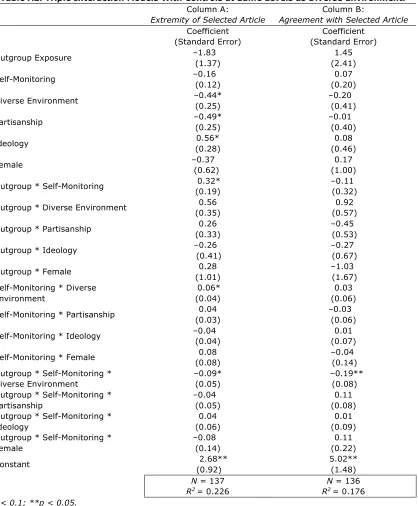
3. Robustness Check
Network environments are not randomized, and thus it is important to account for any differences between subjects who report like-minded networks and subjects who report diverse networks. We find that there are no significant differences when it comes to most of the traits we measure: age, political interest, frequency of social media use, or self-monitoring. They are marginally different with respect to gender (with slightly fewer females reporting diverse networks), and they are significantly different with respect to party identification and ideology (with more Republicans and more conservatives reporting to have diverse networks). We account for these differences by controlling for these traits in the model we present in our study. Here, we provide an additional robustness check.
Table A2. Triple Interaction Models With Controls at Same Levels as Diverse Environment. Column A:
Extremity of Selected Article
Column B:
Agreement with Selected Article Coefficient
(Standard Error)
Coefficient (Standard Error)
Outgroup Exposure ‒1.83
(1.37)
1.45 (2.41)
Self-Monitoring ‒0.16
(0.12)
0.07 (0.20)
Diverse Environment ‒0.44*
(0.25)
‒0.20 (0.41)
Partisanship ‒0.49*
(0.25)
‒0.01 (0.40)
Ideology 0.56*
(0.28)
0.08 (0.46)
Female ‒0.37
(0.62)
0.17 (1.00)
Outgroup * Self-Monitoring (0.19) 0.32* ‒(0.32) 0.11
Outgroup * Diverse Environment (0.35) 0.56 (0.57) 0.92
Outgroup * Partisanship 0.26
(0.33)
‒0.45 (0.53)
Outgroup * Ideology ‒0.26
(0.41)
‒0.27 (0.67)
Outgroup * Female 0.28
(1.01)
‒1.03 (1.67) Self-Monitoring * Diverse
Environment
0.06* (0.04)
0.03 (0.06) Self-Monitoring * Partisanship 0.04
(0.03)
‒0.03 (0.06)
Self-Monitoring * Ideology ‒0.04
(0.04)
0.01 (0.07)
Self-Monitoring * Female 0.08
(0.08)
‒0.04 (0.14) Outgroup * Self-Monitoring *
Diverse Environment
‒0.09* (0.05)
‒0.19** (0.08) Outgroup * Self-Monitoring *
Partisanship
‒0.04 (0.05)
0.11 (0.08) Outgroup * Self-Monitoring *
Ideology
0.04 (0.06)
0.01 (0.09) Outgroup * Self-Monitoring *
Female
‒0.08 (0.14)
0.11 (0.22)
Constant 2.68**
(0.92)
5.02** (1.48) N = 137
R2= 0.226