The seven most common strong acids:
HCl hydrochloric acid HBr hydrobromic acid
HI hydroiodic acid
HNO3 nitric acid HClO3 chloric acid
HClO4 perchloric acid H2SO4 sulfuric acid
Bronsted-Lowry Acids & Bases
Bronsted-Lowry Acids & Bases
Examples of common weak acids:
acetic acid, citric acid,
phosphoric acid
Examples of substances with negligible acidity:
CH4 H2 OH –
Acid – Base Reactions
A reaction between
an acid and a base is called neutralization. An acid-base
mixture is not as
Conjugate acid base pairs
A conjugate base is a base that is
produced when an acid gives up a proton. H2SO4 → HSO4- + H+
In this case the HSO
4- is the base
produced when the H2SO4 gave up the H+
The only difference between a conjugate
acid/base pair is one little hydrogen ion.
The acid has it and the base does not.
So to determine the conjugate base all
you do is subtract one H from the acid and make the resulting ion (-)
Do some practice problems
Learning Check!
Label the acid, base, conjugate acid, and conjugate base in each reaction:
HONORS ONLY!
HONORS ONLY!
HCl + OH
- Cl
-+ H
2O
HCl + OH
-
Cl
-+ H
2
O
H
2O + H
2SO
4 HSO
4-+ H
3
O
+H
2O + H
2SO
4
HSO
4-+ H
Bronsted-Lowry Acids & Bases
An inverse relationship exists between the
strength of an acid and its conjugate base or between a base and its conjugate acid.
Strong acids form very weak conjugate
bases (usually have negligible basicity).
Weak acids form stronger (but still fairly
weak) conjugate bases
Substances with negligible acidity form
Bronsted-Lowry Acids and
Bases
The stronger the acid, the weaker the conjugate
base
The stronger the base,
Example: Use Fig. 15.6 to predict whether the
equilibrium lies predominantly to the left or to the right:
Bronsted-Lowry Acids & Bases
HSO4- (aq) + CO32- (aq) SO
42- (aq) + HCO3- (aq)
acid base Conj.
Acid-Base Behavior
• Consider a compound having the formula HOX.
• If X is highly electronegative, it will have a
strong attraction for the electrons shared with O.
– The O, will in turn, pull strongly on the electrons held
shared with H.
– This H will then be easily lost = acid
• If X has a low electronegativity, the oxygen will
pull the electrons away from X.
– The hydrogen will remain joined to the oxygen.
– Since the O and H can easily remain together, it is
likely that OH- will be formed = base
• Nonmetals tend to have high EN = acids
Neutralization
In general: Acid + Base Salt + Water
All neutralization reactions are double displacement reactions.
HCl + NaOH NaCl + HOH
HCl + Mg(OH)2
Neutralization Reaction of
Weak Acid
HC2H3O2(aq) + NaOH(aq) NaC2H3O2(aq) + H2O(l)
Weak acid strong base soluble salt water
HC2H3O2 + Na+ + OH- Na+ + C
2H3O2- +
H2O(l)
HC
2H
3O
2(aq) + OH
-(aq)
C
2H
3O
2-(aq)+
H
2O(
l
)
*Remember, only strong electrolytes are written as ions.*
2HCl (aq) + Na2S(aq) H2S(g) + 2NaCl(aq)
Hydrochloric acid + Sodium Sulfide
2H+ (aq) + S2-(aq) H
2S(g)
HCl (aq) + NaHCO3(aq) NaCl(aq) + H2CO3(aq)
H2CO3(aq) H2O(l) + CO2(g)
HCl (aq) + NaHCO3(aq) NaCl(aq) + H2O(l) + CO2(g)
Hydrochloric acid + Sodium Hydrogen Carbonate
H+ (aq) + HCO
Acids & Bases
For the following identify the acid and the base as strong or weak .
a. Al(OH)3 + HCl
b. Ba(OH)2 + HC2H3O2
c. KOH + H2SO4
d. NH3 + H2O
Weak base Strong acid
Weak acid
Strong acid
Strong base
Strong base
Acids & Bases
For the following predict the product. To check your answer left click on the mouse. Draw a mechanism detailing the proton movement.
a. Al(OH)3 + HCl
b. Ba(OH)2 + HC2H3O2
c. KOH + H2SO4
d. NH3 + H2O
AlCl
3+ 3 H
2O
Ba(C2H3O2)2 + 2 H2O
K
2SO
4+ 2 H
2O
NH
4++ OH
-2
Acid – Base reactions
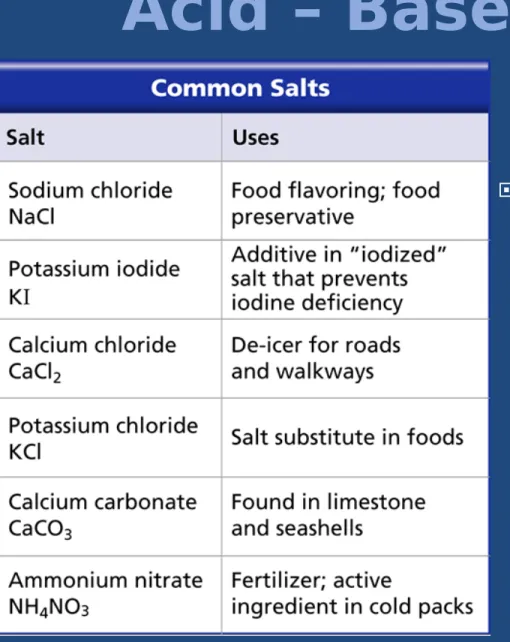
Each salt listed in this
Amphiprotic vs amphoteric
Salts
can act as acids and
bases by donating or accepting
H
+- usually H
3
O+ or OH
-ions are
acid base
HCl + H
2
O
H
3O
++ Cl
- Water is behaving as a base donates proton
base acid
O
2-+ H
2
O
OH
Acid Rain
What is Acid Rain?
SO2 and NO2/NO3 from industry and cars Produce
H2SO4 and HNO3 when combined with
water
Can fall as rain, snow and as solid
What are the effects?
Forrest
depletion: tree death
Can be seen in
NH in White Mountains
Clear lakes due to acid rain: clear
because
Statues like this
one, show
corrosion due to acid rain.
Copper and
Effects of Acid Rain
Maple sugar
production in the Northeast may be
down due to acid rain: this is projected to
continue
Car paints have had
to be reformulated and there are many products on the