Trust in the cloud
MASTER THESIS
MSc in Business Administration
Trust in the cloud
Author
Loes S. Pross
Study program:
Business Administration
Faculty of Behavioural, Management and Social Sciences
Student no.:
1532863
E-mail:
[email protected]
Graduation Committee
Dr. Ir. A.A.M. Spil
Prof. Dr. M. Junger
Acknowledgements
The document you are about to read is the final result of my Master Thesis project, conducted to obtain my Master’s Degree in Business Administration from the University of Twente. With this thesis the program is completed and it concludes my education. The writing of this thesis has been a learning process. Both academically in the field of Business Administration and personally in experiencing challenges along the way. Personally, this process came with some hurdles I had to take and it has taught me to believe in myself and keep on going.
The completion of this project would not have been possible without the help and support of others. In the first place, both my supervisors Dr. Ir. A.A.M. Spil and Prof. Dr. M. Junger deserve a big thanks. They helped and advised me and gave me constructive criticism and support. Furthermore I would like to thank the people who participated in the case studies and the expert that helped me validate and complete the finding of this research for their contributions and their candour.
Abstract
The presented study is an examination of trust in cloud computing for organizations in the Netherlands. In this report the following research question will be answered: “What are the attributes of cloud computing for an organization to trust a cloud provider?”
To answer this research question, a literature research was conducted followed by multiple case studies and an expert interview. The literature research was conducted to gather the attributes of cloud computing for an organization to trust a cloud provider and to propose a research model based on the literature and two main adoption theories. In order to test and validate the research model multiple case studies were held and an expert interview was conducted.
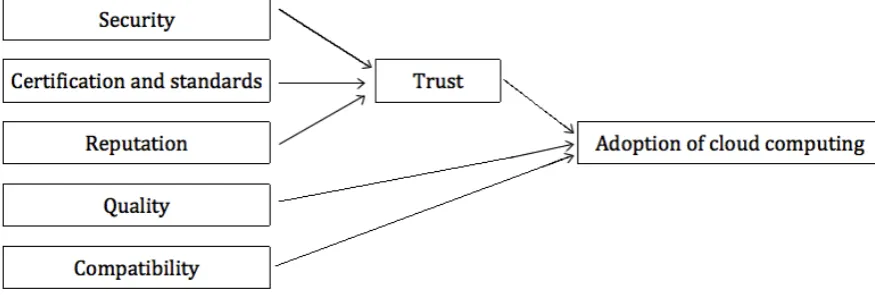
According to the proposed research model trust is expected to have an influence on the adoption of cloud computing, with security, standards and certification, and reputation influencing the level of trust. Besides trust quality, divided into system quality and service quality, and compatibility also are expected to have an influence on the adoption of cloud computing by organizations.
Eight organizations agreed to participate in the multiple case studies. In the multiple case studies the interviewees were asked questions regarding the use of cloud computing and their trust in cloud computing. In addition to the multiple case studies an expert in the field of cloud computing was interviewed as an extra validation of the results of the case studies. The results show that the organizations and expert concluded that security is one of the most important attributes. Although the cloud providers do need to work on their security level. The case study showed that the organizations are hesitant in using the cloud for their core business or private-sensitive information, which makes them use cloud computing in a smaller extent than they could have. While the expert mentioned that a cloud environment in most cases is more secure than your own and you should use it, even for the private-sensitive information. The expert also mentioned that certification and standards show the quality of the cloud provider. The organizations request a more dynamic certification and standards of the cloud provider so the transparency will be increased and a certain level of security can be guaranteed. The continuity and with that the reputation of the cloud provider is of an importance to the organizations when choosing a cloud provider. Concluding the results also show that the compatibility of the cloud environment with the systems of the organization is not validated. The overall quality of the cloud is of greater importance to the organizations and expert. . The quality of the system should meet the quality of their own systems if not exceed this quality in order to adopt cloud computing. Organizations require great service quality with a 24/7 helpdesk from the cloud provider. Not being able to access the cloud environment for even a few hours can be devastating for an organization. Organizations also expect some personalized service of the cloud provider and not being just one of the hundred organizations that have employed their cloud computing service.
Looking at the attributes, no single attribute on its own can explain the trust and adoption of cloud computing. A trusted cloud provider may also not score on all of the attributes. Therefore a right balance between the different attributes is required for a cloud provider to ensure trust from organizations. This research shows that there is not one attribute or sample of attributes that explains the trust in all cases and that every organization and situation allows for a different combination of attributes.
Table of Contents
ACKNOWLEDGEMENTS ... 3
ABSTRACT ... 4
LIST OF ABBREVIATIONS ... 6
LIST OF FIGURES ... 6
LIST OF TABLES ... 6
CHAPTER 1 INTRODUCTION ... 7
1.1 PROBLEM STATEMENT ... 7
1.2 RESEARCH QUESTION ... 8
CHAPTER 2 LITERATURE REVIEW ... 9
2.1 PLANNING OF THE LITERATURE REVIEW ... 9
2.2 CLOUD COMPUTING LITERATURE REVIEW ... 9
2.2.1 History of Cloud Computing ... 9
2.2.2 Characteristics of Cloud Computing ... 10
2.2.3 Status quo on cloud computing ... 13
2.3 TRUST ... 14
2.4 TRUST AND CLOUD COMPUTING ... 14
2.5 RISKS OF CLOUD COMPUTING ... 15
CHAPTER 3 ADOPTION THEORY REVIEW ... 17
3.1 TECHNOLOGY ACCEPTANCE MODEL ... 17
3.1.1 Key Elements ... 18
3.2 TECHNOLOGY ORGANIZATION ENVIRONMENT FRAMEWORK ... 18
3.2.1 Key Elements ... 19
CHAPTER 4 RESEARCH MODEL ... 20
4.1 RESEARCH MODEL ... 20
4.2 ATTRIBUTES ... 21
4.2.1 Security ... 21
4.2.2 Certification and standards ... 22
4.2.3 Reputation ... 22
4.2.4 Trust ... 22
4.2.5 Compatibility ... 22
4.2.6 Quality ... 22
CHAPTER 5 RESEARCH METHODOLOGY ... 24
5.1 CASE STUDY ... 24
5.2 PRIMA MODEL ... 24
5.3 DATA COLLECTION AND ANALYSIS ... 25
CHAPTER 6 CASE ANALYSIS RESULTS ... 27
6.1 WITHIN-CASE ANALYSIS ... 27
6.1.1 Case 1: ALPHA ... 27
6.1.2 Case 2: BRAVO ... 28
6.1.3 Case 3: CHARLIE ... 29
6.1.4 Case 4: DELTA ... 29
6.1.5 Case 5: ECHO ... 30
6.1.6 Case 6: FOXTROT ... 31
6.1.7 Case 7: GOLF ... 32
6.1.8 Case 8: HOTEL ... 33
6.2 CROSS-CASE ANALYSIS ... 35
CHAPTER 7 LIMITATIONS AND FUTURE STUDIES ... 40
CHAPTER 8 CONCLUSION ... 41
APPENDIX ... 42
APPENDIX A PRIMA INTERVIEW QUESTIONS ... 42
APPENDIX B EXPERT INTERVIEW QUESTIONS ... 43
REFERENCES ... 44
List of Abbreviations
CIA Confidentiality, Integrity and Availability CSC Cloud Service Certifications DDos Distributed Denial of Service EC2 Elastic Compute Cloud IaaS Infrastructure as a Service IEC International Electrotechnical Commission IT Information Technology IS Information Security ISO International Organization for Standardization PaaS Platform as a Service NATO North Atlantic Treaty Organization NIST National Institute of Standards and Technology SaaS Software as a Service SLA Service Level Agreement TAM Technology Acceptance Model TOE Technology-Organization-Environment framework VPN Virtualized Private NetworkList of Figures
Figure 1 Overview cloud computing ... 13Figure 2 CIA-triad ... 15
Figure 3 TOE Framework (Source: Tornatzky and Fleischer (1990)) ... 18
Figure 4 Research Model ... 21
List of Tables
Table 1 Search criteria for the systematic literature review in Scopus ... 9Table 2 Attributes of cloud computing ... 20
Table 3 Attributes expected to be measured by the PRIMA model ... 26
Table 4 Overview of usage cloud computing within organizations ... 35
Chapter 1 Introduction
1.1 Problem statement
“Cloud computing is one of the biggest growing segments within the Information Technology” (Subashini & Kavitha, 2011, p. 1). In the popular press cloud computing was in 2011 described as the next big thing and “a major technology disruption” (Weber, 2011, p. 1). Cloud computing has since then grown and its use has increased. Cloud computing is the new paradigm for “hosting and levering services over the Internet” (Zhang, Cheng & Boutaba, 2010, p. 7). It is clear that cloud computing has versatile opportunities for companies and that it is an emerging technology. However when decisions on cloud computing for organizations are made, trust is one critical obstacle for the adoption of cloud computing (Arpaci, 2016).
Adopting cloud computing also has a lot of advantages to offer for organizations; “it dramatically lowers the cost of entry for smaller firms trying to benefit from compute-intensive business analytics that were hitherto available only to the largest corporations; it can provide an almost immediate access to hardware resources, with no upfront capital investment for users, leading to a faster time to market in many organizations; cloud computing can lower IT barriers to innovation, as can be witnessed from the many promising start-ups, such as Facebook and YouTube; cloud computing makes it easier for enterprises to scale their services – which are increasingly reliant on accurate information – according to client demand; and cloud computing also makes possible new classes of applications and delivers services that were not possible before” (Marston, Li, Bandyopadhyay, Zhang & Ghalsasi, 2011, p. 178).
Even with these advantages there still remain trust issues for organizations with the adoption of cloud computing. The IT departments of many organizations feel “more comfortable with supporting old mainframes and enterprise software instead of supporting their company’s business strategy” (Weber, 2011, p. 1). A lack of trust is a key inhibitor to the adoption of cloud computing (Pearson, 2013). Organizations have fewer concerns about the health of the servers, but have more concerns regarding the security and privacy of their content in the cloud. Organizations feel that by brining their environment to the cloud they will face a higher security and privacy risk than if they keep running things the old fashioned way. While cloud providers claim that the cloud is more secure than whatever organizations are using now (Talbot, 2010; Kshetri, 2013). There remains a gap between the cloud providers’ claims on the quality and safety of their system and the users’, in this case organizations’, view on the quality and safety of the system.
1.2 Research Question
This research aims to develop theory regarding the attributes organizations require in order to trust a cloud provider with their content. The following research question will guide the proposed study:
What are the attributes of cloud computing for an organization to trust a cloud provider?
In doing so, the proposed research aims to investigate the experiences organizations have with cloud computing and providers, their level of trust in cloud computing and providers, and the attributes organizations require for cloud computing.
The attributes in this context are meant as the standards organizations have regarding a cloud environment in order to trust it with their content. If these standards are met the organizations have the trust in the cloud environment and provider to use cloud computing for their organization and therefore adopt it. The proposed research will therefore examine the attributes of cloud computing for an organization to trust a cloud provider.
In addition to the central research question the following guiding question have been formulated, in order to guide the process:
1. What types of cloud environments are there for organizations to choose from? 2. What are the keys issues with the adoption of cloud computing?
3. How do these key issues influence the degree to which an organization adopts cloud computing?
4. To what extend do organizations trust cloud providers?
Chapter 2 Literature review
2.1 Planning of the literature review
An extensive literature review provides an overview of the current academic insights in the area of cloud computing. An analysis and review of the existing academic literature gains insights and gives guidance for the research (Tranfield, Denyer & Smart, 2003). The method for a systematic literature review by Wolfswinkel, Fortmueller, and Wilderom (2013) was used. The method of Wolfswinkel et al. (2013) means defining criteria, searching with these criteria, refining the sample, analysing the content and presenting the content. For the systematic research the database of Scopus was used. Within Scopus only the Social Sciences and Humanities section was used. The search criteria are stated in Table 1.
Document type Articles
Subject areas Computer Science; Business management and accounting
Language English
Source type Journals
[image:9.595.62.534.241.317.2]Search terms Cloud computing AND Trust or Cloud AND Trust
Table 1 Search criteria for the systematic literature review in Scopus
Besides Scopus also Google Scholar and Google Books were used to find the needed literature. The same search terms applied here. Throughout the search articles, abstracts, titles, and conclusions were read as well as forward and backward citations checks were performed. The articles that remained are used as the core of this chapter.
2.2 Cloud Computing Literature Review
2.2.1 History of Cloud Computing
In 1961 in the MIT Centennial talk, John McCarthy said that “If computers of the kind I have advocated become the computers of the future, then computing may someday be organized as a public utility just as the telephone system is a public utility … The computer utility could become the basis of a new and important industry”, this implies the underlying concept of cloud computing (McCarthy, 1999).
Nowadays there is a growing trend of cloud computing and therefore many definitions have evolved in the literature. The most used and prominent definition of cloud computing is introduced by the American National Institute of Standards and Technology (NIST).
“Cloud computing is a model for enabling convenient, on-demand network access to a shared pool of configurable computing resources (e.g. networks, servers, storage, applications, and services) that can be rapidly provisioned and released with minimal management effort or service provider
interaction.” (Mell & Grance, 2011, p. 2).
Besides the introduction of the underlying concept of cloud computing in the 1960s by John McCarthy, also the characteristics of cloud computing were explored. In 1966 Douglas Parkhill did this for the first time, in his book The Challenge of the Computer Utility. In his book Parkhill provides a vision for computing in the future where it is a utility just as any other, e.g. phones, electricity: always available when needed (on-demand) (Parkhill, 1966).
offered the same quality service, but at lower costs and with which they were able to switch traffic that enabled balance of the utilization of the overall network. Cloud computing now is the extension of the VPN concept by covering servers and network infrastructure (Harauz, Kaufman & Potter, 2009). But not only the VPN connection has made an impact on what cloud computing is today, also other recent technological advances have made this possible. The three core technologies that have made this possible are: virtualization, multitenancy and Web services (Marston, Li, Bandyopadhyay, Zhang & Ghalsasi, 2011). These technologies made cloud computing as an utility possible, but even more important made it economically feasible and are the drivers behind the evolution and adoption of cloud computing (Creeger, 2009).
Since the sixties and the introduction of the concept by John McCarthy cloud computing has developed itself. In the history of cloud computing the arrival of Salesforce.com in 1999 is one of the first milestones (Harauz et al., 2009). Salesforce.com delivered enterprise applications through a simple website. In 2002 Amazon followed with the development of Amazon Web Services, with this they provided a suite of cloud-based services including storage, computation and even human intelligence through the Amazon Mechanical Turk (Harauz et al., 2009). In 2006 Amazon followed up with the launch of Elastic Compute cloud (EC2), which is a web service that allows individuals and small companies to rent computers on which they can run their own applications. The latest milestone for cloud computing came in 2009 with the development of Web 2.0, which made Google and others to start to offer browser-based enterprise applications, such as Google Apps (Ambrust, Fox, Griffith, Joseph, Konwinsky, … & Zaharia, 2009).
Grid computing has made evolve the concept of cloud computing and also grid is often used as a backbone of cloud computing. With grid computing the focus was on an infrastructure that delivers storage and computing resources, this has shifted to an economy-based focus which aims to deliver more abstract services and resources (in the cloud) (Messerschmidt & Hinz, 2013).
With the emerge of cloud computing as a viable and on-demand platform, many users from various backgrounds are sharing virtual machines to perform their daily activities (Harauz et al., 2009). Also many players in the industry have made their move towards cloud computing and implemented it.
2.2.2 Characteristics of Cloud Computing
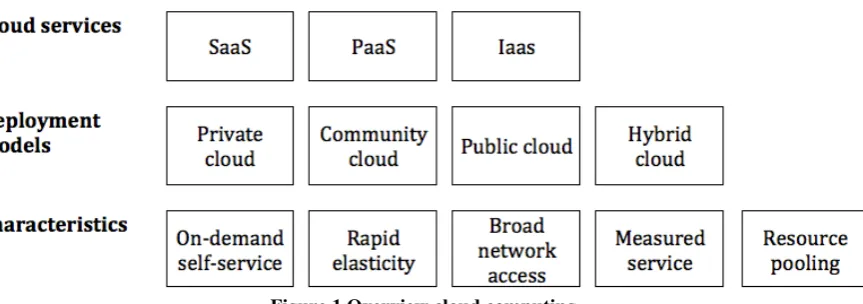
In the previous paragraph the definition of cloud computing by Mell & Grance (2011) was mentioned. Following their definition cloud computing consists of five essential characteristics, three service models, and four deployment models. The five essentials characteristics are on-demand self-service, broad network access, resource pooling, rapid elasticity, and measured service.
As mentioned cloud computing has three different service models, Cloud Software as a Service (SaaS), Cloud Infrastructure as a Service (IaaS) and Cloud Platform as a Service (PaaS).
• SaaS is a software distribution model, in which the customers are provided with a particular piece of software. The cloud provider runs the software and enables the customer to access it, but the customer has to feed the data and instructions (Weis & Alves-Foss, 2011). In SaaS the users are faced with less responsibility than compared to IaaS and PaaS. In the case of SaaS “service levels, security, governance, compliance, and liability expectations of the service and provider are contractually stipulated, managed to, and enforced” (Zargari & Smith, 2014, p. 150). The management of the infrastructure of the cloud is therefore handled completely by the cloud provider.
• IaaS is an on-demand service of compute power and storage space. IaaS can provide customers server, disk storage, database and operating system, among other things (Kshetri, 2013). The users of IaaS are not able to manage or control the underlying cloud infrastructure (Zargari & Smith, 2014). The users do have access and control over the storage, applications, and certain network components. An example of a big IaaS provider is Amazon with its Elastic Compute Cloud (EC2), which will be described in section 3.2.
customers with PaaS are security, application serving, database management, and workflow management. Examples of well-known PaaS vendors are Google, with the Google App Engine, Salesforce.com, and Microsoft with the Windows Azure platform (Kshetri, 2013). Differences in the service models do have an influence on the types of cloud computing related services and products that can be offered by the cloud service provider. But even more importantly the differences in the services models also have an influence on the risks and the degree a cloud service provider is responsible for the maintenance and management of it (Mell & Grance, 2011).
The four deployment models according to the paper by NIST are community cloud, hybrid cloud, private cloud, and public cloud (Mell & Grance, 2011).
(1) The private cloud is a cloud infrastructure for exclusive use by a single customer or organization, hosted either internally or externally and managed by a third-party, internally or a combination of them (Mell & Grance, 2011).
(2) The community cloud is a cloud infrastructure that is shared between several communities or customers with common concerns (e.g., security requirements, mission, compliance considerations, and jurisdiction) and hosted either internally or externally and managed by a third-party, internally or a combination of them (Mell & Grance, 2011). Compared to a private cloud the costs of a community cloud are spread over more users.
(3) The public cloud is a cloud infrastructure that is made for open use by the general public. The public cloud can be owned by an organization such as a government organization, business, academic, or even a combination of these organizations. The public cloud “exists on the premises of the cloud provider” (Mell & Grance, 2011, p. 3). Customers of the public cloud generally have access to it via the Internet, since the cloud providers own and operate the infrastructure at their datacentre. Examples of public cloud providers are Amazon, Microsoft and Google. In contrast to the other deployment models the public cloud is often offered to customers for free.
(4) The hybrid cloud is a cloud infrastructure that is a composition of two or more cloud infrastructures (private, community or public) that remain separate entities but are bound together offering the benefits of these multiple cloud infrastructures. The two or more cloud infrastructures are “bound together by standardized or proprietary technology that enables interoperability” (Jansen & Grance, 2011, p. 3).
The four deployment models of cloud computing are of significance when we look at the potential products and services that are cloud computing related that stakeholders now are able to offer. These products and services differ depending on the deployment model an organization is using or is considering to integrate. The four deployment models give an organization each a different level of control over their data. Higher risks for the organizations are associated with community or public clouds (Jansen & Grance, 2011). Therefore it requires organizations to do a proper evaluation of the risks before choosing one of the deployment models.
Following the definition of cloud computing by Mell & Grance (2011) the five essential characteristics of cloud computing are on-demand self-service, broad network access, resource pooling, rapid elasticity, and measured service.
• On-demand self-service is one of the five essential characteristics of cloud computing.
According to Mell & Grance (2011) it is on-demand self-service when “a consumer can unilaterally provision computing capabilities, such as server time and network storage, as needed automatically without requiring human interaction with each service provider” (p. 2). By adopting cloud computing end-users want to remotely store their data and use the on-demand storage service, without having the burden of local storage (Burda & Teuteberg, 2014). Cloud computing therefore offers the benefit of having continuous availability to archived data, which can be accessed simultaneously from different devices anywhere at anytime.
heterogeneous thin or thick client platforms (e.g., mobile phones, tablets, laptops, and workstations)” (p. 2).
Zaghari & Smith (2014) mentioned the accessibility of multiple datacentres worldwide as one of the big benefits of cloud computing. By having this access the number of hardware components and applications at run time can be reduced. Amazon was one of the pioneers in cloud computing with its Amazon Elastic Compute Cloud (EC2), which provided users a huge amount of storage space that could be accessed from any location connected to the Internet. As mentioned in section 3.3.1.1 according to Burda & Teuteberg (2014) cloud computing provides users with the ability to access it simultaneously from various devices, such as mobile phones and tablets, at anytime and anywhere.
• According to Mell & Grance (2011) resource pooling occurs when “the provider’s computing resources are pooled to serve multiple consumers using a multi-tenant model, with different physical and virtual resources dynamically assigned and reassigned according to the consumer demand” (p. 2). With resource pooling there is a sense of location independence, since the customers have no control and knowledge over the exact location of the provided resources. Customers may have the ability to specify the location at a higher level of abstraction (e.g., datacentre, state or country) (Mell & Grance, 2011). Examples of resources are storage, memory, network bandwidth, and processing.
However, Mell & Grance (2011) may have mentioned resource pooling as one of the five essential characteristics of cloud computing and also as a big advantage for adopting cloud computing in 2009 they noted that the resource pooling in the cloud may result in questioning the data confidentiality and integrity (Mohammed, 2011). The average citizen may be ignorant to the security issues of the cloud, but most organisations are not that ignorant. Therefore organisations are not fully using the online services of cloud computing. In the past there have been several cloud failures that lead to major problems for the customers, examples are Amazon with a lost of service due to the lightning strike (Metz, 2009), Microsoft’s data loss (Lonescu, 2009), and the first crash of Microsoft Azure cloud (Clarke, 2009).
• Rapid elasticity can be described as “capabilities that can be elastically provisioned and
released, in some cases automatically, to scale rapidly outward and inward commensurate with demand. To the consumer, the capabilities available for provisioning often appear to be unlimited and can be appropriated in any quantity at any time” (Mell & Grance, 2011, p. 2). Users can, for example, automatically request additional space in their cloud. Cloud computing is setup to provide users with a seamless service. Therefore the service appears to be automatically and infinite for the users (Zargari & Smith, 2014). There are still some concerns about the rapid elasticity of cloud computing, since the requests of users have an impact on the system. The request the cloud provider gets can require a precise administration and can also be demanding. Some argue that therefore there should be a monitoring tool to control the requests to keep providing the benefits it can with rapid elasticity.
• The fifth essential characteristic of cloud computing is measured service. Measured service is described by Mell & Grance (2011) as “cloud systems automatically control and optimize resource use by leveraging a metering capability at some level of abstraction appropriate to the type of service (e.g., storage, processing, bandwidth, and active user accounts). Resource usage can be monitored, controlled, and reported, providing transparency for both the provider and consumer of utilized service” (p. 2).
Cloud providers are measuring the service to deliver the customer a precisely configured product. Therefore cloud providers will measure, for example, the network bandwidth, memory utilization or any other aspect of the cloud solution. This allows them to deliver the customer a service that meets the customer’s expectations. At the same time the cloud providers provide themselves with numbers, which allows them to measure the costs of the cloud and their return on investment (McLarnon, Robinson, Milligan & Sage, 2014).
Figure 1 Overview cloud computing
2.2.3 Status quo on cloud computing
Research by Lins, Grochol, Schneider and Sunyaev (2016) discusses the cloud service certifications (CSC’s) that have been developed in response to the security, privacy, and reliability concerns of organizations. But even with this certification there remain challenges for cloud providers and organizations. To have this certification widely adopted the providers and auditors “need the motivation and expertise to participate in continuous monitoring and auditing” (Lins et al., 2016, p. 68). In the final recommendation of Lins et al. (2016) they therefore also state: “the ever-changing cloud environment, fast technology cycles, regulatory changes, and increased adoption of business-critical applications demand highly reliable cloud services. Dynamic certification of cloud services can prove providers’ high level of reliability and security to potential customers. However, methods to efficiently and continuously assess cloud services are still in their infancy. Organizations such as the Cloud Security Alliance and EuroCloud are developing processes and techniques for continuous auditing of cloud services. We believe that dynamic certification is a step toward more trustworthy and transparent cloud computing environments” (p. 70).
Research by de Hert, Papakonstantinou & Kamara (2016) discusses the cloud computing standard ISO/IEC 27018. In their research they mostly focus on the protection of personal data in the cloud and therefore on the consumer level. The impact of the ISO/IEC 27018 standard on business is not discussed. But it shows that the standard is intended to use in the market “granting a competitive edge to certified providers, provides concrete incentives to implement – to the benefit of the broader data protection purposes” (de Hert et al., 2016, p. 28).
2.3 Trust
Trust is a concept that has been around for quite a long time. It is as old as the history of mankind and the existence of the human social interactions (Wang & Emurian, 2005). Trust is according to the Oxford English Dictionary (1971) defined as “confidence in or reliance on some quality or attribute of a person or thing, or the trust of a statement” (p. 3423). In the literature however researchers have a difficulty in operationalizing trust and disagree on the basis definitions. This is likely due to trust being an abstract concept that is often used with related concepts (Wang & Emurian, 2005). Besides trust is also a multi-faced concept that incorporates behavioural, cognitive and emotional dimensions (Lewis & Weigert, 1985). Research on trust in cloud computing has shown that trust is not easily defined and many definitions of trust exist within computer science (Artz & Gil, 2007; Mayer & Davis, 1995). The definition of trust by Zaheer, McEvily and Peronne (1998) that received regular mention will be used in this research.
“Trust is the expectation that an actor can be relied on, will be predictable, and will act fairly” (Zaheer et al., 1998, p. 143).
The definition of trust according to Zaheer et al. (1998) allows for the possibility of betrayal. They view it as an inherent feature of trust. The probabilistic element of trust is for persons to make a “leap of faith” by placing confidence in, in this case, a cloud provider, without knowing for certain that the providers’ future actions will not produce unpleasant surprises.
Besides the definition of trust by Zaheer et al. (1998) more recent research has shown that trust in an online setting can be classified in two types: system trust and interpersonal trust (Hew & Kadir, 2016; Hsu, Chang & Yen, 2011; Leimeister, Ebner & Kremar, 2005; Ratnasingam, 2005).
“System trust is the belief resulting from the reliability and reliance of an information system while interpersonal trust refers to the belief resulting from the feeling of secure for other parties in the social exchange” (Hsu et al., 2014, p. 237).
On the other hand the research of Uusitalo, Karppinen & Juhola (2010) argues that there is a difference in ‘hard’ trust and ‘soft’ trust. Hard trust involves “authenticity, encryption, and security” (Uusitalo et al., 2010, p. 713). Whereas soft trust involves “human psychology, brand loyalty, and user-friendliness” (Uusitalo et al., 2010, p. 713). Therefore trusting the cloud computing and the cloud provider involves a lot of issues. Lin and Varadharajan (2007) mentioned that ‘soft’ trust is based on trust relationships through social mechanisms and ‘hard’ trust is based on security mechanisms. These types of trust are inline with the concepts of trust Hsu et al. (2014) introduced. For our research a distinction between ‘hard’ and ‘soft’ trust is used. Hard trust is the trust that is established via security, certification, and encryption (Head et al., 2001; Lin et al., 2004; Uusitalo et al., 2010). Soft trust is the trust that is derived from mechanisms like reputation, experiences and quality (Head et al., 2001; Lin et al., 2004; Uusitalo et al., 2010).
2.4 Trust and cloud computing
Regarding the two types of trust and cloud computing. The issues of ‘soft’ trust cannot be as easily resolved. It concerns the quality of the service, the reputation the provider and cloud computing has, and trust in their privacy (Head et al., 2001). Organizations may also be concerned about whether the cloud provider will stay in business for some time (Jarvenpaa et al., 1999). The continuity of the organization with their reputation can have an effect on the amount of trust organizations have.
While these are all concerns regarding the ‘soft’ trust organizations also have concerns that relate to the ‘hard’ trust. A lack of trust can also be generated by the “perceived lack of clarity in service level agreements (SLAs) and security and privacy policies, standard terms and conditions, and sometimes the immaturity of cloud services” (Cattedu, 2015, p. 1). The concerns on ‘hard’ trust deal with the safety and it focuses on technological solutions to resolve these concerns (Head et al., 2001).
2.5 Risks of cloud computing
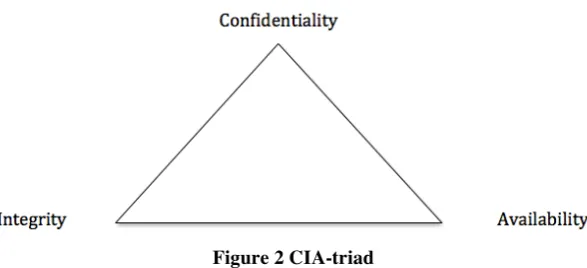
[image:15.595.151.445.303.437.2]Although cloud computing has advantages for organizations there are also risks that involve the adoption of cloud computing and may therefore hinder the adoption of cloud computing. Literature research showed three risks receiving regular mention: confidentiality, integrity and availability. These risks are in the information security known as the CIA-triad. In Figure 2 the CIA-triad is shown.
Figure 2 CIA-triad
The CIA-triad has for several decades been used as a conceptual model for computer security and information security (Whitman & Mattord, 2012). The origin of the CIA-triad can be traced back to 1975 when Saltzer & Schroeder stated that at time three categories of threats to information were distinguished by security specialists: unauthorised information modification (integrity), unauthorised information release (confidentiality) and unauthorised denial of use (availability). The term CIA-triad appeared in 1986-1987 as a term coined by the Johnson Space Center, USA (Parker, 2010). Since then the CIA-triad has rapidly gained popularity among information security practitioners and is now a general accepted foundation of information security. Information security requires that the three components of the CIA-triad are upheld. Information systems, like cloud computing, need to ensure that only the organization that is authorized to use it can access the information and no third parties are able to access it (confidentiality). The information stored in cloud computing need to be protected against unauthorised actions in the cloud like accidental and undesired modifications or deletion (integrity). And of course being able to access the system anywhere at anytime, whenever the organization or user needs their services (availability).
Confidentiality
information from a third party, since these privacy protection acts see the third party as the accountable one instead of the creator of the information. An example is the USA PATRIOT Act which permits U.S. law enforcement agencies to access cloud computing services that are hosted, controlled, and/or maintained by U.S. companies (Zargari & Smith, 2014). The lack of development in cloud-related legal enforcement mechanisms and systems allows the privacy and security issues, and with that the confidentiality, to fall into a legally grey areas (Kshetri, 2013).
Integrity
Weis & Alves-Foss (2011), Arias-Cabarcos et al. (2012), Li, Raghunathan & Jha (2012), MacKay et al. (2012), Kshetri (2013), Morales-Sandoval et al. (2014), Zargari & Smith (2014), and Lian (2015) argue that integrity can be a concern when adopting cloud computing. Integrity is “guarding against improper information modification or destruction” (Arias-Cabarcos et al., 2012, p. 519). As Morales-Sandoval et al. (2014) also mentioned, cloud computing may have big advantages and is so convenient that organisations are willing to trade it for the disadvantages it has, but most organisations such as government organisations cannot do this due to obligations as preserving the integrity of data. Therefore organisations require the security of the integrity of data of their cloud services.
According to Zargari & Smith (2014) integrity is one of the five goals that should be satisfied to guarantee the customer of security of the cloud service. They propose data encryption and colouring options to uphold data integrity and user privacy. However, not every cloud provider uses data encryption and colouring options for their cloud services and security services, as integrity cannot be guaranteed. Not every cloud provider offers these options because of the costs and the overhead it creates (Zargari & Smith, 2014). Encryption is the primary method to use for upholding integrity, but it is extremely expensive for the cloud providers and therefore not always used (Weis & Alves-Foss, 2011).
Availability of data
Chapter 3 Adoption Theory Review
In this paragraph there will be elaborated on two main theories explaining adoption. These adoption theories will give insight in how the adoption of an innovation, like cloud computing, can be enhanced and how it will affect organizations.
Before any adoption theory can be discussed, its needs to be determined what is meant with the term innovation. If we look at it in the broadest sense an innovation can be any new idea. Rogers (1995) defines an innovation as “an idea, practice or object that is perceived as new by an individual or other unit of adoption” (p. 11). In this case it does not matter if the idea, practice or object is objectively new, what matters is the perception of novelty. Also should be noted that innovation does not necessarily mean that the new idea, practice or object is better or more beneficial (Straub, 2009).
A majority of studies in the field of cloud computing investigated the adoption of cloud computing and its determinants (Low et al., 2011; Chong et al., 2012; Morgan & Conboy, 2013; Lian et al., 2014). In these studies several models and theories have been used to explain the adoption of an innovation. Low et al. (2011), Morgan & Conboy (2013) and Lian et al. (2014) employed the Technology-Organization-Environment (TOE) framework by Tornatsky and Fleisher (1990) to study the factors influencing the adopting of cloud computing in organizations, such as hospitals and high technology firms. Since this research also studies the adoption of cloud computing in such organizations the TOE framework is used. However, the adoption of an innovation can fail if the individual users within the organizations are not willing or slow in adopting the innovation (Sharma et al., 2016). The Technology Acceptance Model (TAM) by Davis (1989) explains the factors influencing the intention to use for individuals.
For this research the TOE framework and the TAM are used as a basic knowledge on the adoption of an innovation like cloud computing. The two adoption theories exclude one important variable; trust. Therefore in this research the TOE framework and TAM will be extended with the variable trust. Organizations have issues such as privacy and security that do play an important role in deciding whether to adopt cloud computing or not (Chong et al., 2012).
3.1 Technology Acceptance Model
The Technology Acceptance Model (TAM) was developed by Davis (1986; 1989) to explain computer-usage behaviour. TAM was adapted from Fishein and Ajzen’s (1975) Theory of Reasoned Action (TRA). According to TRA beliefs influence attitudes, which leads to intentions, which then guides or generates behaviours. TAM has adapted this belief-attitude-intention-behaviour relationship to an IT user acceptance model. The goal of TAM is to “provide an explanation of the determinants of computer acceptance that is general, capable of explaining user behaviour across a broad range of end-user computing technologies and end-user populations, while at the same time being both parsimonious and theoretically justified (Davis, Bagozzi & Warshaw, 1989, p. 985).
m-commerce (Chong, Chan & Ooi, 2012; Chong, Ooi, Lin & Tan, 2010; Wei, Marthandan, Chong, Ooi & Arumugam, 2009; Cheng, Lam & Yeung, 2006).
3.1.1 Key Elements
Perceived ease of use
Perceived ease of use is the “degree to which a person believes that using a particular system would be free of effort” (Davis, 1989, p. 320). This follows the definition of ease: “freedom from difficulty or great effort” (Davis, 1989, p. 320). Given that effort is finite resource, an application that is perceived to be easier to use than another application is more likely to be accepted by users (Davis, 1989). Because even when people believe that the technology is useful, they may still believe that the system is too hard to use. Therefore they believe that the benefits of the usage of the technology are outweighed by the effort it takes to use the technology. Davis therefore states “all else being equal, we claim, an application perceived to be easier to use than another is more likely to be accepted by users” (Davis, 1989, p. 320).
Perceived usefulness
Perceived usefulness is the “degree to which a person believes that using a particular system would enhance his or her job performance” (Davis, 1989, p. 320). This follows the definition of the word useful: “capable of being used advantageously” (Davis, 1989, p. 320). The system must, according to the definition, deliver some value. Perceived usefulness has been used in a large variety of previous research as a predictor of purchase intention (Bhattacherjee, 2000; Pavlou, 2003; Venkatesh, 2000). The value of a system, in this case cloud computing, derives in different ways including innovativeness and task ease enablement.
3.2 Technology Organization Environment Framework
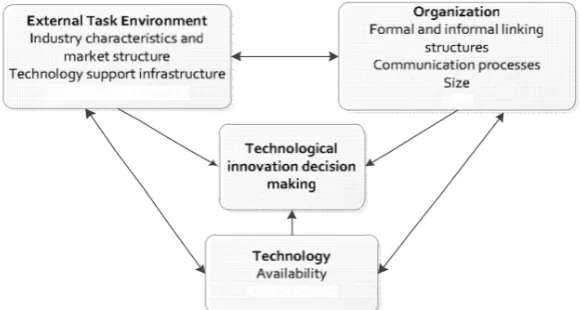
[image:18.595.152.443.529.684.2]The Technology Organization Environment (TOE) framework was developed by Tornatsky and Fleischer (1990). The TOE framework differs from other adoption theories since it provides a technological perspective and emphasizes the important influences of environmental factors and organizational characteristics. Previous studies have examined the adoption of cloud computing with the TOE framework (Alshamaila et al, 2013; Low et al., 2011; Lian et al., 2014). However these studies do not consider critical factors such as security, regulations and certification, satisfaction with their current systems and financials costs as a determinant of cloud computing service adoption (Hsu & Lin, 2015).
Figure 3 TOE Framework (Source: Tornatzky and Fleischer (1990))
characteristics of the organization, e.g. size, formalization, complexity of its managerial structure, and degree of centralization. The external environmental context of the framework describes in which area the organization conducts its business (DePietro et al., 1990).
3.2.1 Key Elements
Technology
According to the TOE framework tow types of technologies have influence on the adoption decision; technologies that are currently in use by the organization, and technologies that are available on the market but are not in use by the organization. The technologies that the organizations already uses influence the adoption decision because they show the limit and scope of the changes on a technological level that the organization can accept. The technologies that are on the market but are not in use by the organization influence the adoption decision because they indicate how the organization can evolve by adopting a new technology.
Organization
The organizational aspects of the TOE framework refer to characteristics such as size, structure and communication process. These organizational characteristics influence the adoption of an innovation in many ways. The structure of the organization influences the adoption decision and the communication process within the organization influences the adoption process. The behaviour of the top management of the organization can also have an influence on the promotion or prevention of the adoption (Baker, 2012).
Environment
Chapter 4 Research Model
4.1 Research Model
Looking at the literature on adoption and cloud computing. Trust has a very important role in the adoption of cloud computing. In order to answer the main question: “What are the attributes of cloud
computing for an organization to trust a cloud provider” attributes from the literature research were
gathered. An explanation of these attributes and a description is given in the following paragraph. These come from the literature research on cloud computing, trust, the Technology Acceptance Model and the Technology Organization Environment Framework.
Articles Attributes
Security Standards & certification
Reputation Trust Quality Compatibility
Arias-Cabarcos et al. (2012)
✓ ✓ ✓ ✓ ✓
Arpaci (2016) ✓ ✓ ✓ ✓ ✓
Burda & Teuteberg (2014) ✓ ✓ ✓ ✓ Chiregi & Navimipour
(2016)
✓ ✓ ✓
Järveläinen (2012) ✓ ✓ ✓ ✓
Hew & Kadir (2016a) ✓ ✓ ✓ ✓
Hew & Kadir (2016b) ✓ ✓ ✓ King & Raja (2012) ✓ ✓ ✓
Kshetri (2013) ✓ ✓ ✓ ✓ ✓
Lian (2015) ✓ ✓ ✓
Messerschmidt & Hinz (2013)
✓ ✓ ✓ ✓
Pazos-Arias et al. (2012) ✓ ✓ ✓ ✓
Rangasamy & Somasundaram (2016)
✓ ✓ ✓ ✓
[image:20.595.65.532.215.479.2]Tehrani (2013) ✓ ✓ ✓ ✓
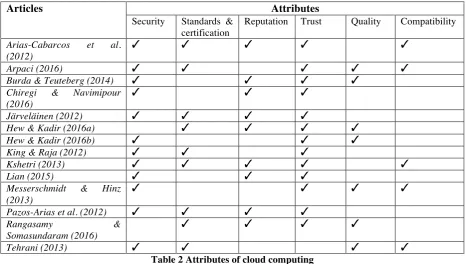
Table 2 Attributes of cloud computing
Table 2 shows the attributes of cloud computing that were found through the research in literature. Based on the literature review this research proposes six attributes for cloud computing adoption. None of the studies that are summarized in Table 2 has integrated all of these six attributes. This research gap is also one of the motivations behind this research.
Previous research did not integrate all of the attributes shown in Table 2. This research wants to examine the attributes of cloud computing for an organization to trust a cloud provider. In order to determine the relationships between the attributes the articles from Table 2 and their research on the adoption of cloud computing and trust in cloud computing was used.
In chapter 2.3 the different types of trust, ‘hard’ and ‘soft’ trust were introduced and inline with this research has shown that security and trust are related (Lian, 2015; Chiregi & Navimipour, 2016). To complement the hard trust research has shown that standards and certification can also be a component of hard trust (Järveläinen, 2012; Raja & King, 2012; Kshetri, 2013; Lian, 2015). Lian (2015) mentioned in his study that standards and certification could ensure the security, while Kshetri (2013) mentions that standards specifically made for the cloud industry could enhance the trust of organizations and adoption of cloud computing.
trust has a positive effect on the intention to use cloud computing. Arpaci (2016) argued that perceived trust has a significant effect on the attitude towards cloud computing.
To continue with the research of Burda & Teuteberg (2014), it states that if organizations positively perceive the service quality it would increase the trust in cloud computing and the provider and hence increase the adoption of cloud computing. In the research of Hew & Kadir (2016b) three types of quality are used: system quality and service quality. Other researchers also distinguish different types of quality and their influence on adoption (Tehrani, 2013; Rangasamy & Somasundaram, 2016).
Previous research by Beatty et al. (2001) on adoption in of an online environment showed that compatibility had a significant effect on the adoption. Tehrani (2013) also believed that compatibility is important for the adoption of cloud computing. Arpaci (2016) states that the compatibility of the cloud and the ease of use can serve as a meaningful predictor in the adoption of cloud computing. Whereas Kshetri (2013) states that compatibility can have a positive effect for cloud providers and their position in the cloud computing market. The more compatible their system is the lesser the chance that an organization or consumer will transfer to another cloud provider.
[image:21.595.77.515.346.494.2]All the above-mentioned relationships between the attributes have contributed in the composition of the research model shown in Figure 4. In the next paragraph the definitions of the attributes will be defined and explained.
Figure 4 Research Model
4.2 Attributes
4.2.1 Security
Security is in the field of cloud computing defined as “the degree to which cloud computing is perceived as being more secure than other computing paradigms”. Previous studies found that security is one of the main concerns about adopting cloud computing (Chong, Lin & Eze, 2009; Mohammed, 2011; Subashini & Kavitha, 2011; Sultan, 2011; Tehrani, 2013; Sharma et al., 2016). Security issues concern the confidentiality, integrity and availability of the system (Gorden & Loeb, 2002).
4.2.2 Certification and standards
Concerns regarding breaches in cloud environments have started the development of cloud service certifications (CSCs) e.g. Cloud Security Alliance’s Security, Trust & Assurance Registry, and EuroCloud Star Audit (Lins et al., 2016). In previous studies the demand for certification and standards for cloud providers was already demonstrated (Mohammed, 2011; Mackay et al., 2012; Kshetri, 2013; Kshetri, 2016). Research has shown “that trust can be built through supporting IT based mechanisms like certifications” (Sunyaev & Schneider, 2013, p. 34). These standards and certifications should also address the accountability of the organization and the cloud provider. Cloud provider do offer policies and Service Level Agreement (SLA) that should cover all the aspects of privacy and damages caused by breaches and especially the accountability for any privacy disclosure (Kshetri, 2013). However, these policies and SLA’s do not adequate address the responsibilities of the cloud provider. Dynamic certification of cloud services could provide a high level of reliability and security to the potential customers (Lins et al., 2016).
4.2.3 Reputation
Reputation is defined by the Oxford English Dictionary (1971) as (1) “reputation is what is generally said or believed about a person’s or thing’s character or standing” and as (2) “a widespread belief that someone or something has a particular characteristic”. In the field of cloud computing reputation is related to trust, but the two attributes are different. Reputation is “the aggregated opinion of a community towards that entity” (Huang & Nicol, 2013, p. 3). Where an entity with a high reputation is trusted by many organizations in that field. As Huang & Nicol (2013) also mentioned reputation is useful for cloud users in choosing a cloud service and provider, but it is inadequate afterwards.
4.2.4 Trust
Trust has previous already been defined paragraph 2.3 as “the expectation that an actor can be relied on, will be predictable, and will act fairly” (Zaheer et al., 1998, p. 143). This definition allows for a leap of faith that the organization needs to make towards the cloud provider. In order to make this leap of faith as small as possible the organizations do have some demands and factors that influence their trust regarding the cloud provider. In the conceptual model in Figure 4 is shown that security and the certification and standards, and reputation influence the trust from the organization to adopt cloud computing.
4.2.5 Compatibility
Compatibility can be defined as “the degree to which an innovation is perceived as consistent with the existing values, past experiences, and needs of potential adopters” (Rogers, 2003, p. 15). In the case of cloud computing and this research compatibility can be defined as the degree to which cloud computing is perceived as consistent with the culture and norms of the organization and the technical aspects of the environment of the organization. With compatibility also comes the perceived ease of use. If the organization believes that adopting the system is free of effort since it is compatible with their own technologies this would enhance the adoption of cloud computing.
4.2.6 Quality
The performance and quality of a cloud provider concerns aspects regarding the system and the service of the cloud provider. Within the attribute quality there is a breakdown in service quality and system quality.
System Quality
Service quality
Chapter 5 Research Methodology
In order to find the answer to the research question a method of data collection and analysis had to be determined. This chapter covers the way the data has been gathered and how it has been analysed.
5.1 Case study
The research will be conducted through an explanatory multiple case study. The use of case study is related to research that concentrates on one particular subject, in this case the trust in cloud computing. Case studies are preferred when the following conditions are met: the main research questions are “why” and “how” questions, the researcher has little or no control over behavioural events, and the focus of the study is a contemporary phenomena (Yin, 2013). As the proposed research meets all of these conditions, case study best serves our needs.
The definition of case study research used by Yin (2013) is as follows: “A case study investigates a contemporary phenomenon (‘the case’) in its real-world context, especially when the boundaries between phenomenon and context may not be clearly evident. […] The second part of the definition points to case study design and data collection features, such as how data triangulation helps to address the distinctive technical condition whereby a case study will have more variables of interest than date points” (Yin, 2013, p. 2).
For the multiple case study according to Yin (2013) theory is “developed” in the beginning of the research and is tested in the case study. This validation process also allows for new insights although it is primarily driven by the “developed” theory (Yin, 2013). With the multiple case studies the research model is examined. To validate the theory and research model that has been developed at the beginning of the research Yin (2013) presses for six to ten cases to get a high degree of certainty.
5.2 PRIMA model
The PRIMA/USE-IT model by Spil, Schuring and Michel-Verkerke (2004) was used for the conducted interviews. The theory of the model is based on the TAM model by Davis (1989), the UTAUT model by Venkatesh (2003), the Information System Success Model by Delone and McLean (2003), and the Innovation Diffusion Model by Rogers (1983). The model consists of five areas of analysis, namely; process, relevance, information needs, means and people, and attitude. The USE IT-model combines theories about adoption and diffusion of innovations and provides an interview IT-model and questionnaire with which the success of an information system from a user’s perspective can be predicted and evaluated. The USE IT-model presents two dimensions: the domain dimension and the innovation dimension. These dimensions were make the USE-IT model very suitable for studying the trust of organizations in cloud computing.
This qualitative research method is chosen to provide a more detailed understanding of the factors that influence the trust of organizations in cloud computing. The literature study complements the interview method with the attributes that will appear through the questions asked with the PRIMA interview model. Data is collected by interviewing several organizations using the PRIMA model. Different types of large professional organizations with experience in cloud computing have been selected. These organizations have employees with great knowledge on cloud computing and therefore can participate in this research.
As mentioned earlier, the model consists of five areas; process, relevance, information needs, means and people, and attitude. In the following section we explain what is expected to be measured by each construct. The validation of these expectations will follow in the discussion section.
The relevance consist questions regarding what the value for the users of the cloud computing is. It is about the acceptance of cloud computing. The extent to which the users of cloud computing are expecting that it will solve problems and will help to achieve targets. It is also about the potential bottlenecks in the system and what kind of improvements the end users would like to see in the system.
Information needs is about which information the user would like to receive from the system and should align with the information the service delivers and captures. In the case of cloud computing information needs also means information quality. With information and data being the primary source of cloud computing information quality suits better. Within information quality we assume that there are some aspects that measure the information quality. These aspects are: timeliness, completeness, reputation, service and free-of-error.
Means and people examines the resources available to the users/organizations given the assumption that hardware and support enable effective use of the cloud computing. In the case of cloud computing, we will examine in what extent organizations already use cloud computing. The cloud computing system also has to joint with their current processes. Further, means and people also examines the perceived risks of cloud computing, like safety, privacy, and reliability.
Finally, the attitude section will expose whether or not there is resistance to this innovation. Resistance is not per definition positive or negative, but it exposes flaws in the system (Lapointe, & Rivard, 2005). With this the attitude of the end users of the system will be taken into account. What is the attitude of the end user of cloud computing pertaining to innovation and IT in general?
5.3 Data collection and analysis
The data collection and analysis of this research has been done through multiple case studies. The format of case studies was chosen due to the lack of knowledge in organizations on cloud computing. Most organizations that were approached for this research were not using cloud computing or did not have an employee in their organization with extensive knowledge on cloud computing. Therefore it was hard to find organizations that fit our criteria. From the organizations that participated in this research their expert on cloud computing was interviewed for the case study.
The PRIMA method was selected for the semi-structured in-depth interviews. The group of interviewees vary as they all work for different organizations. The semi-structured interviews makes sure that the difference in answers are due to the difference in interviewees rather than the differences in questions asked (Barriball & While, 1994).
The interviews were held one-to-one rather than in focus groups, since bias may occur when interviewees are influenced by strong opinions of others (Barriball & While, 1994). The interviews were also held face-to-face as there also might be a bias for not examining non-verbal communication in e.g. phone interviews. The interviews lasted between 30 and 60 minutes each. The sample size consists of eight organizations. This amount of cases allows for a comparison of results between cases (Diefenbach, 2009). The interviewee had to be an expert regarding cloud computing. To ensure confidentiality the interviews were held in a private room away from other professionals and anything that is discussed during the interviews remains between the interviewee and the researcher.
Organizations were asked to participate in this study that already had adopted cloud computing. With the interviews the organizations information was inquired on their opinions on different aspects of cloud computing. The questions asked to the organizations were adapted from the PRIMA model and previous research that has been published (Landeweerd, Spil & Klein, 2013).
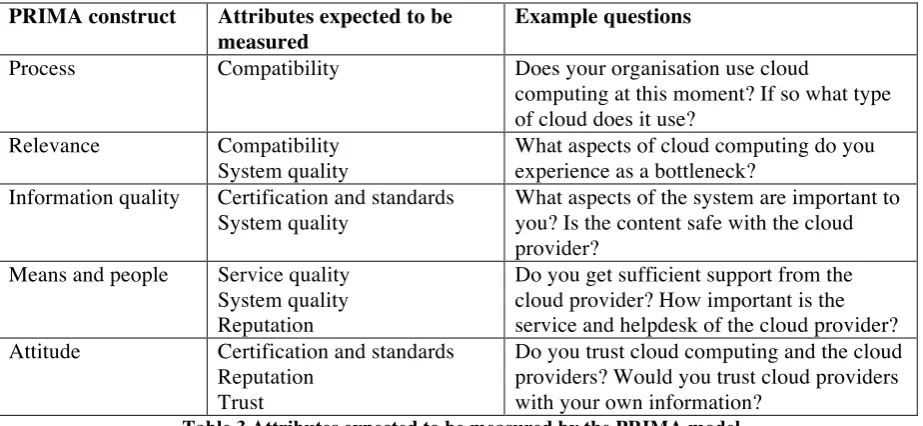
providers. In order to measure the attributes found in the literature research each attribute should have at least one item in the interview model. The different constructs of the PRIMA model are also expected to make the attributes identified in the literature to appear, either directly or indirectly.
PRIMA construct Attributes expected to be measured
Example questions
Process Compatibility Does your organisation use cloud
computing at this moment? If so what type of cloud does it use?
Relevance Compatibility
System quality
What aspects of cloud computing do you experience as a bottleneck?
Information quality Certification and standards System quality
What aspects of the system are important to you? Is the content safe with the cloud provider?
Means and people Service quality System quality Reputation
Do you get sufficient support from the cloud provider? How important is the service and helpdesk of the cloud provider? Attitude Certification and standards
Reputation Trust
[image:26.595.67.529.121.334.2]Do you trust cloud computing and the cloud providers? Would you trust cloud providers with your own information?
Table 3 Attributes expected to be measured by the PRIMA model
In Table 3 the attributes that are expected to be measured with each PRIMA construct are shown. Each construct measures one or more attributes. The final interview set-up can be found in Appendix A.
Chapter 6 Case Analysis Results
This chapter will present the within-case and cross-case comparisons. Each of the eight cases has been presented with an overview of the main issues discussed during the interview. In the cross-case analysis the converging and diverging issues across these cases is revealed. These results are then used to answer the main research question: What are the attributes of cloud computing for an organization
to trust a cloud provider?
6.1 Within-case analysis
6.1.1 Case 1: ALPHA
Size > 1000
Type of organization Healthcare
Interviewee’s position Head of Information Management and the IT department
As head of information management and the IT department of this healthcare organization the interviewee makes sure that the healthcare processes work. Not only the infrastructure for these processes, but also the data and applications. The information management and IT department make sure that the employees can use infrastructure, data and applications. The interviewee’s work process consists of making sure the employees are provided with applications and data whenever they need it.
Case analysis ALPHA
ALPHA uses a private cloud within their organization. The private cloud is only used for certain amounts of data. The main reason for this decision is that the organization has information that is very privacy-sensitive and needs a secure environment. The organization does not have the trust in the cloud that it is that secure that these amounts of information can be placed in the cloud. Therefore ALPHA has chosen to adapt the cloud to a certain level. ALPHA uses cloud computing, but only places information in the cloud that is not privacy-sensitive.
The most important reason for Alpha to choose for cloud computing is the flexibility it has. “We kind
of buy some sort of certainty for up- and downscaling of the amount of space we need”. Besides the
flexibility the management of data is outsourced and that reduces the amount of costs for the IT department of ALPHA.
Privacy and security are the main risks of adopting cloud computing. With security comes privacy according to the interviewee. The main questions regarding the risks in cloud computing for the interviewee are: “What happens with your data when it is in the cloud? If you put the data in the cloud and the provider goes bankrupt, who will be the owner of the data? What happens?”.
When asked which components of cloud computing the interviewee would like to see improved security was appointed again. The interviewee thought it would be helpful if there would be more standards for cloud providers. Judiciary are, according to the interviewee, a lot of steps that need to be made to equal the practice of using cloud computing.
The trust in cloud computing is there until proven otherwise. “If you do not trust the cloud provider you should not adopt cloud computing in the first place. It is in their own interest to maintain their reputation and image”.