University of Warwick institutional repository: http://go.warwick.ac.uk/wrap
A Thesis Submitted for the Degree of PhD at the University of Warwick
http://go.warwick.ac.uk/wrap/45884
This thesis is made available online and is protected by original copyright. Please scroll down to view the document itself.
AUTHOR:Shuyi Wang DEGREE:Ph.D.
TITLE: Optimization of Transmitted-Reference receivers in the Ultra-wide Bandwidth System
DATE OF DEPOSIT: . . . .
I agree that this thesis shall be available in accordance with the regulations governing the University of Warwick theses.
I agree that the summary of this thesis may be submitted for publication. Iagreethat the thesis may be photocopied (single copies for study purposes only).
Theses with no restriction on photocopying will also be made available to the British Library for microfilming. The British Library may supply copies to individuals or libraries. subject to a statement from them that the copy is supplied for non-publishing purposes. All copies supplied by the British Library will carry the following statement:
“Attention is drawn to the fact that the copyright of this thesis rests with its author. This copy of the thesis has been supplied on the condition that anyone who consults it is understood to recognise that its copyright rests with its author and that no quotation from the thesis and no information derived from it may be published without the author’s written consent.”
AUTHOR’S SIGNATURE: . . . .
USER’S DECLARATION
1. I undertake not to quote or make use of any information from this thesis without making acknowledgement to the author.
2. I further undertake to allow no-one else to use this thesis while it is in my care.
DATE SIGNATURE ADDRESS
. . . .
. . . .
. . . .
. . . .
M A E
G NS
I T A T MOLEM
U N
IV
ER
SITAS WARWICE
NS
IS
Optimization of
Transmitted-Reference receivers in
the Ultra-wide Bandwidth System
by
Shuyi Wang
Thesis
Submitted to the University of Warwick
for the degree of
Doctor of Philosophy
School of Engineering
Contents
List of Figures iv
List of Tables vii
Acknowledgments viii
Declarations ix
List of Publications x
Abstract xi
Abbreviations xiii
Chapter 1 Introduction 1
1.1 Introduction to Ultra-wide Bandwidth Systems . . . 1
1.1.1 Historical development of UWB Technologies . . . 2
1.1.2 FCC Regulations for UWB . . . 3
1.1.3 Characteristics of UWB . . . 5
1.1.4 UWB Applications . . . 7
1.1.5 Challenges for UWB . . . 8
1.3 Contributions to Knowledge . . . 10
1.4 Thesis outline . . . 10
Chapter 2 UWB systems 12 2.1 Introduction . . . 12
2.2 UWB Channel Models . . . 13
2.2.1 Saleh-Valenzuela Model . . . 14
2.2.2 IEEE Model . . . 15
2.3 UWB Pulses . . . 19
2.4 UWB Communications . . . 21
2.4.1 Binary PPM . . . 22
2.4.2 Binary PAM . . . 24
2.4.3 TH-SS UWB systems . . . 26
2.4.4 DS-SS UWB systems . . . 27
2.5 UWB Receivers . . . 29
2.5.1 UWB TR Receivers . . . 31
2.6 Conclusions . . . 32
Chapter 3 Optimization of the Traditional UWB TR Receiver 35 3.1 Introduction . . . 35
3.2 System Model for the Traditional UWB TR Receiver . . . 37
3.3 The Channel Capacity Optimization . . . 43
3.3.1 Simulation Approach . . . 45
3.3.2 Semi-analytical Approach . . . 47
3.3.3 Analytical Approach . . . 49
3.3.4 Numerical Results and Discussion . . . 62
3.5 Conclusions . . . 70
Chapter 4 Optimization of Generalized UWB TR Receivers 71 4.1 Introduction . . . 72
4.2 System Model . . . 74
4.3 Optimization for the Generalized TR Receivers by Simulation 77 4.3.1 The generalized TB, ML-I and GLRT-I receivers . . . . 78
4.3.2 The ML-II and GLRT-II receivers . . . 89
4.4 The RD, RI and RDI receivers . . . 92
4.4.1 BER Improvements . . . 93
4.4.2 Numerical Results and Discussion . . . 98
4.5 Conclusions . . . 106
Chapter 5 Conclusions and Future Work 108 5.1 Introduction . . . 108
5.2 Summary of the main findings . . . 109
5.3 Conclusions . . . 111
5.4 Future Work . . . 114
List of Figures
1.1 The definition of UWB systems. . . 4
1.2 The FCC UWB spectral masks. . . 5
2.1 The realizations of the channel impulse response for different
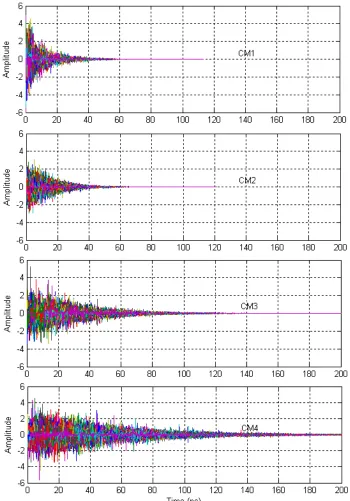
scenarios (CM1-CM4). . . 18
2.2 The Gaussian doublet in the time domain defined in (2.9). . . 20
2.3 The Gaussian doublet in the frequency domain defined in (2.12). 21
2.4 Comparison of several different modulation techniques for UWB
communications:(a) unmodulated pulses, (b) BPPM and (c)
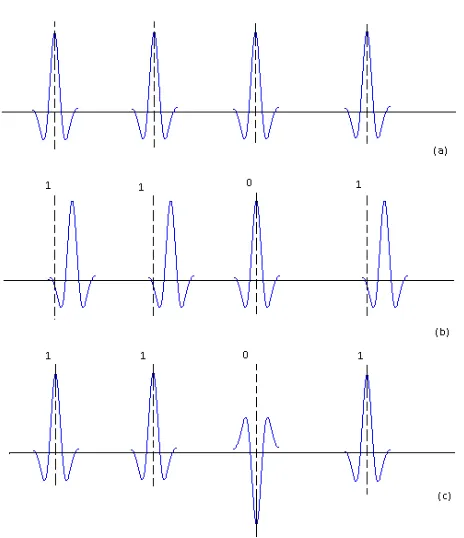
PAM. . . 23
2.5 A typical structure of the UWB TH-SS system with two users. 26
2.6 A typical structure of the UWB DS- system with three users. . 28
3.1 The system model of the conventional TR receiver with different
values of Td. . . 40
3.2 The channel achievable capacity versus Td for the traditional
TR receiver by using the simulation method. . . 46
3.3 The channel achievable capacity versus Td for the traditional
3.4 The channel achievable capacity versus Tdby using simulation,
semi-analytical and analytical methods. . . 59
3.5 The channel achievable capacity versus SNR for the traditional
and improved TR receivers for CM1. . . 62
3.6 The channel achievable capacity versus Tdby using simulation,
semi-analytical and analytical methods for CM2. . . 63
3.7 The channel achievable capacity versus SNR for the traditional
and improved TR receivers for CM2. . . 64
3.8 The BER versus Td for the traditional TR receiver at different
SNRs for CM1. . . 68
3.9 The BER versus SNR for the traditional and improved TR
re-ceivers for CM1. . . 69
4.1 The BER versus α for the generalized TB receiver at TN =Tds
for different SNR scenarios. . . 80
4.2 The BER versus α for the generalized ML-I receivers at TN =
Tds for different SNR scenarios. . . 81
4.3 The BER versusαfor the generalized GLRT-I receivers atTN =
Tds for different SNR scenarios. . . 81
4.4 The BER versus SNR at the optimal α for the generalized TB
and ML-I receivers. . . 83
4.5 The BER versus SNR at the optimal α for the generalized
GLRT-I receivers. . . 83
4.6 The BER versus TN at the optimum values ofα for the
4.7 The BER versus TN at the optimum values ofα for the
gener-alized ML-I receivers. . . 85
4.8 The BER versus TN at the optimum values ofα for the
gener-alized GLRT-I receivers. . . 85
4.9 The BER versus SNR atTN opt, αopt andαopt for the generalized
TB and ML-I receivers. . . 87
4.10 The BER versus SNR at bothα and TN optimized for the
gen-eralized GLRT-I receivers. . . 87
4.11 Comparison of the improved TB and ML-I receivers that
op-timize α first and the improved TB and ML-I receivers that
optimize TN first. . . 88
4.12 Comparison of the improved GLRT-I receivers that optimize α
first and the improved GLRT-I receivers that optimize TN first. 89
4.13 The BER versus SNR atTN opt, αopt andαopt for the generalized
ML-II and GLRT-II receivers. . . 90
4.14 Comparison of the improved ML-II and GLRT-II receivers that
optimize α first and those that optimizeTN first. . . 91
4.15 The BER versusα at SNR = 10 dB and TN =Tmds. . . 99
4.16 The BER versus SNR for non-improved receivers and improved
receivers using αopt. . . 100
4.17 The BER versusTN using αopt at SNR = 10 dB. . . 101
4.18 The BER versus SNR using neither αopt or TNopt,αopt and both
αopt and TNopt,αopt. . . 104
4.19 Comparison of the simulated improved receivers that optimize
α first and the simulated improved receivers that optimize TN
List of Tables
3.1 The Best Values of Td (ns) for Different SNRs. . . 66
4.1 The Best Values of α and TN(ns) for the Simulated TR
Acknowledgments
I would like to acknowledge the advice and guidance of my supervisors, Dr.
Yunfei Chen and Dr. Mark S. Leeson from the School of Engineering at the
University of Warwick. I also thank the members of my graduate committee
for their suggestions and encouragement, especially Prof. Roger J. Green.
Special thanks go to Prof. Norman C. Beaulieu from the University of
Alberta Edmonton, Canada, for his knowledge and assistance in this studies.
I would like to thank my family members, especially my mother, Ms
Yawei Niu, for her supporting and encouraging me to pursue this degree. Last
but not least, I express my sincere appreciation to all my friends who have
Declarations
I herewith declare that I have produced this paper without the prohibited
assistance of third parties and without making use of aids other than those
specified; notions taken over directly or indirectly from other sources have been
identified as such. This paper has not previously been presented in identical
or similar form to any other examination board.
The thesis work was conducted from April 2008 to June 2011 under the
List of Publications
Journal Papers
• Shuyi Wang, Yunfei Chen, Mark S. Leeson, Norman C. Beaulieu,
“Channel Capacity and BER Optimization of the UWB Dual-Pulse
Re-ceiver”,Wireless Communications and Mobile Computing, doi: 10.1002/
wcm.1214, November 2011.
• Shuyi Wang, Yunfei Chen, M. Leeson, N.C. Beaulieu, “New receivers
for generalized UWB transmitted reference systems with improved
per-formances”,IEEE Transactions on Wireless Communications, vol.9, no.6,
pp.1837-1842, June 2010.
• Yunfei Chen, N. Beaulieu; Shuyi Wang, “Novel iterative receivers for
TR UWB systems”,IEEE Communications Letters, vol.13, no.4,
pp.242-244, April 2009.
Conference Papers
• Shuyi Wang, Yunfei Chen, Mark S. Leeson, Norman C. Beaulieu,
“Optimization of the Time Delay in the UWB Dual-pulse Receiver”,
2011 IEEE International Conference on Ultra-Wideband, pp. 445-449,
Abstract
This thesis contributes the research and development of novel receiver
optimization approaches conducted in ultra-wide bandwidth (UWB) systems.
The ultimate goal of the improved receiver technology is to simplify the receiver
structures at the cost of a tolerable performance degradation or improve the
receiver performances at the cost of a tolerable complexity. Recently, UWB
technology has become more and more attractive due to its increased
per-formance. An advanced scheme that can provide a further improvement is
strongly recommended and highly demanded. This research project focuses
on the design of outstanding receivers suitable for the UWB system with
transmitted-reference signaling. Two types of improved receivers are
inves-tigated. The first one is based on the optimization of inter-pulse time delayTd
in the traditional transmitted-reference receivers where one data pulse is
trans-mitted Td seconds delay after one reference pulse in a bit duration. The
sec-ond one is based on the joint optimization of the number of reference symbols
and the integration interval length in the generalized transmitted-reference
receivers where Nd data symbols are transmitted after Nr reference symbols
in a data packet. For both improved receivers, simulation and theoretical
ap-proaches are used to provide the optimization results. The numerical results
show that the improved receivers by using different optimization approaches
An up to 4.2dB performance improvement can be achieved consequently.
The principal conclusion from this thesis is that all the optimization
schemes presented herein can be successfully applied to the design of receivers
in the UWB transmitted-reference systems that the data decision can be
ob-tained by thresholding the correlator output of the reference information with
Abbreviations
UWB descriptive ultra-wide bandwidth
TR descriptive transmitted-reference
WPAN descriptive wireless personal area network
LLNL descriptive Lawrence Livermore national laboratory
DoD descriptive department of defense
FCC descriptive Federal communications commission
Ofcom descriptive office of communications
MIC descriptive ministry of internal affairs and communications
EIRP descriptive equivalent isotropically radiated power
GPS descriptive global positioning system
LPD descriptive low probability of detection
LPI descriptive low probability of interception
SNR descriptive signal-to-noise ratio
MAI descriptive multiple access interference
BER descriptive bit error rate
S-V descriptive Saleh-Valenzuela
LOS descriptive line-of-sight
NLOS descriptive non line-of-sight
PDF descriptive probability density function
PSD descriptive power spectral density
PPM descriptive pulse position modulation
PAM descriptive pulse amplitude modulation
OOK descriptive on-off keying
BPPM descriptive binary pulse position modulation
BPAM descriptive binary pulse amplitude modulation
TH descriptive time-hopping
SS descriptive spreading spectrum
DS descriptive direct-sequence
PN descriptive pseudo-noise
AWGN descriptive added white Gaussian noise
Chapter 1
Introduction
1.1
Introduction to Ultra-wide Bandwidth
Sys-tems
Over the last couple of decades, consumers’ demands for wireless technologies
have been dramatically increased due to the enormous convenience brought
by modern technologies to the real-life world. In the near future, consumers
will continuously increase their requirements for wireless connectivities to
con-nect electronic devices, such as personal computers, portable game systems,
mobile phones, photo printers and radio/video players, to each other in the
home. However, today’s short- or medium-range wireless communication
tech-nologies cannot meet the needs of such high compatibility which require very
wide bandwidth, accommodating the needs for high capacity and data rate.
For example, although the data rate can reach up to 54 Mbits per second for
the IEEE 802.11 standards, the technologies have limitations in bandwidth,
technol-ogy (belongs to IEEE 802.15.1) trades its cost and power consumption off the
data rate of up to 1 Mbit per second [2] which is not sufficient for many
mul-tiple high-bandwidth digital applications in wireless personal area networks
(WPANs). A novel technology named ultra-wide bandwidth (UWB) was
in-vestigated accounting for the high-speed WPANs [3].
1.1.1
Historical development of UWB Technologies
In the long history of radio communications, the dominant electromagnetic
waveform was sinusoidal. The sine-wave was so universal until the
develop-ment of the sampling oscilloscope dating back to the early 1960s. The
de-velopment of hardware devices attracted many institutes and companies to
embark on the pulse transmitter, receiver and antenna investigations. In the
1960s, Lawrence Livermore National Laboratory (LLNL) was one of the
pio-neers leading the research in this area and many applications and technologies
were then imported to UWB communications [4].
By the early 1970s the foundation of UWB radar systems were almost
accomplished [4] and especially in 1973, Ross’ US Patent [5] indicated that
the comprehensive development of UWB systems had entirely started.
Inter-ested readers can refer to [4], [5] and [6] for further pioneer works for UWB
all over the world. At the early stage, the UWB technologies were using
base-band, carrier-less, impulse and time domain. The term ‘ultra-wide
band-width (UWB)’ was first determined by the US Department of Defense (DoD)
in 1989, since it occupies an extremely wide bandwidth. In the last century,
UWB technologies have been diffusely used in numerous fields, such as
few applications developed for data communications like PC- or mobile-device
communications [7].
In April 2002, the US Federal Communications Commission (FCC)
re-leased its report [8], first indicating that UWB technologies could be used
in data communications as well. In [8], it defined UWB communication
sys-tems from many aspects, including UWB definition, bandwidth allocation and
maximum transmission power. These FCC regulations have been widely
ac-cepted and applied for UWB systems, although some countries have their own
variations. For example, the regulator in the UK is the Office of
Communi-cations (Ofcom) and the regulator in Japan is the Ministry of Internal Affairs
and Communications (MIC), and they released their own standards for UWB
communication systems in 2005 and 2004, respectively. However, the
differ-ences in UWB standards among various countries are not significant [9].
Interested readers can refer to [10], [11] and [12] for further historical
reviews of UWB technologies.
1.1.2
FCC Regulations for UWB
The UWB system was defined by FCC [8] in 2002 as a transmission system
with a bandwidth occupancy of more than 500 MHz or the fractional
band-width greater than 20%, as shown in Figure 1.1, where fL and fH represent
the lower and upper frequencies, respectively, at the -10 dB emission point.
Also,fc = fL+2fH represents the centre frequency. The fractional bandwidth is
determined by Bfc, where B =fH −fL is the -10 dB bandwidth (10 dB below
the highest emission point). According to [8], the newest UWB system either
Figure 1.1: The definition of UWB systems [8].
bandwidth greater than 20% when fc <2.5 GHz.
The FCC allocated specific ranges of GHz bandwidth to UWB
commu-nication systems [8]. This extremely wide bandwidth allows UWB systems to
potentially have a high data rate on the order of Gbps (Gbits per second). On
the other hand, UWB has to coexist with other narrowband and wideband
communication systems over the entire frequency bands. Therefore, the FCC
limited the maximum transmission power such that UWB could not conflict
with other existed systems.
Figure 1.2 shows the UWB spectral masks based on FCC 15.517 for
indoor communications. The Equivalent Isotropically Radiated Power (EIRP)
denotes the theoretical power from an isotropic antenna to produce the peak
power in the direction of maximum antenna gain, taking into account the
attenuations during transmission and from devices like an antenna. A
conser-vative maximum emission power spectral density of -41.3 dBm/MHz is allowed
approximately over the total 7.5 GHz bandwidth between 3.1 and 10.6 GHz,
Figure 1.2: The FCC UWB spectral masks [8].
-75.3 dBm/MHz due to the existence of the global positioning systems (GPS)
and some military applications.
For further detailed FCC UWB regulations, interested readers can refer
to [8] or via the FCC official website ‘http://www.fcc.gov/’.
1.1.3
Characteristics of UWB
The UWB techniques have attracted great interest from both research and
industry, because of some of the inherent features which make UWB optimal
for low-cost, high-speed WPANs. The key benefits of UWB are listed as below:
• high data rate;
• low complexity and low cost;
• low probability of detection (LPD) and low probability of interception(LPI);
• increased capacity;
A potential data rate in the order of Gbps can be achieved in UWB,
owing to its extremely high spectral occupancy [13]. From a commercial point
of view, the high data rate is the vital factor in today’s manufacture for new
digital applications. The UWB technologies will bring a new generation of
personal wireless communications.
Unlike conventional communication systems, the UWB system
gener-ates a series of very short time-domain pulses which do not need sine-wave
car-riers to propagate. Consequently, the UWB system can be considered as
com-parably easy implementation and with low cost because no additional product
is required at transmitters or receivers.
According to the UWB spectral masks shown in Figure 1.2, the UWB
signal is substantially noise-like due to its low power density. This makes the
signal quite difficult for unintended detection and also significantly reduces
the interference between the UWB system and other existing systems. This
property benefits UWB for secure and military applications [14].
Based on Shannon’s theory, the channel capacity in an additive white
Gaussian noise (AWGN) channel is expressed as [13]
C =Blog(1 + S
N) (1.1)
where B is the channel bandwidth as described in section 1.1.2, and S
N is
the signal-to-noise ratio (SNR) of the channel. Clearly, the achievable
chan-nel capacity grows linearly with bandwidth but logarithmically with SNR and
therefore, the bandwidth B is the dominant factor affecting the channel
ca-pacity. The UWB system thereby has a potential of relatively high channel
Finally, UWB is commonly known as a low-power and short-range
wire-less communication system whose efficient transmission distance is normally
less than 20 meters. That dramatically increases the system frequency reuse
capability, as the users in different clusters can use the same frequency without
interference. For example, player one (in a cluster) who is playing a wireless
game (like WII) in the living room would not disturb the person (in another
cluster) who is printing photos via a wireless printer in the study room, when
they are using the same frequency bands.
1.1.4
UWB Applications
The UWB signal contains abundant low frequency components such that it
enables the system to be capable of penetration and hence, the UWB
technolo-gies can be applied to imaging systems, such as wall radar imaging, medical
imaging and surveillance systems [16].
Furthermore, owing to the fine time resolution and accurate position
capabilities, UWB technologies can be applied for vehicular radar systems [17].
Consequently, they can be used to improve automotive safety and provide
excellent services, such as safer airbag development and parking assistance.
For wireless communications, UWB enables a wide range of applications
in WPANs. UWB wireless speaker/mouse/USB and even completely freeing
cables among portable devices in the home can be realized, for example.
Sim-ilarly, UWB technologies can also be applied in wireless sensor networks, due
1.1.5
Challenges for UWB
In spite of the numerous advantages of the UWB technology which make it
have an optimistic future for the next generation of communications, many
problems still need to be resolved for UWB to become a widely adopted
tech-nology [19].
A main problem that has always been of concern in UWB is about the
cancellation of multiple access interference (MAI) and narrowband interference
(NBI). Precise synchronization to the extremely short pulse, accurate channel
estimation of the dense multipath coefficients, and adaptive receiver designs
are also some of the key challenges that still have to be improved.
Other challenges include precise channel models in various
environ-ments, high-speed data sampling devices, appropriate multiple access and
mul-tiple access code designs, as well as compatible and universal standard/protocol
solutions outside the physical layer.
1.2
Research Objective
Although UWB technology can be applied for data communications as well as
radar and safety applications, this thesis focuses on investigations of UWB for
data communications.
For the UWB wireless communications, receiver design is a crucial link
to a successful implementation of the entire system. In an indoor environment,
there exists a dense multipath propagation due to a great number of
obsta-cles in the building. In order to take full advantage of these rich multipath
components, an appropriate receiver is required to capture as much energy
efficient power-collection receiver with a relatively simple structure is highly
desire. The current UWB receivers can be classified into two types: coherent
receivers and non-coherent receivers. The transmitted-reference (TR) receiver
is the most common UWB non-coherent receiver in the literature, and it can
be further categorized into, for example, the traditional TR receiver or
gener-alized TR receiver. The performances of all these receivers can be improved by
either optimizing the time interval between the reference and data pulse per
bit for traditional TR receivers or optimizing the number of reference
sym-bols as well as the integration interval at the correlator for generalized TR
receivers. Therefore, this thesis works on the receiver optimizations in the
UWB TR system. A series of novel optimization approaches are specifically
listed as below
• to determine the optimal value of the time intervalTd within pulse pairs
for the traditional TR UWB receiver [52] to improve both its channel
achievable capacity and BER;
• to determine the optimal value of reference symbol amount and
integra-tion interval length for the generalized TR UWB receiver [79] in order
to improve its BER;
• to determine the optimal values of reference symbol amount and
inte-gration interval length for the new generalized TR UWB receivers [80]
1.3
Contributions to Knowledge
In the context of the objectives outlined in Section 1.2, this thesis aims to
provide a significant contribution to knowledge via the demonstration of the
receiver optimization investigations in UWB systems. In particular, it shows
that the current UWB TR receivers [52] can be effectively optimized with
respect to some inherent parameters in receiver designs; and also shows that
several approaches can provide significant system improvements in terms of
two criteria: maximization of channel achievable capacity and minimization
of BER. The approaches proposed and investigated in this thesis will provide
other researchers with a novel method for the receiver design.
1.4
Thesis outline
InChapter 2, an introduction to the UWB system is presented. The main
char-acteristic of the UWB system differing from other systems is the very dense
multipath channel and thus, the properties of the UWB channel models are
dis-cussed first. Due to the extremely wide bandwidth for UWB, it makes many
conventional modulation schemes unsuitable for the UWB system. Several
appropriate modulation schemes for UWB are illustrated. Then,
multiple-access techniques are introduced herein for real UWB communication
sys-tems. Therefore, enhanced channel capacity and reduced interference caused
by multiple users can be obtained, provided that an appropriate
multiple-access scheme is established. Finally, a brief description of UWB receivers is
addressed.
Both the channel achievable capacity and BER are optimized with respect
to the time interval between reference and data pulses. Three approaches to
the problem, being (a) simulation, (b) semi-analytical and (c) analytical, are
separately discussed for the investigations. Detailed mathematical calculations
are included in the chapter.
In Chapter 4, the generalized TR receivers [79] are optimized via
sim-ulation with respect to two parameters: the number of reference symbols in
one data packet and the length of integration interval at the correlator. Then,
by using the same optimization approaches as above, the new generalized TR
receivers [80] are optimized similarly and the semi-analytical results for
opti-mization are also obtained based on Gaussian approximation to the noise plus
interference terms.
Chapter 5 summarizes the key results of the research presented in
Chap-ter 3 and Chapter 4. The relative merits and limitations of the approaches or
methods are discussed, and suggestions for further improvement are provided
as well. This chapter provides the principal conclusions and the main findings
Chapter 2
UWB systems
2.1
Introduction
In wireless communications, UWB has been considered as a very attractive
technology owing to its high data rates, potential high capacity, low power
consumption, low cost and low complexity for implementation [20], [21]. These
benefits of the UWB system over other narrowband communication systems
are all due to some inherent characteristics in UWB. The basic difference
be-tween UWB and other systems is the channel modeling where the extremely
wide frequency bands of more than 500 MHz are occupied by UWB. This also
results in most conventional modulation techniques being no longer
applica-ble to UWB systems. UWB channel models are introduced and discussed in
Section 2.2, then several modulation schemes as well as the multiple access
techniques are described inSection 2.4. On the other hand, the UWB systems
convey data information by transmitting a sequence of ultra-short pulses in the
time domain. These transmission pulses are presented inSection 2.3. In
the key challenge is to design an appropriate receiver with good performance
and low complexity. Several commonly used UWB receivers are introduced in
Section 2.5 and conclusions are drawn in Section 2.6.
2.2
UWB Channel Models
In the communication system, a sequence of data information is sent from the
transmitter to the receiver over a propagation environment which suffers from
reflection, refraction, diffraction, polarization and scattering due to
surround-ing obstacles. Since a great amount of commercial UWB applications considers
indoor communications, this section will focus on the indoor UWB channels
only. A significant amount of research has been reported for the indoor UWB
channel models in the literature, which are experiments on the signal
propagat-ing within buildpropagat-ings [22], [23], [24], [25]. Various measurements were evaluated
for different scenarios in order to provide a precise channel model for the real
system, including the delay spread, power attenuation/gain and multipath
ar-rival time. Win, et al [24] first came up with the statistical model for UWB in
the time domain using impulsive signals. After this, many accurate statistical
models were proposed. In 2003, the IEEE 802.15.3a working group for wireless
personal area networks released the IEEE UWB indoor channel models which
are commonly used nowadays for UWB systems [26].
The proposed IEEE UWB indoor channel models [26] are based on
the Saleh-Valenzuela model, as shown in [22], where multipath rays arrive in
clusters and their multipath gains decay with a double-exponential function.
However, the novel IEEE models differ from the Saleh-Valenzuela model [22]
distribution for the latter one. In the following, the Saleh-Valenzuela model
will be first described and the IEEE channel models will be analysed later.
2.2.1
Saleh-Valenzuela Model
One of the well-known UWB indoor channel models is the Saleh-Valenzuela
(S-V) [22]. This is based on the measurements utilizing radar-like pulses with 10
nsduration and a centre frequency of 1.5 GHz. The S-V model is represented
by multipath components having propagation gains of{ak,l}, delays of{Tl, τk,l}
and associated phase shifts of {θk,l}, where l and k are the indexes of thelth
cluster and the kth ray within the lth cluster, respectively. Therefore, the
channel impulse response can be expressed as [22]
h0(t) =
+∞
X
l=0
+∞
X
k=0
ak,lejθk,lδ(t−Tl−τk,l) (2.1)
where δ(·) is the Dirac delta function. Referring to [22], the cluster arrival
times {Tl}, i.e., the arrival times of the first ray in the clusters, are Poisson
distributed random variables with rate Λ. Within each cluster, the arrival
times of subsequent rays {τl,k} are also Poisson distributed random variables
with rateλ (Normally, λ >>Λ because each cluster contains numerous rays).
{θl,k} are independent uniform random variables over the range of [0,2π),
and {al,k} are independent Rayleigh random variables with power E{a2l,k} =
Ω0e−ΓTle −τl,k
γ where Ω
0 =E{a20,0}is the mean energy of the first ray in the first
cluster, Γ is the cluster decay rate and γ is the ray decay rate in the cluster.
From [22], the double sum term on the right side of eq.(2.1) fulfils
an exponationally decaying power profile in the dense multipath environment
2.2.2
IEEE Model
Instead of using a Rayleigh distribution, the channel modelling sub-committee
of the IEEE 802.15.3a Task Group [26] recommends the log-normal
distribu-tion for the multipath gain, as the log-normal distribudistribu-tion has been verified to
better fit the measured data in UWB systems. Although the IEEE 802.15.4a
Task Group reports another channel model for more scenarios, this model is
suitable for low data rate WPANs, especially for sensor networks [27]. In this
thesis, the IEEE 802.15.3a channel model [26] is applied as a general model
for the UWB system.
From [26], the UWB indoor channel models are specifically divided into
four categories, according to the distance between transmitters and receivers
as well as the transmission types of either line-of-sight (LOS) or non-LOS
(NLOS). CM1 is based on the LOS transmission and corresponds to the very
short communication range of 0 to 4 m. CM2 is defined for the same range as
in CM1 but with the NLOS transmission. CM3 and CM4 are defined for the
NLOS transmission. However, the communication distances are extended to
4-10 m for CM3 and over 10 m for CM4, respectively.
The IEEE UWB channel model in [26], a slightly modified version of
the S-V model, has been confirmed as a precise channel modelling in reality.
It identifies the number of paths, that is, it determines the number of
multi-path arrivals which reach within 10 dB range from the most powerful arrival.
Moreover, the phase shifts{θl,k}are restricted to take the values of 0 orπwith
equal probability due to the signal inversion from reflection, and the random
variables {X} are also introduced to account for the log-normal shadowing.
by [26]
h0(t) =X L
X
l=0
K
X
k=0
ak,lδ(t−Tl−τk,l) (2.2)
where L represents the total number of cluster and K represents the total
number of rays within each cluster. It is clear that the arrival time of thelth
clusterTl is the arrival time of the first ray in thelth cluster, for whichτ0,l = 0.
Letψl =Tl−Tl−1 when l≥1 and ψl =Tl when l= 0, respectively. Then the
probability density function (PDF) of the cluster arrival time is given by [26]
as
pψl(t) = Λe−
Λt, l >0. (2.3)
Similarly, let ϕk,l = τk,l −τk−1,l when k ≥ 1 and ϕk,l = τk,l when k = 0,
respectively. Then the PDF of the ray arrival time in the lth cluster can be
written as
pϕk,l(t) = λe−
λt, k >0. (2.4)
As known from Section 2.2.1 for the S-V model, ψl and ϕk,l are both
ran-dom independent variables in the Poisson process with Λ and λ being the
arrival rates for clusters and rays within their clusters, respectively. Since
Tl =Plx=0ψx and τk,l =Pky=0ϕy,l, the PDFs of Tl and τk,l can be separately
derived as
pTl(t) = Λ·
e−Λt·(Λt)l
l! , t >0, l ≥0 (2.5)
and
pτk,l(t) =λ·
e−λt·(λt)k−1
(k−1)! , t >0, k≥1. (2.6)
However, for the CM1 channel model, the PDF of Tl at l = 0 equals zero
suitable to CM2 - CM4 channel models. In addition, the selection ofkexcludes
the value of 0 asτ0,l = 0.
In [26], the coefficients of multipath gain {ak,l} in (2.2) can be further
represented as ak,l =pk,l·χl·βk,l, where {pk,l}=±1 with equal probabilities
determining the sign of the multipath gain, χl represents the channel fading
associated with thelth cluster andβk,lrepresents the channel fading associated
with the kth ray in the lth cluster. The PDFs of χl and βk,l are separately
given by [28]
pχi(z) =
20
zln 10p2πσ2
1 e−
(20 log10z)2
2σ12 , z >0; (2.7)
pβk,l(z) =
20
zln 10p2πσ2
2 e−
(20 log10z−µk,l)2
2σ22 , z > 0 (2.8)
where µk,l = 10 ln Ωln 100 − Γ ln 1010Tl − γ10ln 10τk,l − (σ
2
1+σ22) ln 10
20 , Ω0 is the average energy
of the first path within the first cluster, Γ is the cluster decay rate and γ is
the ray decay rate in the cluster, σ2
1 is the variance of the log-normal fading
term 20 log10χl associated with clusters, and σ22 is the variance of the term
20 log10βk,l associated with rays.
Figure 2.1 shows the channel impulse response for different scenarios.
All the simulation results are obtained based on 600 channel realizations. One
may see that CM1 and CM2 have the similar average delay profiles. However,
the strongest multipath components in CM2 are delayed by about 5 ns in
comparison with those in CM1, due to the NLOS property in CM2. One
can also see from CM3 and CM4 that, increasing the distance between the
transmitter and the receiver results in a longer time spread, compared with
2.3
UWB Pulses
The widely used pulsesp(t) for UWB systems include Gaussian pulse, Gaussian
monocycle (the first derivation of a Gaussian pulse) and Gaussian doublet (the
second derivation of a Gaussian pulse), due to their very short pulse durations
and simple functions [20], [29], [30], [31]. All these waveforms have very short
duration of Tp. With Tp on the order of nanosecond, the pulse can resolve
a large number of multipath components and hence, enable rich multipath
diversity provided by these multipath components [21].
The mathematical definition for a typical Gaussian pulse is very similar
to the Gaussian function as
p0(t) =exp
"
−2π
t
− tn
2 tn
2#
(2.9)
wheretn is the time-scaling factor. Its nth derivation pulse has the form [32]
pn(t) = εn dn dtnexp
"
−2π
t
− tn
2 tn
2#
. (2.10)
The Gaussian doublet can be modeled by the second derivation of a Gaussian
pulse as
p2(t) =
"
1−16π
t
− tn
2 tn
2#
·exp −8π
t
−tn
2 tn
2!
(2.11)
where the pulse is right-shifted by tn
2 ns in the time domain in order to make
the pulse starting time at the system starting point of t = 0 and, therefore,
to make the pulse suitable for the UWB channel model which start from the
“0” point. The pulse energy is Eg =
R∞
−∞p
2
0 0.5 1 1.5 2 2.5 3 3.5 4 −0.5
0 0.5 1
Time (ns)
Amplitude
Figure 2.2: The Gaussian doublet in the time domain defined in (2.9).
representation of the Gaussian doublet p2(t) in the frequency domain can be
derived by using a Fourier transform of (2.11) as
Fp2 = F {p2(t)}
=
Z ∞
−∞
"
1−16π
t−tn/2 tn
2#
·exp −8π
t−tn/2 tn
2!
·exp(−j2πf t)dt
= √
πt3
nf2
16 ·exp(jπtnf−
πt2
nf2
8 ). (2.12)
The upper frequencyfH and the lower frequency fL for the Gaussian doublet
can be calculated from eq.(2.12). So thatfH ≈2.3 GHz,fL ≈0.99 GHz and
hence,B =fH −fL ≈1.3 GHz and fc = (fH +fL)/2≈1.7 GHz.
Figure 2.2 and Figure 2.3 exhibit the Gaussian doubletp(t) in the time
domain and in the frequency domain, respectively. In the simulation,tn= 1ns
and thereforeEg = 0.1875. The pulse duration Tp = 1 nsshown in Figure 2.2
also determines the bandwidthB asB ≈ 1
Tp ≈1 GHz, as can be demonstrated
0 1 2 3 4 5 6 7 8 9 10 0
0.02 0.04 0.06 0.08 0.1 0.12
Frequency (GHz)
Magnitude
Figure 2.3: The Gaussian doublet in the frequency domain defined in (2.12).
However, the power spectral density (PSD) of the most widely used
Gaussian doublet cannot meet the power spectral constraint of the FCC UWB
mask unless a frequency translation is used. Only the PSD of the Gaussian
pulses with an order higher than three can meet this restrictions [33]. Thus, the
pulse shape design for the real UWB system needs to satisfy two conditions:
i) the pulse duration Tp needs to be very short for multiple access and ii) the
energy or power density needs to very low to meet the FCC frequency masks.
References [34] and [35] proposed several novel methods for the UWB pulse
design that meet both requirements discussed as above.
2.4
UWB Communications
As discussed previously in Section 2.3, a single UWB pulse does not contain
any data information by itself. The digital data information need to be added
to this analogue pulse, by means of modulation [13]. In spite of the benefits of
trans-mission pulse make it very difficult for the traditional modulation schemes for
narrowband systems to be applied for UWB communication systems. Data
rates, spectral characteristics of the transmitted signal, implementation
com-plexity and performance are all significantly related to the employed
modula-tion techniques. Therefore, various UWB modulamodula-tions have been investigated
in the literature to implement suitable modulation schemes for different
sce-narios [36], [37], [38], [39].
Nowadays, the most common modulation technique is pulse position
modulation (PPM) where the data information is modulated by transmitting
at different time instants. Specifically, the pulse is sent before or after a time
scale depending on the value of the digital data. Another common technique
is pulse amplitude modulation (PAM) where the data is modulated by varying
the amplitude of the analogue pulse according to the data value. Other
well-known modulation techniques include, for example, on-off keying (OOK) where
the presence or absence of the analogue pulse determines the data information.
Here, the two most commonly used modulation schemes, PPM and PAM, will
be examined.
2.4.1
Binary PPM
By defining a pulse with arbitrary shape ofp(t), the generic transmitted signal
with the binary PPM (BPPM) in a single-path and single-user environment
can be written as
s(t) = ∞
X
j=−∞
Figure 2.4: Comparison of several different modulation techniques for UWB communications: (a) unmodulated pulses, (b) BPPM and (c) PAM.
where Tf is the frame duration, j is the index of the frame number and Nf
is the number of frames in one symbol. ⌊·⌋ returns the integer part of (·).
δd⌊j/Ns⌋ identifies the pulse position with
d⌊·⌋ being the data information
and δ being the time scale associated with BPPM. The structure diagram of
BPPM is illustrated in Figure 2.4(b), while Figure 2.4(a) shows the
unmod-ulated pulse train for comparison. One can see from Figure 2.4 (b) that the
transmitted pulse containing a digital data bit of ‘1’ is right-shifted byδ; and
the transmitted pulse containing a ‘0’ bit remains.
One can also apply this idea to a M-ary PPM system with various time
shifts. That is, the time shift factor δd⌊j/Ns⌋ in (2.13) is replaced by τm,j for
associated with the jth frame [40], [41]. Take a 4-ary PPM system as an
example. One can make τ1 = −0.75Tf, τ2 = −0.25Tf, τ3 = 0.25Tf, and
τ4 = 0.75Tf for one frame. Thus, the four pulses corresponding to the four
mapping situations can be expressed as
s1(t) = ∞
X
j=−∞
p(t−jTf + 0.75Tf)); s2(t) =
∞
X
j=−∞
p(t−jTf + 0.25Tf));
s3(t) = ∞
X
j=−∞
p(t−jTf −0.25Tf)); s4(t) =
∞
X
j=−∞
p(t−jTf −0.75Tf)).
In this case, each frame can be seen as divided intoM individual sub-slots and
each sub-slot corresponds to a bit sequence. For a single-user UWB system, the
M-ary PPM modulation technique can continuously improve the system
ca-pacity with the increases ofM due to the increased number of bits transmitted
per symbol. However, the capacity differences among the M-ary modulation
schemes with arbitrary M are reduced when the number of system users is
increased. This is due to increased multi-user interference [40].
The PPM modulation scheme benefits from its structure simplicity and
potential high capacity, but it requires extremely fine time control to modulate
and demodulate pulses with an accuracy of a nanosecond.
2.4.2
Binary PAM
With the binary PAM (BPAM), the data is modulated by either inverting the
with BPAM in a single-path and single-user environment can be written as
s(t) = ∞
X
j=−∞
ϑ⌊j/N
f⌋p(t−jTf) (2.14)
where nϑ⌊j/Nf⌋o is the binary codes associated with the data information.
ϑ⌊j/Nf⌋= +1 if the ⌊j/Nf⌋th digital data ‘1’ is transmitted and ϑ⌊j/Nf⌋=−1
if the ⌊j/Nf⌋th digital data ‘0’ is sent. An basic example of BPAM is shown
in Figure 2.4(c). The inverse pulse represents the digital ‘0’ bit, while the
un-inversed pulse represents the digital ‘1’ bit.
Compared with BPPM, the major advantage of using BPAM is due
to the 3 dB gain in the power efficiency [13], [39], [40]. This is due to the
fact that, BPAM can transmit twice the number of pulses and then twice
the data rate over PPM because BPAM does not need to wait for the pulse
transmission. Further discussions about the comparison of BPPM and BPAM
can refer to [42] and [43] for interested readers.
As discussed previously, the modulation schemes can be basically
di-vided into two categories: modelling either the pulse position or the pulse
shape. These schemes all have good performances in a single-user environment,
while in a multi-user system they suffer more interference from other users
ex-isting in the same system. In order to make them suitable for multiple-access
communication systems, spread spectrum techniques are applied and
com-bined with the UWB system in [29]. The most popular spreading spectrum
techniques for UWB systems in the literature are: time-hopping spreading
Figure 2.5: A typical structure of the UWB TH-SS system with two users.
2.4.3
TH-SS UWB systems
With TH-SS, each pulse is positioned within one frame duration Tf.
Specif-ically, the pulse associated with one user hops in the time domain according
to the pseudorandom TH sequence [29], [44]. Combining the modulation
tech-nique BPPM in eq.(2.13) with the TH-SS scheme, a typical UWB transmitted
signal with TH-BPPM for theuth user is given by
s(u, t) = ∞
X
j=−∞
p(t−jTf −Tc·cj(u)−δd⌊j/Nf⌋) (2.15)
wherecj(u) is the TH code for thejth frame associated with theuth user,Nf
is the number of frames per symbol and Tc is the chip interval. Herein, each
frame is divided into Nc = TTfc individual chips and the uth user’s TH code
cj(u) is an arbitrary integer in the range of [0, Nc−1] within one frame. Thus,
another time shift of cj(u)·Tc is added to the transmitted signal, compared
with that employing BPPM only as in eq.(2.13). Figure 2.5 shows a very
represent the desired users with a TH sequence of [2,4,3] and the dashed lines
represent the interfering users with another TH sequence of [1,2,4]. One sees
that, by utilizing the TH codes, increased number of users can be introduced
in the system with acceptable multiple-access interference (MAI).
Similarly, TH-SS can also be combined with the BPAM scheme. In the
TH-BPAM system, a typical transmitted signal for theuth user can be written
as
s(u, t) = ∞
X
j=−∞
ϑ⌊j/Nf⌋(u)p(t−jTf −Tc·cj(u)). (2.16)
The difference between the spreading spectrum techniques applied to
the UWB system and the traditional SS techniques defined in [45] is that, the
signal with the former SS schemes does not occupy the entire spectrum. In
the TH-SS UWB systems, each pulse is sent during an arbitrary chip interval
according to the specified TH code. On the other hand, Foerster applied the
DS-SS technique to UWB where one pulse containing the data information is
repeatedly transmittedNctimes in one symbol duration. The DS-SS technique
can reduce the impact of MAI as well [46].
2.4.4
DS-SS UWB systems
Assume that each user has a specific pseudo-noise (PN) sequence with the
length ofNc and hence, the frame durationTf =Nc·Tc where Tc denotes the
spreading gain. A typical transmitted signal for the uth user with DS-BPAM
can be expressed as
s(u, t) = ∞
X
j=−∞
Nc−1
X
n=0
ϑ⌊j/N
Figure 2.6: A typical structure of the UWB DS- system with three users.
where{cn(u) = ±1} are the spreading codes associated with uth user. In the
DS-SS UWB systems, the frame duration Tf is decreased to a chip duration
Tc and pulses are transmitted successively with a period of Tc. Figure 2.6
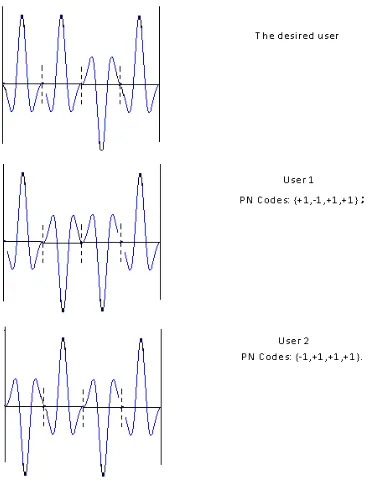
illustrates an example of a UWB DS-BPAM system. The PN codes {cn(u)}
are used herein to change the polarities of the pulses to distinguished different
users.
The system performance is highly related to the PN patterns. With
an appropriate code design, better correlation properties can be achieved in
a multi-user environment [46], [47]. The previous research have demonstrated
that Gold, Kasami, Barker and PN spreading codes are all suitable for UWB
DS-SS systems. Similar investigations for the TH code design in UWB TH-SS
systems are presented in [48].
been discussed in [49]. The DS-SS scheme is more suitable than the TH-SS
scheme in a multi-user environment, as a higher amount of collision occurs in
the TH-SS scheme.
Eq.(2.15) - eq.(2.17) exhibit the transmitted signal employing various
spread spectrum and modulation techniques, as TH-BPPM, TH-BPAM and
DS-BPAM, respectively. These expressions can be also considered as the
sim-plest format of the UWB transmitted signal which will pass through the
mul-tipath propagation channel to reach the receiver afterwards.
2.5
UWB Receivers
At the receiver, the distorted signal caused by interference and noise needs to
be recovered for the data decision, using the TH-BPAM UWB system as an
example. By substituting eq.(2.2) into eq.(2.16), the received signal for the
uth user can be obtained by
r(u, t) = s(u, t)∗h0(t)
= ∞
X
j=−∞
L
X
l=0
K
X
k=0
αk,lϑ⌊j/Nf⌋(u)prx(t−Tl−τk,l−jTf −Tc·cj(u))
+ n(u, t) (2.18)
whereprxis the aggregate pulse taking the effects of multipath, multiple-access
and spectrum spreading into account and ‘∗’ denotes the convolution. n(u, t)
represents the noise for the uth user and it is normally regarded as additive
white Gaussian noise (AWGN).
The receiver design is a major challenge for a UWB system. Several
re-ceivers such as the RAKE receiver [50] [51], and non-coherent rere-ceivers such as
the transmitted-reference (TR) receiver [52] [53] [54] and the energy detection
receiver [55] [56].
The Rake receiver is often applied in UWB systems to take full
ad-vantage of multipath diversity. However, it is computationally prohibitive to
collect the energies of all the multipath components, as one has to employ an
explicit channel estimator for each multipath component. Therefore,
practi-cal Rake receivers often adopt a limited number of ‘fingers’, at the cost of a
degraded system performance [50], [57].
Instead of using a complicated RAKE receiver, reference [52] proposed
the transmitted reference (TR) receiver, to relax the requirements on
synchro-nization and channel estimation. The traditional TR receiver correlates the
received signal corresponding to the data symbol with the template signal
cor-responding to the reference symbol which is transmitted before the data
sym-bol and hence, this noisy template signal degrades the receiver performance
significantly. Several template designs for reliable data detection in the UWB
TR systems have been developed in [58]. Some template signals in [58] have
a high time-consuming requirement due to their complex template formats.
The energy detector (ED) can provide a simple receiver structure avoiding
recursive algorithms, resulting in significant performance degradation. The
received signal at ED is squared and then thresholded to recover the
transmit-ted data signal. Therefore, the selection of the optimal threshold plays a very
important role in the receiver performance [59], [60].
Interested readers can refer to [61] for further detailed comparison
be-tween coherent and non-coherent receivers in UWB communications. Thus,
2.5.1
UWB TR Receivers
The attraction of the UWB TR system has been dramatically drawn from both
academic and industrial environments recently. This is due to the improved
system performance with an acceptable of complexity [62]. In the traditional
TR system, the reference (pilot) pulse is transmitted Td seconds before the
data pulse. The part of the received signal corresponding to the reference
information is used to construct the channel template, which is correlated
with the part of the received signal corresponding to the data information for
data detection.
Considering a multi-user UWB TH-BPM system, the transmitted signal
for the ith bit (i.e., the ith symbol) in the uth user is given by
s(u, t) = pεi(u)
Nf−1
X
j=0
[p(t−jTf −Tc·cj(u))
+ ϑi(u)p(t−jTf −Tc ·cj(u)−Td(u))] (2.19)
whereεi(u) is the signal energy for theith bit in the uth user andTd(u) is the
time interval between data and reference pulses in theuth user. The expression
of the received signal is similar to eq.(2.18) as
r(u, t) = pεi(u)
Nf−1
X
j=0
[h(t−jTf −Tc ·cj(u))
+ ϑi(u)h(t−jTf −Tc·cj(u)−Td(u))] +n(t) (2.20)
whereh(t) = p(t)∗h0(t) is the channel response to the transmitted signal. At
the decision statistic for the ith bit in theuth user can be expressed as [63]
Di(u) =
Nf−1
X
j=0
Ds(j, u) (2.21)
where
Ds(j, u) =
Z jTf+Tc·cj(u)+Td(u)+Tcorr
jTf+Tc·cj(u)+Td(u)
r(u, t)r(u, t−Td(u))dt (2.22)
with Tcorr being the length of integration interval and r(u, t−Td) being the
channel template. Finally, the data decision is made according to
ˆ
di =
(
0, if Di <0
1, if Di ≥0
(2.23)
where ˆ(·) denotes the data decision.
Unlike coherent receivers, TR receivers do not require excellent time
synchronization. However, the TR receiver is very sensitive to the integration
position and duration, as all the multipath components are gathered at the
reception stage [64].
2.6
Conclusions
In this chapter, an overview of the basic UWB communication system was
presented, starting with the multipath channel models for UWB. Nowadays,
the most accurate UWB channel model, proposed by the subcommittee of the
IEEE 802.15.3a group for WPANs in 2003, is a slightly different version of
four categories as CM1 - CM4, according to the transmission type and the
communication distance. The primary parameters that significantly impact
the characteristics of channels were briefly described, including the multipath
fading gain and the multipath arrival times.
A commonly used second-order derivative Gaussian pulse, namely the
Gaussian doublet, was discussed in both the time domain and the frequency
domain. The ultra-short pulse duration in the time domain enables it to
be distinguished from other unwanted multipath components due to its fine
time resolution. On the other hand, this pulse in the frequency domain is
spreaded over an extremely wide bandwidth so that its frequency components
are low enough for the FCC regulations. Therefore, this signal can propagate
very well in the UWB IEEE channels to avoid interference with other existing
communication systems.
Then, two appropriate modulation schemes for the UWB systems, known
as PPM and BPAM, were discussed. Multiple-access techniques for UWB were
also presented. In particular, typical expressions of TH-BPPM, TH-BPAM
and DS-BPAM schemes were provided. The DS-BPAM scheme benefits the
TH-BPAM scheme in a multi-user environment because more collisions
oc-curred in the TH-SS system than in the DS-SS system. Also, the TH-BPAM
scheme always outperforms the TH-BPPM scheme due to the 3 dB gain in
power efficiency. Moreover, a M-ary PPM technology can significantly
im-prove the capacity with a certain number of users.
Finally, a brief description of the UWB receivers was presented.
Nor-mally, the UWB receivers in the literature can be classified as coherent and
non-coherent receivers. Meanwhile, the non-coherent receivers can be further
energy detector. In a traditional TR system, the received data signal is
corre-lated with the received reference signal for reliable data decision. A complex
channel estimation process is not required for UWB TR systems. Owing to its
structural simplicity and tolerable performance degradation, the TR receiver
has become very attractive recently. In the next chapter onwards, the
opti-mization for the TR receiver to improve its performance in various scenarios
Chapter 3
Optimization of the Traditional
UWB TR Receiver
3.1
Introduction
As has been discussed previously, the UWB TR receiver was proposed to relax
the requirements on synchronization and channel estimation. These
proper-ties enable the TR receiver to benefit from a simple structure and to be less
computation-consuming. As a result, this also leads to simple
implementa-tions in the TR system. For the traditional TR receiver, the second pulse
corresponding to the modulated signal is transmittedTd seconds after the first
pulse corresponding to the unmodulated signal [53], [62], [65]. The traditional
TR receiver can be also described as an Autocorrelation Receiver (AcR) where
a reference and data pair is sent per frame. The unmodulated signal containing
the reference information is used as a channel template at the correlator, and
the modulated signal contains the data information to detect. A significant
Stark presented a BER performance analysis of the AcR by using the Gaussian
approximation (GA) in a single-user environment. In [53], Chao and Scholtz
derived the bit error probability (BEP) of the AcR based on knowledge of
the channel properties. In [66], Chao further derived the BEP of the AcR by
using the orthogonal expansion concept instead of the central limit theorem
in the GA for the more accurate theoretical results. In [67], Jia and Kim
de-rived a closed-form expression for the channel-averaged
signal-to-interference-plus-noise ratio (SINR) of the AcR, where multi-user interference (MAI) was
considered. In [68] and [69], Witrisal and Pausini provided the statistical
anal-ysis of the correlation function considering the effect of inter-pulse interference
(IPI), while [68] was based on the Volterra equivalent system model. However,
none of these work has considered the best choice ofTd within the pulse pairs.
This chapter focuses on the optimization of Td in the AcR. Since the
AcR correlates the data signal with the reference signal to capture all the
achievable energies from the multipath, the performance of the AcR suffers
from power loss of the reference signal as well as noise in the template.
Fur-thermore, the value of Td determines the amount of IPI as well as the energy
allocation between the reference signal and the data signal. IfTd is too large,
IPI can be largely eliminated due to the sufficient interval between the
refer-ence and the data signals, but the energy allocated to the data signal could
be too small, assuming fixed total signal energy, such that the useful data
energy captured at the traditional TR receiver may be too small for reliable
detection. This degrades the receiver performance. On the other hand, ifTd is
too small, the inherent IPI could be very significant, although the energy
allo-cated to the data signal is sufficient for reliable detection. This degrades the
the best tradeoff between interference and energy allocation. Herein, the AcR
is optimized with respect to Td for two criteria, maximization of the channel
achievable capacity and minimization of the system BER. The channel
capac-ity and BER are derived by using an accurate approximation to the SINR.
Numerical results show that the optimized TR receiver can provide significant
gains over the traditional TR receiver in terms of channel capacity and BER.
This chapter is organized as follows. Section 3.2 illustrates the system
model for the traditional TR receiver (AcR). The optimization with respect to
Td using the two criteria (channel capacity and BER) is addressed in Section
3.3. Conclusions are drawn in Section 3.4.
3.2
System Model for the Traditional UWB
TR Receiver
A single-user UWB system is first considered. Therefore, time-hopping or
direct-sequence for multiple access are not used. With BPAM applied, theith
transmitted bit can be expressed as
si(t) =
Nf−1
X
j=0
√
εi
h√
αgtr(t−jTf) +ϑi
p
(1−α)gtr(t−jTf −Td)
i
(3.1)
whereNf is the number of frames,j = 0,1,· · · , Nf −1 is the frame index, Tf
is the frame interval, gtr(t) denotes the monocycle pulse with time duration
Tp and energy Eg =
R∞
−∞g
2
tr(t)dt, εi is the total energy for the ith bit, {ϑi} ∈
{+1,−1} with equal probabilities denotes the ith bit associated with the i
data symbol, and Td is the delay between the reference pulse and the data
function of gtr(t) isRg(∆) = E1g
R∞
−∞gtr(t)gtr(t+ ∆)dt. The energy allocation
factor α is defined as
α= εri
εi
(3.2)
whereεri is the reference energy andTb is the bit duration. Here, it is assumed
that the energy is linearly proportional to the time interval. This assumption is
based on the fact that in general energy equals the product of power and time
and the observation that the average transmission power in wireless device is
often fixed. Although the specific relationship between the energy and the time
may be quadratic or even more complicated, the linear relationship is used as
an example to give general guidance on how to choose the time delay. Using
the same method presented here, one can easily replace this linear relationship
with other specific relationships to find the best time delay for the specific
applications. The investigations will be very similar, as the optimum time
delay can be found from the optimum energy allocation factor by solving an
equation using their relationships. For the reference, since the reference pulse
in one frame continues untilTd seconds later when the data pulse starts, the
total reference time interval can be described as Td·Nf for one bit. Thus,
α = εri
εi
= c·Td·Nf
c·Tb
= Td·Nf
Tb
(3.3)
where the assumed linear relationship between energy ε and time interval T
as ε = c·T is used, c is a constant. The bit energy is fixed at εi. Then,
from eq.(3.3), the reference energy per bit is εri = αεi = Tεib ·Td·Nf. Also,
from eq.(3.1), the data energy per bit isεdi = (1−α)εi = Tεib ·(Tb −Td·Nf).
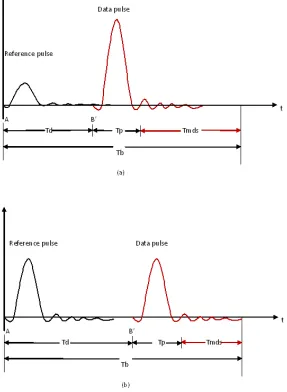
optimization problem can be described by using Figure 3.1. WhenTdincreases,
from eq.(3.3),αincreases. Since the reference pulse has an amplitude of√αεi,
the reference pulse amplitude increases and therefore, the reference energy
increases. Also, since the data pulse has an amplitude ofp(1−α)εi, the data
pulse amplitude decreases and therefore, the data energy decreases. On the
other hand, when Td increases, the time space between the reference pulse
and the data pulse increases so that the inter-pulse interference is reduced.
Thus, an optimal Td exists. One notes that the choice of the time delay Td
is equivalent to the choice of α, when Tb is fixed. This selection approach
can be seen as a joint study of reducing the inherent IPI and increasing the
energy allocated to the data signal. In the following, the optimal α will be
determined.
In order to restrict the noise, an ideal bandpass filter with one-sided
bandwidth ofBp= T1p (Hz) is applied at the front end of the receiver to remove
excessive noise. Thus, the filtered received signal for the ith transmitted bit
can be expressed as
ri(t) =
Ns−1
X
j=0
√ε
i
h√
αh(t−jTf) +ϑi
p
(1−α)h(t−jTf −Td)
i
+ni(t) (3.4)
where h(t) = gtr(t)∗h0(t)∗gre(t) is the equivalent channel response (CR)
to the transmitted waveform, h0(t) is the channel response presented in [26],
gre(t) is the pulse shape of the bandpass filter, and ni(t) is additive white
Gaussian noise (AWGN) with mean zero and variance δ2 = B
pNo with No
being the one-sided noise power density. The multipath channel model used
here is based on [26] and is assumed to be time-invariant over one observation
Figure 3.1: The system model of the conventional TR receiver with different
![Figure 1.1: The definition of UWB systems [8].](https://thumb-us.123doks.com/thumbv2/123dok_us/9685647.469997/21.595.161.471.111.290/figure-the-denition-of-uwb-systems.webp)
![Figure 1.2: The FCC UWB spectral masks [8].](https://thumb-us.123doks.com/thumbv2/123dok_us/9685647.469997/22.595.169.468.112.284/figure-the-fcc-uwb-spectral-masks.webp)