Generalizing Word Lattice Translation
Christopher Dyer∗, Smaranda Muresan, Philip Resnik∗ Laboratory for Computational Linguistics and Information Processing
Institute for Advanced Computer Studies ∗
Department of Linguistics University of Maryland College Park, MD 20742, USA
redpony, smara, resnik AT umd.edu
Abstract
Word lattice decoding has proven useful in spoken language translation; we argue that it provides a compelling model for translation of text genres, as well. We show that prior work in translating lattices using finite state tech-niques can be naturally extended to more ex-pressive synchronous context-free grammar-based models. Additionally, we resolve a significant complication that non-linear word lattice inputs introduce in reordering mod-els. Our experiments evaluating the approach demonstrate substantial gains for Chinese-English and Arabic-Chinese-English translation.
1 Introduction
When Brown and colleagues introduced statistical machine translation in the early 1990s, their key in-sight – harkening back to Weaver in the late 1940s – was that translation could be viewed as an instance of noisy channel modeling (Brown et al., 1990). They introduced a now standard decomposition that distinguishes modeling sentences in the target lan-guage (lanlan-guage models) from modeling the rela-tionship between source and target language (lation models). Today, virtually all statistical trans-lation systems seek the best hypothesisefor a given inputf in the source language, according to
ˆ
e= arg max
e P r(e|f) (1)
An exception is the translation of speech recogni-tion output, where the acoustic signal generally un-derdetermines the choice of source word sequence f. There, Bertoldi and others have recently found that, rather than translating a single-best transcrip-tionf, it is advantageous to allow the MT decoder to
consider all possibilities forf by encoding the alter-natives compactly as a confusion network or lattice (Bertoldi et al., 2007; Bertoldi and Federico, 2005; Koehn et al., 2007).
Why, however, should this advantage be limited to translation from spoken input? Even for text, there are often multiple ways to derive a sequence of words from the input string. Segmentation of Chinese, decompounding in German, morpholog-ical analysis for Arabic — across a wide range of source languages, ambiguity in the input gives rise to multiple possibilities for the source word se-quence. Nonetheless, state-of-the-art systems com-monly identify a single analysisf during a prepro-cessing step, and decode according to the decision rule in (1).
In this paper, we go beyond speech translation by showing that lattice decoding can also yield im-provements for text by preserving alternative anal-yses of the input. In addition, we generalize lattice decoding algorithmically, extending it for the first time to hierarchical phrase-based translation (Chi-ang, 2005; Chi(Chi-ang, 2007).
Formally, the approach we take can be thought of as a “noisier channel”, where an observed signalo gives rise to a set of source-language stringsf0 ∈ F(o)and we seek
ˆ
e = arg max
e fmax0∈F(o)P r(e, f
0|
o) (2)
= arg max
e fmax0∈F(o)P r(e)P r(f
0|
e, o) (3)
= arg max
e fmax0∈F(o)P r(e)P r(f
0|e)P r(o|f0). (4)
Following Och and Ney (2002), we use the maxi-mum entropy framework (Berger et al., 1996) to di-rectly model the posteriorP r(e, f0|o)with parame-ters tuned to minimize a loss function representing
the quality only of the resulting translations. Thus, we make use of the following general decision rule:
ˆ
e = arg max
e fmax0∈F(o)
M X
m=1
λmφm(e, f0, o) (5)
In principle, one could decode according to (2) simply by enumerating and decoding each f0 ∈ F(o); however, for any interestingly largeF(o)this will be impractical. We assume that for many in-teresting cases ofF(o), there will be identical sub-strings that express the same content, and therefore a lattice representation is appropriate.
In Section 2, we discuss decoding with this model in general, and then show how two classes of lation models can easily be adapted for lattice trans-lation; we achieve a unified treatment of finite-state and hierarchical phrase-based models by treating lattices as a subcase of weighted finite state au-tomata (FSAs). In Section 3, we identify and solve issues that arise with reordering in non-linear FSAs, i.e. FSAs where every path does not pass through every node. Section 4 presents two applications of the noisier channel paradigm, demonstrating sub-stantial performance gains in Arabic-English and Chinese-English translation. In Section 5 we discuss relevant prior work, and we conclude in Section 6.
2 Decoding
Most statistical machine translation systems model translational equivalence using either finite state transducers or synchronous context free grammars (Lopez, to appear 2008). In this section we discuss the issues associated with adapting decoders from both classes of formalism to process word lattices. The first decoder we present is a SCFG-based de-coder similar to the one described in Chiang (2007). The second is a phrase-based decoder implementing the model of Koehn et al. (2003).
2.1 Word lattices
A word lattice G = hV, Ei is a directed acyclic graph that formally is a weighted finite state automa-ton (FSA). We further stipulate that exactly one node has no outgoing edges and is designated the ‘end node’. Figure 1 illustrates three classes of word lattices.
0
1 x
2 a
y
3 b c
0 1
a x ε
2
b d 3
[image:2.612.352.501.78.193.2]c 0 a 1 b 2 c 3
Figure 1: Three examples of word lattices: (a) sentence, (b) confusion network, and (c) non-linear word lattice.
A word lattice is useful for our purposes because it permits any finite set of strings to be represented and allows for substrings common to multiple mem-bers of the set to be represented with a single piece of structure. Additionally, all paths from one node to another form an equivalence class representing, in our model, alternative expressions of the same un-derlying communicative intent.
For translation, we will find it useful to encode
G in a chart based on a topological ordering of the nodes, as described by Cheppalier et al. (1999). The nodes in the lattices shown in Figure 1 are labeled according to an appropriate numbering.
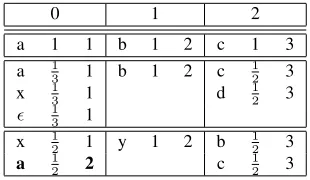
The chart-representation of the graph is a triple of 2-dimensional matriceshF,p,Ri, which can be con-structed from the numbered graph. Fi,j is the word
label of thejth transition leaving node i. The cor-responding transition cost ispi,j. Ri,j is the node
number of the node on therightside of thejth tran-sition leaving nodei. Note thatRi,j > ifor alli, j.
Table 1 shows the word lattice from Figure 1 repre-sented in matrix form ashF,p,Ri.
0 1 2
a 1 1 b 1 2 c 1 3
a 1
3 1 b 1 2 c
1
2 3
x 13 1 d 12 3
13 1 x 1
2 1 y 1 2 b
1
2 3
a 1
2 2 c
1
2 3
[image:2.612.349.504.570.660.2]2.2 Parsing word lattices
Chiang (2005) introduced hierarchical phrase-based translation models, which are formally based on synchronous context-free grammars (SCFGs). Translation proceeds by parsing the input using the source language side of the grammar, simultane-ously building a tree on the target language side via the target side of the synchronized rules. Since de-coding is equivalent to parsing, we begin by present-ing a parser for word lattices, which is a generaliza-tion of a CKY parser for lattices given in Cheppalier et al. (1999).
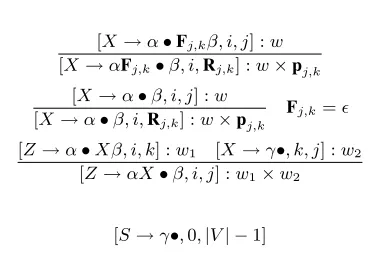
Following Goodman (1999), we present our lat-tice parser as a deductive proof system in Figure 2. The parser consists of two kinds of items, the first with the form[X → α •β, i, j]representing rules that have yet to be completed and span node i to nodej. The other items have the form[X, i, j]and indicate that non-terminal X spans [i, j]. As with sentence parsing, the goal is a deduction that covers the spans of the entire input lattice[S,0,|V| −1].
The three inference rules are: 1) match a terminal symbol and move across one edge in the lattice 2) move across an-edge without advancing the dot in an incomplete rule 3) advance the dot across a non-terminal symbol given appropriate antecedents.
2.3 From parsing to MT decoding
A target language model is necessary to generate flu-ent output. To do so, the grammar is intersected with ann-gram LM. To mitigate the effects of the combi-natorial explosion of non-terminals the LM intersec-tion entails, we use cube-pruning to only consider the most promising expansions (Chiang, 2007).
2.4 Lattice translation with FSTs
A second important class of translation models in-cludes those based formally on FSTs. We present a description of the decoding process for a word lattice using a representative FST model, the phrase-based translation model described in Koehn et al. (2003).
Phrase-based models translate a foreign sentence f into the target language e by breaking upf into a sequence of phrasesfI1, where each phrasefican contain one or more contiguous words and is trans-lated into a target phraseeiof one or more
contigu-ous words. Each word in f must be translated
ex-actly once. To generalize this model to word lattices, it is necessary to choose both a path through the lat-tice and a partitioning of the sentence this induces into a sequence of phrasesfI1. Although the number of source phrases in a word lattice can be exponen-tial in the number of nodes, enumerating thepossible translationsof every span in a lattice is in practice tractable, as described by Bertoldi et al. (2007).
2.5 Decoding with phrase-based models
We adapted the Moses phrase-based decoder to translate word lattices (Koehn et al., 2007). The unmodified decoder builds a translation hypothesis from left to right by selecting a range of untrans-lated words and adding translations of this phrase to the end of the hypothesis being extended. When no untranslated words remain, the translation process is complete.
The word lattice decoder works similarly, only now the decoder keeps track not of the words that have been covered, but of the nodes, given a topo-logical ordering of the nodes. For example, assum-ing the third lattice in Figure 1 is our input, if the edge with worda is translated, this will covertwo
untranslated nodes [0,1] in the coverage vector, even though it is only a single word. As with sentence-based decoding, a translation hypothesis is complete when all nodes in the input lattice are covered.
2.6 Non-monotonicity and unreachable nodes
Axioms:
[X → •γ, i, i] :w (X w
−→ hγ, αi)∈G, i∈[0,|V| −2]
Inference rules:
[X→α•Fj,kβ, i, j] :w
[X→αFj,k•β, i,Rj,k] :w×pj,k
[X→α•β, i, j] :w
[X →α•β, i,Rj,k] :w×pj,k
Fj,k=
[Z→α•Xβ, i, k] :w1 [X→γ•, k, j] :w2
[Z→αX•β, i, j] :w1×w2
Goal state:
[image:4.612.211.395.88.217.2][S→γ•,0,|V| −1]
Figure 2: Word lattice parser for an unrestricted context free grammarG.
0
1 a
2
3 x
Figure 3: The span[0,3]has one inconsistent covering, [0,1] + [2,3].
[2,3] as a possible extension of this hypothesis since there is no path from node 1 to node 2 and therefore the span [1,2] would never be covered. In the parser that forms the basis of the hierarchical decoder de-scribed in Section 2.3, no such restriction is neces-sary since grammar rules are processed in a strictly left-to-right fashion without any skips.
3 Distortion in a non-linear word lattice
In both hierarchical and phrase-based models, the distance between words in the source sentence is used to limit where in the target sequence their trans-lations will be generated. In phrase based transla-tion, distortion is modeled explicitly. Models that support non-monotonic decoding generally include a distortion cost, such as|ai−bi−1−1|whereaiis
the starting position of the foreign phrasefiandbi−1
is the ending position of phrasefi−1 (Koehn et al.,
2003). The intuition behind this model is that since most translation is monotonic, the cost of skipping ahead or back in the source should be proportional to the number of words that are skipped. Addition-ally, a maximum distortion limit is used to restrict
0 a 1
2 x
3 b
y
4 c
Figure 4: Distance-based distortion problem. What is the distance between node 4 to node 0?
the size of the search space.
In linear word lattices, such as confusion net-works, the distance metric used for the distortion penalty and for distortion limits is well defined; however, in a non-linear word lattice, it poses the problem illustrated in Figure 4. Assuming the left-to-right decoding strategy described in the previous section, ifcis generated by the first target word, the distortion penalty associated with “skipping ahead” should be either 3 or 2, depending on what path is chosen to translate the span [0,3]. In large lattices, where a single arc may span many nodes, the possi-ble distances may vary quite substantially depending on what path is ultimately taken, and handling this properly therefore crucial.
Although hierarchical phrase-based models do not model distortion explicitly, Chiang (2007) sug-gests using a span length limit to restrict the win-dow in which reordering can take place.1 The de-coder enforces the constraint that a synchronous rule learned from the training data (the only mechanism by which reordering can be introduced) can span
1
Distance metric MT05 MT06 Difference 0.2943 0.2786 Difference+LexRO 0.2974 0.2890 ShortestP 0.2993 0.2865 ShortestP+LexRO 0.3072 0.2992
Table 2: Effect of distance metric on phrase-based model performance.
maximally Λ words inf. Like the distortion cost used in phrase-based systems, Λ is also poorly de-fined for non-linear lattices.
Since we want a distance metric that will restrict as few local reorderings as possible on any path, we use a functionξ(a, b)returning the length of the shortest path between nodesaandb. Since this func-tion is not dependent on the exact path chosen, it can be computed in advance of decoding using an all-pairs shortest path algorithm (Cormen et al., 1989).
3.1 Experimental results
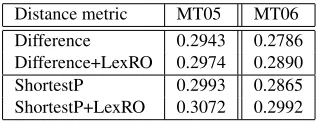
We tested the effect of the distance metric on trans-lation quality using Chinese word segmentation lat-tices (Section 4.1, below) using both a hierarchical and phrase-based system modified to translate word lattices. We compared the shortest-path distance metric with a baseline which uses the difference in node number as the distortion distance. For an ad-ditional datapoint, we added a lexicalized reorder-ing model that models the probability of each phrase pair appearing in three different orientations (swap, monotone, other) in the training corpus (Koehn et al., 2005).
Table 2 summarizes the results of the phrase-based systems. On both test sets, the shortest path metric improved the BLEU scores. As expected, the lexicalized reordering model improved transla-tion quality over the baseline; however, the improve-ment was more substantial in the model that used the shortest-path distance metric (which was already a higher baseline). Table 3 summarizes the results of our experiment comparing the performance of two distance metrics to determine whether a rule has ex-ceeded the decoder’s span limit. The pattern is the same, showing a clear increase in BLEU for the shortest path metric over the baseline.
Distance metric MT05 MT06 Difference 0.3063 0.2957 ShortestP 0.3176 0.3043
Table 3: Effect of distance metric on hierarchical model performance.
4 Exploiting Source Language Alternatives
Chinese word segmentation. A necessary first step in translating Chinese using standard models is segmenting the character stream into a sequence of words. Word-lattice translation offers two possi-ble improvements over the conventional approach. First, a lattice may represent multiple alternative segmentations of a sentence; input represented in this way will be more robust to errors made by the segmenter.2 Second, different segmentation granu-larities may be more or less optimal for translating different spans. By encoding alternatives in the in-put in a word lattice, the decision as to which granu-larity to use for a given span can be resolved during decoding rather than when constructing the system. Figure 5 illustrates a lattice based on three different segmentations.
Arabic morphological variation. Arabic orthog-raphy is problematic for lexical and phrase-based MT approaches since a large class of functional el-ements (prepositions, pronouns, tense markers, con-junctions, definiteness markers) are attached to their host stems. Thus, while the training data may pro-vide good epro-vidence for the translation of a partic-ular stem by itself, the same stem may not be at-tested when attached to a particular conjunction. The general solution taken is to take the best pos-sible morphological analysis of the text (it is of-ten ambiguous whether a piece of a word is part of the stem or merely a neighboring functional el-ement), and then make a subset of the bound func-tional elements in the language into freestanding to-kens. Figure 6 illustrates the unsegmented Arabic surface form as well as the morphological segmen-tation variant we made use of. The limisegmen-tation of this approach is that as the amount and variety of train-ing data increases, the optimal segmentation strat-egy changes: more aggressive segmentation results
2The segmentation process is ambiguous, even for native
[image:5.612.356.498.60.96.2]0 1
硬 2
硬质
4
硬质合金 质
3 合
合金 金
5 号
6 号称
称
7 "
8 工
9 工业
业 牙 10
11 牙齿
齿
[image:6.612.76.552.62.134.2]12 "
Figure 5: Sample Chinese segmentation lattice using three segmentations.
in fewer OOV tokens, but automatic evaluation met-rics indicate lower translation quality, presumably because the smaller units are being translated less idiomatically (Habash and Sadat, 2006). Lattices al-low the decoder to make decisions about what gran-ularity of segmentation to usesubsententially.
4.1 Chinese Word Segmentation Experiments
In our experiments we used two state-of-the-art Chi-nese word segmenters: one developed at Harbin Institute of Technology (Zhao et al., 2001), and one developed at Stanford University (Tseng et al., 2005). In addition, we used a character-based seg-mentation. In the remaining of this paper, we usecs for character segmentation,hsfor Harbin segmenta-tion andssfor Stanford segmentation. We built two types of lattices: one that combines the Harbin and Stanford segmenters (hs+ss), and one which uses all three segmentations (hs+ss+cs).
Data and Settings. The systems used in these experiments were trained on the NIST MT06 Eval corpus without the UN data (approximatively 950K sentences). The corpus was analyzed with the three segmentation schemes. For the systems using word lattices, the training data contained the versions of the corpus appropriate for the segmentation schemes used in the input. That is, for thehs+sscondition, the training data consisted of two copies of the cor-pus: one segmented with the Harbin segmenter and the other with the Stanford segmenter.3 A trigram English language model with modified Kneser-Ney smoothing (Kneser and Ney, 1995) was trained on the English side of our training data as well as por-tions of the Gigaword v2 English Corpus, and was used for all experiments. The NIST MT03 test set was used as a development set for optimizing the in-terpolation weights using minimum error rate
train-3The corpora were word-aligned independently and then
concatenated for rule extraction.
ing (Och, 2003). The testing was done on the NIST 2005 and 2006 evaluation sets (MT05, MT06).
Experimental results: Word-lattices improve translation quality. We used both a phrase-based translation model, decoded using our modified ver-sion of Moses (Koehn et al., 2007), and a hierarchi-cal phrase-based translation model, using our modi-fied version of Hiero (Chiang, 2005; Chiang, 2007). These two translation model types illustrate the ap-plicability of the theoretical contributions presented in Section 2 and Section 3.
We observed that the coverage of named entities (NEs) in our baseline systems was rather poor. Since names in Chinese can be composed of relatively long strings of characters that cannot be translated individually, when generating the segmentation lat-tices that includedcs arcs, we avoided segmenting NEs of typePERSON, as identified using a Chinese NE tagger (Florian et al., 2004).
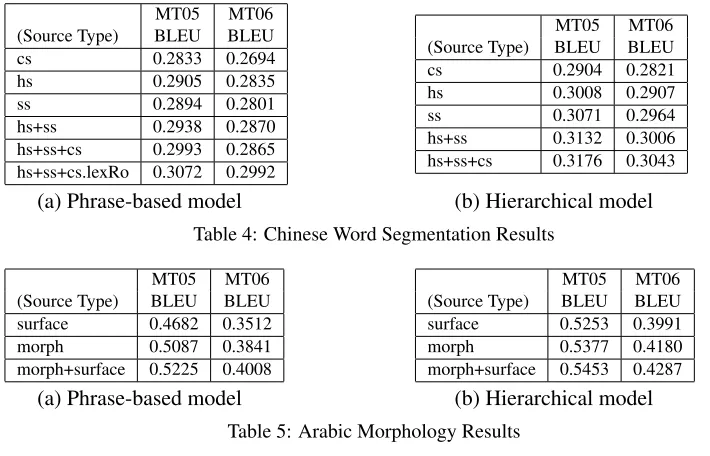
The results are summarized in Table 4. We see that using word lattices improves BLEU scores both in the phrase-based model and hierarchical model as compared to the single-best segmentation approach. All results using our word-lattice decoding for the hierarchical models (hs+ssandhs+ss+cs) are sig-nificantly better than the best segmentation (ss).4 For the phrase-based model, we obtain significant gains using our word-lattice decoder using all three segmentations on MT05. The other results, while better than the best segmentation (hs) by at least 0.3 BLEU points, are not statistically significant. Even if the results are not statistically significant for MT06, there is a high decrease in OOV items when using word-lattices. For example, for MT06 the number of OOVs in the hs translation is 484.
4
Significance testing was carried out using the bootstrap re-sampling technique advocated by Koehn (2004). Unless other-wise noted, all reported improvements are signficant at at least
surface wxlAl ftrp AlSyf kAn mEZm AlDjyj AlAElAmy m&ydA llEmAd .
segmented w- xlAl ftrp Al- Syf kAn mEZm Al- Djyj Al- AElAmy m&ydA l- Al- EmAd . (English) During the summer period , most media buzz was supportive of the general .
Figure 6: Example of Arabic morphological segmentation.
The number of OOVs decreased by 19% forhs+ss and by 75% forhs+ss+cs. As mentioned in Section 3, using lexical reordering for word-lattices further improves the translation quality.
4.2 Arabic Morphology Experiments
We created lattices from an unsegmented version of the Arabic test data and generated alternative arcs where clitics as well as the definiteness marker and the future tense marker were segmented into tokens. We used the Buckwalter morphological analyzer and disambiguated the analysis using a simple unigram model trained on the Penn Arabic Treebank.
Data and Settings. For these experiments we made use of the entire NIST MT08 training data, although for training of the system, we used a sub-sampling method proposed by Kishore Papineni that aims to include training sentences containing n-grams in the test data (personal communication). For all systems, we used a 5-gram English LM trained on 250M words of English training data. The NIST MT03 test set was used as development set for optimizing the interpolation weights using MER training (Och, 2003). Evaluation was car-ried out on the NIST 2005 and 2006 evaluation sets (MT05, MT06).
Experimental results: Word-lattices improve translation quality. Results are presented in Table 5. Using word-lattices to combine the surface forms with morphologically segmented forms significantly improves BLEU scores both in the phrase-based and hierarchical models.
5 Prior work
Lattice Translation. The ‘noisier channel’ model of machine translation has been widely used in spo-ken language translation as an alternative to select-ing the sselect-ingle-best hypothesis from an ASR system and translating it (Ney, 1999; Casacuberta et al., 2004; Zhang et al., 2005; Saleem et al., 2005; Ma-tusov et al., 2005; Bertoldi et al., 2007; Mathias, 2007). Several authors (e.g. Saleem et al. (2005)
and Bertoldi et al. (2007)) comment directly on the impracticality of using n-best lists to translate speech.
Although translation is fundamentally a non-monotonic relationship between most language pairs, reordering has tended to be a secondary con-cern to the researchers who have worked on lattice translation. Matusov et al. (2005) decodes monoton-ically and then uses a finite state reordering model on the single-best translation, along the lines of Bangalore and Riccardi (2000). Mathias (2007) and Saleem et al. (2004) only report results of monotonic decoding for the systems they describe. Bertoldi et al. (2007) solve the problem by requiring that their input be in the format of a confusion net-work, which enables the standard distortion penalty to be used. Finally, the system described by Zhang et al. (2005) uses IBM Model 4 features to translate lattices. For the distortion model, they use the maxi-mum probability value over all possible paths in the lattice for each jump considered, which is similar to the approach we have taken. Mathias and Byrne (2006) build a phrase-based translation system as a cascaded series of FSTs which can accept any input FSA; however, the only reordering that is permitted is the swapping of two adjacent phrases.
simpli-MT05 MT06 (Source Type) BLEU BLEU
cs 0.2833 0.2694
hs 0.2905 0.2835
ss 0.2894 0.2801
hs+ss 0.2938 0.2870
hs+ss+cs 0.2993 0.2865 hs+ss+cs.lexRo 0.3072 0.2992
MT05 MT06
(Source Type) BLEU BLEU
cs 0.2904 0.2821
hs 0.3008 0.2907
ss 0.3071 0.2964
hs+ss 0.3132 0.3006 hs+ss+cs 0.3176 0.3043
(a) Phrase-based model (b) Hierarchical model
Table 4: Chinese Word Segmentation Results
MT05 MT06
(Source Type) BLEU BLEU surface 0.4682 0.3512
morph 0.5087 0.3841
morph+surface 0.5225 0.4008
MT05 MT06
(Source Type) BLEU BLEU surface 0.5253 0.3991
morph 0.5377 0.4180
morph+surface 0.5453 0.4287
[image:8.612.119.474.59.287.2](a) Phrase-based model (b) Hierarchical model
Table 5: Arabic Morphology Results
fications of a surface token when the surface token can not be translated.
Parsing and formal language theory. There has been considerable work on parsing word lattices, much of it for language modeling applications in speech recognition (Ney, 1991; Cheppalier and Raj-man, 1998). Additionally, Grune and Jacobs (2008) refines an algorithm originally due to Bar-Hillel for intersecting an arbitrary FSA (of which word lattices are a subset) with a CFG. Klein and Manning (2001) formalize parsing as a hypergraph search problem and derive anO(n3)parser for lattices.
6 Conclusions
We have achieved substantial gains in translation performance by decoding compact representations of alternative source language analyses, rather than single-best representations. Our results generalize previous gains for lattice translation of spoken lan-guage input, and we have further generalized the approach by introducing an algorithm for lattice decoding using a hierarchical phrase-based model. Additionally, we have shown that although word lattices complicate modeling of word reordering, a simple heuristic offers good performance and en-ables many standard distortion models to be used directly with lattice input.
Acknowledgments
This research was supported by the GALE program of the Defense Advanced Research Projects Agency, Contract No. HR0011-06-2-0001. The authors wish to thank Niyu Ge for the Chinese named-entity anal-ysis, Pi-Chuan Chang for her assistance with the Stanford Chinese segmenter, and Tie-Jun Zhao and Congui Zhu for making the Harbin Chinese seg-menter available to us.
References
S. Bangalore and G. Riccardi. 2000. Finite state models for lexical reordering in spoken language translation. In Proc. Int. Conf. on Spoken Language Processing, pages 422–425, Beijing, China.
A.L. Berger, V.J. Della Pietra, and S.A. Della Pietra. 1996. A maximum entropy approach to natural lan-guage processing. Comput. Linguist., 22(1):39–71. N. Bertoldi and M. Federico. 2005. A new decoder for
spoken language translation based on confusion net-works. InProceedings of the IEEE Automatic Speech Recognition and Understanding Workshop.
N. Bertoldi, R. Zens, and M. Federico. 2007. Speech translation by confusion network decoding. In Pro-ceeding of ICASSP 2007, Honolulu, Hawaii, April. P.F. Brown, J. Cocke, S. Della-Pietra, V.J. Della-Pietra,
F. Jelinek, J.D. Lafferty, R.L. Mercer, and P.S. Roossin. 1990. A statistical approach to machine translation.Computational Linguistics, 16:79–85. F. Casacuberta, H. Ney, F. J. Och, E. Vidal, J. M. Vilar,
Mar-tinez, S. Molau, F. Nevado, M. Pastor, D. Pico, A. San-chis, and C. Tillmann. 2004. Some approaches to statistical and finite-state speech-to-speech translation.
Computer Speech & Language, 18(1):25–47, January. J. Cheppalier and M. Rajman. 1998. A generalized CYK algorithm for parsing stochastic CFG. InProceedings of the Workshop on Tabulation in Parsing and Deduc-tion (TAPD98), pages 133–137, Paris, France. J. Cheppalier, M. Rajman, R. Aragues, and A.
Rozen-knop. 1999. Lattice parsing for speech recognition. InSixth Conference sur le Traitement Automatique du Langage Naturel (TANL’99), pages 95–104.
D. Chiang. 2005. A hierarchical phrase-based model for statistical machine translation. In Proc. of the 43rd Annual Meeting of the Association for Computational Linguistics (ACL’05), pages 263–270.
D. Chiang. 2007. Hierarchical phrase-based translation.
Computational Linguistics, 33(2):201–228.
T.H. Cormen, C. E. Leiserson, and R. L. Rivest, 1989.
Introduction to Algorithms, pages 558–565. The MIT Press and McGraw-Hill Book Company.
M. Costa-juss`a and J.A.R. Fonollosa. 2007. Analy-sis of statistical and morphological classes to gener-ate weighted reordering hypotheses on a statistical ma-chine translation system. InProc. of the Second Work-shop on SMT, pages 171–176, Prague.
C. Dyer. 2007. Noisier channel translation: translation from morphologically complex languages. In Pro-ceedings of the Second Workshop on Statistical Ma-chine Translation, Prague, June.
R. Florian, H. Hassan, A. Ittycheriah, H. Jing, N. Kamb-hatla, X. Luo, N Nicolov, and S Roukos. 2004. A statistical model for multilingual entity detection and tracking. InProc. of HLT-NAACL 2004, pages 1–8. J. Goodman. 1999. Semiring parsing. Computational
Linguistics, 25:573–605.
D. Grune and C.J. H. Jacobs. 2008. Parsing as intersec-tion. Parsing Techniques, pages 425–442.
N. Habash and F. Sadat. 2006. Arabic preprocessing schemes for statistical machine translation. InProc. of NAACL, New York.
D. Klein and C. D. Manning. 2001. Parsing with hyper-graphs. InProceedings of IWPT 2001.
R. Kneser and H. Ney. 1995. Improved backing-off for m-gram language modeling. InProceedings of IEEE Internation Conference on Acoustics, Speech, and Sig-nal Processing, pages 181–184.
P. Koehn, F.J. Och, and D. Marcu. 2003. Statistical phrase-based translation. In Proceedings of NAACL 2003, pages 48–54.
P. Koehn, A. Axelrod, A. Birch Mayne, C. Callison-Burch, M. Osborne, and D. Talbot. 2005. Edinburgh system description for the 2005 IWSLT speech trans-lation evaluation. InProc. of IWSLT 2005, Pittsburgh.
P. Koehn, H. Hoang, A. Birch Mayne, C. Callison-Burch, M. Federico, N. Bertoldi, B. Cowan, W. Shen, C. Moran, R. Zens, C. Dyer, O. Bojar, A. Constantin, and E. Herbst. 2007. Moses: Open source toolkit for statistical machine translation. InAnnual Meeting of the Association for Computation Linguistics (ACL), Demonstration Session, pages 177–180, Jun.
P. Koehn. 2004. Statistical significance tests for machine translation evluation. In Proc. of the 2004 Conf. on EMNLP, pages 388–395.
A. Lopez. to appear 2008. Statistical machine transla-tion. ACM Computing Surveys.
L. Mathias and W. Byrne. 2006. Statistical phrase-based speech translation. InIEEE Conf. on Acoustics, Speech and Signal Processing.
L. Mathias. 2007. Statistical Machine Translation and Automatic Speech Recognition under Uncertainty. Ph.D. thesis, The Johns Hopkins University.
E. Matusov, S. Kanthak, and H. Ney. 2005. On the in-tegration of speech recognition and statistical machine translation. InProceedings of Interspeech 2005. H. Ney. 1991. Dynamic programming parsing for
context-free grammars in continuous speech recogni-tion. IEEE Transactions on Signal Processing, 39(2). H. Ney. 1999. Speech translation: Coupling of
recogni-tion and translarecogni-tion. InProc. of ICASSP, pages 517– 520, Phoenix.
F. Och and H. Ney. 2002. Discriminitive training and maximum entropy models for statistical machine translation. InProceedings of the 40th Annual Meet-ing of the ACL, pages 295–302.
S. Saleem, S.-C. Jou, S. Vogel, and T. Schulz. 2005. Us-ing word lattice information for a tighter couplUs-ing in speech translation systems. In Proc. of ICSLP, Jeju Island, Korea.
H. Tseng, P. Chang, G. Andrew, D. Jurafsky, and C. Man-ning. 2005. A conditional random field word seg-menter. InFourth SIGHAN Workshop on Chinese Lan-guage Processing.
J. Xu, E. Matusov, R. Zens, and H. Ney. 2005. Inte-grated Chinese word segmentation in statistical ma-chine translation. InProc. of IWSLT 2005, Pittsburgh. M. Yang and K. Kirchhoff. 2006. Phrase-based back-off models for machine translation of highly inflected languages. InProceedings of the EACL 2006, pages 41–48.
R. Zhang, G. Kikui, H. Yamamoto, and W. Lo. 2005. A decoding algorithm for word lattice translation in speech translation. InProceedings of the 2005 Inter-national Workshop on Spoken Language Translation. T. Zhao, L. Yajuan, Y. Muyun, and Y. Hao. 2001.