Semi-Supervised Semantic Tagging of Conversational Understanding
using Markov Topic Regression
Asli Celikyilmaz Microsoft
Mountain View, CA, USA
Dilek Hakkani-Tur, Gokhan Tur Microsoft Research
Mountain View, CA, USA
[email protected] [email protected]
Ruhi Sarikaya Microsoft Redmond, WA, USA
Abstract
Finding concepts in natural language ut-terances is a challenging task, especially given the scarcity of labeled data for learn-ing semantic ambiguity. Furthermore, data mismatch issues, which arise when the expected test (target) data does not exactly match the training data, aggra-vate this scarcity problem. To deal with these issues, we describe an efficient semi-supervised learning (SSL) approach which has two components: (i) Markov Topic Regression is a new probabilistic model to cluster words into semantic tags (con-cepts). It can efficiently handle seman-tic ambiguity by extending standard topic models with two new features. First, it en-codes word n-gram features from labeled source and unlabeled target data. Sec-ond, by going beyond a bag-of-words ap-proach, it takes into account theinherent sequential natureof utterances to learn se-mantic classes based on context. (ii) Ret-rospective Learneris a new learning tech-nique that adapts to the unlabeled target data. Our new SSL approach improves semantic tagging performance by 3% ab-solute over the baseline models, and also compares favorably on semi-supervised syntactic tagging.
1 Introduction
Semantic tagging is used in natural language un-derstanding (NLU) to recognize words of seman-tic importance in an utterance, such as entities. Typically, a semantic tagging model require large amount of domain specific data to achieve good
performance (Tur and DeMori, 2011). This re-quires a tedious and time intensive data collection and labeling process. In the absence of large la-beled training data, the tagging model can behave poorly on test data (target domain). This is usually caused by data mismatch issues and lack of cover-age that arise when the target data does not match the training data.
To deal with these issues, we present a new semi-supervised learning (SSL) approach, which mainly has two components. It initially starts with training supervised Conditional Random Fields (CRF) (Lafferty et al., 2001) on the source train-ing data which has been semantically tagged. Us-ing the trained model, it decodes unlabeled dataset from the target domain. With the data mismatch issues in mind, to correct errors that the supervised model make on the target data, the SSL model leverages the additional information by way of a new clustering method. Our first contribution is a new probabilistic topic model, Markov Topic Re-gression (MTR), which uses rich features to cap-ture the degree of association between words and semantic tags. First, it encodes the n-gram context features from the labeled source data and the unla-beled target data as prior information to learn se-mantic classes based on context. Thus, each latent semantic class corresponds to one of the seman-tic tags found in labeled data. MTRis not invari-ant to reshuffling of words due to its Markovian property; hence, word-topic assignments are also affected by the topics of the surrounding words. Because of these properties,MTRis less sensitive to the errors caused by the semantic ambiguities. Our SSL usesMTRto smooth the semantic tag pos-teriors on the unlabeled target data (decoded using theCRF model) and later obtains the best tag se-quences. Using the labeled source and
cally labeled target data, it re-trains a new CRF-model.
Although our iterative SSL learning model can deal with the training and test data mismatch, it neglects the performance effects caused by adapt-ing the source domain to the target domain. In fact, most SSL methods used for adaptation, e.g., (Zhu, 2005), (Daum´e-III, 2010), (Subramanya et al., 2010), etc., do not emphasize this issue. With this in mind, we introduce a new iterative training algorithm,Retrospective Learning, as our second contribution. While retrospective learning itera-tively trains CRF models with the automatically annotated target data (explained above), it keeps track of the errors of the previous iterations so as to carry the properties of both the source and target domains.
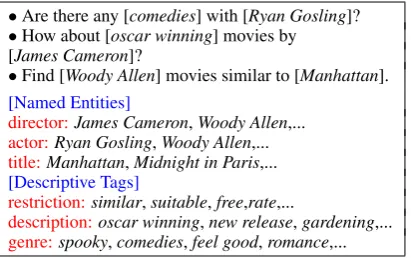
In short, through a series of experiments we show howMTR clustering provides additional in-formation to SSL on the target domain utter-ances, and greatly impacts semantic tagging per-formance. Specifically, we analyzeMTR’s perfor-mance on two different types of semantic tags: named-entities and descriptive tags as shown in Table 1. Our experiments show that it is much harder to detect descriptive tags compared to named-entities.
Our SSL approach uses probabilistic clustering method tailored for tagging natural language utter-ances. To the best of our knowledge, our work is the first to explore the unlabeled data to iteratively adapt the semantic tagging models for target do-mains, preserving information from the previous iterations. With the hope of spurring related work in domains such as entity detection, syntactic tag-ging, etc., we extend the earlier work on SSL part-of-speech (POS) tagging and show in the experi-ments that our approach is not only useful for se-mantic tagging but also syntactic tagging.
The remainder of this paper is divided as fol-lows: §2 gives background on SSL and semantic clustering methods,§3 describes our new cluster-ing approach,§4 presents the new iterative learn-ing, §5 presents our experimental results and §6 concludes our paper.
2 Related Work and Motivation
(I) Semi-Supervised Tagging. Supervised meth-ods for semantic tagging in NLU require a large number of in-domain human-labeled utterances and gazetteers (movie, actor names, etc.),
increas-•Are there any [comedies] with [Ryan Gosling]? •How about [oscar winning] movies by [James Cameron]?
•Find [Woody Allen] movies similar to [Manhattan]. [Named Entities]
director:James Cameron,Woody Allen,...
actor:Ryan Gosling,Woody Allen,...
title:Manhattan,Midnight in Paris,... [Descriptive Tags]
restriction:similar,suitable,free,rate,...
description:oscar winning,new release,gardening,...
[image:2.595.316.522.62.191.2]genre:spooky,comedies,feel good,romance,...
Table 1: Samples of semantically tagged utter-ances from movie domain, named-entities and de-scriptive tags.
ing the need for significant manual labor (Tur and DeMori, 2011). Recent work on similar tasks overcome these challenges using SSL methods as follows:
• (Wang et al., 2009; Li et al., 2009; Li, 2010; Liu et al., 2011) investigate web query tagging using semi-supervised sequence models. They extract semantic lexicons from unlabeled web queries, to use as features. Our work dif-fers from these, in that, rather than just detecting named-entities, our utterances includedescriptive
tags (see Table 1).
•Typically the source domain has different dis-tribution than the target domain, due to topic shifts in time, newly introduced features (e.g., until re-cently online articles did not include facebook ”like” feature.), etc. Adapting the source domain using unlabeled data is the key to achieving good performance across domains. Recent adaptation methods for SSL use: expectation minimization (Daume´-III, 2010) graph-based learning (Chapelle
et al., 2006; Zhu, 2005), etc. In (Subramanya et al., 2010) an efficient iterative SSL method is de-scribed for syntactic tagging, using graph-based learning to smooth POS tag posteriors. However, (Reisinger and Mooney, 2011) argues that vector space models, such as graph-learning, may fail to capture the richness of word meaning, as simi-larity is not a globally consistent metric. Rather than graph-learning, we present a new SSL using a probabilistic model,MTR, to cluster words based on co-occurrence statistics.
keeping the history of the prior predictions. This ensures that a penalty is paid for diverging from the previous model’s predictions, which will be traded off against the benefit of reducing classi-fication loss. We present aretrospective SSL for CRF, in that, the iterative learner keeps track of the errors of the previous iterations so as to carry the properties of both the source and target domains.
(II) Semantic Clustering. A common prop-erty of several context-based word clustering tech-niques, e.g., Brown clustering (Brown et al., 1992), Clustering by Committee (Pantel, 2003), etc., is that they mainly cluster based on local con-text such as nearby words. Standard topic models, such as Latent Dirichlet Allocation (LDA) (Blei et al., 2003), use abag-of-wordsapproach, which disregards word order and clusters words together that appear in a similar global context. Such mod-els have been effective in discovering lexicons in many NLP tasks, e.g., named-entity recognition (Guo et al., 2009), word-sense disambiguation (Boyd-Graber et al., 2007; Li et al., 2010), syntac-tic/semantic parsing (Griffiths et al., 2005; Singh et al., 2010), speaker identification (Nyugen et al., 2012), etc. Recent topic models consider word sequence information in documents (Griffiths et al., 2005; Moon et al., 2010). The Hidden Topic Markov Model (HTMM) by (Gruber et al., 2005), for instance, models sentences in documents as Markov chains, assuming all words in a sentence have the same topic. While MTR has a similar Markovian property, we encode features on words to allow each word in an utterance to sample from any of the given semantic tags, as in ”what are [scary]genremovies by [Hitchcock]director?”.
In LDA, common words tend to dominate all topics causing related words to end up in differ-ent topics. In (Petterson et al., 2010), the vector-based features of words are used as prior informa-tion inLDA so that the words that are synonyms end up in same topic. Thus, we build a seman-tically rich topic model,MTR, using word context
features as side information. Using a smoothing prior for each word-topic pair (instead of a con-stantβ smoother),MTRassures that the words are distributed over topics based on how similar they are. (e.g.,”scary”and”spooky”, which have sim-ilar context features, go into the same semantic tag, ”genre”). Thus, to best of our knowledge, MTR is the first topic model to incorporate word features while considering the sequence of words.
3 Markov Topic Regression -MTR
3.1 Model and Abstractions
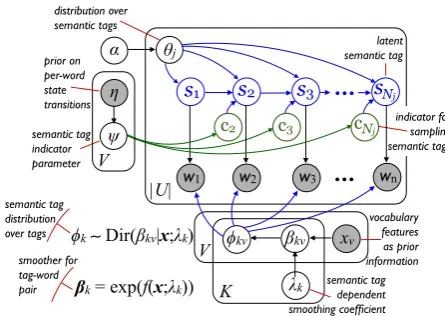
LDA assumes that the latent topics of documents are sampled independently from one ofK topics. MTR breaks down this independence assumption by allowing Markov relations between the hidden tags to capture the relations between consecutive words (as sketched in Figure 1 and Algorithm 1).
(I) Semantic Tags (si): Each word wi of a
given utterance with Nj words, uj={wi}Ni=1j ∈U,
j=1,..|U|, from a set of utterancesU, is associated with a latent semantic tag (state) variable si∈S,
whereSis the set of semantic tags. We assume a fixed K topics corresponding to semantic tags of labeled data. In a similar way toHTMM (Gruber et al., 2005) described for documents, MTR sam-ples eachsi from a Markov chain that is specific
to its utteranceuj. Each statesigenerates a word,
wi, based on the word-state co-occurrences. MTR
allows for sampling of consecutive words from different tag clusters. The initial probabilities of the latent states are sampled from a Dirichlet dis-tribution over state variables, θj, with α
hyper-parameter for eachuj.
(II) Tag Transition Indicator(ψv): Given
ut-terance uj, the decision to sample a wi from a
new topic is determined by an indicator variable, cj,i, that is sampled from aBinomial(ψv=wi) dis-tribution with aBetaconjugate prior. (There arev binomials for each vocabulary term.) cj,i=1
sug-gests that a new state be sampled fromKpossible tags for the wordwiinuj, andcj,i=0 suggests that
the statesiofwishould be the same as the
previ-ous word’s latent statesi−1. The first position of
the sequence is sampled from a new state, hence cj,i=1=1.
(III) Tag Transition Base Measure(η): Prior
probability of a word given a tag should increase the chances of sampling words from the correct se-mantic tag.MTRconstrains the generation of a tag si given the previous tag si−1 and the current wi
based oncj,i by using a vocabulary specific Beta
prior,ψv∼Beta(ηv)1, on each word in vocabulary
wv=1,..V. We inject the prior information on
se-mantic tags to define values of the base measure ηvusing external knowledge from two sources:
(a) Entity Priors (ηS): Prior probability on
named-entities and descriptive tags denoted as
1For each beta distribution we use symmetric
latent semantic tag distribution over
semantic tags
s1
...
w1
...
!j
"
c2 c3 #
$kv %kv xv
&k
s2 s3
w2 w3 wn
'
V
K |U| V
indicator for sampling semantic tags
vocabulary features as prior information semantic tag
dependent smoothing coefficient semantic tag
indicator parameter
prior on per-word state transitions
$k! Dir(%kv|x;&k)
!k = exp(f(x;&k)) semantic tag
distribution over tags
smoother for tag-word pair
cNj
[image:4.595.73.296.66.224.2]sNj
Figure 1: The graph representation of the Markov Topic Regression (MTR). To demonstrate hidden state Markov Chain, the generation of each word is explicitly shown (inside of the plate).
ηS=p(si|si−1,wi=v,wi−1). We use web sources
(wiki pages on movies and urls such as imdb.com) and labeled training data to extract entity lists that correspond to the semantic tags of our domains. We keep the frequency of each n-gram to convert into (empirical) prior probability distribution. (b) Language Model Prior (ηW): Probabilities
on word transitions denoted asηW=p(wi=v|wi−1).
We built a language model using SRILM (Stol-cke, 2002) on the domain specific sources such as top wiki pages and blogs on online movie reviews, etc., to obtain the probabilities of domain-specific n-grams, up to 3-grams. The observed priors,ηS
andηW, are used for calculating the base measure
ηfor each vocabularywvas:
ηsi|si−1
v =
(
ηsi|si−1,wi=v
S , ifη
si|si−1,wi=v
S exists,
ηwi=v,wi−1
W , otherwise
(1) In Eq.(1), we assume that the prior on the se-mantic tags, ηS, is more indicative of the
deci-sion for sampling awi from a new tag compared
to language model posteriors on word sequences, ηW. Here we represent the base-measure
(hyper-parameter) of the semantic tag indicator variable, which is not to be confused with a probability measure2
We update the indicator parameter via mean cri-teria, ψv=wi=
PK
i,j=1η si|sj
v=wi/(K2). If no prior on
2The base-measure used in Eq.(1) does not relate to a
back-off model in LM sense. Here, instead of using a constant value for the hyper-parameters, we use probability scores that we obtain from LM.
Algorithm 1 Markov Topic Regression
1: foreach semantic tag topicsk,k←1, ..., Kdo
2: −draw a topic mixtureφk∼Dir(βk|λk,x), 3: −letβk=exp(f(x;λk));x={xv}Vlv=1,βk∈ RVl
4: foreach wordwvin vocabularyv←1, ..., V do
5: −draw a tag indicator mixtureψv∼Beta(η), 6: foreach utterancej←1, ...,|U|do
7: −draw transition distributionθs
j∼Dir(α)
8: over statessiand setcj1=1.
9: −forwordswiinuj,i←1, ..., Njdo
10: ifi >1, toss a coincj,i∼Binomial(ψwi).
11: Ifcj,i=1, drawsi∼M ulti(θ si,si−1
j )†
12: otherwisesi=si−1. 13: Samplewi∼Multi(φsi).
†Markov assumption over utterance words is used (See Eq.(4)).
a specific word exists, a default value is used for base measure,ηv=0.01.
(IV) Topic-Word Distribution Priors (βk):
Different from (Mimno et al., 2008), which uses asymmetric hyper-parameters on document-topic distributions, in MTR, we learn the asymmetric hyper-parameters of the semantic tag-word distri-butions. We use blocked Gibbs sampling, in which the topic assignments sk and hyper-parameters
{βk}Kk=1 are alternately sampled at each Gibbs
sampling lag periodggiven all other variables. We impose the prior knowledge on naturally related words, such that if two words ”funny” and ” hilar-ious” indicate the same given ”genre” class, then their latent tag distributions should also be simi-lar. We enforce this on smoothing parameterβk,v,
e.g.,βk,0f unny0∼βk,0hilarious0 for a given tag kas
follows:
At eachglag period of the Gibbs sampling,K log-linear models with parameters, λ(kg)∈RM, is
trained to predict βkv(g)∈βk, for each wv of a tag
sk:
β(kg) = exp(f(xl;λ(kg))) (2)
where the log-linear functionf is:
n(kvg)=f(xlv;λ(kg)) =X m
λ(k,mg) xlv,m (3)
Here x∈RV×M is the input matrix x, wherein
rows xv∈RM represents M-dimensional scalar
vector of explanatory features on vocabulary words. We use the word-tag posterior probabili-ties obtained from aCRFsequence model trained on labeled utterances as features. Thex={xl,xu} has labeled (l) and unlabeled (u) parts. The labeled part containsVlsize vocabulary of which we know
K latent topics to theK semantic tags of our la-beled data. Therefore, we assign lala-beled words to their designated topics. This way we use observed scalar counts of each labeled word v associated with its semantic tag k, n(kvg), as the output label of its input vector,xlv; an indication of likelihood of words getting sampled from the correspond-ing semantic label sk. Since the impact of the
asymmetric prior is equivalent to adding pseudo-counts to the sufficient statistics of the semantic tag to which the word belongs, we predict the pseudo-countsβkv(g) using the scalar counts of the labeled data, n(kvg), based on the log-linear model in Eq. (2). Atg=0, we useβ(0)kv=28, ifxv∈Xl;
oth-erwiseβkv(0)=2−2, commonly used values for large
and small β. Note that larger β-values indicate correlation between the word and the topic.
3.2 Collapsed Sampler
The goal ofMTRis to infer the degree of relation-ship between a wordv and each semantic tagk, φkv. To perform inference we need two
compo-nents:
• a sampler which can draw from condi-tionalPMTR(sji=k|sji−1, s\ji, α, ψi, βji), when
cj,i=1, where sji and sji−1 are the semantic
tags of the current wi=v of vocabulary v and
previous word wi−1 in utterance uj, and s\ji
are the semantic tag topics of all words except forwi; and,
• an estimation procedure for (βkv, λk) (see
§3.1).
We integrate out the multinomial and binomial pa-rameters of the model: utterance-tag distributions θj, binomial state transition indicator distribution
per each word ψv, andφk for tag-word
distribu-tions. We use collapsed Gibbs sampling to re-duce random components and model the posterior distribution by obtaining samples(sji, cj,i)drawn
from this distribution. Under the Markov assump-tion, for each wordwi=v in a given utteranceuj,
if cj,i=1, we sample a new tag si=k given the
remaining tags and hyper-parameters βk, α, and ηsi|si−1
wi=v . Using the following parameters; n
(si)
ji ,
which is the number of words assigned to a seman-tic classsi=k excluding casei, andns(sii−1)is the number of transitions from classsi−1tosi, where
indicatorI(si−1, si)=1 if slot si=si−1, the update
equation is formulated as follows:
p(sji=k|w, s−ji, α, ηwsii|si−1,βk)∝
n(si)
ji +βkwi
n((k.))+Pvβkv
∗(n(si−1)
si +α)∗
(n(si)
si+1+I(si−1, si) +I(si+1, si) +α)
n(si)
(.) +I(si−1, k) +Kα
(4)
4 Semi-Supervised Semantic Labeling
4.1 Semi Supervised Learning (SSL) with
CRF
In (Subramanya et al., 2010), a new SSL method is described for adapting syntactic POS tagging of sentences in newswire articles along with search queries to a target domain of natural language (NL) questions. They decode unlabeled queries from target domain (t) using aCRFmodel trained on the POS-labeled newswire data (source do-main (o)). The unlabeled POS tag posteriors are then smoothed using a graph-based learning algo-rithm. On graph, the similarities are defined over sequences by constructing the graph over types, word 3-grams, wheretypescapture the local con-text of words. Since CRF tagger only uses lo-cal features of the input to score tag pairs, they try to capture all the context with the graph with additional context features ontypes. Later, using viterbi decoding, they select the 1-best POS tag sequence,s∗j for each utteranceuj. Graph-based
SSL defines a newCRFobjective function:
Λ(nt+1) =argmin Λ∈RK
(
−P
j=1:l
logp(sj|uj; Λn(t)) +µkΛ(nt)k2
)
−
n
τPlj+=ullogpn(s∗j|uj; Λ(nt))
o
(5)
The first bracket in Eq.(5) is the loss on the la-beled data and L2 regularization on parameters, Λ(nt), from nth iteration, same as standard CRF.
The last term is the loss on unlabeled data from target domain with a hyper-parameterτ. They use a small value forτ to enable the new model to be as close as possible to the initial model trained on source data.
smoothing model, instead of a graph-based model, as follows:
I. DECODING and SMOOTHING. The poste-rior probability of a tag sji=k given a word wji
in unlabeled utterance uj from target domain (t) ˆ
pn(j, i)=pˆn(sji=k|wji; Λ(nt)), is decoded using the
n-th iterationCRFmodel. MTR uses the decoded probabilities as semantic tag prior features on vo-cabulary items. We generate a word-tag matrix of posteriors,x∈(0,1)V×K, whereK is the number
of semantic tags andV is the vocabulary size from n-th iteration. Each row is aKdimensional vector of tag posterior probabilitiesxv={xv1,. . . xvK}on
the vocabulary term, wv. The labeled rowsxl of
the vocabulary matrix, x={xl,xu}, contain only
{0,1} values, indicating the word’s observed se-mantic tags in the labeled data. Since a labeled termwv can have different tags (e.g., ”clint
east-wood” may be tagged asactor-nameand director-namein the training data),PK
k xvk≥1 holds. The
xis used as the input matrix of thekth log-linear model (corresponding tokth semantic tag (topic)) to infer theβ hyper-parameter ofMTRin Eq. (2). MTRgenerates smoothed conditional probabilities φkvfor each vocabulary termvgiven semantic tag
k.
II. INTERPOLATION. For each word wji=v
in unlabeled utterance uj, we interpolate tag
marginals from CRF and MTR for each semantic tagsji=k:
ˆ
qn(sji|wij; Λ(nt)) =π
CRFposterior
z }| {
ˆ
pn(sji|wij; Λ(nt))
+(1−π)
MTR
z}|{
φkv (6)
III. VITERBI. Using viterbi decoding over the tag marginals,qˆn(sji|wij; Λ(nt)), and transition
probabilities obtained from the CRF model ofn-th iteration, we getpˆn(s∗j|uj; Λ(nt)), the 1-best decode
s∗j of each unlabeled utteranceuj∈Unu.
IV.RETROSPECTIVE SSL (R-SSL). After we decode the unlabeled data, we re-train a new CRFmodel at each iteration. Each iteration makes predictions on the semantic tags of unlabeled data with varying posterior probabilities. Motivated by (Lavoie et al., 2011), we want the loss function to have a dependency on the prior model predictions. Thus,R-SSLencodes the history of the prior
pre-Algorithm 2Retrospective Semi-SupervisedCRF
Input: LabeledUl, and unlabeledUudata. Process:Λ(no)=crf-train(Ul) atn=0,n=n+1†. Whilenot converged
ˆ
p=posterior-decode(Unu,Λ(no))
φ=smooth-posteriors(pˆ) usingMTR,
ˆ
q=interpolate-posteriors(pˆ,φ), Unu=viterbi-decode(qˆ)
Λ(nt+1) =crf-retrospective(Ul,Uu
n,. . .,U1u,Λ (t)
n )
†(n):iteration, (t):target, (o):source domains.
dictions, as follows:
Λ(nt+1) =argmin Λ∈RK
(
−P
j=1:l
logp(sj|uj; Λn(t)) +µkΛ(nt)k2
)
(
−P
j=1:(l+u)
max{0,pˆ∗∗n }
)
(7)
where, pˆ∗∗n=1 −loghn(uj)ˆpn(s∗j|uj; Λ(nt)). The
first two terms are same as standard CRF. The last term ensures that the predictions of the cur-rent model have the same sign as the predic-tions of the previous models (using labeled and unlabeled data), denoted by a maximum margin hinge weight,hn(uj)=n−11Pn1−1pˆn(s∗j|uj; Λ(nt)).
It should also be noted that withMTR, theR-SSL learns the word-tag relations by using features that describe the words in context, eliminating the need for additional type representation of graph-based model. MTR provides a separate probability dis-tributionθj over tags for each utterancej,
implic-itly allowing for the same wordvin separate utter-ances to differ in tag posteriorsφkv.
5 Experiments
5.1 Datasets and Tagsets
5.1.1 Semantic Tagging Datasets
We focus here on audiovisual media in themovie
interact with the media system as if they were talk-ing to a person.
Our data from target domain is internally col-lected from real-use scenarios of our spoken dia-log system. The transcribed text forms of these ut-terances are obtained from speech recognition en-gine. Although the crowd-sourced data is similar to target domain, in terms of pre-defined user in-tentions, the target domain contains more descrip-tive vocabulary, which is almost twice as large as the source domain. This causes data-mismatch is-sues and hence provides a perfect test-bed for a domain adaptation task. In total, our corpus has a 40K semantically tagged utterances from each source and target domains. There are around 15 named-entity and 10 descriptive tags. We sep-arated 5K utterances to test the performance of the semantic tagging models. The most frequent entities are: movie-director (’James Cameron’),
movie-title (’Die Hard’), etc.; whereas top de-scriptive tags are: genre(’feel good’),description
(’black and white’, ’pg 13’), review-rate (’epic’, ’not for me’), theater-location (’near me’,’city center’), etc.
Unlabeled utterances similar to the movie do-main are pulled from a month old web query logs and extracted over 2 million search queries from well-known sites, e.g., IMDB, Netflix, etc. We filtered queries that are similar to our target set that start withwh-phrases (’what’, ’who’, etc.) as well as imperatives ’show’, ’list’, etc. In addition, we extracted web n-grams and entity lists (see§3) from movie related web sites, and online blogs and reviews. We collected around 300K movie review and blog entries on the entities observed in our data. We extract prior distributions for entities and n-grams to calculate entity listη and word-tagβ priors (see§3.1).
5.1.2 Syntactic Tagging Datasets
We use the Wall Street Journal (WSJ) section of the Penn Treebank as our labeled source data. Fol-lowing previous research, we train on sections 00-18, comprised of 38,219 POS-tagged sentences. To evaluate the domain adaptation (DA) approach and to compare with results reported by (Subra-manya et al., 2010), we use the first and second half of QuestionBank (Judge et al., 2006) as our development and test sets (target). The Question-Bank contains 4000 POS-tagged questions, how-ever it is difficult to tag with WSJ-trained tag-gers because the word order is different than WSJ
and contains a test-set vocabulary that is twice as large as the one in the development set. As for unlabeled data we crawled the web and col-lected around 100,000 questions that are similar in style and length to the ones in QuestionBank, e.g. ”wh” questions. There are 36 different tag sets in the Penn dataset which includes tag la-bels for verbs, nouns, adjectives, adverbs, modal, determiners, prepositions, etc. More information about the Penn Tree-bank tag set can be found here (Marcus et al., 1993).
5.2 Models
We evaluated several baseline models on two tasks:
5.2.1 Semantic Clustering
Since MTR provides a mixture of properties adapted from earlier models, we present perfor-mance benchmarks on tag clustering using: (i) LDA; (ii) Hidden Markov Topic Model HMTM (Gruber et al., 2005); and, (iii)w-LDA(Petterson et al., 2010) that uses word features as priors in LDA. When a uniformβ hyper-parameter is used with no external information on the state transi-tions in MTR, it reduces to a HMTM model. Sim-ilarly, if no Markov properties are used (bag-of-words),MTRreduces tow-LDA. Each topic model uses Gibbs sampling for inference and parameter learning. We sample models for 1000 iterations, with a 500-iteration burn-in and a sampling lag of 10. For testing we iterated the Gibbs sampler us-ing the trained model for 10 iterations on the test-ing data.
5.2.2 SSL for Semantic/Syntactic Tagging
We evaluated three different baselines against our SSL models:
?CRF: a standard supervised sequence tagging. ? Self-CRF: a wrapper method for SSL using self-training. First a supervised learning algorithm is used to build aCRFmodel based on the labeled data. A CRF model is used to decode the unla-beled data to generate more launla-beled examples for re-training.
?SSL-Graph: A SSL model presented in (Sub-ramanya et al., 2010) that uses graph-based learn-ing as posterior tag smoother forCRFmodel using Eq.(5).
In addition to the three baseline, we evaluated three variations of our SSL method:
LDA w-LDA HMTM MTR 0.6
0.7 0.8 0.9
82% 77%
84% 82%
79% 78%
74% •Descriptive Tags
Named-Entities
All Tags
[image:8.595.88.278.62.190.2]F-Measure
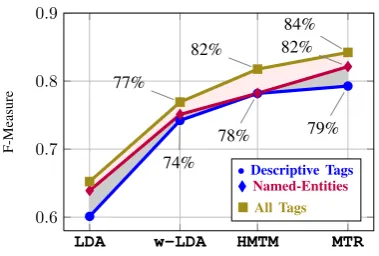
Figure 2: F-measure for semantic clustering per-formance. Performance differences for three dif-ferent baseline models and ourMTR approach by different semantic tags.
smooth the semantic tag posteriors of a unlabeled data decoded by theCRFmodel using Eq.(5). ? R-SSL-Graph: Our second version uses graph-learning to smooth the tag posteriors and re-train a newCRFmodel usingretrospectiveSSL in Eq.(7).
? R-SSL-MTR: Our full model uses MTR as a Bayesian smoothing model, and retrospective SSL in Eq.(7) for iterativeCRFtraining.
For all the CRF models, we use lexical fea-tures consisting of unigrams in a five-word win-dow around the current word. To include contex-tual information, we add binary features for all possible tags. We inject dictionary constraints to all CRFmodels, such as features indicating label prior information. For each model we use sev-eral named entity features, e.g.,movie-title, actor-name, etc., non-named entity (descriptive) fea-tures, e.g., movie-description, movie-genre, and domain independent dictionaries, e.g, time, loca-tion, etc. For graph-based learning, we imple-mented the algorithm presented in (Subramanya et al., 2010) and used the same hyper-parameters and features. For the rest of the hyper-parameters, we used:α=0.01 forMTR,π=0.5 for interpolation mixing. These parameters were chosen based on the performance of the development set. AllCRF objective functions were optimized using Stochas-tic Gradient Descent.
5.3 Results and Discussions
5.3.1 Experiment 1: Clustering Semantic Tags.
Here, we want to demonstrate the performance ofMTRmodel for capturing relationships between words and semantic tags against baseline topic
models: LDA, HMTM, w-LDA. We take the se-mantically labeled utterances from the movie tar-get domain and use the first half for training and the rest for performance testing. We use all the collected unlabeled web queries from the movie domain. For fair comparison, each benchmark topic model is provided with prior information on word-semantic tag distributions based on the la-beled training data, hence, each K latent topic is assigned to one of K semantic tags at the begin-ning of Gibbs sampling.
We evaluate the performance separately on de-scriptive tags, named-entities, and all tags to-gether. The performance of the four topic models are reported in Figure 2.LDAshows the worst per-formance, even though some supervision is pro-vided by way of labeled semantic tags. Although w-LDAimproves semantic clustering performance over LDA, the fact that it does not have Markov properties makes it fall short behindMTR. As for the effect of word features inMTR, we see a 3% absolute performance gain over the second best performingHMTM baseline on named-entity tags, a 1% absolute gain on descriptive tags and a 2% absolute overall gain. As expected, we see a drop in F-measure on all models on descriptive tags.
5.3.2 Experiment 2: Domain Adaptation Task.
tag-ging performance overSSL-Graph. On syntac-tic tagging, the two retrospective learning models is comparable, close to 1% improvement over the SSL-GraphandSSL-MTR.
Movie Domain QBank
Model Desc. NE All POS
CRF 75.05 75.84 75.84 83.80
Self-CRF 78.96 79.53 79.19 84.00
SSL-Graph 80.27 81.35 81.23 86.80
SSL-MTR 79.87 79.31 79.19 86.30
R-SSL-Graph 80.58 81.95 81.52 87.12
R-SSL-MTR 82.76 82.27 82.24 87.34
Table 2: Domain Adaptation performance
in F-measure on Semantic Tagging on
Movie Target domain and POS tagging on
QBank:QuestionBank. Best performing models arebolded.
5.3.3 Experiment 3: Analysis of Semantic Disambiguation.
Here we focus on the accuracy of our models in tagging semantically ambiguous words. We inves-tigate words that have more than one observed se-mantic tag in training data, such as ”are there any
[war]genre movies available.”, ”remove all movies about [war]description.”). Our corpus contained
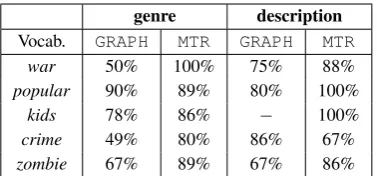
30,000 unique vocabulary, 55% of which are con-tained in one or more semantic categories. Only 6.5% of those are tagged as multiple categories (polysemous), which are the sources of semantic ambiguity. Table-3 shows the precision of two best models for most confused words.
We compare our two best SSL models with dif-ferent smoothing regularizes:R-SSL-MTR(MTR) and R-SSL-Graph (GRAPH). We use preci-sion and recall criterion on semantically confused words.
In Table 3 we show two most frequent descrip-tive tags; genre and description, and commonly misclassified words by the two models. Results indicate that the R-SSL-MTR, performs better than theR-SSL-Graph, in activating the correct meaning of a word. The results indicate that incor-porating context information withMTRis an effec-tive option for identifying semantic ambiguity.
6 Conclusions
We have presented a novel semi supervised learn-ing approach uslearn-ing a probabilistic clusterlearn-ing
genre description
Vocab. GRAPH MTR GRAPH MTR
war 50% 100% 75% 88%
popular 90% 89% 80% 100%
kids 78% 86% − 100%
crime 49% 80% 86% 67%
[image:9.595.323.512.61.149.2]zombie 67% 89% 67% 86%
Table 3: Classification performance in F-measure for semantically ambiguous words on the most fre-quently confused descriptive tags in the movie do-main.
method to semantically tag spoken language ut-terances. Our results show that encoding priors on words and context information contributes sig-nificantly to the performance of semantic cluster-ing. We have also described an efficient iterative learning model that can handle data inconsisten-cies that leads to performance increases in seman-tic and syntacseman-tic tagging.
As a future work, we will investigate using ses-sion data, namely the entire dialog between the human and the computer. Rather than using sin-gle turn utterances, we hope to utilize the con-text information, e.g., information from previous turns for improving the performance of the seman-tic tagging of the current turns.
References
D. Blei, A. Ng, and M. Jordan. 2003. Latent dirichlet allocation.Journal of Machine Learning Research. J. Boyd-Graber, D. Blei, and X. Zhu. 2007. A
topic model for word sense disambiguation. Proc. EMNLP.
P.F. Brown, V.J.D. Pietra, P.V. deSouza, and J.C. Lai. 1992. Class-based n-gram models of natural lan-guage. Computational Linguistics, 18(4):467–479. O. Chapelle, B. Schlkopf, and Alexander Zien. 2006.
Semi-supervised learning. MIT Press.
H. Daume´-III. 2010. Frustratingly easy semi-supervised domain adaptation. Proc. Workshop on Domain Adaptation for Natural Language Process-ing at ACL.
T.L Griffiths, M. Steyvers, D.M. Blei, and J.M. Tenen-baum. 2005. Integrating topics and syntax. Proc. of NIPS.
A. Gruber, M. Rosen-Zvi, and Y. Weiss. 2005. Hidden topic markov models.Proc. of ICML.
J. Judge, A. Cahill, and J.Van Genabith. 2006. Question-bank: Creating corpus of parse-annotated questions. Proc. Int. Conf. Computational Linguis-tics and ACL.
A. Lavoie, M.E. Otey, N. Ratliff, and D. Sculley. 2011. History dependent domain adaptation. Proc. NIPS Workshop on Domain Adaptation.
X. Li, Y.-Y. Wang, and A. Acero. 2009. Extracting structured information from user queries with semi-supervised conditional random fields. Proc. of SI-GIR.
L. Li, B. Roth, and C. Sporleder. 2010. Topic mod-els for word sense disambiguation and token-based idiom detection. Proc. ACL.
X. Li. 2010. Understanding semantic structure of noun phrase queries.Proc. ACL.
J Liu, X. Li, A. Acero, and Ye-Yi Wang. 2011. Lex-icon modeling for query understanding. Proc. of ICASSP.
M. P. Marcus, B. Santorini, and M.A. Marcinkiewicz. 1993. Building a large annotated corpus of en-glish: The penn treebank. Computational Linguis-tics, 27:1–30.
D. Mimno, W. Li, and A. McCallum. 2008. Topic models conditioned on arbitrary features with dirichlet-multinomial regression.Proc. UAI. T. Moon, K. Erk, and J. Baldridge. 2010.
Crouch-ing dirichlet, hidden markov model: Unsupervised pos tagging with context local tag generation. Proc. ACL.
V.-A. Nyugen, J. Boyd-Graber, and P. Resnik. 2012. Sits: A hierarchical nonparametric model using speaker identity for topic segmentation in multiparty conversations. Proc. ACL.
P. Pantel. 2003. Clustering by committee. Ph.D. The-sis, University of Alberta, Edmonton, Alta., Canada. J. Petterson, A. Smola, T. Caetano, W. Buntine, and S. Narayanamurthy. 2010. Word features for latent dirichlet allocation. InProc. NIPS.
J. Reisinger and R. Mooney. 2011. Cross-cutting mod-els of lexical semantics. InProc. of EMNLP. S. Singh, D. Hillard, and C. Leggetter. 2010.
Minimally-supervised extraction of entities from text advertisements. Proc. NAACL-HLT.
A. Stolcke. 2002. An extensible language modeling toolkit. Proc. Interspeech.
A. Subramanya, S. Petrov, and F. Pereira. 2010. Effi-cient graph-based semi-supervised learning of struc-tured tagging models. InProc. EMNLP.
G. Tur and R. DeMori. 2011. Spoken language under-standing: Systems for extracting semantic informa-tion from speech. Wiley Press.
Y.-Y. Wang, R. Hoffman, X. Li, and J. Syzmanski. 2009. Semi-supervised learning of semantic classes for query understanding from the web and for the web. InThe 18th ACM Conference on Information and Knowledge Management.