Applying Collocation Segmentation to the ACL Anthology Reference Corpus
Vidas Daudaraviˇcius
Vytautas Magnus University / Vileikos 8, Lithuania
Abstract
Collocation is a well-known linguistic phe-nomenon which has a long history of research and use. In this study I employ collocation segmentation to extract terms from the large and complex ACL Anthology Reference Cor-pus, and also briefly research and describe the history of the ACL. The results of the study show that until 1986, the most signifi-cant terms were related to formal/rule based methods. Starting in 1987, terms related to statistical methods became more important. For instance,language model,similarity mea-sure, text classification. In 1990, the terms
Penn Treebank, Mutual Information , statis-tical parsing, bilingual corpus, and depen-dency treebecame the most important, show-ing that newly released language resources ap-peared together with many new research areas in computational linguistics. AlthoughPenn Treebank was a significant term only tem-porarily in the early nineties, the corpus is still used by researchers today. The most recent significant terms areBleu scoreandsemantic role labeling. Whilemachine translationas a term is significant throughout the ACL ARC corpus, it is not significant for any particu-lar time period. This shows that some terms can be significant globally while remaining in-significant at a local level.
1 Introduction
Collocation is a well-known linguistic phenomenon which has a long history of research and use. The importance of the collocation paradigm shift is
raised in the most recent study on collocations (Sere-tan, 2011). Collocations are a key issue for tasks like natural language parsing and generation, as well as real-life applications such as machine translation, in-formation extraction and retrieval. Collocation phe-nomena are simple, but hard to employ in real tasks. In this study I introduce collocation segmentation as a language processing method, maintaining simplic-ity and clarsimplic-ity of use as per then-gram approach. In the beginning, I study the usage of the terms collo-cationandsegmentationin the ACL Anthology Ref-erence Corpus (ARC), as well as other related terms such asword,multi-word, andn-gram. To evaluate the ability of collocation segmentation to handle dif-ferent aspects of collocations, I extract the most sig-nificant collocation segments in the ACL ARC. In addition, based on a ranking like that ofT F-IDF, I extract terms that are related to different phenom-ena of natural language analysis and processing. The distribution of these terms in ACL ARC helps to un-derstand the main breakpoints of different research areas across the years. On the other hand, there was no goal to make a thorough study of the methods used by the ACL ARC, as such a task is complex and prohibitively extensive.
2 ACL Anthology Reference Corpus
This study uses the ACL ARC version 20090501. The first step was to clean and preprocess the corpus. First of all, files that were unsuitable for the analysis were removed. These were texts containing ters with no clear word boundaries, i.e., each charac-ter was separated from the next by whitespace. This problem is related to the extraction of text from .pdf
format files and is hard to solve. Each file in the ACL ARC represents a single printed page. The file name encodes the document ID and page number, e.g., the file nameC04-1001 0007.txtis made up of four parts: Cis the publication type, (20)04 is the year,1001is the document ID, and0007is the page number. The next step was to compile files of the same paper into a single document. Also, headers and footers that appear on each document page were removed, though they were not always easily rec-ognized and, therefore, some of them remained. A few simple rules were then applied to remove line breaks, thus keeping each paragraph on a single line. Finally, documents that were smaller than 1 kB were also removed. The final corpus comprised 8,581 files with a total of 51,881,537 tokens.
3 Terms in the ACL ARC related to
collocations
The list of terms related to the term collocation
could be prohibitively lengthy and could include many aspects ofwhat it is andhow it is used. For simplicitys sake, a short list of related terms, includ-ing word, collocation, multiword, token, unigram,
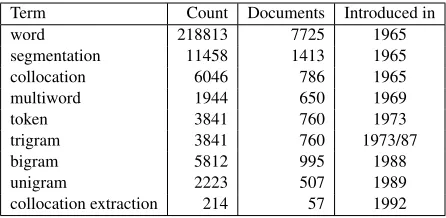
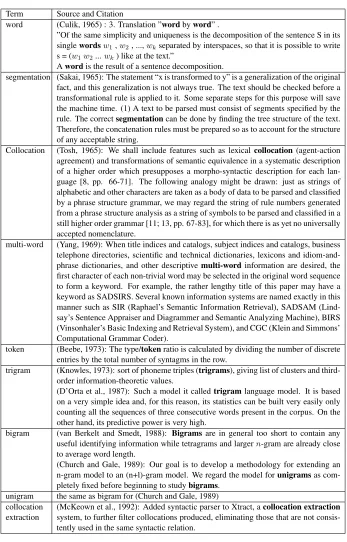
bigram,trigram,collocation extractionand segmen-tation, was compiled. Table 2 shows when these terms were introduced in the ACL ARC: some terms were introduced early on, others more recently. The term collocation was introduced nearly 50 years ago and has been in use ever since. This is not unex-pected, as collocation phenomena were already be-ing studied by the ancient Greeks (Seretan, 2011). Table 2 presents the first use of terms, showing that the terms segmentation, collocationand multiword
are related to a similar concept of gathering consec-utive words together into one unit.
Term Count Documents Introduced in word 218813 7725 1965 segmentation 11458 1413 1965 collocation 6046 786 1965 multiword 1944 650 1969
token 3841 760 1973
[image:2.612.74.297.573.682.2]trigram 3841 760 1973/87 bigram 5812 995 1988 unigram 2223 507 1989 collocation extraction 214 57 1992
Table 1: Term usage in ACL ARC
While the term collocation has been used for many years, the first attempt to define what a col-location iscould be related to the time period when statistics first began to be used in linguistics heavily. Until that time,collocationwas used mostly in the sense of an expression produced by a particular syn-tactic rule. The first definition of collocation in ACL ARC is found in (Cumming, 1986).
(Cumming, 1986): By ”collocation” I mean lex-ical restrictions (restrictions which are not pre-dictable from the syntactic or semantic properties of the items) on the modifiers of an item; for example, you can say answer the door but not answer the window. The phenomenon which I’ve called col-location isof particular interest in the context of a paper on the lexicon in text generation because this particular type of idiom is something which a gener-ator needs to know about, while a parser may not.
It is not the purpose of this paper to provide a def-inition of the term collocation, because at the mo-ment there is no definition that everybody would agree upon. The introduction ofunigrams,bigrams
andtrigramsin the eighties had a big influence on the use of collocations in practice. N-grams, as a substitute to collocations, started being used in-tensively and in many applications. On the other hand,n-grams are lacking in generalization capabil-ities and recent research tends to combinen-grams, syntax and semantics (Pecina, 2005) .
The following sections introduce collocation seg-mentation and apply it to extracting the most signif-icant collocation segments to study the main break-points of different research areas in the ACL ARC.
4 Collocation Segmentation
bound-Term Source and Citation
word (Culik, 1965) : 3. Translation ”wordbyword” .
”Of the same simplicity and uniqueness is the decomposition of the sentence S in its singlewordsw1,w2, ...,wkseparated by interspaces, so that it is possible to write
s = (w1w2...wk) like at the text.”
Awordis the result of a sentence decomposition.
segmentation (Sakai, 1965): The statement “x is transformed to y” is a generalization of the original fact, and this generalization is not always true. The text should be checked before a transformational rule is applied to it. Some separate steps for this purpose will save the machine time. (1) A text to be parsed must consist of segments specified by the rule. The correctsegmentationcan be done by finding the tree structure of the text. Therefore, the concatenation rules must be prepared so as to account for the structure of any acceptable string.
Collocation (Tosh, 1965): We shall include features such as lexical collocation(agent-action agreement) and transformations of semantic equivalence in a systematic description of a higher order which presupposes a morpho-syntactic description for each lan-guage [8, pp. 66-71]. The following analogy might be drawn: just as strings of alphabetic and other characters are taken as a body of data to be parsed and classified by a phrase structure grammar, we may regard the string of rule numbers generated from a phrase structure analysis as a string of symbols to be parsed and classified in a still higher order grammar [11; 13, pp. 67-83], for which there is as yet no universally accepted nomenclature.
multi-word (Yang, 1969): When title indices and catalogs, subject indices and catalogs, business telephone directories, scientific and technical dictionaries, lexicons and idiom-and-phrase dictionaries, and other descriptivemulti-wordinformation are desired, the first character of each non-trivial word may be selected in the original word sequence to form a keyword. For example, the rather lengthy title of this paper may have a keyword as SADSIRS. Several known information systems are named exactly in this manner such as SIR (Raphael’s Semantic Information Retrieval), SADSAM (Lind-say’s Sentence Appraiser and Diagrammer and Semantic Analyzing Machine), BIRS (Vinsonhaler’s Basic Indexing and Retrieval System), and CGC (Klein and Simmons’ Computational Grammar Coder).
token (Beebe, 1973): The type/tokenratio is calculated by dividing the number of discrete entries by the total number of syntagms in the row.
trigram (Knowles, 1973): sort of phoneme triples (trigrams), giving list of clusters and third-order information-theoretic values.
(D’Orta et al., 1987): Such a model it calledtrigramlanguage model. It is based on a very simple idea and, for this reason, its statistics can be built very easily only counting all the sequences of three consecutive words present in the corpus. On the other hand, its predictive power is very high.
bigram (van Berkelt and Smedt, 1988): Bigrams are in general too short to contain any useful identifying information while tetragrams and largern-gram are already close to average word length.
(Church and Gale, 1989): Our goal is to develop a methodology for extending an n-gram model to an (n+l)-gram model. We regard the model forunigramsas com-pletely fixed before beginning to studybigrams.
unigram the same as bigram for (Church and Gale, 1989) collocation
extraction
(McKeown et al., 1992): Added syntactic parser to Xtract, acollocation extraction
[image:3.612.133.480.49.591.2]system, to further filter collocations produced, eliminating those that are not consis-tently used in the same syntactic relation.
Table 2: Terms introductions in ACL ARC.
aries (Monson et al., 2004), paragraph boundaries (Filippova and Strube, 2006), word boundaries (Ryt-ting, 2004), constituent boundaries (Kinyon, 2001), topic boundaries (Tur et al., 2001).
Collocation segmentation is a new type of seg-mentation whose goal is to detect fixed word
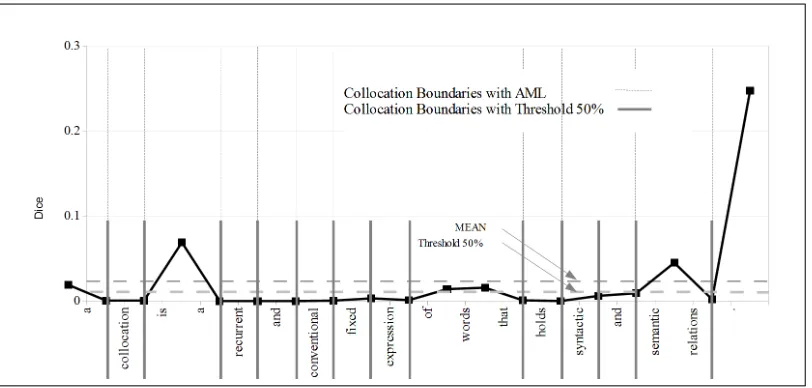
Figure 1: The collocation segmentation of the sentencea collocation is a recurrent and conventional fixed expression of words that holds syntactic and semantic relations . (Xue et al., 2006).
length (even a single word) and the length is not de-fined in advance. This definition differs from other collocation definitions that are usually based on n-gram lists (Tjong-Kim-Sang and S., 2000; Choueka, 1988; Smadja, 1993). Collocation segmentation is related to collocation extraction using syntactic rules (Lin, 1998). The syntax-based approach allows the extraction of collocations that are easier to describe, and the process of collocation extraction is well-controlled. On the other hand, the syntax-based ap-proach is not easily applied to languages with fewer resources. Collocation segmentation is based on a discrete signal of associativity values between two consecutive words, and boundaries that are used to chunk a sequence of words.
The main differences of collocation segmentation from other methods are: (1) collocation segmenta-tion does not analyze nested collocasegmenta-tions it takes the longest one possible in a given context, while the
n-gram list-based approach cannot detect if a collo-cation is nested in another one, e.g.,machine trans-lation system; (2) collocation segmentation is able to process long collocations quickly with the complex-ity of a bigram list size, while then-gram list-based approach is usually limited to 3-word collocations and has high processing complexity.
There are many word associativity measures, such as Mutual Information (MI), T-score, Log-Likelihood, etc. A detailed overview of
associativ-ity measures can be found in (Pecina, 2010), and any of these measures can be applied to colloca-tion segmentacolloca-tion. MI and Dice scores are almost similar in the sense of distribution of values (Dau-daravicius and Marcinkeviciene, 2004), but the Dice score is always in the range between 0 and 1, while the range of the MI score depends on the corpus size. Thus, the Dice score is preferable. This score is used, for instance, in the collocation compiler XTract (Smadja, 1993) and in the lexicon extraction system Champollion (Smadja et al., 1996). Dice is defined as follows:
D(xi−1;xi) =
2·f(xi−1;xi)
f(xi−1) +f(xi)
length unique segments segment count word count corpus coverage
1 289,277 31,427,570 31,427,570 60.58% 2 222,252 8,594,745 17,189,490 33.13% 3 72,699 994,393 2,983,179 5.75% 4 12,669 66,552 266,208 0.51% 5 1075 2,839 14,195 0.03%
6 57 141 846 0.00%
7 3 7 49 0.00%
[image:5.612.164.447.57.157.2]Total 598,032 41,086,247 51,881,537 100%
Table 3: The distribution of collocation segments
2 word segments CTFIDF 3 word segments CTFIDF
machine translation 10777 in terms of 4099
speech recognition 10524 total number of 3926
training data 10401 th international conference 3649
language model 10188 is used to 3614
named entity 9006 one or more 3449
error rate 8280 a set of 3439
test set 8083 note that the 3346
maximum entropy 7570 it is not 3320
sense disambiguation 7546 is that the 3287
training set 7515 associated with the 3211
noun phrase 7509 large number of 3189
our system 7352 there is a 3189
question answering 7346 support vector machines 3111
information retrieval 7338 are used to 3109
the user 7198 extracted from the 3054
word segmentation 7194 with the same 3030
machine learning 7128 so that the 3008
parse tree 6987 for a given 2915
knowledge base 6792 it is a 2909
information extraction 6675 fact that the 2876
4 word segments CTFIDF 5 word segments CTFIDF
if there is a 1690 will not be able to 255
human language technology conference 1174 only if there is a 212
is defined as the 1064 would not be able to 207
is used as the 836 may not be able to 169
human language technology workshop 681 a list of all the 94
could be used to 654 will also be able to 43
has not yet been 514 lexical information from a large 30
may be used to 508 should not be able to 23
so that it can 480 so that it can also 23
our results show that 476 so that it would not 23
would you like to 469 was used for this task 23
as well as an 420 indicate that a sentence is 17
these results show that 388 a list of words or 16
might be able to 379 because it can also be 16
it can also be 346 before or after the predicate 16
have not yet been 327 but it can also be 16
not be able to 323 has not yet been performed 16
are shown in table 320 if the system has a 16
is that it can 311 is defined as an object 16
if there is an 305 is given by an expression 16
[image:5.612.126.494.197.681.2]4.1 Setting segment boundaries with a Threshold
A boundary can be set between two adjacent words in a text when the Dice value is lower than a cer-tain threshold. We use a dynamic threshold which defines the range between the minimum and the av-erage associativity values of a sentence. Zero equals the minimum associativity value and 100 equals the average value of the sentence. Thus, the threshold value is expressed as a percentage between the min-imum and the average associativity values. If the threshold is set to 0, then no threshold filtering is used and no collocation segment boundaries are set using the threshold. The main purpose of using a threshold is to keep only strongly connected tokens. On the other hand, it is possible to set the thresh-old to the maximum value of associativity values. This would make no words combine into more than single word segments, i.e., collocation segmentation would be equal to simple tokenization. In general, the threshold makes it possible to move from only single-word segments to whole-sentence segments by changing the threshold from the minimum to the maximum value of the sentence. There is no reason to use the maximum value threshold, but this helps to understand how the threshold can be used. (Dau-daravicius and Marcinkeviciene, 2004) uses a global constant threshold which produces very long collo-cation segments that are like the clichs used in le-gal documents and hardly related to collocations. A dynamic threshold allows the problem of very long segments to be reduced. In this study I used a thresh-old level of 50 percent. An example of threshthresh-old is shown in Figure 1. In the example, if the threshold is 50 percent then segmentation is as follows: a |
collocation|is a |recurrent|and|conventional |
fixed|expression|of words that|holds|syntactic
|and|semantic relations|. To reduce the problem of long segments even more, the Average Minimum Law can also be used, as described in the following section.
4.2 Setting segment boundaries with Average Minimum Law
(Daudaravicius, 2010) introduces the Average Min-imum Law (AML) for setting collocation segmen-tation boundaries. AML is a simple rule which is
applied to three adjacent associativity values and is expressed as follows:
boundary(xi−2, xi−1) =
=
T rue D(xi−3;xi−2) +D(xi−1;xi)
2 < D(xi−2;xi−1)
F alse otherwise
The boundary between two adjacent words in the text is set where the Dice value is lower than the av-erage of the preceding and following Dice values. In order to apply AML to the first two or last two words, I use sequence beginning and sequence end-ing as tokens and calculate the associativity between the beginning of the sequence and the first word, and the last word and the end of the sequence as shown in Figure 1. AML can be used together with Threshold or alone. The recent study of (Daudar-avicius, 2012) shows that AML is able to produce segmentation that gives the best text categorization results, while the threshold degrades them. On the other hand, AML can produce collocation segments where the associativity values between two adjacent words are very low (see Figure 1). Thus, for lexicon extraction tasks, it is a good idea to use AML and a threshold together.
5 Collocation segments from the ACL
ARC
Before the collocation segmentation, the ACL ARC was preprocessed with lowercasing and tokeniza-tion. No stop-word lists, taggers or parsers were used, and all punctuation was kept. Collocation seg-mentation is done on a separate line basis, i.e., for each text line, which is usually a paragraph, the av-erage and the minimum combinability values are de-termined and the threshold is set at 50 percent, mid-way between the average and the minimum. The Av-erage Minimum Law is applied in tandem. The tool
CoSegmentfor collocation segmentation is available
at (http://textmining.lt/).
4,484,358, which is more than 10 times the size of the word list and 7 times that of the collocation seg-ment list. About 40 percent of the corpus comprises collocation segments of two or more words, showing the amount of fixed language present therein. The longest collocation segment is described in section 2 . 2 , which contains seven words (when punctu-ation is included as words). This shows that collo-cation segmentation with a threshold of 50 percent and AML diverges to one-, two- or three-word ments. Despite that, the list size of collocation seg-ments is much shorter than the list size of bigrams, and shorter still than that of trigrams.
After segmentation, it was of interest to find the most significant segments used in the ACL ARC. For this purpose I used a modified TF-IDF which is defined as follows:
CT F IDF(x) =T F(x)∗ln
N −D(x) + 1 D(x) + 1
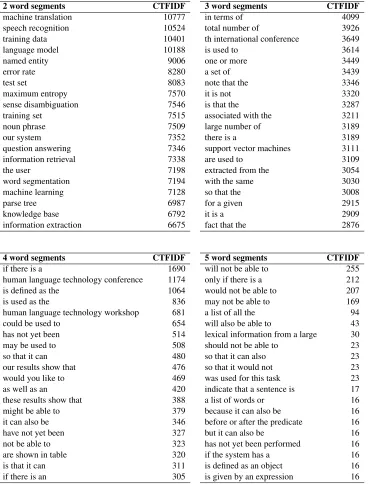
whereT F(x)is the raw frequency of segmentxin the corpus, N is the total number of documents in the corpus, andD(x) is the number of documents in which the segmentxoccurs. Table 4 presents the top 20 collocation segments for two-, three-, four-and five-word segments of items that contain alpha-betic characters only. The term machine transla-tion is the most significant in CTFIDF terms. This short list contains many of the main methods and datasets used in daily computational linguistics re-search, such as: error rate, test set, maximum en-tropy,training set,parse tree,unknown words,word alignment,Penn Treebank,language models,mutual information, translation model, etc. These terms show that computational linguistics has its own ter-minology, methods and tools to research many top-ics.
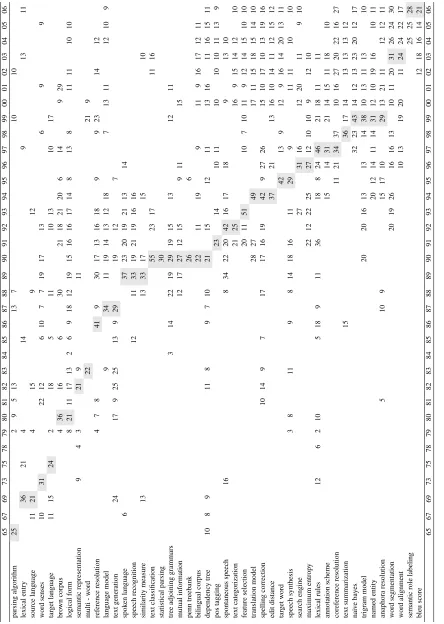
Finally, 76 terms of two or more words in length with the highest CTFIDF values were selected. The goal was to try to find how significant terms were used yearly in the ACL ARC. The main part of the ACL ARC was compiled using papers published af-ter 1995. Therefore, for each selected af-term, the av-erage CTFIDF value of each document for each year was calculated. This approach allows term usage throughout the history of the ACL to be analysed, and reduces the influence of the unbalanced amount
of published papers. Only those terms whose aver-age CTFIDF in any year was higher than 20 were kept. For instance, the termmachine translationhad to be removed, as it was not significant throughout all the years. Each term was ranked by the year in which its average CTFIDF value peaked. The ranked terms are shown in Table 5. For instance, the peak of the CTFIDF average of the term sta-tistical parsing occurred in 1990, of the term lan-guage model in 1987, and of the term bleu score
in 2006. The results (see Table 5) show the main research trends and time periods of the ACL com-munity. Most of the terms with CTFIDF peaks prior to 1986 are related to formal/rule-based meth-ods. Beginning in 1987, terms related to statistical methods become more important. For instance, lan-guage model, similarity measure, and text classifi-cation. The year 1990 stands out as a kind of break-through. In this year, the termsPenn Treebank, Mu-tual Information, statistical parsing, bilingual cor-pus, anddependency tree became the most impor-tant terms, showing that newly released language re-sources were supporting many new research areas in computational linguistics. Despite the fact that
Penn Treebankwas only significant temporarily, the corpus is still used by researchers today. The most recent important terms areBleu scoreandsemantic role labeling.
This study shows that collocation segmentation can help in term extraction from large and complex corpora, which helps to speed up research and sim-plify the study of ACL history.
6 Conclusions
compu-tational linguistics is supported by the publication of new language resources. ThePenn Treebank, which was only significant temporarily, it still used today. The most recent terms areBleu scoreandsemantic role labeling. While machine translationas a term is significant throughout the ACL ARC, it is not sig-nificant in any particular time period. This shows that some terms can be significant globally, but in-significant at a local level.
References
Galen Andrew. 2006. A hybrid markov/semi-markov conditional random field for sequence segmentation. In Proceedings of the 2006 Conference on Empirical Methods in Natural Language Processing, pages 465– 472, Sydney, Australia, July. Association for Compu-tational Linguistics.
Jaime Arguello and Carolyn Rose. 2006. Topic-segmentation of dialogue. InProceedings of the An-alyzing Conversations in Text and Speech, pages 42– 49, New York City, New York, June. Association for Computational Linguistics.
J. Bachenko and E. Fitzpatrick. 1990. A computational grammar of discourse-neutral prosodic phrasing in en-glish. Computational Linguistics, 16:155–170. Ralph D. Beebe. 1973. The frequency distribution of
english syntagms. InProceedings of the International Conference on Computational Linguistics, COLING. Y. Choueka. 1988. Looking for needles in a haystack, or
locating interesting collocational expressions in large textual databases. InProceedings of the RIAO Confer-ence on User-Oriented Content-Based Text and Image Handling, pages 21–24, Cambridge, MA.
Kenneth W. Church and William A. Gale. 1989. En-hanced good-turing and cat.cal: Two new methods for estimating probabilities of english bigrams (abbrevi-ated version). InSpeech and Natural Language: Pro-ceedings of a Workshop Held at Cape Cod.
Ren´e Collier, Jan Roelof de Pijper, and Angelien San-derman. 1993. Perceived prosodic boundaries and their phonetic correlates. InProceedings of the work-shop on Human Language Technology, HLT ’93, pages 341–345, Stroudsburg, PA, USA. Association for Computational Linguistics.
Karel Culik. 1965. Machine translation and connected-ness between phrases. InInternational Conference on Computational Linguistics, COLING.
Susanna Cumming. 1986. The lexicon in text gener-ation. In Strategic Computing - Natural Language Workshop: Proceedings of a Workshop Held at Ma-rina del Rey.
V. Daudaravicius and R Marcinkeviciene. 2004. Grav-ity counts for the boundaries of collocations. Interna-tional Journal of Corpus Linguistics, 9(2):321–348. Vidas Daudaravicius. 2010. The influence of
colloca-tion segmentacolloca-tion and top 10 items to keyword assign-ment performance. In Alexander F. Gelbukh, editor,
CICLing, volume 6008 ofLecture Notes in Computer Science, pages 648–660. Springer.
Vidas Daudaravicius. 2012. Automatic multilingual an-notation of eu legislation with eurovoc descriptors. In
In Proceedings of the 8th International Conference on Language Resources and Evaluation (LREC’2012). Paolo D’Orta, Marco Ferretti, Alessandro Martelli, and
Stefano Scarci. 1987. An automatic speech recogni-tion system for the italian language. InThird Confer-ence of the European Chapter of the Association for Computational Linguistics.
Haodi Feng, Kang Chen, Xiaotie Deng, and Weimin Zheng. 2004. Accessor variety criteria for chinese word extraction. Computational Linguistics, 30:75– 93.
Katja Filippova and Michael Strube. 2006. Using lin-guistically motivated features for paragraph boundary identification. InProceedings of the 2006 Conference on Empirical Methods in Natural Language Process-ing, pages 267–274, Sydney, Australia, July. Associa-tion for ComputaAssocia-tional Linguistics.
Alexandra Kinyon. 2001. A language independent shallow-parser compiler. InProceedings of 39th An-nual Meeting of the Association for Computational Linguistics, pages 330–337, Toulouse, France, July. Association for Computational Linguistics.
F. Knowles. 1973. The quantitative syntagmatic anal-ysis of the russian and polish phonological systems. InComputational And Mathematical Linguistics: Pro-ceedings of the International Conference on Computa-tional Linguistics, COLING.
Gina-Anne Levow. 2004. Prosodic cues to discourse segment boundaries in human-computer dialogue. In Michael Strube and Candy Sidner, editors, Proceed-ings of the 5th SIGdial Workshop on Discourse and Dialogue, pages 93–96, Cambridge, Massachusetts, USA, April 30 - May 1. Association for Computational Linguistics.
Hang Li and Kenji Yamanishi. 2000. Topic analysis using a finite mixture model. In2000 Joint SIGDAT Conference on Empirical Methods in Natural Lan-guage Processing and Very Large Corpora, pages 35– 44, Hong Kong, China, October. Association for Com-putational Linguistics.
Yang Liu, Andreas Stolcke, Elizabeth Shriberg, and Mary Harper. 2004. Comparing and combining generative and posterior probability models: Some advances in sentence boundary detection in speech. In Dekang Lin and Dekai Wu, editors,Proceedings of EMNLP 2004, pages 64–71, Barcelona, Spain, July. Association for Computational Linguistics.
Kathleen McKeown, Diane Litman, and Rebecca Passon-neau. 1992. Extracting constraints on word usage from large text corpora. InSpeech and Natural Lan-guage: Proceedings of a Workshop Held at Harriman. Christian Monson, Alon Lavie, Jaime Carbonell, and Lori Levin. 2004. Unsupervised induction of natural language morphology inflection classes. In Proceed-ings of the Seventh Meeting of the ACL Special Inter-est Group in Computational Phonology, pages 52–61, Barcelona, Spain, July. Association for Computational Linguistics.
Karin M¨uller. 2006. Improving syllabification models with phonotactic knowledge. In Proceedings of the Eighth Meeting of the ACL Special Interest Group on Computational Phonology and Morphology at HLT-NAACL 2006, pages 11–20, New York City, USA, June. Association for Computational Linguistics. Pavel Pecina. 2005. An extensive empirical study of
collocation extraction methods. InProceedings of the ACL Student Research Workshop, pages 13–18, Ann Arbor, Michigan, June. Association for Computational Linguistics.
Pavel Pecina. 2010. Lexical association measures and collocation extraction. Language Resources and Eval-uation, 44(1-2):137–158.
C. Anton Rytting. 2004. Segment predictability as a cue in word segmentation: Application to modern greek. In Proceedings of the Seventh Meeting of the ACL Special Interest Group in Computational Phonology, pages 78–85, Barcelona, Spain, July. Association for Computational Linguistics.
Itiroo Sakai. 1965. Some mathematical aspects on syntactic discription. InInternational Conference on Computational Linguistics, COLING.
Erik F. Tjong Kim Sang and Herve Dejean. 2001. Intro-duction to the conll-2001 shared task: clause identifi-cation. InProceedings of the ACL 2001 Workshop on Computational Natural Language Learning, Toulouse, France, July. Association for Computational Linguis-tics.
Violeta Seretan. 2011. Syntax-Based Collocation Ex-traction, volume 44 of Text, Speech and Language Technology. Springer.
Frank Smadja, Vasileios Hatzivassiloglou, and Kath-leen R. McKeown. 1996. Translating collocations for bilingual lexicons: A statistical approach. Computa-tional Linguistics, 22:1–38.
Frank Smadja. 1993. Retrieving collocations from text: Xtract. Computational Linguistics, 19:143–177. E. Tjong-Kim-Sang and Buchholz S. 2000. Introduction
to the conll-2000 shared task: Chunking. InProc. of CoNLL-2000 and LLL-2000, pages 127–132, Lisbon, Portugal.
L. W. Tosh. 1965. Data preparation for syntactic trans-lation. InInternational Conference on Computational Linguistics, COLING.
Gokhan Tur, Andreas Stolcke, Dilek Hakkani-Tur, and Elizabeth Shriberg. 2001. Integrating prosodic and lexical cues for automatic topic segmentation. Com-putational Linguistics, 27:31–57.
Brigitte van Berkelt and Koenraad De Smedt. 1988. Tri-phone analysis: A combined method for the correction of orthographical and typographical errors. In Pro-ceedings of the Second Conference on Applied Natu-ral Language Processing, pages 77–83, Austin, Texas, USA, February. Association for Computational Lin-guistics.