Proof-of-concept design for a Product Development Maturity Optimization (PDMO) model and a Product Development Process Maturity Audit (PDPMA) model
A product development
success?
Providing insights in improvement of
industry’s product development maturity
MSc Thesis Alicia Vermaas
3
2
A product development success?
Providing insights in improvement of industry’s product
development maturity
Alicia Vermaas
Education
Faculty: Engineering Technology
Department: Design, Production and Management Master programme: Industrial Design Engineering
Master track:
Management of Product Development
Educational institution
University of Twente Drienerlolaan 5 7522 NB EnschedeExamination board
Chair: Dr. ir. D. Lutters Supervisor: Dr. ir. R.G.J. Damgrave External member: Dr. ir. K. Nizamis
Examination date
August 30, 2019DPM:
1623Master Thesis
This report is written to attain the Master’s degree in
Industrial Design Engineering at the
5
4
Preface
Industrial Design Engineers are often connected to the design or improvement of products and systems. That process is completed many times during the courses of Industrial Design Engineering in different manners and with multiple approaches and strategies. As a master student Industrial Design Engineering, I learned a widely applicable skill: to see the predominant problem within its context and find and apply the knowledge required for solving it. During this thesis, I learned how I enjoy – not designing a ‘beautiful’ product, but – the multifunctional and multidisciplinary role of placing and evaluating all required information objectively in the right position to add value to industrial and academical stakeholders.
Later years of my educational exploration shifted my interest from design into the more managerial aspects related to development and production. The felicitous Management of Product Development specialization as follow-up of the Bachelor Industrial Design Engineering formed the perfect match. Acting on this interest and finding ways for practical use of optimization ideologies through this research has been a challenging and rewarding experience. I believe that Industrial Design Engineers play a crucial role in utilizing the valuable combination of practical as well as theoretical information for problem solving. This results in the commitment and responsibility to consider and communicate holistic insights and consequences of decisions, an honourable contribution to society through design, production and management practices.
Acknowledgements
With this research, I got the opportunity to gain knowledge and experience related to maturity optimization, product development and performing research. I am grateful for this unique opportunity to complete a master thesis on my main interest. I wish to acknowledge those who played a role in the execution of this research, for their guidance and support have made this research into an enjoyable and inspiring experience.
First, I want to thank the University of Twente for providing me with the resources and facilities for completing this project. In particular, I would like to express my appreciation to Eric Lutters for his professional and meaningful guidance. Insightful questions, critical notes and challenging ‘puzzle’ moments formed an essential contribution to the research process and results. The enthusing meetings during – and prior to – this thesis project encouraged me in pursuing my interests, steering this research in the right direction.
I also wish to acknowledge my fellow master thesis colleagues of the University of Twente ‘Buitenhorst’ building for the mental support, brainstorm sessions and social companion. Furthermore, I would like to thank the Fraunhofer Project Center team, for giving me the opportunity to experience two maturity audit projects in practice. This provided me valuable insights, contributing to validation of practicability of results and providing realistic benchmarks for existing maturity optimization practices.
My very profound gratitude I express to my family and friends, for their patient and continuous support throughout my years of study and the process of researching and writing this thesis. My special thanks are extended to Fabian Breukers, whose unconditional endorsement, support and patience have been of great value to me.
This accomplishment would not have been possible without you. I am grateful to you all.
Alicia
7
6
Abbreviations
9
Summary
10
Samenvatting
12
Introduction
14
1.1 General Statements
16
1.1.1 Product Development and value creation
16
1.1.2 Deliverables and scope
17
1.2 Orientation
18
1.2.1 Product development
18
1.2.2 Process optimization projects and decision making
19
1.2.3 Maturity assessment and decision making
22
1.2.4 Design Science contributing to process structuring
23
1.3 Gap indication
27
1.3.1 Gap between specific industry and generic academy 27
1.3.2 Limitations of maturity audit models and methods
29
1.4 Research
31
1.4.1 Research directive
31
1.4.2 Research value
35
1.4.3 Scope and limitations
37
1.4.4 Development methodology
42
1.4.5 Validation and verification approach
45
1.4.6 Report structure
46
Maturity vision
48
2.1 Vision on maturity
50
2.2 Vision on PD maturity optimization
51
2.2.1 Maturity levels and locations
51
2.2.2 Lower locations as focus for optimization
52
PDMO model design
54
3.1 PDMO model directive
56
3.1.1 Summarizing prior findings
56
3.1.2 Vision based PDMO model idea
57
Table of Contents
Table of Contents
3.1.3 Objectives and requirements
59
3.2 PDMO model idea
61
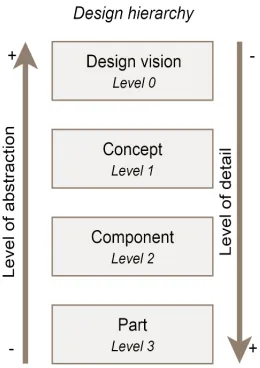
3.2.1 Design, components and parts
61
3.2.2 Three components for PDMO model design
62
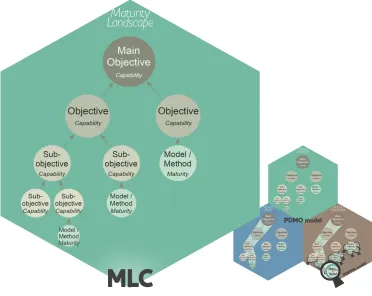
3.3 PDMO model design: MLC
64
3.3.1 MLC Directive
64
3.3.2 MLC Design
64
3.3.3 MLC Validation
68
3.4 PDMO model design: MRC
71
3.4.1 MRC Directive
71
3.4.2 MRC Design
72
3.4.3 MRC validation
78
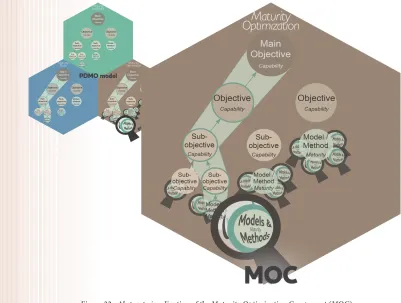
3.5 PDMO model design: MOC
81
3.5.1 MOC Directive
81
3.5.2 MOC Design
81
3.5.3 MOC Validation
83
PDPMA model design
84
4.1 PDPMA model directive
86
4.1.1 Generic three-step maturity audit models
86
4.1.2 Objectives and requirements
87
4.2 PDPMA model idea
91
4.3 PDPMA model design: MTP
92
4.3.1 MTP Directive
92
4.3.2 MTP Design
92
4.3.3 MTP Validation
103
4.4 PDPMA model design: OSP
107
4.4.1 OSP Directive
107
4.4.2 OSP Design
108
4.4.3 OSP Validation
118
4.5 PDPMA model design: CIP
121
4.5.1 CIP Directive
121
9
8
Concepts summary
126
5.1 The PDMO model
128
5.2 The PDPMA model
129
Future prospects
132
6.1 Resources for development
134
6.2 Models as tools
135
6.2.1 The PDMO model as tool in industry
135
6.2.2 The PDPMA model as tool in industry
136
6.3 Model operation
137
Concluding remarks
140
7.1 General validation and evaluation
142
7.1.1 Specifying the basic design validation approach and
selected set of techniques
142
7.1.2 Validating the maturity vision
143
7.1.3 PDMO model design validation
146
7.1.4 PDPMA model design validation
151
7.1.5 Research process evaluation
160
7.2 Discussion
163
7.2.1 Summarizing the research results and key findings 163
7.2.2 Considering findings of the research question
164
7.2.3 Discussing the value to stakeholders
166
7.2.4 Validity influenced by scope and limitations
171
7.2.5 Validity influenced by assumptions
175
7.3 Recommendations
179
7.4 Conclusion
183
7.5 References
186
Table of Contents
Appendices
192
8.1 Principles of maturity models
194
8.2 Model development standards
196
8.3 Levels of relations
198
8.4 Change and implementation theory
200
8.5 Work packages example
201
8.6 Validation techniques
202
8.7 Research process evaluation
205
8.8 Research Claims
206
Table of Contents
Relevant definitions are provided in the footnotes of related pages.
CIP: Change and Implementation part (3rd part of the PDPMA concept model)
DP: Design Principle (Chapter 1.4.4: Development methodology, page 42)
KPI: Key Performance Indicator (definition is stated in the footnotes on the related page) MLC: Maturity Landscape component (component of the PDMO concept model) MOC: Maturity Optimization component (component of the PDMO concept model) MRC: Maturity Route component (component of the PDMO concept model) MTP: Maturity Test part (1st part of the PDPMA concept model)
OSP: Optimization Strategy part (2nd part of the PDPMA concept model)
PD: Product Development
PDMO: Product Development Maturity Optimization (model) PDPMA: Product Development Process Maturity Audit (model)
11
10
Summary
Companies strive for success – or ‘maturity’ as ‘the capability to achieve success’ – and act towards that by optimizing the effectiveness and efficiency of value creating processes. Effectiveness represents ‘doing the right things’, where efficiency is ‘doing the things right’. The Design Science domain in the academical context aims at providing useful artefacts which guide and structure those processes, resulting in maturity audit models and process structuring models and methods.
Product Development (PD) is one possible value creating process. Surprisingly, existing maturity audit models do not adequately target PD practices for optimization in specific and literature on PD process structuring and optimization does not sufficiently address tailoring the structures to the company contexts. However, uncertainties, sensitivities and stakeholder involvement result in complex multi-criteria decisions concerning optimization projects and process structuring solutions. Objective insights in PD maturity improvement in industry are limited and artefacts for maturity optimization and PD process structuring are not utilized effectively and efficiently.
This research aims at providing insights in improving industry’s PD maturity. With those insights, the industry is capable of making deliberate decisions related to PD maturity optimization. This is a twofold research objective. To start with, optimizing a maturity factor (a process with a certain level of maturity) does not automatically result in increased company success. Therefore, insights for deliberately selecting a process for optimization are required. If the PD process is identified as the appropriate maturity factor to optimize regarding to achieving company success, insight in optimization of the PD process are required. This research results in a vision on maturity and two concept models. They form a starting point and illustrate what is possible in the future regarding PD maturity optimization in industry.
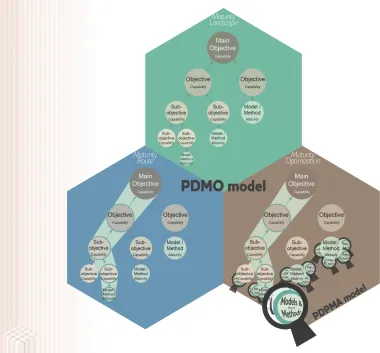
The maturity vision states that higher company objectives form the directive for selecting processes for optimization. Since optimizing a process does not automatically lead to success on higher objectives, identifying a top-down maturity context is requires, which allows a bottom-up process optimization for effectively and efficiently optimizing processes towards company success. The Product Development Maturity Optimization (PDMO) concept model is designed to provide insights in the influences of maturity optimization on company success. Through a maturity topology network, it provides insights in the maturity context related to PD maturity. It guides stakeholders in objectively selecting a maturity factor for optimization and a maturity audit can be performed to optimize that specific maturity factor.
Specifically for PD processes, knowledge on selecting appropriate PD process structures for the context is limited. Therefore, a concept model is developed for optimizing PD process maturity: the Product Development Process Maturity Audit (PDPMA) model. The PDPMA model forms one possible solution within the solution domain of the PDMO model. It starts with validating if accreditation of the model is valuable for the context. Then, it relates specific context parameters to relevant model and method parts through corresponding functions, forming relation profiles. These are the input for a tailored change and implementation advice for the company.
For the research results, development and validation standards are used and decisions are substantiated, providing a firm theoretical base. The PDMO model is capable of providing insights in the value of optimizing a specific process in the company context, guiding decision makers to optimization process selection while aiming for company success. The PDPMA model is capable of proposing appropriate solutions for PD process structures and first ideas for iterations of the first step in the PDPMA model are stated. This research does not present fully developed results, but identifies, illustrates and contextualizes interesting opportunities for PD maturity optimization in industry. Recommendations entail further development activities, design testing and performing research contributing to the models’ content.
The valuable combination of practical and theoretical knowledge is made accessible to industry after developing the PDMO and PDPMA model into practical tools. Combined, they provide the industry with insights in improvement of their PD maturity and enable stakeholders in optimization projects to make deliberate decisions regarding optimization projects and PD process optimization. The versatile designs allow availability, flexibility and sustainability of the models’ content. Optimization project execution with use of the PDMO model and / or PDPMA model allows tailoring the focus and effort to (often fluctuating) needs of industrial stakeholders, contributing to the industry’s aim for company success.
This research contributes to the Design Science domain and builds on theoretically firm standards for model development and validation. Research results are represented as generic semantic ontologies – independent of specific instances – exploring maturity assessments for a new application: PD optimization. The PDMO and PDPMA model have three unique char-acteristics: the focus on Product Development practices, the use of company success and the design for relating context with solutions based on overlapping functions. By providing the industry with insights in the potential value of them, utilization of developed artefacts by the academy is promoted, contributing to the success of the Design Science domain. In conclusion, this research forms a proof-of-concept model development success, proposing designs which provide companies with insights in improvement of their PD maturity.
13
12
Samenvatting
Summary
Bedrijven streven naar succes en trachten om de effectiviteit en efficiëntie van waardecreërende processen te verhogen. Het ‘Design Science’-vakgebied in de academische context is gericht op het ontwikkelen van modellen en methodes die deze processen effectief en efficiënt begeleiden en structureren. Dit resulteert in auditmodellen voor procesoptimalisatie en processtructure-ringsmodellen en -methodes.
Productontwikkeling (PD) is een van de mogelijke activiteiten voor waardecreatie in de industrie. Verrassend genoeg zijn bestaande auditmodellen voor optimalisatie onvoldoende gericht op het optimaliseren van PD-activiteiten. Bovendien besteedt de literatuur onvoldoende aandacht aan het afstemmen van de modellen en methodes op de specifieke bedrijfscontexten. Onzekerheid en gevoeligheid in de bedrijfscontext leiden tot complexe beslissingen betreffende optimalisa-tieprojecten en processtructurering. Daardoor zijn objectieve inzichten in PD optimalisatie in de industrie beperkt en worden optimalisatiemodellen en PD-proces structuren niet effectief en efficiënt gebruikt.
De doelstelling van dit onderzoek betreft het verschaffen van inzichten in het optimaliseren van PD-activiteiten, waardoor de industrie in staat is om weloverwogen beslissingen te nemen. Dit is een tweeledige doelstelling. Om te beginnen leidt het optimaliseren van een proces niet automatisch tot hoger succes van een bedrijf. Daarom (1) zijn inzichten nodig in het selecteren van een geschikt proces voor effectieve en efficiënte optimalisatie. (2) Als het PD-proces wordt geïndiceerd voor optimalisatie, is een auditmodel voor optimalisatie van dat proces nodig. Uiteindelijk resulteert dit onderzoek in een visie en twee conceptmodellen die elk een deel van de tweeledige onderzoeksdoelstelling bereiken. Ze vormen een startpunt en illustreren wat er in de toekomst mogelijk is met betrekking tot PD-optimalisatie in de industrie.
Hogere bedrijfsdoelstellingen vormen de richtlijn voor het selecteren van processen voor optimalisatie. Aangezien het optimaliseren van een proces niet automatisch leidt tot succes van hogere doelstellingen, is het identificeren van de context rondom PD-optimalisatie essentieel. Dat maakt het mogelijk om een weloverwogen keuze voor procesoptimalisatie te maken, welke effectief en efficiënt bijdraagt aan het succes van een bedrijf. Deze stellingen vormen de visie. Naast de visie, is het PDMO conceptmodel ontworpen om inzicht te geven in de invloeden van procesoptimalisatie op bedrijfssucces. Het begeleidt stakeholders bij het objectief selecteren van een proces voor optimalisatie en een auditmodel kan worden uitgevoerd om dat specifieke proces te optimaliseren.
Kennis over PD-procesoptimalisatie is beperkt. Voornamelijk methodes voor het selecteren van effectieve en efficiënte PD-processtructuren voor PD-processen in een context ontbreken. Daarom is er een concept voor het PDPMA-model ontworpen, welke inzicht geeft in de optimalisatie van PD-processen.. Het PDPMA-conceptmodel vormt een mogelijke oplossing binnen het oplossingsdomein van het PDMO-conceptmodel. Het begint met het valideren of accreditatie van het PDPMA-model waardevol is binnen de context van het bedrijf. Vervolgens relateert het model de specifieke contextparameters aan processtructuren, via overeenkoms-tige functies. De resulterende relatieprofielen vormen de input voor een strategisch advies voor het bedrijf, gefocused op verandering en implementatie.
De onderzoeksresultaten zijn gevormd vanuit een goede theoretische basis. Het PDMO-conceptmodel is in staat inzichten te verschaffen in de waarde van het optimaliseren van een specifiek proces in de bedrijfscontext. Daardoor kunnen besluitvormers weloverwogen beslissingen maken betreffende optimalisatie gericht op bedrijfssucces. Het PDPMA-model genereert en adviseert over passende oplossingen voor PD-processtructuren. Dit onderzoek presenteert geen volledig ontwikkelde resultaten, maar identificeert, illustreert en contextu-aliseert interessante mogelijkheden voor PD-optimalisatie in de industrie. Aan de hand van dit onderzoek kunnen verdere ontwikkelingsactiviteiten, ontwerptesten en onderzoeken plaatsvinden die bijdragen aan de ontwikkeling en inbedrijfstelling van de modellen.
De PDMO- en PDPMA-conceptmodellen maken de waardevolle combinatie van praktische en theoretische kennis toegankelijk gemaakt voor de industrie. De ontwerpen stellen bedrijven in staat om weloverwogen beslissingen te nemen met betrekking tot optimalisatieprojecten en PD-procesoptimalisatie. Ze zijn ontworpen met beschikbaarheid, flexibiliteit en duurzaamheid van de inhoud van de modellen als doel. Bedrijven kunnen optimalisatie projecten afstemmen op hun(vaak fluctuerende) behoeften, strevend naar succes van het bedrijf.
In
tr
oduction
Ma
tur
ity vision
PDMO model design
PDPMA model design
Conc
epts s
ummar
y
Fut
ur
e pr
ospects
Concluding r
emar
ks
Appendic
es
Chapter content
Product developing (PD) companies aspire PD success (PD maturity) and act towards that by adapting PD processes to fit interpretations of the companies environment. Result-ing maturity optimization projects – guided by external advice and insights from maturity audit models – aim for increased effectiveness and efficiency through process structuring. Maturity optimization projects are subject to the environment the company operates in and decision making on them requires practical as well as theoretical knowledge. For PD process maturity optimization, limited knowledge is available. This research aims at provid-ing insights in PD maturity optimization with takprovid-ing into account the changprovid-ing company context and proposes a concept model for achieving that. This broad objective has a limited model target group and a selected, illustrative solution domain. The maturity audit model development uses standardized model development steps and is approached as a product development process with Cross’ PD process model as guide. It is validated by using a stan-dard validation and verification model from R.G. Sargent and D.K. Pace. The report starts with this introduction for providing background and research information. This is followed by defining a vision on PD maturity and a design with three hierarchical levels that support the main objective of this research. Future prospects are stated and final chapters validate, evaluate, discuss and conclude on the research.
1
Introduction
Introduc
17
16
This report starts with describing the general statements to provide the reader with a rough overview of the research context and main statements before diving into (more abstract and theoretical) detail. The introductory chapters state the knowledge required for a Maturity vision, which works towards two proof-of-concepts for PD maturity optimization. Definitions are stated in the footnotes, guiding the interpretation of terms during the report.
1.1.1 Product Development and value creation
Companies strive for creating value, resulting in company success. That can be achieved with a wide range of strategies, for example by designing and producing goods or by providing services. The context of this thesis focusses on Product Development1 (PD) as
value creation strategy. The success of a company is determined by how well the company performs – creates value – within the everchanging (PD) environment. Regarding that, companies aim to adapt their value creating practices to the everchanging context, to obtain or retain competitive advantage and assure company success2.
The capability to perform and achieve an objective (e.g. value creation) in a context is referred to as ‘maturity3’. The gap between the aim of the company and the everchanging
reality, makes it impossible for a company to operate ‘fully mature’, since the environment which determines maturity is constantly changing and the performance of a company occurs in a certain point in time based on an interpreted context of that point in time. Per company it differs how big the gap is between operating ‘fully mature’ for the reality of the everchanging environment and how mature a company really operates while aiming at an approximation of the environment at a certain point in time. Increase in maturity would mean increase of company success, since the company can adapt better to the environment. This results in the wish for industry is to increase maturity of value creating practices, specifically for them to be capable4 of and have insights in how-to optimize their
processes5. This statement forms the initiation for this research.
1 Product Development (PD): “the creation of products with new or different characteristics that offer new or additional benefits to stakeholders. Product development may involve modification of an existing product or its presentation, or formulation of an entirely new product that satisfies a newly defined customer want or market niche.” (BusinessDictionary, 2019).
2 Success: “the fact that you have achieved something that you want and have been trying to do or get.” (Oxford Learner’s Dictionaries, 2019). “Achievement of an action within a specified period of time or within a specified parameter. Success can also mean completing an objective or reaching a goal.” (BusinessDictionary, 2019). 3 Maturity: “the state of being complete, perfect or ready.” Soanes and Stevenson (2006) or “the state of being fully
grown or developed.” (Oxford Learner’s Dictionaries, 2019).
4 Capability: “measure of the ability of an entity (department, organization, person, system) to achieve its objectives, specially in relation to its overall mission.” (BusinessDictionary, 2019).
5 Process: “sequence of interdependent and linked procedures which, at every stage, consume one or more resources (employee time, energy, machines, money) to convert inputs (data, material, parts, etc.) into outputs. These outputs then serve as inputs for the next stage until a known goal or end result is reached.” (BusinessDictionary, 2019).
1.1.2 Deliverables and scope
This research develops and delivers two proof-of-concept6 maturity models7 that fulfil the
aim of providing insights for industry in how to optimize PD maturity. Within the broad landscape of PD optimization, the concept designs starts with a low maturity – since capability is not assessed initially – and form a starting point in the search for mature designs to increase PD maturity in industry. The maturity of the concept models is tested and evaluation for future applications on a broader scope can be performed.
Only industries with the chance that optimization efforts are beneficial are included within this research’ scope, with evaluation for expansion after further development of the proof-of-concepts. As a starting point and directive, this thesis focuses on application in product developing industries other than automotive, one-off or rusted-up. In order to increase the maturity of PD practices for a company, the effort required for improving the maturity must not exceed the benefits. Therefore, industries with a high chance of not meeting this requirement are out of scope, but can be included in application after the concept model has been proven to be mature. In conclusion, this research encourages iterations and scope widening of the proof-of-concept model in the future.
Results of this research will not be quantifiable, nor have Key Performance Indicators8
(KPIs) to be expressed. Maturity, as well as the term optimization (which relies on increase of effectiveness9 and efficiency10), are per definition relative and dependent on the context.
Therefore, only the combination to a context provides means to say something about maturity levels, effectiveness and efficiency increases or improvement potentials. Since the level of detail of the concept is limited to only a proof-of-concept, a direct combination to a specific contexts is not provided. Consequently, the proof-of-concept model does not address measures of those aspects in quantities, but explains future opportunities.
The context of this research can be described roughly with the following key words:
Product Development, Maturity, Capability, Effectiveness & Efficiency, Model, Optimization.
6 Proof-of-concept (PoC): “is a small exercise to test the design idea or assumption. The main purpose of developing a POC is to demonstrate the functionality and to verify a certain concept or theory that can be achieved in development.” (Singaram & Jain, 2019).
7 Maturity models: “a simplified description of a system, used for identifying and explaining how mature something works or calculating what might happen, etc.“ (Oxford Learner’s Dictionaries, 2019). “Models are systematic (i.e., they deliver rules on how to act and instructions on how to solve problems), goal-oriented (i.e., they stipulate standards on how to proceed or act to achieve a defined goal), and repeatable (i.e., they are inter-subjectively practicable).” (Braun et al., 2005).
8 Key Performance Indicator (KPI): “key business statistics such as number of new orders, cash collection efficiency, and return on investment (ROI), which measure a firm’s performance in critical areas.” (BusinessDictionary, 2019). 9 Effectiveness: “the fact of producing the result that is wanted or intended.” (Oxford Learner’s Dictionaries, 2019).
Doing the right things.
10 Efficiency: “the quality of doing something well with no waste of time or money.” (Oxford Learner’s Dictionaries, 2019). Doing things the right way.
19
18
1.2.1 Product development
In order to provide a starting point for this research, this thesis focuses on the process of developing products. In this report, the term ‘process’ is often related to Product Development (PD) unless stated otherwise.
Product development as value creation strategy
Product development is one of the strategies in industry to create value. This value can result in, for example, money, goods or recognition, on which the existence and success of a company can be based. Logically, from industry, there is an interest in increasing effectiveness and efficiency of processes such as the PD process, resulting in higher value creation.
Effectiveness represents ‘doing the right things’, where efficiency represents ‘doing things the right way’. These terms are per definition relative and highly dependent on the context, e.g. the organization, project, stakeholders and product (Nieberding, 2009). Therefore, only the combination to a specific context provides means to say something about effectiveness and efficiency levels and improvement potentials. The effectiveness and efficiency of the PD process directly influence the amount of value creation in this context.
In relation to process structuring
A positive correlation between the effectiveness and efficiency of PD processes and the structuring of PD processes exists. When process steps are chosen intentionally, they can be influenced and communicated and support the heuristic structure of human thought (Pahl, Beitz, Feldhusen, & Grote, 2007) (Dörner, 1987). This means that the amount of value creation by – and the success of – a product developing company is influenced by the structure of the PD process. Logically, the aim of industry to increase their PD success leads to the search for effective and efficient structures of PD processes.
1.2 Orientation
1.2.2 Process optimization projects and decision making
Standardized optimization projects
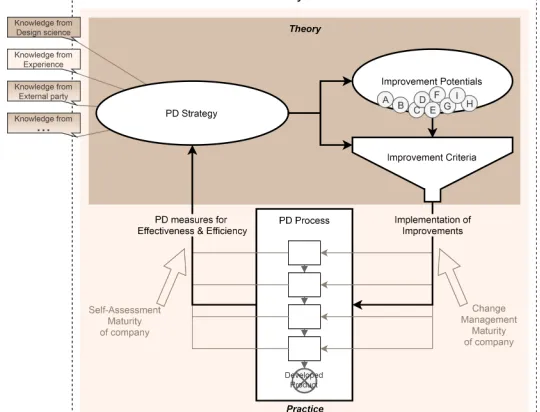
The aim for optimization in industry leads to a standardized process of analyses, identifying optimization and selecting and implementing optimizations. Supporting the aim of industry to increase effectiveness and efficiency of processes, optimization projects are performed. These projects roughly follow comparable steps, since they all have comparable objectives to go from a certain situation into an improved situation. First, the current situation is analysed. Subsequently, potentials for improvement are identified and analysis of costs compared to benefits determine the value of implementing an improvement. Improvements for implementation are selected by using stated criteria for added value compared to the costs of them. They need to be changed in the current situation, resulting in increased effectiveness and efficiency of the process. Based on this information, a representation of the PD optimization process is provided in Figure 1.
Optimization projects as cycle
Optimization projects can be performed as continuous cycles. A PD optimization project roughly consists of the PD factors as shown in Figure 1. In practice, the PD process in place is the ‘current situation’. The PD strategy builds on theory and requires all available knowledge on how to optimize the process of the current situation. This includes detailed information about effectiveness and efficiency and new technologies and potentials for improvements. That information – with for example Design Science artefacts as tools,
[image:10.964.603.873.393.599.2]1.2 Orientation
21
20
practical experience and knowledge from stakeholders – is used to create criteria for identified improvement potentials. The criteria form a filter determining whether or not to implement the improvement potentials in the current situation. Aiming at continuous competitive advance, optimization processes can be continuously striving for effective and efficient processes.
Decision making regarding to optimization projects
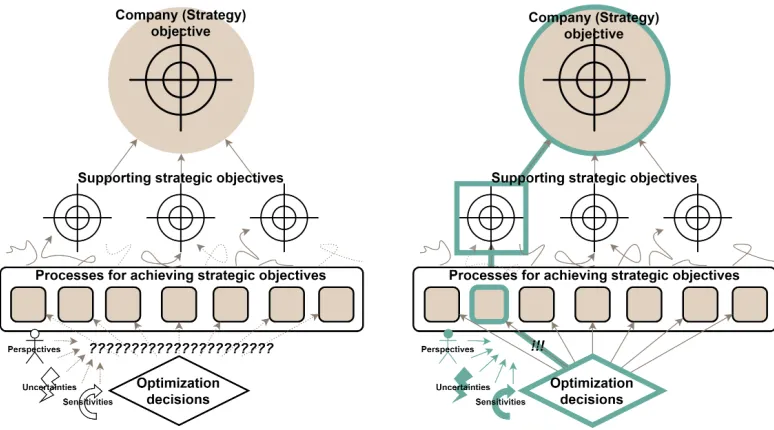
In and before each optimization project, myriad decisions are made, influencing the company context and being influenced by the company context. Uncertainty of the context causes unknown results if the results are sensitive to those uncertainties. Consequently, decision making on processes and optimization is difficult due to the existing combination of sensitivity and uncertainty. For optimizing processes, uncertainties in the context combined with sensitivity of decision outcomes cause difficulties in having insights in all influences and effects of making a certain decision. Making a decision with insights in uncertainties and sensitivities enables stakeholders to make deliberate decisions appropriate for the company. Consequently, decision can be based on what the company wants to risk or invest in order to obtain an effectiveness and / or efficiency increase.
Stakeholder involvement in processes and decisions, results in biased perspectives influencing the credibility of the decision outcome. Criteria for decision making can be created from a wide range of perspectives, since multiple stakeholders of maturity optimization projects have variating (individual) objectives. However, for company success and competitive advantage, the criteria for decision making are soundly stated in the company strategy11, determining what to risk while striving for company success.
For objective decision making, theoretical knowledge and practical knowledge both are required (Figure 1 shows the optimization cycle which crosses both, theoretical and practical sides). Insights in uncertainties, sensitivities and perspectives require practical knowledge of the company context. In order to gain insights in the process structures which are suitable for the context, theoretical knowledge is required. This valuable combination of knowledge is difficult to obtain. However, it allows the translation of uncertainties (or ‘unknown unknowns’) into ‘known unknowns’, increasing the capability to indicate the outcome of a decision. Consequently, stakeholders on optimization projects which posses the previously mentioned combination of theoretical and practical knowledge, are more mature in making decisions deliberately.
11 Company strategy: “a plan that is intended to achieve a particular purpose.” (Oxford Learner’s Dictionaries, 2019), in the company context primarily related to ‘company success’ as purpose.
1.2 Orientation
Figure 2 provides a visualization of an optimization project that requires the valuable and difficult combination of practical and theoretical knowledge. Regarding maturity optimization projects, practical information consists of, for example, best practices from experience, uncertainties, sensitivities, applied models and methods in industry, use and implementa-tions of change and advice documents, and the specific company context surrounding the process. Theoretical knowledge consists of, for example, literature and information about models, methods and methodologies, best practices, change management strategies, sensitivity analyses and capability and maturity assessment models. The effectiveness and efficiency of PD practices and the result of optimization projects is determined by the combination of those knowledge sources. With that reason, the academy12 cannot
develop an effective and efficient PD process structure without practical knowledge of the context and the industry cannot optimize their PD maturity without use of e.g. design theories, guiding literature and developed artefacts.
12 Academy: ”a type of official organization which aims to encourage and develop art, literature, science, etc.” (Oxford Learner’s Dictionaries, 2019), in this research primarily related to the Design Science domain.
1.2 Orientation
Figure 2 - For process optimization both, theoretical and practical knowledge are required
23
22
1.2.3 Maturity assessment and decision making
Maturity dimensions, factors and levels
For performing optimization projects, the company has a certain capability of performing individual steps in that project. The capability to perform a step in an effective and efficient way is called ‘maturity’.
“Maturity implies an evolutionary progress in the demonstration of a specific ability or in the accomplishment of a target from an initial to a desired or normally occurring end stage.”
(Mettler, 2011).
For example, capability of the company to change the current situation and implement improvements, can be called the change management maturity, and the capability of the company to objectively assess effectiveness and efficiency of PD processes in an effective and efficient way is the self-assessment maturity of the company. Likewise, high PD maturity refers to the capability of a company to perform PD practices effectively and efficiently. Imaginably, many locations for improving capability exist. In other words, many locations for optimizing maturity can be addressed, referred to as maturity dimensions13 in
this report.
A maturity dimension exists of maturity factors14, which contribute to the main maturity
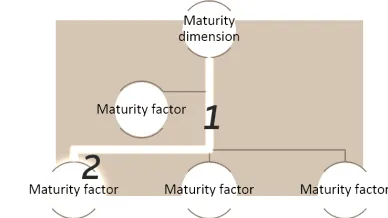
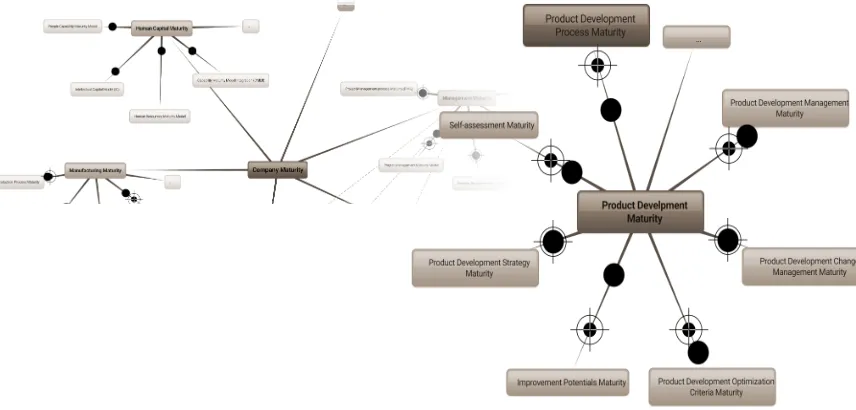
on that location. For example, as identified by Mettler (2001), tree maturity factors exist as commonly used basis for maturity assessments in the field of social systems. These are identified from a highly abstract view with social systems as scope. He states that lower maturity dimensions exist of maturity factors, for example concerning process or structure maturity. Every lower location pursues more specific and detailed maturity objectives, contributing to the higher objective of the maturity dimension (Figure 3). Automatically, high maturity of a maturity factor is a required but not sufficient condition for high maturity of the maturity dimension above it, since the capabilities – or maturity levels – of the maturity factors combined determine the capability of the maturity dimension. The exact distribution of contributions between maturity factors depend fully on the context. This research uses that concept of maturity dimensions being supported by maturity factors, but adds the note that a maturity factor can be a maturity dimension on its own on a lower level, having maturity factors on a lower level as well. A visualization of this construction is shown in Figure 4.
13 Maturity dimension: “dimension is an aspect, or way of looking at or thinking about something.” (Oxford Learner’s Dictionaries, 2019). A maturity dimension can be described as “an aspect of maturity”.
14 Maturity factor: “one of several things that cause or influence something” (Oxford Learner’s Dictionaries, 2019), in the maturity context: one or several maturity aspects that cause or influence maturity on a higher level.
1.2 Orientation
Since maturity builds on effectiveness and efficiency of maturity factors, it requires a relation to a context to define meaningful levels of maturity. The maturity level15 indicates the
capability on a specific dimension and is determined by the capability, which is determined by the effectiveness and efficiency. As stated in the previous chapter, the effectiveness represents ‘doing the right things’, where efficiency represents ‘doing things the right way’. These terms are per definition relative and highly dependent on the context, e.g. the organization, project, stakeholders and product (Nieberding, 2009). Therefore, only the combination to a specific context provides means to say something about maturity levels on maturity locations. Since the context brings uncertainties, sensitivities and perspectives, quantifying a maturity level can be complex. Furthermore, the direct interpretation of a quantified maturity level forms a risk, since the context is everchanging and a maturity level interpretation is only sensible with unequivocal insights in that context, which is unrealistic. Therefore, using quantified maturity levels without sufficient contextualization forms a risk for erroneous interpretation. Instead, added value for the company lies in received objective insights for change management, leading to implementation.
1.2.4 Design Science contributing to process structuring
Artefact development for process structuring
The search for structuring PD processes and optimization projects in a way that results in increased effectiveness and efficiency, is supported by the study of Design Science16.
Design Science contributes to process optimization by providing theoretical knowledge on how to structure processes and perform projects effectively and efficiently. In recent years, the study of Design Science has focused predominantly on developing artefacts17
15 Maturity level: “defined and ordinal scale for measuring the maturity of an organization’s process and for evaluating its process capability. The levels also help an organization prioritize its improvement efforts.” (Paulk, Curtis, Chrissis, & Weber, 1993).
16 Design Science: “the design-science paradigm seeks to extend the boundaries of human and organizational capabilities by creating new and innovative artefacts. Knowledge and understanding of a problem domain and its solution are achieved in the building and application of the designed artefact.” (Hevner, 2004).
17 Artefact: “March and Smith’s differentiation of constructs, models, methods, and instantiations as artefact types (1995) is commonly accepted.” (Winter, Design Science research in Europe, 2008).
1.2 Orientation
25
24
– such as models and methods18 - for industry to use for e.g. designing, developing and
producing products and optimizing corresponding processes. Hevner et al. (2004) define Design Science as a combination between the understanding of and knowledge about a problem and its solution domain. With that understanding, optimization and structuring of processes take place. Building and application of artefacts in a company intends to extend capability boundaries through design oriented research. He states that Design Science:
“... seeks to extend the boundaries of human and organizational capabilities by creating new and innovative artefacts” (Hevner, 2004).
Design Science contributes to the industrial search for effective and efficient processes. This research locates itself within the Design Science domain for its practice being able to guide, provide insights in and structure processes and contexts.
Design Science develops artefacts for problem-solving in the engineering technology field. The roots of Design Science lie in engineering technology, which makes use of artefacts. Artefacts in the engineering context consist of vocabulary and symbols, abstractions and representations, algorithms and practices, and implemented and prototype systems to provide guidance and understanding of processes, systems and situations (Mettler, 2011). They are shaped as tactile constructs, models, methods, instantiations or design theories to achieve that purpose and put across structuring theories (Hevner, 2004) (Tuunanen, Peffers, Gengler, Hui, & Virtanen, 2006) (Vahido, 2006) (March & Smith, 1995).
Models and methods for processes
Models and methods form the solution domain for artefacts supporting process improvement. Models and methods are more closely interrelated to each other and to process structuring than other artefact types resulting from Design Science (Winter, 2008). They are widely examined and developed in the research field and are proven to structure processes and process execution and optimization. Models and methods either are descriptive19, explanatory20 or predictive21. All forms “… reflect the state of a particular
18 Method: “a particular way of doing something.” “An established, habitual, logical, or prescribed practice or systematic process of achieving certain ends with accuracy and efficiency, usually in an ordered sequence of fixed steps.” (BusinessDictionary, 2019).
19 Descriptive model: “says how something is actually used or done, without giving rules for how it should be used or done.” (Oxford Learner’s Dictionaries, 2019).
20 Explanatory model: “gives the reasons for something; intended to describe how something works or to make something easier to understand.” (Oxford Learner’s Dictionaries, 2019). “I.e., they deliver a depiction of causal connections to better understand reality” (Mettler, 2011).
21 Predictive model: “tells what should be done.” (Oxford Learner’s Dictionaries, 2019). “I.e., they recommend an efficient solution state of a future reality.” (Mettler, 2011).
1.2 Orientation
application domain whether it is the exact description of the current situation or a suggestion for a more efficient or ideal target state.” (Mettler, 2011). A model is defined as a representation of philosophies or strategies proposed to show how (PD) processes may be done, using mainly state descriptions (Evbuomwan, Sivaloganathan, & Jebb, 1996). It focuses on the result perspective and implies procedural aspects, where methods focus on procedural aspects and imply results, with specification of activities as focus (Winter, 2008). The char-acteristics of models and methods contribute to process structuring – an often pursued goal in industry for achieving competitive advantage and company success.
The value or success of a model or method is determined by the utility of it in practice, strongly related to the effectiveness and efficiency of PD and optimization processes. That definition of the value of artefacts puts ‘utility´ in the centre of Design Science research’ interest (Hevner, 2004). Methods and models can be certified as reasonable tools for specific uses and functionalities, if proven to be useful and utilized in that specific context (Dhrymes, et al., 1972). This term, ‘useful’, is subjective and directly determined by the increase of effectiveness and / or efficiency achieved by utilizing the artefact in the company context. ‘Utility’ is strongly related to the amount of attention a model or method receives. By forcing attention on the usefulness of an artefact, utility is the result, leading to success of the artefact developed in Design Science practices.
Models and methods for maturity assessments
Optimization projects in industry are common practice and valuable for making decision on improving the effectiveness and efficiency of processes. They are often shaped as maturity assessments or maturity audits22. Maturity assessments provide advice and insights for
decision making for optimization. Based on the sequence of steps that optimization projects follow, a change and implementation advice results from the assessments. Companies base decisions on the opportunities for change, of which positive cost-benefit results lead to implementation and an improved level of maturity. Therefore, strengthened by the interests and needs from industry, the term process maturity is more and more recognised as measurement for assessing capabilities of companies for optimizing processes and achieving objectives.
Maturity audit models are applied as derived approaches for increasing the capability of a maturity dimension. Maturity assessments and audits guide the optimization process in the shape of models and methods, often developed during Design Science practices in academy or by external companies. Derived maturity assessment models are increasingly
22 Maturity audit: “an official examination of the maturity of something.” (Oxford Learner’s Dictionaries, 2019).
27
26
applied, both as approach for continuous improvement (Ahern, Clouse, & Turner, 2004) as well as for self or third-party assessments (Hakes, 1996) (Fraser, Moultrie, & Gregory, 2002). These are performed mainly on process level and combine state descriptions (i.e. levels of maturity) with a number of key practices (i.e. potentials for improvement and activities for implementation) to achieve certain goals (perform more effectively or efficiently or solve new emerging problems) (Mettler, 2011). The main objective is to derive an approach (e.g. in the shape of a model or method) for increasing the capability of a specific domain within an organization (Ahern, Clouse, & Turner, 2004) (Hakes, 1996) by using maturity models as evaluative and comparative basis for improvement (Tekwe, et al., 2004) (Spanyi, 2019).
Decision making on optimization approaches for capability improvements is sensitive to multiple uncertainties in e.g. the company context. Maturity audit models as Design Science artefacts are used for providing insights in capability improvement in company contexts. Influences on optimization of processes exist of for example (1) the process structure (defined by artefacts such as models or methods), (2) the company context and (3) the determined objectives for the future, including sometimes divergent company objectives. The objective for decision makers is to decide and balance those influences based on a comprehensive set of criteria (Bruin, Rosemann, Freeze, & Kulkarni, 2005). Contributing to this aim, maturity assessment models provide overview and structure for the approach and process, resulting in higher effectiveness and efficiency of both. Furthermore, they aim to provide insights for decision makers to objectively compare influences on and consequences of optimizing a process capability. The Design Science artefacts intent to close the gap between the industrial need for structure and insights, and the broad field of existing general artefacts.
Most of the developed maturity models provide means for positioning a selected unit of analysis on a pre-defined scale (maturity levels), with some of them reaching the level of a compliance standard (Mutafelija & Stromberg, 2003). The objective interpretation of the context is the reason for maturity optimization projects often being performed by external companies. They intend to objectively assess the current maturity and define potentials for improvement, avoiding conflicting interests by using a maturity model – which is developed externally to the assessed organization – as measurement tool (Fraser, Vaishnavi, 1997). The models differ per topic and are available in contexts as: production automation, lead time reduction, industry 4.0 applications and quality assurance (Mettler, 2011). Artefacts developed for PD process optimization are not evidently mentioned in literature.
1.2 Orientation
Although an extensive collection of artefacts has been developed over time, utilization of artefacts is limited. This chapter elaborates on the gap between artefacts and limited utilization.
1.3.1 Gap between specific industry and generic academy
Selecting models and methods for specific contexts
The PD context within a company determines the effectiveness and efficiency of certain models and methods within that context. Per project, details and company contexts differ and no project is executed in an identical manner (Nieberding, 2009). These context differences determine the ‘fit’ or ‘appropriateness’ of a model or method in that context and influence the effectiveness and efficiency of the process. Consequently, a first difficulty is indicated: selecting the right (combination of) models and methods for generic industrial contexts, since every situation requires a different solution.
Knowledge on the effects of the context on the selection of artefacts is limited. Research on best practices for the effective and efficient use of models and methods in industry exists, but the interpretations and findings remain superficial, data is often pertaining to a limited amount of and only a certain type of companies without sufficient context descriptions (this statement results from a literature review (Cooper & Kleinschmidt, 1995) (Griffin, 1997) (Kahn, Barczak, & Moss, 2006) (Barczak, Griffin, & Kahn, 2009) (Barczak & Kahn, 2012) (Kahn, Barczak, Nicholas, Ledwith, & Perks, 2012) (Rossi, Kerga, Taisch, & Terzi, 2014). They do not comprehensively underpin the path to the results, making them not directly suitable for industrial application. Chorn (1991) agrees that researchers are focussed on evaluating situations, strategies and styles seeming capable of consistently producing good performance. He proposes to:
“Abandon the search for universally appropriate strategies or management styles” and “… recognise that any strategy (process structure) is only appropriate in a given set of
competitive conditions (context).” (Chorn, 1991).
In research as well as in industry, knowledge about effects of contexts on effective and efficient utilization and selection of models and methods is insufficient. Consequently, decision making on process structuring is often based on limited knowledge and intuition, leading to immature optimization processes.
29
28
Translating general models and methods into specific structures
There is limited knowledge on translating the general literature of the Design Science domain into practical information for the industry. Once models or methods are found to be suitable for a company context, a second difficulty appears. A considerable body of research exists, proposing models and methods on the product development process. Researchers in the Design Science field agree that models and methods should be adapted to the context for enabling effective and efficient implementation and use (Chorn, 1991) (Nieberding, 2009). Surprisingly, only limited amount of studies propose how such an adaptation process is performed (Nieberding, 2009), hindering the industry to use the models and methods in practice.
Due to the abstraction of processes, tailoring them to specific structures for industry is difficult. Processes often are only similar on a very high level of abstraction, causing the literature and development of models and methods to be concentrated principally on a high level of generality. On that high level of abstraction, every PD process is based on a certain flow of logic that drives the development from the product idea to the stages resulting in production. A logic result of that is generalization of models and methods in literature. But, for guiding and utilization in and providing value to the industry, a more tailored and specific depiction of processes is required. Therefore, models and methods need to contain a certain level of detail to be specific enough for implementation in practice.
Fragmented knowledge in processes
Practical and theoretical knowledge are both required to close the optimization cycle. For optimization projects, many stakeholders are involved with information and knowledge scattered over project locations and levels. The PD process optimization cycle, as shown in Figure 1, builds on theory and requires all available knowledge on how to optimize the process of the current situation. Therefore, the results of the optimization process is highly dependent on the knowledge and information used to built and perform it. The combination of practical and theoretical knowledge is difficult to obtain, due to the fragmentation of the knowledge among stakeholders and disciplines, hindering optimization projects to be executed effectively and efficiently.
1.3 Gap indication
1.3.2 Limitations of maturity audit models and methods
External companies and maturity audits
Insights in models and methods developed by external firms is often confidential. A high amount of recent work exists on the development and application of effective and efficient maturity assessments or audits for optimization projects in general (Grant and Pennypacker (2006) state examples of these). A large contribution to development of maturity models and methods is given by project management consulting firms, playing a leadership role in maturity audits designed for identified fields for improvement (Grant & Pennypacker, 2006). With that, maturity audit models form a more applied topic in industry than the Design Science topic concerning abstract models and methods developed for structuring PD processes. Often, external companies take the role of interpreter for the theoretical information on optimization projects and transform it into the practical information of optimization potentials, which the industry can apply. However, many structures and design details of maturity models and methods are confidential and not available for secondary users. Within a great part of developed assessment models, research methods and underlying design decisions are not disclosed (Mettler, 2011). Consequently, the company receives advice on ‘how-to’, but the ‘why-to’ is not included.
Besides the missing ‘why-to’ insights, utility as measure for success results in a biased solution domain of maturity audit models and external auditors focus on utilizing their own models and methods. Maturity audit models developed to create desired insights, often use a limited source of models and methods as solution space. Since the success of models and methods depend on utility, often a ‘push’ strategy for specific (often self-developed) models and methods evolves. This results in biased and subjective advice towards companies, without insights for the companies on the reasoning behind decisions and validation of choices for certain model or method solutions. Consequently, advice from external companies often provides ‘falsified certainty’ to decision makers, since (1) results are based on the standardized outcomes of the maturity models and methods – without including effects of uncertainty, sensitivity and perspectives – (2) are not tailored to the company context and strategy and (3) do not provide the required insights in reasoning behind the created advice.
31
30
Knowledge, application and theoretical backbone
The results of maturity audits are too generic for the companies and specific, practical steps for implementation are often not included. After improvement potentials are identified, gaps between the ‘current’ and ‘intended’ situation within a company need to be closed by change management and improvement implementation activities (Pfeffer & Sutton, 1999). However, many models do not specify the path for effective execution of these activities. This gap is called the ‘knowing-doing gap’ and can be difficult to close if not all required knowledge concerning the models and methods is available in the optimization project.
Besides the biased solution space of included models and methods, maturity audit models focus predominantly on production, manufacturing, industry 4.0 and Information Technology subjects. In other words, there is a limitation in processes where maturity audits are developed for. Notably, the PD phase is only targeted to a limited extend. However, an extensive amount of value is created during the PD phase for a large amount of companies, forming the relevance of this research. Furthermore, the relationships between and influences of higher levels of maturity are often neglected and form the focus of a new, growing base of research supporting that aim (Grant & Pennypacker, 2006).
For existing maturity audit models, the most important critique is their poor theoretical basis (Biberoglu & Haddad, 2002). Projects in companies with favourable results form the inspiration for deriving best practices, while there is no agreement on ‘one true way’ for assuring a positive outcome (Montoya-Weiss & Calantone, 1994). Becker, Knackstedt and Pöppelbuß (2009) state requirements for assuring a better theoretical base in maturity audit model development. The keywords of the requirements are stated and provide guidance during this research.
Requirements for a firm theoretical backbone Comparison with existing maturity models
Iterative procedure Evaluation
Multi-methodological procedure Identification of problem relevance
Problem definition Targeted presentation of results
Scientific documentation
1.3 Gap indication
This chapter starts with summarizing the findings of previous chapters. From those findings, an objective is derived forming the value proposition of this research. However, this highest objective does not fit within the limitations and boundaries of the thesis assignment. Therefore, as a starting point, a smaller research objective is derived which contributes to achieving the highest objective. The resulting limited solution domain of this research is formed into a research question, of which the answers are evaluated for their added value for stakeholders. Limitations are stated and development and validation methods are determined.
1.4.1 Research directive
Highest objective
Summarizing previous chapters, Table 1 lists the findings of the orientation and gap indication chapters on which the highest objective is based. An objective is stated with the identified gaps numbered and related to the aspects within that objective. With the findings in mind, the orientation and gap indication substantiate evidently the need for:
decision makers in industry (gap #3) to have objective (gap #4, 6, 9) and detailed insights (gap #1, 5, 7) in PD maturity optimization (gap #8), tailored to their specific PD practices (gap #2).
1.4 Research
33
32
Resulting from that statement, the highest objective is formulated as:
Provide industry with objective and detailed insights for improving product development maturity.
“Provide industry…”
This part of the research question ensures the value of the results for the companies and applicability in industry. Previously, the limited utility of models and methods in practice is mentioned. Therefore, this research includes this focus.
“… with objective and detailed …”
This section relates to the added value of tailoring the models and methods to the company context in a structured way. Added value to industry as well as to academy is provided in this step.
“… insights …”
The insights in optimization need to be communicated to the companies for them to objectively decide on potentials for implementation. Insights require a certain logic or level of underpinned results, relating to the transparency of the information behind the insights, on which objectively decisions can be based by providing knowledge of e.g. sensitivities, uncertainties and perspectives. The word ‘insights’ represents the information required by the company for making deliberate decisions on PD optimization.
“… for improving…”
This section refers to the implementation of PD improvements. This research is not dependent on whether optimization potentials are implemented or not, but only provides insights enabling stakeholders to make improvement decisions deliberately.
“… their product development …”
Other phases in the value creation chain (i.e. production or logistics) may also be optimized with use of other maturity audit models and optimization strategies, but this research focuses specifically on PD practices. The author is specialized in the PD process and its existing models and methods and will not focus on discussing optimization strategies and maturity audits on other phases.
“… maturity”
Improving maturity per definition entails increasing the effectiveness and efficiency of processes, which is related to structuring processes (Chapter 1.2.1: Product development).
1.4 Research
Many models and methods are developed for structuring and guiding the PD process, as discussed in Chapter 1.2.4: Design Science contributing to process structuring. They have proven to contribute to effectiveness and efficiency of processes, dependent on the context. Due to the large amount of existing models and methods, the author prioritizes research on the selection process for optimizing PD process maturity above creation of new models and methods. Therefore, this research focuses on using reconfigurations of existing models and methods. This leads to increased value creation when companies meet the requirements that will be discussed later in the scope definition (Chapter 1.4.3: Scope and limitations). The improvement of maturity forms the value proposition towards the industry and the main reason for the existence of this research.
Solution domain
Ideally, this idea results in a utilized and mature model or method which has proven to be able to guide and structure all steps required for improving PD maturity in industry, performed in the wide application scale of the product developing industry. Making PD maturity optimization insights available for industry is the key deliverable, objective tailoring of solutions to context aspects is the key challenge and objective decision making on PD maturity optimization by the company is the aimed key result.
This research focuses on optimizing one dimension of PD maturity: PD process maturity, and provides overall insights in influences on PD maturity optimization. This thesis is limited to the length and depth of a master thesis. In the orientation, the many dimensions of maturity are discussed, with the relations, influences and contributions between maturity locations (Chapter 1.2.3: Maturity assessment for decision making on process optimization). High PD maturity is influenced and determined by all maturity factors contributing to that dimension. Stated before: high maturity of a maturity factor is a required but not sufficient condition for high maturity of the maturity dimension above it. Therefore, all maturity dimensions involved require comprehensive research. This will not fit the master thesis duration. Consequently, this research focuses on optimizing one dimension of PD maturity: PD process maturity, which involves the structuring of the PD process with use of tailored models and methods. However, other involved maturity dimensions play their role in this research as well. These will be examined for their theoretical influence, but will not be identified and examined comprehensively.
A twofold design problem is initiated in previous chapters (Figure 5), (1) objective selection of an appropriate maturity dimension for optimization must be guided and (2) insights for PD process maturity improvement must be provided. This research will not result in a fully