Soil microbes, the living part of soil organic mat-ter, function as a transient nutrient sink and are responsible for releasing nutrients from organic matter for use by plants (e.g. n, P, and S) (Smith and Paul 1990). it was shown that microbial bio-mass n contributes to the primary n source of potentially mineralizable n in soil (Bonde et al. 1988). n mineralization and immobilization are soil microbial processes governed by C availability and are supposed to be linked closely to active fractions of soil organic matter (Hassink 1994). Soil microbes are typically C-limited (Smith and Paul 1990); lower microbial biomass in soils from conventional agroecosystems is often caused by reduced organic C content in the soil (Flieβbach and Mäder 2000). the quantity and quality of organic inputs are the most important factors af-fecting microbial biomass and community structure
(Peacock et al. 2001). in a long-term experiment, García-Gil et al. (2000) found microbial biomass C to be by 29% higher in soils receiving manure at the annual rate of 20 t/ha than at control with no amendment. Quality of organic inputs also influ-ences the extent of microbial biomass. Carbon and n concentrations and their ratios were extensively used to measure the substrate quality (Mueller et al. 1998, Martens 2000). Microbial biomass measurements can detect fertilization and crop rotation effects on soil earlier than total organic C or n measurements in soil (Powlson et al. 1987) and therefore they may be an indicator of poten-tial C sequestration. in this context, microbial biomass can be a valuable tool for understanding changes in soil properties and in the degree of soil degradation or soil quality (Smith and Paul 1990, Sparling 1997).
The changes in microbial biomass C and N
in long-term field experiments
J. Černý, J. Balík, M. Kulhánek, V. Nedvěd
Faculty of Agrobiology, Food and Natural Resources, Czech University of Life Sciences,
Prague, Czech Republic
ABSTRACT
Microbial biomass nitrogen and carbon were studied in long-term field experiments with continuous cultivation of silage maize and with crop rotation. a positive effect of organic fertilizers on the microbial biomass nitrogen and the carbon content in soil was observed. Statistically significant effect of organic fertilizers on the higher content of microbial biomass C and n was established in the first year after their application. During the application the content of microbial biomass carbon and nitrogen decreased, but there were higher biomass C and n contents compared to control, even without statistical significance. a negative effect on microbial biomass carbon and nitro-gen content in soil came from the application of mineral nitronitro-gen fertilizers in experiments with maize. Statistically significant effect of mineral n fertilizers was observed after their application. in the course of the n fertilizers ap-plication the content of microbial biomass carbon and nitrogen was lower than control. no statistically significant effects of mineral nitrogen fertilizers on the microbial biomass nitrogen and carbon content were observed in field experiments with crop rotation over the eight years of experiment duration. The higher effect of mineral and orga-nic fertilizers application on the changes in microbial biomass C and n was reported in experiments with continu-ous cultivation of maize compared to experiments with crop rotation.
Keywords: microbial biomass; nitrogen; long-term field experiment; silage maize; crop rotation
Supported by the Czech Science Foundation, Project no. 521/02/D128, and by the Ministry of agriculture of the Czech republic, Project no. 1G58027.
the aim of the present research was to evaluate the changes in microbial biomass C and n in the agricultural soil amended with manure, sewage sludge at two different rates, straw and a mineral fer-tilization, and to compare them with non-amended control; the nine-year experiment studied the soil under crop rotation and monoculture.
MATERIAL AND METHODS
Microbial biomass carbon and nitrogen were studied in long-term field experiments: (i) with continuous cultivation of silage maize and (ii) with crop rotation.
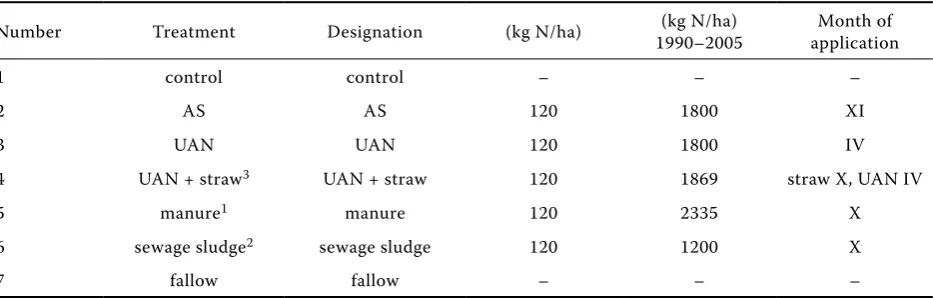
the experiment (i) with continuous cultivation of silage maize was established in 1990 and it consisted of seven treatments: (1) control, (2) am-monium sulphate – aS, (3) urea amam-monium nitrate solution – Uan, (4) Uan + straw, (5) manure, (6) slurry, and (7) unfertilized fallow; each treat-ment was repeated four times. all plots (2–6) were treated with 120 kg n/ha (table 1). the soil was a luvisol, containing 1.66% total C, 0.23% total n, pH was 6.6.
the field experiments (ii) with crop rotation were established in 1996 in five different soils and climatic regions of the Czech republic. there was a rotation of three crops in following order – po-tato, winter wheat and spring barley. the experi-ment consisted of seven treatexperi-ments: (1) control, (2) sewage sludge 1, (3) sewage sludge 3, (4) farm-yard manure, (5) farmfarm-yard manure 1/2 + mineral n-fertilizer, (6) mineral n-fertilizer, (7) mineral n-fertilizer + straw. organic fertilizers (sewage sludge, manure and straw) were applied for potato fertilization in autumn (november) and mineral n-fertilizers were applied in spring (March) for
wheat and barley fertilization (table 2). the size of experimental plots was 60 m2.
Soil samples were collected from the upper soil layer (0–30) cm in autumn (September) every year in the period from 1997 to 2005.
Microbial biomass C and n were estimated by the fumigation-extraction method after pre-ex-traction (Brookes et al. 1985, vance et al. 1987, Wu et al. 1990, Mueller et al. 1992).
Microbial biomass n was calculated as a dif-ference in n content in fumigated and non-fumi-gated sample (En) using kEn coefficient (microbial biomass n = En:kEn). the value of kEn = 0.54 was used to calculate microbial biomass n (Brookes et al. 1985, Jenkinson 1988).
Microbial biomass C was calculated as a differ-ence in C content in fumigated and non-fumigated sample (EC) using kEC coefficient (microbial bio-mass C = EC:kEC). the value kEC = 0.45 was used to calculate microbial biomass C (Wu et al. 1990, Mueller et al. 1992).
RESULTS AND DISCUSSION
Field experiment with continuous cultivation of silage maize
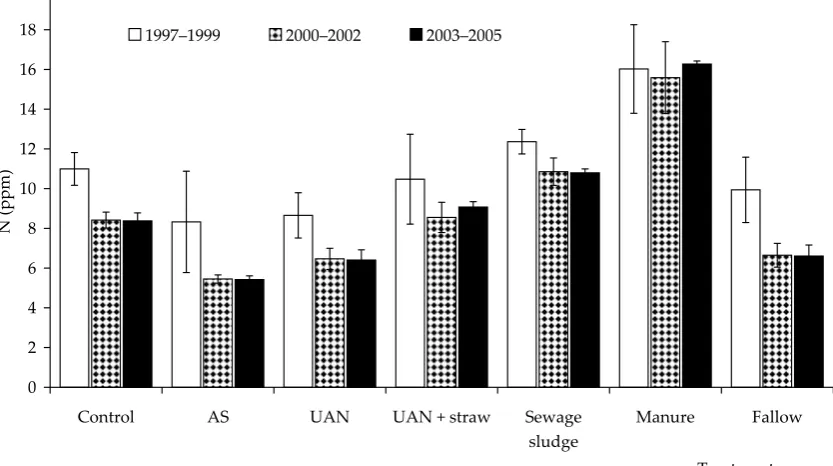
[image:2.595.66.533.579.728.2]the content of microbial biomass C and n de-pended on the treatment. as shown by the evalu-ation of the particular treatments, the highest content of microbial biomass was determined for manure application (Figures 1 and 2). Microbial biomass n was higher by 45% to 95% in the years of observation compared to the control; microbial biomass C was higher by 19% to 32% compared to the control. in the treatments with mineral nitrogen fertilizers microbial biomass was lower table 1. the experiment layout: long-term field experiment with continuous cultivation of silage maize
number treatment Designation (kg n/ha) 1990–2005(kg n/ha) applicationMonth of
1 control control – – –
2 aS aS 120 1800 Xi
3 Uan Uan 120 1800 iv
4 Uan + straw3 Uan + straw 120 1869 straw X, Uan iv
5 manure1 manure 120 2335 X
6 sewage sludge2 sewage sludge 120 1200 X
7 fallow fallow – – –
1manure: 1990, 1992, 1994, 1996–2005 every year; 2sewage sludge 1996–2005 every year; 3straw 1991, 1993,
than in the control. Several studies of microbial biomass documented the effect of manure ap-plications on the increase of microbial biomass C and n (ritz et al. 1997, García-Gil et al. 2000). applications of dairy-feedlot manure showed to maintain or increase soil carbon and microbial biomass to a greater extent than those with mineral fertilization (Dormaar et al. 1988). the application of ammonium sulphate resulted in the content of microbial biomass n lower by 30% compared to the control; for Uan treatment microbial biomass n was lower by 25% compared to the control. the content of microbial biomass carbon was lower
[image:3.595.63.533.84.232.2]by 13% compared to the control; in the treatment with Uan it was lower by 8% compared to the control. lovell and Jarvis (1998) reported that especially regular and long-term applications of nitrogen led to a decrease in the content of soil microbial biomass. on the other hand, Coote and ramsey (1983) stated that nitrogen fertilizers had an indirect positive influence on soil microbial biomass by the increased crop yield, and subse-quently by a higher return of organic n and C into the soil through post-harvest residues. the results of our experiments however indicate that in the field with silage maize a relatively low amount table 2. the experiment layout: long-term field experiments with crop rotation
number treatment Designation (kg n/ha)Potatoes Winter wheat (kg n/ha) Spring barley (kg n/ha)
1 control control –
2 sewage sludge 1 sewage sludge 1 120 – –
3 sewage sludge 3 sewage sludge 3 360 – –
4 manure manure 120 – –
5 manure 1/2 + n manure + n 60 110 55
6 mineral n fertilizer n 120 140 70
7 mineral n fertilizer + straw n + straw 120 140 70
organic fertilizers (potato block): X; mineral n fertilizers (winter wheat block): iii + iv; mineral n fertilizers (spring barley block): iii
Figure 1. the content of microbial biomass nitrogen in soil (long-term field experiment with continuous cultiva-tion of silage maize); aS – ammonium sulphate; Uan – urea ammonium nitrate solucultiva-tion
0 2 4 6 8 10 12 14 16 18 20
Control AS UAN UANȱ+ȱstraw Sewage
sludge
Manure Fallow
Treatments
N
ȱ(p
pm
)ȱ
[image:3.595.89.506.487.720.2]of organic residues returns into the soil in the form of post-harvest residues, namely roots and low stubble in our experiment. it is to note that maize is a crop with negative balance of organic matters (Körschens and Schulz 1999). Microbial biomass was found to be a sensitive indicator of soil disturbance by crop rotation vs. monoculture (anderson and Domsch 1989). the content of
microbial biomass nitrogen in the case of Uan + straw treatment was on the control level. on aver-age, by 19% higher content of microbial biomass nitrogen and by 13% higher content of microbial biomass carbon were determined for Uan + straw treatment compared to Uan application. this finding corresponds to conclusions published by ocio et al. (1991), who measured about 18% higher 0
50 100 150 200 250
Control AS UAN UANȱ+ȱstraw Sewage
sludge
Manure Fallow
Treatments
C
ȱ(p
pm
)ȱ
[image:4.595.93.508.69.301.2]1997–1999 2000–2002 2003–2005
Figure 2. the content of microbial biomass carbon in soil (long-term field experiment with continuous cultiva-tion of silage maize); aS – ammonium sulphate; Uan – urea ammonium nitrate solucultiva-tion
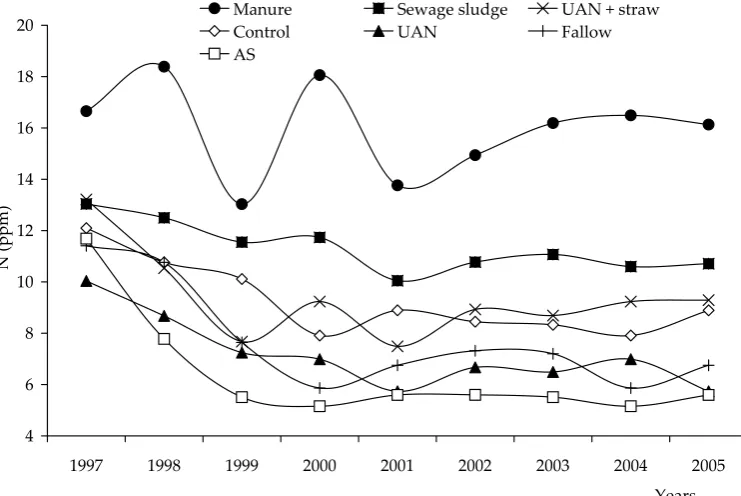
4 6 8 10 12 14 16 18 20
1997 1998 1999 2000 2001 2002 2003 2004 2005
Years
N
ȱ
(p
pm
)
ȱ
Manure Sewageȱsludge UANȱ+ȱstraw
Control UAN Fallow
AS
[image:4.595.118.489.475.723.2]content of microbial biomass n (FE-n) over the control in experiments with straw ploughing-in, a year after its application. Microbial biomass in fallow treatment corresponded to the content of biomass in the control in the years of observation (Figure 3). Control microbial biomass n and C con-tents were found to be higher by 23% and 12% on average compared to fallow land, respectively.
Field experiment with crop rotation
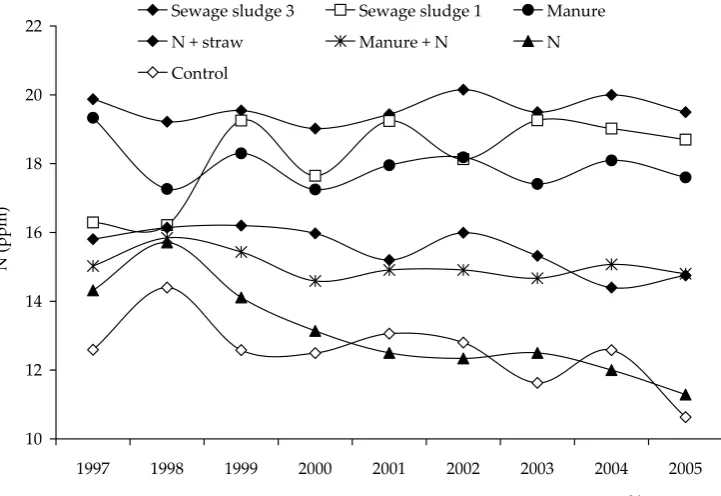
the content of microbial biomass depended on the treatment, soil, climatic region and the year of sampling. Higher contents were found in treatments with organic fertilizers. the highest contents of microbial biomass C and n were es-timated in the plots treated with sewage sludge. the average content of microbial biomass n in the sewage sludge treatment 1 was by 52% higher compared with the control and by 60% higher in the sewage sludge treatment 3.
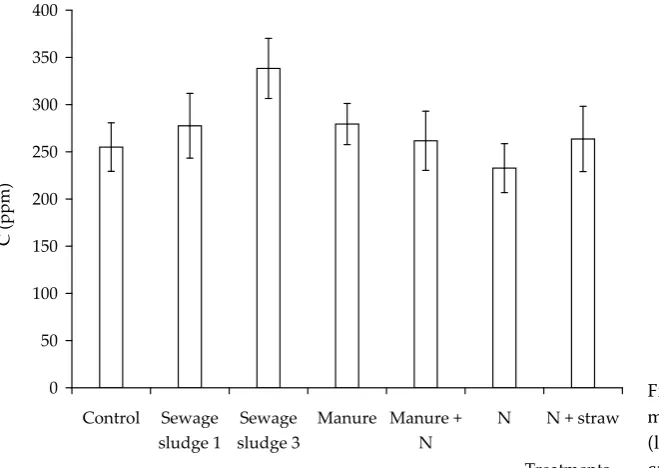
The average content of microbial biomass C in the sewage sludge treatment 1 was by 11% higher compared with the control and it was 36% higher in sewage sludge treatment 3. High amounts of or-ganic inputs often result in high microbial biomass (Flieβbach and Mäder 2000). García-Gil et al. (2000) found microbial biomass C to be 33% higher in soils receiving municipal solid waste compost at the annual rate of 80 t/ha than at 20 t/ha. a positive influence of the manure application on the microbial biomass content was observed. The average contents of mi-crobial biomass n and C were estimated to be by 40% and 12% higher than the control, respectively.
[image:5.595.67.397.523.757.2]the highest contents of microbial biomass C and n in plots with organic fertilizers were found in samples collected during the first year after or-ganic fertilizers application on plots with potato (Figure 4). at the samples from winter wheat and barley plots (samplings of the second and the third year after application of organic fertilizers) the content of microbial biomass nitrogen declined to about half of the amount recorded in the first year after organic fertilizers addition. this value was approx. 15–25% more than in the unfertilized control, but the differences were not significant (Figure 5). a high content of easily decomposable organic C can lead to fast growth of soil microbes, likely resulting in a higher microbial biomass and its activity. For example, Chowdhury et al. (2000) observed that manure compost with high easily decomposable C was more effective than sawdust and rice husk composts in enhancing soil micro-bial biomass C.
in the treatments with mineral n-fertilizers, there was a tendency towards a lower contents of micro-bial biomass, compared to the non-fertilized plots. There were no significant differences between control and mineral n-fertilizers treatments. Flieβbach and Mäder (2000) described, that mineral fertilization had a distinct effect on crop yield, but no positive effect on microbial biomass. However, the addition of straw (n + straw treatment) caused an increase in the content of microbial biomass n by 12% com-pared to n-fertilizers treatment. There were differ-ences between soil conditions and duration of the experiment (Figure 6). During the first six years of the experiment (two crop rotations), there were no differences observed between control and
n-fertil-Figure 4. the average contents of microbial biomass carbon in soil (long-term field experiments with crop rotation – potato block) 0
50 100 150 200 250 300 350 400
Control Sewage sludge 1
Sewage sludge 3
Manure Manure + N
N N + straw
Treatments
C
(p
pm
Figure 5. the average contents of microbial biomass nitrogen in soil (long-term field experiments with crop rotation)
Figure 6. the changes in microbial biomass nitrogen in soil (long-term field experiments with crop rotation – potato block)
0 5 10 15 20 25
Control Sewage sludgeȱ1
Sewage sludgeȱ3
Manure Manureȱ+ȱN N Nȱ+ȱstraw Treatments
N
ȱ(p
pm
)ȱ
Potato Wheat Barley
izers treatments. in the last crop rotation of the experiment the average content of microbial biomass n decreased by 13% in variant with n-fertilizers on experimental sites with sandy-loam soil. There were no differences between control and n-fertilizers treatments on experimental sites with clay-loam soils. in many arable agricultural soils, the soil microbial biomass is related to the soil organic matter content. Microbial biomass is the living part of soil organic
matter, and can be a good index for comparing soil changes (Houot and Chaussod 1995).
REFERENCES
anderson t.H., Domsch K.H. (1989): ratios of micro-bial biomass carbon to total organic carbon in arable soils. Soil Biol. Biochem., 21: 471–479.
10 12 14 16 18 20 22
1997 1998 1999 2000 2001 2002 2003 2004 2005
Years
N
ȱ(p
pm
)ȱ
Sewageȱsludgeȱ3 Sewageȱsludgeȱ1 Manure
Nȱ+ȱstraw Manureȱ+ȱN N
[image:6.595.119.480.477.725.2]Bonde t.a., Schnürer J., rosswall t. (1988): Microbial biomass as a fraction of potentially mineralizable nitrogen in soils from long-term field experiments. Soil Biol. Biochem., 20: 447–452.
Brookes P.C., landman a., Pruden G., Jenkinson D.S. (1985): Chloroform fumigation and the release of soil nitrogen: a rapid direct extraction method to measure microbial biomass nitrogen in soil. Soil Biol. Biochem., 17: 837–842.
Chowdhury M.a.H., Kouno K., ando t., nagaoka t. (2000): Microbial biomass, S mineralization and S up-take by african millet from soil amended with various composts. Soil Biol. Biochem., 32: 845–852.
Coote M.r., ramsey J.F. (1983): Quantification of the effects of over 35 years of intensive cultivation of four soils. Can. J. Soil Sci., 63: 1–14.
Dormaar J.F., lindwall C.W., Kozub G.C. (1988): Ef-fectiveness of manure and commercial fertilizer in restoring productivity of an artificially eroded dark brown chernozemic soil under dryland conditions. Can. J. Soil Sci., 68: 669–679.
Flieβbach a., Mäder P. (2000): Microbial biomass and size-density fractions differ between soils of organic and conventional agricultural systems. Soil Biol. Biochem., 32: 757–768.
García-Gil J.C., Plaza C., Soler-rovira P., Polo a. (2000): long-term effects of municipal solid waste compost application on soil enzyme activities and microbial biomass. Soil Biol. Biochem., 32: 1907–1913. Hassink J. (1994): active organic matter fractions and
microbial biomass as predictors of n-mineralization. Eur. J. agron., 3: 257–265.
Houot S., Chaussod r. (1995): impact of agricultural practices on the size and activity of the soil microbial biomass in a long-term field experiment. Biol. Fertil. Soils, 19: 309–316.
Jenkinson D.S. (1988): The determination of microbial biomass carbon and nitrogen in soil. in: Wilson J.r. (ed.): advances in nitrogen Cycling in agricultural Eco-systems. CaB international, Wallingford: 368–386. Körschens M., Schulz E. (1999): Die organische
Boden-substanz – Dynamik – reproduktion – ökonomisch und ökologisch begründete richtwerte. UFZ-Bericht no. 13, Halle.
lovell r.D., Jarvis S.C. (1998): Soil microbial biomass and activity in soil from different grassland manage-ment treatmanage-ments stored under controlled conditions. Soil Biol. Biochem., 30: 2077–2085.
Martens D.a. (2000): Plant residue biochemistry regu-lates soil carbon cycling and carbon sequestration. Soil Biol. Biochem., 32: 361–369.
Mueller t., Jensen l.S., nielsen n.E., Magid J. (1998): turnover of carbon and nitrogen in a sandy loam soil following incorporation of chopped maize plants, barley straw and blue grass in the field. Soil Biol. Biochem., 30: 561–571.
Mueller t., Joergensen r.G., Meyer B. (1992): Estimation of soil microbial biomass C in the presence of fresh roots by fumigation-extraction. Soil Biol. Biochem.,
17: 179–181.
ocio J.a., Martinez J., Brookes P.C. (1991): Contribu-tion of straw-derived n to total microbial biomass n following incorporation of cereal straw to soil. Soil Biol. Biochem., 23: 655–659.
Peacock a.D., Mullen M.D., ringelberg D.B., tyler D.D., Hedrick D.B., Gale P.M., White D.C. (2001): Soil microbial community responses to dairy manure or ammonium nitrate applications. Soil Biol. Biochem.,
33: 1011–1019.
Powlson D.S., Brookes P.C., Christensen B.t. (1987): Measurement of soil microbial biomass provides an early indication of changes in the total soil organic matter due to straw incorporation. Soil Biol. Bio-chem., 19: 159–164.
ritz K., Wheatley r.E., Griffiths B.S. (1997): Effects of animal manure application and crop plants upon size and activity of soil microbial biomass under organically grown spring barley. Biol. Fertil. Soils, 24: 372–377. Smith J.l., Paul E.a. (1990): the significance of soil
microbial biomass estimations. in: Bollag J.M., Stotz-ky G. (eds.): Soil Biochemistry, vol. 6. Marcel Dekker, inc., new York: 357–396.
Sparling G.P. (1997): Soil microbial biomass, activity and nutrient cycling as indicators of soil health. in: Pankhurst C., Doube B.M., Gupta v.v.S.r. (eds.): Bio-logical indicators of Soil Health. CaB international, Wallingford: 97–119.
vance E.D., Brookes P.S., Jenkinson D.S. (1987): an extraction method for measuring soil microbial bio-mass C. Soil Biol. Biochem., 19: 703–707.
Wu J., Joergensen r.G., Pommering B., Chaussod r., Brookes P.C. (1990): Measurement of soil microbial biomass C – an automated procedure. Soil Biol. Bio-chem., 22: 1167–1169.
received on March 20, 2008
Corresponding author:
ing. Jindřich Černý, Ph.D., Česká zemědělská univerzita v Praze, Fakulta agrobiologie, potravinových a přírodních zdrojů, Kamýcká 129, 165 21 Praha, Česká republika