© 2019, IRJET | Impact Factor value: 7.211 | ISO 9001:2008 Certified Journal
| Page 5948
Effect of Core wall on Torsional and Dynamic Behaviour of High –Rise
Flat Slab Structure
Supriya S
1, H.S Narashimhan
21
PG Student, Department of Civil Engineering, Malnad College of Engineering, Hassan, Karnataka, India
2
Associate Professor, Department of Civil Engineering, Malnad College of Engineering, Hassan, Karnataka, India
---***---
Abstract:- From last two decades there is a high increase in the high-rise buildings and modern trend is towards high rise structures. In tall buildings with increase in height lateral loads have prime consideration. From the effect of gravity resulting most common loads are dead load, live load and snow load. Buildings are also subjected to lateral loads caused by wind and earthquake. Due to the lateral loads develop high stresses, produce sway movement or vibrations. Flat slab is mostly used system to avoid the beam-column clogging, and it is very economical. Flat slabs directly transfer the loads to columns without beams. But flat slabs are not efficient in transfer the lateral loads. Punching shear strength around the column-slab connections always possess a problem. Punching shear is a type of failure of reinforced concrete slabs subjected to high localized forces. When the total shear force exceeds the shear resistance of the slab, the slab will be pushed down around the column is termed as punching shear in flat slabs. This results in the column breaking through the portion of the surrounding slab.
Key words: Flat slab, Shear wall, Torsional irregularity, Storey drift, Equivalent static Method, Time history dynamic analysis
1. INTRODUCTION
During the design of buildings, many external effects such as earthquake, wind, snow should be considered. The earthquakes are the most unpredictable and devastating among the natural disasters and in recent years however, a trend of high-rise buildings with complex planning and irregular vertical elevations are trending in a big way but which is a difficult task to evaluate the seismic behaviour of irregular buildings.
Torsion in buildings during earthquake is caused due to various reasons and the most common is unsymmetrical distribution of mass and stiffness along the height of building. For practical purposes, major seismic codes distinguish between irregularity in plan and elevation, but it must be realized that quite often structural irregularity is the result of a combination of both.
2. METHODOLOGY
In the present study, an high-rise/tall structure has been considered as per the specifications of IS 16700-2017 and it is analysed by taking it as 4 models for better understanding using ETABS 2015 using equivalent static and time history dynamic analysis.
Model 1- Beam slab system irregular structure.
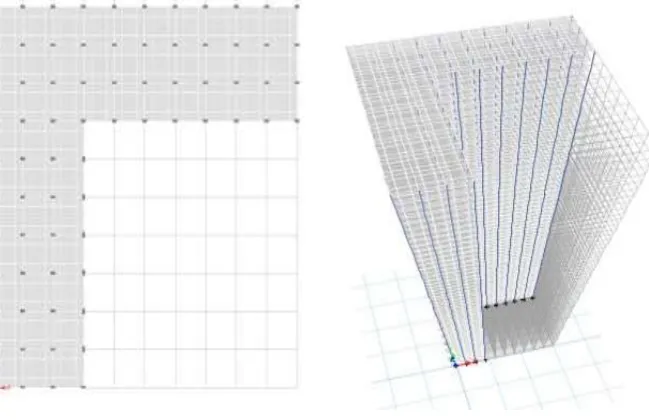
Model 2- Flab slab system irregular structure without core wall.
Model 3- Flab slab system irregular structure with core wall location Model 4- Flab slab system irregular structure with core wall location
For the above models, the torsional behaviour is studied and conclusions are made with respect to safety of tall structural systems considered.
2.1 Material Properties
Table 1:- Material Properties
Grade of Concrete, fck M-50
Grade of Steel, fst Fe-500
© 2019, IRJET | Impact Factor value: 7.211 | ISO 9001:2008 Certified Journal
| Page 5949
2.2 Model DescriptionTable 2:- Material Properties
Number of bays along X Dir 10
Number of bays along Y Dir 10
Bay width along X and Y Direction each 5m
Number of stories 60
Storey Height 3 and 4Mtrs
Storey Height at Ground floor 4 and 5Mtrs
Beam Dimension 300X600MM
Column Dimension 400X900MM
Slab Thickness 150MM
2.3 Analysis
The modelling and analysis of the building is carried out using ETABS 2015 and the method of seismic analysis now considered is Equivalent Static Method and Time History Analysis.
2.4 Model Details with Plan and Elevation
[image:2.595.122.263.338.468.2]1) Model 1:- Beam slab system irregular structure
Fig- 1 Plan View of Model 1 Fig- 2 3D View of Model 1
[image:2.595.131.456.533.743.2] [image:2.595.302.457.540.743.2]2) Model 2:- Flab slab system irregular structure without core wall
© 2019, IRJET | Impact Factor value: 7.211 | ISO 9001:2008 Certified Journal
| Page 5950
3) Model 3:- Flab slab system irregular structure with core wall locationFig-5 Plan view of Model 3 Fig-6 3D view of Model 3
4) Model 4:- Flabslab system irregular structure with core wall location
© 2019, IRJET | Impact Factor value: 7.211 | ISO 9001:2008 Certified Journal
| Page 5951
3. RESULTS AND DISCUSSIONResults for 240 m height tall buildings
3.1 Lateral load analysis: Equivalent Static analysis as per IS 1893- 2016
Equivalent Static analysis has been carried out as per IS 1839-2016 for high seismic zone and results are extracted and presented in the form of tables and graphs.
[image:4.595.165.434.214.480.2]3.1.1 Base Shears
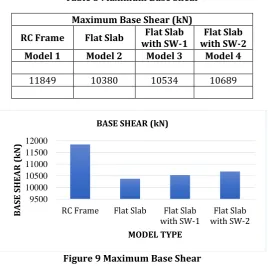
Table 3 Maximum Base Shear
Maximum Base Shear (kN)
RC Frame Flat Slab with SW-1 Flat Slab with SW-2 Flat Slab Model 1 Model 2 Model 3 Model 4
11849 10380 10534 10689
Figure 9 Maximum Base Shear
[image:4.595.126.470.550.745.2]From base shear response of all the structural systems, it is observed that, conventional RC frame structural system has relatively large base shear compared to all other structural systems. With the removal of beams from the structural system about 12% reduction in base shear is observed in flat slab structural system.
Table 1 Torsional Moment
Torsional Moment (kN-m)
RC Frame Flat Slab Flat Slab with SW-1 Flat Slab with SW-2
456261 400149 402193 410769
Figure 10 Torsional Moment
9500 10000 10500 11000 11500 12000
RC Frame Flat Slab Flat Slab
with SW-1 with SW-2Flat Slab
B A SE SHEAR ( kN) MODEL TYPE BASE SHEAR (kN)
360000 380000 400000 420000 440000 460000 480000
RC Frame Flat Slab Flat Slab with
SW-1 Flat Slab withSW-2
© 2019, IRJET | Impact Factor value: 7.211 | ISO 9001:2008 Certified Journal
| Page 5952
Similar to Base Shear, torsional moment at the base of the structure is found to be around 10% more in RC frame with respect to all other structural systems.3.2 Dynamic Time History Analysis
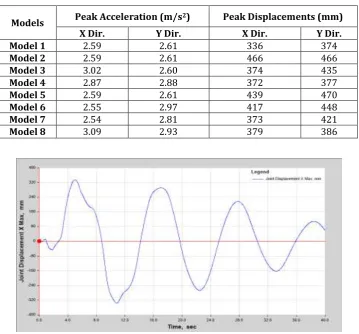
[image:5.595.119.479.198.532.2]Dynamic time history analysis has been carried out for ELCENTRO earthquake and key results are presented and summarised in this section. Peak Responses
Table 3 Time History Response Summary Chart - ELCENTRO
Models Peak Acceleration (m/s2) Peak Displacements (mm) X Dir. Y Dir. X Dir. Y Dir.
Model 1 2.59 2.61 336 374
Model 2 2.59 2.61 466 466
Model 3 3.02 2.60 374 435
Model 4 2.87 2.88 372 377
Model 5 2.59 2.61 439 470
Model 6 2.55 2.97 417 448
Model 7 2.54 2.81 373 421
[image:5.595.147.451.554.702.2]Model 8 3.09 2.93 379 386
Figure 11 Typical Peak Displacement Response
© 2019, IRJET | Impact Factor value: 7.211 | ISO 9001:2008 Certified Journal
| Page 5953
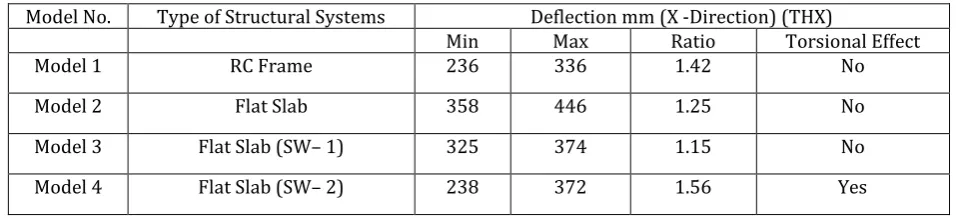
3.2.1 Torsional Irregularity RatiosTable 6 Torsional Irregularity Ratio – THX – 4 m (Storey Height)
Model No. Type of Structural Systems Deflection mm (X -Direction) (THX)
Min Max Ratio Torsional Effect
Model 1 RC Frame 236 336 1.42 No
Model 2 Flat Slab 358 446 1.25 No
Model 3 Flat Slab (SW– 1) 325 374 1.15 No
Model 4 Flat Slab (SW– 2) 238 372 1.56 Yes
[image:6.595.75.519.450.558.2]
Table 7 Torsional Irregularity Ratio – THY – 4 m (Storey Height)
Model No. Type of Structural Systems Deflection mm (Y -Direction) (THX)
Min Max Ratio Torsional Effect
Model 1 RC Frame 287 374 1.30 Yes
Model 2 Flat Slab 364 466 1.28 No
Model 3 Flat Slab (SW– 1) 210 435 2.07 Yes
Model 4 Flat Slab (SW– 2) 243 377 1.55 Yes
Due to dynamic time history effect, Model 4 fall in to torsional irregularity type of structural system along X direction, but with respect to Y direction Model 3 and 4 has the torsion effect.
Table 8 Torsional Irregularity Ratio – THX – 5 m (Storey Height)
Model No. Type of Structural Systems Deflection mm (X -Direction) (THX) Min Max Ratio Torsional Effect
Model 1 RC Frame 307 439 1.43 307
Model 2 Flat Slab 231 417 1.81 231
Model 3 Flat Slab (SW– 1) 234 373 1.59 234
Model 4 Flat Slab (SW– 2) 169 379 2.24 169
Table 9 Torsional Irregularity Ratio – THY – 5 m (Storey Height)
Model No. Type of Structural Systems Deflection mm (Y -Direction) (THX)
Min Max Ratio Torsional Effect
Model 1 RC Frame 305 470 1.54 305
Model 2 Flat Slab 212 448 2.11 212
Model 3 Flat Slab (SW– 1) 170 421 2.48 170
Model 4 Flat Slab (SW– 2) 162 386 2.38 162
[image:6.595.67.534.586.703.2]© 2019, IRJET | Impact Factor value: 7.211 | ISO 9001:2008 Certified Journal
| Page 5954
4. CONCLUSIONSFollowing conclusions are made from results and discussion
With the increase in storey height from 4 m to 5 m, a change in the overall vibrational characterises of the tall structural system has been observed. Unlike in 240 m height building, Conventional RC frame structure has more time period than all other tall structural system.
For the displacement and drift results and discussions it can be concluded that, for tall structural system additional structural component like shear walls are necessary to limit reduce the displacements and drifts.
With respect to torsional irregularity, the core wall has significant effect. From the results of torsional irregularity ratio from both equivalent static and dynamic analysis it can be concluded that, core will (shear walls) will induce additional torsional effect on floors in tall structural systems along both X and Y direction.
With introduction of core wall in both the extreme locations more torsion will be induced.
Also, with the increase in the floor height from 4 to 5 m, the effect of torsion will have impact on the overall performance of the structure.
Hence from the present study, it can be concluded that, for tall structural systems, in addition of core wall, other structural components like outrigger, belt truss, cap truss has to be incorporated to limit the displacements, drifts and torsional rotation of the building.
References
1. Adarsh A, Rajeeva S V, “ Seismic analysis of multi storey reinforced concrete buildings having torsional irregularity”, International Journal of Research in Engineering and Technology, 2017
2. Mario Stefano, “ A review of research on seismic behaviour of irregular building structures since 2002”, Bulletin of Earthquake Engineering, 05/2008
3. Mohammed Fatir, “Relative study of seismic analysis between flat slab and grid slab of RCC structures with different masonry infills in two different zones”, International Journal of Research in Engineering and Technology, 2016
4. Murulidhar G.B, “ Comparision of Performance of Lateral load resisting systems in multi storey flat slab building”, International Journal of Research in Engineering and Technology, 2016
5. Proceedings of the International Symposium on Engineering under Uncertainity; Safety assessment and management(ISEUSAM-2012)”, Springer Nature,2013