© 2019, IRJET | Impact Factor value: 7.211 | ISO 9001:2008 Certified Journal
| Page 1202
PREDICTION OF FRUITS AND FLOWERS USING IMAGE ANALYSIS
TECHNIQUES
K. Gowsalya
1, P. Sridevi
21
Research Scholar, Department of Computer Science, Vellalar College for Women, Erode,
2
Assistant Professor, Department of Computer Science, Vellalar College for Women, Erode, Tamilnadu, India,
---***---ABSTRACT
-
Digital image processing is a technique used for enhancement of the image and to improve the efficiency of automatic detection in agricultural product. This system has been developed to predict the yield of fruits and flowers. The key feature of this work is to predict the yield of fruits and flowers in earlier stage using image processing techniques. The ability to predict the yield would benefit the farmers to plant sale, shipment and operations. Digital images are segmented to identify the fruits and flowers. This work includes pre-processing, image segmentation, morphological shape analysis, counting of Regions of Interest (ROI), feature extraction and classification. In this work, dragon fruits and daisy flowers images are used. Segmentation is done by using Fast and Robust Fuzzy C-Mean clustering algorithm. Gradient and magnitude values are extracted in various directions of fruits and flowers using Histogram of Gradient (HOG) feature and classification is done by using minimum distance classifier to display the number the number of fruits and flowers.Keywords: Automated counting, Dragon fruit, Daisy flower, Yield prediction, FRFCM, HOG, MDC
1. INTRODUCTION
Image processing is a method to perform some operations on an image, in order to get an enhanced image or to extract some useful information from it. Image analysis techniques are widely used in agricultural product and food engineering for the identification of cereals, pulses, plant disease, counting of flowers and fruits and grains. It is used in the detection of cracks, dark spots etc. Image processing techniques can be used to enhance agricultural practices by improving accuracy and consistency of processes while reducing farmer’s manual monitoring.
In agriculture the counting of fruits and flowers play an important role to estimate the amount of harvest. The manual counting of fruits and flowers in a farm is very tedious job. It needs plenty of time to complete the task, high cost and has low accuracy. Image processing techniques helps to count the harvest of the field/orchard. The automated fruit and flower counting is introduced in the agriculture field by using digital image analysis to count the total number of fruits/flowers.
Manual counting of products in farm may lead to bad estimations due to the inaccuracy. If it is overestimated, it will cause the farm to lose money on the shipping part. On the other hand, the products are underestimated; the farm will suffer from insufficient pickers and packer to handle the bigger amount of harvested product. The pre-order shipment needs to add-on extra weight to ship all fruit out to desired destinatiadd-on. There is no automated system designed to count the total number of fruits or flowers before harvesting. The automated fruit and flower counting technique is a helpful system for the agricultural community. It consists of six steps which are image acquisition, image noise removal, image segmentation, object recognition, automated fruit and flower counting and yield prediction.
2. REVIEW OF LITERATURE
Najmah Alharbim et al. [1] presented an automatic system based on image processing techniques and machine learning algorithms for counting wheat spikes (ears) on wheat plant images. It consists of three main functions: pre–processing raw images, segmenting the area of wheat ears from other regions and estimating the number of wheat ears through clustering and regression. The system is tested by using wheat plant images taken from wheat fields. The results showed that the system is achieved an average accuracy of 90.7% with a standard deviation of 0.055.
Tao Lei et al. [2] proposed Fast and Robust Fuzzy C-Means clustering algorithm for image segmentation to improve the segmentation quality and reduce the influence of image noise. FRFCM algorithm employs MR to replace mean or median filters due to its robustness to noise. It is simpler and significantly faster for computing the distance between pixels within local spatial neighbors and clustering centers.
© 2019, IRJET | Impact Factor value: 7.211 | ISO 9001:2008 Certified Journal
| Page 1203
error is 8.07% for Dragon fruit and 5.54% for Daisy flower. The experimental results conclude that Cr channel of YCbCr color model gives better results.Suvarna Nandyal prof et al. [8] presented a Crop Growth Prediction Based on Fruit Recognition Using Machine Vision. In which the fruit region is located and segmented using edge detection and circular fitting algorithm. The color and shape features are extracted for the fruit region. The recognition accuracy of only 90% is observed.
H N Patel, et al [10] has worked on efficient location of fruit on the tree is one of the major requirements for the fruit harvesting system and implements the fruit detection using shape analysis. The algorithm was composed of edge detection, region labeling and circle fitting based detection. The Edge detection and combination of a circular fitting algorithm is applied for the automatic segmentation of fruit in the image. The results showed that the work can accurately segment the occluded fruits with the efficiency of 98% and the average yield measurement error was found as 31.4 %.It was designed to solve the problems of varying illumination and fruit occlusion through segmentation and shape-based detection.
3. METHODOLOGY
Agriculture is the most supreme source for human living as it provides requisite food for human alive and consumption and also plays a major role in the economy of the country. In agriculture, the counting of fruits and flowers plays a major role to estimate the amount of harvest. Without predicting yield of fruit and flowers, the farmers does not able to plan the sales, the shipment, operations related to the harvest and it also leads to money lose.
The phases involved in this system are represented by using Fig 1,
Image Collection
Segmentation using FRFCM clustering algorithm Object recognition using morphological shape analysis Histogram of Gradient (HOG) feature extraction Classification using minimum distance classifier
Fig.1 Architecture of proposed system Counting of fruits and flowers
Segmentation (using Fast and Robust Fuzzy
C-Mean)
Object recognition (using morphological shape
analysis)
Feature extraction (using Histogram of Gradient)
Classification (using minimum distance
classifier)
Display the count of fruits and flowers
© 2019, IRJET | Impact Factor value: 7.211 | ISO 9001:2008 Certified Journal
| Page 1204
The images of dragon fruit and daisy flower is acquired from the agriculture farm by using digital camera as shown in Fig 2.Fig.2 Dragon Fruit Daisy Flower
A. SEGMENTATION USING FAST AND ROBUST FUZZY C-MEANS (FRFCM)
Image segmentation is the process of partitioning an image into numerous segments to find the object of interest. In this work segmentation is carried out with Fast and Robust Fuzzy C-Means clustering algorithm (FRFCM) method and it employs the morphological reconstruction (MR).To improve the image quality without using any filter is done by using FRFCM method. FRFCM is better suit for removing different type of noise.
Steps in FRFCM algorithm
Step 1: Set the cluster prototype value c, fuzzification parameter m, the size of filtering window w and the minimal error threshold ὴ.
Step 2: Compute the new image € by using following equation and compute the histogram of €. (1)
Where denotes morphological closing reconstruction and f represents an original image. Step 3: Initialize randomly the membership partition matrix U (0).
Step 4: Set the loop counter t = 0.
Step 5: Update the clustering centers using following equation. (2)
(3)
Where represents the fuzzy membership of gray value with respect to cluster , and (4)
Step 6: Update the membership partition matrix U(t+1)using (2),
Step 7: If then stop, otherwise, set t = t + 1 and go to Step 5.
Step 8: Implement median filtering on membership partition matrix U’ using following equation,
(5)
After applying FRFCM method, the image is segmented with simultaneously removing the noise is shown in Fig 3.
Fig.3 Segmentation using FRFCM
B. OBJECT RECOGNITION – MORPHOLOGICAL SHAPE ANALYSIS
© 2019, IRJET | Impact Factor value: 7.211 | ISO 9001:2008 Certified Journal
| Page 1205
Fig.4 Morphological shape analysisC. HISTOGRAM OF GRADIENT (HOG) FEATURE EXTRACTION
Histogram of Oriented Gradients (HOG) technique is used for feature extraction to extract the gradient value of image. HOG features are obtained by orientation histograms of edge intensity in local region. The features such as gradient computation, orientation binning, descriptor blocks and block normalization are used for classification. The dragon fruit and daisy flower image is segmented into small connected cells for gradient calculation. Each cell calculates a histogram of gradient directions for the pixels within the cell. To improve accuracy, block is obtained by calculating a measure of the intensity over a larger region of the image for contrast normalization of local histogram and then using this value to normalize all cells within the block.
Gradient Computation
Gradient is a directional change in the intensity in an image. Compute gradient on both horizontal and vertical directions
Then magnitude m and direction O of the gradients are computed by the following equation (6)
(7)
Orientation Binning
Create cell histograms, the cell can either be rectangular or horizontal. The histogram channels are evenly spread over 0 to 180 or 0 to 360 degrees depending whether the gradient is “unsigned” or “signed”.
Descriptor Blocks
The blocks are divided into two types, R-HOG
C-HOG
R-HOG represents the square grids and the C-HOG represents the centered grid. These cells are angularly divided.
Block Normalization
The large histogram is obtained by combining all generated histogram. In order to reduce the influence of variations in illumination and contrast, L1-norm is adopted in this work. The large histogram is normalized by
(8)
Where Vk is the vector for combined histogram, € is a small constant, and v is the normalized vector, which is a final
HOG feature of dragon fruit and daisy flower.
D. CLASSIFICATION USING MINIMUM DISTANCE CLASSIFIER
Image classification refers to the task of extracting information classes from image. Minimum distance classifier is used to classify unknown image data to classes which minimize the distance between the image data and the class in multi-feature space.
Steps in Minimum Distance Classifier (MDC) Calculate the mean vector for each class
Calculate the statistical (Euclidean) distance from each pixel to class mean vector Assign each pixel to the class it is closest to
The minimum distance classifier is defined by the following equation: Mean : (9)
Euclidean distance :
© 2019, IRJET | Impact Factor value: 7.211 | ISO 9001:2008 Certified Journal
| Page 1206
X - Vector of image data (n bands)mk - Mean of the kth class
mk - sum [m1,m2,….mn]
T - Transportation of the elements
The images are classified as fruit or flower using minimum distance classifier based on HOG features. Finally, the number of fruits and flowers will be displayed are shown in Fig 5.
Fig.5 Classification using minimum distance classifier
4. RESULTS AND DISCUSSION
EXPERIMENTAL RESULTS
The proposed work counts the number of dragon fruits and dasiy flowers using minimum distance classifier (MDC). Dragon fruits is red in color and round in shape. The average production in one hectare is more than 10 tons per hectare. The size of fruit depends on several factors such as weather, sufficient water and farm management. The spacing of daisy plant between the rows should be 30-40 cm and 25-30 cm within the row accommodating 8-10 plants/m2.. The reference yield takes
the average of the flowers under open conditions are around 130-160 flowers/m2/year.
This work has been implemented using Matlab tool. The image data set is collected from www.scribd.com and www.krishisandesh.com. The proposed work is tested with 100 images. Among them 10 images are used to display the result.
Counting of Dragon Fruits
Sample dragon fruit images
Img1 Img2 Img3 Img4 Img5
[image:5.595.266.329.169.226.2]Img6 Img7 Img8 Img9 Img10
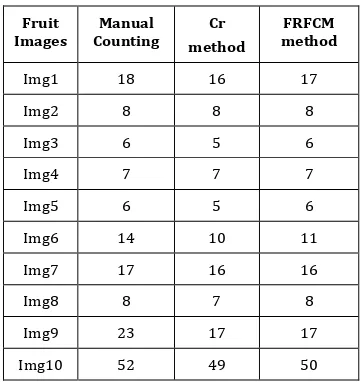
Table 1 Comparison of Cr and FRFCM method
Fruit
Images Counting Manual method Cr method FRFCM
Img1 18 16 17
Img2 8 8 8
Img3 6 5 6
Img4 7 7 7
Img5 6 5 6
Img6 14 10 11
Img7 17 16 16
Img8 8 7 8
Img9 23 17 17
Img10 52 49 50
[image:5.595.207.389.537.728.2]© 2019, IRJET | Impact Factor value: 7.211 | ISO 9001:2008 Certified Journal
| Page 1207
Fig.6 Performance analysis of dragon fruitsCounting of Daisy Flowers
Sample daisy flower images
Img1 Img2 Img3 Img4 Img5
[image:6.595.187.405.77.234.2]Img6 Img7 Img8 Img9 Img10
Table 2 Comparison of (Cr) and FRFCM method
Flower Images
Manual Counting
Cr
method
FRFCM
method
Img1 19 17 18
Img2 7 7 6
Img3 6 7 6
Img4 19 17 19
Img5 7 8 8
Img6 20 20 21
Img7 18 17 18
Img8 28 25 26
Img9 12 10 12
Img10 9 8 9
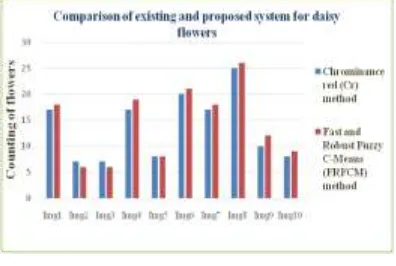
The Fig 7 represents the performance analysis of fruits counting. FRFCM clustering algorithm have higher optimized value when compared with the existing chrominance red (Cr) method.
[image:6.595.205.392.394.587.2] [image:6.595.199.397.633.766.2]© 2019, IRJET | Impact Factor value: 7.211 | ISO 9001:2008 Certified Journal
| Page 1208
5. CONCLUSION
Nowadays the automated counting systems are high demand in agricultural field. In this work, an automatic system is developed based on image processing algorithms for counting fruits and flowers. FRFCM clustering algorithm is used to segment the region of interest, morphological shape analysis is applied to analyze the shape of fruits and flowers, HOG features are extracted and minimum distance classifier is used to estimate the count and predict the yield of the dragon fruits and daisy flowers. The simulation result shows better performance in accuracy and time. In future, the system will be enhanced by using various techniques in segmentation, object recognition, feature extraction and classification.
REFERENCES
1) Najmah Alharbi, Ji Zhou and Wenjia Wang., “Automatic Counting of Wheat Spikes from Wheat Growth Images”, In Proceedings of the 7th International Conference on Pattern Recognition Applications and Methods, ISBN: 978-989-758-276-9, [2018].
2) Tao Lei, XiaohongJia, Yanning Zhang, Lifeng He, Hongying Meng, and Asoke K. Nandi, “Significantly Fast and Robust Fuzzy C-Means Clustering Algorithm Based on Morphological Reconstruction and Membership Filtering”, IEEE Transactions On Fuzzy Systems, 1063-6706 (c) IEEE, [2018].
3) Salome Hema Chitra H, Suguna S and Naganandini Sujatha S, “A Survey on Image Analysis Techniques in Agricultural Product”, Indian Journal of Science and Technology, Vol 9(12), [2016].
4) Humaira Nisar, Hoo Zhou Yang and Yeap Kim Ho., “Predicting Yield of Fruits and Flowers using Image Analysis Techniques”, International Journal of Science and Technology, Vol 8(32), [2015].
5) Sai Sundar V, Bagyamani J, “Flower Counting In Yield Approximation Using Digital Image Processing Techniques”, International Journal of Advance Research In Science and Engineering IJARSE, ISSN-2319-8354(E), Vol. No.4, Special Issue (03), [2015].
6) Neetika Bairwa, “Counting of Flowers using Image Processing”, (IJERT) ISSN: 2278-0181 vol. 3 Issuse 9, [2014].
7) Anisha Syal, Divya Garg, Shanu Sharma, “A Survey of Computer Vision Methods for Counting Fruits and Yield Prediction”, International Journal of Computer Science Engineering (IJCSE), ISSN : 2319-7323, Vol. 2 No.06, [2013].
8) Suvarna Nandyal Prof, Jagadeesha, "Crop Growth Prediction Based on Fruit Recognition Using Machine Vision ", International Journal of Computer Trends and Technology (IJCTT) – volume4Issue 9, pp. 3132-3138, [2013].
9) Syal Garg A, and Sharma S, “A Survey of Computer Vision Methods for Counting Fruits and Yield Prediction”, vol.2, pp. 2319-7323, [2013].
10)H N Patel, A D.Patel, "Automatic Segmentation and Yield Measurement of Fruit using Shape Analysis ", International Journal ofComputer Applications (0975 – 8887) Volume 45– No.7, pp. 19-24, [2012].
11)Raphael Linker, OdedCohen, AmosNaor “Determination of the number of green apples in RGB images recorded in orchards ", Computers and Electronics in Agriculture 81, Elsevier, 45–57, [2012].
12)Anil K Jain [2002], “Fundamentals of Digital Image Processing”, Eastern Economy Edition, Prentice Hall of India Private ltd., New Delhi.
13)Rafael C. Gonzalez & Richard E Woods [2000], “Digital Image Processing”, Pearson Education Asia, Addison Wesley Publishing Company Inc.