ISSN Online: 2165-4018 ISSN Print: 2165-400X
DOI: 10.4236/jsbs.2019.94012 Dec. 23, 2019 179 Journal of Sustainable Bioenergy Systems
Influence of Red Pepper (
Capsicum annuum
)
Addition on Bioenergy Production in
Microbial Fuel Cells
Sohyun Chang
1, Min Jae Shin
1, Yujin Kim
2, Sung Jun Jang
2, Seog In Moon
3, Seoyeon Jeong
3,
Richard Shim
3, Fengjun Shen
3, Sara Kang
1, Paul S. Chung
2,31School of Arts & Sciences, Johns Hopkins University, Baltimore, MD, USA 2Fuzbien Technology Institute, Rockville, MD, USA
3Youth with Talents, Fairfax, VA, USA
Abstract
The current study was performed to evaluate the beneficial effect in the power output of microbial fuel cells (MFCs) through supplementation of dried red pepper (Capsicum annuum) powder into the anodic chamber. Mediator-less H-type MFCs were set up where the anode chamber contained rumen micro-organisms as inocula on cellulose (Avicel) and the cathode chamber of phos-phate buffered saline (pH 7.4), both separated by cation exchange membrane. Electrical power generation in MFC was monitored daily over a 10-day pe-riod and the accumulated amounts and components of gaseous byproducts were measured at the end of 10 d operation of MFC. For both groups of MFCs with red pepper and the control, the head space gases collected were methane and CO2, and its volume and composition were similar between treatments.
Methane and CO2 produced for 10 d operation were 210.7 and 106.5 mL,
re-spectively, in MFC. The addition of red pepper powder caused an average power density to increase from 24.0 mW/m2 to 39.6 mW/m2 (P < 0.0001).
The greatest power density was 25.9 and 35.6 mW/m2 for control and
bellflow-er, respectively. This study provides the strong evidence that red pepper (Cap-sicum annuum) supplementation might modify the anaerobic fermentation characteristics of rumen microorganisms in anode chamber and improve the cellulosic bioenergy production in MFC.
Keywords
MFC, Capsicum annuum, Bioenergy Production
How to cite this paper: Chang, S.-H., Shin, M.J., Kim, Y.-J., Jang, S.J., Moon, S.I., Jeong, S.-Y., Shim, R., Shen, F.-J., Kang, S. and Chung, P.S. (2019) Influence of Red Pepper (Capsicum annuum) Addition on Bioenergy Production in Microbial Fuel Cells. Journal of Sustainable Bioenergy Systems, 9, 179-188.
https://doi.org/10.4236/jsbs.2019.94012
Received: September 19, 2019 Accepted: December 20, 2019 Published: December 23, 2019
Copyright © 2019 by author(s) and Scientific Research Publishing Inc. This work is licensed under the Creative Commons Attribution International License (CC BY 4.0).
DOI: 10.4236/jsbs.2019.94012 180 Journal of Sustainable Bioenergy Systems
1. Introduction
Fossil fuels such as petroleum, coal and natural gas are limited resources that will be eventually depleted and are not renewable in short term, however have served as the main energy resources for the past century [1] and represent around 79.4% of the global primary energy use in 2001 [2]. Fossil fuel combustion and natural gas and petroleum systems generate tremendous amount of greenhouse gases such as CO2, methane (CH4) and nitrous oxide (N2O) to atmosphere [3]
and represent 94% to 96% of total greenhouse emission in the USA [4]. Green-house gases absorb infrared radiation and consequently result in global warm-ing. Demands on technologies generating clean and sustainable energy sources that would replace or displace fossil fuels are increasing for these energy and en-vironmental concerns [5].
Cellulosic biomass is particularly attractive renewable resources for clean and sustainable energy production because of its low cost, abundance [6] [7] and neutral carbon balance [8]. Cellulose is a significant component in the annual production of 1.3 billion dry tons of biomass feedstock, 250 million tons of mu-nicipal solid wastes and 40 billion cubic meters waste water [9]. Cellulosic bio-mass can be used in the production of bioethanol [10] biodiesel [11] and hydro-gen and electricity [8].
The direct conversion of biomass to electric energy through microbial fuel cells (MFCs) system or to biohydrogen through microbial electrolysis cells (MECs) system is the potential clean and sustainable energy production representing alternative methods of renewable energy recovery [12]. MFCs and MECs are bioelectrochemical reactors that convert wide range of renewable biomass and wastewaters using electrochemically active microorganisms as biocatalysts di-rectly into electricity [12] or biohydrogen [13] that are endowed with tremend-ous electron donor versatility including glucose, acetate, and lactate [14] [15] [16]; municipal and industrial wastewaters [17] [18] and cellulose [1][19][20] [21] [22]. Electrochemically active microorganisms in MFCs or MECs transfer electrons to anode and initiate electric current, however none of them showed cellulolytic activity to directly generate electrons but require products of cellu-lose hydrolysis as electron donors [14][23]. With the lack of an isolated micro-organism providing both cellulose lysis and solid extracellular electron acceptor reduction, mixed microorganisms have been tested as biocatalysts for use in MFCs including mixed cultures from sea floor sediments [24], municipal and industrial wastewater or anaerobic digester [25] soil [1], [26] and rumen micro-biota [22].
DOI: 10.4236/jsbs.2019.94012 181 Journal of Sustainable Bioenergy Systems which is a carotenoid [28] and have antioxidant activity [29]. Capsaicin addition has modified microbial fermentation characteristics. Dose of capsaicin decreased intestinal gas production in patients with irritable bowel syndrome [30]. When capsicum oil containing capsaicin was added into rumen microbial fermenta-tion, the ammonia nitrogen concentration was reduced, total VFA production and the propionate proportion were increased, and the acetate proportion and acetate-to-propionate ratio was reduced at higher acidity (pH 5.5), while the total VFA and ammonia N concentrations were reduced and the acetate-to-propionate ratio was increased at lower acidity (pH 7.0) [31].
Therefore, we hypothesized that addition of red pepper (Capsicum annuum) powder which has antioxidant activity and contains capsaicin into anode of MFCs would decrease methanogenesis and increase power generation. In the current study, we established MFCs using rumen mixed microorganisms as biocatalysts to generate electricity from cellulose and investigate the effects of red pepper powder on anolyte gas production and power production.
2. Materials and Methods
1) Microorganisms and culture media: The rumen fluid collected from dry dairy cow was filtered through 4 layers of cheese cloth and glass wool to remove feed debris while flushing CO2 gas through heated copper column, and maintained
anaerobically by flushing and bubbling with CO2 gas through heated copper
column until transferred to MFCs.
A medium containing KH2PO4, 0.48 g; K2HPO4, 0.48 g; (NH4)2SO4, 0.48 g;
NaCl, 0.96 g; Trypticase, 5.0 g; yeast extract, 1.0 g; isobutyric acid, isovaleric ac-id, and DL-2methylbutyric acac-id, 0.1 ml of each; cysteine hydrochloride, 0.5 g; CaCl2·2H2O, 0.13 g; MgSO4·7H2O, 0.2 g; Na2CO3, 4.0 g; sodium fumarate, 1.0 g,
and resazurin, 1.0 mg per 1L of volume with distilled deionized (dd) H2O was
prepared anaerobically [32] and autoclaved at 121˚C for 30 min and stored at room temperature until transferred to MFCs.
Phosphate buffered saline (PBS) was prepared by dissolving NaCl, 8 g; KCl, 0.2 g; Na2HPO4, 1.44 g; and KH2PO4, 0.24 g in 800 ml dd H2O and adjusting pH
to 7.4 and volume to 1 L with dd H2O. PBS was autoclaved at 121˚C for 30 min
and stored at room temperature until transferred to MFCs.
2) Microbial Fuel Cells: Microbial fuel cell was constructed using two 125 mL-volume glass bottles clamped at branched tubular bridge and separated with a cation exchange membrane (CMI-7000S, Membranes International Inc., NJ). Two gram of cellulose (Avicel PH-101, Sigma-Aldrich, MO), 80 mL of anaerobic medium and 20 mL of stained rumen fluid were transferred to the anode cham-ber and suspended by agitation. Graphite flat stick (12 cm2) connected with copper
wire was placed in the middle of anode chamber and the butyl rubber stopper was placed to prevent air contamination. 100 mL PBS was transferred to the ca-thode chamber and a graphite flat stick (12 cm2) connected with copper wire was
stop-DOI: 10.4236/jsbs.2019.94012 182 Journal of Sustainable Bioenergy Systems per but was made open to air through a tubing on the stopper. Anode and ca-thode were connected externally through a copper wire and a load resistor (300 ohm). MFCs were operated in a water bath at 39˚C for 9 d prior to treatment inoculation
After 9 d of MFC pretrial operation and before the treatments were added, current density of MFCs was 210.3 ± 4.23 mA/m2. MFCs for treatment group
received 0.1 g dried red pepper powder (CJ CheilJedang, Seoul, Korea) in anode chambers at d 0. All anode chamber stoppers were open to the atmosphere in order to equalize pressure and remove headspace gas, then 2 L-volume Mylar balloons were connected to each anode chamber to collect gases produced.
3) Measurements and calculation: During the experimental period, voltage across external resistor, end point potential and current were measured daily using a digital multimeter. The power density (P) was calculated using an equa-tion: P = I × V/A, where I = current, V = voltage, R = external resistance (Ohm), and A (m2) = the projected area of the anode.
In the end of operation at d 10, the volumes of gas produced from anode chamber in Mylar balloons were measured using a 250 mL-glass syringe. Me-thane and CO2 compositions were analyzed using an Agilent 6890 series gas
chromatograph equipped with a thermal conductivity detector and a stainless steel packed column containing 60/80 Carboxen 1000 (12390-U Supelco, Sig-ma-Aldrich, MO).
4) Statistical analyses: Red pepper effects on electricity generation, gas pro-duction and gas composition were analyzed using the one-way ANOVA proce-dure of JPM 14.1.0 (SAS Institute Inc., NC). Significance was declared at P < 0.05.
3. Results and Discussion
3.1. Electricity Generation
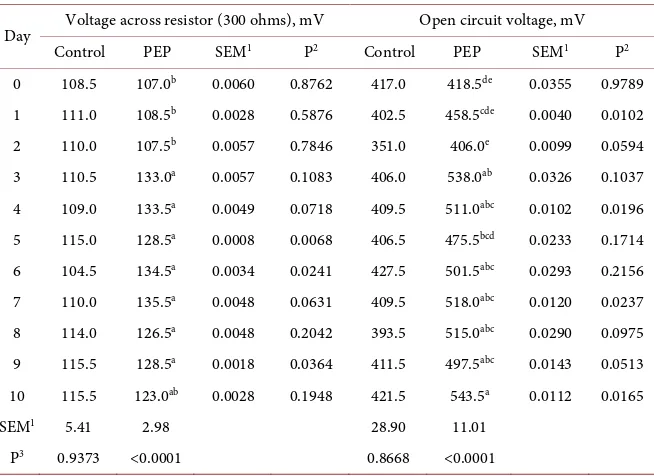
During the 9 d pretrial period MFCs established with 20 mL of stained rumen fluid, 80 mL of anaerobic medium and 2% w/v cellulose (Avicel®) were stabi-lized, and voltage across resistor 109 and 107 mV (P = 0.8762) and open circuit voltage (end point potential) were 417 and 419 mV (P = 0.9789) for control and pepper group MFCs, respectively, prior to treatment addition. Voltages across resistor and end point potential (Table 1) in control MFCs were steady and av-erages were 111 ± 6.4 and 405 ± 35.6 mV, respectively, during 10d operation. In MFCs received red pepper powder, voltages across resistor were higher (P < 0.05) for d 3 through d 9 than for d 0 to d 2, and end point potentials were also higher (P < 0.05) for d 3 though d 10 except d 5 than for d 0 and d 2. Red pepper group yielded greater (P < 0.05) voltage across resistor and end point potential than control group on d 5, 6 and 9, and on d 1, 4, 7 and 10, respectively.
DOI: 10.4236/jsbs.2019.94012 183 Journal of Sustainable Bioenergy Systems
Table 1. Closed circuit voltage across 300 ohms resistor and terminal voltage measured
from microbial fuel cells established with strained rumen fluid and 2 g of cellulose with or without red pepper (Capsicum annuum: PEP) addition.
Day Voltage across resistor (300 ohms), mV Open circuit voltage, mV
Control PEP SEM1 P2 Control PEP SEM1 P2
0 108.5 107.0b 0.0060 0.8762 417.0 418.5de 0.0355 0.9789
1 111.0 108.5b 0.0028 0.5876 402.5 458.5cde 0.0040 0.0102
2 110.0 107.5b 0.0057 0.7846 351.0 406.0e 0.0099 0.0594
3 110.5 133.0a 0.0057 0.1083 406.0 538.0ab 0.0326 0.1037
4 109.0 133.5a 0.0049 0.0718 409.5 511.0abc 0.0102 0.0196
5 115.0 128.5a 0.0008 0.0068 406.5 475.5bcd 0.0233 0.1714
6 104.5 134.5a 0.0034 0.0241 427.5 501.5abc 0.0293 0.2156
7 110.0 135.5a 0.0048 0.0631 409.5 518.0abc 0.0120 0.0237
8 114.0 126.5a 0.0048 0.2042 393.5 515.0abc 0.0290 0.0975
9 115.5 128.5a 0.0018 0.0364 411.5 497.5abc 0.0143 0.0513
10 115.5 123.0ab 0.0028 0.1948 421.5 543.5a 0.0112 0.0165
SEM1 5.41 2.98 28.90 11.01
P3 0.9373 <0.0001 0.8668 <0.0001
abcdeMeans within a treatment with different superscripts differ, P < 0.05. 1Standard error of means. 2P-value: probabilities that treatments effect is not significant within the day. 3P-value: probabilities that day effect is not significant within the treatment.
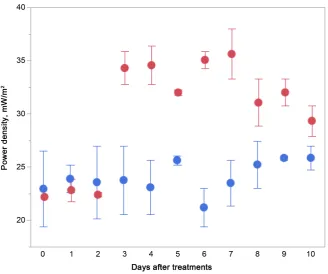
21.2 and 25.9 mW/m2 (Figure 1), however in red pepper group it changed (P <
0.0001) with operation time. Power density increased after d 3 and was main-tained until d 9 in red pepper group. Power density in red pepper group was greater (P < 0.05) than in control group at d 5, 6 and 9. Power density during 10d operation was also greater (P = 0.0009) in red pepper group with average of 30.1 mW/m2 than in control group (24.0 mW/m2). In a similar experiment
per-formed with sole rumen fluid as anolyte [22] the highest and stable power den-sity were 55 and 26.7 mW/m2, respectively, however in their setup, aerobic
po-tassium ferricyanide solution (50 mM K3Fe(CN)6) had been employed as the
ca-tholyte to enhance oxygen reduction while the current MFCs were constructed using PBS which is nontoxic and environmentally friendly as catholyte. Further-more, the performance in the current study could be restricted by the intrinsic large internal resistance of H-type fuel cells with long distance between the anode and cathode and small surface area of the cation exchange membrane [12]. Thus, the performance of the current MFCs will not stand a direct comparison to the previous report, but the stable power density of 24.0 mW/m2 in control group is
close to the previously reported value in the MFC system established with the similar anolyte.
3.2. Gas Production and Composition
DOI: 10.4236/jsbs.2019.94012 184 Journal of Sustainable Bioenergy Systems
Figure 1. Power densities over 10 day operation of MFCs. Anode chambers were
estab-lished for 9d with strained rumen fluid and 2g of cellulose (Avicel®), then 100 mg of red pepper (Capsicum annuum) was added to anode chamber of treatment group. After treatment was added, microbial fuel cells were incubated at 39˚C. And power generation over 300 ohm resistor was measured every 24 hrs. Power densities are presented as least square means (n = 2) with standard error of mean for control ( ) and red pepper treatment ( ). abcMeans within red pepper treatment with different superscripts differ
(P < 0.05). *Means between control and red pepper treatment differ (P < 0.05).
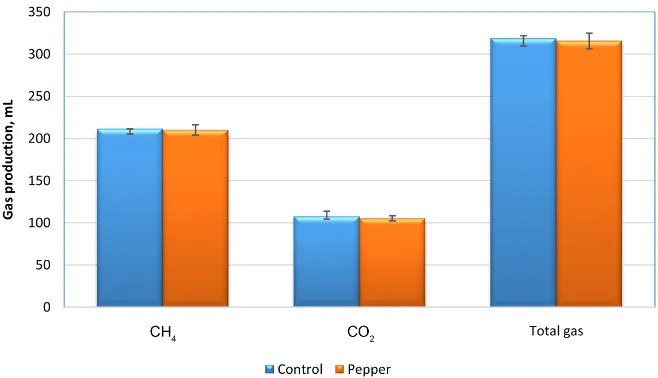
MFCs (Figure 2). Methane (P = 0.8960) and CO2 (P = 0.6862) productions were
also not different between control and treatment group, and volumes were 211 and 107 mL in control group, respectively, and 210 and 106 mL in red pepper group, respectively.
Once sole proton donor substrates, cellulose, were degraded by cellulolytic microorganisms in the anolyte, the ideal glucose decomposition in MFCs is into CO2, proton and electron in anode chamber under anaerobic condition
(C H O6 12 6 6H O2 6CO2 24H 24e
+ −
+ → + + ) [34] by symbiotic microorganisms.
The electrons and the protons move to cathode via the external electrical circuit and the cation exchange membrane, respectively, then reduce oxygen and pro-duce water (24H 24e 6O2 12H O2
++ −+ → ). Overall scheme in whole MFC in
this case is C H O6 12 6+6O2 →6CO2+6H O2 + Electrical energy [34]. Cellulose fermentation products by rumen fluid like the anolyte in the current MFCs are mainly volatile fatty acids including acetate, propionate, and butyrate [35] and these products are readily metabolized and converted to electric energy by elec-trochemically active microbial community on electrode [36]. However, in the most of MFCs, both acetoclastic methanogenesis (CH COO3 H CH4 CO2
DOI: 10.4236/jsbs.2019.94012 185 Journal of Sustainable Bioenergy Systems
Figure 2. Components and total volume of gases produced in the anode chamber of
mi-crobial fuel cells for 10 d operation. Anode chambers were established for 9 d with strained rumen fluid and 2 g of cellulose (Avicel®), then 100mg of red pepper (Capsicum annuum) was added to anode chamber of treatment group. After treatment was added, microbial fuel cells were incubated at 39˚C and gases produced in anode chamber were collected in externally connected Mylar balloons for 10 d. Methane, CO2 and total gas are presented as
least square means (n = 2) with standard deviation.
and hydrogenotrophic methanogenesis (4H2+CO2→CH4+2H O2 ) occurred and reduced the energy production. Both methanogeneses require exogenous energy consumption [37] and reduce the flow of proton and electron to cathode, therefore methane production is regarded as an inefficient process which de-tracts from electricity generation.
In the current study, similar quantity and overall pathway of cellulose fer-mentation in all group can be deduced from the production of total gas, methane and CO2, which were not different between control and red pepper MFCs.
There-fore, the increase in power generation by red pepper addition in the current study may result from changes in intermediate products which were observed in previous capsaicin studies in rumen fluid fermentation [31] and/or the possible favorable environment for electrochemically active microorganisms which can be caused by antioxidant activity of red peppers [29].
4. Conclusion
DOI: 10.4236/jsbs.2019.94012 186 Journal of Sustainable Bioenergy Systems pepper powder may change the intermediate cellulose fermentation products and/or provide antioxidant activity favorable to electrochemically active micro-organisms which transfer electrons to electrode, and increase power generation in MFCs. Further researches are required to investigate the mode and mechan-ism of red pepper effects on symbiosis and electrode reduction in anode or MFCs.
Acknowledgements
The authors acknowledge the STEM Research Institute and Youth with Talents for sponsoring this research project (SRI-2018-6).
Conflicts of Interest
The authors declare no conflicts of interest regarding the publication of this pa-per.
References
[1] Hassan, S.H., Kim, Y.S. and Oh, S.E. (2012) Power Generation from Cellulose Using Mixed and Pure Cultures of Cellulose-Degrading Bacteria in a Microbial Fuel Cell. Enzyme and Microbial Technology, 51, 269-273.
https://doi.org/10.1016/j.enzmictec.2012.07.008
[2] Goldemberg, J. and Johansson, T.B. (2004) World Energy Assessment Overview: 2004 Update. United Nations Development Programme, New York.
[3] Saratale, G. and Oh, S. (2011) Production of Thermotolerant and Alkalotolerant Cel-lulolytic Enzymes by Isolated Nocardiopsis sp. KNU. Biodegradation, 22, 905-919.
https://doi.org/10.1007/s10532-010-9450-0
[4] EPA (2016) Inventory of U.S. Greenhouse Gas Emissions and Sinks: 1990-2014.
https://www.epa.gov/sites/production/files/2016-04/documents/us-ghg-inventory-2 016-main-text.pdf
[5] Levin, D.B., Islam, R., Cicek, N. and Sparling, R. (2006) Hydrogen Production by Clostridium thermocellum 27405 from Cellulosic Biomass Substrates. International Journal of Hydrogen Energy, 31, 1496-1503.
https://doi.org/10.1016/j.ijhydene.2006.06.015
[6] Lynd, L.R., Weimer, P.J., van Zyl, W.H. and Pretorius, I.S. (2002) Microbial Cellu-lose Utilization: Fundamentals and Biotechnology. Microbiology and Molecular Bi-ology Reviews, 66, 506-577. https://doi.org/10.1128/MMBR.66.3.506-577.2002
[7] Schwarz, W.H. (2001) The Cellulosome and Cellulose Degradation by Anaerobic Bacteria. Applied Microbiology and Biotechnology, 56, 634-649.
https://doi.org/10.1007/s002530100710
[8] Niessen, J., Schröder, U., Harnisch, F. and Scholz, F. (2005) Gaining Electricity from in Situ Oxidation of Hydrogen Produced by Fermentative Cellulose Degradation. Letters in Applied Microbiology, 41, 286-290.
https://doi.org/10.1111/j.1472-765X.2005.01742.x
DOI: 10.4236/jsbs.2019.94012 187 Journal of Sustainable Bioenergy Systems
[10] Mielenz, J.R. (2001) Ethanol Production from Biomass: Technology and Commer-cialization Status. Current Opinion in Microbiology, 4, 324-329.
https://doi.org/10.1016/S1369-5274(00)00211-3
[11] Powlson, D.S., Riche, A.B. and Shield, I. (2005) Biofuels and Other Approaches for Decreasing Fossil Fuel Emissions from Agriculture. Annals of Applied Biology, 146, 193-201.https://doi.org/10.1111/j.1744-7348.2005.040056.x
[12] Logan, B.E. and Regan, J.M. (2006) Microbial Fuel Cells-Challenges and Applica-tions. Environmental Science & Technology, 40, 5172-5180.
https://doi.org/10.1021/es0627592
[13] Tremouli, A., Greenman, J. and Ieropoulos, I. (2018) Investigation of Ceramic MFC Stacks for Urine Energy Extraction. Bioelectrochemistry, 123, 19-25.
https://doi.org/10.1016/j.bioelechem.2018.03.010
[14] Bond, D.R. and Lovley, D.R. (2003) Electricity Production by Geobacter sulfureducens Attached to Electrodes. Applied and Environmental Microbiology, 69, 1548-1555.
https://doi.org/10.1128/AEM.69.3.1548-1555.2003
[15] Liu, H., Cheng, S. and Logan, B.E. (2005) Production of Electricity from Acetate or Butyrate Using a Single-Chamber Microbial Fuel Cell. Environmental Science & Technology, 39, 658-662. https://doi.org/10.1021/es048927c
[16] Park, D.H. and Zeikus, J.G. (2002) Impact of Electrode Composition on Electricity Generation in a Single-Compartment Fuel Cell Using Shewanella putrefaciens. Ap-plied Microbiology and Biotechnology, 59, 58-61.
https://doi.org/10.1007/s00253-002-0972-1
[17] Min, B., Kim, J., Oh, S., Regan, J.M. and Logan, B.E. (2005) Electricity Generation from Swine Wastewater Using Microbial Fuel Cells. Water Research, 39, 4961-4968.
https://doi.org/10.1016/j.watres.2005.09.039
[18] Aelterman, P., Rabaey, K., Clauwaert, P. and Verstraete, W. (2006) Microbial Fuel Cells for Wastewater Treatment. Water Science & Technology, 54, 9-15.
https://doi.org/10.2166/wst.2006.702
[19] Ishii, S., Suzuki, S., Norden-Krichmar, T.M., Nealson, K.H., Sekiguchi, Y. and Gor-by, Y.A. (2012) Functionally Stable and Phylogenetically Diverse Microbial Enrich-ments from Microbial Fuel Cells during Wastewater Treatment. PLoS ONE, 7, e30495. https://doi.org/10.1371/journal.pone.0030495
[20] Ren, Z., Ward, T.E. and Regan, J.M. (2007) Electricity Production from Cellulose in a Microbial Fuel Cell Using a Defined Binary Culture. Environmental Science and Technology, 41, 4781-4786.https://doi.org/10.1021/es070577h
[21] Rezaei, F., Richard, T.L., Brennan, R.A. and Logan, B.E. (2007) Substrate-Enhanced Microbial Fuel Cells for Improved Remote Power Generation from Sediment-Based Systems. Environmental Science and Technology, 41, 4053-4058.
https://doi.org/10.1021/es070426e
[22] Rismani-Yazdi, H., Christy, A.D., Dehority, B.A., Morrison, M., Yu, Z. and Tuovi-nen, O.H. (2007) Electricity Generation from Cellulose by Rumen Microorganisms in Microbial Fuel Cells. Biotechnology and Bioengineering, 97, 1398-1407.
https://doi.org/10.1002/bit.21366
[23] Lovley, D.R. (2006) Bug Juice: Harvesting Electricity with Microorganisms. Nature Reviews Microbiology, 4, 497-508. https://doi.org/10.1038/nrmicro1442
[24] Bond, D.R., Holmes, D.E., Tender, L.M. and Lovley, D.R. (2002) Electrode-Reducing Microorganisms That Harvest Energy from Marine Sediments. Science, 295, 483-485.
DOI: 10.4236/jsbs.2019.94012 188 Journal of Sustainable Bioenergy Systems
[25] Higgins, S.R., Lopeza, R.J., Pagalingb, E., Yanb, E. and Cooney, M.J. (2013) Towards a Hybrid Anaerobic Digester-Microbial Fuel Cell Integrated Energy Recovery Sys-tem: An Overview of the Development of an Electrogenic Biofilm. Enzyme and Mi-crobial Technology, 52, 344-351.https://doi.org/10.1016/j.enzmictec.2013.02.017
[26] Rubaba, O., Araki, Y., Yamamoto, S., Suzuki, K., Sakamoto, H., Matsuda, A. and Futamata, H. (2013) Electricity Producing Property and Bacterial Community Structure in Microbial Fuel Cells Equipped with Membrane Electrode Assembly. Journal of Bioscience and Bioengineering, 116, 106-113.
https://doi.org/10.1016/j.jbiosc.2013.01.019
[27] Krause, D.O., Denman, S.E., Mackie, R.I. and Morrison, M. (2003) Opportunities to Improve Fiber Degradation in the Rumen: Microbiology, Ecology, and Genomics. FEMS Microbiology Reviews, 27, 663-693.
https://doi.org/10.1016/S0168-6445(03)00072-X
[28] Cichewicz, R.H. and Thorpe, P.A. (1996) The Antimicrobial Properties of Chile Peppers (Capsicum Species) and Their Uses in Mayan Medicine. Journal of Ethno-pharmacology, 52, 61-70.https://doi.org/10.1016/0378-8741(96)01384-0
[29] Howard, L.R., Talcott, S.T., Brenes, C.H. and Villalon, B. (2000) Changes in Phyto-chemical and Antioxidant Activity of Selected Pepper Cultivars (Capsicum Species) as Influence by Maturity. Journal of Agricultural and Food Chemistry, 60, 1713-1720.
https://doi.org/10.1021/jf990916t
[30] Serra, J. (2012) Intestinal Gas: Has Diet Anything to Do in the Absence of a De-monstrable Malabsorption State? Current Opinion in Clinical Nutrition & Meta-bolic Care, 15, 489-493.https://doi.org/10.1097/MCO.0b013e328356662d
[31] Cardozo, P.W., Calsamiglia, S., Ferret, A. and Kamel, C. (2005) Screening for the Effects of Natural Plant Extracts at Different pH on in Vitro Rumen Microbial Fer-mentation of a High-Concentrate Diet for Beef Cattle. Journal of Animal Science, 83, 2572-2579.https://doi.org/10.2527/2005.83112572x
[32] Goering, H.K. and Van Soest, P.J. (1970) Forage Fiber Analyses (Apparatus, Rea-gents, Procedures, and Some Applications). Agriculture Handbook 379. ARS, USDA, Washington DC.
[33] Choi, S. (2015) Microscale Microbial Fuel Cells: Advances and Challenges. Biosen-sors Bioelectronics, 69, 8-25. https://doi.org/10.1016/j.bios.2015.02.021
[34] Pham, T.H., Rabaey, K., Aelterman, P., Clauwaert, P., De Schamphelaire, L., Boon, N. and Verstraete, W. (2006) Microbial Fuel Cells in Relation to Conventional Anaerobic Digestion Technology. Engineering in Life Sciences, 6, 285-292.
https://doi.org/10.1002/elsc.200620121
[35] Leschine, S.B. (1995) Cellulose Degradation in Anaerobic Environments. Annual Review of Microbiology, 49, 399-426.
https://doi.org/10.1146/annurev.mi.49.100195.002151
[36] Freguia, S., The, E.H., Boon, N., Leung, K.M., Keller, J. and Rabaey, K. (2010) Mi-crobial Fuel Cells Operating on Mixed Fatty Acids. Bioresource Technology, 101, 1233-1238.https://doi.org/10.1016/j.biortech.2009.09.054