doi:10.4236/wsn.2009.15045 Published Online December 2009 (http://www.scirp.org/journal/wsn).
An Application of Context Middleware Based on Fuzzy
Logic for Wireless Sensor Networks
Ye NING1,2, Ruchuan WANG2,3, Shouming MA2, Zhili WANG1
1
Department of Information Science, Nanjing College for Population Program Management, Nanjing, China 2
Institute of Computer Science, Nanjing University of Post and Telecommunications, Nanjing, China 3
State Key Laboratory for Novel Software Technology, Nanjing University, Nanjing, China Email: cathery163@163.com
Received May 25, 2009; revised July 22, 2009; accepted July 25, 2009
Abstract
The research of context-aware computing based on wireless sensor network (WSN) aims at intelligently connecting computers, users, and environment. So its application system should be flexibly adaptable to dy-namic changes of context and application requirements and proactively provides the information satisfied with current context for users. The middleware can be very effective to provide the support runtime services for context-aware computing. In this paper we propose middleware architecture for context processing. This architecture is based on fuzzy logic control (FLC) system for context reasoning and sensor fusion. We pro-pose a formal context representation model in which a user’s context is described by a set of roles and rela-tions correspond to a context space. A middleware prototype has been developed, which detect tourist’ physical context and provide reminding. The experiments prove that the model and approach proposed are feasible.
Keywords:WSN, Context-Aware, Middleware, FLC, Pervasive Computing
1. Introduction
Context-aware has recently become a hot topic in the areas of pervasive computing, which was introduced by Schilit and Theimer [1]. With the development of wireless sensor networks (WSNs), the space and physical context informa-tion can be obtained by a large number of sensor nodes. How to intelligently integrating multiple sensors and sensor fusion is a crucial technology for context processing in WSNs.
To avoid increasing complexity and allow the users is to concentrate on his tasks, applications and services must be aware of their contexts and automatically adapt to their changing contexts-known as context-awareness.
In most situations, humans react opportunistically, switching among a set of possible goals, abandoning and adding new goals in response to events and opportunities. One of the most difficult challenges in designing context aware systems is to recognize and allow for such unpre-dictable behavior [2]. In this respect, middleware can be very effective to provide the support if they can reduce the effort required to develop distributed software and runtime services for applications with the abovementioned charac-teristics, in addition to providing the normal services, such
as interoperability, location transparency, naming service, etc [3].
In this paper, we present the design and implementation of a middleware approach for context-awareness, and adopted fuzzy logic [4] as an intelligent reasoning method for selecting data dissemination protocols in the design of the decision mechanism.
The remainder of the paper continues as follows: in Sec-tion 2 discusses related work and main problem. In SecSec-tion 3 we describe our formal context representation model and the structure of FLC system for Context processing. Sec-tion 4 describes an applicaSec-tion we have developed for our middleware prototype. Finally, the paper ends with conclu-sion in Section 5.
2. Relate Work and Problem Formulation
We are not aware of any integrated middleware platform that aims to achieve all of the goals described above.
The Gaia project [6] developed at the University of Illi-nois is a distributed middleware infrastructure that provides support for ubiquitous computing.
The EasyLiving project [7] from Microsoft focuses on development of an architecture and technologies for intel-ligent environments.
Work at Illinois has developed the Universal Interoper-able Core (UIC) which is a reflective middleware platform designed for handheld devices [8].
Recent research work has focused on middleware exten-sions for pervasive computing by standardizing on web services and service discover-oriented technology [9].
To sum up, it is important that middleware for con-text-aware application should be able to fulfill the follow-ing functionalities and objectives.
1) The middleware architecture should be modular and extensible.
2) The middleware should be based on a service-oriented architecture, in which each application and device is repre-sented as a service entity.
Based on the above-mentioned study, we developed a middleware for pervasive computing, which adopted fuzzy logic as context processing method.
3. Fuzzy Logic Based Context Processing
3.1. A Formal Context Representation Model
We use a context space theory model shown in [10] for model fundamental nature of context and enable context and situation awareness for context processing. Our con-text model gives a common representation for concon-text that all entities in the environment use of pervasive computing. Instead, it provides a common base on which various reasoning mechanisms can be specified to handle context.
Definition 1:
We define a attribute value as any type of data that is associated with Contextual information, include physical contexts, environmental contexts, informational contexts, personal contexts, social contexts, application contexts and system contexts [11].
i
a
Definition 2:
For a context state , defined over a collection of N attribute-values, where each value
corresponds to an attribute ’s value at time t. )
, , ( 1t 2t Nt
t
i a a a
C
i a t i a Definition 3:
Let be a context space in an environment of
per-vasive computing, describes the application’s current state in relation to chosen context. In our model, context spaces are represented as first-order calculus. The basic model has the form of predicate(subject,Catt), in which
space C
- : set of the expression entity of context information, e.g. visitor, location, etc.
* S
subject
- : set of predicate name, e.g. is located in, has status, etc.
* V
predicate
- : set of all values of context state in , e.g. warm, cold, open, close, empty, etc.
* att
C C S*
For example, Location (Marry, laboratory) means Marry is located in the laboratory.
The basic context model can be extended to form a set of contexts by combining the predicate and Boolean al-gebra (union, intersection and complement).
For example,
y,90) Pluse(Marr y,38)
ature(Marr
BodyTemper
repre-sents physical signs about Marry.
3.2. Fuzzy Logic-Based Context Processing
Fuzzy logic was proposed by Lotfi A. Zaheh in 1965 [12] to emulate the way that the human brain processes un-certainty, unun-certainty, imprecision, and vagueness. Fuzzy logic is suitable for context management because it is capable of processing imprecise and unreliable informa-tion coming from pervasive computing, and it can de-scribe a problem in a common sense format in which expert knowledge, instead of differential equations, can be applied [13].
For , be an input is applied to a FLC
system, the inference engine computes the output set corresponding to each rule. On analyzing the context processing of various potential services, we use singleton fuzzification and “IF-THEN” rules of form [14].
space C ,
ai ai
Rl: IF is and is and …and is ,
THEN y is . 1 a
G
l
F1 a2
l
F2 aN
l N
F
l
Assuming singleton fuzzification, when an input is applied, the degree of firing corre-sponding to lth rule is computed as
} , , {
A' a1' a'N
) ( T ) ( * * ) ( * )
( 1 '
' ' 2 ' 1 2
1 F i
N i N F F
Fl a l a Nl a il a
Where
* and T both indicate the chosen t-norm. In this paper, we focus on the height defuzzifier and used trapezoidal membership ship functions to represent low, high, very strong, very weak to represent moderate, medium, strong, and weak.
In this paper, we are primarily interested in developing middleware based on the structure of FLC mentioned above. We design a FLC system for travels services, which is one of component in our pervasive computing prototype Tourist Reminder.
On analyzing the data requirements of travels services, four linguistic variables were defined, representing the physical sign of tourist. The membership functions of these input parameters of the fuzzy logic are illustrated in Figure 1.These member functions have been determined based on the simulation result. The labels in the fuzzy variables are presented as follows.
Age= {infant, youth, midage, old};
BodyTemp= {Normal};
Pulse= {t1, t2, t3, t4}; //different intervals of nor-mal pulse
R= {N (Normal), L (Lower), H (Higher)};// degree of reminding for physical signs
Based on above fuzzy variables, we can define fuzzy IF-THEN rules such as follows.
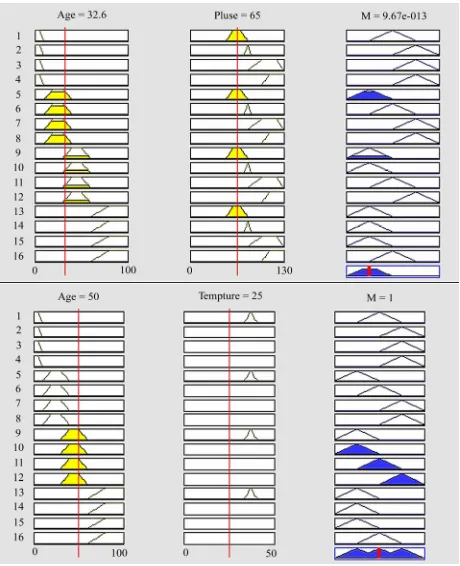
1) If (Age is infant) and (Pulse is t1) then (R is N) 2) If (Age is infant) and (Pulse is t2) then (R is H) 3) If (Age is infant) and (Pulse is t3) then (R is H) 4) If (Age is infant) and (Pulse is t4) then (R is H)…… A sample fuzzy calculation at a value of context in-formation point is described in Figure 2.
4. Fuzzy Middleware Protoype Implementation
We have evaluated the context processing mechanism that based on fuzzy logic system by developing a simple prototype application called Tourist Reminder. As Figure 3 shows, we use medical sensors (body temperature sen-sor, pulse sensor and blood oxygen sensen-sor, etc) and GPS/RFID in detecting tourist’s physical signs/location anywhere and anytime. All sensor data are transmitted by ZigBee wireless sensor nodes to the middleware running on PC or PDA for analyzing and providing reminding message to tourist.
[image:3.595.309.539.77.360.2]Figure 1. Membership functions for input context (physical signs).
[image:3.595.57.286.498.687.2]Figure 2. A sample fuzzy calculations.
Figure 3. The process of prototype application.
4.1. Middleware Architecture
To create Tourist Reminder, we developed generic ref-erence architecture applicable to pervasive computing space. As Figure 4 shows, the middleware contains separate physical, sensor platform, service, knowledge, context management, and application layers. Physical Layer: contains a variety of sensors and actuators which monitor and gather context information about the perva-sive environment.
Context Acquire Layer: integrates the sensors and actuators from the layer beneath and export their service representations to the layers above, which includes query processing component that can process filters and queries for sensor readings sent to it from the query processor in the service layer.
Figure 4.The architecture of middleware.
(a) UbiCell node
(b) physical sign sensors and PC
Figure 5. The hardware of Tourist Reminder.
sensors or actuators. It holds the registry of the software service representation of all sensors and actuators con-nected to the hardware nodes and FLC system as infer-ence engine.
Context application layer: sits at the top and con-sists of the execution environment that provides an API to access and control sensors, actuators, and other ser-vices. It contains a service authoring tool to enable rapid and efficient development and deployment of services and applications.
4.2. Middleware Prototype Implement
We develop sensor node called UbiCell[15], which in-grate models of GPS and physical sign sensors. The hardware of middleware prototype is composed of PC, UbiCell and sink nodes (Figure 5).
In this project, the develop platform of software was based on J2sdk1.4+Eclipse3.2.
As shows in Figure 6, the main function of Tourist Reminder include subscribed service, query service, message reminding, GIS location, etc.
Client as the user of tourist service subscribes the services to Server (middleware) according to the ID about tourist.
After sampling and aggregating the physical con-text about subscribed tourist, Server realizes reasoning based FLC system and returns the relevant messages of services (reminding/query).
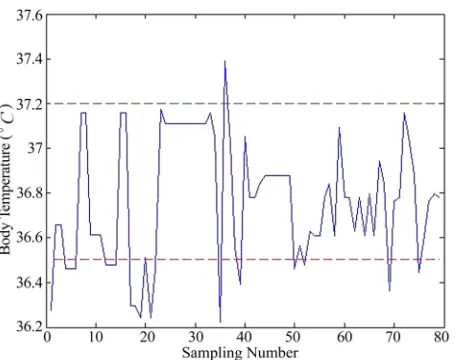
Figure 7 is one of the capture images about sampling data of body temperature. As shows in Figure 7, the trend of data is stability.
5. Conclusions
[image:4.595.308.538.412.701.2]Context-aware computing has been a key issue for pervasive computing based on WSN. In a pervasive computing environment, Services should be intelligent
Figure 7. The capture image of sampling data.
enough to understand the real world. Our study in this paper demonstrates that fuzzy logic based middleware is feasible for facilitate context processing. A key feature of our model is the presence of FLC based context archi-tecture.
The work of this paper is a part of our ongoing mid-dleware prototype for pervasive computing which pro-vides the reminding service to tourist. Now we furthering work are to apply in practice trade.
6. Acknowledgements
This work is supported by the National Natural Science Foundation of China (No. 60773041), Science Founda-tion of Jiangsu High School (No. 09KJB510020) and sponsored by Qing Lan Project.
7. References
[1] B. Schilit and M. Theimer, “Disseminating active map information to mobile hosts,” IEEE Network, Vol. 8, No. 5, pp. 22–32, 1994.
[2] P. Dourish, “What we talk about when we talk about context,” Personal and Ubiquitous Computing, Vol. 8, No.
1, pp. 19–30, 2004.
[3] A. Helal, “Programming pervasive spaces,” The Stan-dards and Emerging Technologies Department, IEEE Pervasive Computing magazine, Sumi Helal, Dept. Editor, Vol. 4, No. 1, January–March 2005.
[4] H. J. Zimmermann, “Fuzzy sets theory and its applica-tions,” Second, revised edition, Kluwer Academic Pub-lishers, 1991.
[5] H. Wu, M. Siegel, and S. Ablay, “Sensor fusion for con-text understanding,” Instrumentation and Measurement Technology Conference, IMTC/2002, Proceedings of the 19th IEEE, Vol. 1, pp. 13–17, May 2002.
[6] M. Roman, C. K. H., R. Cerqueira, et al, “Gaia: A mid-dleware infrastructure to enable active spaces,” IEEE Pervasive Computing, pp. 74–83, 2002.
[7] Microsoft Research, “Easy living,” 2009,
http://research.microsoft.com/easyliving/.
[8] M. Roman, F. Kon, and R. H. Campbell, “Reflective middleware: From your desk to your hand,” IEEE DS Online (Special Issue on Reflective Middleware), 2001.
[9] S. Ou and K. Yang, “An effective offloading middleware for pervasive services on mobile devices,” Pervasive and Mobile Computing, Vol. 3, No. 4, pp. 362–385, 2007.
[10] A. Padovitz, et al, “An approach to data fusion for con-text awareness,” Fifth International Conference on Mod-elling and Using Context, CONTEXT’05, Paris, France, July 2005.
[11] M. Korkea-aho, “Context-aware applications survey,” 2009, http://www.hut.fi/~mkorkeaa/doc/context-aware.html.
[12] L. A. Zadeh, Fuzzy sets, Information and Control, pp. 338–353, 1965.
[13] M. Marin-Perianu, C. Lombriser, et al, “Distributed ac-tivity recognition with fuzzy enabled wireless sensor networks,” Technical Report TRCTIT-07-68, Enschede, September 2007.
[14] E. Hisdal, “The IF THEN ELSE statement and inter-val-valued fuzzy sets of higher type,” International Jour-nal Man-Machine Studies, Vol. 35, pp. 385–455, 1981.