Wavelet chaotic neural networks and their application
to continuous function optimization
Jia-Hai Zhang1, Yao-Qun Xu2
1College of Electrical and Automatic Engineering, Sanjing University, Nanjing, China; [email protected]
2Institute of Computer and Information Engineering Harbin Commercial University, Harbin, China; [email protected]
Received 7 September 2009; revised 10 October 2009; accepted 12 October 2009.
ABSTRACT
Neural networks have been shown to be pow-erful tools for solving optimization problems. In this paper, we first retrospect Chen’s chaotic neural network and then propose several novel chaotic neural networks. Second, we plot the figures of the state bifurcation and the time evolution of most positive Lyapunov exponent. Third, we apply all of them to search global minima of continuous functions, and respec-tively plot their time evolution figures of most positive Lyapunov exponent and energy func-tion. At last, we make an analysis of the per-formance of these chaotic neural networks.
Keywords:
Wavelet Chaotic Neural Networks;
Wavelet; Optimization
1. INTRODUCTION
Hopfield and Tank first applied the continuous-time, continuous-output Hopfield neural network (HNN) to solve TSP [1], thereby initiating a new approach to op-timization problems [2,3]. The Hopfield neural network, one of the well-known models of this type, converges to a stable equilibrium point due to its gradient decent dy-namics; however, it causes sever local-minimum prob-lems whenever it is applied to optimization probprob-lems. M-SCNN has been proved to be more power than Chen’s chaotic neural network in solving optimization problems, especially in searching global minima of con-tinuous function and traveling salesman problems [4].
In this paper, we first review the Chen’s chaotic neural network. Second, we propose several novel chaotic neu-ral networks. Third, we plot the figures of the state bi-furcation and the time evolution of most positive Lyapunov exponent. Fourth, we apply all of them to search global minima of continuous functions, and re-spectively plot their time evolution figures of most
posi-tive Lyapunov exponent and energy function. At last, simulation results are summarized in a Table in order to make an analysis of their performance.
2. CHAOTIC NEURAL NETWORK
MODELS
In this section, several chaotic neural networks are given. And the first is proposed by Chen, the rest proposed by ourselves.
2.1. Chen’s Chaotic Neural Network
Chen and Aihara’s transiently chaotic neural network [5] is described as follows:
( ) / 1 ( ) ( ( ))
1 i
i i y t
x t f y t
e
(1)
( 1) ( ) ( )( ( ) )
i i ij j i i i
j
y t ky t W x Iz t x t I
0i
(2)
( 1) (1 ) ( ) i
z t z t (3) wherex ti( )
j
is output of neuron ; denotes internal state of neuron ;W describes connection weight from neuron to neuron , ;
i ji W W ( ) i y t i i ij
i ij I is input bias of neuron ,
a
a positive scaling parameter for neural in-puts, damping factor of nerve membrane, 0≤ ≤1,self-feedback connection weight (refractory strength) ≥0,
i
k k
( ) i
z t
damping factor of z ti( ), 0< <1, a positive parameter,
0 I
steepness parameter of the out-put function,
>0.2.2. Morlet Wavelet Chaotic Neural Network (MWCNN)
Morlet wavelet chaotic neural network is described as follows:
2
( ( )) / 2
( ) ( ( )) uy ti (5 ( ))
i i i
SciRes Copyright © 2009 Openly accessible athttp://www.scirp.org/journal/NS/
( 1) ( ) ( )( ( ) )
i i ij j i i i
j
y t ky t W x I z t x t I
0i
(5)
( 1) (1 ) ( ) i
z t z t (6) wherex ti( ),y ti( ) , Wij , , k , Ii , z ti( ) , I0 are the same with the above. And the Eq.4 is the Morlet wavelet function. is a steepness parameter of the output function which is varied with different optimiza-tion problems.
u
2.3. Mexican Hat Wavelet Chaotic Neural Network (MHWCNN)
Mexican hat wavelet chaotic neural network is described as follows:
2
( ( )) / 2 2
2
( ) ( ( )) (1 ( ( )) ) 3
i
uy t
i i i
x t f y t uy t e
(7)
( 1) ( ) ( )( ( ) )
i i ij j i i i
j
y t ky t W x I z t x t I
0i
(8)
( 1) (1 ) ( ) i
z t z t (9) wherex ti( ),y ti( ) , Wij , ,k ,Ii , z ti( ) , I0, are the same with the above. And the Eq.7 is the Shannon wavelet function.
u
3. RESEARCH ON CONTINUOUS
FUNCTION PROBLEMS
In this section, we apply all the above chaotic neural net- works to search global minima of the following three continuous functions.
The three continuous functions are described as foll- ows [6]:
2 2 2
1 2
1 1 2 2 2 2
1 2
sin 0.5
( , ) 0.5
[1 0.001( )] x x f x x
x x
xi 100 (10)
2 4 6 2
2( , ) 41 2 1 2.11 1 / 3 1 2 4 2 4 24 f x x x x x x x x x xi 5
(11)
2 2
4 1 2 2 1 1 1
5.1 5 1
( , ) ( 6) 10(1 ) cos 10
8 4
f x x x x x x
1 2
5 x 10,0 x 15
(12) The minimum value of Eq.10, 11, 12 respectively are -1, -1.0316285, 0, 0.398 and its responding point are (0, 0), (0.08983, -0.7126) or (-0.08983, 0.7126), (-3.142, 2.275) or (3.142, 2.275) or (9.425, 2.425).
In order to make comparison conveniently, we set some parameters such as the annealing speed , the self-feedback and the initial value of internal state
as follows: ) 0 , 0 ( z (0,0)
y =0.002, =[0.8, 0.8], =[0.283, 0.283]. Meanwhile, we set the iteration as large as 5000 so as to get stable state of a global minimum.
(0,0) z (0,0)
y
3.1. Chen’s Chaotic Neural Network 1) Simulation on the First Continuous Function
The rest parameters are set as follows: k=1,=0.5,=1/10,I0=0.85.
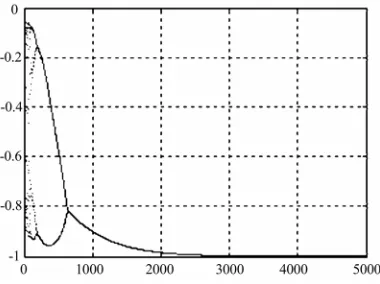
The time evolution figures of the biggest positive Lyapunov exponent and energy function of Chen’s in solving the first continuous function are shown as Fig-ure 1, FigFig-ure 2.
The global minimum and its responding point of the simulation are respectively -0.99989 and (0.0073653, 0.0073653).
2) Simulation on the Second Continuous Function The rest parameters are set as follows:
k=1,=0.02,=1/20,I0=0.85.
[image:2.595.328.519.366.512.2]The time evolution figures of most positive Lyapunov exponent and energy function of Chen’s in
Figure 1. Time evolution figure of Lyapunov
exponent.
Figure 2. Time evolution figure of energy
[image:2.595.330.520.541.683.2]Figure 3. Time evolution figure of Lyapunov exponent.
Figure 4. Time evolution figure of
en-ergy function.
solving the first continuous function are shown as Fig-ure 3, FigFig-ure 4.
The global minimum and its responding point of the simulation are respectively -1 and (0, 0.70712).
3) Simulation on the Third Continuous Function The rest parameters are set as follows:
Figure 5. Time evolution figure of
Lyapunov exponent.
Figure 6. Time evolution figure of energy
function.
k=1,=0.2,=1,I0=0.5.
The time evolution figures of most positive Lyapunov exponent and energy function of Chen’s in solving the first continuous function are shown as Figure 5, Figure 6.
The global minimum and its responding point of the simulation are respectively 0.39789 and (9.4246, 2.4747).
3.2. Morlet Wavelet Chaotic Neural Network (Mwcnn)
1) Simulation on the First Continuous Function The rest parameters are set as follows:
k=1,=0.5,u=0.5,I0=0.65.
The time evolution figures of most positive Lyapunov exponent and energy function of MWCNN in solving the first continuous function are shown as Figure 7, Figure 8. The global minimum and its responding point of the simulation are respectively -0.99997 and (0.0038638, 0.0038638).
2) Simulation on the Second Continuous Function The rest parameters are set as follows:
k=1,=0.05,u=0.7,I0=0.2.
The time evolution figures of most positive Lyapunov exponent and energy function of MWCNN in solving the first continuous function are shown as Figure 9, Figure 10.
Figure 7. Time evolution figure of Lyapunov
exponent.
Figure 8.Time evolution figure of energy
SciRes Copyright © 2009 Openly accessible athttp://www.scirp.org/journal/NS/
Figure 9. Time evolution figure of
Lyapunov exponent.
Figure 10. Time evolution figure of
en-ergy function.
Figure 11. Time evolution figure of
[image:4.595.336.510.239.682.2]Lyapunov exponent.
Figure 12. Time evolution figure of
en-ergy function.
The global minimum and its responding point of the simulation are respectively -1.0021 and (-0.074007, 0.76863).
3) Simulation on the Third Continuous Function The rest parameters are set as follows:
k=1,=0.02,u=0.09,I0=0.2.
The time evolution figures of most positive Lyapunov exponent and energy function of MWCNN in solving the first continuous function are shown as Figure 11, Figure 12.
The global minimum and its responding point of the simulation are respectively 0.39789 and (3.1413, 2.2733).
3.3. Mexican Hat Wavelet Chaotic Neural Network (MHWCNN)
1) Simulation on the First Continuous Function The rest parameters are set as follows:
k=1,=0.5, =0.2,u I0=0.8.
Figure 13. Time evolution figure of
[image:4.595.341.506.419.550.2]Lyapunov exponent.
Figure 14. Time evolution figure of energy
[image:4.595.93.249.514.634.2]function.
Figure 15. Time evolution figure of
[image:4.595.343.505.582.719.2]Table 1. the simulation results of the chaotic neural networks. The time evolution figures of most positive Lyapunov
exponent and energy function of MHWCNN in solving
Fu n
Model
GM/ER
Chen’s MWCNN MHWCNN
TGM -1 -1 -1
PGM -0.99989 -0.99997 -0.99996
1 f
ER 0.00011 0.00003 0.00004
TGM -1.0316285 -1.0316285 -1.0316285
PGM -1 -1.00021 -1.0316
2 f
ER 0.0316285 0.031418
5 0.0000285
TGM 0.398 0.398 0.398
PGM 0.3789 0.3789 0.3789
4 f
ER 0.0191 0.0191 0.0191
AVE AVER 0.01270962 0.01263712 0.00479212
the first continuous function are shown as Figure 13, Figure 14.
The global minimum and its responding point of the simulation are respectively -0.99996 and (0.0043259, 0.0043259).
2) Simulation on the Second Continuous Function The rest parameters are set as follows:
k=1,=0.05,u=2.8,I0=0.05.
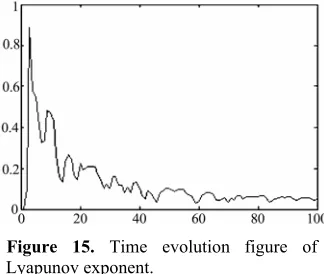
The time evolution figures of most positive Lyapunov exponent and energy function of MHWCNN in solving the first continuous function are shown as Figure 15, Figure 16.
The global minimum and its responding point of the simulation are respectively -1.0316 and (-0.089825,
0.71263).
3) Simulation on the Third Continuous Function. The rest parameters are set as follows:
k=1,=0.05, =0.3,u I0=0.2.
The time evolution figures of most positive Lyapunov exponent and energy function of MHWCNN in solving the first continuous function are shown as Figure 17, Figure 18.
Figure 16. Time evolution figure of
en-ergy function.
The global minimum and its responding point of the simulation are respectively 0.39789 and (3.1415, 2.2743).
4. ANALYSIS OF THE SIMULATION
RESULTS
Simulation results are summarized in Table 1. The col-umns “GM/ER”, “TGM”, “PGM” and “AVER” repre-sent, respectively, global minimum/error rate; theoretical global minimum; practical global minimum; average error.
Figure 17. Time evolution figure of
Lyapunov exponent.
Seen from the Table 1, we can conclude that the wavelet chaotic neural networks are superior to Chen’s in AVER
5. CONCLUSION
We have introduced Chen’s and wavelet chaotic neural networks. We make an analysis of them in solving con-tinuous function optimization problems, and find out that wavelet chaotic neural networks are superior to Chen’s in general.
Figure 18. Time evolution figure of
SciRes Copyright © 2009 Openly accessible athttp://www.scirp.org/journal/NS/
REFERENCES
[1] J. J. Hopfield and D. W. Tank, (1985) Neural com- putation of decision in optimization problems. Biol. Cybern., 52, 141-152.
[2] J. Hopfield, (1982) Neural networks and physical systems with emergent collective computa-tional abilities. In: Proc Natl Acad Sci, 79, 2554-2558.
[3] J. Hopfield, (1984) Neural networks and physical systems with emergent collective computational abilities. 81, Proc. Natl. Acad. Sci., 3088-3092.
[4] Y. Q. Xu, M. Sun, and G. R. Duan, (2006) Wavelet chaotic neural networks and their application to optimi- zation problems. Lecture Notes in Computer Science.
[5] L. P. Wang and F. Y. Tian, (2000) Noisy chaotic neural networks for solving combinatorial optimization pro- blems. International Joint Conference on Neural Net- works. Italy, IEEE, 37-40.
[6] L. Chen and K. Aihara, (1995) Chaotic simulated annealing by a neural network model with transient chaos. Neural Networks., 8, 915-930.
[7] L. Wang, (2001) Intelligence optimization algorithm and its application. Press of TUP.
[8] C. Q. Xie, C. He, and H. W. Zhu, (2002) Improved noisy chaotic neural networks for solving combinational opti-mization problems. Journal of Shanghai Jiaotong univer-sity, 36, 351-354.