D S Sharma, R Sangal and J D Pawar. Proc. of the 11th Intl. Conference on Natural Language Processing, pages 30–38, Goa, India. December 2014. c2014 NLP Association of India (NLPAI)
Supertag Based Pre-ordering in Machine Translation
Rajen Chatterjee, Anoop Kunchukuttan, Pushpak Bhattacharyya Department of Computer Science and Engineering
Indian Institute of Technology, Bombay {rajen,anoopk,pb}@cse.iitb.ac.in
Abstract
This paper presents a novel approach to integrate mildly context sensitive grammarin the context of pre-ordering for machine translation. We discuss the linguistic insights available in this grammar formalism and use it to de-velop a pre-ordering system. We show that mildly context sensitive gram-mar proves to be beneficial over con-text free grammar, which facilitates better reordering rules. For English to Hindi, we see significant improve-ment of 1.8 BLEU and error reduc-tion of 4.46 TER score over CFG based pre-ordering system, on the WMT14 data set. We also show that our ap-proach improves translation quality for English to Indian languages machine translation over standard phrase based systems.
1 Introduction
India is a multilingual country with 22 offi-cial languages, spanning four language fam-ilies (Indo-Aryan,Dravidian, Tibeto-Burman and Austro-Asiatic)1. In such a liguistically diverse country there is always a great need for translation services to serve government, busi-ness and overall social communication needs. Hindi and English act aslink languagesacross the country and languages of official commu-nication for the Union Government. Thus, the importance of English to Hindi translation is obvious.
Languages can be differentiated in terms of structural divergences and morphological us-age. English is structurally classified as a Subject-Verb-Object (SVO) language as op-posed to Hindi which follows Subject-Object-Verb (SOV) word order. Largely, these di-vergences are responsible for the difficulties
1http://en.wikipedia.org/wiki/Languages_of_ India
in standard statistical machine translation (SMT) systems.
Our objective is to reduce the structural di-vergence by reordering words in the source language (English) to conform to the target language (Hindi) word order and then provide this data to train a pharse based SMT system. This approach is known as pre-ordering in SMT research. The novelty of our work is the inclusion of linguistic context obtained from higher level of grammar formalism known as mildly context sensitive grammar. To the best of our knowledge, this is the first approach to bring such a formalism for pre-ordering in ma-chine translation.
To begin with, Section 2 discusses work re-lated to pre-ordering. We then provide an in-troduction to TAG and Supertag, in Section 3. Section 4 describes our approach for pre-ordering. In Section 5, we provide the method-ology for pre-ordering. Experimental setup is explained in Section 6, while corresponding re-sults are shown in Section 7. We conclude our work in Section 8 providing acknowledgement in Section 9.
2 Related Work
Word order has direct impact on the flu-ency of transaltion obtained using SMT sys-tems. There are basically two paradigms for generating correct word order. The first paradigm deals with developing a reordering model which is used during decoding. Dif-ferent solutions such as syntax-based models (Chiang, 2005), lexicalized reordering (Och et al., 2004), and tree-to-string methods (Zhang et al., 2006) have been proposed. Most of these approaches use statistical models to learn re-ordering rules, but all of them have differ-ent methods to solve the reordering problem. The next paradigm deals with developing a re-ordering model which is used as pre-processing step (also known as pre-ordering) in SMT sys-tems. In pordering, the objective is to
order source language words to conform to the target language word order.
Xia and McCord (2004) describe an ap-proach for translation from French to En-glish, where reordering rules are acquired au-tomatically using source and target parses and word alignment. The reordering rules in their approach operate at the level of context-free rules in the parse tree. Collins et al. (2005), describe clause restructuring for Ger-man to English machine translation. They use six transformations that are applied on Ger-man parsed text to reorder it before train-ing with a phrase based system. Popovic and Ney (2006) use hand-made rules to re-order the source side based on POS infor-mation. Zhang et al. (2007) propose chunk level reordering, where reordering rules are au-tomatically learned from source-side chunks and word alignments. They allow all possi-ble reorderings to be used to create a lattice that is input to the decoder. Genzel (2010), shows automatic rule extraction for 8 language pairs. They first extract a dependency tree and then converts it to a shallow constituent tree. The trees are annotated by both POS tags and by Stanford dependency types, then they learn reordering rules given a set of fea-tures. This paper discusses about creating manual reordering rules with the help of Tree Adjoining Grammar (TAG), a mildly context sensitive formalism as discussed in Section 3.
3 Introduction to TAG/Supertag
Tree Adjoining Grammar (TAG) was intro-duced by Joshi et al. (1975). Tree Adjoin-ing Languages (TALs) generate some strictly context-sensitive languages and fall in the class of the so-called mildly context-sensitive lan-guages. Lexicalized Tree Adjoining Grammar (LTAG) (Joshi and Schabes, 1991) is the TAG formalism where each lexical item is associated with atleast one elementary structure. This elementary structure of LTAG is known as Supertag. The concept of Supertag was first proposed by Joshi and Srinivas (1994). Su-pertag localize dependencies, including long-distance dependencies, by requiring that all and only the dependent elements be present within the same structure. They provide syn-tactic as well as dependency information at the
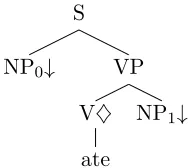
word level by imposing complex constraints in a local context. Supertags provide informa-tion like POS tag, subcategorizainforma-tion and other syntactic constraints at the level of agreement feature. Supertag can also be viewed as frag-ments of parse tree associated with each lex-ical item. An example of supertag is shown in Figure 1. This supertag is used for tran-sitive verbs. Subcategorization information is
S
NP0↓ VP
V♢
ate
[image:2.612.377.472.172.256.2]NP1↓
Figure 1: Supertag for transitive verbate
clearly visible in the verb, which takes a sub-ject to its left and an obsub-ject to its right.
3.1 Structural description of supertag
Each supertag, at its frontier, has exactly one anchor node marked by ♢, to which a lexical item gets anchored. Apart from anchor node at its frontier, it may have an optional substi-tutionnode marked by↓or anadjunctionnode marked by ∗. Substitution and adjunction are those nodes which can be replaced by another supertag. For an adjunction node, it is nec-essary for its label to match the label of root node of supertag. A supertag can have atmost one adjunction node but can have more than one substitution node.
3.2 Supertagging
Supertagging refers to tagging each word of a sentence with a supertag. An example of a supertagged sentence is shown in figure 2.
NP
G♢
I
S
NP0↓ VP
V♢
ate
NP1↓
NP
A♢
dark NP∗
NP
N♢
chocolate
Figure 2: Supertagged sentence “I ate dark chocolate”
We use MICA Parser (Bangalore et al.,
[image:2.612.328.528.597.674.2]2009)2 to obtain rich linguistic information like POS tag, supertag, voice, the presence of empty subjects (PRO), wh-movement, deep syntactic argument (deep subject, deep direct object, deepindirect object), whether a verb heads a relative clause and also dependency relation, for each word. From this rich set of features, for each word, we extract word ID (essentially word position in a sentence), supertag, dependency relation and deep syn-tactic argument. Given a dependency rela-tion, these supertags can be assembled using composition operation of TAG to form a con-stituent tree. Composition operation includes substitution and adjunction:
• Substitution: It deals with substituting a non-terminal node at the frontier of su-pertag with another susu-pertag. An exam-ple of substitution operation is shown in Figure 3. When substitution occurs at a node, the node is replaced by the supertag to be substituted.
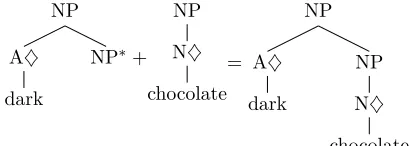
• Adjunction: It deals with inserting a su-pertag within another susu-pertag satisfying adjunction constraints (Joshi, 1987). An example of adjoining operation is shown in Figure 4. One of the key contraint is the root label of supertag to be adjoined should match label of the node where ad-junction occurs.
NP
G♢
I
S
+ NP0↓ VP
V♢
ate
NP1↓
S
= NP
G♢
I
VP
V♢
ate
NP1↓
Figure 3: Example illustraingSubstitution op-eration
4 Supertag Based Reordering
Each supertag encapsulates rich linguistic con-text, based on which, we reorder supertag nodes to preserve same context in target lan-guage. We first highlight linguistic relevance of supertag followed by showing why supertag facilitates reordering and finally illustrate re-ordering with supertag.
2http://mica.lif.univ-mrs.fr/
NP
A♢
dark
NP∗+
NP
N♢
chocolate
NP
= A♢
dark
NP
N♢
[image:3.612.323.529.38.111.2]chocolate
Figure 4: Example illustraing Adjunction op-eration
4.1 Linguistic Relevance
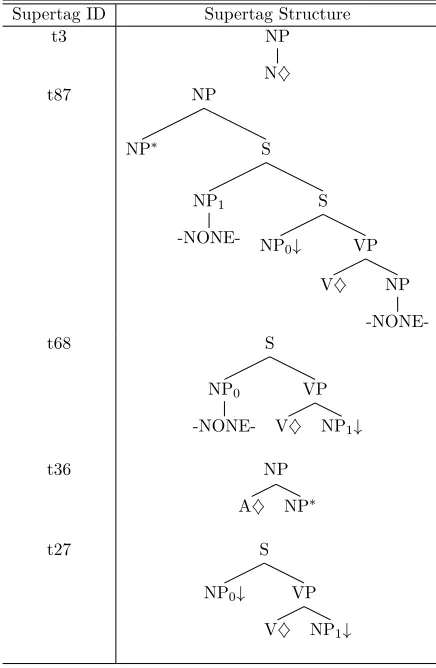
[image:3.612.318.539.370.515.2]In this section, we show the linguistic relevance of supertag. Each Supertag falls in a specific syntactic environment, a few examples of su-pertag along with their syntactic environment are shown in Table 1. For each supertag ID, Table 1 gives the linguistic context (syntac-tic environment) in which a supertag appears along with an example sentence. The lexical item attached to the anchor node of supertag is written in italic, in the example sentence. Table 2 shows supertag ID and their corre-sponding tree structure.
Supertag ID
Linguistic Context
Example
t3 Noun Phrase theman
t87 Topicalization Those dogs, I amterrifiedof t68 Imperative Please tidy
your room. t36 Adjectival
Modi-fier
redhat
t27 Transitive Verb I brought dark chocolates.
Table 1: Example showing syntactic environ-ment of different supertag
Syntactic environment of a supertag gives us the liberty to control reordering at a finer granularity. Thus, supertags of tree adjoining grammar prove to be advantageous over con-text free grammar (CFG) for reordering.
4.2 Why Supertag facilitates Reordering
In this section, we discuss key properties of LTAG which facilitates reordering, such as lex-icalization, followed by Extended Domain of Locality (EDL) and finally Factoring of Recur-sion from the Domain of dependency (FRD)
Supertag ID Supertag Structure
t3 NP
N♢
t87 NP
NP∗ S
NP1
-NONE-S
NP0↓ VP
V♢ NP
-NONE-t68 S
NP0
-NONE-VP
V♢ NP1↓
t36 NP
A♢ NP∗
t27 S
NP0↓ VP
[image:4.612.82.300.38.372.2]V♢ NP1↓
Table 2: Figure showing supertag structure for each supertag ID
• Lexicalization:
Lexicalization ensures that each supertag is anchored by a lexical item. This prop-erty prove to be linguistically crucial since it establishes a direct connection between the lexicon and the syntactic structures defined in the grammar. Reordering syn-tactic structure at word level for every word in a sentence helps us to obtain word order that conforms to target language word order.
• Extended Domain of Locality (EDL):
This property of LTAG states that for each lexical item, the grammar must contain an elementary structure for each syntactic environment, the lexical item might appear in. This means that for each lexical item there can be multiple supertags representing different syntactic environment. Another part of EDL states that every supertag must contain
all and only the argument of anchor in the same structure. This allows the anchor to impose syntactic and semantic constraints on its arguments directly since they appear in the same elementary structure that it anchors. This ensures, to reorder we deal only with primary features of lexical item on which the reordering primarily depends on.
• Factoring of Recursion from the Do-main of dependency (FRD): This property ensures that supertags are min-imal in nature; i.e. there is no recur-sion present within the given elementary structure of supertag. Recursive con-structs are carried out with the help of adjunction operation. Auxiliary supertag, by adjunction to other supertag, accounts for long distance behavior of these depen-dencies. Due to this property the fea-ture space of supertag is simplified with-out any recursive feature involved. This helps to build simple but strong reorder-ing rules by just considerreorder-ing few but most important features of the supertag.
4.3 Detecting Linguistic Patterns for Reordering
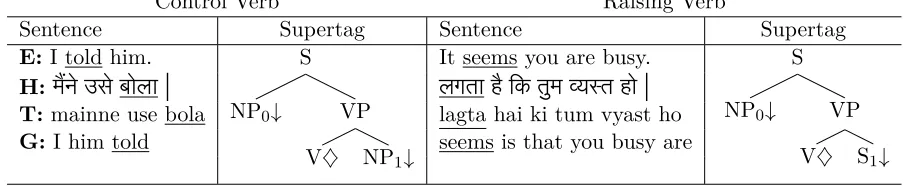
In this section, we show that linguistic pat-terns can be detected with the help of su-pertag. English is structurally classified as a Subject-Verb-Object (SVO) language whereas Hindi is Subject-Object-Verb (SOV) language. However, this is not true for all verbs, specially in case of raising verb. We compare control verb v/s raising verb, where the former re-quires reordering as opposed to the later. An example has been shown in Table 3. It can be seen that supertag provides finer granular-ity to control reordering based on linguistic features. Studying supertag in-depth and as-sociating it with linguistic context will help to discover various pattern useful for building better reordering system.
5 Methodology for Reordering
Listed below are the sequence of modules of our reordering system:
• Reorder Supertags
We begin with reordering supertags, for
Control Verb Raising Verb
Sentence Supertag Sentence Supertag
E:I told him. S
NP0↓ VP
V♢ NP1↓
It seems you are busy. S
NP0↓ VP
V♢ S1↓
H: मैंने उसे बोला | लगता है िक तुम व्यस्त हो |
T: mainne use bola lagta hai ki tum vyast ho
[image:5.612.80.532.46.139.2]G: I him told seems is that you busy are
Table 3: Table showing comparision of control verb v/s raising verb
E:English; H:Hindi; T:Transliteration; G:Gloss
which we are provided with 4725 su-pertags 3 in all, but seldom all of them are seen in action. Therefore, we supertag 50,000 sentences from health and tourism domain of ILCI corpus (Jha, 2010), from which we filter out spurious supertags which occur less than 10 times, leaving 600 supertags with us, for analysis. Our manual analysis shows that out of 600 su-pertags, 200 required reordering transfor-mations to be applied.
Example of supertag, representing transi-tive verb, before and after reordering in shown in Table 4
Before Reordering After Reordering S
NP0↓ VP
V♢ NP1↓
S
NP0↓ VP
[image:5.612.84.295.396.479.2]NP1↓ V♢
Table 4: Example showing transitive verb be-fore and after reordering
An example of reordering prepositional phrase which gets adjunct to a noun phrase is shown in Table 5.
Before Reordering After Reordering NP
NP∗ PP
IN♢ NP1↓
NP
PP
NP1↓ IN♢ NP∗
Table 5: Example of prepositional phrase be-fore and after reordering
3http://mica.lif.univ-mrs.fr/
• Extract Linguistic Information
[image:5.612.82.292.589.670.2]As stated in Section 3.2, we use MICA Parser to obtain linguistic informa-tion along with superatg at word level. For example, consider the input sentence “I told him”, for which we extract essential information and ap-pend it with respective words as shown “I|1|2|PRP|t29|0 told|2|2|VBD|t27|. him|3|2|PRP|t29|1”. Here, each word contains “lexical-item|ID|parent- ID|POStag|Supertag|deep-argument-position”. We carry this example sentence in further modules of reorder-ing.
• Construct Derivation Tree
Once linguistic information is extracted, we proceed with construction of deriva-tion tree. The process of combining the elementary trees (supertags) to yield a parse of the sentence is represented by the derivation tree. Derivation tree for the ex-ample sentence is shown in Figure 5.
told|2|2|VBD|t27|.
I|1|2|PRP|t29|0 him|3|2|PRP|t29|1
Figure 5: Example of Derivation Tree
• Construct Derived Tree
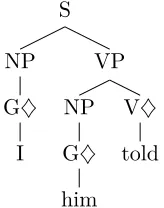
We have implemented the composition operation (adjunction and substitution), which, given a derivation tree would build a derived/parse tree. Derived tree for the example sentence is shown in Figure 6. To build this derived tree we use reordered version of supertag (for eg. t27 for tran-sitive verb from Table 4).
S
NP
G♢
I
VP
NP
G♢
him V♢
[image:6.612.149.231.39.143.2]told
Figure 6: Example of Derived Tree
• Extract leaf nodes Finally, we extract leaf nodes from the derived tree, which gives us reordered English sentence. In our case, the input sentence is “I told him” for which, we get “I him told ” as output. We now use these reordered English sentences along with their paral-lel Hindi translation to train English to Hindi machine translation system.
6 Experiment Setup
In this section, we discuss different data set used and various experiments that we have performed.
6.1 Data Sets
We use the shared task data set provided in Workshop on Statistical Machine Translation, 2014 (WMT14)4 to train English to Hindi translation system. WMT14 training set con-tains data from general domain, obtained from multiple sources, whereas test set belongs to news domain. The training set consist of 275K parallel segments, while test set contains 2.5K. We train a 5 gram language model us-ing SRILM5 on 1.5M monolingual Hindi cor-pus provided in WMT14 shared task.
For translation from English to multiple In-dian languages we use Indian Language Cor-pora Initiative (ILCI) (Jha, 2010) corpus. ILCI data belongs to the health and tourism domain. The training set consist of 40K paral-lel sentences while test set contains 1.1K. We train a 5 gram language model using SRILM on a 50K monolingual Hindi corpus from the same domain.
4WMT14 resources:-http://ufallab.ms.mff. cuni.cz/~bojar/hindencorp/
5http://www.speech.sri.com/projects/srilm
The English data was tokenized using the Stanford tokenizer and then true-cased using truecase.perl provided in MOSES toolkit. We normalize Hindi corpus using NLP Indic Li-brary (Kunchukuttan et. al.,2014)6. Normal-ization is followed by tokenNormal-ization, wherein we make use of the trivtokenizer.pl provided with WMT14 shared task.
6.2 List of Experiments
We use the MOSES toolkit (Koehn et al., 2007) to train various statistical machine translation systems. For English to Hindi we train three systems, on each data set (WMT14 and ILCI), as follows:
• Phrase Based Systems: We train phrase based model without pre-ordering.
• Context Free Grammar based pre-orderding: In this model, we reorder both train and test set using Patel et al. (2013)’s source side reordering rules which is refinement of Ramanathan et al. (2008)’s rule-based reordering system.
• Supertag based pre-ordering: In this model, we reorder both train and test set using our supertag based pre-ordering method as discussed in Section 5.
We provide systematic comparision among these systems in Section 7. As the reordering rules are developed to conform Hindi word or-der, we were interested to see how does it affect other Indian languages which have the same word order as Hindi. So, we developed various translation systems from English to other In-dian languages using ILCI corpus and compare it with standard pharse based systems.
7 Results
In this section, we also provide quantitative results for various systems and provide sys-tematic comparision among them. We also provide couple of translations from English to Hindi, showing improvement in translation quality with our approach.
6https://bitbucket.org/anoopk/indic_nlp_ library
Data Set Phrase Based CFG based reordering Supertag based reordering
BLEU TER BLEU TER BLEU TER
WMT14 8.00 84.00 8.6 86.66 10.40 82.20
[image:7.612.83.472.42.96.2]ILCI 23.77 58.36 26.45 56.24 25.75 56.14
Table 6: Result of English to Hindi SMT System
Higher BLEU Score and Lower TER Score indicate better system
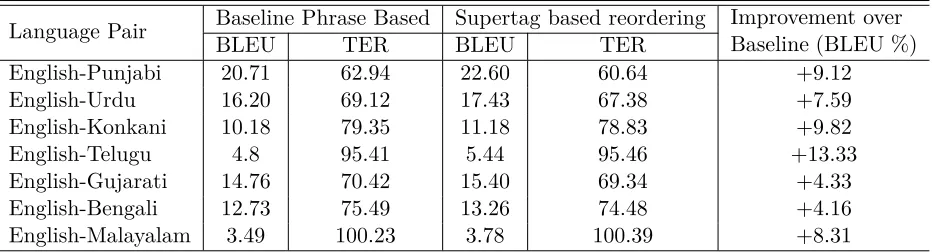
Language Pair Baseline Phrase Based Supertag based reordering Improvement over Baseline (BLEU %)
BLEU TER BLEU TER
English-Punjabi 20.71 62.94 22.60 60.64 +9.12
English-Urdu 16.20 69.12 17.43 67.38 +7.59
English-Konkani 10.18 79.35 11.18 78.83 +9.82
English-Telugu 4.8 95.41 5.44 95.46 +13.33
English-Gujarati 14.76 70.42 15.40 69.34 +4.33
English-Bengali 12.73 75.49 13.26 74.48 +4.16
English-Malayalam 3.49 100.23 3.78 100.39 +8.31
Table 7: Result of English to Indian Language SMT System
7.1 Quantitative Evaluation
We use two standard evaluation metrics BLEU (Papineni et al., 2002) and TER (Snover et al., 2006), for comparing translation quality of various systems. Table 6 compares phrase based, CFG based reordering and supertag based reordering systems built using WMT14 and ILCI data set, for English to Hindi lan-guage pair. We see TER score of our system is best for both data sets. For WMT14 data set, our approach shows improvement of 1.8 BLEU score and error reduction of 4.46 TER score over CFG based reordering system.
For the ILCI data set, our approach shows significant improvement over both evaluation metrics over phrase based SMT sytem but shows slight degradation in BLEU score when compared with CFG based reordering system. However, TER score remains almost same. On an average, over both data sets, we see that TAG based reordering performs better than PB and CFG based systems.
Also from Table 7, we see our approch of re-ordering English data set proves to give signif-icant improvement in translation quality over phrase based, for most of the English to Indian language machine translation systems. The re-sult is statistically significant at the p <= 0.07 level.
7.2 Qualitative Evaluation
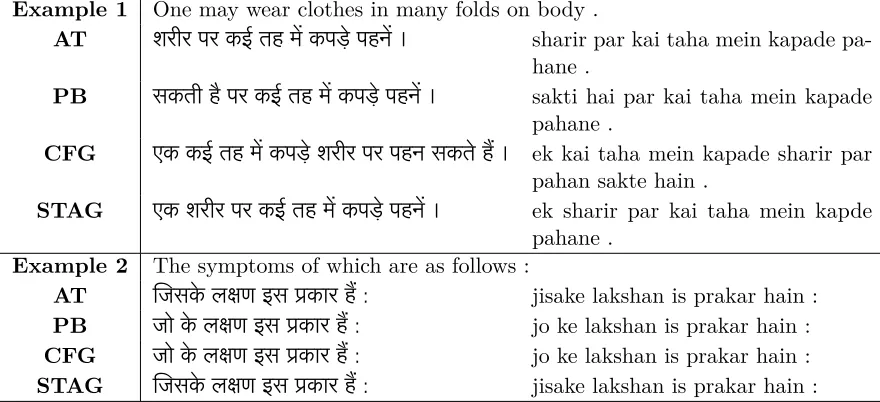
We provide two source (English) sentences (Example 1 and Example 2) along with their actual translation (AT) and machine transla-tions obtained from phrase based system (PB), CFG based reordered system (CFG) and TAG based reordered system (TAG), as shown in Table 8. Transliteration of all Hindi sen-tences have been shown in corresponding col-umn. We see that translations of TAG is much closer to the actual translation. Example 1 shows improvement in reordering which is the main focus of our work, whereas, Example 2 shows morphological improvement inherently achieved with reordering.
8 Conclusion
We presented a novel method of using mildly context sensitive grammar formalism in the context of pre-ordering in SMT systems. We show that the rich linguistic information em-bedded in supertags provides finer granular-ity for framing reordering rules over Context Free Grammar (CFG). We also showed that supertag can be used for detecting linguis-tic pattern based on which specific reorder-ing rules can be written. We also discuss the linguistic relevance of Supertag and bridg-ing it with machine translation. Finally our approach has shown significant improvement over CFG based reordered systems. In future
[image:7.612.82.548.138.264.2]Example 1 One may wear clothes in many folds on body .
AT शरीर पर कई तह में कपड़े पहनें । sharir par kai taha mein kapade pa-hane .
PB सकती है पर कई तह में कपड़े पहनें । sakti hai par kai taha mein kapade pahane .
CFG एक कई तह में कपड़े शरीर पर पहन सकते हैं । ek kai taha mein kapade sharir par pahan sakte hain .
STAG एक शरीर पर कई तह में कपड़े पहनें । ek sharir par kai taha mein kapde pahane .
Example 2 The symptoms of which are as follows :
AT जसके लक्षण इस पर्कार हैं : jisake lakshan is prakar hain :
PB जो के लक्षण इस पर्कार हैं : jo ke lakshan is prakar hain :
CFG जो के लक्षण इस पर्कार हैं : jo ke lakshan is prakar hain :
[image:8.612.84.524.42.243.2]STAG जसके लक्षण इस पर्कार हैं : jisake lakshan is prakar hain :
Table 8: Comparision of translation among various systems for English to Hindi
work, we would like to classify supertag based on their linguistic relevance and try to gener-alize reordering rules for each class.
9 Acknowledgement
We thank Owen Rambow and Srinivas Ban-galore to help us in understanding supertags and also making the grammar file of supertags available to us. We would like to thank the Technology Development for Indian Lan-guages (TDIL) Programme and the Depart-ment of Electronics Information Technology, Govt. of India for providing the ILCI cor-pus. Also we would like to thank all members of the Centre for Indian Language Technology (CFILT) for their valuable feedback and com-ments.
References
Srinivas Bangalore, Pierre Boulllier, Alexis Nasr, Owen Rambow, and Benoît Sagot. 2009. Mica: a probabilistic dependency parser based on tree insertion grammars application note. In Pro-ceedings of HLT-NAACL, pages 185–188.
David Chiang. 2005. A hierarchical phrase-based model for statistical machine translation. In
Proceedings of the 43rd Annual Meeting on ACL, pages 263–270.
Michael Collins, Philipp Koehn, and Ivona Kučerová. 2005. Clause restructuring for sta-tistical machine translation. In Proceedings of the ACL, pages 531–540.
Dmitriy Genzel. 2010. Automatically learning source-side reordering rules for large scale ma-chine translation. In Proceedings of the COL-ING, pages 376–384.
Girish Nath Jha. 2010. The tdil program and the indian language corpora initiative (ilci). In Pro-ceedings of the LREC.
Aravind K Joshi and Yves Schabes. 1991. Tree-adjoining grammars and lexicalized grammars.
Aravind K Joshi and Bangalore Srinivas. 1994. Disambiguation of super parts of speech (or su-pertags): Almost parsing. InProceedings of the COLING, pages 154–160.
Aravind K Joshi, Leon S Levy, and Masako Taka-hashi. 1975. Tree adjunct grammars. Journal of computer and system sciences, 10(1):136–163.
Aravind K Joshi. 1987. An introduction to tree adjoining grammars. Mathematics of language, 1:87–115.
Philipp Koehn, Hieu Hoang, Alexandra Birch, Chris Callison-Burch, Marcello Federico, Nicola Bertoldi, Brooke Cowan, Wade Shen, Christine Moran, Richard Zens, et al. 2007. Moses: Open source toolkit for statistical machine translation. InProceedings of the ACL, pages 177–180.
Franz Josef Och, Daniel Gildea, Sanjeev Khu-danpur, Anoop Sarkar, Kenji Yamada, Alexan-der Fraser, Shankar Kumar, Libin Shen, David Smith, Katherine Eng, et al. 2004. A smorgas-bord of features for statistical machine transla-tion. InProceedings of the HLT-NAACL, pages 161–168.
Kishore Papineni, Salim Roukos, Todd Ward, and Wei-Jing Zhu. 2002. Bleu: a method for au-tomatic evaluation of machine translation. In
Raj Patel, Rohit Gupta, Prakash Pimpale, and M. Sasikumar. 2013. Reordering rules for English-Hindi SMT. In Proceedings of the Sec-ond Workshop on Hybrid Approaches to Trans-lation.
Maja Popovic and Hermann Ney. 2006. Pos-based word reorderings for statistical machine transla-tion. InProceedings of the LREC, pages 1278– 1283.
Ananthakrishnan Ramanathan, Jayprasad Hegde, Ritesh M Shah, Pushpak Bhattacharyya, and M Sasikumar. 2008. Simple syntactic and mor-phological processing can help english-hindi sta-tistical machine translation. In Proceedings of the IJCNLP, pages 513–520.
Matthew Snover, Bonnie Dorr, Richard Schwartz, Linnea Micciulla, and John Makhoul. 2006. A study of translation edit rate with targeted hu-man annotation. In Proceedings of the AMTA, pages 223–231.
Fei Xia and Michael McCord. 2004. Improving a statistical mt system with automatically learned rewrite patterns. In Proceedings of the COL-ING, page 508.
Hao Zhang, Liang Huang, Daniel Gildea, and Kevin Knight. 2006. Synchronous binarization for machine translation. In Proceedings of the HLT-NAACL, pages 256–263.
Yuqi Zhang, Richard Zens, and Hermann Ney. 2007. Chunk-level reordering of source language sentences with automatically learned rules for statistical machine translation. In Proceedings of the HLT-NAACL, pages 1–8.