Experiments to Improve Named Entity Recognition on Turkish Tweets
Dilek K¨uc¸¨uk and Ralf Steinberger
European Commission, Joint Research Centre Via E. Fermi 2749
21027 Ispra (VA), Italy
Abstract
Social media texts are significant informa-tion sources for several applicainforma-tion areas including trend analysis, event monitor-ing, and opinion mining. Unfortunately, existing solutions for tasks such as named entity recognition that perform well on formal texts usually perform poorly when applied to social media texts. In this pa-per, we report on experiments that have the purpose of improving named entity recog-nition on Turkish tweets, using two dif-ferent annotated data sets. In these ex-periments, starting with a baseline named entity recognition system, we adapt its recognition rules and resources to better fit Twitter language by relaxing its capital-ization constraint and by diacritics-based expansion of its lexical resources, and we employ a simplistic normalization scheme on tweets to observe the effects of these on the overall named entity recognition per-formance on Turkish tweets. The evalua-tion results of the system with these differ-ent settings are provided with discussions of these results.
1 Introduction
Analysis of social media texts, particularly mi-croblog texts like tweets, has attracted recent at-tention due to significance of the contained in-formation for diverse application areas like trend analysis, event monitoring, and opinion mining. Tools for well-studied problems like named entity recognition (NER) are usually employed as com-ponents within these social media analysis appli-cations. For instance, in (Abel et al., 2011), named entities extracted from tweets are used to deter-mine trending topics for user modeling within the context of personalized recommender systems and
in (Ritter et al., 2012), named entities in tweets are used to complement the events extracted by an open domain event extraction system for Twitter. However, existing NER solutions for well-formed text types like news articles are reported to suf-fer from considerable performance degradations when they are ported to social media texts, mainly due to the peculiarities of this latter text type (Rit-ter et al., 2011).
In this paper, we report on our NER experiments on Turkish tweets in order to determine facilitating and impeding factors during the development of a NER system for Turkish tweets which can be used in social media analysis applications. We carry out these experiments on two tweet data sets an-notated with named entities. After the initial eval-uation results of a rule-based NER system (K¨uc¸¨uk and Yazıcı, 2009) on these data sets, we gradually present the performance results achieved by the extended versions of the system together with dis-cussions of these results. For these experiments, we first perform two system adaptations, i.e., re-laxing the capitalization constraint of the system and diacritics-based expansion of the system’s lex-ical resources. Next, we incorporate a simplistic tweet normalization scheme into the NER proce-dure. After the evaluation of these extensions, we provide discussions on the plausible features of a NER system tailored to Turkish tweets.
The rest of the paper is organized as follows: In Section 2, we review the literature on NER on tweets and NER on Turkish texts. In Section 3, we present our NER experiments on Turkish tweets. Directions of future work are outlined in Section 4 and finally Section 5 concludes the paper.
2 Related Work
There are several recent studies presenting ap-proaches for NER on microblog texts, especially on tweets in English. Among these studies, in (Ritter et al., 2011), a NER system tailored to
tweets, called T-NER, is presented which employs Conditional Random Fields (CRF) for named en-tity segmentation and labelled topic modelling for subsequent classification, using Freebase dictio-naries. A hybrid approach to NER on tweets is presented in (Liu et al., 2011) where k-Nearest Neighbor and CRF based classifiers are sequen-tially applied. In (Liu et al., 2012), a factor graph based approach is proposed that jointly performs NER and named entity normalization on tweets. An unsupervised approach that performs only named entity extraction on tweets using resources like Wikipedia is described in (Li et al., 2012). A clustering-based approach for NER on microtexts is presented in (Jung, 2012), a lightweight filter based approach for NER on tweets is described in (de Oliveira et al., 2013), and a series of NER experiments on targeted tweets in Polish is pre-sented in (Piskorski and Ehrmann, 2013). Finally, an adaptation of the ANNIE component of GATE framework to microblog texts, called TwitIE, is described in (Bontcheva et al., 2013).
Considering NER research on Turkish texts, various approaches have been employed so far including those based on using Hidden Markov Models (HMM) (T¨ur et al., 2003), on manually engineered recognition rules (K¨uc¸¨uk and Yazıcı, 2009; K¨uc¸¨uk and Yazıcı, 2012), on rule learning (Tatar and C¸icekli, 2011), and on CRFs (Yeniterzi, 2011; S¸eker and Eryi˘git, 2012). All of these ap-proaches have been proposed for news texts and the CRF-based approach (S¸eker and Eryi˘git, 2012) is reported to outperform the previous proposals with a balanced F-Measure of about 91%.
[image:2.595.321.506.70.203.2]To the best of our knowledge, there are only two studies on NER from Turkish tweets. In (C¸elikkaya et al., 2013), the CRF-based NER sys-tem (S¸eker and Eryi˘git, 2012) is evaluated on in-formal text types and is reported to achieve an F-Measure of 19% on tweets. In (K¨uc¸¨uk et al., 2014), a tweet data set in Turkish annotated with named entities is presented. The adaptation of a multilingual rule-based NER system (Pouliquen and Steinberger, 2009) to Turkish, which achieves an F-Measure of about 61% on a news article data set, gets an F-Measure of 37% on this tweet data set, and after extending the resources of the NER system with frequently appearing person and orga-nization names in Turkish news articles, the corre-sponding scores increase to about 69% and 43%, respectively (K¨uc¸¨uk et al., 2014).
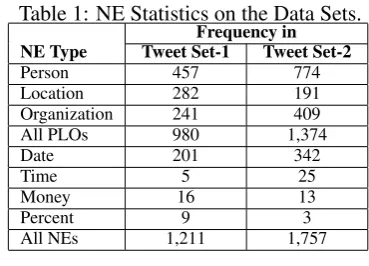
Table 1: NE Statistics on the Data Sets. Frequency in NE Type Tweet Set-1 Tweet Set-2
Person 457 774
Location 282 191
Organization 241 409
All PLOs 980 1,374
Date 201 342
Time 5 25
Money 16 13
Percent 9 3
All NEs 1,211 1,757
3 Named Entity Recognition Experiments
The NER experiments are performed using the rule-based NER system (K¨uc¸¨uk and Yazıcı, 2009) which makes use of a set of lexical resources, i.e., lists of person/location/organization names (henceforth referred to as PLOs), and patterns for the extraction of named entities (NEs) of type PLOs and time/date/money/percent expressions (K¨uc¸¨uk and Yazıcı, 2009). The system is pro-posed for news articles which is a considerably well-formed text type usually with proper capital-ization of the initial letters of PLOs and separa-tion of these PLOs from their suffixes with apos-trophes1. Yet, as even such well-formed texts may
be lacking these important indicators of PLOs, the system can be configured to make use of the cap-italization clue or not, and it includes a simplistic morphological analyzer to check the suffixes at the end of PLO candidates and thereby validate these candidates (K¨uc¸¨uk and Yazıcı, 2009).
tweets with about 50K tokens and is described in (C¸elikkaya et al., 2013).
3.1 Initial Experiments
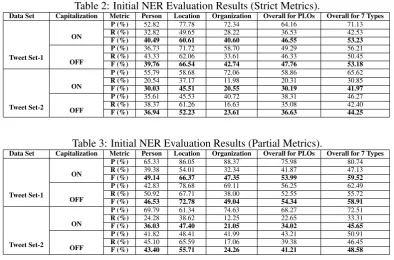
We have first evaluated the system’s performance on the data sets without any extensions to the exist-ing NER system. Table 2 presents these evaluation results using the commonly employed metrics of precision, recall, and balanced F-Measure, with-out giving any credit to partially extracted NEs. Table 3 displays those results with the same met-rics this time giving credit to partial extractions with the constraint that the NE type within the sys-tem output and the answer key must be the same, where these metrics have been employed in stud-ies like (Maynard et al., 2001).
The evaluation results in Table 2 and Table 3 are in line with the common finding reported in the literature that the NER systems for com-paratively well-formed text types face consider-able performance decreases when they are eval-uated on tweets. This observation is usually at-tributed to the peculiarities of tweet texts such as common grammatical/spelling errors and deliber-ate contractions. With strict metrics, the system is reported to achieve an F-Measure rate of 78.7%. When it is ported to tweets, the best overall F-Measure rates achieved are 53.23% and 44.25% onT weet Set−1andT weet Set−2, respectively, while the corresponding best F-Measure rates for only PLOs are 47.76% and 36.63%, respectively, all with strict metrics. The difference between the results for PLOs and the overall results also confirms that the system recognizes temporal and numerical expressions (within its scope) with de-cent performance, compared to the recognition of PLOs.
The F-Measure rates obtained when partial ex-tractions are also given credit are about 5% higher than those obtained without giving any credit to partially extracted NEs. This increase is impor-tant due to pragmatic reasons as these partially extracted NEs can help conveniently filter tweet streams and retrieve relevant subsets of tweets in several application settings.
3.2 NER Experiments with Rule/Resource Adaptations
Tweet texts possess the following peculiarities usually as opposed to other formal text types:
• Grammatical/spelling errors are common,
like incorrectly writing proper names all in lowercase letters. A Turkish example illus-trating a spelling error is the use ofgeliyoooo instead ofgeliyor(meaningis coming).
• Contracted word forms are commonly used instead of full forms, like referring to the football club called F enerbahc¸e as F ener only, where the latter contracted form is also homonymous to a common name in Turkish (meaninglantern).
• For the particular case of Turkish tweets, non-accentuated characters (c, g, i, o, s, and u) are often utilized instead of the corre-sponding Turkish characters with diacritics (c¸, ˘g, ı, ¨o, s¸, and ¨u). An example of this phe-nomenon is writingcunkuinstead of the cor-rect form,c¸¨unk¨u(meaningbecause).
Considering the above features, in order to im-prove the initial NER performance on Turkish tweets, we have tested two adaptations of the rule-based NER system. The details of these adapta-tions and the corresponding evaluation results are presented in the following subsections.
3.2.1 Relaxing the Capitalization Constraint of the System
As proper capitalization of PLOs is usually lack-ing in tweets, we have evaluated the NER sys-tem with its capitalization feature turned off, so that the system considers all tokens (no matter whether their initial character is capitalized or not) as valid NE candidates. The initial evaluation re-sults of the system with this setting are provided in Table 2 and Table 3 within the rows where the Capitalizationcolumn has a corresponding OF F value. The results for these two capitaliza-tion settings are also similarly provided in Tables 4-6 which present the evaluation results described in the upcoming sections.
Table 2: Initial NER Evaluation Results (Strict Metrics).
Data Set Capitalization Metric Person Location Organization Overall for PLOs Overall for 7 Types
Tweet Set-1
ON
P (%) 52.82 77.78 72.34 64.16 71.13
R (%) 32.82 49.65 28.22 36.53 42.53
F (%) 40.49 60.61 40.60 46.55 53.23
OFF
P (%) 36.73 71.72 58.70 49.29 56.21
R (%) 43.33 62.06 33.61 46.33 50.45
F (%) 39.76 66.54 42.74 47.76 53.18
Tweet Set-2
ON
P (%) 55.79 58.68 72.06 58.86 65.62
R (%) 20.54 37.17 11.98 20.31 30.85
F (%) 30.03 45.51 20.55 30.19 41.97
OFF
P (%) 35.61 45.53 40.72 38.31 46.27
R (%) 38.37 61.26 16.63 35.08 42.40
F (%) 36.94 52.23 23.61 36.63 44.25
Table 3: Initial NER Evaluation Results (Partial Metrics).
Data Set Capitalization Metric Person Location Organization Overall for PLOs Overall for 7 Types
Tweet Set-1
ON
P (%) 65.33 86.05 88.37 75.98 80.74
R (%) 39.38 54.01 32.34 41.87 47.13
F (%) 49.14 66.37 47.35 53.99 59.52
OFF
P (%) 42.83 78.68 69.11 56.25 62.49
R (%) 50.92 67.71 38.00 52.55 55.72
F (%) 46.53 72.78 49.04 54.34 58.91
Tweet Set-2
ON
P (%) 69.79 61.34 74.63 68.27 72.51
R (%) 24.28 38.62 12.25 22.65 33.31
F (%) 36.03 47.40 21.05 34.02 45.65
OFF
P (%) 41.82 48.41 41.99 43.21 50.91
R (%) 45.10 65.59 17.06 39.38 46.45
F (%) 43.40 55.71 24.26 41.21 48.58
simplistic morphological analyzer to validate suf-fixes added at the ends of the NEs, thereby the sys-tem does not overgenerate with this new setting, although the precision rates decrease considerably in return to corresponding increases in the recall rates. To summarize, together with the fact that about 25.1% of all PLOs withinT weet Set−1are lacking proper capitalization (K¨uc¸¨uk et al., 2014), these findings suggest that the ability to relax this capitalization constraint is a convenient feature of a practical NER system for Turkish tweets. An alternative feature would be to automatically cor-rect the capitalization of NEs instead, as a pre-processing step.
3.2.2 Diacritics-Based Expansion of the Lexical Resources
In Turkish tweet texts, words including Turkish characters with diacritics are often, usually ei-ther erroneously or deliberately for pragmatic rea-sons such as to type faster, spelled with their non-diacritic equivalents, as pointed out above. There-fore, we expand the entries in the lexical resources of the NER system to include both diacritic and non-diacritic variants of these entries. For in-stance, the Turkish name of the island Cyprus, Kıbrıs, may appear in tweets asKıbris,Kibrıs, orKibris, as well. As this example denotes, for each existing entry with n such Turkish-specific characters, 2n entries (including the original en-try) are included in the ultimate expanded forms
of the lexical resources, since each such character may be used as it is or may be replaced with its equivalent.
During this expansion stage, we have applied a filtering procedure over these newly considered 2n−1entries to check whether they are homony-mous to common names in Turkish. This fil-tering procedure basically checks whether an ex-pansion candidate is within a list of unique, sup-posedly well-formed, Turkish words comprising about 1,140,208 items including inflected forms (Zemberek, 2010), and if it is, then this candidate is discarded to avoid overgeneration during the ac-tual NER procedure.
Table 4: NER Evaluation Results After Diacritics-Based Expansion of Resources (Strict Metrics).
Data Set Capitalization Metric Person Location Organization Overall for PLOs Overall for 7 Types
Tweet Set-1
ON
P (%) 53.00 78.80 73.20 64.89 71.95
R (%) 32.82 51.42 29.46 37.35 44.26
F (%) 40.54 62.23 42.01 47.41 54.81
OFF
P (%) 36.17 71.31 59.03 48.95 56.16
R (%) 43.76 63.48 35.27 47.35 52.35
F (%) 39.60 67.17 44.16 48.13 54.19
Tweet Set-2
ON
P (%) 58.22 58.73 70.67 60.20 67.29
R (%) 22.87 38.74 12.96 22.13 34.89
F (%) 32.84 46.69 21.90 32.36 45.95
OFF
P (%) 36.80 44.61 32.43 37.61 46.24
R (%) 43.41 62.83 17.60 38.43 47.64
[image:5.595.89.510.73.191.2]F (%) 39.83 52.17 22.82 38.01 46.93
Table 5: NER Evaluation Results After Diacritics-Based Expansion of Resources (Partial Metrics).
Data Set Capitalization Metric Person Location Organization Overall for PLOs Overall for 7 Types
Tweet Set-1
ON
P (%) 65.58 87.46 88.76 76.81 81.44
R (%) 39.38 56.12 33.62 42.80 48.98
F (%) 49.21 68.37 48.77 54.97 61.17
OFF
P (%) 42.21 79.17 69.00 56.02 62.49
R (%) 51.56 69.85 39.70 53.88 57.90
F (%) 46.42 74.22 50.40 54.93 60.11
Tweet Set-2
ON
P (%) 71.48 61.29 72.97 69.07 73.68
R (%) 26.68 40.21 13.24 24.51 37.47
F (%) 38.86 48.56 22.41 36.18 49.67
OFF
P (%) 42.26 47.07 33.33 41.75 50.23
R (%) 50.14 66.76 18.04 42.65 51.72
F (%) 45.86 55.21 23.41 42.20 50.96
about 6.3% of all NEs inT weet Set−1are writ-ten in characters with missing diacritics. A plausi-ble alternative to this feature would be to perform diacritics-based correction (or, normalization) as presented in studies like (Mihalcea, 2002) prior to the actual NER procedure. Similar approaches can be tested on tweets in other languages having com-mon characters with diacritics.
3.3 Tweet Normalization
Tweet normalization has emerged as an important research problem (Han and Baldwin, 2011), the solutions to which can readily be used in systems for sentiment analysis and NER (as considered in studies such as (Liu et al., 2012)), among others. In order to observe the effects of normalization on NER performance on Turkish tweets, we have first experimented with a simplistic tweet normal-ization scheme which aims at decreasing repeated characters in words, as repetition of characters in tweets is a frequent means to express stress. The scheme is outlined below:
1. In order to determine the list of valid Turk-ish words with consecutively repeated char-acters, we have employed the list of Turk-ish unique words (Zemberek, 2010), that we have previously utilized during the diacritics-based resource expansion procedure in Sec-tion 3.2.2. Within this list, 74,262 words (about 6.5% of the list) turn out to have
con-secutively repeated characters.
2. Using this sublist as a reference resource, we have implemented the actual simplistic nor-malization scheme: if a word in a tweet has consecutively repeated character sequences and the word is not included within the afore-mentioned sublist, then all of these character sequences are contracted to single character instances. For instance, with this procedure, the tokenzamaanlaaais correctly replaced with zamanla (meaning with time) and mirayyyis correctly replaced withmiray(a proper person name).
The employment of the above normalization scheme prior to the actual NER procedure has led to slightly poorer results as some NEs which should not be normalized through this scheme are normalized instead. For instance, the city name C¸anakkale is changed to C¸anakale during the normalization procedure and it is missed by the subsequent NER procedure. Hence, we employ a three-phase pipelined NER approach where we first run the NER procedure on the input text, then employ the normalization scheme on the NER out-put, and finally run the NER procedure again on the normalization output, in order to avoid that the normalization step corrupts well-formed NEs that can readily be extracted by the system.
both of the actual NER phases, is evaluated only on T weet Set−1. Therefore, the performance evaluations of the first NER phase correspond to the previously presented results in the rows 4-6 of Table 2 and Table 3, with strict and partial versions of the metrics, respectively.
Below we summarize our findings regarding the intermediate normalization procedure employed, based on its evaluation results. Although some of these findings are not directly relevant for the pur-poses of the NER procedure, we provide them for the completeness of the discussion on the normal-ization of Turkish tweets.
• Excluding the normalization cases which in-volve non-alphabetical characters only (like normalizing>>>>>>to>), those that result in a normalized form with a single alphabet-ical character (like normalizing oooooo to
o), and those that involve emotion expres-sions (like normalizing:DDDDDto:D), the number of resulting instances considered for performance evaluation is 494.
• The number of normalization instances in which an incorrect token is precisely con-verted into its corresponding valid form is 253, so, the precision of the overall normal-ization scheme is 51.21%.
• 117 of the incorrect cases are due to the fact that the token that is considered for normal-ization is a valid but foreign token (such as normalizing Harry to Hary, jennifer to jenifer, full to ful, and tweet to twet). Hence, these cases account for a decrease of 23.68% in the precision of the normalization scheme.
• 15 of the incorrect instances are due to the fact that Turkish characters with diacritics are not correctly used, hence they cannot be found within the reference sublist of valid Turkish words, and subsequently considered by the normalization procedure, although they could instead be subject to a diacritics-based normalization, as pointed out at the end of Section 3.2.2. For instance, s¸iir (mean-ing poem) is incorrectly written as siir in a tweet and since it, in this incorrect form, cannot be found on the reference sublist, it is erroneously changed to sir. There are also
other incorrect instances in which superflu-ous characters are correctly removed with the normalization procedure, yet the resulting to-ken is still not in its correct form as a subse-quent diacritics-based correction is required. Though they are not considerably frequent (as we only consider here tokens with consec-utively repeated characters), these instances serve to confirm that the restoration of dia-critics should be considered along with other forms of normalization.
• Some other frequent errors made by the nor-malization scheme are due to incorrect kenization as whitespaces to separate to-kens can be missing due to writing errors or the tendency to write some phrases hashtag-like. An example case is incorrectly writ-ing the adverb, demek ki (meaning so or that means), asdemekkiin a tweet, which in turn is erroneously changed to demeki during normalization. This token,demekki, should not be considered within this type of normalization at all, although it needs pro-cessing to be transformed into its correct form,demek ki.
To summarize, the normalization scheme can be enhanced considering the above points, where proper treatment of non-Turkish tokens and the consideration of diacritics-based issues stand as the most promising directions of improvement. Other more elaborate ways of normalizing tweets, as presented in studies such as (Han and Bald-win, 2011), should also be tested together with the NER procedure, to observe their ultimate con-tribution. Along the way, a normalization dictio-nary for Turkish can be compiled, following stud-ies like (Han et al., 2012).
Table 6: Evaluation Results of the NER Pipeline with Normalization, onT weet Set−1.
Metric Type Metric Person Location Organization Overall for PLOs Overall for 7 Types
Strict
P (%) 36.45 71.72 58.99 48.94 55.91
R (%) 44.42 62.06 34.02 46.94 51.20
F (%) 40.04 66.54 43.16 47.92 53.45
Partial
P (%) 42.32 78.68 69.35 55.73 62.04
R (%) 52.07 67.71 38.43 53.18 56.48
F (%) 46.69 72.78 49.45 54.43 59.13
false positives, the ways of improving the normal-ization procedure discussed above can be imple-mented and thereby less errors will be propagated into the second NER phase.
Though the overall results in Table 6 are slightly better than their counterparts when normalization is not employed, we cannot derive sound conclu-sions about the contribution of this normalization scheme to the overall NER procedure. The slight improvement is also an expected result as the size of the test data set is quite small and the number of NEs to be recognized after this type of nor-malization is already limited since only about 1% of all PLOs inT weet Set−1have incorrectly re-peated consecutive characters. Yet, the results are still promising in that with a more elaborate nor-malization procedure evaluated on larger corpora, more dramatic increases in the NER performance can be obtained on Turkish tweets.
4 Future Work
Directions of future work based on the current study include the following:
• Following the points made throughout Sec-tion 3, several normalizaSec-tion schemes also in-volving case and diacritics restoration can be implemented and incorporated into the NER procedure on tweets.
• Since tweet texts are short and informal, they often lack contextual clues needed to perform an efficient NER procedure. Additionally, there is a tendency to mention new and pop-ular NEs in tweets which might be missed by a NER system with static lexical resources. Hence, extending the lexical resources of the NER system with contemporary up-to-date NEs automatically obtained from Turk-ish news articles can be considered. For this purpose, we can readily employ resources like JRC-Names (Steinberger et al., 2011), a publicly available continuously-updated NE and name variant dictionary, as a source of up-to-date NEs in Turkish.
5 Conclusion
In this study, we target the problem of named en-tity recognition on Turkish tweets. We have car-ried out experiments starting with a rule-based recognition system and gradually extended it in two directions: adapting the rules/resources of the system and introducing a tweet normalization scheme into the recognition procedure. Thereby, we present our findings on named entity recogni-tion on Turkish tweets in addirecogni-tion to those on the normalization of Turkish tweets. Based on these findings, we outline some desirable features of a named entity recognition system tailored to Turk-ish tweets. Future work includes the employment and testing of more elaborate tweet normalization procedures along the way, on larger tweet data sets, in addition to evaluating the system after its resources are automatically extended with dictio-naries of up-to-date named entities.
Acknowledgments
This study is supported in part by a postdoctoral research grant from T ¨UB˙ITAK.
References
Fabian Abel, Qi Gao, Geert-Jan Houben, and Ke Tao. 2011. Analyzing Temporal Dynamics in Twitter Profiles for Personalized Recommendations in the
Social Web. InProceedings of the 3rd ACM
Inter-national Web Science Conference.
Kalina Bontcheva, Leon Derczynski, Adam Funk, Mark Greenwood, Diana Maynard, and Niraj Aswani. 2013. TwitIE: An Open-Source Informa-tion ExtracInforma-tion Pipeline for Microblog Text. In Pro-ceedings of the International Conference on Recent Advances in Natural Language Processing.
G¨okhan C¸elikkaya, Dilara Toruno˘glu, and G¨uls¸en Eryi˘git. 2013. Named Entity Recognition on Real Data: A Preliminary Investigation for Turkish. In
Proceedings of the 7th International Conference on Application of Information and Communication Technologies.
Entity Recognition. In Proceedings of the Inter-national Conference on Computational Linguistics, pages 2459–2474.
Diego Marinho de Oliveira, Alberto H.F. Laender, Adriano Veloso, and Altigran S. da Silva. 2013. FS-NER: A Lightweight Filter-Stream Approach to
Named Entity Recognition on Twitter Data. In
Pro-ceedings of the 22nd International Conference on World Wide Web Companion, pages 597–604. Bo Han and Timothy Baldwin. 2011. Lexical
Nor-malisation of Short Text Messages: Makn Sens a
#twitter. InProceedings of the 49th Annual
Meet-ing of the Association for Computational LMeet-inguis- Linguis-tics, pages 368–378.
Bo Han, Paul Cook, and Timothy Baldwin. 2012. Automatically Constructing a Normalisation
Dictio-nary for Microblogs. In Proceedings of the Joint
Conference on Empirical Methods in Natural guage Processing and Computational Natural Lan-guage Learning.
Jason J. Jung. 2012. Online Named Entity Recog-nition Method for Microtexts in Social Networking
Services: A Case Study of Twitter. Expert Systems
with Applications, 39(9):8066–8070.
Dilek K¨uc¸¨uk and Adnan Yazıcı. 2009. Named En-tity Recognition Experiments on Turkish Texts. In T. Andreasen et al., editor,Proceedings of the Inter-national Conference on Flexible Query Answering Systems, volume 5822 ofLecture Notes in Computer Science, pages 524–535.
Dilek K¨uc¸¨uk and Adnan Yazıcı. 2012. A Hybrid
Named Entity Recognizer for Turkish. Expert
Sys-tems with Applications, 39(3):2733–2742.
Dilek K¨uc¸¨uk, Guillaume Jacquet, and Ralf Stein-berger. 2014. Named Entity Recognition on Turkish
Tweets. InProceedings of the Language Resources
and Evaluation Conference.
Chenliang Li, Jianshu Weng, Qi He, Yuxia Yao, An-witaman Datta, Aixin Sun, and Bu-Sung Lee. 2012. TwiNER: Named Entity Recognition in Targeted
Twitter Stream. In Proceedings of the 35th
Inter-national ACM SIGIR Conference on Research and Development in Information Retrieval, pages 721– 730.
Xiaohua Liu, Shaodian Zhang, Furu Wei, and Ming
Zhou. 2011. Recognizing Named Entities in
Tweets. InProceedings of the 49th Annual Meeting
of the Association for Computational Linguistics: Human Language Technologies - Volume 1, pages 359–367.
Xiaohua Liu, Ming Zhou, Furu Wei, Zhongyang Fu, and Xiangyang Zhou. 2012. Joint Inference of Named Entity Recognition and Normalization for
Tweets. In Proceedings of the 50th Annual
Meet-ing of the Association for Computational LMeet-inguis- Linguis-tics: Long Papers - Volume 1, pages 526–535.
Diana Maynard, Valentin Tablan, Cristan Ursu, Hamish Cunningham, and Yorick Wilks. 2001. Named en-tity recognition from diverse text types. In Proceed-ings of the Conference on Recent Advances in Natu-ral Language Processing.
Rada F. Mihalcea. 2002. Diacritics Restoration: Learning from Letters versus Learning from Words. InProceedings of the 3rd International Conference on Intelligent Text Processing and Computational Linguistics, pages 339–348.
Jakub Piskorski and Maud Ehrmann. 2013. On Named Entity Recognition in Targeted Twitter Streams in
Polish. In Proceedings of the ACL Workshop on
Balto-Slavic Natural Language Processing. Bruno Pouliquen and Ralf Steinberger. 2009.
Auto-matic Construction of Multilingual Name
Dictionar-ies. In C. Goutte et al., editor, Learning Machine
Translation, Advances in Neural Information Pro-cessing Systems Series, pages 59–78. MIT Press. Alan Ritter, Sam Clark, Mausam, and Oren Etzioni.
2011. Named Entity Recognition in Tweets: An
Experimental Study. In Proceedings of the
Con-ference on Empirical Methods in Natural Language Processing, pages 1524–1534.
Alan Ritter, Mausam, Oren Etzioni, and Sam Clark. 2012. Open Domain Event Extraction from
Twit-ter. InProceedings of the 18th ACM SIGKDD
Inter-national Conference on Knowledge Discovery and Data Mining, pages 1104–1112.
Bilge Say, Deniz Zeyrek, Kemal Oflazer, and Umut ¨Ozge. 2002. Development of a Corpus and a
Tree-bank for Present-Day Written Turkish. In
Proceed-ings of the 11th International Conference of Turkish Linguistics.
Ralf Steinberger, Bruno Pouliquen, Mijail Alexandrov Kabadjov, Jenya Belyaeva, and Erik Van der Goot. 2011. JRC-Names: A Freely Available, Highly
Multilingual Named Entity Resource. In
Proceed-ings of the Conference on Recent Advances in Natu-ral Language Processing.
Serhan Tatar and ˙Ilyas C¸icekli. 2011. Automatic Rule Learning Exploiting Morphological Features
for Named Entity Recognition in Turkish. Journal
of Information Science, 37(2):137–151.
G¨okhan T¨ur, Dilek Hakkani-T¨ur, and Kemal Oflazer. 2003. A Statistical Information Extraction
Sys-tem for Turkish. Natural Language Engineering,
9(2):181–210.
Reyyan Yeniterzi. 2011. Exploiting Morphology in
Turkish Named Entity Recognition System. In
Pro-ceedings of the ACL Student Session, pages 105– 110.