Self-Training without Reranking for Parser Domain Adaptation and
Its Impact on Semantic Role Labeling
Kenji Sagae
Institute for Creative Technologies
University of Southern California
Marina del Rey, CA 90292
[email protected]
Abstract
We compare self-training with and with-out reranking for parser domain adapta-tion, and examine the impact of syntactic parser adaptation on a semantic role la-beling system. Although self-training without reranking has been found not to improve in-domain accuracy for parsers trained on the WSJ Penn Treebank, we show that it is surprisingly effective for parser domain adaptation. We also show that simple self-training of a syntactic parser improves out-of-domain accuracy of a semantic role labeler.
1
Introduction
Improvements in data-driven parsing approaches, coupled with the development of treebanks that serve as training data, have resulted in accurate parsers for several languages. However, port-ability across domains remains a challenge: pars-ers trained using a treebank for a specific domain generally perform comparatively poorly in other domains. In English, the most widely used train-ing set for parsers comes from the Wall Street Journal portion of the Penn Treebank (Marcus et al., 1993), and constituent parsers trained on this set are now capable of labeled bracketing preci-sion and recall of over 90% (Charniak and John-son, 2005; Huang, 2008) on WSJ testing sen-tences. When applied without adaptation to the Brown portion of the Penn Treebank, however, an absolute drop of over 5% in precision and re-call is typire-cally observed (McClosky et al., 2006b). In pipelined NLP applications that in-clude a parser, this drop often results in severely degraded results downstream.
We present experiments with a simple self-training approach to semi-supervised parser do-main adaptation that produce results that contra-dict the commonly held assumption that im-proved parser accuracy cannot be obtained by self-training a generative parser without rerank-ing (Charniak, 1997; Steedman et al., 2003; McClosky et al., 2006b, 2008).1 We compare
this simple training approach to the self-training with reranking approach proposed by McClosky et al. (2006b), and show that although McClosky et al.’s approach produces better la-beled bracketing precision and recall on out-of-domain sentences, higher F-score on syntactic parses may not lead to an overall improvement in results obtained in NLP applications that include parsing, contrary to our expectations. This is evidenced by results obtained when different ad-aptation approaches are applied to a parser that serves as a component in a semantic role labeling (SRL) system. This is, to our knowledge, the first attempt to quantify the benefits of semi-supervised parser domain adaptation in semantic role labeling, a task in which parsing accuracy is crucial.
2
Semi-supervised parser domain
adap-tation with self-training
Because treebanks are expensive to create, while plain text in most domains is easily obtainable, semi-supervised approaches to parser domain adaptation are a particularly attractive solution to the domain portability problem. This usually involves a manually annotated training set (a
1 Reichart and Rappoport (2007) show that self-training without reranking is effective when the manually annotated training set is small. We show that this is true even for a large training set (the standard WSJ Penn Treebank training set, with over 40k sentences).
treebank), and a larger set of unlabeled data (plain text).
Bacchiani and Roark (2003) obtained positive results in unsupervised domain adaptation of language models by using a speech recognition system with an out-of-domain language model to produce an automatically annotated training cor-pus that is used to adapt the language model us-ing a maximum a posteriori (MAP) adaptation strategy. In subsequent work (Roark and Bac-chiani, 2003), this MAP adaptation approach was applied to PCFG adaptation, where an out-of-domain parser was used to annotate an in-out-of-domain corpus automatically with multiple candidate trees per sentence. A substantial improvement was achieved in out-of-domain parsing, although the obtained accuracy level was still far below that obtained with domain-specific training data.
More recent work in unsupervised domain ad-aptation for state-of-the-art parsers has achieved accuracy levels on out-of-domain text that is comparable to that achieved with domain-specific training data (McClosky et al., 2006b). This is done in a self-training setting, where a parser trained on a treebank (in a seed domain) is used to parse a large amount of unlabeled data in the target domain (assigning only one parse per sentence). The automatically parsed corpus is then used as additional training data for the parser. Although initial attempts to improve in-domain parsing accuracy with self-training were unsuccessful (Charniak, 1997; Steedman et al., 2003), recent work has shown that self-training can work in specific conditions (McClosky et al., 2006b), and in particular it can be used to im-prove parsing accuracy on out-of-domain text (Reichart and Rappoport, 2007).
2.1 Self-training with reraking
McClosky et al. (2006b) presented the most suc-cessful semi-supervised approach to date for ad-aptation of a WSJ-trained parser to Brown data containing several genres of text (such as relig-ion, mystery, romance, adventure, etc.), obtain-ing a substantial accuracy improvement usobtain-ing only unlabeled data. Their approach involves the use of a first-stage n-best parser and a reranker, which together produce parses for the unlabeled dataset. The automatically parsed in-domain corpus is then used as additional training mate-rial. In light of previous failed attempts to im-prove generative parsers through self-training (Charniak, 1997; Steedman et al., 2003), McClosky et al. (2006a) argue that the use of a reranker is an important factor in the success of
their approach. That work used text from the LA Times (taken from the North American News Corpus, or NANC), which is presumably more similar to the parser’s training material than to text in the Brown corpus, and resulted not only in an improvement of parser accuracy on out-of-domain text (from the Brown corpus), but also in an improvement in accuracy on in-domain text (the standard WSJ test set of the Penn Treebank). It can be argued that the McClosky et al. ap-proach is not a pure instance of self-training, since two parsing models are used: the first-stage generative model, and a discriminative model for reranking. The generative parser is improved based on the output of the discriminative model, but McClosky et al. found that the discriminative model does not improve when retrained with its own output.
2.2 Self-training without reraking
Although there have been instances of self-training (or similar) approaches that produced improved parser accuracy without reranking, the success of these efforts are often attributed to other specific factors.
Reichart and Rappoport (2007) obtained posi-tive results in in-domain and out-of-domain sce-narios with self-training without reranking, but under the constant condition that only a rela-tively small set of manually labeled data is used as the seed training set. Sagae and Tsujii (2007) improved the out-of-domain accuracy of a de-pendency parser trained on the entire WSJ train-ing set (40k sentences) by ustrain-ing unlabeled data in the same domain as the out-of-domain test data (biomedical text). However, they used agreement between different parsers to estimate the quality of automatically generated training instances and selected only sentences with high estimated accuracy. Although the parser im-proves when trained with its own output, the training instances are selected through the use of a separate dependency parsing model.
2.3 Simple self-training without reranking for domain adaptation
model’s accuracy.2 This assumption, however, is largely based on previous attempts to improve
in-domain accuracy through self-training
(Steedman et al., 2003; Charniak, 1997; McClosky et al., 2006a, 2008). We will refer to this type of self-training as simple self-training, to avoid confusion with other self-training set-tings, such as McClosky et al.’s, where a reranker is involved.
We propose a simple self-training framework for domain adaptation, as follows:
1. A generative parser is trained using a tree-bank in a specific source domain.
2. The parser is used to generate parse trees from text in a target domain, different from the source domain.
3. The parser is retrained using the original treebank, augmented with the parse trees generated in step 2.
There are intuitive reasons that may lead one to assume that simple self-training should not
work. One is that no additional information is provided to the model. In self-training with reranking, the generative model can be enriched with information produced by the discriminative model. When two parsers are used for training instance selection, one parser informs the other. In simple self-training, however, there is no addi-tional source of syntactic knowledge with which the self-trained model would be enriched.
Another possible reason is that the output of the self-trained parser should be expected to in-clude the same errors found in the automatically generated training material. If the initial parser has poor accuracy on the target domain, the training data it generates will be of poor quality, resulting in no improvement in the resulting trained model. The self-trained model may sim-ply learn to make the same mistakes as the origi-nal model.
Conversely, there are also intuitive reasons for why it might work. A possible source of poor performance in new domains is that the model lacks coverage. Specific lexical items and syn-tactic structures in a new domain appear in a va-riety of contexts, accompanied by different words and structures. The parser trained on the source domain may analyze some of these new
2 Except for in cases where the initial model is trained using a very small treebank.
items and structures correctly, and it may also make mistakes. As long as errors in the auto-matically generated training material are not all systematic, the benefits of adding target-domain information could outweigh the addition of noise in the model.
Naturally, it may be that these conditions hold for some pairs of source and target domains but not others. In the next section, we present ex-periments that investigate whether simple self-training is effective for one particular set of train-ing (WSJ) and testtrain-ing (Brown) corpora, which are widely used in parsing research for English.
3
Domain adaptations experiments
In our experiments we use primarily the Charniak (2000) parser. In a few specific ex-periments we also use the Charniak and Johnson (2005) reranker; such cases are noted explicitly and are not central to the paper, serving mostly for comparisons. We follow the three steps de-scribed in section 2.3. The manually labeled training corpus is the standard WSJ training sec-tions of the Penn Treebank (secsec-tions 02 to 21). Sections 22 and 23 are used as in-domain devel-opment and testing sets, respectively. The out-of-domain material is taken from the Brown por-tion of the Penn Treebank. We use the same Brown test set as McClosky et al. (2006b), every tenth sentence in the corpus. Another tenth of the corpus is used as a development set, and the rest of the Brown corpus is not used. The out-of-domain text then contains not one but several genres of text. The larger set of unlabeled data is composed of approximately 5.3 million words (320k sentences) of 20th century novels available from Project Gutenberg3, which do not match exactly the target domain, but is closer to it in general than to the source domain (WSJ).3.1 Simple self-training results
The precision, recall and F-score of labeled brackets of the initial parser, trained only on the WSJ Penn Treebank, are shown in the first row of results in Table 1 for the WSJ (in-domain) test set and the Brown (out-of-domain) test set. These figures serve as our baseline. The second row of results in Table 1 shows the results ob-tained with a model produced using simple self-training. The baseline model is used to parse the entire unlabeled dataset (320k sentences), and
the resulting parse trees are added to the WSJ training set to produce the self-trained model.
A substantial improvement is observed for the target test set (Brown), close to an absolute im-provement of 2% in precision, recall and F-score. Table 1 also shows that parser accuracy fell by 1% on WSJ. Although we do not see this as a problem, since the our goal is to produce an im-proved model for parsing Brown, it is interesting that, unlike in the work of McClosky et al. (2006a, 2006b) where self-training includes reranking, simple self-training is effective spe-cifically for domain adaptation, but not for im-proving the accuracy of the parser on in-domain data. At least in this case, simple self-training does not result in an absolutely improved parsing model (as appears to be the case with McClosky et al.’s self-training), although it does result in an improved model for the target data.
Finally, the last row in Table 1 shows the re-sults on WSJ and Brown obtained by McClosky et al. (2006a, 2006b) using self-training with reranking. As they have shown, the discrimina-tive reranker can be used to provide further im-provements, as discussed in the next subsection.
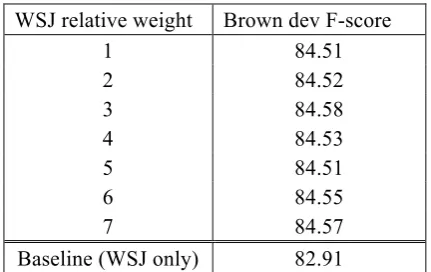
Unlike McClosky et al. (2006a), we did not give different weights to the original and auto-matically generated training instances. In our experiments with the Brown development data, varying the weight of the gold-standard WSJ training data from 1 to 7, we observed only small differences in score (Table 2). The highest F-score, obtained when the WSJ training corpus is given a relative weight of 3, was only 0.07 higher than the F-score obtained when the WSJ training corpus is given a relative weight of 1.
WSJ relative weight Brown dev F-score
1 84.51
2 84.52
3 84.58
4 84.53
5 84.51
6 84.55
7 84.57
Baseline (WSJ only) 82.91
Table 2: Brown development set F-scores ob-tained with self-trained models with different relative weights given to the gold-standard WSJ training data. The last row shows the F-score for the original model (without adaptation).
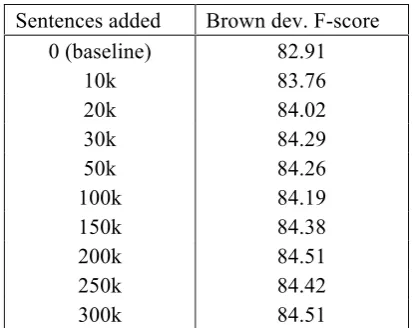
Table 3 shows results on the Brown develop-ment set when different amounts of unlabeled data are used to create the self-trained model. Although F-score generally increases with more unlabeled data, the effect is not monotonic. McClosky et al. observed a similar effect in their self-training experiments, and hypothesized that this may be due to differences between portions of the unlabeled data and the target corpus, and to varying parsing difficulty in portions of the unlabeled data, which results in varying quality of the parse trees produced automatically for training. A large improvement in F-score over the baseline is observed when adding only 30k sentences. Additional improvement is observed when additional sentences are added, but these are small in comparison. One interesting note is
WSJ Brown
Precision Recall F-score Precision Recall F-score
Baseline 89.49 88.78 89.13 83.93 83.19 83.56
Self-trained 88.26 87.86 88.06 85.78 85.05 85.42
[image:4.595.76.524.78.183.2]MCJ 91.0 87.1
[image:4.595.309.525.322.458.2]that, although self-training produced improved bracketing precision and recall, part-of-speech tagging accuracy of Brown remained largely un-changed from the baseline, in the range of 94.42% to 94.50% accuracy. It is possible that separate adaption for part-of-speech tagging may improve parsing F-score further.
The results in this section show that simple self-training is effective in adapting WSJ-trained parser to Brown, but more experiments are needed to determine if the same effects observed in our simple self-training experiments would also be observed with other pairs of seed training data and target datasets, and what characteristics of the datasets may affect domain adaptation.
3.2 Self-training with reranking results To provide a more informative comparison be-tween the results obtained with simple self-training and other work, we also performed McClosky et al.’s self-training with reranking using our unlabeled dataset. In this experiment, intended to provide a better understanding of the role of the unlabeled data (20th century novels vs. LA Times articles), we parse the unlabeled dataset with the Charniak (2000) parser and the Charniak and Johnson (2005) discriminative reranker to produce additional training material for the generative parser. The resulting genera-tive parser produces slightly improved F-scores compared to the simple self-training setting (88.78% on WSJ and 86.01 on Brown), although a slight drop in WSJ F-score is still observed, indicating that the use of news text is likely an
important factor in McClosky et al.’s superior F-score figures.
All of these models can be used to produce n-best parses with the Charniak parser, and these can be reranked with the Charniak and Johnson reranker, whether or not the self-training proce-dure that created the generative model involved reranking. McClosky et al. found that although their self-training procedure involves reranking, the gains in accuracy are orthogonal to those provided by a final reranking step, applied to the output of the self-trained model. As in their case, applying the WSJ-trained reranker to our self-trained model improves its accuracy. In the case of our simple self-trained model, the im-provement is of about 1.7%, which means that if a reranker is used at run-time (but not during self-training), F-score goes up to 87.12%. Inter-estingly, applying a final pass of reranking to the model obtained with self-training with reranking brings F-score up only by less than 1.2%, to 87.17%. So at least in our case, improvements provided by the use the reranker appear not to be completely orthogonal.
4
Semantic Role Labeling with syntactic
parser adaptation
To investigate the impact of parser domain adap-tation through self-training on applications that depend on parser output, we use an existing se-mantic role labeling (SRL) system, the Illinois Semantic Role Labeler4, replacing the provided parsing component with our (WSJ) baseline and (adapted) self-trained parsers.
We tested the SRL system using the datasets of the CoNLL 2005 shared task (Carreras and Màrquez, 2005). The system is trained on the WSJ domain using PropBank (Palmer et al. 2005), and the shared task includes WSJ and Brown evaluation sets. Using the baseline WSJ syntactic parser, the SRL system has an F-score of 77.49 on WSJ, which is a competitive result for systems using a single syntactic analysis per sentence. The highest scoring system (also a UIUC system) in the shared task has 79.44 F-score, and used multiple parse trees, which has been shown to improve results (Punyakanok et al., 2005). On the Brown evaluation, F-score is 64.75, a steep drop from the performance of the system on WSJ, which reflects that not just the syntactic parser, but also other system compo-nents, were trained with WSJ material. The
4 http://l2r.cs.uiuc.edu/~cogcomp/asoftware.php?skey=SRL Sentences added Brown dev. F-score
0 (baseline) 82.91
10k 83.76
20k 84.02
30k 84.29
50k 84.26
100k 84.19
150k 84.38
200k 84.51
250k 84.42
300k 84.51
[image:5.595.76.284.76.240.2]highest scoring system on the Brown evaluation in the CoNLL 2005 shared task had 67.75 F-score.
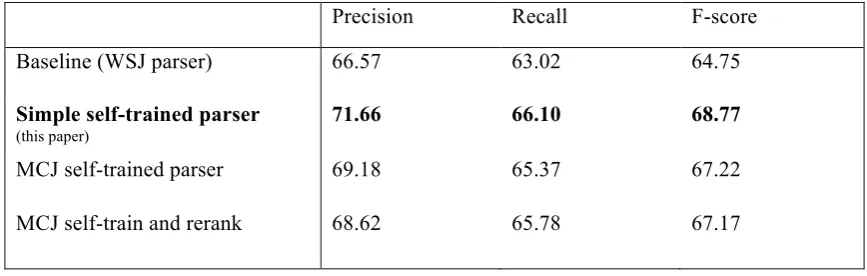
Table 4 shows the results on the Brown evaluation set using the baseline WSJ SRL sys-tem and the results obtained under three self-training parser domain adaptation schemes: sim-ple self-training using novels as unlabeled data (section 3.1), the self-trained model of McClosky et al.5, and the reranked results of the McClosky et al. self-trained model (which has F-score com-parable to that of a parser trained on the Brown corpus).
As expected, the contributions of the three adapted parsing models allowed the system to produce overall SRL results that are better than those produced with the baseline setting. Sur-prisingly, however, the use of the model created using simple self-training and sentences from novels (sections 2.3 and 3.1) resulted in better SRL results than the use of McClosky et al.’s reranking-based self-trained model (whether its results go through one additional step of rerank-ing or not), which produces substantially higher syntactic parsing F-score. Our self-trained pars-ing model results in an absolute increase of 4% in SRL F-score, outscoring all participants in the shared task (of course, systems in the shared task did not use adapted parsing models or external resources, such as unlabeled data). The im-provement in the precision of the SRL system
5 http://www.cs.brown.edu/~dmcc/selftraining.html
using simple self-training is particularly large. Improvements in the precision of the core argu-ments Arg0, Arg1, Arg2 contributed heavily to the improvement of overall scores.
We note that other parts of the SRL system remained constant, and the difference in the re-sults shown in Table 4 come solely from the use of different (adapted) parsers.
5
Conclusion
We explored the use of simple self-training, where no reranking or confidence measurements are used, for parser domain adaptation. We found that self-training can in fact improve the accuracy of a parser in a different domain from the domain of its training data (even when the training data is the entire standard WSJ training material from the Penn Treebank), and that this improvement can be carried on to modules that may use the output of the parser. We demon-strated that a semantic role labeling system trained with WSJ training data can improve sub-stantially (4%) on Brown just by having its parser be adapted using unlabeled data.
Although the fact that self-training produces improved parsing results without reranking does not necessarily conflict with previous work, it does contradict the widely held assumption that this type of self-training does not improve parser accuracy. One way to reconcile expectations based on previous attempts to improve parsing accuracy with self-training (Charniak, 1997;
Precision Recall F-score
Baseline (WSJ parser) 66.57 63.02 64.75
Simple self-trained parser (this paper)
71.66 66.10 68.77
MCJ self-trained parser 69.18 65.37 67.22
MCJ self-train and rerank 68.62 65.78 67.17
[image:6.595.81.515.77.215.2]Steedman et al., 2003) and the results observed in our experiments is that we focus specifically on domain adaptation. In fact, the in-domain accuracy of our adapted model is slightly inferior to that of the baseline, more in line with previous findings.
This work represents only one additional step towards understanding of how and when self-training works for parsing and for domain adap-tation. Additional analysis and experiments are needed to understand under what conditions and in what domains simple self-training can be ef-fective.
One question that seems particularly interest-ing is why the models adapted usinterest-ing self-traininterest-ing with reranking and news text, which produce substantially higher parsing F-scores, did not outperform our model built with simple self-training in contribution to the SRL system. Al-though we do not have an answer to this ques-tion, two factors that may play a role are the do-main of the training data and the use of the reranker, which may provide improvements in parse quality that are of a different kind of those most needed by the SRL system. This points to another interesting direction, where adapted parsers can be combined. Having different ways to perform semi-supervised parser adaptation may result in the creation of adapted models with improved accuracy on a target domain but differ-ent characteristics. The output of these parsers could then be combined in a voting scheme (Henderson and Brill, 1999) for additional im-provements on the target domain.
Acknowledgments
We thank Andrew S. Gordon and the anonymous reviewers for valuable comments and sugges-tions. The work described here has been spon-sored by the U.S. Army Research, Development, and Engineering Command (RDECOM). State-ments and opinions expressed do not necessarily reflect the position or the policy of the United States Government, and no official endorsement should be inferred.
References
Michiel Bacchiani and Brian Roark. 2003. Unsuper-vised language model adaptation. In Proceedings of the International Conference on Acoustics, Speech and Signal Processing (ICASSP).
Xavier Carreras and Lluís Màrquez. 2005. Introduc-tion to the CoNLL-2005 Shared Task: Semantic
Role Labeling. In Proceedings of the CoNLL 2005 shared task.
Eugene Charniak. 1997. Statistical parsing with a con-text-free grammar and word statistics. In Proceed-ings of AAAI, pages 598–603.
Eugene Charniak. 2000. A maximum-entropy-inspired parser. In Proceedings of the First Meet-ing of the North American Chapter of the Associa-tion for ComputaAssocia-tional Linguistics (NAACL).
Pages 132-139. Seattle, WA.
Eugene Charniak and Mark Johnson. 2005. Coarse- to-fine n-best parsing and MaxEnt discriminative reranking. In Proceedings of the 2005 Meeting of the Association for Computational Linguistics (ACL), pages 173–180.
John C. Henderson, Eric Brill. 1999. Exploiting Di-versity in Natural Language Processing: Combin-ing Parsers. In Proceedings of the Fourth Confer-ence on Empirical Methods in Natural Language Processing (EMNLP-99), pp. 187–194. College Park, Maryland.
Liang Huang (2008). Forest Reranking: Discrimina-tive Parsing with Non-Local Features. In Proceed-ings of the 2008 Meeting of the Association for Computational Linguistics (ACL). Columbus, OH. Mitchell P. Marcus, Mary Ann Marcinkiewicz and
Beatrice Santorini. 1993. Building a large anno-tated corpus of English: the Penn Treebank. In
Computational Linguistics 19(2), 313-330. David McClosky, Eugene Charniak and Mark
John-son. 2006a. Effective self-training for parsing. In
Proceedings of the Main Conference on Human Language Technology Conference of the North American Chapter of the Association of Computa-tional Linguistics (NAACL). New York, NY. David McClosky, Eugene Charniak and Mark
John-son. 2006b. Reranking and self-training for parser adaptation. In Proceedings of the 21st international Conference on Computational Linguistics and the 44th Annual Meeting of the Association For Com-putational Linguistics (ACL). Sydney, Australia. David McClosky, Eugene Charniak and Mark
John-son. 2008. When is self-training effective for pars-ing? In Proceedings of the 22nd international Con-ference on Computational Linguistics (COLING) - Volume 1. Manchester, United Kingdom.
Martha Palmer, Daniel Gildea, and Paul Kingsbury. 2005. The proposition bank: An annotated corpus of semantic roles. Computational Linguistics, 31(1).
Roi Reichart and Ari Rappoport. 2007. Self-training for enhancement and domain adaptation of statisti-cal parsers trained on small datasets. In Proceed-ings of the 45th Annual Meeting of the Association for Computational Linguistics (ACL). Pages 616-623. Prague, Czech Republic.
Brian Roark and Michiel Bacchiani. 2003. Supervised and unsupervised PCFG adaptation to novel do-mains. In Proceedings of the 2003 Conference of the North American Chapter of the Association for Computational Linguistics on Human Language Technology – Volume 1 (NAACL-HLT).
Kenji Sagae and Jun’ichi Tsujii. 2007. Multilingual dependency parsing and domain adaptation with data-driven LR models and parser ensembles. In
Proceedings of the CoNLL 2007 shared task. Pra-gue, Czech Republic.