Abstract
The system presented in this paper uses a combination of two techniques to directly transliterate from grapheme to grapheme. The technique makes no language specific as-sumptions, uses no dictionaries or explicit phonetic information; the process transforms sequences of tokens in the source language directly into to sequences of tokens in the target. All the language pairs in our experi-ments were transliterated by applying this technique in a single unified manner. The approach we take is that of hypothesis re-scoring to integrate the models of two state-of-the-art techniques: phrase-based statistical machine translation (SMT), and a joint multi-gram model. The joint multimulti-gram model was
used to generate an n-best list of
translitera-tion hypotheses that were re-scored using the models of the phrase-based SMT system. The both of the models’ scores for each hypothesis were linearly interpolated to produce a final hypothesis score that was used to re-rank the hypotheses. In our experiments on develop-ment data, the combined system was able to outperform both of its component systems substantially.
1
Introduction
In statistical machine translation the re-scoring of hypotheses produced by a system with addi-tional models that incorporate information not available to the original system has been shown to be an effective technique to improve system performance (Paul et al., 2006). Our approach uses a re-scoring technique to integrate the models of two transliteration systems that are each capable in their own right: a phrase-based statistical machine translation system (Koehn et al., 2003), and a joint multigram model (Deligne and Bimbot, 1995; Bisani and Ney, 2008).
In this work we treat the process of translit-eration as a process of direct transduction from sequences of tokens in the source language to sequences of tokens in the target language with
no modeling of the phonetics of either source or target language (Knight and Graehl, 1997). Tak-ing this approach allows for a very general transliteration system to be built that does not require any language specific knowledge to be incorporated into the system (for some language pairs this may not be the best strategy since lin-guistic information can be used to overcome issues of data sparseness on smaller datasets).
2 Component Systems
For this shared task we chose to combine two systems through a process of re-scoring. The systems were selected because of their expected strong level of performance (SMT systems have been used successfully in the field, and joint multigram models have performed well both in grapheme to phoneme conversion and Arabic-English transliteration). Secondly, the joint mul-tigram model relies on key features not present in the SMT system, that is the history of bilin-gual phrase pairs used to derive the target. For this reason we felt the systems would comple-ment each other well. We now briefly describe the component systems.
2.1 Joint Multigram Model
The joint multigram approach proposed by (De-ligne and Bimbot, 1995) has arisen as an exten-sion of the use of variable-length n-grams (mul-tigrams) in language modeling. In a joint multi-gram, the units in the model consist of multiple input and output symbols. (Bisani and Ney, 2008) refined the approach and applied to it grapheme-to-phoneme conversion, where its performance was shown to be comparable to state-of-the-art systems. The approach was later applied to Arabic-English transliteration (Dese-laers et al., 2009) again with promising results.
Joint multigram models have the following characteristics:
• The symbols in the source and target are co-segmented
Transliteration using a Phrase-based Statistical Machine Translation
System to Re-score the Output of a Joint Multigram Model
Andrew Finch
NICT
3-5 Hikaridai
Keihanna Science City
619-0289 JAPAN
Eiichiro Sumita
NICT
3-5 Hikaridai
Keihanna Science City
619-0289 JAPAN
- Maximum likelihood training using an EM algorithm (Deligne and Bimbot, 1995)
• The probability of sequences of joint mul-tigrams is modeled using an n-gram model
In these respects the model can be viewed as a close relative of the joint source channel model proposed by (Li et al., 2004) for translit-eration.
2.2 Phrase-based SMT
It is possible to view the process of translitera-tion as a process of translatranslitera-tion at the character level, without re-ordering. From this perspective it is possible to directly employ a phrase-based SMT system in the task of transliteration (Finch and Sumita, 2008; Rama and Gali, 2009). A phrase-based SMT system has the following characteristics:
• The symbols in the source and target are aligned one to many in both directions. Joint sequences of source and target sym-bols are heuristically extracted given these alignments
• Transliteration is performed using a log-linear model with weights tuned on de-velopment data
• The models include: a translation model (with 5 sub-models), and a target lan-guage model
The bilingual phrase-pairs are analogous to the joint multigrams, however the translation model of the SMT system doesn’t use the con-text of previously translated phrase-pairs, in-stead relying on a target language model.
3
Experimental Conditions
3.1 SMT Decoder
In our experiments we used an in-house phrase-based statistical machine translation decoder called CleopATRa. This decoder operates on exactly the same principles as the publicly available MOSES decoder (Koehn et al., 2003). Our decoder was modified to be able to decode source sequences with reference to a target se-quence; the decoding process being forced to generate the target. The decoder was also con-figured to combine scores of multiple deriva-tions yielding the same target sequence. In this way the models in the decoder were used to de-rive scores used to re-score the n-best (we used
n=20 for our experiments) hypotheses generated by the joint multigram model. The phrase-extraction process was symmetrized with re-spect to token order using the technique pro-posed in (Finch and Sumita, 2010). In order to adapt the SMT system to the task of translitera-tion, the decoder was constrained decode in a monotone manner, and furthermore during train-ing, the phrase extraction process was con-strained such that only phrases with monotone order were extracted in order to minimize the effects of errors in the word alignment process.
In a final step the scores from both systems were linearly interpolated to produce a single integrated hypothesis score. The hypotheses were then re-ranked according to this integrated score for the final submission.
3.2 Joint Multigram model
For the joint multigram system we used the pub-licly available Sequitur G2P grapheme-to-phoneme converter (Bisani and Ney, 2008). The system was used with its default settings, and pilot experiments were run on development data to determine appropriate settings for the maxi-mum size of the multigrams. The results for the English-to-Japanese task are shown in Figure 1. As can be seen in the figure, the system rapidly improves to a near-optimal value with a maxi-mum multigram size of 4. No improvement at all was observed for sizes over 7. We therefore chose a maximum multigram size of 8 for the experiments presented in this paper, and for the systems entered in the shared task.
3.3 Pre-processing
In order to reduce data sparseness we took the decision to work with data in only its lowercase form.
We chose not to perform any tokenization or phonetic mapping for any of the language pairs Figure 1: The effect on F-score by tuning with
respect to joint multigram size 0.3
0.4 0.6 0.7 0.9
1 2 3 4 5 6 7 8 9 10
F
-S
core
in the shared task. We adopted this approach because:
• It allowed us to have a single unified approach for all language pairs
• It was in the spirit of the shared task, as it did not require extra knowledge out-side of the supplied corpora
3.4 Handling Multi-Word Sequences
The data for some languages contained some multi-word sequences. To handle these we had to consider the following strategies:
• Introduce a <space> token into the se-quence, and treat it as one long charac-ter sequence to translicharac-terate; or
• Segment the word sequences into indi-vidual words and transliterate these in-dependently, combining the n-best hy-pothesis lists for all the individual words in the sequence into a single output se-quence.
We adopted both approaches: for those multi-word sequences where the number of multi-words in the source and target matched, the latter ap-proach was taken; for those where the numbers of source and target words differed, the former approach was taken. The decoding process for multi-word sequences is shown in Figure 2. During recombination, the score for the target word sequence was calculated as the product of the scores of each hypothesis for each word. Therefore a search over all combinations of hy-potheses is required. In almost all cases we were able to perform a full search. For the rare long word sequences in the data, a beam search strat-egy was adopted.
3.5 Building the Models
For the final submissions, all systems were trained on the union of the training data and de-velopment data. It was felt that the training set was sufficiently small that the inclusion of the development data into the training set would yield a reasonable boost in performance by in-creasing the coverage of the systems. All tunable parameters were tuned on development data us-ing systems built usus-ing only the trainus-ing data. Under the assumption that these parameters would perform well in the systems trained on the combined development/training corpora, these tuned parameters were transferred directly to the systems trained on all available data.
3.6 Parameter Tuning
[image:3.595.129.472.87.270.2]The SMT systems were tuned using the mini-mum error rate training procedure introduced in (Och, 2003). For convenience, we used BLEU as a proxy for the various metrics used in the shared task evaluation. The BLEU score is commonly used to evaluate the performance of
Figure 2: The transliteration process for multi-word sequences
Word 1 Word 2 Word m
Segment into individual words and transliterate each word independently
T
ra
n
sl
ite
ra
te
T
ra
n
sl
ite
ra
te
T
ra
n
sl
ite
ra
te
n-best hypothesis 1 hypothesis 2
... hypothesis n
n-best hypothesis 1 hypothesis 2
... hypothesis n
n-best hypothesis 1 hypothesis 2
... hypothesis n
Search for the best path
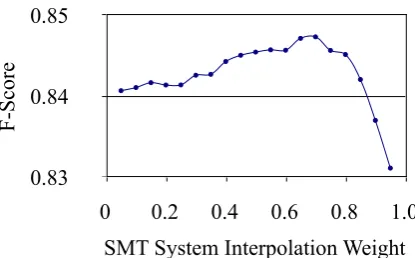
Figure 3: The effect on the F-score of the integrated system by tuning with respect to the SMT system’s interpolation weight
0.83 0.84 0.85
0 0.2 0.4 0.6 0.8 1.0
F
-S
core
[image:3.595.74.282.311.440.2]machine translation systems and is a function of the geometric mean of n-gram precision. The use of BLEU score as a proxy has been shown to be a reasonable strategy for the metrics used in these experiments (Finch and Sumita, 2009). Nonetheless, it is reasonable to assume that one would be able to improve the performance in a particular evaluation metric by doing minimum error rate training specifically for that metric. The interpolation weight was tuned by a grid search to find the value that gave the maximal f-score (according to the official f-f-score evalua-tion metric for the shared task) on the develop-ment data, the process for English-Japanese is shown in Figure 3.
4 Results
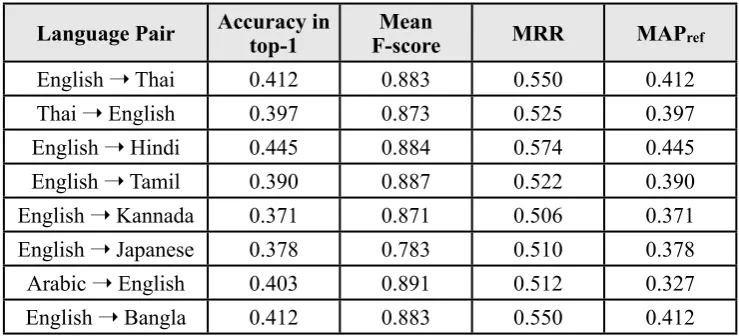
The results of our experiments are shown in Ta-ble 1. These results are the official shared task evaluation results on the test data, and the scores for all of the evaluation metrics are shown in the table. The reader is referred to the workshop white paper (Li et al., 2010) for details of the evaluation metrics. The system achieved a high level of performance on most of the language pairs. Comparing the individual systems to each other, and to the integrated system, the joint multigram system outperformed the phrase-based SMT system. In experiments run on the English-to-Japanese katakana task, the joint multigram system in isolation achieved an F-score of 0.837 on development data, whereas the SMT system in isolation achieved an F-score of 0.824. When integrated the models of the sys-tems complemented each other well, and on the same English-Japanese task the integrated sys-tem achieved an F-score of 0.843.
We feel that for some language pairs, most notably Arabic-English where a large difference
existed between our system and the top-ranked system, there is much room for improvement. One of the strengths in terms of the utility of our approach is that it is free from dependence on the linguistic characteristics of the languages being processed. This property makes it gener-ally applicable, but due to the limited amounts of data available for the shared task, we believe that in order to progress, a language-dependent approach will be required.
5 Conclusion
We applied a system that integrated two state-of-the-art systems through a process of re-scoring, to the NEWS 2010 Workshop shared task on transliteration generation. Our systems gave a strong performance on the shared task test set, and our experiments show the integrated system was able to outperform both of its component systems. In future work we would like to depart from the direct grapheme-to-grapheme approach taken here and address the problem of how best to represent the source and target sequences by either analyzing their symbols further, or ag-glomerating them. We would also like to inves-tigate the use of co-segmentation schemes that do not rely on maximum likelihood training to overcome the issues inherent in this technique.
Acknowledgements
The results presented in this paper draw on the following data sets. For English-Japanese and Arabic-English, the reader is referred to the CJK website: http://www.cjk.org. For English-Hindi, English-Tamil, and English-Kannada, and English-Bangla the data sets originated from the work of Kumaran and Kellner, 2007.
Language Pair Accuracy in top-1 F-scoreMean MRR MAPref
English ➝ Thai 0.412 0.883 0.550 0.412
Thai ➝ English 0.397 0.873 0.525 0.397
English ➝ Hindi 0.445 0.884 0.574 0.445
English ➝ Tamil 0.390 0.887 0.522 0.390
English ➝ Kannada 0.371 0.871 0.506 0.371
English ➝ Japanese 0.378 0.783 0.510 0.378
Arabic ➝ English 0.403 0.891 0.512 0.327
[image:4.595.113.483.95.263.2]English ➝ Bangla 0.412 0.883 0.550 0.412
References
Peter Brown, Stephen Della Pietra, Vincent Della Pietra, and Robert Mercer, 1991. The mathematics of statistical machine translation: parameter
esti-mation. Computational Linguistics, 19(2),
263-311.
Sabine Deligne, and Frédéric Bimbot, 1995. Lan-guage modeling by variable length sequences: theoretical formulation and evaluation of
multi-grams. In: Proc. IEEE Internat. Conf. on
Acous-tics, Speech and Signal Processing, Vol. 1, Detroit, MI, USA, pp. 169–172.
Maximilian Bisani and Hermann Ney, 2008. Joint-Sequence Models for Grapheme-to-Phoneme Conversion. Speech Communication, Volume 50, Issue 5, Pages 434-451.
Thomas Deselaers, Sasa Hasan, Oliver Bender, and Hermann Ney, 2009. A Deep Learning Approach
to Machine Transliteration. In Proceedings of the
EACL 2009 Workshop on Statistical Machine Translation (WMT09), Athens, Greece.
Andrew Finch and Eiichiro Sumita, 2008.
Phrase-based machine transliteration. In Proceedings of
WTCAST'08, pages 13-18.
Andrew Finch and Eiichiro Sumita, 2009. Translit-eration by Bidirectional Statistical Machine
Trans-lation, Proceedings of the 2009 Named Entities
Workshop: Shared Task on Transliteration, Singa-pore.
Andrew Finch and Eiichiro Sumita, 2010. Exploiting Directional Asymmetry in Phrase-table Generation
for Statistical Machine Translation, In
Proceed-ings of NLP2010, Tokyo, Japan.
Kevin Knight and Jonathan Graehl, 1997. Machine
Transliteration. Proceedings of the Thirty-Fifth
Annual Meeting of the Association for Computa-tional Linguistics and Eighth Conference of the European Chapter of the Association for Compu-tational Linguistics, pp. 128-135, Somerset, New Jersey.
Philipp Koehn, Franz Josef Och, and Daniel Marcu,
2003. Statistical Phrase-Based Translation. In
Pro-ceedings of the Human Language Technology Conference 2003 (HLT-NAACL 2003), Edmonton, Canada.
Franz Josef Och, 2003. Minimum error rate training
for statistical machine translation, Proceedings of
the ACL.
A Kumaran and Tobias Kellner, 2007. A generic
framework for machine transliteration, Proc. of
the 30th SIGIR.
Haizhou Li, Min Zhang, Jian Su, 2004. A joint source
channel model for machine transliteration, Proc.
of the 42nd ACL.
Haizhou Li, A Kumaran, Min Zhang and Vladimir Pervouchine, 2010. Whitepaper of NEWS 2010
Shared Task on Transliteration Generation. In
Proc. of ACL2010 Named Entities Workshop. Michael Paul, Eiichiro Sumita and Seiichi
Yama-moto, 2006, Multiple Translation-Engine-based Hypotheses and Edit-Distance-based Rescoring for a Greedy Decoder for Statistical Machine
Translation, Information and Media Technologies,
Vol. 1, No. 1, pp.446-460 .
Taraka Rama and Karthik Gali, 2009. Modeling ma-chine transliteration as a phrase based statistical
machine translation problem, Proceedings of the