NEUDM:
A System for Topic-Based Message Polarity Classification
Yaqi Wang, Yang Wang, Shi Feng, Daling Wang, Yifei Zhang
Northeastern University, Shenyang, China
{wyqnumber1,wangyangdm}@gmail.com
{fengshi,wangdaling,zhangyifei}@ise.neu.edu.cn
Abstract
In this paper, we describe our system for the topic-based Chinese message polarity classification in SIGHAN 8 Task 2. Our system integrates two SVM classifiers which consist of LinearSVC and LibSVM to train the classification model and predict the results of Chinese mes-sage polarity in the restricted resource and the unrestricted resource, respective-ly. In order to assure our feature engi-neering effort on the task, we use some feature selection methods, such as LDA, word2vec, and sentiment lexicons includ-ing DLUT emotion ontology and NTUSD. Our system achieves the overall F1 score of 74.88% in the restricted eval-uation and 74.43% in the unrestricted evaluation.
1
Introduction
With the development of social network, more and more people are actively sharing information with others and expressing their opinions and feelings on Chinese Weibo platform. Weibo has aggregated huge number of tweets that contain-ing people’s opinion about commercial products, celebrities, social event and so on. Therefore, mining people’s sentiments expressed in tweets has attracted more and more attention for both research and industrial communities.
For the Chinese microblog, our task is to clas-sify people’s sentiments for a given topic as posi-tive, negaposi-tive, and neutral. Among the varieties of topics, people could express neutral, positive, and negative sentiments for them, respectively. If the topic information is ignored, it is difficult to obtain the correct sentiment for a specified target.
Topic-dependent features. The traditional learning-based methods for solving sentiment classification problem, such as (Go et al., 2009; Barbosa and Feng, 2010), basically followed (Pang et al., 2002), who utilized machine
learn-ing based classifiers for the sentiment classifica-tion of text. They worked in a topic-independent way: all the features have no relation with the topic. That is to say: the sentiment is decided no matter what the target is. Jiang et al. (2011) combined the target-independent features (con-tent and lexicon) and target-dependent features (rules based on the dependency parsing results) together for tweet subjectivity and polarity clas-sification.
Sparse vectors. The microblog usually has a length limitation, such as 140 characters. There-fore, the vectors formed by microblog data are extremely sparse, which sets obstacles for further classification algorithms.
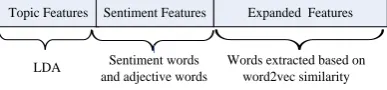
To tackle these challenges, in this paper we first leverage the generative model LDA (An-drew Ng et al. 2003) to extract the top ranked topic words as topic-related features. Secondly, we count the number of positive and negative sentiment words through sentiment lexicon in the sentence and get the adjective word which only occur in the polarity sentences. Finally, we uti-lize the well-known deep learning word embed-ding tool word2vec1 to find the top-k semantical-ly similar words in the topic document to expand the feature representation. The used words in the word embedding tool word2vec both appear in a sentiment lexicon and the topic document. The component of feature vector can be described as follows.
Topic Features Expanded Features
LDA Words extracted based on word2vec similarity Sentiment Features
[image:1.595.319.513.588.633.2]Sentiment words and adjective words
Fig. 1. The feature vector components
In Figure 1, the topic, sentiment and expanded features attempt to handle the topic-based senti-ment analysis problem. The expanded features based on word2vec try to enrich the feature space and alleviate the sparse vector problem. Based on the feature vector, we can utilize off-the-shelf machine learning algorithms to train the topic-based sentiment classification model.
1
http://code.google.com/p/word2vec/
2
Related Work
The traditional sentiment classification focus-es on people's sentiment exprfocus-essed in text. For example, whether a product review is positive or negative (Pang, Lee, & Vaithyanathan, 2002). Different from the traditional sentiment classifi-cation, topic-based classification is more chal-lenging. The identification of topic-based senti-ment needs to extract more information.
Jiang et al. (2011) proposed to improve target-dependent Twitter sentiment classification by 1) incorporating target-dependent features; and 2) taking related tweets into consideration. More specifically, they used two-step classification method to handle target-dependent twitter senti-ment classification. They classified the tweets to the subjective and objective class, and then the subjective tweets are divided into positive and negative emotion class. Finally, they get the tar-get-dependent twitter sentiment polarity.
Li Dong et al. (2014) proposed to the Adaptive Recursive Neural Network (AdaRNN) for target-dependent Twitter sentiment classification. AdaRNN adaptively propagated the sentiments of words to target depending on the context and syntactic relationships between them.
In this paper, we present machine learning based algorithms and deep learning system for SIGHAN 8 Task 2 which has restricted resource and unrestricted resource respectively.
3
System Overview
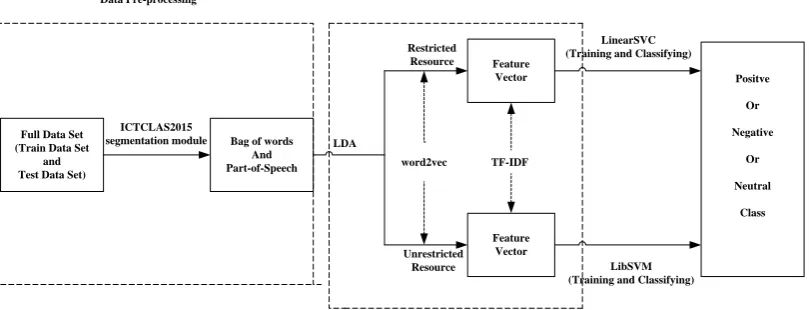
We use two-way classification framework which is used for the restricted resource and the unre-stricted resource, respectively. Figure 2 illus-trates the general framework of our system that includes the module of pre-processing, feature extraction, classifier training and predicting.
3.1 Data Pre-processing
Before the Chinese message is trained and pre-dicted for the task, it needs to process the data so that the Chinese message can be split into words (tokenization). Meanwhile, it attaches more in-formation to each word (part-of-speech tagging). We adopt ICTCLAS20152 segmentation mod-ule, which is developed by Institute of Compu-ting Technology, Chinese Academy of Science, to segment the given Chinese message including train and test data into words and proper part-of-speech (POS) tags. In the process, we delete the stop words, punctuation characters and other
2
www.nlpir.org
necessary processing. At last, we obtain the data for further feature extraction.
Chinese message “魅族黄章叫板三星 Galaxy S6
也不过如此!
http://t.cn/RwHsCt6 @凤凰新闻
客户端”
Bag of words “魅族黄章叫板三星 Galaxy
S6 也不过如此!”
Part-of-Speech features “魅/w 族/ng 黄/nr1 章/n 叫/vi
板/ng 三星/nt Galaxy/n S6/n 也
/d 不过如此/vl !/wt”
Table 1: the example of ICTCLAS2015 segmen-tation result
3.2 Feature Extraction
The feature extraction plays very important role for the machine learning algorithms. A better feature extraction method can improve the pre-diction performance of the classifier, provide faster and more cost-effective classifier, and pro-vide a better understanding of the underlying process that generated the data (Isabelle Guyon, Andre Elisseeff. 2003).
Due to the microblog can be split into many words and phrases, the overall Chinese mi-croblog will be generate a rich set of features and may meet the curse of dimensionality problem. How to extract the appropriate features for topic-based sentiment classification is the key issue for the task. Our proposed approach of feature ex-traction includes:
Topic Features. Each microblog may be viewed as a mixture of various topic words. In order to obtain words and phrases which are rela-tionship with the topic, we conduct LDA model-ing for each topic collection and extract the top ranked words with higher topic generative prob-ability.
Sentiment Features. We utilize the sentiment lexicons to select the sentiment features from Chinese microblog sentences. We calculated the number of positive emotion words and the num-ber of negative emotion words in the Chinese microblog sentences, respectively. Then, we put the result into feature Set. The DLUT emotion ontology and NTUSD are chosen for the restrict-ed resource setting of the SIGHAN task. For the unrestricted resource setting, we use our own sentiment lexicon. Besides the words in the lexi-con, we also employ the POS tagging method to select the adjective words which only occur in the positive sentence and negative sentence as sentiment features.
em-ploy the word embedding tool word2vec to en-rich the feature representations. Given the topic documents d, SF is the feature set of d. The inter-section set of sentiment lexicon and d is ST and stST. Non-feature word nwSF. Each word in the topic documents is represented as a vector based on word2vec (Dongwen Zhang et al., 2015)
and then we calculate the cosine similarities be-tween each sentiment and non-sentiment word pairs (st, nw). The nw with top-k similarity is added into final feature vector.
After feature selection, we utilize TFIDF method to calculate the weight of each feature in the vectors.
Full Data Set (Train Data Set
and Test Data Set)
ICTCLAS2015
segmentation module Bag of words And Part-of-Speech
LDA
Restricted Resource
Unrestricted Resource word2vec
Feature Vector
Feature Vector TF-IDF
LinearSVC (Training and Classifying)
LibSVM (Training and Classifying)
Positve
Or Negative
Or Neutral
Class
[image:3.595.97.502.169.324.2]Data Pre-processing Feature Extraction
Fig. 2. The general framework of our system
3.3 Classifier
In this step, the extracted feature vectors are trained by a classifier to predict the sentiment polarity of the test data set. Lots of previous re-searches prove that Support Vector Machine shows substantial performance gains and is more robust in the work of sentiment classification compared with other state-of-art models (Pang et al., 2002; Tang, Tan, & Cheng, 2009). Due to this reason, SVM is adopted as the classification algorithm.
In the restricted resource, the SVM classifier is the linear support vector classification (LinearSVC) which is implemented in terms of Liblinear rather than LibSVM form the python based machine learning open source projects called Scikit-Learn3. In the unrestricted resource, the SVM classifier is the LibSVM which is im-plemented by C language. We search the best parameter c and g separately in the LibSVM for each topic dataset.
The implementation of Support Vector Classi-fication is based on LibSVM. The fit time com-plexity is more than quadratic with the number of samples. Linear Support Vector Classification (LinearSVC) is similar to SVC with parameter kernel='linear'. It is implemented in terms of liblinear rather than LibSVM. The LinearSVC supports both dense and sparse input and the
3
http://scikit-learn.org/stable
multiclass support is handled according to a one-vs-the-rest scheme.
4
Experiments and Results
In this section, we explain details of the data and the general settings for the different experi-ments we conducted. We train and evaluate our classifier for restricted resource and unrestricted resource respectively, training and testing da-tasets provided by SIGHAN 8 Task 2.
4.1 Dataset
The train dataset is composed of five different topics and includes 4,905 Chinese microblogs. The test dataset is composed of twenty different topics and includes 19,469 Chinese microblogs. Each topic contains approximately 1,000 Chinese microblogs. But the ratio of subjective class to objective class is four to one and the ratio of pos-itive class to negative class is one to one in the subjective class. The serious imbalanced data set has an adverse effect on classification results. So in order to keep the train data set balanced, we adopt the sampling strategy. We do not change the neutral class data and the sum of the positive class and the negative class is resampled to be an equal number of the neutral class.
4.2 Evaluation criteria
to measure the performance of positive, negative, neutral class respectively.
4.3 Classifier and Result
In the Section 3.2, the process of feature ex-traction has been done. We use the result of fea-ture engineering into the classifier to train the classification model. In order to transform the each topic document in the train data set and test data set to vector matrix which complies with the input format of LinearSVC classifier in the re-stricted resource, we use the method of TF-IDF which is often used as a weighting factor in text mining and reflect how important a word is to a document in a collection or corpus.
If the adjectives appear only in the subjective sentences, the weight of the adjectives are set to 10. It means that the adjectives are more valuable. Meanwhile, we also make the input format com-plied with the LibSVM in the unrestricted
re-source and the parameter c and g of LibSVM in the unrestricted resource is set to c=8.0 and g=0.125.
At last, we use the classifiers which consist of LinearSVC in the restricted resource and LibSVM in the unrestricted resource to train the model and predict the label of the microblogs. Table 2 shows the result of the experiments.
The results in Table 2 show that the values of Precision, Recall, F1 measure is approximately equal to 0.74 in the restricted source and unre-stricted source. We have achieve good perfor-mances in overall Precision, Recall and F1 measure. However, the values of Precision+, Re-call+, F1+, Precision-, Recall-, F1- are not good. It means that the problem of imbalance data need to be better solved and we may further improve Topic-Based Chinese Message Polarity Classifi-cation task by adding more topic-related linguis-tic features.
Restricted
Precision Recall F1 Precision+ Recall+ F1+ Precision- Recall- F1-
0.74883145 0.74883145 0.74883145 0.31879196 0.082465276 0.1310345 0.44460857 0.082715034 0.13948101
Unrestricted
Precision Recall F1 Precision+ Recall+ F1+ Precision- Recall- F1-
0.74436283 0.74436283 0.74436283 0.17627119 0.045138888 0.071872845 0.40792078 0.05660896 0.09942085
Table 2: the results of our system
Restricted
Precision Recall F1
NEUDM2 0.74883 0.74883 0.74883
TICS-dm 0.83573884 0.83573884 0.83573884
LCYS_TEAM 0.7259232 0.7259232 0.7259232
Restricted
Precision Recall F1
NEUDM2 0.74436283 0.74436283 0.74436283
TICS-dm 0.85356206 0.85356206 0.85356206
xk0 0.74893427 0.74893427 0.74893427
Table 3: the compare of competition results
5
Discussion
After conducting a series of experiments, in this section, we discuss the effectiveness of our method. The compare of competition results in Table 3 show that the overall F1 score of our sys-tem is good. Firstly, the noise of Data is effective removed. Secondly, the quantity of feature is sufficient through the extracting of topic features, sentiment features and expanded features, re-spectively. Finally, LinearSVM is better than LibSVM and it trains faster and predicts more accurate in large-scale training set. As a result, the performance of the our system proposed method for Chinese microblog polarity classifi-cation is acceptable.
6
Conclusion and future work
Different from most of the conventional methods for subjective and objective classification, our research focuses on the topic-based polarity clas-sification. In this paper, our system relied heavily on the topic features, sentiment and expanded sentiment features. These features assure the ef-fect of our classifiers in this task. Our system, we can achieve medium score in the SIGHAN 8 task 2.
We have a lot of work ahead of us. In the fu-ture, we would like to find more topic-related linguistic features to add in the representation vectors. We would like to extract more structured information and composition unit existing in sen-tences for topic features in the future work.
7
Acknowledgements
Reference
Blei, David M.; Ng, Andrew Y.; Jordan, Michael I (January 2003). Lafferty, John, ed. "Latent Di-richlet allocation". Journal of Machine Learning Research 3 (4–5): pp. 993–1022.
doi:10.1162/jmlr.2003.3.4-5.993
Alec Go, RichaBhayani, Lei Huang. 2009. Twitter Sentiment Classification using Distant Supervision.
Luciano Barbosa and Junlan Feng. 2010. Robust Setiment Detection on Twitter from Biased and Noisy Data. Coling 2010.
Long Jiang, Mo Yu, Ming Zhou, Xiaohua Liu, and Tiejun Zhao. 2011. Target-dependent twitter senti-ment classification. In Proceedings of the 49th An-nual Meeting of the Association for Computational Linguistics: Human Language Technologies - Vol-ume 1, HLT ’11, pages 151–160, Stroudsburg, PA, USA. Association for Computational Linguistics.
Isabelle Guyon, Andre Elisseeff. 2003. An Introdution to Variable and Feature Selection.
Dongwen Zhang, Hua Xu, Zengcai Su, Yunfeng Xu. 2015. Chinese comments sentiment classification based on word2vec andSVMpref.
Pang, B., Lee, L., &Vaithyanathan, S. (2002). Sen-ment classification using machine learning tech-niques.In Proceedings of the conference on empiri-cal methods in natural language processing (pp. 79–86). Association for Computational Linguistics.