EUR 8527 EN
Multiannual Programme
of the Joint Research Centre
1980-1983
1982
Annual Status Report
Protection of the environment
Published by the
COMMISSION OF THE EUROPEAN COMMUNITIES Directorate-General
Information Market and Innovation Bâtiment Jean Monnet
LUXEMBOURG
Reproduction in whole or in part of the contents of this publication is free, provided the source is acknowledged
©ECSC-EAEC, Brussels · Luxembourg, 1982
Printed in Italy
ISBN 92-825-3581-9
PROTECTION OF THE ENVIRONMENT
1982
Research Staff:
Budget:
92 men-year
11.123.000 ECU
Projects:
— ECDIN: Environmental Chemical Data Information Network — Exposure to Chemicals:
• Indoor Pollution
• Chemical Products (Organics) — Air Quality
— Water Quality
• Nutrient Mass Balance in Aquatic Ecosystems • Ecological Effects of Chemical Pollution
— Heavy Metal Pollution
• I.L.E. (Pathway of Automotive Lead) • Exposure and Health Effects
— Environmental Impact of Conventional Power Plants
Programme Manager: B. VERSINO
Commission of the European Communities Joint Research Centre
Ispra Establishment 1-21020 Ispra (Varese), Italy
1. INTRODUCTION
The present 4 years programme (1980-1983) «Protection of the Environment» is the follow-up of the former programme «En-vironment and Resources» (1977-1980).
With a research staff of about 90 people working mainly at the Ispra and to a smaller extent at the Petten establishment, this programme represent about 8% of the total research effort of the Joint Research Centre. .
The principal scope of the programme «Protection of the En-vironment» it to provide together with the related Indirect and Concerted Action Programme, scientific support to the Com-munity's Programme of Action on the Environment (1982-1986). The following table gives a synoptic view of the major links of this action programme managed by D.G. XI (Direction: Protection and Improvement of the Environment) at Brussels with the above mentioned research programmes. ECDIN, a pilot-data bank on environmental chemicals is by face the largest project in financial volume and already now ac-ting as an internal consultant to other Commission services and has given proof of its use and competence especially in establishing the European core inventory EINECS in behalf of the D.G. XI. The longend survival of this project will depend, however, on the successful implementation of a «commercial»
ECDIN justifying an ongoing research effort of a «scientific» ECDIN inside the Joint Research Centre.
Striking differences in air pollution levels inside and outside of private houses and public buildings led to the conception of the «Indoor Pollution» project. The study will be focussed on organic emissions in private houses, school rooms and depart-ment stores. The final goal is to reconsider the relevance of air quality standards.
The title «Chemical Products (Organics)» is related to the ac-tivities of a research group at the Petten establishment. This work is mainly concerned with analytical and synthesis aspects of organic chemicals related to environmental protection pro-blems (e.g. carcinogenic and toxic substances).
The project «Air Quality» deals with the analysis of at-mospheric pollutants with special regard to particle formation and photochemical reactions. It is fully integrated into the COST 61a-bis concerted action «Physico-chemical behaviour of atmospheric pollutants».
CEC ENVIRONMENTAL PROGRAMMES
JRC
DIRECT ACTION PROGRAMME 1980-1983
D.G.XII DIRECTION G
INDIRECTS CONCERTED ACTION PROGRAMME 1981-1985
O.G. XI
PROGRAMME OF ACTION ON ENVIRONMENT 1982-1986
A. PROTECTION of the ENVIRONMENT
1.
ECDIN2. Exposure to chemicals -2.1. Indoor pollution 2.2. Chemical products
(organics)
3. Air quality—
4. Water quality
-5. Heavy metal
pollutions'. Environmental impact of -power plants
I. REMOTE SENSING from SPACE
1. Agriculture
2. Sea protection
I. ENVIRONMENTAL PROTECTION
1. Sources, pathways and effects of pollutants
,1.1. Heavy metals^
1.2. New chemicals & organic micropollutants
1.3. Asbestos & other fibre materials
-1.4. Air quality^
remote sensing of atm. pollutants dispersion and transport
—y¿— physico-chemical behaviour (COST Eia bis)
M.5. Freshwater quality—
1.6. Thermal pollution
1.7. Marine environmental quality'
1.8. Noise pollution
2. Reduction, prevention of pollution & nuisances
3. Protection, conservation & management of natural environments
3.2. Bio-geochemical cycles
- 4. Environmental information management
5. Overall man-environment interactions
II. CLIMATOLOGY
2. DEVELOPING AN OVERALL STRATEGY
2.1.1 The dissemination of and access to research results
2.1.2 Procedures which could ensure that environmental data are taken into account in planning and decision making
3. PREVENTION AND REDUCTION OF POLLUTION AND NUISANCES IN THE DIFFERENT ENVIRONMENTS 3.1 3.2 3.3 3.4 3.5 3.6
Fresh water and sea water
Atmospheric pollution
Chemicals
Noise
Waste
Clean technologies
4. THE PROTECTION AND RATIONAL MANAGEMENT OF LAND.
THE ENVIRONMENTAL AND NATURAL RESOURCES
5. ACTION AT INTERNATIONAL LEVEL
O.G. VI AGRICULTURE
Directives for better management of agricultural resources
• assistance to less favoured zones
• coordination of agronomical research programmes
In future these more or less randomly assembled projects and research activities will be regrouped under three major chapters.
1. ENVIRONMENTAL CHEMICALS aiming at studying chemicals (and their transformation products) of major en-vironmental concern likely to have ecological effects and health effects on man.
2. ENVIRONMENTAL QUALITY including activities related to the identification of pollutants (and their reaction pro-ducts) in air and water and their impact (fate, pathways, ef-fects) on non human targets in the different environmental media.
3. ENERGY and the ENVIRONMENT aiming at studying pollution problems related to the energy production pro-cesses: dispersion and transport of pollutants, risk assess-ment studies.
2. RESULTS
ECDIN (Environmental Chemicals Data and Informa-tion Network)
The experimental ECDIN service, launched in 1981, began ef-fective operation in Spring 1982 after the administrative
for-malities (user contracts, etc.) had been completed. The planned target of 100 users of the experimental service was soon reach-ed. The reaction of users were closely monitored by a team from ASLIB who participated in a user workshop which was organised in Ispra in October 1982. The workshop followed a number of training sessions held earlier in the year in London, Delft and Paris.
Soon after the experimental service had begun, new and unan-ticipated problems were encountered with the interface bet-ween EURONET and the JRC Ispra AMDAHL 470/V8 com-puter.
Initial reactions of users attending the workshop were in-evitably conditioned by the problems of access to the data base which had been compounded by telecommunication problems in national networks and in EURONET itself. Nevertheles the workshop provided a fruitful discussion of the ECDIN concept and many positive recommendations for improving the service, the ECDIN display system and the data base were made. Un-fortunately the loss of a programmer in August 1982 and the diversion of resources to EINECS slowed down the develop-ment of ECDIN at this crucial stage.
During 1982 a considerable portion of the efforts of the EC-DIN group was devoted to the EINECS inventory. The second phase of EINECS, the 9 month supplementary reporting period, began on schedule on 31 March 1982. The early months of 1982 were concerned with the logistical problems of the preparations for EINECS. Some 350.000 reporting forms in sewn languges had to be printed and distributed to industry through the Member State Contact Points for EINECS. Dur-ing the reportDur-ing period the Commission's contact point for EINECS (based in JRC Ispra) answered nearly 100 enquiries on the reportability of various types of substances and on policy questions. The EINECS form tracking and processing system was designed and progressively implemented. Input of reporting forms began in October 1982 and trasmission of data and forms to CAS in Columbus, Ohio via the dedicated telecommunications line began in November 1982. It is now known that almost 80.000 completed reporting forms were received by Member State Contact Points by the end of the reporting period on 31 December 1982.
During 1982 preparations for the commercial ECDIN service to be based on the computer centre of Data Centralen in "Copenhagen accelerated. A test version of the ECDIN data base and display system was successfully installed in Copenhagen. At the end of the year a contract was concluded with Data Centralen for the installation, operation and marketing of the commercial ECDIN service. The target date for the start of this service is 1 July 1983.
EXPOSURE TO CHEMICALS
INDOOR POLLUTION
This activity developed along three lines: Promotion of European collaboration
An expert group was convened in Ispra in order to assist JRC and DG XII staff in defining an appropriate frame for a euro-pean collaboration in the field of indoor air quality. It was con-cluded that a Concerted Action should be proposed. It was fur-ther agreed to initiate work for an inventory of pollutants detected indoors as a first step towards practical collaboration. A draft proposal for a concerted action «Indoor Air Quality» has been prepared and was revised at a second expert group meeting at Aarhus University. For thè same meeting a first ver-sion of a format for the indoor pollutant inventory hás been prepared. As a result of the discussion, a.second version is under elaboration which will also serve as core of a protocol for field measurements of indoor pollution.
Intercomparison campaigns have been started in order to assess the usefulness of passive samplers for organic indoor pollutants (see below).
Analytical Developemnt
Exposure to organic compounds is the most complex but least investigated problem of indoor air pollution. Among others the lack of simple, inexpensive but reliable and not disturbing sampling techniques is one of the reasons for lack of com-prehensive data. Work has therefore been started to assess the reliability and sensitivity which can be obtained using so-called passive samplers. Passive samplers have been deviced for oc-cupational exposure monitoring where concentration levels are in general considerably higher than in non-occupational indoor environments. The maximum safe exposure time for currently encountered organic indoor pollutants has been determined to be about 1 week. At longer exposure time losses may occur. As further parameters sampling and desorption efficiencies have been investigated. An intercomparison program has been started involving different european laboratories in order to assess the reliability of different types of samplers and of results otained in different laboratories.
Among other work the setup of a reliable method for the simultaneous detection of a wide range of carbonyl compounds including formaldehyde at levels down to a few nanogram per liter of air should be mentioned.
Field Measurements
Measurements of organic pollutants have been performed in a series of private residential dwellings with the threefold scope to contribute data to a european inventory of indoor pollutants, to gain experience with a core protocol for indoor pollutant measurements, and to assess various sampling and analysis strategies.
The following classes of compounds have shown to be virtually ubiquitous at concentrations which are systematically higher indoors than outdoors:
aldehydes, chloroaliphates, alkanes and alkenes, alkylbenzenes and terpenes.
Table I reports organic compounds which have been detected during our field measurements, together with the lowest (LDC) and highest (HDC) detected concentrations and, where defin-ed, one tenth of the maximum admissible workplace concen-tration (MAK - values valid in FRG) which is often tentatively used as an indoor air quality criterium.
At the present stage, the reported results can only be regarded as a small part of a complex since they refer to a few types of residential buildings, living habits and situations only.
CHEMICAL PRODUCTS (ORGANICS)
Environmental Carcinogens
TableI.Lowest(LDC)andhighest(HDC)detectedconcentrationsoforganiccompoundsidentified during1982measurementsin residentialdwellings COMPOUND ALDEHYDES formaldehyde acetaldehyde npentanal nhexanal nheptanal noctanal nnonanal ηdecanal KETONES acetone methylisobutylketone cyclohexanone CHLOROCOMPOUNDS dichloromethane chloroform 1.1.1.trichloroethane carbontetrachloride trichloroethylene tetrachloroethylene 1.4 dichlorobenzene pentachlorophenol
SALKANES +ALKENES
MAK/10 (Mg/1)
0 . 1 2 36 — — 240 40 20 35 5 a) 108 6.5 a) 26 a) 67 45 0.05
36200 b)
LDC (ng/1) 8 2 n.d.* n.d. n.d. n.d. n.d. n.d. 2 n.d. n.d. n.d. n.d. 1 1 1.5 2.5 n.d. n.d. 50 HDC (ng/1) 50 26 20 15 2 4 10 5 12 3 4 4000 1.5 5 20 30 100 65 0.25 1200 COMPOUND MAK/10 (Mg/l)
BENZENEANDALKYLBENZENES
benzene toluene ethylbenzene m,pxylene oxylene SC3benzenes TERPENES ' apinene camphene 0pinene 1.8cineol limonene aterpineol c) 75 43.5 87 87 24.5 d) 56 e) 56 e) 56 e) 56 e) 56 e) 56 e)
VARIOUSALIPHATICCOMPOUNDS
ethanol 190
ethylacetate 140
isobutylacetate 95
nbutylacetate 95
VARIOUSAROMATICCOMPOUNDS
styrene phenol naphthalene 1methylnaphthalene 2methylnaphthalene 42 1.9 5 . LDC (ng/1) 8 32 4 11 2 3 7 n.d. n.d. n.d. 5 n.d. n.d. n.d. n.d. n.d. 2 n.d. 2 n.d. n.d. HDC (ng/1) 28 270 21 84 10 190 900 24 200 30 230 3 9 3 48 5 14 5 8 2 4
* n.d. = notdetected,i.e.concentration< 1 ng/1
a) valuetobereconsideredinviewofthesuspectedcarcinogenicityofthecompound
b) 360=MAK valuefornhexane;2000=MAKvalueforηheptaneandmethylcyclohexane. NoMAKvaluedefinedfor'otheralkanesoralkenes
c) inviewoftherecognizedcarcinogenicityofbenzenenoMAKvaluecanbedefined d) valueofisqpropylbenzene;forotherC3benzenesnoMAKvalueshavebeendefined e) valuedefinedforoilofterpentine. Novalueshavebeendefinedforitssinglecomponents
resultofthechemicaland biochemicalcharacterizationofthe coalgasification tar itcan beconcluded that themajor con tribution initsmutagenetic activity comesfrom the fraction which contains the polycyclic aromatic compounds (about 75%oftotalmutageneticactivity).Theremainingmutagenetic activity isaccounted for bythebasicfraction, containing the aromaticamines(approximately20%oftotalactivity)andthe insolublefraction (incyclohexane),about4°7oofthetotalac tivity,presumablycontainingalsotheinorganiccomponents. Themutagenicitytestingofindividualcompoundsresultedin theidentification ofseveralnewstrongmutagens,whichoccur incoalcombustion,gasificationorliquefaction,andinairpar ticulatesordieselexhausts(seetableII).Veryhighmutagenic effects werefound forsomeisomersofanaromaticamineex ceedinginonecase2000revertantsinSalmonella typh.TA98 per /¿gofsubstance. Isomerswiththesamemassnumber are regularlyfound inprocessstreamofcoal liquefaction. Experimental work for the systematic collection of the molecularspectraunderstandardconditionswasconcentrated onthedeterminationandevaluationofIRspectra.Mostofthe 350 spectra (including IR—, UV—, fluorescence—, m a s s
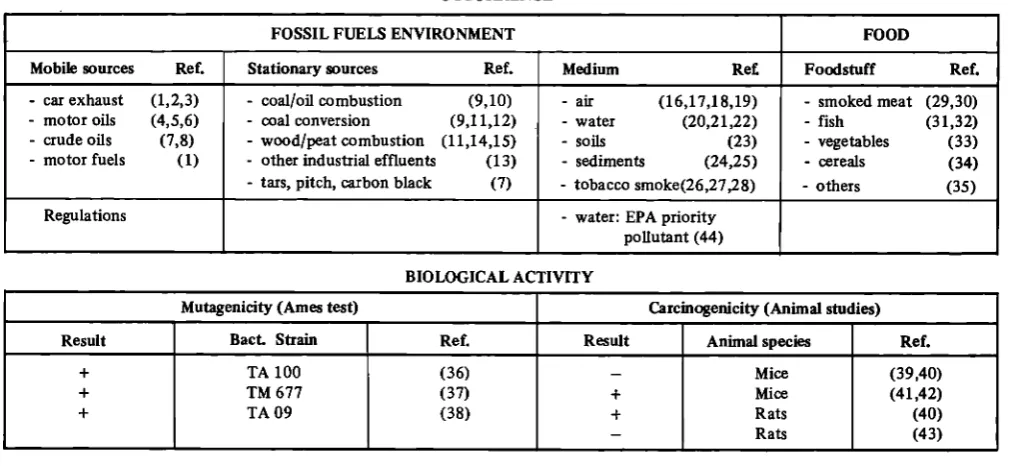
andNMRspectra)which areneededfor theplanned spectral Atlasarenowavailable.Inadditiontothemolecularspectraof 42PAHcompundsofenvironmentalandoccupationalimpor tance,theeditionistoincludeaconciseoverviewand evalua tionof environmental sourcesand biologicaleffects for each compound (foranexample,seetable III).
Occupational carcinogens/Toxic chemicals
Underthisactivity,theexperimental workaimingatreducing contamination risks of packed foodstuffs from packaging componentswhichposehealthhazardshasshownfurtherpro gress.Anewtypeofplastic additive(antioxidant)whichhad been developed and synthesized previously, was built into polymers which areused in food packaging applications, to study its behaviour and migration tendency into food simulatingliquids.
Table II. Results of screening tests for mutagenic activity COMPOUND Benz(a)acridine Dibenz(a, c)acridine Dibenz(a,h)acridine Dibenz(aj)acridine Dibenz(a,j)acridine Dibenz(c,h)acridine
2-Aminobenzo( c) phenanthrene 3-Aminobenzo(c)phenanthrene 4-Aminobenzo( c)phenanthrene Benzo(a)fluoranthene Benzo (ghi)fluoranthene Benzo(b)chrysene Benzo(c)chrysene Dibenzo(a4)pyrene OCCURRENCE
air particulates, coal conversion, coal combustion and conversion air
particulates, car exhaust coal combustion and conversion
air particulates, car exhaust
coal gasification and liquefaction (isomers)
coal combustion, used motor oil, coal tar air particulates, diesel exhaust, coal and peat combustion, coal tar, food
coal tar coaltar
coal gasification, air particulates
MUTAGENIC ACTIVITY + ++ (++) + + (++) +++ (toxic) +++ (toxic) +++ (toxic) ++ +/++ — (+) +++ CARCINOGENICITY (LITERAT. DATA) -(not available) ++ (not available) + + (not available) (not available) — — ++ +++
Key: — negative ± weak/inactive + mutagenic ++ significant mutagen +++ strong mutagen
(bracketed values are based on results of a single bact. strain)
Table III. Example: Chrysene
OCCURRENCE
.
Mobile sources
- car exhaust - motor oils - crude oils - motor fuels
Ref. (1,2,3) (4,5,6) (7,8) (D Regulations
FOSSIL FUELS ENVIRONMENT
Stationary sources Ref.
- coal/oil combustion (9,10) - coal conversion (9,11,12) - wood/peat combustion (11,14,15) - other industrial effluents (13) - tars, pitch, carbon black (7)
Medium Ref.
- air (16,17,18,19) - water (20,21,22) - soils (23) - sediments (24,25) - tobacco smoke(26,27,28) - water: EPA priority
pollutant (44)
FOOD
Foodstuff
- smoked meat - fish - vegetables - cereals - others Ref. (29,30) (31,32) (33) (34) (35) BIOLOGICAL ACTIVITY Mutagenicity (Ames test)
Result
+ + +
Bact Strain
TA 100
TM 677
TA 09
Ref. (36) (37) (38)
Carcinogenicity (Animal studies) Result + + Animal species Mice Mice Rats Rats Ref. (39,40) (41,42) (40) (43) AIR QUALITY
This project comprises two lines of activities.
The first one is rather advanced and aims at a description of the processes leading to ozone and particle formation in the troposphere. The experimental approach involves field measurements of different nature (comparative monitoring of
[image:9.595.46.551.441.675.2]The second line of activity is centered around the analytical possibilities of Infra-red Fourier Transform Spectroscopy. Besides an analytical support to the above activity it should provide in the long term an orientation versus the study of En-vironmental Chemicals in the atmosphere, which are of in-creasing importance to the environment. Their behaviour and degradation under photo-oxidation conditions is of major con-cern.
Field Measurements
Aircraft measurements, planned for 1982, in the framework of a collaboration contract with the «Deutsche Forschungs- und Versuchsanstalt für Luft- und Raumfahrt (DFVLR)», could not be performed due to difficulties of our contractor to obtain the necessary flight permits for the Po Valley till the end of summer. However, some flight measurements were carried out
N-NE WSW SSE N-NE
NNW WSW NW N-NE
NNE NNW wsw W-NW
Β T ,
100
so
so.
ε 3
10 12
G.M.T+2
N-NE W WSW
100-Fig.1.Measurementofozone,sulfurdioxide,sulfate,scatteringcoefficient(bs),sunlightUVintensityandwinddirectionon
fouiconsecutivedaysduringaseverehazeepisodeinSeptember1982 aroundDFVLR'sairbaseatOberpfaffenhofen, nearMunich, duringseverehazeconditionsandwithquitehigh ozonecon centrations.
Somehorizontaltracks,westofMunich,havebeenflownand vertical profilestoover3.000mwereobtainedaswell. Thesedataareunderevaluation.
A method forthe continuous measurement of sulfate inair, based onamodified flame photometerwasfurther improved andappliedforcorrelationstudiesof different metereological
and pollutant parameter»duringphotooxidation episodes at theIsprasite.
InFigure 1are reported theresults of aseverehaze episode duringSeptember1982.
Application of Infrared Spectroscopic Techniques
Monitoring of CO and CH4, slowly reacting atmospheric speciessupposedtocontributetobackground photochemical reactivity, started with the 72mcell. Air sampling wasper formedneartotheroutinemonitoringstationforNO,03,S02 and metereological parameters. A twomonth period (April June) gave CH4 concentrations ranging from 1490 to 1925 ppbvandCOconcentrations from 228ppbvto700ppbv,the highervaluesbeingrelatedtoearlyAprilwithaslowdecrease towards250300ppbv.
Atechniqueof cryogenic enrichment toconcentratetracegases in the atmposphere has been set up with the advice of Dr. HanstfromEPA,ResearchTriangle.Theevaluationofparaf finichydrocarbonsismadewithrespecttotheN20bandinten sityusedasreference standard.
Themultiple reflection system of the photochemical reactor hasachieved a satisfying performance with agood signal to noiseratiooverthetotalbeamlenthof256m.
TheComputerProgrammefor the generation of synthetic in frared spectra has been expanded for the simulation of dif ferentrelativeabundancesoftheisotopiespeciesofsomegases (e.g.CO,CH3 ).Thisoffers thepossibilitytosimulatein theinfrared spectralconditionswhich thenwillbeexperimen tallydeltwithinisotopiedilutiontechniques(importantforthe studyofCOreleasefrom sunirradiatedTeflon bags).
WATER QUALITY
Nutrient mass balance in aquatic ecosystems
In order toreach general conclusionsabout theinfluence of Phosphorusreleasefrom sediment onthelaketrophicevolu tion, the experimental and modellistic analysis previously relatedtothePonteTresabasinofLakeLuganohasbeenex tendedtothedeeperandmorecomplexAgnobay.
Samplingcampaignsduring 1982wereaiming:
—atcompletingexperimentalinformationabouttheevolution ofthewaterbodybetweentwoconsecutive overturns. —atcollectingnewdataaboutthedistributionofthedissolv
edcomponentintheorganicPhosphoruspoolinthebay. —atprovidingsamplesforthedetailed(speciesspecific)study
ofanautumnalgalbloom, tobeperformed bymeansofa lightscatteringtechnique.
Algal bioassays, using Selenastrum capricornutum as test organismandsediment from thelakeastheonlyPhosphorus source, have showed the following results for sediment Phosphorusalgalavailability.
Besidethenonapatite inorganicform whichisingeneralthe onlyΡ sourceavailableand utilizedforalgalgrowth,insum mermonthsarelativelyhighavailabilityoforganicandapatite forms hasbeenfound. ThepercentageofsedimentarytotalΡ utilizedisbetween8%and 11%inwinter,springandautumn, and22%insummer(Phosphorusdirectlyutilizablebetween40 and 144 mgP/kgfresh sediment;averagevalue80mgP/kg). Somemodellisticresultsobtainedin 1982concern:
—hypolimnic eddydiffusion coefficient evaluatedby means of a onedimensionalmodelapplied toPP04diffusion in thehypolymnion(χ„„~ 10χ,»).
—theeffect of an important (50%)dissolved component in the organic Ppool leads to a 10% increase of the phytoplanktonbiomassconcentrationlevel.
—conclusionof the methodologicalanalysis for thecalcula tionofverticaleddydiffusion coefficients inlakesbymeans ofmeasured temperature profiles.
—theintroduction ofintracellularPhosphorus concentration as state variable in the description of phytoplankton dynamics, and first assessment of the related parameters (minimum and maximum cell quotas, maximum uptake velocity),inapplyingaoneboxmodeltoalgalcultureex periments.
Ecological effects of chemical pollution
Theaimofthisstudyistoevaluatetheeffects oftoxicmetals (e.g. Cu, Cd, Hg) on freshwater communities under semi naturalconditions(«enclosure»method).
Theinitialconcentrationofeach«enclosure»anchoredduring different seasonsintheshallowandeutrophiclakeComabbio (Varese)was 100ppboftracemetal.
Themostevidentresultsobtainedwerethe following:
—Theeffectsproducedbythesamemetalonthephysicaland chemicalcharacteristicsofthewater(e.g.pH,dissolvedox ygen,watertransparency)andonthebiomassandthecom munity structure of phyto and zooplankton varied with season.
Thesevariationsweremainlyduetowatertemperatureand the abundanceof suspended material which adsorbed the greatestpart ofthetracemetal.
—Theresistancetothesamemetalvariedwiththespecies;for example,amongphytoplanktonspeciesDiatomsweremore resistant than Cianophyceae and among zooplankton, CladoceransweremoresensitivethanCopepodsand these morethan Rotifers.
—At theend of eachexperiment (20thday)acertain quan titativerecoveryoftheplanktoniccommunitieswasobserv ed,but theirstructuresweregreatly modified.
—Mercury and Vanadium did not influence the fertility of adultsnails,(Physaacuta)whereascadmiumdecreasedthe fertility inproportion upto 125ppb.Athigherconcentra tionsofcadmium,thesmailsweresterile.
—Viability (number of newborns/number of eggs·100) of contaminatedembryosdecreasedwithincreasingconcentra tionandbecomeszeroat250ppb for Cd,500ppbfor Hg and1000ppbfor V.Inconclusion, Physa acuta adultswere ratherresistanttoCd(250ppb),Hg(500ppb)andV(1000 ppb),butatthesameconcentrationsnoembryowasableto survive;consequently, thefinalresultswastheelimination ofthespeciesfromtheenvironment.
HEAVY METAL POLLUTION Isotopie Lead Experiment (I.L.E.)
significantly different from the lead encountered in the en vironment ofthetestarea atthebeginningoftheproject. Forthispurposeitwasmanagedtoeffect analmostcomplete exchange (90%) of theusual petrollead,isotopieleadPb 206/Pb207around1.18,withpetrolhavingaratioof1.04,for thepetrol distributedintheNorthernItalian RegionofPied mont.Theleadconcentrationinpetrolswasabout0.60g/1. Theobjectivesof theILEprojectwere:
a. to determinethe contribution of automotivelead tototal airborneleadinurban andruralareas.
b. todeterminethecontribution ofautomotiveleadtoblood leadlevelinvariouspopulationgroups.
c. tofollow moregenerally thepathway oflead throughthe environmental compartments.
Theproject canbesubdivided intothefollowing phases: —Phase«0» background definition
—Phase«1» transitionperiod from
July74July75
August75April77
January 80? the old lead to the
Australian lead in petrols
—Phase«2» use of about 90% May77December79 Australianleadasad
ditiveinpetrols
—Phase«3» gradual switchback to the initial lead in petrols
Themajor results obtained so far are as follows: the yearly averageairborneleadconcentrationinTurinwasestimatedat about2.0μg/m3thatinthesurroindingcountrysideupto25 kmfrom Turinat0.56/tg/m3,andintheareasfurther than25 kmat0.33μ/m3. Duringthe 19741979period themeanlevel ofthe24hconcentrationsremained fairlyconstant.Thecon centrationmaximaovertheyearwereobservedforeachplace during theOctoberMarch period. Theyagreedwellwith the atmospheric circulation during the cold season over the WesternPoValleyingeneralandoverPiedmontinparticular. Theseriesofmeasurements inTurinitselfin areaswith both heavyand littletraffic, gaveasimilarreductioninconcentra tions inside the dwelling with an (INDOOR)/(OUTDOOR) ratiobetween0.76and0.85.
Theairborne leadin Turincontained about 90%and in the ruralareasabout60%oflabelledlead.
There is evidence, both in rural and urban zones, that the isotopieratioisclosesttothatofpetrolforthefinest fraction of the airborne particulate. Literature values show that automobileexhausthasamassmedianequivalentdiameterof 0.30±0.12μπιwhichisclosetothatoftheairborneparticlesat Turin (0.33 μτα). A shift to higher values with increasing distance from Turin (Santena 0.43, Druento 0.63, Ispra 0.91.2) wasobserved.
Theconsiderablespreadofisotopieratiosbothintimeandin placefortheruralareasmustbeinterpretedintermsofmove mentfrom otherareasofairmassesfrom regionsfarfrom the testareaareadvected.Thisisreflectedbytheaverageratioof 1.13 in rainwater samples in Turin and Ispra with some ex tremesashighas 1.16.
Themalebloodleadconcentrationsareslightlyhigherfor our ruralarea(average26.9Mg/100mlforlessthan25kmand29.6 /¿g/100mlformorethan25kmfron Turin)thanforthecityof Turin(average22.5/ig/ml)andthereisnoapparentcorrelation withtheairborneleadconcentration.
The average isotopie ratio Pb206/Pb207 in adult blood decreasedduring19751979from 1.1628to1.1325inTurin.In the zone within 25 km of Turin, the Pb206/Pb207 ratio decreased from 1.1589 to 1.1604 to 1.1450 respectively. Limiteddataonschoolchildrenmesuredonlyduring19771979 gaveanaverageratioof 1.1273.
The figure 2 shows the change of Pb206/Pb207 ratios in petrol,airborneparticulateand bloodfrom 1974to1981. UsingasimplemodelfortheTurinfollowupsubjectsitcanbe calculatedthatthepetrolfractionofbloodleadisoftheorder of either 24% or 27% (i.e. 5.46.1 jtg/100 ml) depending whetherthecalculationsarebasedontheisotopieratiovaria tionsmeasured inpetrolorin airborneleadrespectively. The correspondingfollowup values for adultslivinginthecoun trysidelessthan25kmfromTurinare12%and21%(i.e.3.2 and5.6¿tg/lOOml)forthoselivinginthecountryside further morethan25kmfromTurin 11%and 19%(i.e.3.3and 5.6 /tg/100 ml). Uncertainties stem mostly from the apparently continuingdecreaseofbloodleadisotopieratioin1979anda backlogofdata(e.g.dietsamples).Noconclusionscanasyet bemadeonthefeatures oftherecoveryphase.
Exposure and Health Effects
During thereportingperiod theproject hasbeen slightlyad justedaccordingtotherecommendationoftheexpertpanelin vited for aroundtablediscussion onfuture trendsofHeavy Metal Pollution research in November, 1981,Three are the main research lines: sources and environmental pathways
1.20 1.18-1.16 r>1.14-£ ¡1.12-1.10 1.08 1.06 Fig.2.
·) basedonalimitednumberofsamples
• Adults<25km Blood . Adults>25km
°AdultsTurin °TrafficWardens-Turin •SchoolChildren-Turin
Airborne ·Turin
¿ Particulate «Countryside
Petrol» Phase011 Phase1 Phase2 Phase3
I I Γ " " !1" " ! I |ll'll|'llll| |lm.|...|..M.Mll.| I I ι —
10
(assessment studies); environmental biochemical toxicology (metabolism and biochemical mechanisms of HMat present environmentallevelsand studiesontissuesofhumanorigin); analyticalqualityassurancestudies(parametersandfactor af fecting themicrodetermination of HMin environmental and biologicalsamples).
Assessment studies
Thecompartmentalizationandthedesignoftheenvironmental modelwasfurtherimproved.Themainscopeofthemodeling activity was to develop a sensitivity analysis capable of evaluating thedegreeto which the predicted timedependent movementsofHMareaffected byindividualparametersofthe environmental model. Identification of these «critical» parameters is particularly important because they rank ex perimental research priorities.Theneed to study parameters *affecting thedistributioncoefficients betweensoilcomponents for Cd which makedly affect thepercolation of the element from soilto groundwater isan examplefor anidentified ex perimental researchpriority.
The long term prediction of HM migration from soil to groundwater was continued, paying attention to chromium (tworeferencecases;a500MWcoalfiredpowerplant(CFPP) and fertilizer application). The results (figure 3) suggest a significantlyhigherimpactofCronwaterqualityinthecaseof fertilizer usecomparedtothereleasefrom CFPP.Inthe first casetheMaximumPermissibleConcentration(MPC)adopted intheEC maybereached and exceeded after about 80years whileinthesecondcasethislimitwouldbeneverreached. Considerableprogress hasbeen achievedin theexperimental studies ofthesorptiveand leachingbehaviour ofHM's from waste ofCFPP's and municipal incinerators.As, Sb,Cr, Bi, Se,Te,Mo,NiandCd,includingtheirchemicalformswerein vestigated usingleachingof neutron activatedfly ash bysea anddistilledwaterincolumnandradiotracersfrombatchand columnexperiments.
Theexperimentalactivityfor theestablishment ofadatabase foranincineratorinItalycontinuedwiththeanalysisofHMin bottom ash, flyash and suspended particles collectedin dif ferentperiodsover8months.Zn,As,Cd,Pb,Sb,andHgpre sentasignificant enrichmentinthesuspendedparticles.These elements,withpredominantlysmallparticlesizedistributions, are suspended infumes andvapours comingfrom the stack.
E α. a.
i KP
s io»- /
10"4
Fertilizersurfacewater
MPCdrinking
_——*** water
-jf —-*"1 - i » i i » « « « ' «ι« Presentlevel
_y surfacewater
CFPPsurfacewater
--Fertilizer
groundwater
CFPPgroundwater
' - _ _ - - . . . - . - f # Presentlevel
groundwater
20 — ι —40
I 1—
60 80
Years
100
Fig.3.LongtermimpactofCronsurfaceandgroundwateras releasedfromCFPPsandphosphaticfertilizer
Theirpossiblepresenceincondensablefractionnotretainedby thewholefilters hastobecontrolled.
Environmental biochemical toxicology
Work concerning the metabolism of environmental levelsof As, V and Tl has considerably progressed. Particularly in terestingarethefindings from:
—comparative metabolic studies on inorganic and en vironmental organicforms of As in different animal species:the interaction of inorganic Aswith intracellular componentsofrats,mice,rabbitsand monkeysvariesac cordingtotheanimalspeciesdependingonthebiotransfor mation of inorganic As because arsenobetaine is not biotransformed and is excreted unchanged. This is par ticularlyrelevantfortoxicologicalassessmentstudiesandin establishingdoseeffect relationships forAs.
—A studyontransplacentaltransportandthechemicalform of vanadiumin milk wasdone in collaboration withthe Ecole Veterinarie de Toulouse, Laboratorie de radioélé mentsed'études métaboliques.
Vanadiumis capable to passthe placental barrier of rats and thuswillbemetabolized inthefetuses.Although itis transferred to newborn ratsvia the maternal milk in the formofabiocomplexwithlactoferrin, theelementispoor lyretained in the tissues of young animals in agreement with our recent results on the absence of long term ac cumulationofvanadiuminadultrats.
—Longtermtoxicitystudy of thallium.Resultsonthedaily intoxicationofratswithTl(I)viadrinkingwaterfor9mon thssuggestthecumulativenatureofselectedtoxiceffectsof Tlandindividualvariationsin thesusceptibilityof therat tothe induced neuropathy.This suggeststhat continuous exposureoftherattorelativelylowdosesof thallousions mayberesponsible ofdisordersof theperipheral nervous system.
—Researchontissuesofhumanoriginbyneutronactivation analysis(NAA) passed from a development period toan application oriented activity. An important aspect is the good collaboration with Institutes of Occupation Health and Medical Centres allowing for a regularly flow of samplesfrom peopleexposed todifferent HMlevels.The joint campaignwiththe Clinicadel LavoroofMilan and the ENEL of Piacenza for the determination of the vanadiuminthebloodandurineofboilercleanersoflarge oilfiredpowerplantsisagoodexampleforthe usefulness oftheNAAmethod.
Analytical quality control research
11
tercomparison studies started between our laboratory with trench, italian and british organizations coordinated by the DG V in view of a proposal of a directive on the Al content in renal dialysis fluids.
ENVIRONMENTAL IMPACT OF CONVENTIONAL POWER PLANTS
This project represents the follow-up of studies which were undertaken in recent years and progressively unified under the general theme «Remote Sensing of pollution phenomena around intense local sources».
Techniques and methods developed in this frame constitute a proven structure for applications in field, as shown by joint participation of JRC teams in national or European cam-paigns. Four laboratories with different measuring techniques are contributing, namely:
Micrometeorology; Correlation Spectrometry (COSPEC and TELETEC); LIDAR; Tracers.
The activities of these groups for 1982 can be summarized as follows:
—'Elaboration of data of the 5th CEC Campaign (Ghent). In June 1981, two of our teams (Correlation Spectrometry and Micrometeorology) participated with their mobile units in the European field exercise, in association with other teams of CEC Member States. It was organised in the frame of the Belgian R & D Environmental Programme and under the spon-sorship of DG XII/G. During this Campaign, efforts have been concentrated on emission and dispersion measurements of the Ghent industrial area (power plants, refineries, chemical factories) in order to establish a pollutant mass balance in rela-tion with the surrounding region.
The data gathered by our teams have been condensed in two reports.
A further elaboration in the light of new information by other teams is now progressing.
— Characterisation of plume dispersion in breeze regime by remote sensing and tracer techniques. The analysis of ex-perimental data gathered by Lidar, ^Cospêc, Tracers and micrometeorological groups in the 1980 Turbigo campaign has been completed. A report on this joint dispersion study has been edited.
— Pollutant Mass Flow over Milano Area. A validation of pollutant burden and mass flow measured in 1980 and 1981 around the Milan area has been made by thè classical urban models ATDL, PLUME and an ad hoc developed analytical model. This work, performed in collaboration with ARS Milan has been described in a paper presented at the Xlllth NATO Meeting on Air Pollution Modelling held at He des Embiez (Fr) in October 1982.
— Tracer experiments. A report describing dispersion ex-periments carried out at the Turbigo Power Plant in collabora-tion with the Nuclear Research Centre of Karlsruhe has been completed. Tracer dispersion experiments on a medium-range distance (50 km) in the Rhine valley and in the Po valley are in preparation.
—Micrometeorology. In 1982 a thematic study for the inter-comparison of micrometeorological measuring systems in dif-ferent meteorological condition started at the ENEL Power Plant at Turbigo. In this study classical instrumentation, pro-peller anemometer, resistance thermometer, pyranometers are compared with the ultrasonic anemometer/thermometer of the JRC.
All systems are linked to a computer for data elaboration in real time.
3. CONCLUSIONS
Progress of the ECDIN project has slowed down due to the emphasis given to the EINECS inventory for which JRC Ispra is acting as the Commission's Contact Point on behalf of DG XI.
The first reactions of users of the ECDIN experimental service were obtained at a users' workshop held in Ispra in October. The users's advice on the priorities for data collection and systems development will be considered in the further develop-ment of the data bank.
Although the backlog of data in machine readable form awaiting loading to ADABAS has been eliminated, there still exists a considerable backlog of data presented by contractors in tabular form for new files as legislation, mutagenicity, teratogenicity, carcinogenicity.
After the ECDIN ADABAŞ.software had been successfully transferredtoDataCentralen(Copenhagen)thecontractfor a marketingstudyofacommercialECDINwiththiscompanyis readyforsignature.Bythiswayinthesecondhalfof1983EC DIN will probably be open to the public via EURONET DIANE.
Thesponsoringofeuropeancollaborationandthepreparation ofaconcerted actionhasbecomeacentralpointof J.R.C.'s activityintheframe ofthe «Indoor Air Pollution» Project. Theexperimental activitieshavebeenslightlyreviewedinthis contextand are nowstressing onsampling and analysispro cedureswhich arepotentiallyusefull forjoint studiesand on workfor theestablishment ofan indoor airpollutantsinven tory.AfirstdraftofanEuropeanprotocolforthecollectionof fieldmeasurementdata,beingabasisforfurther protocolson measurementsandcollectionofI.A.Q.datahasbeenprepared byJ.R.C, andrevisedbyaneuropeanexpertgroup.
12
behalf at D.G. XI for the technical part of the implementation of the E.C. directive 80/779 (control of S02 and suspended
matter in ambient air).
The flight measurements scheduled for August/September of this year had to be cancelled due to unexpected difficulties with flight permits. The contractual arrangements with DFVLR per-mit however a repetition of these measurements in 1983. The application of a new method for the continuous measurement of airborne sulfates gave interesting results on the sulfate for-mation process by photo-oxidation of S02.
The photochemical reactor (long path IR-FTS technique) is now fully operating with a 256 m total beam length. As first ap-plications the role of CO in tropospheric ozone formation pro-cesses and the daily/yearly trend of CO and CH, in ambient air will be studied.
The project Water Quality continued along the two research lines «ecological effects of chemical pollution» and «nutrient mass balance». In parallel the preparation of the follow-up ac-tivities namely «chemical structure versus biological effects in aquatic ecosystems» and «mass balance of heavy metals in a complex freshwater aquatic ecosystem» continued.
A new powerful research vessel was purchased and will be operational in spring 1983 for sampling of water and sediments of Lago Maggiore by JRC staff.
The final version of the Status Report of the ILE project (pathway of automotive lead) finally was printed in December
1982 and will be available to a broader public. A 25 percent contribution of petrol lead to total lead in the blood of adults in Turin are now appearing as rather probable. Additional data
on air-borne particulate, petrols, blood, diets and other samples will hopefully reduce some uncertainties in the inter-pretation of results.
The project Heavy Metal Exposure and Health Effects con-tinued along the research lines «environmental impact assess-ment of fossil fuelled power plants, municipal incinerators, fer-tilizer practises and similar anthropogenic activities» and the study of the «metabolic behaviour of trace metals in tissues and cellular components of laboratory animals and man» (en-vironmental biochemical toxicology).
In the reporting period work was focused on the experimental development- of sampling procedures from municipal in-cinerators, leaching behaviour of Chromium from precipitator fly ash and metallobiochemistry studies on Vanadium, Mer-cury and Thallium.
The project Environmental Impact of Power Plants continued with the further evaluation of the data of the Ghent campaign (June 1981). New information on the validity of the COSPEC method is expected from a critical analysis of the data collected by different teams.
The preparation of the Fos (France) CEC campaign scheduled for June 1983 has already started. From Ispra the COSPEC, LIDAR and Micrometeorology teams were invited to par-ticipate.
Salg og abonnement -Verkauf undAbonnement -Πωλήσεις,καίσυνδρομές - Sales and subscriptions Vente et abonnements - Vendita e abbonamenti - Verkoop en abonnementen
BELGIQUE/BELGIE IRELAND ESPANA
Moniteurbelge/ BelgischStaatsblad
RuedeLouvain4042/Leuvensestraat4042 1000 Bruxelles/ 1000 Brussel
Tél. 5120026
CCP/Postrekening 000200550227
Sousagents/ Agentschappen:
Librairieeuropéenne/EuropeseBoekhandel
Ruede la Loi244/ Wetstraat 244 1040 Bruxelles/ 1040 Brussel
CREDOC
Rue de la Montagne 34/ Bergstraat 34 Bte 11/ Bus 11
1000 Bruxelles/ 1000 Brussel
DANMARK
SchultzForlag
Møntergade 21 1116 KøbenhavnΚ Tlf: (01) 12 11 95 Girokonto 200 11 95
Underagentur:
Europa Bøger
GammelTorv 6 Postbox 137 1004 KøbenhavnK Tlf. (01) 15 62 73 Telex 19280 EUROINDK
GovernmentPublications
Sales Office GPO Arcade Dublin 1 or by post
Stationery Office
Dublin 4 Tel. 78 96 44
ITALIA
LibreriadelloStato
PiazzaG.Verdi, 10 00 198 Roma Tel. (6) 8508 Telex 62 008 CCP 387 001
Licosa Spa
Via Lamarmora,45 Casella postale 552 50 121 Firenze Tel. 57 97 51
Telex 570466 LICOSA I CCP 343 509
Subagente:
LibreriascientificaLuciodeBiasio■AEIOU
Via Meravigli, 16 20 123 Milano Tel. 80 76 79
Mundi-PrensaLibros,S.A.
Castellò 37 Madrid 1
Tel.(91) 275 46 55 Telex 49370MPLIE
PORTUGAL
LivrariaBertrand,s.a.r.l
RuaJoão de Deus Venda Nova Amadora Tél.97 45 71 Télex 12709LITRANP
SCHWEIZ/SUISSE/SVIZZERA
FOMA
5,avenue de Longemalle Case postale 367
CH 1020 Renens Lausanne Tél.(021) 35 13 61 Télex 25416
Sousagent:
Librairie Payot
6, rueGrenus 1211 Genève Tél. 31 89 50 CCP 12236
BRDEUTSCHLAND
VerlagBundesanzeiger
Breite Straße Postfach 10 80 06 5000 Köln 1 Tel.(0221) 20 290 Fernschreiber:
ANZEIGER BONN8882 595
GREECE
G.C.EleftheroudakisS.A.
International bookstore 4 Nikis Street Athens (126) Tel. 322 63 23 Telex 219410 ELEF
Subagentfor NorthernGreece: Molho's Bookstore
TheBusiness Bookshop 10 Tsimiski Street Thessaloniki Tel.275 271 Telex 412885 LIMO
FRANCE
ServicedeventeenFrancedespublications
desCommunautés européennes
Journal officiel
26, rue Desaix 75732 ParisCedex 15 Tél. (1) 578 61 39
GRANDDUCHÉDELUXEMBOURG
Officedespublicationsofficielles
des Communautés européennes
5, Ruedu Commerce L2985 Luxembourg Tél. 49 00 81
Télex PUBLOF Lu 1322 CCP 19 19081
CCbancaire BIL 8109/6003/300
NEDERLAND
Staatsdrukkerij-enuitgeverijbedrijf
Christoffel Plantijnstraat Postbus 20014 2500 EA 'sGravenhage Tel. (070) 78 99 11
UNITEDKINGDOM
H.M.StationeryOffice
Ρ 0 Box 569
London SE1 9NH
Tel.(01) 928 69 77 ext 365 National Giro Account 5821002
SubAgent:
Alan Armstrong & Associates
Sussex Place,Regent'sPark London NW1 4SA
Tel. (01) 723 39 02
SVERIGE
LibrairieCE.Fritzes
Regeringsgatan 12 Box 16356 103 27 Stockholm Tél.0823 89 00
UNITEDSTATESOFAMERICA
EuropeanCommunityInformation
Service
2100 M Street, N.W. Suite 707
Washington, D.C.20 037 Tel.(202) 862 95 00
CANADA
RenoufPublishingCo.,Ltd.
2182 St.Catherine Street West Montreal
Québec H3H 1M7 Tel.(514) 937 3519
JAPAN
KinokuniyaCompanyLtd.
177 Shinjuku 3Chome Shiniukuku