Nanoparticle Electromagnetic Properties for Sensing
Applications
Luigi La Spada, Renato Iovine, Lucio Vegni Department of Applied Electronics, Roma Tre University, Rome, Italy Email: [email protected], [email protected], [email protected]
Received June 2,2012; revised July 12, 2012; accepted August 5, 2012
ABSTRACT
Nanoparticles play a crucial role in biomedical and sensing applications. In this paper the design of non-spherical gold nanoparticles, operating in the near infrared and visible regime, is proposed. The structures consist of metallic resonat-ing inclusions of different shapes embedded in a dielectric environment. Different geometries, such as cube, elliptical cylinder and rod are considered. The main purpose of this study is to develop new analytical formulas useful in the nanoparticle design for specific biomedical and sensing applications. These analytical models are developed in order to describe the electromagnetic behavior of the nanoparticles in terms of resonant wavelength position, magnitude and amplitude width for absorption and scattering cross section. The obtained results are compared to the numerical ones, performed by full-wave simulations, and to the experimental values existing in literature. A good agreement among analytical, experimental and numerical results was obtained. Then, the structure is analyzed in terms of sensitivity properties. Exploiting the proposed analytical models, it is possible to design the nanostructures with the desired electromagnetic properties. The results show that these structures can be successfully applied for sensing applications.
Keywords: Nanoparticles; Analytical Models; Localized Surface Plasmon Resonance; Biomedical Applications
1. Introduction
In the last few years there has been a huge interest in nanostructure fabrication, due to a wide variety of poten-tial applications offered by their use. Nanoparticles are of great scientific interest as they possess particular proper-ties, related to their size, shape, inclusion electromagnetic properties and to the refractive index of the surrounding dielectric environment [1].
When the nanoparticle is exposed to an electromagnetic source, the electromagnetic field response is highly local-ized near the nanostructure. In particular, the excitation of a Localized Surface Plasmon Resonance (LSPR), at the nanoparticle resonant frequency, results in a strong local enhancement of the electromagnetic field at the nanostruc-ture surface. The interaction between the electromagnetic field and the surrounding dielectric environment is re-stricted to a small area, reaching a very high sensitivity.
Such phenomenon is the principle underlying several sensing applications and different lab-on-a-chip sensors. In fact, the optical properties derived from LSPR make gold nanoparticles suitable for several application areas, such as optics and photonics [2,3], biochemical sensing and detection [4,5], protein analysis [6,7], cell membrane function [8], biomedical applications [9,10], electron mi-croscopy [11], electronics [12], nanotechnology [13] and
materials science [14].
The main advantages in using nanoparticles as sensors are:
A reduction in the structure size, without affecting sensitivity. Light intensity enhancement is a very im-portant aspect in LSPR sensors, while the electromag-netic localization means that such structures have a very high spatial resolution, limited only by the size of nanoparticles. As a consequence, the sample vol-ume required for sensing applications is reduced by several orders of magnitude.
The possibility of arranging nanoparticles in an array configuration and tuning their resonance to coincide with spectral characteristics of a selected in/organic chemical group. This can turn out to be useful for molecules detection.
Increasing bio-sensing system performances: due to
netic problem for any inclusion geometry it is necessary to understand their electromagnetic behavior and develop design formulas useful for their implementation. The pos-sibility of predicting, by proper analytical models, the electromagnetic behavior of different kinds of structures is of considerable interest in order to build up inclusions that satisfy certain requirements.
Starting from this background, this research attempts to present a design method for a selected group of nanopar-ticles with desired electromagnetic properties.
Thus, the paper mean objectives are:
Developing new analytical models for the
nanoparti-cles considered, in order to describe their resonant be-havior;
Studying the structures in terms of sensitivity, in or-der to verify their capability to be used as a sensing platform;
Comparing the electromagnetic properties in order to choose the structure that best suits to specific applica-tions.
The main advantage is the possibility to tune the na- noparticle resonance by changing its geometrical and elec-tromagnetic properties.
The nanostructure proposed in this study consists of metallic resonating inclusions of different shape embed-ded in a dielectric environment. An electromagnetic source excites the nanostructure under study and the nanoparti-cle electromagnetic properties are revealed in terms of ab-sorption and scattering cross section. In particular, the nanostructure has a specific resonant frequency in terms of position, magnitude and amplitude width, depending on its geometrical (shape, dimensions) and electromag-netic characteristics.
In this paper a comprehensive study of the electromag-netic properties of the following geometrical cases is pro-posed: cube, nanorod and elliptical cylinder.
The article is structured as follows: firstly, new ana-lytical models describing the electromagnetic behavior of the considered nanostructures are presented, in order to correlate their geometrical and electromagnetic parame-ters with their resonant frequency properties (wavelength position, magnitude and amplitude width) in terms of ab-sorption and scattering cross sections.
Secondly, the results obtained by the proposed models are compared to the ones performed by full-wave simula-tions and to the experimental values existing in literature. Then, the sensitivity properties of the structure are ana-lyzed in order to optimize it, according to the specific application required.
2. Analytical Models and Electromagnetic
Properties of Non-Spherical
Nanoparticles
In this Section, new analytical models describing the na- noparticle electromagnetic behavior are presented. The tar-
get is to develop new analytical closed form formulas for the design of such nanostructures.
Let’s assume that the structure is excited by an im-pinging plane wave, having the electric field parallel and the propagation vector k perpendicular to the
nanoparti-cle principal axis, as depicted in Figure 1, where the
single particle is shown.
Specifically, the electromagnetic properties of gold cube, nanorod and elliptical cylinder in terms of absorption (Cabs) and scattering cross section (Csca), are quantified.
The geometrical parameters considered are shown in
Figure1. The cube length l, the elliptical cylinder semi-
axes a and b, the rod thickness ar and the height of the whole structures h.
Let’s point out some relevant aspects concerning the carried out study:
For gold nanoparticles, experimental values [15] of
the complex permittivity function have been inserted;
The surrounding dielectric medium is considered to
be vacuum.
For gold nanostructure the electromagnetic absorption and scattering cross section are performed by using full- wave simulation code, through the integration commer-cial code CST Studio Suite [16]. In the following subsec-tions a new electromagnetic study, for all the nanostruc-ture considered, is proposed.
2.1. Nanoparticle Absorption and Scattering Cross-Section Design Formulas
In order to study the nanoparticle electromagnetic field distribution when an oscillating electromagnetic field in-teracts with a metallic nanoparticle, some assumptions must be done.
[image:2.595.339.508.548.676.2]First of all, let’s assume that the particle size is much smaller than the wavelength in the surrounding medium [17]: under the limit of “electrically” small particles the electromagnetic field is approximately constant over the particle volume. Therefore the resonant behavior of the
individual structure can be studied in terms of a quasi-static approximation.
Secondly, the considered particle is homogeneous and isotropic and the surrounding material is a homogeneous, isotropic and non-absorbing medium: in such conditions we can relate the nanoparticle macroscopic dielectric function to its microscopic polarizability. Therefore, in order to develop an accurate analytical model it is crucial to find out the expression of the polarizability for the nanostructure considered. Typically the particle polariza-bility can be expressed as [18]:
i e e e i V L e (1)
where V is the particle volume, εe is the electric permit-tivity of the surrounding dielectric environment, εi is the particle electric permittivity and L is the depolarization factor.
Following the same procedure [19], new depolariza-tion factors for the selected particles have been devel-oped. Starting from such factors, it is possible to develop new analytical closed-form formulas for the scattering and absorption cross-section of the aforementioned particles. The general absorption (Cabs) and scattering (Csca) cross- section expressions read:
Im
abs
C k (2)
4 2 6
sca
k
C
(3)
where k 2 n
is the wave number, λ is the wave length
and n is the refractive index of the surrounding dielectric environment. Considering such elements and the electric field polarization of the impinging plane wave, the ab-sorption cross-section follows:
Cube:
3 cube cube 2 Im 1 10 2 12 with
e i e
abs e
e i e
C l L L l (4)
Nanorod:
2 2 nanorod nanorod 2 2 24 3 Im 3
1 with 1
1
4
e i e
abs e r r
e i
r
r
C a a h
L L a h a
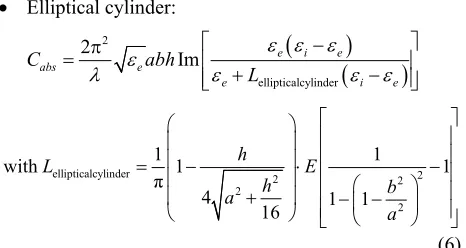
Elliptical cylinder:
2
ellipticalcylinder 2
Im e i e
abs e e i C abh L
e
ellipticalcylinder 2 2 2
2
2
1 1
with 1 1
π
4 1 1
16 h L E h b a a (6) where E is the Complete Elliptic Integral of the second kind, εe the surrounding medium electric permittivity, εi the inclusion permittivity, l the cube side length, a and b
the elliptical cylinder base semi-axes lengths, ar the rod thickness, h the height length of the whole structures and
e
n .
It is worth noting that if the elliptical cylinder degen-erates into a regular cylinder (a = b), the polarizability coin-cide with the classical formula existing in literature [19].
For the sake of brevity, only the absorption terms are shown here, but the same formulas can be obtained for the scattering one.
2.2. Comparison between Analytical Model, Numerical and Experimental Values
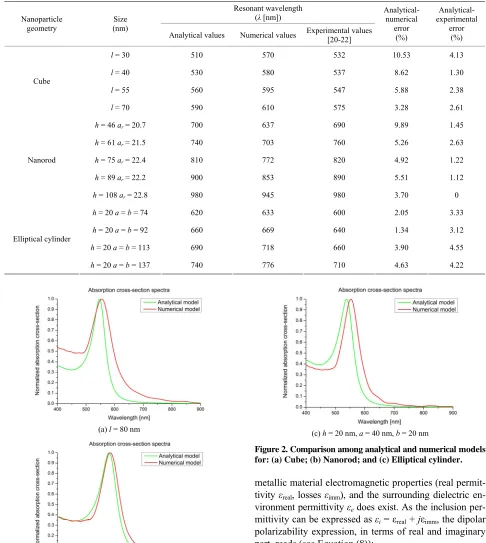
Using the analytical models reported in the previous sec-tion, it is possible to calculate analytically the inclusion resonant wavelengths. In this sub-section numerical re-sults, performed by full-wave simulations, are compared to the theoretical ones, obtained from the proposed model, and to the experimental values [20-22], for different geo-metrical parameter configurations, as reported in Table 1.
The surrounding dielectric medium is considered to be water with a complex refractive index n=1.33 + j0 at all wavelengths.
[image:3.595.308.541.88.212.2]The relative analytical-numerical errors and analytical- experimental ones have been calculated and reported in
Table 1. Their expressions read, respectively:
analytical numerical analytical numerical numerical analytical experimental analytical experimental experimental error error (7) e (5)
In Figure 2, an example of absorption cross-section
spec-tra for the selected nanoparticles is presented.
3. Effect of Geometrical and
Electromagnetic Parameters
[image:3.595.57.288.543.733.2]Table 1. Comparison of resonant wavelengths for the considered inclusions.
Resonant wavelength (λ [nm]) Nanoparticle
geometry
Size (nm)
Analytical values Numerical values Experimental values [20-22]
Analytical- numerical
error (%)
Analytical- experimental
error (%)
l = 30 510 570 532 10.53 4.13
l = 40 530 580 537 8.62 1.30
l = 55 560 595 547 5.88 2.38
Cube
l = 70 590 610 575 3.28 2.61
h = 46 ar = 20.7 700 637 690 9.89 1.45
h = 61 ar = 21.5 740 703 760 5.26 2.63
h = 75 ar = 22.4 810 772 820 4.92 1.22
h = 89 ar = 22.2 900 853 890 5.51 1.12
Nanorod
h = 108 ar = 22.8 980 945 980 3.70 0
h = 20 a = b = 74 620 633 600 2.05 3.33
h = 20 a = b = 92 660 669 640 1.34 3.12
h = 20 a = b = 113 690 718 660 3.90 4.55 Elliptical cylinder
h = 20 a = b = 137 740 776 710 4.63 4.22
[image:4.595.53.539.101.644.2](a) l = 80 nm (c) h = 20 nm, a = 40 nm, b = 20 nm
Figure 2. Comparison among analytical and numerical models for: (a) Cube; (b) Nanorod; and (c) Elliptical cylinder.
metallic material electromagnetic properties (real permit-tivity εreal, losses εimm), and the surrounding dielectric
en-vironment permittivity εe does exist. As the inclusion per-mittivity can be expressed as εi= εreal + jεimm, the dipolar
polarizability expression, in terms of real and imaginary part, reads (see Equation (8)):
It is worth noting that, in order to reach the resonant behavior, the denominator of (8) must go to zero in both its real and imaginary part. Starting from (8), the role of
(b) h = 40 nm, ar = 20 nm
2 2 3 2 2
real imm imm
2 2 2 2 2 2
real real imm
1 2 1
2 (1 ) ( 1)
e real e e e e
e e
V L L L L j V
L L L L L
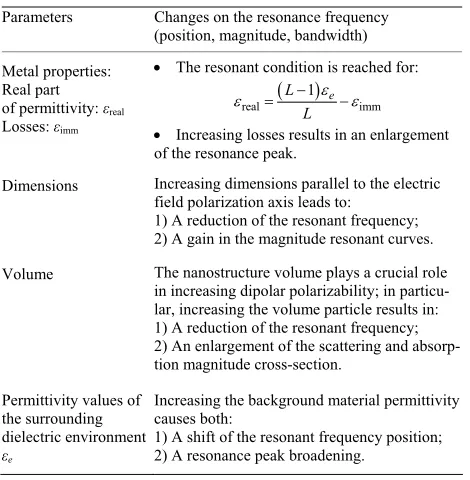
each term is studied and briefly reviewed in Table 2.
4. Sensitivity Analysis
In this Section we analyze the designed nanoparticle sen-sitivity properties in order to optimize the single inclu-sion for sensing applications.
Sensitivity is expressed in terms of the output variation (i.e., the wavelength shift Δλ) corresponding to a unit change of the input (i.e., the unit variation of either per-mittivity Δε or refractive index Δn). If the refractive in-dex variation range is narrow enough, the input-output relation can be considered as a linear one. The sensitivity is commonly defined as:
S n
(9)
expressed in nm/RIU (Refractive Index Unit).
In Table 3, we report the sensitivity values for the
in-dividual inclusions considered in this paper. In particular, analytical, numerical and experimental values [23] of sen-sitivity are compared.
A test material surrounding the nanoparticle, with a varying refractive index n in the range 1 - 3, has been used.
5. Conclusions
[image:5.595.308.539.112.210.2]This study investigated the potential role of non-spherical nanoparticles to be used for sensing applications. Differ- ent shapes of the nanostructure were considered, namely cube, nanorod and elliptic cylinder.
Table 2. The role of the geometrical parameters, metal prop- erties and permittivity value of the dielectric environment on the nanoparticle resonant frequency.
Parameters Changes on the resonance frequency (position, magnitude, bandwidth)
Metal properties: Real part of permittivity: εreal
Losses: εimm
The resonant condition is reached for:
real imm
1 e
L L
Increasing losses results in an enlargement of the resonance peak.
Dimensions Increasing dimensions parallel to the electric field polarization axis leads to:
1) A reduction of the resonant frequency; 2) A gain in the magnitude resonant curves.
Volume The nanostructure volume plays a crucial role in increasing dipolar polarizability; in particu-lar, increasing the volume particle results in: 1) A reduction of the resonant frequency; 2) An enlargement of the scattering and absorp-tion magnitude cross-secabsorp-tion.
Permittivity values of the surrounding dielectric environment
εe
Increasing the background material permittivity causes both:
1) A shift of the resonant frequency position; 2) A resonance peak broadening.
Table 3. Comparison of the sensitivity values for the inclu-sions considered.
Sensitivity (nm/RIU) Nanoparticles
Analytical sensitivity
Numerical sensitivity
Experimental sensitivity
Cube 220 194 165
Elliptical
cylinder 300 281 327
Nanorod 660 490 650
In particular, new closed-form design formulas in or-der to describe the nanoparticle resonant behavior in terms of wavelength position, magnitude and bandwidth for ab-sorption and scattering cross-section were developed. A good agreement among the proposed analytical model, the numerical values and the experimental ones present in lit-erature was reached.
In addition, it was verified the possibility to use such nanoparticles as sensing platforms in the visible and in-frared frequency regime. Exploiting the proposed analyti-cal models, the effects of the geometrianalyti-cal and electromag-netic parameters on the particle resonant behavior were explored.
Analytical and full-wave results have validated and con-firmed the high sensitivity properties of these structures.
Finally, the electromagnetic properties of the selected nanoparticles were compared with each other, in order to choose the structure that best suits specific sensing ap-plications.
The employment of nanostructures grants for a reduc-tion of the overall sensing platform size, and therefore, the biological volume required for sensing is reduced by several orders of magnitude.
REFERENCES
[1] A. Moores and F. Goettmann, “The Plasmon Band in No- ble Metal Nanoparticles: An Introduction to Theory and Applications,” New Journal of Chemistry, Vol. 30, No. 8, 2006, pp. 1121-1132. doi:10.1039/b604038c
[2] J. B. Pendry, “Playing Tricks with Light,” Science, Vol. 285, No. 5434, 1999, pp. 1687-1688.
doi:10.1126/science.285.5434.1687
[3] S. A. Maier, P. G. Kik, H. A. Atwater, S. Meltzer, E. Harel, B. E. Koel and A. G. Requicha, “Local Detection of Electromagnetic Energy Transport below the Diffrac- tion Limit in Metal Nanoparticle Plasmon Waveguides,”
Nature Materials, Vol. 2, No. 4, 2003, pp. 229-232. doi:10.1038/nmat852
[image:5.595.56.291.499.739.2][5] J. J. Storhoff, R. Elghanian, R. C. Mucic, C. A. Mirkin and R. L. Letsinger, “DNA Directed Synthesis of Binary Nanoparticle Network Materials,” Journal of American Chemical Society, Vol. 120, No. 48, 1998, pp. 12674- 12675. doi:10.1021/ja982721s
[6] E. M. Larsson, J. Alegret, M. Kall and D. S. Sutherland, “Sensing Characteristics of NIR localized Surface Plas- mon Resonances in Gold Nanoring for Application as Ul- trasensitive Biosensors,” Nano Letters, Vol. 5, No. 5, 2007, pp. 1256-1263. doi:10.1021/nl0701612
[7] R. Bukasov, T. A. Ali, P. Nordlander and J. S. Shumaker- Parry, “Probing the Plasmonic Near-Field of Gold Nano- crescent Antennas,” ACS Nano, Vol. 4, No. 11, 2010, pp. 6639-6650. doi:10.1021/nn101994t
[8] W. J. Galush, S. A. Shelby, M. J. Mulvihill, A. Tao, P. Yang and J. T. Groves, “A Nanocube Plasmonic Sensor for Molecular Binding on Membrane Surfaces,” Nano Letters, Vol. 9, No. 5, 2009, pp. 2077-2082.
doi:10.1021/nl900513k
[9] N. L. Rosi and C. A. Mirkin, “Nanostructures in Biodi- agnostics,” Chemical Review, Vol. 105, No. 4, 2005, pp. 1547-1562. doi:10.1021/cr030067f
[10] J. Chen, B. J. Wiley, H. Cang, D. Campbell, F. Saeki, L. Au, J. Lee, X. Li and Y. Xia, “Gold Nanocages: Engi- neering the Structures for Biomedical Applications,”Ad- vanced Materials, Vol. 17, No. 18, 2005, pp. 2255-2261. doi:10.1002/adma.200500833
[11] M. J. Dukes, D. B. Peckys and N. de Jonge, “Correlative Fluorescence Microscopy and Scanning Transmission Elec- tron Microscopy of Quantum-Dot-Labeled Proteins in Whole Cells in Liquid,” ACS Nano, Vol. 4, No. 7, 2010, pp. 4110-4116. doi:10.1021/nn1010232
[12] C. N. Ramachandra Rao, G. U. Kulkarni, P. J. Thomas and P. P. Edwards, “Metal Nanoparticles and Their As- semblies,” Chemical Society Reviews, Vol. 29, No. 1, 2000, pp. 27-35. doi:10.1039/a904518j
[13] X. Qian, X. H. Peng, D. O. Ansari, Q. Yin-Goen, G. Z. Chen, D. M. Shin, L. Yang, A. N. Young, M. D. Wang and S. Nie, “In Vivo Tumor Targeting and Spectroscopic
Detection with Surface-Enhanced Raman Nanoparticle Tags,” Nature Biotechnology, Vol. 26, No. 1, 2008, pp. 83-90. doi:10.1038/nbt1377
[14] W. Cai, T. Gao, H. Hong and J. Sun, “Application of Gold Nanoparticles in Cancer Nanotechnology,” Nanotechnol- ogy, Science and Application, Vol. 1, 2008, pp. 17-32. [15] P. B. Johnson and R. W. Christy, “Optical Constants of
the Noble Metals,” Physical Review B, Vol. 6, No. 12, 1972, pp. 4370-4379. doi:10.1103/PhysRevB.6.4370 [16] CST Computer Simulation Technology.
http://www.cst.com
[17] C. Bohren and D. Huffmann, “Absorption and Scattering of Light by Small Particles,” John Wiley, New York, 1983. [18] A. Sihvola, “Electromagnetic Mixing Formulas and Ap-
plications,” The Institution of Engineering and Technol- ogy, London, 2008.
[19] J. G. Van Bladel, “Electromagnetic Fields,” John Wiley & Sons, Hoboken, 2007. doi:10.1002/047012458X [20] H.-L. Wu, C.-H. Kuo and M. H. Huang, “Seed-Mediated
Synthesis of Gold Nanocrystals with Systematic Shape Evolution from Cubic to Trisoctahedral and Rhombic Do- decahedral Structures,” Langmuir, Vol. 26, No. 14, 2010, pp. 12307-12313. doi:10.1021/la1015065
[21] M. Hu, J. Chen, Z. Y. Li, L. Au, G. V. Hartland, X. Li, M. Marquez and Y. Xia, “Gold nanostructures: Engineering Their Plasmonic Properties for Biomedical Applications,”
Chemical Society Reviews, Vol. 35, No. 11, 2006, pp. 1084-1094. doi:10.1039/b517615h
[22] P. Hanarp, M. Käll and D. S. Sutherland, “Optical Prop- erties of Short Range Ordered Arrays of Nanometer Gold Disks Prepared by Colloidal Lithography,” The Journal of Physical Chemistry B, Vol. 107, No. 24, 2003, pp. 5768- 5772. doi:10.1021/jp027562k
[23] T. Chung, S.-Y. Lee, E. Y. Song, H. Chun and B. Lee, “Plasmonic Nanostructures for Nano-Scale Bio-Sensing,”